Hosted by TruLight Ministries – The Place of Truth
SELECT YOUR READING LANGUAGE – BOTTOM LEFT = YOUR DAILY MANNA NOW AVAILABLE IN 103 LANGUAGES
a New Study : for the Next 21 Daily Manna Days
In My Control vs Out of My Control
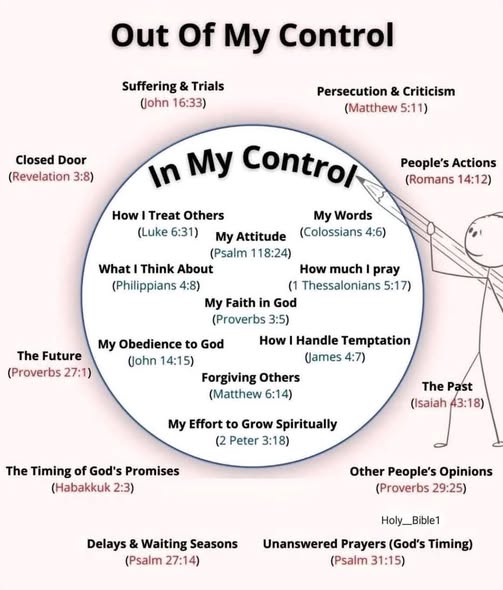
My Words : Our words and the way we communicate them are important. Believers are exhorted in Colossians 4:6, “Let your words be seasoned with salt.” As believers, our words should reflect to others the truth of the gospel. They should reveal how this gospel has transformed our lives. Our words should impact our conversations for the better as we bring a different “flavor” to our interactions, build others up, and share as well as defend the gospel.
The words we speak reflect what is in our hearts, “for the mouth speaks what the heart is full of” (Luke 6:45). When we trust in Christ for the forgiveness of our sins, we become new creations (2 Corinthians 5:17). Our lives are transformed; we have been saved from our sins and brought from death to life (Ephesians 2:6). The Holy Spirit lives within us (Romans 8:11). For these reasons, believers’ words should always be “seasoned with salt.”
Jesus called believers to be the salt of the earth (Matthew 5:13). Salt is an important mineral; it preserves food, brings out flavor, soothes and heals, and is necessary for life: it balances fluids in the blood and is vital for nerve and muscle function. The salt of the earth metaphor applies to the way believers talk as well as how they live, as Paul indicates: “Be wise in the way you act toward outsiders; make the most of every opportunity. Let your conversation be always full of grace, seasoned with salt, so that you may know how to answer everyone” (Colossians 4:5–6). The content and tone of our words should impact those around us for the better, especially unbelievers.
A believer’s words are to be seasoned with salt so that we can “know how to answer everyone” (Colossians 4:6). Sharing the gospel includes knowing it, sharing it accurately, and doing so with a humble and gracious attitude—in a palatable way. Believers are called to “always be prepared to give an answer to everyone who asks you to give the reason for the hope that you have. But do this with gentleness and respect” (1 Peter 3:15). Having an unwholesome, distasteful attitude is not becoming to the gospel of Christ; unsavory motives and attitudes do not produce words “seasoned with salt.”
While not every conversation must specifically be about God, every conversation should be seasoned with salt. We should always be ready to answer others’ questions about our faith, and our words should always reflect Christ, bringing a different “flavor” to what might otherwise be an unsavory conversation. What a Christian says and how he says it ought to add value to a conversation just as salt does for food.
Just the right amount of salt in food brings out flavor and transforms a meal. Our words can be seasoned with salt by speaking the truth in love (Ephesians 4:15) and being gracious in every circumstance. As Proverbs 16:24 says, “Gracious words are a honeycomb, sweet to the soul and healing to the bones.” Just as salt has healing properties, our words should bring healing and goodness, encouraging its hearers and pointing them to the One who is vital for life.
Jesus said, “Have salt among yourselves, and be at peace with each other” (Mark 9:50b). What we say and how we say it should always be seasoned with the salt of grace and peace. In order to give a seasoned answer, we must present what we say and how we say it in a way that reflects Christ. May we all prayerfully consider our hearts before we engage our mouths and reflect what the psalmist says in Psalm 19:14: “May these words of my mouth and this meditation of my heart be pleasing in your sight, LORD, my Rock and my Redeemer.”

Bible Verse and Prayer for Today
We ought always to thank God for you, brothers, and rightly so, because your faith is growing more and more, and the love every one of you has for each other is increasing.
—2 Thessalonians 1:3
“Please increase my faith, O, Lord.”
“Please increase my strength, dear God.”
“Please increase my wisdom, Father.”
We often pray for these kinds of things, but when was the last time you prayed asking God to increase your capacity to love, and your congregation’s capacity to love others? Can you think of anything more exciting to say about your friends and fellowship than to say, “The love everyone has for each other is increasing, and that love for those around them who don’t know Jesus is growing!” Let’s pray and act to make this dimension of our love real and noticeable to the broken world that is fractured all around us!
Prayer
Holy God, may your love fill me as I seek to share it with those I meet each day. May this love grow and increase so that others may readily see its benefits and recognize that it is a direct response to the lavish love you have shared with me. I trust that as I seek to grow in love, the Holy Spirit will empower me to love in greater ways (Romans 5:5), ways that are beyond my capacity, so that others recognize it is your love working through me. Through the power of your Spirit, please empower my love to increase! In Jesus name I pray. Amen and Amen
Bible Teaching of the Day
For sure, words are powerful things. God’s words were so powerful that they actually created everything (Genesis 1). But even the words of us humans can do powerful things. Solomon wrote in Proverbs 18:21 that “death and life are in the power of the tongue.” The power of life and death can be seen in jury trials, where witnesses and jury members can speak words that might literally determine whether a defendant lives or dies. Less extreme, but no less real, are the power of encouraging words to give hope and joy and the power of discouraging words to spark dismay and depression.
Jesus said, “I tell you that everyone will have to give account on the day of judgment for every empty word they have spoken” (Matthew 12:36). The KJV translates “every empty word” as “every idle word”; the ESV says, “every careless word.” The Greek phrase is rema argos, meaning “careless or inactive or unprofitable words.” In context, Jesus is contrasting the “good things” within a good person with the “evil things” in the heart of an evil person. We are admonished to make the best use of our words, because words express what is in our hearts: “The mouth speaks what the heart is full of” (Matthew 12:34).
In Matthew 12:37, the significance of words is that they will be used to gauge a person’s spiritual condition in the judgment: “For by your words you will be acquitted, and by your words you will be condemned.” Jesus was speaking to a group of Pharisees who had just accused Jesus of being demon-possessed (verse 24). Jesus calls them a “brood of vipers” and asks them, “How can you who are evil say anything good?” (verse 34). Just as vipers have a mouthful of poison, so the Pharisees had evil words concerning the Savior.
Then Jesus warns the Pharisees of the coming judgment, at which they will be held accountable for their words (Matthew 12:37). There is no better judge of a person’s heart than the words he allows to come forth from his mouth. Just like good trees produce good fruit and bad trees produce bad fruit, so does the mouth reveal the heart’s condition (verse 33).
But it’s not just evil words for which people must give account. Jesus said every “careless” or “idle” word can also be used as a judgment against the speaker. Even the slightest sin, the smallest deviation from God’s perfection, will condemn a person in God’s eyes. The Pharisees’ sin was great—they had blasphemed the Lord of glory with their words—but even seemingly insignificant words, sometimes excused as “slips of the tongue,” are considered sinful if they do not bring glory to God. According to verse 38, Jesus had the last word on this subject, for the scribes and Pharisees changed the subject immediately.
Other passages give additional insight. Ephesians 4:29 sets the standard: “Do not let any unwholesome talk come out of your mouths, but only what is helpful for building others up according to their needs, that it may benefit those who listen.” James 3:8 advises us on how hard it is to control the tongue: “No human being can tame the tongue. It is a restless evil, full of deadly poison.” Then in James 4:11–12, “Brothers and sisters, do not slander one another. Anyone who speaks against a brother or sister or judges them speaks against the law and judges it. When you judge the law, you are not keeping it, but sitting in judgment on it. There is only one Lawgiver and Judge, the one who is able to save and destroy. But you—who are you to judge your neighbor?”
Given the weighty consequences of our words—even our “careless” ones—we must learn to yield our body’s members, including our tongues, to the control of the Holy Spirit—the only One who can tame the tongue. “Set a guard over my mouth, LORD; keep watch over the door of my lips” (Psalm 141:3).
Today’s Devotional
Psalm 19, a psalm written by King David around 1000 BC, begins with a beautiful explanation of general revelation—that revealing result creation has due to how God created it—and ends with a request that the meditations of David’s heart would be pleasing to God. Creation reveals the glory of God (Psalm 19:1), declares the works of His hands (Psalm 19:1), and does all of this without words (Psalm 19:3). The biblical God has created the universe and all that it contains in such a way that it constantly glorifies Him through events such as the sun rising and setting. As Romans 1 states, “Since what may be known about God is plain to them, because God has made it plain to them. For since the creation of the world God’s invisible qualities—his eternal power and divine nature—have been clearly seen, being understood from what has been made, so that people are without excuse.”
God’s creative role rightfully gives Him all authority, as all things are His (Job 38—41). With this authority, God gave laws and instructions to His people in the Mosaic Covenant, which David references in Psalm 19:7–11. David describes the laws as perfect or complete, the legal notices as sure, the Lord’s instructions as right, the Lord’s commandments as pure, and the judgments as true, righteous, and desirable. As David describes these various aspects of the law of God, notice the synonymous nature of his concepts. Each is working through an aspect of the relationship David has with the law and with God.
David then makes two requests of God: 1) that God would forgive him of hidden faults, and 2) that God would keep him from sins coming from arrogance and pride. He then concludes with the request that the meditations of his heart and words of his mouth would be pleasing to the Lord. David seems to be making a final request regarding his previous claims. Essentially, he’s saying, “Please let those things I have previously meditated upon and stated in this psalm be pleasing to you, Lord.”
The idea of “meditating” in the Scriptures points to filling the mind with thoughts of something or someone. To empty the mind, as some might think of meditation, is not the biblical principle. For example, in Psalm 63, David parallels the idea of thinking and meditating (Psalm 63:6). What David presents in Psalm 19 is a desire for God to be pleased with David’s thinking and, in turn, his speaking.
Jesus also makes a connection between the words of the mouth and the meditation of the heart. He taught, “A good man brings good things out of the good stored up in his heart, and an evil man brings evil things out of the evil stored up in his heart. For the mouth speaks what the heart is full of” (Luke 6:45; cf. Matthew 12:34). In the same way, David connects the mouth and the heart. Our words and our thinking are related. Both should be pleasing to the Lord.
Paul mentions the idea of pleasing God multiple times in his writing. In Romans 12:2, Paul shows that the renewal of the mind is critical for personal transformation and the understanding of God’s will, which is good, well-pleasing, and perfect. He reiterates this idea in Colossians 1:9–10 as he prays that the Colossians would be filled with the knowledge of God’s will so that they could then do that which is pleasing to God. He also tells Timothy that the Scriptures are God-breathed and profitable, making the man of God equipped to do every good work (2 Timothy 3:16–17). These good works are what Christians were created anew in Christ to complete and are predestined by God (Ephesians 2:10). The mind must be filled with that which is pleasing to God so that the mouth, and other body parts required for action, can also do what is pleasing to God.
Like David states at the end of Psalm 19, we should desire for our thoughts or meditations to be pleasing to God. We can ensure pleasing thoughts by filling our minds with scriptural truth, and that will lead to words and actions that are also pleasing to Him.

Bible Prophecy, Signs of the Times and Gog and Magog Updates with Articles in the News
Doctrines of Demons gets Arrogant = ‘Blessed Are Those Who End Pregnancies’ Pastor Redefines Jesus
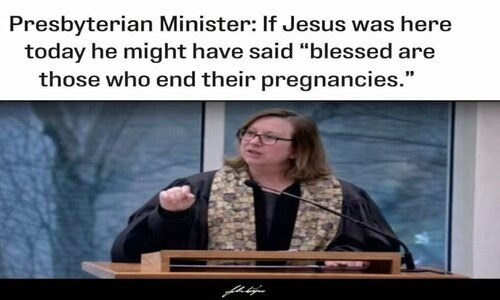
Imagine sitting in a church pew, expecting to hear Jesus’ words of mercy, hope, and eternal truth–and instead hearing Him recast as an advocate for ending unborn life. This is the reality confronted by those who witnessed Rev. Dr. Rebecca Todd Peters, a Presbyterian pastor, openly bless abortion from her pulpit.
She did not hedge, soften, or apologize. She claimed that Jesus would act as an abortion escort, a doula, and even bless those who terminate pregnancies. And she rewrote the Beatitudes to declare: “Blessed are those who end pregnancies, for they will be known for their loving kindness.”
This is not Christianity being “inclusive” or “progressive.” This is a direct assault on the words of Christ, the moral foundation of Scripture, and the conscience of the Church.
The Beatitudes are not suggestions for modern moral convenience. They are the radical, God-given blueprint for life in the Kingdom of Heaven. “Blessed are the meek,” “Blessed are the merciful,” “Blessed are the pure in heart”–these are declarations of God’s eternal values, not interchangeable slogans for contemporary political agendas. To rewrite them in service of human ideology is not creativity; it is sacrilege.
From a biblical perspective, human life is sacred from conception. Psalm 139 declares, “For you created my inmost being; you knit me together in my mother’s womb.” The unborn are not property, inconvenience, or political talking points. They are persons, loved and known by God, entrusted to the care of humanity. To bless their intentional destruction is to invert the very gospel Christ came to proclaim.
What makes this sermon all the more shocking is the absolute confidence with which it was delivered. There was no nuance, no lamentation, no acknowledgement of moral complexity. There was a replacement of sin with celebration, a redefinition of tragedy as sanctity.
Rev. Peters even shared her own personal history–two abortions alongside two children–and declared each “sacred.” But Christianity does not sanctify sin; it offers redemption from it. Forgiveness presupposes the reality of wrongdoing. Blessing what Scripture mourns erases the need for repentance and nullifies the transformative power of Christ’s love.
The sermon also highlights a dangerous shift: the elevation of personal experience over divine revelation. Personal stories are valuable in the Church–they can inspire empathy, understanding, and pastoral care. But no story, however compelling, can override the authority of God’s Word. When experience becomes the lens through which Jesus is interpreted, the Church stops proclaiming Christ–it begins to proclaim human desire.
Furthermore, framing opposition to abortion as “violence” and celebrating abortion as “kindness” is not compassionate theology. It is moral inversion. The consistent Christian witness to protect the unborn is not cruelty; it is a reflection of God’s justice, love, and care for the weakest among us. The unborn, entirely dependent on human stewardship, are precisely those whom the Church is called to protect.
This issue is not denominational or political–it is spiritual. It is a question of whether the Church continues to preach the Christ of Scripture or a Christ molded to fit cultural preference. The Apostle Paul warned against teachers who tell listeners what their “itching ears” want to hear (2 Timothy 4:3). Here, that warning rings alarmingly true: a Jesus who affirms every choice without confronting sin is far more palatable–but He is not the Christ of the Bible.
The tragedy is not simply the sermon itself; it is the surrender it represents. Surrender of biblical authority. Surrender of moral clarity. Surrender of the Church’s prophetic voice. When pastors start rewriting Jesus, the Church must choose: follow the Christ who spoke from the mount, or the Christ reinvented at the podium.
For those who still believe that Jesus Christ is the same yesterday, today, and forever, this is a call to vigilance, courage, and unwavering fidelity to the Word. Christianity is not a platform for human ideology–it is the proclamation of a Savior whose truth does not bend with public opinion. And the Church must not bend with it.
Satans Country Builds to the 666 = Canada’s Digital ID Push: Convenience Or Control?

Canada is quietly moving toward a digital identity system, and most citizens barely know it’s happening. A tool called GC Wallet has already launched in limited form, promising to make government services easier to access, all from the convenience of a smartphone. On the surface, it’s hard to argue with the idea of simplification: fewer passwords, fewer cards, and faster service. But beneath this glossy veneer lies a far deeper concern — one that touches on freedom, privacy, and control.
At first, digital IDs are sold as optional. Use them if you want; skip them if you don’t. But history shows how “optional” quickly becomes mandatory once governments and businesses integrate a system into everyday life. Banks, airlines, healthcare, and grocery stores could all eventually require digital verification. The moment participation becomes necessary to function in daily life, choice disappears. And with that disappearance comes control — control over how citizens access money, travel, healthcare, and even social interactions.
Critics warn that a centralized digital ID creates a single point of failure — a honeypot of personal information that hackers, corporations, or governments could exploit. But the threat isn’t just cyberattacks. A digital ID system allows authorities to monitor behavior, track purchases, record travel, and even restrict access based on conduct. Imagine your ID being suspended because of something you said online — a post critical of a government policy, or a social opinion deemed illegal under shifting rules. Suddenly, your ability to live and work is instantly curtailed.
This is not a far-off scenario. Once personal identity becomes digital, the government holds the keys. What starts as a convenience could very quickly become a mechanism of enforcement, shaping behavior in ways citizens never consented to. Your movements, your spending, your online speech — all become visible and accountable. And because these systems are designed to be interoperable across borders, a digital ID in Canada could one day connect to systems in Europe, or beyond. This is global control, wrapped in the guise of convenience.
The United States is moving in a similar direction. Several states are exploring or piloting digital driver’s licenses and identity wallets, and federal initiatives are quietly laying the groundwork for national interoperability. While officials frame these programs as tools for convenience and security, critics warn that the same pattern could take hold: optional participation quickly becoming essential, personal data aggregated and monitored, and citizens losing real control over how they access everyday services. The U.S. could soon find itself navigating the same privacy and liberty trade-offs already emerging in Canada.
The danger is compounded by corporations and financial institutions. Banks, retailers, and tech companies are eager to integrate digital IDs into their systems, seeing efficiency, fraud prevention, and customer data collection as major benefits. Once corporate adoption becomes widespread, citizens may feel they have no choice but to participate. Digital ID systems could become a requirement for banking, online shopping, flights, or even employment verification. Convenience for the consumer and profit for the companies could push society into a situation where opting out is no longer feasible — effectively normalizing surveillance and control under the guise of modern commerce.
The dangers are not theoretical. Look to China, where a nationwide digital ID and social credit system already monitor every aspect of life. Citizens’ access to travel, financial services, housing, and education is tied to compliance with government rules. Behavior deemed undesirable can trigger restrictions, punishments, or surveillance. The Chinese system demonstrates how digital identity can shift the balance of power from individuals to the state — how a society can be reshaped quietly, incrementally, until people realize their freedoms have been restricted in ways previously unimaginable.
Canada is moving quietly down a similar path. There is no fanfare, no public debate, no robust discussion of the consequences. Yet the framework is in place. The digital ID is live. Once this infrastructure becomes embedded in banking, healthcare, travel, and commerce, rolling it back will be far more difficult than implementing it. “Voluntary” becomes default, and citizens may only discover the limitations after the system is entrenched.
Convenience should never come at the price of freedom. Digital IDs may streamline daily life, but they also create a tool for monitoring, control, and restriction. Canada is taking small steps now, but the potential impact is enormous. Without careful legal safeguards, transparent oversight, and broad public debate, this quiet shift toward digital identity could redefine what it means to live freely.
History shows that once systems like this are in place, reversing them is almost impossible. Interoperable global digital IDs are already on the rise, and all it might take is a push from the economic or technological world to normalize them everywhere. Canada’s citizens — and the rest of the world — should ask themselves a simple but urgent question: how much convenience is too much if it comes at the cost of liberty?
Magog VS the Eagle Wings // Gog VS the Dragon with the 10 Horns
A Simulated Russian Incursion Tests NATO – And It Fails Quickly

Europe likes to speak the language of resolve. Leaders invoke unity, deterrence, and “never again.” Yet a recent wargame conducted in Germany cuts through the rhetoric with uncomfortable clarity: Europe may be preparing for war with Russia–but it is nowhere near ready to fight one on its own.
The exercise, organized by Die Welt in cooperation with the German Wargaming Center at Helmut Schmidt University, simulated a Russian incursion into Lithuania in October 2026. What unfolded was not a massive armored thrust or a dramatic blitzkrieg. Instead, it was something far more unsettling: a limited, plausibly deniable operation that exploited hesitation, political division, and the absence of decisive American leadership. Within days, NATO’s credibility collapsed in the game, and Russia achieved strategic dominance in the Baltics with a surprisingly small force.
That outcome should alarm every European capital.
What the Wargame Actually Revealed
The scenario hinged on Kaliningrad, Russia’s heavily militarized exclave wedged between Poland and Lithuania. Using the pretext of a fabricated humanitarian crisis, Moscow launched a “limited” intervention to seize Marijampole, a Lithuanian city of just 35,000 people–but one that sits astride a critical highway junction connecting the Baltic states to the rest of NATO.
The brilliance, from Russia’s perspective, was not military might but narrative control. The incursion was framed as humanitarian, muddying the waters just enough for Washington–under a disengaged or skeptical U.S. administration–to decline invoking NATO’s Article 5. Germany hesitated. Poland mobilized but stopped short of crossing the border. Even German troops already deployed in Lithuania were neutralized without a firefight, their movement blocked by drone-laid mines.
The lesson was brutal: deterrence failed not because NATO lacked soldiers or tanks, but because Russia correctly judged that Europe would argue while territory was taken.
As one participant who role-played Russia’s top general put it, the outcome hinged on belief. Moscow believed Germany would hesitate–and that belief proved enough to win.
The Baltic Weak Point
The wargame exposed a geographic truth Europe has long known but preferred not to dwell on. Lithuania, Latvia, and Estonia are connected to the rest of NATO by a narrow and vulnerable land corridor. A single strategic highway–the Via Baltica–carries not only military reinforcements but the economic lifeblood of the region.
Control that chokepoint, even temporarily, and the Baltics are isolated.
In the exercise, Russia achieved this with roughly 15,000 troops–hardly an overwhelming force. The rest was accomplished through hybrid tactics: information warfare, humanitarian pretexts, cyber pressure, and the calculated exploitation of NATO’s internal decision-making process. The alliance, designed to deter clear-cut aggression, struggled when faced with something deliberately ambiguous.
That ambiguity is not accidental. It is doctrine.
Why “Time” Is the Most Dangerous Illusion
For years, European planners operated under the assumption that Russia would not be capable of threatening NATO territory until closer to 2029. That timeline is now rapidly eroding. Russia has reoriented its economy toward war, expanded arms production, and continues to recruit tens of thousands of troops each month despite heavy losses in Ukraine.
More importantly, Russia may not need to “win” a war to achieve its goals. It only needs to prove that NATO cannot respond decisively and quickly.
A limited incursion, framed as humanitarian, designed to test Article 5 rather than trigger it, could fracture the alliance politically even if it fails militarily. The wargame suggests such a move could succeed precisely because European leaders are conditioned to de-escalate first and decide later.
That instinct–so deeply embedded after decades of peace–may now be Europe’s greatest vulnerability.
Europe’s Dependence on America
At the heart of the scenario lies an uncomfortable truth: Europe’s security architecture still rests on American will.
European nations collectively dwarf Russia in population and economic power. On paper, they should be able to defend themselves. In practice, they remain dependent on U.S. leadership for intelligence fusion, rapid decision-making, strategic lift, missile defense, and–crucially–political clarity.
The wargame made clear what many European officials privately fear: absent strong and immediate U.S. backing, Europe struggles to act as a single strategic actor. Decisions slow. Red lines blur. Russia advances not because it is unstoppable, but because Europe is uncertain.
This dependence becomes even more precarious in an era of strained transatlantic relations. Disputes over Ukraine, trade, and broader strategic priorities have already raised doubts in European capitals about Washington’s reliability. Moscow is watching closely–and learning.
The BiggerPicture
Russia does not need to conquer Europe. It only needs to demonstrate that borders can be changed, alliances paralyzed, and commitments questioned. A small city. A single highway. A few days of hesitation.
That is the scale of the risk revealed by this wargame.
Europe is spending more on defense. It is training more troops. But readiness is not just hardware–it is mindset. It is the willingness to act quickly, decisively, and collectively, even when the facts are deliberately obscured and the narrative is contested.
Until Europe can do that without waiting for Washington to lead, its vulnerability will remain. And Russia, opportunistic and patient, will continue to probe for the moment when hesitation becomes opportunity.
The wargame was fictional. The warning is not.
Mystery Babylon takes on God’s School System
California’s Quiet Assault On Christian Education

It does not begin with padlocks on church doors or police standing in chapel aisles. It begins with paperwork. With notices taped to bulletin boards. With a government rule that sounds reasonable—until you follow it to its logical end.
California has decided that Christian education itself must be optional.
Under a state regulation upheld by the Ninth Circuit, Christian schools are now required to allow students to opt out of religious services and activities—and to publicly advertise that option at the state’s command. On paper, it is framed as a matter of “choice.” In reality, it is something far more serious: the state inserting itself into the spiritual formation of children and quietly redefining what faith-based education is allowed to mean.
Christian schools exist for one reason—to form children in a Christian worldview. Not to dabble in faith. Not to offer religion as an elective alongside art or band. But to shape hearts and minds around the truth of Christ. Scripture does not present faith as a detachable component of life. It presents it as the foundation of all things.
California’s mandate treats worship as optional, prayer as negotiable, and spiritual formation as a preference rather than a purpose. That is not neutrality. That is interference.
For Christian parents, this strikes at something deeply personal. Mothers and fathers who choose Christian schools are not outsourcing education for convenience. They are exercising a sacred responsibility. They are saying, “We want our children grounded in truth before the world tries to redefine it.” The state’s response is effectively: you may choose religious education, but only if you agree to dilute it.
That is not a compromise—it is coercion.
Even more troubling is the message this policy sends to children themselves. By forcing schools to post opt-out notices, the state subtly teaches young minds that faith is something one might need protection from. That worship is burdensome. That religious conviction is an imposition rather than a gift. Long before a child reads a philosophy book or watches a political debate, they are already being discipled—by the assumptions embedded in rules like this one.
And then there is the role the government now assigns to itself. Inspectors must determine whether students feel “free” to opt out of religious activities. Think about that. State officials are being asked to evaluate worship, community prayer, and spiritual instruction—things the government has neither the authority nor the competence to judge. This is precisely the kind of entanglement the Constitution was designed to prevent.
History teaches us that when the state begins to supervise religious life, faith does not remain free for long.
Perhaps most alarming is the forced speech component. Christian schools are being compelled to promote a message that contradicts their beliefs—that religious participation is optional within a Christian institution. This echoes past attempts by California to force pro-life pregnancy centers to advertise abortion services. Different issue. Same tactic. Turn faith-based organizations into mouthpieces for ideas they reject.
Christians should recognize the pattern by now.
This is not about protecting children from coercion. No one is forced to attend a Christian school. Enrollment itself is a choice—one made by parents precisely because they want religious formation woven into daily life. California’s regulation pretends to expand freedom while actually eroding it, replacing parental authority with bureaucratic oversight.
And if this decision is allowed to stand, it will not stop here. If worship can be made optional today, doctrine can be labeled harmful tomorrow. If religious instruction can be carved out, it can eventually be regulated out of existence. What begins as a notice requirement ends as a leash.
The Christian response to this moment must be clear-eyed and courageous. Scripture reminds us that faith has always faced pressure—not just from open hostility, but from quiet conformity. The danger is not only persecution, but permission granted on the state’s terms.
This is why Supreme Court review matters—not for political reasons, but for spiritual ones. The question before the nation is simple: do religious institutions have the freedom to remain authentically religious, or only the freedom to exist so long as their convictions are treated as optional?
Christian education cannot survive if its spiritual core is negotiable. Parental rights cannot endure if they are conditional. And religious liberty is not liberty at all if it requires faith to apologize for itself.
TruLight Ministries Daily Entertainment
TruLight TV – Are You a People-Pleaser or a God-Follower? Discover the Truth!
We can be people-pleasers or God-followers. There’s so much pressure to fit into the crowd, but blending in can lead us away from God’s best for us. He calls us to stand out with goodness so that in the long run we are blessed and secure. In today’s lesson from Dr. Charles Stanley, There are three questions that haunt the minds of people everywhere. Sadly, even many people who are in church each week wrestle with knowing who the one true God is, what He is like, and understanding how to have an intimate relationship with Him.
Today on TruLight Radio XM
TruLight Radio XM 24/7
Program
GMT / UTC +2
Monday To Fridays
00:15 Words to Live By Testimonies
01.15 Science Scripture and Salvation
02.15 Ground Works
04.00 Gospel Concert of the Day
05.00 The Daren Streblow Comedy Show
5:55 It is Today devotional
6:00 Gaither Homecoming Morning Show
7:15 Discover the Word
8.15 Destined for Victory
8:55 Science Scripture and Salvation
9:00 Holy Spirit Hour – Normally Sermons
10:15 Hope of the Heart
11:15 Unshackled
11.45 Words to Live By
12:15 Truth for Life
13:15 Living on the Edge with Chip Ingram
14:15 Focus on the Family
15:00 Kids Hour
16:00 In Touch with Dr. Charles Stanley
16:30 Groundwork
17:15 Live in the Light
18:15 Renewing your Mind
19:00 Gaither Homecoming Show
20:15 Growing Hope
21:15 Adventures in Odyssey Radio Drama
21:45 Bible Reading
22:15 Night-sounds
23.00 Good Old Country Gospel / Rhema Gospel Express
VISIT THE WEBSITE
https://TruLightradioXM.org.za
TruLight Ministry News
TruLight Ministries orders from God since 2012 . Teach Them , Comfort Them and Warn Them!
Healing Truths
End Time Articles :
Share this Feeding of Manna with your Friends and Family. just click on the Social Media icon and share !