Hosted by TruLight Ministries – The Place of Truth
SELECT YOUR READING LANGUAGE – BOTTOM LEFT = YOUR DAILY MANNA NOW AVAILABLE IN 103 LANGUAGES
a New Study : for the Next 18 Daily Manna Days
In My Control vs Out of My Control
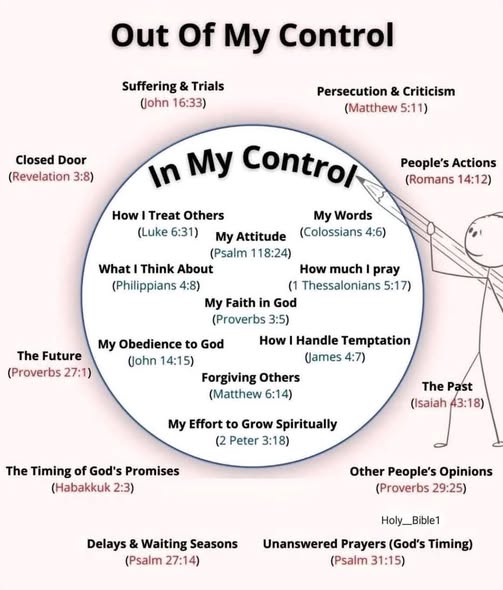
In My Control = What I Think About : What we Think About ::: One is reminded of Elijah and his flight from Jezebel. Elijah was a man of God whom God used to do some mighty things. However, when word reached him that Jezebel had threatened his life, he ran (1 Kings chapter 19). Elijah prayed to the Lord and in effect complained about how he was being treated: “He replied, ‘I have been very zealous for the Lord God Almighty. The Israelites have rejected your covenant, torn down your altars, and put your prophets to death with the sword. I am the only one left, and now they are trying to kill me too’” (1 Kings 19:10). The Lord’s answer to Elijah is thrilling: “The Lord said, ‘Go out and stand on the mountain in the presence of the Lord, for the Lord is about to pass by.’ Then a great and powerful wind tore the mountains apart and shattered the rocks before the Lord, but the Lord was not in the wind. After the wind there was an earthquake, but the Lord was not in the earthquake. After the earthquake came a fire, but the Lord was not in the fire. And after the fire came a gentle whisper” (1 Kings 19:11-12).
We see in this passage of Scripture that what Elijah thought was not true. Elijah thought God was silent and that he was the only one left. God was not only “not silent,” but He had an army waiting in the wings so that Elijah was not alone: “Yet I reserve seven thousand in Israel—all whose knees have not bowed down to Baal and whose mouths have not kissed him” (1 Kings 19:18).
In our walk as born-again believers, it may seem that God is silent, but God is never silent. What looks like silence and inactivity to us is God allowing us the opportunity to listen to “the still small voice” and to see the provisions that He has made for us by faith. God is involved in every area of a believer’s life–the very hairs on our heads are numbered (Mark 10:30; Luke 12:7). However, there are times when we have to walk in obedience to the light that God has given us before He sheds more light on our path, because in this age of grace God speaks to us through His Word.
“‘For my thoughts are not your thoughts, neither are your ways my ways,’ declares the Lord. ‘As the heavens are higher than the earth, so are my ways higher than your ways and my thoughts than your thoughts. As the rain and the snow come down from heaven, and do not return to it without watering the earth and making it bud and flourish, so that it yields seed for the sower and bread for the eater, so is my word that goes out from my mouth: It will not return to me empty, but will accomplish what I desire and achieve the purpose for which I sent it’” (Isaiah 55:8-11).
Therefore, when God seems silent to us as born-again believers, it may mean that we have stopped listening to His voice, we have allowed the cares of this world to plug our spiritual ears, or we have neglected His Word. God does not speak to us today in signs, wonders, fire, or wind. His Spirit speaks to us through the Word, and in that Word we have the “words of life.”

Bible Verse and Prayer for Today
Love is patient, love is kind. It does not envy, it does not boast, it is not proud. It is not rude, it is not self-seeking, it is not easily angered, it keeps no record of wrongs.
—1 Corinthians 13:4-5
True love does not focus on itself, but on others. Each of these qualities of love — patience, kindness, does not envy, does not boast, is not proud, is not rude, is not self-seeking, is not easily angered, keeps no records of wrongs — is based on an affectionate, compassionate, and forgiving attitude that regards others as valuable to us, and to Jesus. Rather than placing value only on ourselves and our desires, we remember how Jesus lived and seek to have a heart like his (Philippians 2:5-11). This kind of love comes from the power of the Holy Spirit within us (Romans 5:5; Galatians 5:22-23). It is part of the Spirit’s transforming us into more JESUShaped people (2 Corinthians 3:18). The old saying is true: “In the middle of all SIN is a big I!” When “I” become more important than others, when what “I” want and how “I” win are more significant than what others truly need, then “I” have lost my way and do not display the love of Christ.
Prayer
Holy God and Sacrificial Father, please teach us to notice others and value them just as you do and as Jesus demonstrated while on earth. We know you loved us when we were not lovable, and redeemed us when we were not worthy. So we ask for the Holy Spirit’s help in having the heart like yours, as we take our focus off ourselves, and seek to see others as you do. In the name of Jesus, we pray. Amen and Amen

Bible Teaching of the Day
Taking control of our thoughts is essential. Proverbs 4:23 states, “Above all else, guard your heart, for it is the wellspring of life.” The “heart” includes the mind and all that proceeds from it. Someone said that every sin we commit, we commit twice, once in our thoughts and again when we act upon those thoughts. It is easier to rid our lives of sin if we attack it at this fundamental thought level rather than waiting for it to become rooted in our lives by our actions and then try to pull it out.
There is also a difference between being tempted (a thought entering into the mind) and sinning (dwelling upon an evil thought and wallowing in it). It is important to understand that when a thought enters our mind, we examine it based upon God’s Word and determine if we should continue down that path or reject the thought and replace it with another thought. If we have already allowed a habit to form in our thought lives, it becomes more difficult to change the path of our thoughts, even as it is hard to get a car out of a deep rut and onto a new track. Here are some biblical suggestions for taking control of our thoughts and getting rid of wrong thoughts:
- Be in God’s Word so that when a sinful thought enters our mind (a temptation), we will be able to recognize it for what it is and know what course to take. Jesus in the wilderness (Matthew 4) responded to each of Satan’s temptations with Scripture that applied to the direction He knew His mind should take instead of beginning down the path of the sinful thought. When tempted to meet His physical need (turn stone into bread), He recited the passage about the importance of relying upon God. When tempted to serve Satan in order to obtain the glory of the world, He brought up the passage that says we are to serve and worship God alone and speak of the glory that belongs to Him and those who are His. When tempted to test God (to see if God was really there and would keep His promises), Jesus responded with passages that stress the importance of believing God without having to see Him demonstrate His presence.
Quoting Scripture in a time of temptation is not a talisman, but rather serves the purpose of getting our minds onto a biblical track, but we need to know the Word of God AHEAD of time in order to accomplish this. Thus, a daily habit of being in the Word in a meaningful way is essential. If we are aware of a certain area of constant temptation (worry, lust, anger, etc.), we need to study and memorize key passages that deal with those issues. Looking for both what we are to avoid (negative) and how we are to properly respond (positive) to tempting thoughts and situations—before they are upon us—will go a long way to giving us victory over them.
- Live in dependence upon the Holy Spirit, chiefly through seeking His strength through prayer (Matthew 26:41). If we rely upon our own strength, we will fail (Proverbs 28:26;Jeremiah 17:9; Matthew 26:33).
- We are not to feed our minds with that which will promote sinful thoughts. This is the idea of Proverbs 4:23. We are to guard our hearts—what we allow into them and what we allow them to dwell on. Job 31:1 states, “I have made a covenant with my eyes; Why then should I look upon a young woman” (NKJV). Romans 13:14 states, “But put on the Lord Jesus Christ, and make no provision for the flesh, to fulfill its lusts.” Thus, we are to avoid periodicals, videos, websites, conversations, and situations that will set us up for a fall. We should also avoid spending time with those who would encourage us down these wrong paths.
- We are to pursue hard after God, replacing sinful thoughts with godly pursuits and mindsets. This is the principle of replacement. When tempted to hate someone, we replace those hateful thoughts with godly actions: we do good to them, speak well of them, and pray for them (Matthew 5:44). Instead of stealing, we should work hard to earn money so we can look for opportunities to give to others in need (Ephesians 4:28). When tempted to lust after a woman, we turn our gaze, praise God for the way He has made us—male and female—and pray for the woman (for example: “Lord, help this young woman to come to know you if she does not, and to know the joy of walking with you”), then think of her as a sister (1 Timothy 5:2). The Bible often speaks of “putting off” wrong actions and thoughts but then “putting on” godly actions and thoughts (Ephesians 4:22-32). Merely seeking to put off sinful thoughts without replacing those thoughts with godly ones leaves an empty field for Satan to come along and sow his weeds (Matthew 12:43-45).
- We can use fellowship with other Christians the way God intended. Hebrews 10:24-25 states, “And let us consider how we may spur one another on toward love and good deeds. Let us not give up meeting together, as some are in the habit of doing, but let us encourage one another—and all the more as you see the Day approaching.” Fellow Christians who will encourage us in the changes we desire (best if of the same gender), who will pray for and with us, who will ask us in love how we are doing, and who will hold us accountable in avoiding the old ways, are valuable friends indeed.
- Last and most important, these methods will be of no value unless we have placed our faith in Christ as Savior from our sin. This is where we absolutely must start! Without this, there can be no victory over sinful thoughts and temptations, and God’s promises for His children are not for us, nor is the Holy Spirit’s power available to us! God will bless those who seek to honor Him with what matters most to Him: who we are inside and not just what we appear to be to others. May God make Jesus’ description of Nathanael true also of us—a man [or woman] in whom there is no guile (John 1:47).
Today’s Devotional
Life is full of decisions that do not have absolute, specific-by-name, how-to directions in the Bible. How many hours a day should my kids spend on screens? Is it okay to play certain video games? Am I allowed to go on a date with a coworker ? Is it okay to miss work because I stayed up too late the night before? We all have notions about the truth, but how do we know for sure that these ideas are coming from God? Am I hearing God? Or am I only hearing myself? Worse yet, am I hearing the temptations of Satan disguised as the leading of the Holy Spirit? Sometimes distinguishing our own ideas from God’s leading is difficult. And what if our urges are actually coming from the enemy of our souls and not from God? How do we “take every thought captive” (2 Corinthians 10:5) when we aren’t sure where the thoughts are coming from?
Most commonly, God communicates through the Bible, His inspired Word, preserved through the centuries for us today. It is through the Word that we are sanctified (John 17:17), and the Word is the light for our path (Psalm 119:105). God can also guide us through circumstances (2 Corinthians 2:12), the promptings of the Spirit (Galatians 5:16), and godly mentors providing wise counsel (Proverbs 12:15). If God wants to speak to us, nothing can stop Him. Here are some ways to discern the source of our thoughts:
Pray
If we are confused about whether or not we are hearing God, it is good to pray for wisdom (James 1:5). (It’s good to pray for wisdom even when we don’t think we’re confused!) We should ask God to make His will known to us clearly. When we pray, we “must believe and not doubt, because the one who doubts is like a wave of the sea, blown and tossed by the wind” (James 1:6). If we have no faith, we “should not expect to receive anything from the Lord” (James 1:7).
Talk to God in prayer and earnestly wait for His answer. However, keep in mind that God doesn’t give us everything we desire, and sometimes His answer is, “No.” He knows what we need at any given time, and He will show us what is best. If God says, “No,” then we can thank Him for the clarity of His direction and move on from there.
Study the Word
The Bible is called “God’s Word” for a reason—it is the primary way God speaks to us. It is also the way we learn about God’s character and His dealings with people throughout history. All Scripture is “breathed out by God” and is the guide for a righteous life (2 Timothy 3:16–17). While we speak to God in prayer, He speaks to us through His Word. As we read, we must consider the words of the Bible to be the very words of God.
Any thought, desire, inclination, or urge we may have must be brought to the Word of God for comparison and approval. Let the Bible be the judge of every thought. “For the word of God is alive and active. Sharper than any double-edged sword, it penetrates even to dividing soul and spirit, joints and marrow; it judges the thoughts and attitudes of the heart” (Hebrews 4:12). No matter how urgent the urge, if it goes against what Scripture says, then it is not of God and must be rejected.
Follow the Holy Spirit’s Leading
The Holy Spirit is God—a divine Being with a mind, emotions, and will. He is always with us (Psalm 139:7–8). His purposes include interceding for us (Romans 8:26–27) and giving gifts to benefit the church (1 Corinthians 12:7–11).
The Holy Spirit wills to fill us (Ephesians 5:18) and produce in us His fruit (Galatians 5:22–25). No matter what decisions we’re making day to day, we can’t go wrong when we exhibit love, joy, peace, etc., to the glory of God. When we have a random thought pop into our heads, we must learn to “test the spirits” (1 John 4:1). Will following this inclination lead to more Christlikeness? Will dwelling on this thought produce more of the fruit of the Spirit in me? The Holy Spirit will never lead us to gratify the sinful desires of the flesh (Galatians 5:16); He will always lead us toward sanctification (1 Peter 1:2). Life on earth is a spiritual battle. The enemy is eager to supply diversions to distract us from God’s will (1 Peter 5:8). We must be vigilant to ensure that what we heed is more than a feeling but is truly from God Himself.
Remember, God wants to show us the right path to take. He’s not in the business of hiding His will from those who seek Him.
Here are some good questions to ask as we examine whether or not we are hearing God: Are the promptings confusing or vague? God is not the author of confusion; He is the bringer of peace (1 Corinthians 14:33). Do the thoughts go against God’s Word? God will not contradict Himself. Will following these promptings lead to sin? Those who “keep in step with the Spirit” have “crucified the flesh with its passions and desires” (Galatians 5:24–25).
In addition, it is good to seek counsel from a Christian friend, family member, or pastor (Proverbs 15:22). Our pastors are there to help shepherd us: “Have confidence in your leaders and submit to their authority.

Bible Prophecy, Signs of the Times and Gog and Magog Updates with Articles in the News
On The Brink – War Timeline Is Narrowing
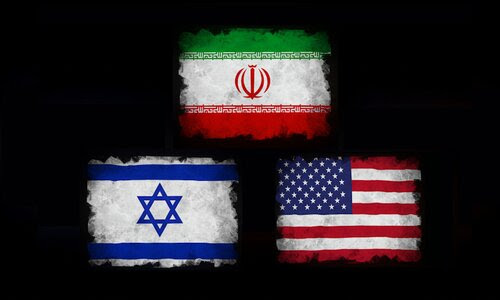
War rarely begins with a declaration. More often, it arrives disguised as routine meetings, shipping advisories, and “defensive” military movements that quietly redraw the boundaries of risk. That is where the United States, Israel, and Iran now stand–locked in a cycle of escalation where diplomacy continues in form, but preparation for conflict is advancing in substance.
At the center of this accelerating crisis is an unusually urgent meeting in Washington between President Donald Trump and Israeli Prime Minister Benjamin Netanyahu. Originally planned for a later date, Netanyahu’s visit was moved up in response to growing Israeli concerns about Iran’s ballistic missile program, underscoring the rapid pace at which the situation is evolving. Israeli officials have described it not as symbolic diplomacy, but as a “strategy-shaping session”–a meeting intended to align on contingency plans, not photo opportunities.
Adding to the pressure, the so-called Board of Peace is scheduled to convene on February 19, a forum intended to explore regional de-escalation but one that also sets a hard point on the calendar for decisions. The compression of these timelines is stark: with diplomacy, military planning, and multilateral talks converging, the window for preventing a confrontation is narrowing fast.
Publicly, the White House maintains that it prefers a negotiated outcome. Vice President JD Vance has reiterated that President Trump is seeking a “meaningful deal” with Iran–one that stabilizes the region and restrains Tehran’s ambitions. Privately, however, patience is thinning. U.S. officials are pressing Iran to arrive at the next round of talks with concrete concessions, warning that time and tolerance are both finite.
Iran has responded by hardening its stance. Tehran has offered only limited compromises in exchange for the complete removal of sanctions, a condition Washington is unwilling to accept. As the diplomatic gap widens, the United States has quietly begun preparing for contingencies that suggest officials are no longer confident talks will hold. U.S.-flagged vessels have been advised to stay “as far as possible” from Iranian waters while navigating the Strait of Hormuz–one of the world’s most vital energy corridors. Such advisories are rare, and they reflect a genuine concern that maritime confrontation could erupt with little warning.
Military Signals Beneath the Diplomatic Surface
While negotiations continue on paper, the military picture tells a more sobering story. Open-source intelligence analysts have tracked an unusual surge in U.S. military movement from Europe into the Middle East. Strategic airlift aircraft–C-17 Globemaster IIIs typically used to transport heavy equipment, missile systems, and personnel–have appeared in notable concentrations at Ramstein Air Base in Germany and Al Udeid in Qatar. Tanker aircraft, surveillance platforms, drones, and naval patrols have followed.
U.S. Navy reconnaissance aircraft have been repeatedly observed flying maritime routes south of Iran, while aerial refueling tankers briefly operated close enough to Iranian airspace to raise alarms before tracking feeds went dark. A U.S. carrier strike group is already operating in the region, and President Trump has publicly stated that he is considering deploying an additional carrier if talks collapse. Patriot missile systems, meanwhile, remain mounted on mobile platforms, allowing rapid repositioning either to defend against Iranian retaliation or to support offensive operations.
This posture goes beyond deterrence. It reflects readiness.
Iran’s Warning: A War Preview, Not a Threat
Tehran has responded with a message designed to be seen, not merely heard. The Iranian regime has released a highly produced propaganda video depicting the destruction of what it derisively labels Donald Trump’s “armada” in the Middle East. The footage simulates a coordinated, multi-domain assault on a U.S. carrier strike group–ballistic and cruise missiles raining down from land, submarines firing torpedoes, fast patrol boats swarming the fleet, and waves of jet-powered Shahed drones slamming into American warships. These are the same drones Russia has used extensively to terrorize Ukrainian cities.
The video is more than propaganda. It reflects a strategic shift. Israeli officials are no longer primarily focused on Iran’s nuclear program, which they believe was largely neutralized during previous U.S. strikes. The greater concern now is Iran’s rapidly expanding ballistic missile arsenal–thousands of increasingly precise weapons designed to overwhelm air defenses and strike multiple targets simultaneously. This is saturation warfare, and it is central to Iran’s deterrence doctrine.
Israel’s Calculus–and the Risk of Acting Alone
For Israel, the margin for error is narrowing. Netanyahu’s expedited meeting with Trump has fueled speculation that Jerusalem is seeking clarity–either assurance that the United States will act if diplomacy fails or tacit approval to move independently if it does not.
An Israeli operation would likely focus on missile infrastructure and command-and-control nodes rather than nuclear sites. But such a strike would almost certainly trigger a broader regional response. Hezbollah in Lebanon, Iranian-backed militias in Syria and Iraq, and Houthi forces in Yemen could all be activated. Israel could find itself engaged on multiple fronts within days.
Even if Washington does not initiate such a conflict, it would be difficult to remain on the sidelines.
Four Paths Forward–and None Without Consequences
Scenario One: Limited Strikes, Managed Escalation
In this scenario, the U.S. or Israel conducts precision strikes on Iranian missile infrastructure and command nodes, aiming to degrade capabilities without triggering a full-scale war. Iran would likely respond through proxy militias in Iraq, Syria, Lebanon, or Yemen, and possibly launch cyberattacks on critical U.S. infrastructure.
Shipping through the Strait of Hormuz could be disrupted temporarily by mines or missile harassment, sending oil prices spiking overnight. While this path avoids a broader war, it leaves the region on a knife’s edge–any misstep, miscalculation, or misidentification of targets could trigger escalation beyond the original plan.
Scenario Two: Israeli First Strike, Regional Firestorm
If Israel acts independently, perhaps believing that U.S. diplomacy will fail to stop Iran’s missile buildup, the consequences could be swift and chaotic. Iranian ballistic and cruise missiles would likely target Israel and U.S. bases in the Gulf. Hezbollah in Lebanon might open a northern front, while Iran-backed militias could attack across Syria, Iraq, and Yemen.
Israel could find itself fighting simultaneously on multiple fronts, requiring emergency coordination with Washington–but without guaranteed support. Regional energy markets would face prolonged disruptions, and the risk of a broader U.S. military entanglement would increase exponentially.
Scenario Three: Full U.S.-Iran Confrontation
A direct conflict between Washington and Tehran could involve sustained air and naval operations, missile barrages, and attacks on energy infrastructure across the Gulf. Iranian forces could target U.S. bases, shipping, and regional partners with high-volume missile strikes, Shahed drone swarms, and cyberattacks.
The Strait of Hormuz, a critical artery for global energy supplies, could be closed for days or weeks. China and Russia would likely maneuver diplomatically and economically, exploiting instability for strategic gain. Casualties and destruction would escalate quickly, and the war could spread far beyond the Gulf–pulling in regional powers and allies on both sides.
Scenario Four: A Deal–But Only Temporary
A negotiated settlement could theoretically pause hostilities. Iran might agree to limited concessions, the U.S. could ease certain sanctions, and public messaging could emphasize diplomacy “winning the day.” But historical behavior suggests the agreement would be fragile: Iranian negotiators have repeatedly proven willing to stall, mislead, or exploit loopholes. Israel, deeply skeptical of Tehran’s intentions, would face a difficult choice.
Would it accept temporary relief, or continue covert or preemptive operations to reduce the missile threat? Even a signed deal would likely set the stage for future crisis, forcing Israel–and potentially the U.S.–to maintain military readiness and surveillance indefinitely. In this scenario, the region enjoys only a pause, not peace, as both sides anticipate the next round of confrontation.
A Test of Deterrence
Diplomacy has not ended–but it is no longer driving events. Military leverage now defines the boundaries of choice, and each side is testing how far it can push without triggering the very war it claims to want to avoid.
History suggests such moments rarely end quietly.
Corporations Finally Getting The Message As LGTB Agenda Falters

The Human Rights Campaign long has been one of the biggest LGBT agenda promoters in America.
It assembled a ranking system and corporations jumped to meet its requirements in pursuit of that elusive 100% rating from HRC.
But its agenda got more and more extreme, and American society realized the down side of promoting the alternative lifestyle choices involved – many millions of Americans didn’t support the ideology – and now the HRC influence is plunging.
According to a report at the Washington Stand, the group previously rated 377 Fortune 500 companies for their ideological agenda support.
That was for 2025.
But for 2026, the company list is down “to just 131.”
That’s a plunge of 65%.
“The rankings, which started back in 2002, have been the best indicator of a business’s political leanings for two decades. These days, to get within striking distance of a perfect score, employers have to agree to wild concessions like covering the cost of gender-transition procedures for staff and their families, publicly advocating for pro-LGBTQ legislation, forcing employees to undergo multiple ideological trainings, opening restrooms to both sexes, introducing a pronoun sharing guide, recruiting employees based on sexual orientation and gender identity (not merit and experience), and more,” the Washington Stand explained.
HRC was, in fact, “once feared by corporate boardrooms and executives alike.”
Now, the report said, it “intimidates no one.”
The report attributed part of the change to “six beer cans.”
“One of the best things that’s ever happened in this century will also go down as one of the worst business decisions ever made. When Bud Light plastered Dylan Mylvaney’s face on a pack of cold ones, a switch flipped in this country — sparking a grassroots revolution that’s still turning woke brands on its head. And while it’s gratifying to see the power shift from cocky CEOs to the people, what’s even better is seeing the bully behind it all crumble,” the report said.
“Gone are the days when businesses raced to contort their internal policies to the radical demands of HRC’s Corporate Equality Index. Now, the old shine of a 100% score, of being perfectly aligned with the most outspoken pro-trans, pro-gay agenda in the world, is more damaging than desirable,” the report noted.
The result is that most CEOs see taking themselves out of the index altogether is the best answer, since “A low score would open them up to public shaming by HRC, and a good score would put them at odds with an army of Americans who could tank their revenue. It’s a lose-lose.”
Will Hild, of Consumers’ Research, said in an interview with the publication that “The number of Fortune 500 companies abandoning participation in HRC’s radical activist index is yet another sign that ESG and woke capitalism were never about profits.”
“The more consumers learn about companies’ advocacy for bizarre, fringe LGBTQ politics, the less they think of the brands. And corporations are finally getting the message. Hopefully, the companies still participating will soon concede that their job isn’t to tell Americans how to live or what to believe, but to simply serve their needs.
The impact is real, the report said, with HRC laying off 20% of its staff over recent months.
Stephen Soukup of the Heritage Fondation’s Free Enterprise Initiative, explained to the Washington Stand, there was a “near-simultaneous realization among individuals in an oppressed population that they are not alone — that they are not the only ones who have been putting on a brave face and pretending not to detest the ‘regime’ for fear of public reprisal.”
The agenda quickly fell.
It was Tractor Supply that first conceded it felt pressure to participate in the HRC plans, but when it quit, John Deere, Harley-Davidson and other corporations quickly followed.
He said today, “HRC’s entire corporate pressure movement is on the verge of complete collapse.”
A Nation Debates The Death Penalty: Why Life In Prison No Longer Works In Israel
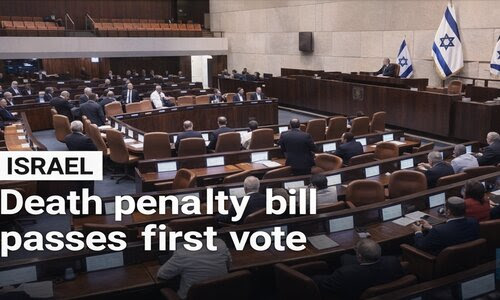
The Israel Prison Service has begun operational preparations to implement capital punishment for terrorists following the Knesset’s preliminary approval of new death penalty legislation. According to Channel 13 News, the preparations include establishing a dedicated execution facility–internally dubbed the “Israeli Green Mile”–designed specifically for carrying out death sentences by hanging.
The facility will operate with execution teams composed entirely of volunteers who will undergo specialized training. Three prison officers will simultaneously activate the execution mechanism, a design intended to distribute psychological responsibility. The Israel Prison Service plans to carry out executions within 90 days of a final verdict, significantly faster than the often decades-long delays seen in other death penalty jurisdictions. An IPS delegation is scheduled to visit an East Asian country to study the practical, legal, and ethical aspects of implementing capital punishment in a regulated manner.
The proposed law, advanced by the Otzma Yehudit Party and championed by National Security Minister Itamar Ben-Gvir, mandates the death penalty for terrorists convicted of murdering Israelis “out of motives of racism or hostility toward the public, and under circumstances in which the act was carried out with the intention of harming the State of Israel and the rebirth of the Jewish people.”
The legislation passed its first reading on November 30, 2025, by a vote of 39-16. Prime Minister Benjamin Netanyahu and Brig. Gen. (res.) Gal Hirsch, Israel’s coordinator for captives and missing persons, have both endorsed the measure, though they refrained from public support until after the return of living hostages due to concerns about negotiation impacts.
Initial implementation would target Hamas Nukhba force terrorists who participated in the October 7 massacre, followed by terrorists convicted of severe attacks in Judea and Samaria.
Why Life Sentences No Longer Deter Terrorism
The Bible does not blur moral lines when it comes to those who shed innocent blood. “And you shall not take ransom for the life of a murderer who is guilty of death, for he shall surely be put to death” (Numbers 35:31). The Hebrew phrase dam naki, innocent blood, is treated with absolute seriousness. The Sages explain that a society which tolerates unpunished murder endangers itself, because violence unrestrained invites more violence. This is not a call for vengeance. It is a demand for justice and for the protection of life. Releasing convicted terrorists with blood on their hands is not a neutral policy; it is a decision with predictable consequences.
In December 1996, Israeli criminologist Anat Berko sat across a small metal table from Hamas founder Ahmed Yassin in an Israeli prison. Five hours later, Yassin, who was convicted on terrorism charges, invited her to continue the conversation outside the prison.
“He told me that if I had more questions, I could ask him in Gaza, wherever he would be,” Berko, a former Knesset member, told JNS in late December. “He was convinced that he would be freed.”
A few months later, after a failed Israeli assassination attempt on then-Hamas politburo chief Khaled Mashal in Jordan, Yassin was released. His conviction that he wouldn’t rot in prison is common among security prisoners in Israel, who rarely see life sentences as permanent in an era defined by hostages-for-prisoners exchanges.
“They know that even if they receive a life sentence, they will not stay in jail for their entire lives,” she told JNS, “because Hamas or another terror organization will kidnap soldiers, civilians, or others, and they will be released in a hostage deal.”
The release of security prisoners during the current Gaza war has again placed a hard, uncomfortable fact at the center of Israel’s national debate. Men convicted of murder and attempted murder, terrorists responsible for Israeli civilian bloodshed, were freed as part of wartime deals and returned to Gaza, Judea, and Samaria. Many were welcomed publicly by Hamas, a terrorist organization, and immediately folded back into the terror infrastructure that Israel has spent years dismantling. This is not theory or speculation. It is a pattern with a long and bloody record.
The record of recidivism among released terrorists is extensive and well-documented by Israel’s security establishment. After the Shalit deal in 2011, Israeli intelligence assessed that a significant percentage of released prisoners returned to terror activity, including senior Hamas operatives who later planned attacks, recruited cells, and directed violence from Gaza and abroad.
During the current war, similar dynamics have already emerged. Terrorists freed in exchanges have appeared in Hamas propaganda videos, resumed command roles, and in some cases, were later eliminated by the IDF after returning to operational activity. Israeli officials have repeatedly stated that releases are not acts of mercy but calculated risks taken under extreme pressure, with full awareness that many of those freed will return to violence.
Israel’s enemies understand this dynamic clearly. Hamas celebrates prisoner releases not as humanitarian gestures but as strategic victories. Each freed terrorist is proof, in their worldview, that kidnapping and mass murder work. Each return to terror reinforces that lesson. Israeli security officials have acknowledged that prisoner releases strengthen Hamas politically and operationally, even when carried out under wartime duress. This is why terror groups invest enormous effort in abducting Israelis alive rather than killing them outright. Prisoner exchanges are not peripheral to terror strategy. They are central to it.
That assumption–and its implications for Israeli national security–has resurfaced as Israel again weighs the death penalty for terrorists. After October 7, Israel released almost 2,000 Palestinian prisoners and detainees during hostage exchanges, many convicted of terrorism. Berko, who opposed the death penalty before the attacks, changed her position.
“As a criminologist, I was against it,” Berko said. “But I believed at least that if somebody received punishment, they would stay in jail.”
Berko has since concluded that prison is no longer a sufficient deterrent. Inside Israeli jails, terrorists can earn academic degrees, eat regular meals, and receive extensive medical care–living for years in regimented routines that, Berko said, do little to deter future violence.
“Many times, prison becomes a place to study, to improve abilities, to socialize with other terrorists, to coordinate attacks outside jail, and to prepare for the next step,” she told JNS. “Their ideology is very clear. It’s not about borders or having a state. It’s about killing the last Jew in Israel.”
Berko challenged one of the most persistent myths about terrorist motivation. Terrorists “value their lives very much,” she told JNS, “and the lives of their families.”
Contrary to widespread belief that many Islamist terrorists seek martyrdom, leaders of terrorist groups refuse to send their own children to attack Israelis or confront Israeli troops, according to Berko.
“Ismail Haniyeh did not send his children even to demonstrations near the border,” she said. “Many terrorists surrender. They raise their hands. They don’t want to die. The idea that everyone wants to be a shahid is a legend.”
Her observations strike at the heart of the deterrence debate. If terrorists genuinely believed death would follow conviction, the calculation changes. If prison means eventual release, comfortable conditions, and the opportunity to continue the fight from behind bars, there is no reason not to murder Jews.
Can Jewish law accommodate the execution of terrorists who murder Jews?
The question of capital punishment under Jewish law presents complexities that Israeli rabbinical authorities have debated for decades. Israeli law currently permits the death penalty only under exceptional circumstances–genocide, crimes against humanity, and wartime treason–but the state has executed only two individuals: IDF officer Meir Tobianski in 1948 following a field court-martial on treason charges during the War of Independence (he was posthumously exonerated), and Nazi official Adolf Eichmann in 1962 for his role in orchestrating the Holocaust.
Rabbi Daniel Feldman, Rosh Yeshiva at the Rabbi Isaac Elchanan Theological Seminary at Yeshiva University, explained that Jewish law distinguishes between ideal legal systems and emergency measures necessary to protect society. Historically, rabbinic authorities viewed capital punishment as a last resort, arguing that if life imprisonment could adequately protect the public, execution was unnecessary. “The feeling of the rabbis at that time was that if life imprisonment could protect society in the same way, then it wouldn’t be appropriate to have the death penalty,” Feldman said.
That calculation has shifted. With life imprisonment no longer carrying significant weight, he said that Jewish legal discussions about the death penalty have become “more serious,” as rabbis weigh concerns such as potential reciprocal attacks against Jews or Israelis in response to executions.
Another central question, he said, is whether Israeli society can be adequately protected without capital punishment.
“It’s a very severe question, a very grave question–how to properly address that,” Feldman told JNS. “It has to be looked at very, very carefully. With an eye toward both justice and fairness, and protecting the innocence of society overall.
The Sages established that Jewish law permits–and in certain circumstances requires–execution to protect society from murderers. “Whoever sheds the blood of man, by man shall his blood be shed; for in the image of God He made man” (Genesis 9:6). This verse applies to all humanity, not exclusively to Jews, establishing a universal principle predating the giving of the Torah at Sinai.
Rabbi Shmuel Eliyahu, Chief Rabbi of Safed and a prominent religious-Zionist authority, has argued forcefully that Jewish law forbids leaving murderers alive. “It is forbidden to leave a murderer alive,” he stated. Responding to a question about whether terrorists should be kept alive for interrogation, Eliyahu wrote, “If you leave him alive, there is a fear that he will be released and kill other people.” He added that interrogation is permissible only when no alternative exists and when there is an immediate threat–a ticking bomb scenario–after which the terrorist should be “sent to hell as quickly as possible.”
Former IDF Chief Rabbi Avichai Ronsky articulated two reasons for applying the death penalty to terrorist murderers. First, removing evil from the world improves it. Second, the existence of capital punishment alters terrorist calculations, creating genuine deterrence. Rabbi Ronsky warned that failing to apply the death penalty increases bloodshed by providing Hamas and other terrorist organizations with experienced operatives through prisoner exchanges, making future attacks more likely to succeed. He also noted the danger of vigilantism when victims’ families see killers released. The rabbi noted that he does not personally support vigilante acts, but can understand those who turn to extrajudicial action out of despair.
The UN’s Selective Outrage
UN experts issued a statement condemning the Israeli legislation, warning it would violate the right to life and discriminate against Palestinians. “Mandatory death sentences are contrary to the right to life,” a dozen independent UN rights experts declared. “By removing judicial and prosecutorial discretion, they prevent a court from considering the individual circumstances, including mitigating factors, and from imposing a proportionate sentence that fits the crime.”
Among the signatories was Francesca Albanese, the special rapporteur who has been accused of anti-Israel and antisemitic bias. Albanese claimed that unintentional killings were not among the “most serious” crimes to which the death penalty can be applied under international law. While refusing to accuse Hamas of war crimes and crimes against humanity, she condemned executing terrorists. “Denial of a fair trial is also a war crime,” she stated, ignoring that the death penalty would result from a full trial in Israeli courts.
The UN experts also warned that “the bill makes matters worse by allowing death sentences to be imposed by a simple majority vote of military judges.” Hamas responded by calling the proposed law an embodiment of “the ugly fascist face of the rogue Zionist occupation” and a violation of international law. The Hamas charter calls for murdering every Jew, presumably without trials.
The selective nature of this criticism becomes clear when examining the global landscape of capital punishment. Globally, capital punishment remains legal in 55 countries. China, Iran, Saudi Arabia, Egypt, and several U.S. states carry out the majority of executions worldwide. Iran executes hundreds annually, including for crimes such as adultery, apostasy, and homosexuality. Saudi Arabia beheads dozens each year for offenses including drug trafficking and sorcery. The Palestinian Authority has executed prisoners, and Hamas has executed accused collaborators in Gaza, in many cases without trials.
No UN statement has condemned these executions. No special rapporteurs have traveled to East Asian countries to investigate their death penalty procedures. No warnings about violations of the right to life have been issued to Iran for hanging political dissidents. The silence is deafening and deliberate.
The double standard reveals itself starkly: Israel faces international condemnation for proposing to execute terrorists who murdered Jews after full trials in civilian or military courts with appeals processes, while regimes that execute political opponents, religious minorities, and women for moral offenses receive no comparable scrutiny. The UN’s moral credibility on this issue collapsed long before Albanese signed her name to the latest denunciation of the Jewish state.
Capital Punishment and Counterterrorism Strategy
Maurice Hirsch framed capital punishment as one component of a comprehensive counterterrorism strategy. “The war on terror has to be fought on every level,” he said. “It’s not just the death sentence, it’s revoking citizenship, seizing terrorist payments, forfeiting assets, and imposing real prison sentences.”
He compared terrorism to organized crime, arguing Israel should employ the same tools to dismantle terrorist infrastructure. “Terrorism is a form of organized crime,” he said. “There’s no reason we shouldn’t use the same tools, asset seizure, forfeiture, mandatory sentencing, to dismantle it.”
If Israeli law prescribes ten years for rock-throwing but terrorists receive six-month sentences, “you don’t deter anyone,” he said. “Israel has never put together a full terror-fighting package without wavering, and that wavering is exactly what terrorists exploit.”
Hirsch rejected framing the issue as Jews versus Palestinians. “This is the Jewish state saying that anyone who murders Jews for being Jews will pay that price,” he said. “If a Japanese terrorist or a German Hezbollah operative committed the same acts, they would be treated exactly the same.”
“This isn’t about vengeance,” he added. “It’s about deterrence and about finally taking terrorism seriously.”
The death penalty debate in Israel forces a reckoning with the failure of life imprisonment to protect Jewish lives. When terrorists view prison as temporary, when they use incarceration to plan future massacres, when they expect release through hostage exchanges, the Jewish state confronts an obligation older than the modern prison system itself. The verse commands it plainly: justice demands that those who spill innocent blood forfeit their own. What remains is whether Israel will enforce that ancient standard or continue releasing murderers who will kill again.
TruLight Ministries Daily Entertainment

TruLight TV –The TruLight Radio Top 10 – Number 1 songs of 2025
The TruLight Top 10 broadcast-ed on TruLight Radio XM Saturdays at 17h00 is now also available on Video format via TruLight TV with your Host Dilize Light. Every week on Saturdays afternoon at 17h00 GMT + 2 We count down the TruLight Gospel Top 10 by votes.
Today on TruLight Radio XM
TruLight Radio XM 24/7
Program
GMT / UTC +2
Monday To Fridays
00:15 Words to Live By Testimonies
01.15 Science Scripture and Salvation
02.15 Ground Works
04.00 Gospel Concert of the Day
05.00 The Daren Streblow Comedy Show
5:55 It is Today devotional
6:00 Gaither Homecoming Morning Show
7:15 Discover the Word
8.15 Destined for Victory
8:55 Science Scripture and Salvation
9:00 Holy Spirit Hour – Normally Sermons
10:15 Hope of the Heart
11:15 Unshackled
11.45 Words to Live By
12:15 Truth for Life
13:15 Living on the Edge with Chip Ingram
14:15 Focus on the Family
15:00 Kids Hour
16:00 In Touch with Dr. Charles Stanley
16:30 Groundwork
17:15 Live in the Light
18:15 Renewing your Mind
19:00 Gaither Homecoming Show
20:15 Growing Hope
21:15 Adventures in Odyssey Radio Drama
21:45 Bible Reading
22:15 Night-sounds
23.00 Good Old Country Gospel / Rhema Gospel Express
VISIT THE WEBSITE
TruLight Ministry News

TruLight Ministries orders from God since 2012 . Teach Them , Comfort Them and Warn Them!
Healing Truths
End Time Articles :
Share this Feeding of Manna with your Friends and Family. just click on the Social Media icon and share !