Hosted by TruLight Ministries – The Place of Truth
SELECT YOUR READING LANGUAGE – BOTTOM LEFT = YOUR DAILY MANNA NOW AVAILABLE IN 103 LANGUAGES
By Grace alone , By Faith Alone !
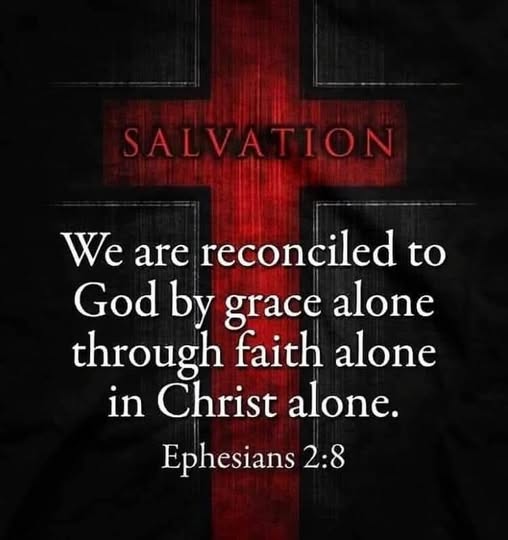
Is salvation by faith alone, or is salvation by faith plus works? This is perhaps the most important question in all of Christian theology. This question was the cause of the Reformation, the split between Protestantism and Catholicism. This question is a key difference between biblical Christianity and most of the cults. Is salvation through faith alone or through faith plus human works? Stated another way, am I saved by trusting in Jesus, or do I have to believe in Jesus and, in addition, do certain things?
The works in addition to faith needed for salvation differ in various religious circles. Many groups point to water baptism as a work that must be added to faith for salvation—if you’re not baptized, you’re not saved. Some go even further: you must be baptized by the right minister, using the right method, saying the right words.
Others suggest different rites to be observed in order to be saved, but the formula is always faith + [fill in the blank]. Salvation is through faith + receiving Mass, faith + going to confession, faith + tithing, etc.
Many passages of the Bible teach that salvation is through faith alone, not faith plus works. Ephesians 2:8–9, for example, is clearly worded and unequivocal: “It is by grace you have been saved, through faith—and this is not from yourselves, it is the gift of God—not by works, so that no one can boast.” Of great importance is the word grace, which refers to God’s blessings on the undeserving. The very idea of grace negates all attempts to earn salvation. Paul makes that argument when teaching on God’s choosing of the remnant of Israel: “Since it is through God’s kindness, then it is not by their good works. For in that case, God’s grace would not be what it really is—free and undeserved” (Romans 11:6, NLT).
Other passages that clearly teach salvation through faith alone include Acts 16:31; Romans 3:28; 4:5; 5:1; Galatians 2:16; 3:24; Ephesians 1:13; and Philippians 3:9.
There are a few Bible passages that, at first glance, seem to teach salvation through faith plus works. One such is James 2:24, which appears to say that justification is by faith plus works: “You see that a person is considered righteous by what they do and not by faith alone.” This apparent problem is solved by examining the whole of James’ argument in his epistle. James is refuting the idea that a person can have saving faith without producing any good works (see James 2:17–18). Genuine faith in Christ, James says, will produce a changed life and result in good works (James 2:20–26). James is not saying that justification is by faith plus works, but that a person who is truly justified by faith will have good works in his or her life. The works are an outward show of genuine faith in Christ (James 2:14, 17, 20, 26)—and it’s that outward show that “justifies” the believer in the sight of other people.
Paul says those who have true faith in Jesus Christ will be “eager to do what is good” (Titus 2:14). To return to Ephesians 2, immediately after teaching that we are saved through faith, not through works (Ephesians 2:8–9), Paul says that we were created “to do good works” (Ephesians 2:10). Salvation comes by God’s grace through faith, and that faith is made manifest in good works. The works follow the faith and are a proof of it.
If we’re going to say that we are saved by works, we must qualify whose works. We are not saved by our own works, however meritorious they are in our own eyes. We are saved solely by the work of Christ on our behalf. His death and His resurrection are the works that save us. We receive our Savior by faith (John 1:12).

Bible Verse and Prayer for Today
In everything, do to others what you would have them do to you, for this sums up the Law and the prophets.
—Matthew 7:12
This verse is called “The Golden Rule”! It’s golden because it’s genuine, lasting, doable, understandable, and valuable. It’s golden because it clearly and beautifully summarizes what God’s Law teaches about how we should treat others. Imagine how different our world would be if we all practiced this principle — not just in our “church life” but in our daily life? If we practiced this Gold Rule with our family, our coworkers and employer, and with the people we manage, the folks on the freeway, in the neighborhoods where we drive, and toward the waiters and waitresses and others who serve us… Wow! What a wonderfully different world we would have! So, let’s each start changing our world and making it a bit more golden today!
Prayer
Generous Father, you have blessed me with so many rich and wonderful gifts. I can never adequately express how much thanks you deserve. One thing I want you to know from my heart, dear Father, is that I especially appreciate the way you have treated me with grace, not with justice or judgment. Empower me through your Holy Spirit to treat others as I would have them treat me and as you have treated me. In Jesus’ name, I pray to live this golden way. Amen and Amen
Bible Teaching of the Day
Salvation by grace through faith is at the heart of the Christian religion. “For it is by grace you have been saved, through faith—and this not from yourselves, it is the gift of God—not by works, so that no one can boast” (Ephesians 2:8–9). The statement has three parts— salvation, grace, and faith—and they are equally important. The three together constitute a basic tenet of Christianity.
The word salvation is defined as “the act of being delivered, redeemed, or rescued.” The Bible tells us that, since the fall of Adam and Eve in the Garden of Eden, each person is born in sin inherited from Adam: “Sin entered the world through one man, and death through sin, and in this way death came to all men, because all sinned” (Romans 5:12). Sin is what causes all of us to die. Sin separates us from God, and sin destines each person to eternal separation from Him in hell. What each of us needs is to be delivered from that fate. In other words, we need salvation from sin and its penalty.
How are we saved from sin? Most religions throughout history have taught that salvation is achieved by good works. Others teach that acts of contrition (saying we are sorry) along with living a moral life is the way to atone for our sin. Sorrow over sin is certainly valuable and necessary, but that alone will not save us from sin. We may repent of our sins, also valuable and necessary, and determine to never sin again, but salvation is not the result of good intentions. The road to hell, as the saying goes, is paved with good intentions. We may fill our lives with good works, but even one sin makes us a sinner in practice, and we are already sinners by nature. No matter how well-intentioned or “good” we may be, the fact is that we simply do not have the power or the goodness to overcome the sin nature we have inherited from Adam. We need something more powerful, and this is where grace comes in.
The grace of God is His undeserved favor bestowed on those He has called to salvation through His love (Ephesians 2:4–5). It is His grace that saves us from sin. We are “justified freely by his grace through the redemption that came by Christ Jesus” (Romans 3:24). Being justified, we are vindicated and determined to be sinless in the eyes of God. Our sin no longer separates us from Him and no longer sentences us to hell. Grace is not earned by any effort on our part; otherwise, it could not be called grace. Grace is free. If our good works earned salvation, then God would be obligated to pay us our due. But no one can earn heaven, and God’s blessings are not His obligation; they flow from His goodness and love. No matter how diligently we pursue works to earn God’s favor, we will fail. Our sin trips us up every time. “By the deeds of the law no flesh will be justified in His sight” (Romans 3:20, NKJV).
The means God has chosen to bestow His grace upon us is through faith. “Now faith is being sure of what we hope for and certain of what we do not see” (Hebrews 11:1). Salvation is obtained by faith in God’s Son, Jesus Christ, in what He has done—specifically, His death on the cross and His resurrection. But even faith is not something we generate on our own. Faith, as well as grace, is the gift of God (Ephesians 2:8). He bestows saving faith and saving grace upon us in order to redeem us from sin and deliver us from its consequences. So God saves us by His grace through the faith He gives us. Both grace and faith are gifts. “Salvation belongs to the LORD” (Psalm 3:8, ESV).
By grace, we receive the faith that enables us to believe that He has sent His Son, Jesus Christ, to die on the cross and provide the salvation we cannot achieve on our own. Jesus, as God in flesh, is the “author and perfecter of our faith” (Hebrews 12:2). Just like the author of a book creates it from scratch, Jesus Christ wrote the story of our redemption from beginning to end. “For he chose us in him before the creation of the world to be holy and blameless in his sight. In love he predestined us to be adopted as his sons through Jesus Christ, in accordance with his pleasure and will—to the praise of his glorious grace, which he has freely given us in the One he loves” (Ephesians 1:4–6). The Lord died for our sins and rose for our justification, and He forgives, freely and fully, those who accept His gift of grace in Christ—and that acceptance comes through faith. This is the meaning of salvation by grace through faith.
Today’s Devotional
It is entirely true that the one verse in the Bible that contains the exact phrase “faith alone” seems to argue against salvation by faith alone. James 2:24 reads, “You see that a person is justified by works and not by faith alone” (ESV). However, rejecting the doctrine of salvation by faith alone based on this verse has two major problems. First, the context of James 2:24 is not arguing against the doctrine of salvation by faith alone. Second, the Bible does not need to contain the precise phrase “faith alone” in order to clearly teach salvation by faith alone.
James 2:14–26, as a whole, and especially verse 24, has been the subject of some confused interpretations. The passage definitely seems to cause serious problems for the “salvation by faith alone” concept. First, we need to clear up a misconception, namely, that James means the same thing by “justified” in James 2:24 that Paul means in Romans 3:28. Paul is using the word justified to mean “declared righteous by God.” Paul is speaking of God’s legal declaration of us as righteous as Christ’s righteousness is applied to our account. James is using the word justified to mean “being demonstrated and proved.”
The 2011 NIV provides an excellent rendering of James 2:24: “You see that a person is considered righteous by what they do and not by faith alone” (emphasis added). Similarly, the NLT translation of James 2:24 reads, “So you see, we are shown to be right with God by what we do, not by faith alone” (emphasis added). The entire James 2:14–26 passage is about proving the genuineness of your faith by what you do. A genuine salvation experience by faith in Jesus Christ will inevitably result in good works (cf. Ephesians 2:10). The works are the demonstration and proof of faith (James 2:18). A faith without works is useless (James 2:20) and dead (James 2:17); in other words, it is not true faith at all. Salvation is by faith alone, but that faith will never be alone.
While James 2:24 is the only verse that contains the precise phrase “faith alone,” there are many other verses that do, in fact, teach salvation by faith alone. Any verse that ascribes salvation to faith/belief, with no other requirement mentioned, is a declaration that salvation is by faith alone. John 3:16 declares that salvation is given to “whoever believes in Him.” Acts 16:31 proclaims, “Believe in the Lord Jesus, and you will be saved.” Ephesians 2:8 says, “For by grace you have been saved through faith.” See also Romans 3:28; 4:5; 5:1; Galatians 2:16; 3:24; Ephesians 1:13; and Philippians 3:9. Many other verses could be referenced in addition to these.
In summary, James 2:24 does not argue against salvation by faith alone. Rather, it argues against a salvation that is alone, a salvation devoid of good works and obedience to God’s Word. James’s point is that we demonstrate our faith by what we do (James 2:18). Regardless of the absence of the precise phrase “faith alone,” the New Testament definitely teaches that salvation is the product of God’s grace in response to our faith. “Where, then, is boasting? It is excluded. On what principle? . . . On that of faith” (Romans 3:27).
Bible Prophecy, Signs of the Times and Gog and Magog Updates with Articles in the News
Trump’s Board Of Peace Explained: Many Layers, One Huge Risk For Israel
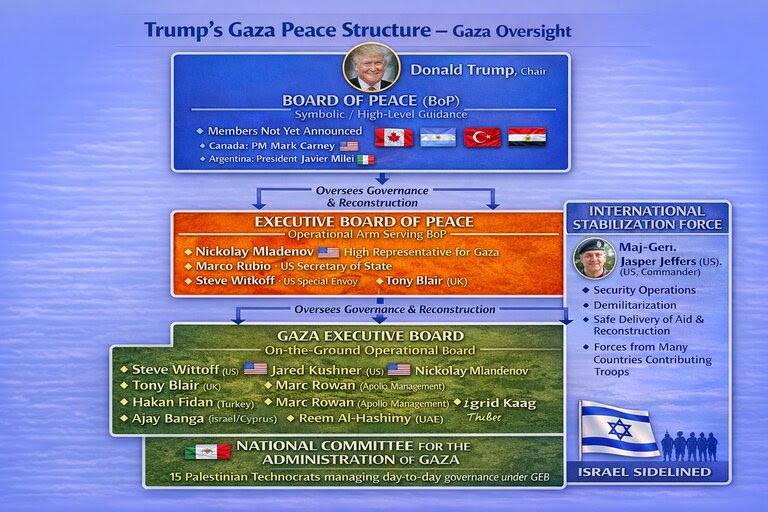
President Donald Trump’s Gaza peace initiative has entered a complex new phase, with multiple overlapping boards and committees designed to oversee governance, reconstruction, and security in the Strip. While Trump chairs the symbolic Board of Peace (BoP), operational authority is divided among a formally announced Executive Board of Peace, the Gaza Executive Board (GEB), and the local technocratic government, the National Committee for the Administration of Gaza (NCAG).
The structure is intricate, but understanding the hierarchy is critical to assessing its implications–particularly for Israel, which is effectively sidelined in decisions over Gaza.
Board of Peace (BoP) – Symbolic / Umbrella Body
Trump chairs the BoP, which provides overarching strategic guidance for Gaza’s postwar governance. This board is largely symbolic, intended to lend legitimacy and oversight to the US-led peace plan. Its official membership has not yet been fully revealed, but multiple world leaders have hinted acceptance, including Canadian Prime Minister Mark Carney, Argentina’s President Javier Milei, Turkey’s President Recep Tayyip Erdoğan, and Egypt’s President Abdel Fattah al-Sisi.
The BoP is meant to supervise the overall peace initiative, providing high-level direction while leaving day-to-day execution to subordinate boards. According to the White House, BoP will oversee diplomacy, infrastructure, development, and economic strategy across Gaza. Participation reportedly comes with a $1 billion buy-in, signaling the high stakes of influence within this symbolic body.
Executive Board of Peace – Operational Arm Serving BoP
Beneath the BoP sits the Executive Board of Peace, a formally announced operational body that executes the strategic directives of BoP. Its members include:
Nickolay Mladenov – High Representative for Gaza
Marco Rubio – United States Secretary of State
Steve Witkoff – United States Special Envoy to the Middle East
Jared Kushner – Donald Trump’s son-in-law
Tony Blair – Former Prime Minister of the United Kingdom
Marc Rowan – CEO of Apollo Global Management
Ajay Banga – President of the World Bank
Robert Gabriel Jr. – American political advisor
This board functions as the executive engine for the BoP, overseeing portfolios critical to Gaza’s stabilization, investment, reconstruction, and international coordination. Unlike BoP, the Executive Board of Peace is fully operational, managing the flow of decisions and linking strategic guidance with local governance.
Gaza Executive Board (GEB) – On-the-Ground Operational Board
The Gaza Executive Board is distinct from the Executive Board of Peace. This board operates on the ground in Gaza and manages day-to-day governance, reconstruction, and service delivery. Its members overlap with the Executive Board of Peace but include key international figures from countries historically critical of Israel:
Steve Witkoff – United States Special Envoy to the Middle East
Jared Kushner – Donald Trump’s son-in-law
Hakan Fidan – Turkey’s Minister of Foreign Affairs
Ali Al Thawadi – Qatar’s Minister for Strategic Affairs
Hassan Rashad – Director of Egypt’s General Intelligence Directorate
Tony Blair – Former Prime Minister of the United Kingdom
Marc Rowan – CEO of Apollo Global Management
Reem Al-Hashimy – Minister of State for International Cooperation of the United Arab Emirates
Nickolay Mladenov – High Representative for Gaza
Yakir Gabay – Businessperson
Sigrid Kaag – United Nations’ Special Coordinator for the Middle East Peace Process
The GEB works directly with the NCAG, coordinating reconstruction, service delivery, and stabilization programs across Gaza. It effectively bridges the High Representative’s office and local governance structures.
National Committee for the Administration of Gaza (NCAG) – Local Palestinian Technocrats
At the base of the hierarchy sits the NCAG, a technocratic body led by Dr. Ali Shaath, a seasoned Palestinian administrator. The NCAG includes 15 members (one woman) with clear portfolios: trade, economy, telecom, agriculture, health, education, finance, water, municipal affairs, women’s affairs, land, judiciary, and security.
The NCAG is intended to manage Gaza’s day-to-day operations once Hamas is rolled back, providing expertise in governance and service delivery. It functions under the guidance of the GEB and the High Representative, making it a critical but subordinate component of the governance framework.
International Stabilization Force (ISF) and Civil-Military Coordination Center (CMCC)
Security in Gaza is managed by the ISF, commanded by Maj.-Gen. Jasper Jeffers (US), responsible for demilitarization and safe delivery of aid. The CMCC, based in Kiryat Gat, Israel, coordinates humanitarian aid with over 50 countries, the IDF, US Central Command, and NGOs. Both entities operate in support of GEB and NCAG, ensuring stability during reconstruction.
Implications for Israel
This structure places Israel at a disadvantage. Countries historically critical of Israel, particularly Turkey and Qatar, have direct influence over Gaza’s operational governance through the GEB. The Executive Board of Peace, acting on BoP directives, also includes international members with influence over reconstruction and investment priorities.
Historically, UN agencies such as UNRWA have faced infiltration and operational challenges, raising concerns that international oversight could create similar risks. Israel’s strategic control over Gaza is effectively minimized, while foreign actors gain authority over governance, security, and humanitarian aid.
Prophetic Perspective
From a biblical standpoint, these developments echo warnings in Scripture about the nations aligning against Israel. Zechariah 12:3 states: “All the nations of the earth will come against Jerusalem.” The layered governance structure of BoP, Executive Board of Peace, GEB, NCAG, ISF, and CMCC illustrates how modern geopolitical structures can formalize international pressure against Israel.
While the initiative is framed as a peace and reconstruction effort, the combination of symbolic, operational, and local boards ensures Israel has limited input, leaving it largely on the sidelines of decisions that directly affect its security and interests.
5 Years Hard Labor Sentence For Defending The Faith Online
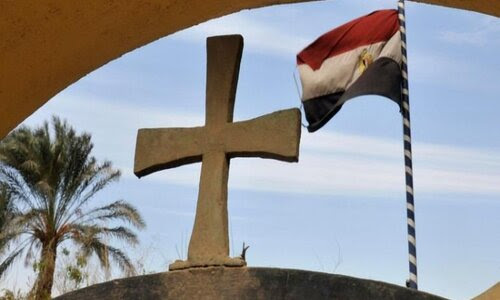
In January 2026, Augustinos Samaan, a 37-year-old Coptic Christian and scholar of comparative religion, was sentenced to five years of hard labor in Egypt — not for committing a crime, but for defending his faith.
Through his YouTube channel, with over 100,000 subscribers, Samaan peacefully discussed Christian beliefs, countered anti-Christian narratives, and sought to educate rather than provoke. Yet the government saw his faith as a threat and his online presence as a crime.
Samaan’s arrest was swift and brutal. Masked officers stormed his home in the early morning hours, confiscating his books, laptop, and personal papers. He was accused of “joining a terrorist organization” and “spreading false news” before the charges were quietly altered to “contempt of religion.”
Even the legal process was designed to intimidate: he was tried without notifying his family or lawyers, and his defense has had no real access to the case files. Justice, in this instance, was little more than a performance — a warning to anyone daring to speak openly about their faith.
This case is not an isolated tragedy. Across Egypt and many other nations where Islam dominates public life, Christians face the daily reality of persecution, especially those who have left Islam or speak out in defense of their faith. Blasphemy and apostasy laws are wielded less as tools for maintaining harmony than as instruments to silence minority voices.
Expressing one’s beliefs peacefully, educating others, or challenging prevailing narratives can lead to harassment, imprisonment, and even death. Faith becomes an act of courage, each word spoken a quiet rebellion against fear.
Samaan’s ordeal is a reminder of how fragile religious freedom can be when it is conditional. On paper, Egypt’s constitution guarantees freedom of belief and expression. In practice, those rights are subordinated to laws protecting the majority faith, leaving minorities like the Copts vulnerable to discrimination and abuse. The result is a system where Christians must navigate not only societal prejudice but also a legal landscape that can punish them for existing.
The courage of people like Samaan cannot be overstated. He stands among countless others who refuse to hide their faith despite overwhelming pressure to conform or remain silent. His sentence is intended to break him, to send a message that defending Christianity is dangerous.
Yet, history shows that persecution rarely extinguishes belief — it often strengthens it. For every Christian silenced, there are countless more inspired to continue speaking, teaching, and living boldly in the light of their convictions.
Beyond the personal tragedy lies a global lesson. Samaan’s sentence challenges all of us to confront uncomfortable truths: Do we truly value religious liberty, or only when it is convenient? Are we willing to speak out when injustice occurs in nations tied to strategic alliances, economic interests, or political expediency? Faith, courage, and the right to express belief should never be conditional on geography or politics.
Augustinos Samaan’s story is more than a case of injustice in Egypt; it is a stark reminder of the ongoing struggle for freedom of conscience worldwide. Christians, particularly those who leave Islam or challenge dominant religious narratives, continue to pay a high price for their faith. And yet, even behind prison walls, the human spirit proves resilient. Faith persists where fear seeks to dominate. Courage shines in the shadows. And hope — though tested — refuses to be silenced.
Anti-Ice Mob Storms Sunday Service Shutting Down Worship
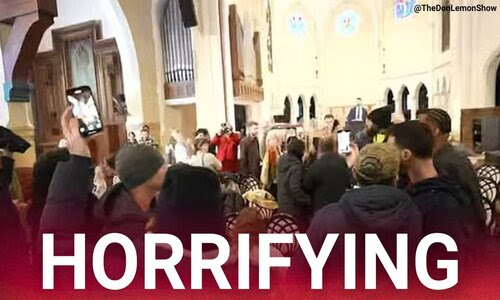
On Sunday, the unthinkable happened in St. Paul, Minnesota. Cities Church, a Southern Baptist congregation gathered for worship, was invaded by a mob of anti-ICE protesters, and choreographed for the camera by none other than former CNN anchor Don Lemon.
Chants of “ICE out!,” “Hands up, don’t shoot,” and “Justice for Renee Good!” pierced the sanctuary, shattering the peace of a holy place and terrifying parishioners who came to commune with God. This was not protest. This was desecration. And it is a warning to every Christian in America: sacred spaces are under attack, and we cannot stay silent.
The pretext for this intrusion was a pastor’s previous role as acting director of the St. Paul ICE field office–a role discussed publicly on C-SPAN last year. Yet the anger and aggression displayed by the mob went far beyond political disagreement. They came into a house of God with shouts and livestream cameras, treating a sanctuary as a stage for political theater.
Pastor Jonathan Parnell’s response was immediate and righteous: “Shame on you! Shame on you! This is a house of God!” His words were not just a rebuke–they were a stand for the sanctity of worship, for the spiritual safety of his flock, and for the principle that God’s house is inviolable.
Don Lemon, livestreaming the disruption, attempted to frame it as First Amendment protest. “This is what the First Amendment is about, the freedom to protest,” he said. But let’s be clear: freedom of speech does not give anyone the right to terrorize worshippers, to trample on sacred rituals, or to turn prayer into a spectacle for social media. This is not “uncomfortable protest.” This is moral assault.
The outrage extends beyond Christian sensibilities. ICE rightly condemned the intrusion, noting a dangerous trend: “Agitators aren’t just targeting our officers. Now they’re targeting churches, too. They’re going from hotel to hotel, church to church, hunting for federal law enforcement who are risking their lives to protect Americans.” And yet, in the midst of this chaos, the perpetrators seemed proud, emboldened by media coverage, blind to the fact that they crossed a line that should never, ever be crossed.
The federal government is taking the matter seriously. Harmeet Dhillon, assistant attorney general for the Civil Rights Division, confirmed that the DOJ is investigating potential violations of the federal FACE Act, which protects houses of worship from interference and intimidation. “A house of worship is not a public forum for your protest!” Dhillon said. “Nor does the First Amendment protect your pseudo-journalism of disrupting a prayer service. You are on notice!”
Let that sink in. The law itself recognizes that churches are sacred ground, protected from precisely this kind of mob action. And yet, here we are, witnessing a brazen assault on Christian worship, carried out on camera and celebrated in some media corners as “provocative journalism.” This is not journalism. This is intimidation. Several families with young children could be seen exiting the church in fear over the protests.
Spiritually and morally, what happened is unforgivable. Scripture teaches that God’s house is holy, a refuge for the faithful. The psalmist declares: “I was glad when they said unto me, let us go into the house of the Lord” (Psalm 122:1). What happened in St. Paul turned gladness into fear. Reverence into chaos. Worship into spectacle. Christians were made to feel unsafe in a place that should be their sanctuary.
This incident should serve as a clarion call to believers across America. We must stand firmly for the protection of churches, for the sanctity of worship, and for the right of pastors to lead without fear. We cannot remain quiet as mobs treat sanctuaries as stages for political rage. The line has been crossed. Our response must be loud, unyielding, and unapologetic.
To the Christians of St. Paul and beyond: Sunday should have been a day of prayer. It should have been a day of peace. Instead, it became a day of violation, intimidation, and moral outrage. We must say clearly, with one voice: this is wrong. This is unacceptable. And it will not be allowed to stand. The house of God is sacred. Our worship is sacred. And our God is watching.
Let this event serve as both warning and rallying cry: we must defend our churches, protect our pastors, and reclaim our sanctuaries. For in protecting the holy, we protect the faith itself–and remind the world that God’s house is not a place for mobs to play politics.
TruLight Ministries Daily Entertainment

TruLight TV : Putting Our Burdens into God’s Hands
Building and maintaining friendships can be difficult, but they can also serve as a reflection of the friendship Jesus has with us. Check out this video to be reminded of the significance of nurturing friendships. Dr. Charles Stanley’s message – Are you stressed out? Overwhelmed with responsibility? Continuously tired? If so, you may be headed for burn out. It’s a common malady that God never intended for you to experience. In this message, ‘When We Feel Burned Out,’ you find the keys to dealing with burn out are: learn to trust God and put the burden of your responsibilities into His capable hands. Share this video with friends to offer them encouragement too!
Today on TruLight Radio XM
TruLight Radio XM 24/7
Program
GMT / UTC +2
Monday To Fridays
00:15 Words to Live By Testimonies
01.15 Science Scripture and Salvation
02.15 Ground Works
04.00 Gospel Concert of the Day
05.00 The Daren Streblow Comedy Show
5:55 It is Today devotional
6:00 Gaither Homecoming Morning Show
7:15 Discover the Word
8.15 Destined for Victory
8:55 Science Scripture and Salvation
9:00 Holy Spirit Hour – Normally Sermons
10:15 Hope of the Heart
11:15 Unshackled
11.45 Words to Live By
12:15 Truth for Life
13:15 Living on the Edge with Chip Ingram
14:15 Focus on the Family
15:00 Kids Hour
16:00 In Touch with Dr. Charles Stanley
16:30 Groundwork
17:15 Live in the Light
18:15 Renewing your Mind
19:00 Gaither Homecoming Show
20:15 Growing Hope
21:15 Adventures in Odyssey Radio Drama
21:45 Bible Reading
22:15 Night-sounds
23.00 Good Old Country Gospel / Rhema Gospel Express
VISIT THE WEBSITE
TruLight Ministry News
TruLight Ministries orders from God since 2012 . Teach Them , Comfort Them and Warn Them!
End Time Truth (introduction video)
How much time do we have left? Until Armageddon happens?
Obtain knowledge about what lies ahead and our place in God’s timeline. Discover the answer to your question about the end times through the guidance of Bible verses that confirm its truth. Instead of fearing what is to come, take comfort in knowing that the creator of heaven and earth, your God, is in control.
Visit Website – www.endtimetruth.co.za
Doctrine of Demons – Teaching for the Christian , Discerning the spirits
Share this Feeding of Manna with your Friends and Family. just click on the Social Media icon and share !