Hosted by TruLight Ministries – The Place of Truth
SELECT YOUR READING LANGUAGE – BOTTOM LEFT = YOUR DAILY MANNA NOW AVAILABLE IN 103 LANGUAGES
a New Study : for the Next 10 Daily Manna Days
The Symbols of the Word of God
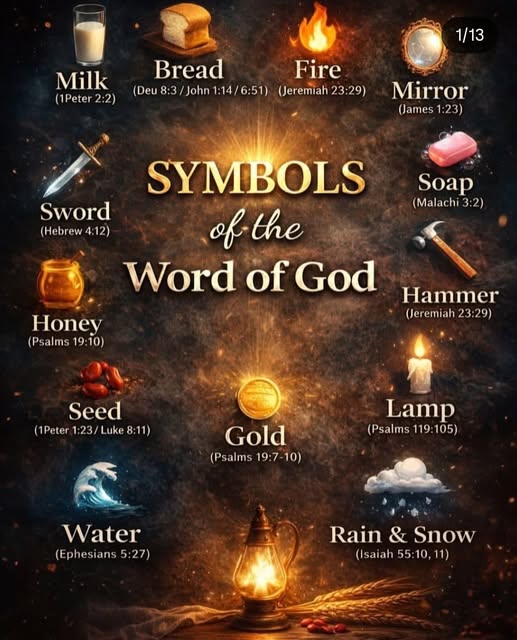
Symbols in the Word of God = Mirror
In 1 Corinthians 13:8–13, the apostle Paul compares the Christian virtue of love to other highly prized spiritual gifts and finds them all lacking. Love is uniquely superior (verse 8). As Christians, we share in giving and receiving the grace of God’s love (see 1 John 4:8, 16). This earthly experience of God’s divine love gives us a taste of His perfect grace and glory. Through the love of Christ poured into our hearts (see Ephesians 3:17; Romans 5:5), we participate to a limited degree in the full perfection we will know and enjoy when we stand in God’s presence in eternity: “For now we see in a mirror dimly, but then face to face. Now I know in part; then I shall know fully, even as I have been fully known” (1 Corinthians 13:12, ESV).
Paul explains that spiritual gifts like prophecy, tongues, and knowledge are temporary and partial. Eventually, they “will become useless. But love will last forever! Now our knowledge is partial and incomplete, and even the gift of prophecy reveals only part of the whole picture! But when the time of perfection comes, these partial things will become useless” (1 Corinthians 13:8–10, NLT). In our current state of existence, the gifts of the Holy Spirit are valuable to us and to the church, but their worth will run out when we are face to face with the Lord in heaven. These gifts only give us an obscured, unfinished picture of our spiritual reality, and they will ultimately pass away.
Paul uses two illustrations to explain this truth. First, he employs the example of a child maturing into adulthood: “When I was a child, I talked like a child, I thought like a child, I reasoned like a child. When I became a man, I put the ways of childhood behind me” (1 Corinthians 13:11). Right now, we are like children playing with plastic toys that will wear out and become unusable. One day we will trade them in for the enduring, grown-up, perfection of eternity. Second, Paul contrasts looking at someone in a dull, dimly lit mirror with meeting that person face to face. In the Greco-Roman world, mirrors were fashioned out of polished metal discs that reflected a blurred, imperfect image, nothing like seeing someone up close, in vivid, eye-to-eye clarity.
Thus, now we see in a mirror dimly is Paul’s figure of speech for “now we have imperfect knowledge and understanding.” The New Living Translation renders the imagery like so: “Now we see things imperfectly, like puzzling reflections in a mirror, but then we will see everything with perfect clarity. All that I know now is partial and incomplete, but then I will know everything completely, just as God now knows me completely” (1 Corinthians 13:12, NLT). Flawless understanding and unrestricted knowledge of matters pertaining to God and His kingdom will only be achieved when we meet Jesus Christ in person.
The apostle John affirms that our knowledge of Jesus is partial now but will become clear when we see Him face to face: “Dear friends, we are already God’s children, but he has not yet shown us what we will be like when Christ appears. But we do know that we will be like him, for we will see him as he really is” (1 John 3:2, NLT).
Within the Scriptures, we have the complete revelation of God, but our understanding of it remains limited (see 1 Corinthians 8:1–3). As we grow in the faith, we undergo a process of spiritual maturation as individual believers (2 Peter 3:18) and together as the body of Christ (Ephesians 4:11–16). Paul calls this progressive development toward Christian maturity “the upward call of God in Christ Jesus” (Philippians 3:14, ESV). It is our heavenward journey of intimate fellowship with Jesus Christ.
Along the way, we must stay laser-focused on Jesus, who is the trailblazing forerunner of our quest (Hebrews 12:1–2). He demonstrates the way through His perfect obedience to the Father (John 4:34; 5:30; Luke 22:42). As the Author and Perfecter of our faith, He not only inspires us, but Christ also empowers us to grow toward our heavenly stature. He starts the good work in us and “will carry it on to completion until the day of Christ Jesus” (Philippians 1:6).
In the meantime, until the Lord returns or we reach heaven, we have limited understanding and knowledge—we see in a mirror dimly. But one day our onward and upward growth in ever-increasing degrees of Christian maturity will culminate in heavenly perfection as “we bear the image of the heavenly man” (1 Corinthians 15:49).

Bible Verse and Prayer for Today
The Lord your God is God; he is the faithful God, keeping his covenant of love to a thousand generations of those who love him and keep his commands.
—Deuteronomy 7:9
God is faithful to his promises and his people. He fulfilled every promise with a great “Amen!” in Jesus Christ (2 Corinthians 1:18-20). His covenant is far more than a set of agreements between a god and his people. God’s covenant with us is a covenant of love. He will not forsake us or abandon us (Hebrews 13:5-6; Romans 8:32-39). He will treat us better than we deserve, just as a loving parent treats a rebellious child better than she or he deserves. We must tune our hearts to beat in honor of God as our God. We must not treat him as a good luck charm, a bellhop to bring us our every wish, or our weekly guest we occasionally invite to visit in the margins of our otherwise busy lives. What we do must be done with an awareness and intention that what we have done has been done before him, to honor him! As we do these things, God is faithful. He will uphold his covenant to love us, forgive us, restore us, and empower us until he brings us home to be with him.
Prayer
Faithful God, thank you for loving me so sacrificially and steadfastly. Thank you for keeping your promises to the Israelites and for bringing Jesus just as you promised. I trust your promise to send him back to bring me home to you. Until then, please receive the deeds and words of this day as my thanks to you for your covenant of love with me and those who love Jesus. In the name of Jesus, your gift of love, I pray. Amen and Amen
Bible Teaching of the Day
a Mirror Meeting called a Face to Face Meeting :
First Corinthians 13 is one of the most famous passages in the New Testament. It is often referred to as the “Love Chapter” because it illustrates a biblical understanding of love. It’s in this chapter that Paul speaks of a time when “we shall see face to face” (1 Corinthians 13:12).
In 1 Corinthians 13:1–3, Paul argues that love surpasses all spiritual gifts. Even the greatest spiritual gift is worthless without love.
In 1 Corinthians 13:4–7, Paul describes the characteristics of love. These characteristics emphasize the importance of putting the interests of others above our own (cf. John 15:13; Philippians 2:14).
In 1 Corinthians 13:8–12, Paul speaks to the temporary nature of spiritual gifts and the hope that Christians have for a full, complete, and intimate knowledge of God in the future. This section reminds us that spiritual gifts such as speaking in tongues and prophesying are not eternal. Love, however, is eternal and will never fail (verse 8 and verse 13). Therefore, love is what truly matters.
This section also speaks to the limitations of human understanding. Because of sin and human finitude, we can only know and prophesy in part (1 Corinthians 13:9). Currently, we cannot understand God’s ways (Romans 11:33), nor can we fathom the depths of His love (Ephesians 3:17–19). But when Christ returns, sin will disappear and we will finally see God face to face (1 Corinthians 13:12).
The expression face to face appears in 1 Corinthians 13:12. The full verse reads, “For now we see only a reflection as in a mirror; then we shall see face to face. Now I know in part; then I shall know fully, even as I am fully known.” The event described in this verse is often referred to as the “Beatific Vision” (to see God as He is), promised to Christians when Christ returns: “We know that when Christ appears, we shall be like him, for we shall see him as he is” (1 John 3:2). In our present state, however, we only have an indirect and imperfect knowledge of God’s infinite wisdom, glory, and love. Thus, we cannot see God as He is.
Paul compares our present knowledge of divine things to a dark reflection in a mirror. In New Testament times, a mirror was formed from polished metal, which could only reflect a dim and imperfect image. Yet Paul promises that God will exchange our dim images for a face-to-face encounter with Himself. On that glorious day, the light of God will shine upon us, and we will be free from all darkness. imperfection, and error. We will know Him fully, even as we are fully known by Him. This mutual recognition and understanding is the epitome of a deeply intimate relationship.
The beatific vision has roots in the Old Testament (Genesis 32:20; Exodus 33:11; Deuteronomy 34:10). In Exodus 33:18–23, Moses asks to see God’s glory, but God tells Moses that no one can see His glory and live. However, God allows Moses to see His back, but not Him in His entirety (that is, in His full glory).
In Matthew 5:8, Jesus promises that the pure in heart will see God. Jesus can make this promise because He is the only one who has seen the Father (John 1:18), and whoever has seen Jesus has seen the Father (John 14:9). Jesus is the “radiance of God’s glory and the exact representation of His being” (Hebrews 1:3). And when He returns, we will behold the fullness of God’s glory. On that day, we will see God as He truly is.
This hope for a face-to-face encounter with God gives Christians peace and comfort, even in difficult circumstances. When this life comes to an end, we will see and be seen by the One who loved us enough to die for us (John 3:16; Romans 5:8).
Today’s Devotional
One person says, “Salvation is by grace and grace alone.” Another person counters, “That idea leads to lawlessness. God’s righteous standard in the Law must be upheld.” And someone else chimes in with, “Salvation is by grace, but grace only comes to those who obey God’s Law.” At the root of the debate are differing views on the basis of salvation. The importance of the issue helps fuel the intensity of the discussion.
When the Bible speaks of “the law,” it refers to the detailed standard God gave to Moses, beginning in Exodus 20 with the Ten Commandments. God’s Law explained His requirements for a holy people and included three categories: civil, ceremonial, and moral laws. The Law was given to separate God’s people from the evil nations around them and to define sin (Ezra 10:11; Romans 5:13; 7:7). The Law also clearly demonstrated that no human being could purify himself enough to please God—i.e., the Law revealed our need for a Savior.
By New Testament times, the religious leaders had hijacked the Law and added to it their own rules and traditions (Mark 7:7–9). While the Law itself was good, it was weak in that it lacked the power to change a sinful heart (Romans 8:3). Keeping the Law, as interpreted by the Pharisees, had become an oppressive and overwhelming burden (Luke 11:46).
It was into this legalistic climate that Jesus came, and conflict with the hypocritical arbiters of the Law was inevitable. But Jesus, the Lawgiver, said, “Do not think that I have come to abolish the Law or the Prophets; I have not come to abolish them but to fulfill them” (Matthew 5:17). The Law was not evil. It served as a mirror to reveal the condition of a person’s heart (Romans 7:7). John 1:17 says, “For the law was given through Moses; grace and truth came through Jesus Christ.” Jesus embodied the perfect balance between grace and the Law (John 1:14).
God has always been full of grace (Psalm 116:5; Joel 2:13), and people have always been saved by faith in God (Genesis 15:6). God did not change between the Old and New Testaments (Numbers 23:19; Psalm 55:19). The same God who gave the Law also gave Jesus (John 3:16). His grace was demonstrated through the Law by providing the sacrificial system to cover sin. Jesus was born “under the law” (Galatians 4:4) and became the final sacrifice to bring the Law to fulfillment and establish the New Covenant (Luke 22:20). Now, everyone who comes to God through Christ is declared righteous (2 Corinthians 5:21; 1 Peter 3:18; Hebrews 9:15).
The conflict between Jesus and the self-righteous arose immediately. Many who had lived for so long under the Pharisees’ oppressive system eagerly embraced the mercy of Christ and the freedom He offered (Mark 2:15). Some, however, saw this new demonstration of grace as dangerous: what would keep a person from casting off all moral restraint? Paul dealt with this issue in Romans 6: “What shall we say, then? Shall we go on sinning so that grace may increase? By no means! We are those who have died to sin; how can we live in it any longer?” (verses 1—2). Paul clarified what Jesus had taught: the Law shows us what God wants (holiness), and grace gives us the desire and power to be holy. Rather than trust in the Law to save us, we trust in Christ. We are freed from the Law’s bondage by His once-for-all sacrifice (Romans 7:6; 1 Peter 3:18).
There is no conflict between grace and the Law, properly understood. Christ fulfilled the Law on our behalf and offers the power of the Holy Spirit, who motivates a regenerated heart to live in obedience to Him (Matthew 3:8; Acts 1:8; 1 Thessalonians 1:5; 2 Timothy 1:14). James 2:26 says, “As the body without the spirit is dead, so faith without deeds is dead.” A grace that has the power to save also has the power to motivate a sinful heart toward godliness. Where there is no impulse to be godly, there is no saving faith.
We are saved by grace, through faith (Ephesians 2:8–9). The keeping of the Law cannot save anyone (Romans 3:20; Titus 3:5). In fact, those who claim righteousness on the basis of their keeping of the Law only think they’re keeping the Law; this was one of Jesus’ main points in the Sermon on the Mount (Matthew 5:20–48; see also Luke 18:18–23).
The purpose of the Law was, basically, to bring us to Christ (Galatians 3:24). Once we are saved, God desires to glorify Himself through our good works (Matthew 5:16; Ephesians 2:10). Therefore, good works follow salvation; they do not precede it.
Conflict between “grace” and the “Law” can arise when someone 1) misunderstands the purpose of the Law; 2) redefines grace as something other than “God’s benevolence on the undeserving” (see Romans 11:6); 3) tries to earn his own salvation or “supplement” Christ’s sacrifice; 4) follows the error of the Pharisees in tacking manmade rituals and traditions onto his doctrine; or 5) fails to focus on the “whole counsel of God” (Acts 20:27).
When the Holy Spirit guides our search of Scripture, we can “study to show ourselves approved unto God” (2 Timothy 2:15) and discover the beauty of a grace that produces good works.
Bible Prophecy, Signs of the Times and Gog and Magog Updates with Articles in the News
The Quiet Compromise: Christian Colleges’ Growing Ties To The Abortion Industry

For generations, Christian parents have sacrificed, saved, and prayed so their children could attend universities that claim to be grounded in biblical truth. These schools promise something rare in modern higher education: a place where faith is not mocked but nurtured, where Scripture shapes the worldview of the next generation.
Yet a shocking new report suggests that many institutions bearing the name of Christ have quietly compromised one of the most fundamental teachings of the Christian faith — the sanctity of human life.
According to a new nationwide study, one in seven Christian colleges and universities in the United States now has some form of connection to the abortion industry. For many believers, that statistic is almost unthinkable. But the numbers are real, and they raise serious questions about what “Christian” actually means in the context of modern higher education.
The findings come from the 2025 Christian Schools Project conducted by the Demetree Institute for Pro-Life Advancement. Researchers examined 725 colleges and universities affiliated with denominations that publicly claim a historic Christian foundation. These were not secular schools with religious roots buried somewhere in the distant past. These institutions actively present themselves as faith-based.
Yet the study found that 114 of those schools maintain ties to abortion providers, most commonly through connections with Planned Parenthood, the nation’s largest abortion provider. These connections vary in form but include promoting internships with abortion organizations, listing them as healthcare resources for students, advertising their events, or incorporating their materials into coursework.
Perhaps most disturbing is that the problem is growing — not shrinking.
Researchers found that support for Planned Parenthood or similar abortion-linked services at Christian colleges has increased nearly 20 percent since 2022, the year the U.S. Supreme Court overturned Roe v. Wade and returned abortion laws to the states.
In other words, while many Christians celebrated the historic pro-life victory that ended federal protection for abortion, some institutions that claim to represent Christian values moved in the opposite direction.
For believers who view abortion not simply as a political issue but as a profound moral tragedy, the implications are staggering.
Christians have historically taught that every human life is created in the image of God and therefore possesses inherent dignity and worth. Scripture repeatedly affirms God’s intimate involvement in the creation of life in the womb. To many faithful believers, abortion represents the deliberate destruction of that life — the killing of an innocent child.
From that perspective, the idea that a Christian university might direct students toward abortion providers for internships or healthcare resources represents not just institutional drift but moral collapse.
The report also reveals where many of these compromises are concentrated.
Among the denominations surveyed, Methodist-affiliated institutions accounted for the largest share of infractions, representing nearly 37 percent of all violations identified in the report. Catholic-affiliated schools made up just under 25 percent of infractions, despite the Catholic Church’s longstanding and unequivocal opposition to abortion.
The study graded schools on a scale ranging from A-plus — meaning no ties to the abortion industry and active support for pregnancy resource centers — down to F for institutions with four or more infractions.
Forty-seven schools received failing grades.
One of the most striking examples cited in the report was American University in Washington, D.C., a Methodist-affiliated institution chartered by Congress in 1893. Researchers documented 34 separate infractions, including programs that involved working with Planned Parenthood as part of student service initiatives.
Another example was Hope College in Michigan, affiliated with the Reformed Church in America. The report found 14 infractions, including the listing of abortion counselor as a possible career path for sociology majors.
For many Christians reading these findings, the sense of betrayal is profound.
Parents send their children to Christian colleges trusting that those institutions will reinforce biblical convictions, not undermine them. Donors contribute millions of dollars believing they are supporting schools that will stand firm on foundational moral issues. Churches recommend these universities as safe environments for spiritual and intellectual growth.
Yet in too many cases, the name “Christian” appears to function more as branding than conviction.
The reality is that many universities founded by Christians have gradually drifted from their roots. Some still maintain religious language in their mission statements while quietly adopting the moral framework of the surrounding culture.
And nowhere is that tension morevisible than on the issue of abortion.
Yet the report also includes signs of hope.
The number of schools receiving A-plus grades increased nearly 14 percent between 2024 and 2025, suggesting that many institutions are taking steps to strengthen their pro-life commitments.
Some universities have created on-campus housing for pregnant students, partnered with pregnancy resource centers, or actively removed abortion providers from their recommended resources.
In fact, the report notes that roughly 50 ties between Christian colleges and Planned Parenthood were eliminated between 2024 and 2025 after awareness efforts brought attention to the issue.
Those victories show that change is possible when believers pay attention and hold institutions accountable.
But they also highlight a larger lesson for Christian families.
Choosing a college should never be based on the word “Christian” alone.
Parents and students must look deeper. They must examine whether a school truly upholds biblical teachings in practice — not just in marketing brochures. What organizations does the school partner with? What worldview is being taught in classrooms? What moral vision shapes campus life?
These questions matter because college is not just an academic experience. It is one of the most formative seasons in a young person’s life.
Students will leave campus not only with degrees but with convictions that will shape their families, careers, and faith for decades to come.
For Christians who believe that every life in the womb matters to God, the stakes could not be higher.
A university that quietly normalizes abortion while claiming the name of Christ is not simply failing academically or administratively. It is failing spiritually.
And for the next generation of Christian leaders, that failure carries consequences far beyond the classroom.
Record ‘Nones’ In America – Could War Trigger A Spiritual Awakening?

A generation that once felt it could live comfortably without faith may suddenly be rediscovering just how fragile the world really is.
For decades, sociologists have tracked a quiet but dramatic shift in American life. Religion — once the beating heart of communities across the country — has slowly been moving to the margins. The latest numbers suggest that trend has now reached a historic milestone.
According to new data from Gallup, Americans with no formal religious identity — often called the “nones” — now make up 24% of the U.S. population, the highest level ever recorded. Just a few generations ago, that number was almost unimaginable. In 1948, only 2% of Americans identified this way.
At the same time, the poll reveals another striking reality: only 47% of Americans say religion is “very important” in their lives. That number once stood between 70% and 75% during the 1950s and 1960s, a time when faith shaped not just private belief but the moral vocabulary of the entire nation.
Today, the landscape looks very different. Millions of Americans describe themselves as spiritual but not religious, skeptical of organized religion, or simply indifferent. For many, life feels busy, comfortable, and stable enough that deeper spiritual questions can wait.
But history has a way of interrupting that sense of security.
And as tensions rise in the Middle East — particularly with the growing conflict involving Iran — the world suddenly feels far less predictable than it did just a few years ago.
Moments like this often awaken questions people thought they had moved beyond.
Here are ten reasons why the rise of global uncertainty may lead some of the “nones” to reconsider their spiritual outlook.
- War Has a Way of Reminding Us How Fragile Life Really Is
Most of us live day-to-day assuming tomorrow will look much like today. We plan vacations, build careers, raise families, and assume the world will keep humming along.
War shatters that illusion.
When nations move toward conflict, when energy markets shake, and when headlines carry the language of missiles and mobilization, we’re reminded of something humanity has always known but often tries to forget: life is fragile. In those moments, the question of whether there is something — or Someone — beyond this world suddenly feels far more important.
- The Darkness of Human Nature Becomes Harder to Ignore
Modern culture often teaches that people are basically good and that progress will eventually smooth out the rough edges of history.
Yet war keeps exposing something darker.
Nations still threaten each other. Leaders gamble with lives. Violence erupts even in an age of incredible education and technological progress.
Christianity has always explained this reality through the idea of a fallen human nature — that something deep inside us is broken. When conflict erupts again and again despite humanity’s progress, that ancient explanation begins to feel less like theology and more like simple honesty.
- Crisis Has Always Sparked Spiritual Searching
History shows that when the ground begins to shake beneath society, people instinctively start searching for something deeper.
After the attacks of September 11, churches across America filled with people who hadn’t attended in years. During the Cold War, faith became a stabilizing force for millions living under the shadow of nuclear tension.
Comfort often dulls spiritual curiosity. Crisis tends to awaken it.
- The Middle East Keeps Pulling the World Back
Many Americans rarely think about the Middle East — until suddenly it dominates every headline.
Conflicts involving Iran, Israel, and neighboring nations seem to pull global attention back to the same region again and again.
For Christians, that reality carries another layer of meaning. Much of the Bible’s history — and many of its prophetic passages, including those in the book of Ezekiel — revolve around this very region. Even those who once dismissed such discussions may find themselves wondering whether history has deeper patterns than we once assumed.
- War Forces Us to Talk About Right and Wrong Again
In peaceful times, it’s easy to believe that morality is simply a matter of personal opinion.
But war doesn’t allow that luxury.
When nations invade, when civilians are threatened, and when global leaders debate justice and retaliation, people instinctively start speaking in moral terms again. Words like evil, justice, and responsibility return to public conversation.
And those words have always lived most naturally inside a moral framework shaped by faith.
- Politics Suddenly Looks Smaller Than We Thought
Many Americans have placed enormous faith in political systems to solve humanity’s problems.
Yet time and again, global conflict reminds us that governments are limited. Diplomacy fails. Alliances fracture. Leaders make decisions that send shockwaves around the world.
When political solutions fall short, people oftenbegin asking whether something greater must ultimately anchor hope.
- The Questions We Tried to Ignore Come Back
When the world feels safe, it’s easy to push aside life’s biggest questions.
What happens after death?
Is history moving toward some purpose?
Is there a God guiding the story of humanity?
But when the future suddenly feels uncertain, those questions come rushing back.
Many “nones” may not have rejected these questions as much as they simply postponed them.
- Faith Communities Offer Something Modern Culture Often Cannot
One thing crises reveal is how deeply people need community.
Churches and faith groups historically become places where people gather, pray, share resources, and comfort one another during uncertain times. They provide meaning when headlines feel overwhelming.
In a culture that increasingly celebrates individualism, that kind of spiritual community can suddenly feel incredibly valuable.
- The World Still Revolves Around a Very Ancient Story
Despite all our technological advancement, humanity still finds itself drawn back to the same ancient lands and conflicts that shaped biblical history.
That alone doesn’t prove anything spiritually. But it does raise a fascinating question: why does so much of world history keep circling back to the very places Scripture placed at the center of its story?
For some observers, that question alone is enough to spark deeper curiosity.
- Crisis Reveals the Limits of a Material-Only Life
Modern culture has largely promised that happiness comes through comfort, success, and technological progress.
Yet war reminds us how quickly those things can shake. Markets fall. Energy supplies tighten. Stability suddenly looks far less permanent.
When the foundations of everyday life begin to tremble, people often rediscover something their grandparents understood well: material success alone cannot answer the deepest questions of the human heart.
The rise of the “nones” tells an important story about modern America. Many people have drifted away from organized religion, often quietly and gradually.
But history suggests something else as well.
Moments of global uncertainty have a way of reopening spiritual conversations that once seemed settled.
And as the world watches tensions involving Iran unfold, millions of Americans who once felt comfortable living without faith may find themselves asking an unexpected question again:
What if the spiritual questions we set aside were actually the most important ones all along?
Iran warns: No oil exports from the Middle East until war ends

Gulf officials warn continued attacks on energy facilities could devastate the global economy.
Iran vowed to continue disrupting the global energy market, warning that not a “single liter” of oil would be exported from the region until the fighting with the United States and Israel ends.
The Islamic Republic “will not allow the export of even a single liter of oil from the region to the hostile side and its partners until further notice,” a spokesman for the Islamic Revolutionary Guard Corps (IRGC) said in a statement Tuesday.
The spokesman, Ali Mohammad Naeini, added that “attempts to reduce and control oil and gas prices will be temporary and ineffective.”
Naeini stressed that “trade in wartime conditions is subject to security considerations.”
Since the outbreak of the war, Iran has attacked oil infrastructure in neighboring Gulf countries and closed the Strait of Hormuz, a major chokepoint for global oil exports. About 25 percent of the world’s oil travels through the maritime passage each year. The blockade of the route, along with attacks on refineries and oil reserves, has sent energy prices soaring.
According to a CNN report, Iran has recently begun laying mines in the Strait of Hormuz after launching drone attacks on oil tankers passing through the area.
Satellite images reveal Iran shoring up Isfahan nuclear facility’s defenses
Qatari Foreign Ministry spokesman Majed Al-Ansari warned that “the attacks on energy facilities, which have also happened on both sides, are a dangerous precedent.”
Al-Ansari stressed that “what is happening right now is going to have grave consequences for the international economy.”
Last Saturday, Israel struck Iranian oil infrastructure. The attack sparked backlash from American officials, who called on the Jewish state to refrain from doing so again in the future.
Sen. Lindsey Graham, who has long pushed for a war against Iran, wrote on X that while he supports Israel’s military actions, attacks on Iran’s oil facilities must stop.
Graham said those oil reserves could help bring prosperity to a future free Iran after the Islamic regime is toppled.
TruLight Ministries Daily Entertainment

TruLight TV : and Kingdom Kidz TV = Godly Character
Mike and Chef Elaine teach Claire about godly character on Apple Pie Day at Konnect HQ. And Later we meet Nicolai, a 13-year-old from Norway, who is learning to help his family herd reindeer. In this episode we learn that even when life seems scary, God is good! This and some stunning kids’ songs. Enjoy!
Today on TruLight Radio XM
TruLight Radio XM 24/7
Program
GMT / UTC +2
Monday To Fridays
00:15 Words to Live By Testimonies
01.15 Science Scripture and Salvation
02.15 Ground Works
04.00 Gospel Concert of the Day
05.00 The Daren Streblow Comedy Show
5:55 It is Today devotional
6:00 Gaither Homecoming Morning Show
7:15 Discover the Word
8.15 Destined for Victory
8:55 Science Scripture and Salvation
9:00 Holy Spirit Hour – Normally Sermons
10:15 Hope of the Heart
11:15 Unshackled
11.45 Words to Live By
12:15 Truth for Life
13:15 Living on the Edge with Chip Ingram
14:15 Focus on the Family
15:00 Kids Hour
16:00 In Touch with Dr. Charles Stanley
16:30 Groundwork
17:15 Live in the Light
18:15 Renewing your Mind
19:00 Gaither Homecoming Show
20:15 Growing Hope
21:15 Adventures in Odyssey Radio Drama
21:45 Bible Reading
22:15 Night-sounds
23.00 Good Old Country Gospel / Rhema Gospel Express
VISIT THE WEBSITE
TruLight Ministry News
TruLight Ministries orders from God since 2012 . Teach Them , Comfort Them and Warn Them!
We Starting , the 1st May 2026 . with Our Preachers Diploma Online Platform – TruTheology.co.za . 36 Subjects with between 10 to 15 Lessons per Subject , equivalent to a 3 Year Theology Degree , The Training is Free to Approved Members and Tests Online after Each Lesson , You Determine the Speed of Your Studies . If you are interested registrations will take place from 1 April 2026 .
Healing Truths
End Time Articles
Bonus Teaching for the Child of God !!
Today, you and I must ask ourselves the following questions: “Are we willing to stand for Jesus? Are we willing to stand for righteousness and holiness? Are we willing to stand and be counted?” When Jesus sent us into the world, He did not say it would be easy. He did not say we would not be condemned. He did not say our lives would be safe. But He promised that He would never leave us or forsake us. (Hebrews 13:5) And, because of that promise, we can say fearlessly, “The Lord is my helper; I will not fear; what can man do to me?” (Hebrews 13:6)
When we said yes to Jesus, we also placed the obligation on ourselves to also say no. We are now obligated to say no to the works of the flesh, namely adultery, fornication, impurity, licentiousness; idolatry, sorcery, enmity, strife, jealousy, fits of anger, envy, dissensions, factions; envy, murder, drunkenness, revelries, and the like. (Galatians 5:19-21)
This brings me to the following: Jesus said to Satan, “Get thee hence, Satan! for it is written, Thou shalt worship the Lord thy God, and him only shalt thou serve.” (Matthew 4:10) Jesus also said, “No man can serve two masters: for either he will hate the one, and love the other; or else he will be devoted to the one, and despise the other.” (Matthew 6:24)
When Joshua cried out and said, “Choose ye this day whom ye will serve!” the people answered, “Far be it from us that we should forsake the LORD to serve other gods.” When Daniel had to choose between betraying God and being thrown into the lions’ den, he chose to serve God. When Shadrach, Meshach, and Abednego had to choose, they chose God and were thrown into a fiery furnace. Daniel, Shadrach, Meshach, and Abednego were saved by God, but not everyone was so lucky. Stephen was stoned to death (Acts 7) while John was beheaded. (Mark 6) But even in their death, God was glorified. As Paul said, “For to me, to live is Christ, and to die is gain.” (Philippians 1:21)
Today, you and I have an opportunity to stand up and be counted. Today, you and I must choose between God and the devil. Let me be clear: Any person who celebrates “Halloween” is turning their back on God, forsaking Jesus, and worshipping the devil. Today can be your day of reformation where you stand up for Jesus or you can open the doors wide open for the devil. Now some may say that this is just fun. And then I just ask how much fun it will be when Jesus says, “Depart, I never knew you.” Remember these words of Jesus: “Everyone who acknowledges me before men, the Son of Man will also acknowledge before the angels of God. But he who denies me before men will be denied before the angels of God.” (Luke 12:8-9)
We are warned: “Be sober, be vigilant; because your adversary the devil, as a roaring lion, walks about, seeking whom he may devour. Resist him, steadfast in the faith, knowing that the same sufferings are being experienced by your brothers in the world.”
But we are also promised: “And the God of all grace, who called us to his eternal glory in Christ Jesus, after we have suffered a little while, make you perfect, establish, strengthen, establish you!” (1 Peter 5: 8-10)
Today I invite you to sing: “I have made my decision. I have staked my claim. I have drawn a line in the sand and I’ll not be ashamed. With the world behind me and the cross before, by the grace of God I will serve the Lord” (From the song “Serve the Lord” by Carman)
Share this Feeding of Manna with your Friends and Family. just click on the Social Media icon and share !