26/02/2026 Prophetic Date
Hosted by TruLight Ministries – The Place of Truth
SELECT YOUR READING LANGUAGE – BOTTOM LEFT = YOUR DAILY MANNA NOW AVAILABLE IN 103 LANGUAGES
a New Study : for the Next 8 Daily Manna Days
In My Control vs Out of My Control
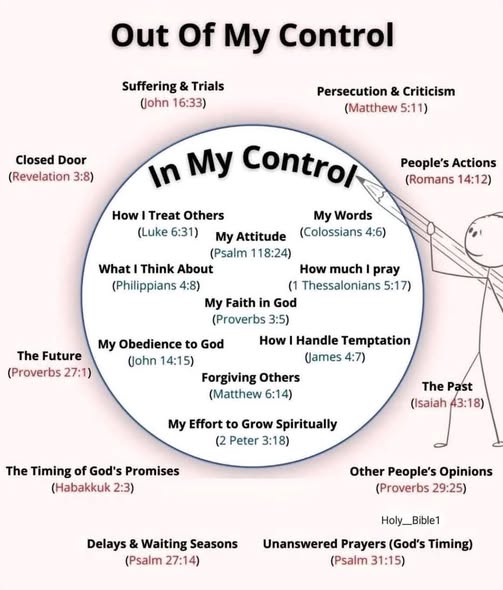
Out of My Control = People’s Actions
Often, when we are annoyed by someone’s actions, words, or behavior, it is because that person has failed to understand or use a social cue that we think is obvious. The person either cannot or will not interpret the situation correctly and then proceeds to say or do something we see as annoying.
Different people have different “triggers” for what annoys them. Some people are annoyed by bad grammar; others are annoyed by those who correct bad grammar. But there are some behaviors that many, if not most, people find annoying: using one’s cell phone during a face-to-face conversation, talking during a movie, humming to oneself, exhibiting poor table manners, invading others’ personal space, being late, picking one’s teeth in public, and making all conversations about oneself. There’s nothing particularly harmful about such behaviors; they’re just annoyances. But what’s a believer to do when encountering people who do such things?
First, we must deal with our own reaction to people who annoy us. We cannot control another person’s behavior. We most certainly are called to control our own (2 Timothy 1:7).
Many times, pride is at the root of our annoyance (Proverbs 13:10). We believe that we know better and behave better than the person who is annoying us. Again, we see the social cue, and they do not. We take issue with that person and his or her failure to properly behave.
After an inward check on our hearts (Proverbs 4:23), we must ask the Holy Spirit for help in seeing the person and the situation from His point of view. A fruit of the Holy Spirit is patience (Galatians 5:22–23), and patience is definitely needed when dealing with people who annoy us. We are called to love (John 13:35), compassion, kindness, humility, and gentleness (Colossians 3:12–13). These attributes should guide our response to all people, including those who annoy us.
There were several times that the disciples wanted to prevent people from “annoying” Jesus. At various times, children, a blind man, a Samaritan woman, and a prostitute with perfume wanted to interact with Jesus, and the disciples or others desired to prevent them from “bothering” the Lord. But Jesus was not annoyed. He never put social norms above loving the person in front of Him (Matthew 19:13; John 4; Luke 7:36–39; Luke 18:35–42).
When someone annoys us, we must first check our hearts and then ask the Holy Spirit for help in reflecting Jesus Christ to others (2 Corinthians 6:3–10). If “love covers over all wrongs” (Proverbs 10:12), then love can surely cover annoyances.

Bible Verse and Prayer for Today
Love the Lord your God with all your heart and with all your soul and with all your mind. This is the first and greatest commandment. And the second is like it: Love your neighbor as yourself.
—Matthew 22:37-39
Some things are just not complicated to understand. However, that doesn’t mean putting them into practice is easy for me. Jesus was clear in what he said. Living for God can be boiled down to two principles:
Loving God with everything I am and have.
Loving others and treating them as I would like to be treated.
Those principles are certainly not too hard to understand. It’s the living of them that is our challenge. So, let’s not just understand these two principles of love; let’s live them out in our daily lives:
Love the Lord your God with all your heart and with all your soul and with all your mind. … Love your neighbor as yourself.
Prayer
Dear Father, the one true and living God, please accept the work of my hands, the words of my mouth, the moments of my rest, and the love of my heart as my worship to you this day. I pray that these are pleasing and refreshing to you as I seek to live out your two love commands in my life today. In the name of your Son, the Lord Jesus, I pray. Amen and Amen

Bible Teaching of the Day
Part of growing up is taking responsibility for oneself. We start as infants with no personal responsibility whatsoever—everything that we need done is done for us. As we progress through the various stages of childhood, we take on more and more responsibility. We learn to tie our own shoes, clean our own rooms, and turn in our own homework. We learn that responsibility has its rewards—and irresponsibility has other, less-than-desirable effects. In many ways, the difference between a child and a man is his willingness to take personal responsibility for his actions. As Paul says, “When I became a man, I put the ways of childhood behind me” (1 Corinthians 13:11).
The Bible teaches the concept of personal responsibility: “The one who sins is the one who will die. The child will not share the guilt of the parent, nor will the parent share the guilt of the child. The righteousness of the righteous will be credited to them, and the wickedness of the wicked will be charged against them” (Ezekiel 18:20). Personal responsibility is closely related to the law of sowing and reaping (Galatians 6:7–8). “Tell the righteous it will be well with them, for they will enjoy the fruit of their deeds. Woe to the wicked! Disaster is upon them! They will be paid back for what their hands have done” (Isaiah 3:10–11).
The commands of the Old Testament were attached to blessings for obedience and penalties for disobedience; in other words, the Law emphasized the responsibility of individuals to respond in morally appropriate ways to God’s revealed truth. God clearly defined right and wrong, and His people were expected to do what was right. This has been the case ever since the Garden of Eden, when Adam was given a specific command and expected to obey it. Later, Adam’s son Cain was warned by God that he would be held personally responsible for his actions (Genesis 4:7).
Achan was held responsible for his sin at Jericho (Joshua 7:14–15). Jonah was held responsible for his choice to run from the Lord (Jonah 1:7–8). The Levites were held responsible for the care of the tabernacle (Numbers 18:5). The deacons of the early church took personal responsibility for meeting some practical needs of the church (Acts 6:3). Paul was given the responsibility to blaze a gospel trail to the Gentiles (Ephesians 3:2).
The Bible expects us to take personal responsibility in all areas of life. Able-bodied people should work for their food. “The one who is unwilling to work shall not eat” (2 Thessalonians 3:10). Men are to take responsibility for providing for their households (1 Timothy 5:8).
At times, people try to avoid personal responsibility, usually through blame-shifting. Adam tried to blame Eve for his sin (Genesis 3:12). Cain tried to dodge responsibility (Genesis 4:9). Pilate attempted to absolve his guilt in the matter of the crucifixion of Christ: “‘I am innocent of this man’s blood,’ he said. ‘It is your responsibility!’” (Matthew 27:24). Ultimately, attempts to pass the buck are futile. “You may be sure that your sin will find you out” (Numbers 32:23).
Each one of us has the personal responsibility to “repent and believe the good news” (Mark 1:15) and then to glorify the Lord with good works (Ephesians 2:10). “Whoever has the Son has life; whoever does not have the Son of God does not have life” (1 John 5:12). Those who choose to reject the truth of God “are without excuse” (Romans 1:20). We cannot evade our personal responsibility to exercise faith in Christ.
Today’s Devotional
People-pleasing is the motivational force that drives a person to make decisions based solely on the level of approval they believe they will receive. Related to people-pleasing are codependency and enabling; within a biblical framework, people-pleasing borders on idolatry.
People-pleasers have learned that it feels good to be liked by others, so they steer their words and actions in the direction that offers the most approval. On the surface, people-pleasers appear to be selfless, kind, and generous. However, beneath the surface, they are desperately insecure and believe that approval equals value. They eventually find that trying to please people all the time is not only exhausting, it is impossible. Some people-pleasers may start manipulating relationships and situations in order to gain the rush of satisfaction associated with creating pleasant responses in others. So the term people-pleaser is actually a misnomer. People-pleasers strive to please everyone because they are trying to please themselves.
Some people, by nature, are more prone to people-pleasing. Compliant, sensitive types are often keenly aware of the responses of other people, so they gauge words and choices to avoid negative feedback. Sometimes they view this trait as positive, comparing their people-pleasing with the selfless actions of the Lord Jesus Christ (see Acts 10:38). However, the difference between Jesus’ unselfish service and the actions of a people-pleaser is motive. Jesus lived to glorify and obey His Father (John 8:29). He loved, gave to, and served people, but He was also not afraid to say what needed to be said, even when people got angry. He often rebuked people in public for their hypocrisy and lack of faith (e.g., Matthew 23:15). He seemed to care little about how well His audience would receive His words. He spoke exactly what needed to be said, even when it led to His death (Mark 15:1–2; John 18:37). Jesus was the opposite of a people-pleaser.
We can take steps to stop a habit of pleasing people by first acknowledging it as sin. When our guiding force is popularity, we have switched gods, and that is idolatry. When we allow anything to control us other than the Holy Spirit, our hearts have erected a shrine to a competing god (Ephesians 5:18; Galatians 5:16, 25). Seeking praise from fallible human beings rather than seeking God’s approval is a slippery slide into error. John 12:43 tells us that, even in Jesus’ day, some people believed His message but refused to follow Him because “they loved the praise of men more than the praise of God.” People-pleasing can lead to eternal separation from God when we allow it to dictate our choices.
Once we recognize our people-pleasing inclinations as sin and repent of them, we must find an alternate motivation. First Corinthians 10:31 tells us that our motive in everything should be to glorify God. When we develop an intimate relationship with Him through saving faith in Jesus, He becomes our focus. We switch allegiance from self-worshiping to God-worshiping. Our goal is no longer pleasing ourselves but pleasing Him (Colossians 1:10). We find great freedom when we break the vise-like grip that people-pleasing has on our lives. Rather than trying to please a hundred voices, we need listen only to One (John 10:27). At the end of every day, only one question is relevant to a Christian: “Lord, was I as pleasing to you today as I know how?” When the answer is “yes,” we can bask in the pleasure of God. We find our validation in who He says we are.
Another important step in overcoming an addiction to people-pleasing is to guard our hearts against covetousness. Envy feeds people-pleasing when we covet the approval or popularity of someone else. This is most evident in teenagers idolizing rock stars and athletes, but adults are guilty of this, too. People-pleasing based on envy is more prevalent than we realize, and most of us can find traces of it somewhere in our lives.
People-pleasing prevents us from being all God has called us to be. It silences us when we should speak and threatens us when we do speak. An insidious form of people-pleasing in the church today is forecast in 2 Timothy 4:3: “For the time will come when people will not put up with sound doctrine. Instead, to suit their own desires, they will gather around them a great number of teachers to say what their itching ears want to hear.” Preachers whose desire is to draw crowds and sell books cultivate the sin of people-pleasing and call it “ministry.” Drawing crowds is not a sin, but when the motivation is to please people and not God, there is a problem. If the apostles had been people-pleasers, they would never have been martyred for their faith.
We cannot serve two masters (Matthew 6:24). We cannot be fully devoted to the gospel of Christ and also fully devoted to the approval of people. They will not merge. That may be one reason Jesus made discipleship such a narrow road. He said, “If anyone would come after me, he must deny himself, take up his cross daily, and follow me” (Luke 9:23). Part of denying ourselves is crucifying our need to please people and have them like us (1 Thessalonians 2:3–5; Galatians 1:10).
We say with Peter, “We must obey God rather than human beings!” (Acts 5:29). It is not our job to make people happy. Rather, we are to live as the best people we can be, serve the Lord in every way He calls us, die daily to our own selfish desires, and receive our reward from Him (1 Corinthians 4:5). When that is our life goal, we will stop being people-pleasers.

Bible Prophecy, Signs of the Times and Gog and Magog Updates with Articles in the News
F-22 Raptors land in Israel as region stands on brink of war

The aircraft is primarily designed to penetrate contested airspace and neutralize enemy air defenses in the early stages of potential operations.
The United States has deployed a squadron of F-22 Raptor stealth fighter jets to Ovda Airbase in southern Israel, a senior official within U.S. Central Command confirmed Monday evening, in what appears to be part of Washington’s expanding military posture across the Middle East.
The aircraft arrived earlier in the day after transiting from RAF Lakenheath in the United Kingdom, supported by U.S. aerial refueling aircraft, including KC-46 Pegasus and KC-135 Stratotankers. The deployment comes as the United States continues to reinforce forces throughout the region amid rising tensions with Iran and growing concerns over potential escalation.
Stationing American combat aircraft inside Israel is relatively rare, and the deployment of the F-22 — a fifth-generation stealth fighter operated exclusively by the U.S. Air Force — is viewed by defense analysts as a particularly strong signal of readiness. The aircraft is primarily designed to penetrate contested airspace and neutralize enemy air defenses in the early stages of potential operations.
The move unfolds against the backdrop of a massive U.S. military buildup in the Middle East, which already includes multiple aircraft carrier strike groups, additional warships, and expanded air assets positioned within striking distance of Iran.
At the same time, diplomatic efforts remain underway. A third round of talks between U.S. and Iranian negotiators is scheduled for Thursday in Geneva, centered on proposals aimed at reviving a nuclear agreement. However, officials in Washington have indicated that the window for negotiations is narrowing, increasing uncertainty over whether diplomacy can prevent a broader confrontation.
While much of the F-22’s operational capability remains classified, the aircraft is widely regarded as one of the most advanced fighters in the world and has never been exported to allied nations, underscoring the strategic weight of its deployment.
With stealth aircraft, carrier strike groups, and supporting forces now assembled across the region, the military buildup increasingly resembles preparation for action rather than precaution, raising the possibility that a decision point may be approaching.
Stage set for decisive moment in Iran crisis

“This Thursday 26/02/2026 will decide everything – a war or a deal,” a source familiar with the talks told CNN.
As Iranian Foreign Minister Abbas Araghchi and his negotiating delegation departed Tehran en route to Geneva ahead of Thursday’s nuclear talks, a growing sense of urgency began to surround what officials increasingly describe as a decisive moment in the escalating crisis between Washington and Tehran.
The upcoming round of negotiations is widely viewed by diplomats and regional officials as a potential turning point that could determine whether diplomacy survives or the standoff shifts toward confrontation.
A senior Israeli official speaking to Channel 12 warned that expectations for a genuine diplomatic breakthrough remain extremely low.
“It would be the surprise of the year if Iran agrees to a real diplomatic solution,” the official said. “If the regime bends to American demands, it would contradict everything this regime represents.”
The official added that it would be “no less surprising” if Washington agreed to a deal perceived as cosmetic or designed merely to buy time.
Regional assessments appear similarly stark. “This Thursday will decide everything – a war or a deal,” a regional source familiar with the talks told CNN.
Another source cited by the network said that, based on recent discussions with Iranian officials, Tehran does not appear prepared to present proposals materially different from those discussed before Israel’s recent military operation, suggesting limited movement toward compromise.
IAEA chief meets Iranian FM ahead of US nuclear talks in Geneva
At the same time, the head of the United Nations nuclear watchdog issued a stark warning about the narrowing diplomatic window.
International Atomic Energy Agency Director-General Rafael Grossi said the only viable path out of the current crisis remains a negotiated agreement but cautioned that failure of diplomacy could raise the possibility of military action.
Speaking to Colombian outlet RTVC, Grossi said uncertainty surrounding Iran’s nuclear program has intensified because international inspectors have not been able to resume monitoring key nuclear facilities following the recent 12-day conflict.
“The enriched uranium stockpiles could eventually be used to make nuclear weapons,” Grossi said, emphasizing that while this does not prove Iran currently possesses nuclear weapons, the absence of inspections leaves critical questions unanswered.
He warned that Iran’s continued restrictions on IAEA oversight are creating dangerous ambiguity. “Uncertainty can lead to very serious decisions,” Grossi said.
According to RTVC, Grossi is expected to travel to Geneva to participate in the third round of U.S.-Iran negotiations, underscoring the high stakes surrounding what many officials now view as a potential last opportunity to prevent escalation.
The critical advantage of a first strike – analysis

If Iran were to launch a coordinated first strike, it could overwhelm Israeli defenses, damage critical infrastructure, and disrupt the Air Force’s ability to respond.
In any confrontation involving the United States, Israel, and Iran, the question of who strikes first carries enormous strategic weight.
This is not simply a matter of military advantage but of shaping the political narrative, controlling escalation, and determining how the conflict unfolds in its earliest and most decisive hours.
In a region where missile ranges are short, warning times are minimal, and command structures are vulnerable, the opening move can define the entire trajectory of the war.
For Israel, the first strike has always been tied to survival. Iran possesses a large arsenal of ballistic missiles, cruise missiles, drones, and proxy forces positioned across the Middle East. Many of these systems are mobile, concealed, or embedded within civilian areas.
If Iran were to launch a coordinated first strike, it could overwhelm Israeli defenses, damage critical infrastructure, and disrupt the Air Force’s ability to respond.
A pre‑emptive Israeli strike, by contrast, could degrade Iran’s launchers, command centers, and air defenses before they are activated, dramatically reducing the scale of incoming fire.
From a Romanian forced labor camp to a proud IDF legacy
This logic echoes the lessons of the 1967 Six‑Day War, where Israel’s opening strike determined the outcome within hours.
For the United States, the first-strike question is tied to deterrence and alliance credibility. Washington must signal that attacks on Israel or American forces will be met with overwhelming force.
If Iran were to strike first and the U.S. responded slowly or ambiguously, it could embolden Tehran and its regional partners, undermining American influence across the Middle East.
A decisive American first strike—if triggered by clear Iranian escalation—would demonstrate resolve, protect regional bases, and prevent Iran from dictating the pace of the conflict.
For Iran, avoiding being struck first is equally critical. A U.S.–Israeli opening blow could destroy key elements of its nuclear program, cripple its air defenses, and eliminate senior IRGC commanders.
Iran’s strategy therefore emphasizes ambiguity, dispersal, and the use of proxies to complicate attribution and delay direct retaliation.
Ultimately, the importance of the first strike lies in its ability to shape the psychological and operational landscape.
In a conflict where minutes matter and miscalculation can spiral into regional war, the side that controls the opening move often controls the narrative, the tempo, and the strategic high ground.
TruLight Ministries Daily Entertainment

TruLight TV & Kingdom Kidz TV = Teaching Your Child to Overcome Worry
How can I help my child when they are worried? In week four of “Blueprints,” your child will learn about Gideon and what they should do when they can’t stop worrying (Judges 6)! and later on Konnect HQ, Guess what? It’s time for—you guessed it—the Mountains of Wiltshire, Part III! This time, everyone’s playing as epic heroes from Bible. But it doesn’t take them long to figure out that these heroes all had strengths AND weaknesses. This and some stunning gospel kids’ songs Enjoy!
Today on TruLight Radio XM
TruLight Radio XM 24/7
Program
GMT / UTC +2
Monday To Fridays
00:15 Words to Live By Testimonies
01.15 Science Scripture and Salvation
02.15 Ground Works
04.00 Gospel Concert of the Day
05.00 The Daren Streblow Comedy Show
5:55 It is Today devotional
6:00 Gaither Homecoming Morning Show
7:15 Discover the Word
8.15 Destined for Victory
8:55 Science Scripture and Salvation
9:00 Holy Spirit Hour – Normally Sermons
10:15 Hope of the Heart
11:15 Unshackled
11.45 Words to Live By
12:15 Truth for Life
13:15 Living on the Edge with Chip Ingram
14:15 Focus on the Family
15:00 Kids Hour
16:00 In Touch with Dr. Charles Stanley
16:30 Groundwork
17:15 Live in the Light
18:15 Renewing your Mind
19:00 Gaither Homecoming Show
20:15 Growing Hope
21:15 Adventures in Odyssey Radio Drama
21:45 Bible Reading
22:15 Night-sounds
23.00 Good Old Country Gospel / Rhema Gospel Express
VISIT THE WEBSITE
TruLight Ministry News

TruLight Ministries orders from God since 2012 . Teach Them , Comfort Them and Warn Them!
Healing Truths
End Time Articles
Share this Feeding of Manna with your Friends and Family. just click on the Social Media icon and share !