Hosted by TruLight Ministries – The Place of Truth
SELECT YOUR READING LANGUAGE – BOTTOM LEFT = YOUR DAILY MANNA NOW AVAILABLE IN 103 LANGUAGES
FOR THE NEXT 7 DAYS : WE ARE GOING TO STUDY THE ARMOR OF GOD : WEAPONS OF SPIRITUAL WARFARE.
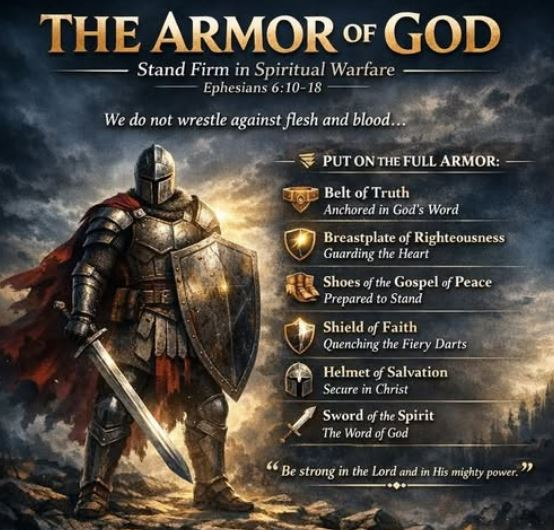
The phrase “full armor of God” comes from Ephesians 6:13-17: “Therefore put on the full armor of God, so that when the day of evil comes, you may be able to stand your ground, and after you have done everything, to stand. Stand firm then, with the belt of truth buckled around your waist, with the breastplate of righteousness in place, and with your feet fitted with the readiness that comes from the gospel of peace. In addition to all this, take up the shield of faith, with which you can extinguish all the flaming arrows of the evil one. Take the helmet of salvation and the sword of the Spirit, which is the word of God.”
Ephesians 6:12 clearly indicates that the conflict with Satan is spiritual, and therefore no tangible weapons can be effectively employed against him and his minions. We are not given a list of specific tactics Satan will use. However, the passage is quite clear that when we follow all the instructions faithfully, we will be able to stand, and we will have victory regardless of Satan’s strategy.
The first element of our armor is truth (Ephesians 6:14). This belt immediately sets the believer apart from the world, since Satan is the “father of lies” (John 8:44). Deception is high on the list of things God considers to be an abomination. A “lying tongue” is one of the things He describes as “detestable to Him” (Proverbs 6:16-17). We are therefore exhorted to put on truth for our own sanctification and deliverance, as well as for the benefit of those to whom we witness.
Also in verse 14, we are told to put on the breastplate of righteousness. A breastplate shielded a warrior’s vital organs from blows that would otherwise be fatal. This righteousness is not works of righteousness done by men. Rather, this is the righteousness of Christ, imputed by God and received by faith, which guards our hearts against the accusations and charges of Satan and secures our innermost being from his attacks.
Verse 15 speaks of the preparation of the feet for spiritual conflict. In warfare, sometimes an enemy places dangerous obstacles in the path of advancing soldiers. The idea of the preparation of the gospel of peace is that we need to advance into Satan’s territory, aware that there will be traps. The message of grace is essential to winning souls to Christ, and we must be prepared with the gospel. Satan has many obstacles placed in the path to halt the propagation of the gospel.
The shield of faith in verse 16 “can extinguish all the flaming arrows of the evil one.” When we bear the shield of faith, Satan can cast all the aspersions, doubt, and dismay he wants, but they will be ineffective. Our faith—of which Christ is “the author and perfecter” (Hebrews 12:2)—is like a shield, solid and substantial.
The helmet of salvation in verse 17 is protection for the head, keeping safe a critical part of the body. We could say that our way of thinking needs preservation. The head is the seat of the mind, which, when it has laid hold of the sure hope of eternal life, will not receive false doctrine or give way to Satan’s temptations. The unsaved person has no hope of warding off the blows of false doctrine because he is without the helmet of salvation and his mind is incapable of discerning between spiritual truth and spiritual deception.
Verse 17 interprets the sword of the Spirit as the Word of God. While all the other pieces of spiritual armor are for defense, the sword of the Spirit allows us to take the offense. The sword analogy speaks of the holiness and power of the Word of God. There is no greater spiritual weapon. In Jesus’ temptations in the desert, the Word of God was always His overpowering response to Satan. What a blessing that the same Word is available to us!
In verse 18, we are told to pray in the Spirit (that is, with the mind of Christ, with His heart and His priorities) in addition to wearing the full armor of God. We cannot neglect prayer, as it is the means by which we draw spiritual strength from God. Without prayer, without reliance upon God, our efforts at spiritual warfare are empty and futile. The full armor of God—truth, righteousness, the gospel, faith, salvation, the Word of God, and prayer—are the tools God has given us, through which we can be spiritually victorious. Satan is a defeated foe.

Bible Verse and Prayer for Today
In my anguish I cried to the Lord, and he answered by setting me free. The Lord is with me; I will not be afraid. What can man do to me?
—Psalm 118:5-6
The beginning of the year is a trying time for people I care about. Maybe it’s been that way for you or those you love. My prayer for you, and for them, is that they may know the comfort of God’s presence. Whether it’s the popular little poem “Footprints in the Sand” or the familiar “Yea though I walk through the valley of the shadow of death, I will fear no evil for thou art with me…” (Psalm 23:4 KJV). The presence of the Lord is absolutely vital to us if we are going to stand up for him and stand firm in the face of trial. The Lord does long to be with us, especially in those moments when we feel most alone and abandoned. He told us that by experiencing anguish himself and being alone on the cross. You can lean in, call upon, and have your hope in Jesus because he has been in the places you were hurting and came through to give us a way to God’s steadfast presence.
Prayer
I am thankful, O God, that you refused to be God from a safe distance. Because you came and felt what it was like to be abandoned, forsaken, and alone in Jesus, I know I can trust that you will never forsake me. Please give me a clearer sense of your presence with me in my life today, however, because I need to feel you close to me in these trying times. I pray through Jesus, and because of his assurance. Amen and Amen
Bible Teaching of the Day
As the apostle Paul begins to close his letter to the Ephesian church, he makes this appeal: “Finally, be strong in the Lord and in his mighty power” (Ephesians 6:10). The word translated “be strong” here actually means “be strengthened,” as rendered in the New English Translation: “Finally, be strengthened in the Lord and in the strength of his power.”
Paul had been teaching the Ephesians about the high calling of God in Christ Jesus and the life that flows from it. He outlined the standards of this life for believers individually, for fellowship within the Christian community, and for the more intimate family relationships within the home. Finally, Paul reminded believers that the Christian life means participation in a spiritual battle. From his own experience, the apostle knew the opposition is real and the warfare intense: “For our struggle is not against flesh and blood, but against the rulers, against the authorities, against the powers of this dark world and against the spiritual forces of evil in the heavenly realms. Therefore put on the full armor of God, so that when the day of evil comes, you may be able to stand your ground, and after you have done everything, to stand” (Ephesians 6:12–13).
Since believers are engaged in an ongoing spiritual battle with the powers of darkness, they cannot endure without the power of God. To be strong in the Lord and the power of His might is vital to living a victorious Christian life.
First, it’s important to understand what “be strong in the Lord” does not mean. In the original Greek language, the term is a passive voice verb meaning “to be rendered (more) capable or able for some task.” To be strong in the Lord does not involve building up your own strength. Believers cannot strengthen themselves in the Lord; rather, they must be empowered or be strengthened, as the Greek voice indicates.
The next key to understanding what it means to be strong in the Lord is the apostle’s use of “in the Lord,” rather than “by the Lord” or “of the Lord.” Only when our lives are positioned in the Lord, in union with Him, do we possess the appropriate power to overcome the enemy. Jesus said, “Remain in me, as I also remain in you. No branch can bear fruit by itself; it must remain in the vine. Neither can you bear fruit unless you remain in me. I am the vine; you are the branches. If you remain in me and I in you, you will bear much fruit; apart from me you can do nothing” (John 15:4–5). The believer’s empowerment comes from being in Jesus. Apart from Him, we can do nothing, but in Christ we have at our disposal all the strength of His might. Through the high calling of God in Christ Jesus, the Lord’s power makes us able or capable. He strengthens us with everything we need for any task. Closing his letter to the Ephesians, Paul goes into detail about how the Lord equips us for ongoing spiritual warfare with the full armor of God (Ephesians 6:13–18).
Earlier in Ephesians, Paul had prayed that his readers might understand and experience “what is the immeasurable greatness of his power toward us who believe, according to the mighty working of his strength. He exercised this power in Christ by raising him from the dead and seating him at his right hand in the heavens—far above every ruler and authority, power and dominion, and every title given, not only in this age but also in the one to come. And he subjected everything under his feet and appointed him as head over everything for the church, which is his body, the fullness of the one who fills all things in every way” (Ephesians 1:19–23, CSB).
When Paul encourages believers to “be strong in the Lord,” he is calling them to faithfulness—to abiding in Christ and trusting in the Lord’s power for everything in life. True Christian strength comes from recognizing our utter dependence on God. This is what Paul meant when he wrote, “I am able to do all things through him who strengthens me” (Philippians 4:13, CSB).
Often we are strongest in the Lord when we operate in the realm of human weakness. God allowed Satan to afflict Paul, but God’s purpose was to keep Paul humble and to demonstrate His power in his life: “But [Jesus] said to me, ‘My grace is sufficient for you, for my power is made perfect in weakness.’ Therefore I will boast all the more gladly about my weaknesses, so that Christ’s power may rest on me” (2 Corinthians 12:9). The power of Christ in the Christian’s life can be defined as “power in weakness,” for the Lord’s grace is apprehended only in recognition of our weakness.
Throughout the Bible, God delights in demonstrating His power in situations where human strength is lacking (1 Samuel 14:6–15; 1 Corinthians 1:27). When we are weak in ourselves, we are strong in the Lord because God’s strength becomes evident: “For he was crucified in weakness, but he lives by the power of God. For we also are weak in him, but in dealing with you we will live with him by God’s power” (2 Corinthians 13:4, CSB). To be strong in the Lord means to be in spiritual union with Christ. Only then can we experience both the weakness of the cross and the power of the resurrection (Romans 6:5).
Today’s Devotional
Before demonic strongholds can be overcome, we should understand exactly what demonic strongholds are. The word stronghold appears only once in the New Testament (2 Corinthians 10:4), and the Greek word translated “stronghold” means “a fortification such as a castle.” In this passage, the apostle Paul is instructing the church at Corinth on how to fight against and “destroy arguments and every lofty opinion raised against the knowledge of God” (2 Corinthians 10:5). They do this, not by using the weapons of the world, but by “divine power.” Lofty arguments and opinions are the result of pride and evil and vain imaginations, the very strongholds in which demons reside. This, then, is the essence of demonic warfare—the power of God to overcome the strongholds of demons.
In Ephesians 6:10–18, Paul describes the resources that God makes available to His followers—the armor of God. Here we are told how, in an attitude of humility and dependence, we are to avail ourselves of God’s resources. Note that we are to be strong “in the Lord” and “in the power of His might.” We do not take on demonic strongholds in our own strength. We protect ourselves with the first five pieces of defensive armor and wield the one offensive weapon—the sword of the Spirit which is the Word of God. We do all of this “with all kinds of prayers and requests . . . praying for all the Lord’s people” (verse 18). In verses 12 and 13 of Ephesians 6, Paul writes, “For we do not wrestle against flesh and blood, but against principalities, against powers, against the rulers of the darkness of this age, against spiritual hosts of wickedness in the heavenly places. Therefore take up the whole armor of God, that you may be able to withstand in the evil day, and having done all, to stand.”
One habit that every believer needs to develop is focusing on Ephesians 6:10–18 and “getting dressed” spiritually every day. It would go a long way to giving victory over the devil and his schemes. Here Paul states that, while we walk in the flesh (we are living and breathing in this human body), we do not war according to the flesh (we can’t fight spiritual battles with fleshly weapons). Instead, as we focus on the resources and weapons of spiritual strength, we can see God give us victory. No demonic stronghold can withstand praying Christians wearing the full armor of God, battling with the Word of God, and empowered by His Spirit.
Bible Prophecy, Signs of the Times and Gog and Magog Updates with Articles in the News
Trumps Board Of Peace Reveal Is Coming Soon – Kings Without Kingdoms?
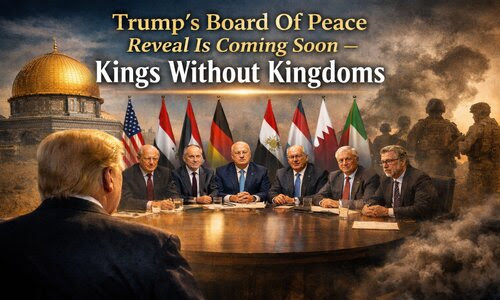
History has a way of repeating itself–not always in identical form, but often in eerily familiar patterns. As reports emerge that President Donald Trump’s administration is preparing to unveil a sweeping international “Board of Peace,” Christians would be wise to pay close attention. Not with fear, not with sensationalism–but with discernment. The pieces now being placed on the global chessboard bear striking resemblance to patterns described long ago in the pages of Scripture.
According to U.S. and regional officials, the Trump administration plans to announce the Board of Peace as early as next week, positioning it as a global body not only to guide postwar Gaza but eventually to assist in resolving conflicts worldwide.
Confirmed participants reportedly include Egypt, Qatar, the United Arab Emirates, the United Kingdom, Italy, and Germany–already a powerful and geographically diverse coalition. But perhaps most striking is the administration’s consideration of filling remaining seats with the heads of major multinational institutions such as the World Bank, the International Monetary Fund, and the World Economic Forum.
These institutions possess extraordinary influence but govern no land, command no armies, and answer to no electorate. These are leaders who do not wear crowns, yet their decisions shape economies, determine development paths, and exert leverage over sovereign governments. They are, in every meaningful sense, kings without kingdoms.
Power Without Borders, Authority Without Nations
This is where the Board of Peace could take on a distinctly new character. The presence of multinational institutional leaders would fundamentally transform the board from a gathering of national representatives into a technocratic ruling council. These figures do not negotiate treaties on behalf of citizens; they set conditions, control capital flows, and define the rules by which nations must operate to receive aid, investment, or legitimacy.
Their inclusion signals a model of peace not rooted in reconciliation between peoples, but in compliance with global systems. Reconstruction funds, security cooperation, governance frameworks, and even leadership legitimacy could all be conditioned on adherence to standards defined by unelected global authorities. In this model, peace is no longer simply brokered–it is managed, enforced through economic incentives and institutional pressure.
For students of Scripture, the parallels are difficult to ignore. The Bible describes a future period in which authority is concentrated not solely in traditional kingdoms, but in a limited number of powerful figures who operate beyond national boundaries. Daniel speaks of rulers who arise suddenly, wield influence disproportionate to their origins, and play decisive roles in confirming agreements that directly impact Israel. Revelation later describes ten kings who rule briefly, not over historic empires, but through shared authority–leaders who ultimately “give their power” to one central figure.
Again, this is not to claim fulfillment–but to recognize a familiar pattern. Power detached from geography. Authority divorced from accountability. Leaders who shape the fate of nations without ever standing for election.
Gaza: Testing Ground for a Global Model
The immediate focus of the Board of Peace will be Gaza. The Trump administration has made clear it is committed to the return of Israel’s remaining deceased hostage and to the disarmament of Hamas–but notably, it is unwilling to condition phase two of its peace plan on either. That second phase envisions sweeping changes: rebuilding Gaza, managing it through external oversight, and phasing out Israeli military control.
To that end, the U.S. is working with Egypt, Qatar, Turkey, and others on a gradual Hamas disarmament plan. This reportedly includes surrendering heavy weapons and a “buy-back” program for lighter arms. Hamas, for its part, insists disarmament can only occur alongside the establishment of a Palestinian state–highlighting how fragile and conditional these assurances remain.
Parallel to this effort is the creation of a Palestinian technocratic committee–a group of politically unaffiliated administrators tasked with governing postwar Gaza. Egypt has taken the lead in assembling this body, with Israel vetoing any direct Palestinian Authority leadership role. Eight approved technocrats will now govern a devastated territory of more than two million people, backed not by elections, but by international mandate.
An intermediate executive committee–featuring figures like Jared Kushner, Steve Witkoff, Tony Blair, and former UN envoy Nickolay Mladenov who has now been appointed as director-general of the Board–will oversee the process. The structure is unmistakable: layers of authority, none directly accountable to the people on the ground, all answerable to global stakeholders.
Security, Reconstruction, and the Illusion of Stability
The proposed International Stabilization Force (ISF) is intended to phase out Israeli forces in Gaza. Yet Washington has struggled to secure troop commitments. Indonesia and Azerbaijan were floated as contributors, though Azerbaijan has already declined. U.S. officials insist participation will grow once nations realize the force will not be expected to confront Hamas directly–an admission that underscores Israel’s lingering security concerns.
Meanwhile, reconstruction is already underway. A pilot residential compound near Rafah is being cleared, with plans to house 20,000 Palestinians. The U.S. hopes to replicate this model across Gaza, contingent on the success of the technocratic government and the marginalization of Hamas.
It is a massive experiment–politically, militarily, and spiritually.
Watching the Puzzle Take Shape
Scripture does not tell us to panic when global structures emerge. It tells us to watch. To understand the times. To recognize that the final system will look reasonable, humanitarian, and even noble at first. “For when they say, ‘Peace and safety!’ then sudden destruction comes upon them” (1 Thessalonians 5:3).
What we are witnessing may not be the final picture–but it looks very much like pieces being laid out on the table. A peace guaranteed by outsiders. Power consolidated in elite hands. Decisions about Israel made far from Jerusalem. A world growing comfortable with governance by committee rather than covenant.
For now, it is like a jigsaw puzzle–many pieces, no clear image yet. But Christians should not look away. The God who declared the end from the beginning has not been surprised by any of this. Our calling is not to speculate recklessly, but to remain anchored in truth, prayerful for Israel, and confident that even when the nations gather, the Lord still reigns.
The stage may be forming–but the final word belongs to Him.
Gog / Russia’s Hypersonic Warning Shot: Why The Oreshnik Strike Changes Everything
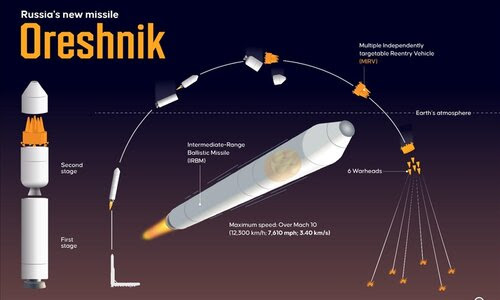
The war in Ukraine crossed a dangerous new threshold this week — not because of territory gained or lost, but because of what Russia chose to fire.
Reports indicate that Moscow launched its Oreshnik hypersonic missile in a strike on Lviv, a city just 40 miles from NATO and the European Union. That geographic detail matters. This was not a random battlefield decision. It was a message — aimed not just at Kyiv, but at Washington, Brussels, and every Western capital watching the conflict inch closer to a wider confrontation.
Hypersonic weapons are not just faster missiles. They are strategic disruptors. And Russia just demonstrated it is willing to use one in active combat.
What Makes the Oreshnik So Dangerous
The Oreshnik is believed to be an intermediate-range ballistic missile equipped with hypersonic reentry vehicles. Once launched, it accelerates to Mach 10 or higher, separating into multiple warheads that descend toward their targets at blistering speed.
At that velocity, reaction time collapses. Radar detection windows shrink. Interceptors struggle to calculate trajectories that change mid-flight. Traditional missile defense systems — built for slower, predictable ballistic arcs — suddenly look outdated.
Russia claims that no existing missile defense system can stop Oreshnik. That statement is almost certainly exaggerated. No weapon is truly invincible. But the more uncomfortable truth is this: there is currently no reliable, proven defense against a full hypersonic strike of this kind, especially when multiple warheads are involved.
Even NATO’s most advanced systems were not designed for this scenario at scale. And Ukraine, already stretched thin, has virtually no way to counter it.
That reality is what makes this moment so unsettling.
Why Strike Lviv — and Why Now?
Lviv is not just another Ukrainian city. It is a logistical hub, a symbol of Western support, and a gateway between Ukraine and Europe. By striking so close to NATO territory, Russia was drawing a line — deliberately and visibly.
This strike came amid rising tensions far beyond Ukraine’s borders. The United States and Russia are increasingly at odds over oil shipments, sanctions enforcement, tanker seizures, and geopolitical maneuvering in places like Venezuela. At the same time, Western leaders have doubled down on long-term security guarantees for Ukraine, signaling that Kyiv will not be abandoned.
Moscow sees these moves as encirclement.
And it has responded accordingly.
Russian officials have now openly declared that any foreign troops or military units operating in Ukraine would be considered legitimate targets. That is not idle rhetoric. It is escalation language — the kind that precedes decisions rather than follows them.
The Oreshnik strike fits perfectly into that posture.
The Bigger Picture: Escalation by Design
This war is no longer confined to tanks, trenches, and drones. It has become a contest of thresholds — how far each side can go without triggering direct confrontation, and how much pressure can be applied before something breaks.
Russia is signaling that it is willing to:
Introduce strategic-level weapons into a regional war
Undermine confidence in Western defensive guarantees
Force NATO planners to confront uncomfortable new realities
The message is not subtle: your defenses may not be enough, and your proximity will not protect you.
For NATO, this presents a serious dilemma. Deterrence relies not just on military capability, but on credibility. If populations believe that advanced weapons cannot be stopped, public pressure to avoid escalation grows — and that pressure can shape political decisions.
That is exactly the space Russia is trying to exploit.
A Feedback Loop with No Easy Exit
Every escalation creates momentum. Hypersonic weapons invite counter-development. Counter-development invites preemptive deployment. And preemptive deployment raises the risk of catastrophic miscalculation.
This is how arms races accelerate — not in decades, but in months.
What makes this moment especially dangerous is how multiple global flashpoints are beginning to overlap. Ukraine, energy markets, sanctions, shipping lanes, and political instability in oil-producing nations are no longer separate issues. They are threads in the same strategic web.
Pull one too hard, and the entire structure shifts.
The Sobering Reality
The Oreshnik strike is not just about Ukraine. It is about the future of warfare — and the fragile assumptions that have kept major powers from direct conflict for generations.
Speed changes everything. When weapons travel faster than diplomacy can respond, the margin for restraint narrows. When leaders openly label foreign forces as legitimate targets, ambiguity disappears. And when advanced systems are tested in live combat, what was once theoretical becomes precedent.
The world should take this moment seriously.
Not because war is inevitable — but because the rules that once slowed escalation are eroding, one missile launch at a time.
The strike on Lviv was not just an attack.
It was a warning shot.
And history suggests that warning shots = rarely the last.
Landmark Court Ruling – Faith Groups Can’t Be Forced To Hire Unbelievers

A decision issued on Tuesday, January 6, by the U.S. Court of Appeals for the Ninth Circuit may be one of the most significant religious liberty decisions of 2026.
In Union Gospel Mission of Yakima v. Brown, the court affirmed that religious organizations have a constitutional right to hire according to their faith, even for “ordinary” or non-minister positions, and they can do this without government interference. It’s a moment worth celebrating, not only for the plaintiff, Union Gospel Mission, but for every church and ministry organization that takes its faith seriously.
At the heart of the case was this question: Can the government force a Christian organization to hire employees who openly reject its faith and mission? Attorneys for the state of Washington said, yes. The Ninth Circuit responded with a resounding, no.
Union Gospel Mission, a Christian ministry serving the homeless and addicted, requires its staff to affirm and live by its biblical beliefs, including Christian teachings on sexuality and marriage. Under the state of Washington’s Law Against Discrimination, this long-standing policy was under threat. After Washington’s Supreme Court narrowed the law’s religious exemptions several years ago, Union Gospel Mission feared being punished simply for hiring those who shared its faith.
Thankfully, the Ninth Circuit affirmed what many of us already know: religious organizations are more than just employers of labor. Rather, they are communities of shared belief and religious mission. As the court powerfully said in its decision, “personnel is policy,” and “who a religious organization hires may go to the very character of its religious mission.”
This decision is about much more than hiring. It’s about the ability of a religious organization to secure and protect its identity. Whenever ministries are forced to dilute their convictions in order to comply with secular norms, they cease to be who they are. As the Ninth Circuit noted in its decision, this kind of pressure would drive many religious missions out of the public square entirely. That would be a loss not just for churches and ministries, but also for communities and the countless people served by organizations of faith.
The decision is all the more significant because of the court that handed it down. The Ninth Circuit covers states like Washington, Oregon, and California, progressive states that have, in recent years, become increasingly hostile to people and institutions of faith. At the same time, the Ninth Circuit has long been a bastion of judicial activism and progressive ideology. However, it now hosts a growing number of principled judicial conservatives, thanks to key appointments by President Trump, including Judge Patrick Bumatay, the author of the Union Gospel decision.
Now, as important as this decision is, it has its limits. For example, it does not grant religious institutions blanket immunity from employment laws. And it does not necessarily apply to for-profit businesses or hospitals. Still, it does affirm the right of ministries like Union Gospel Mission to make personnel decisions that flow directly from their religious convictions, even if those convictions conflict with secular orthodoxy.
The court’s decision also reminds us of a critical truth: Faith is personal, but it is not private. Religious liberty doesn’t just protect our rights to believe in the privacy of our heads, our hearts, our homes, or our houses of worship. The First Amendment protects religious exercise, the active, practical living out of one’s deepest-held conviction, including the building and running of organizations designed to apply those convictions to the challenges and struggles of life. America in particular would be far worse off without the pre-political organizations that run headlong into the problems of our society seeking to help those in need.
Already in 2026, we can be thankful for a decision that understands the essential role these organizations play and the essential role that faith and morals play in making these organizations what they are. At the very least, this is not a bad way to start off a New Year.
TruLight Ministries Daily Entertainment

TruLight TV : The Dottie Rambo Gospel Collection
Hundreds of Gospel music classics have been born in the Pen and heart of Dottie Rambo. Now, through this timeless DVD honoring the songs of Dottie Rambo, everyone can enjoy a moving compilation of unforgettable moments from the Homecoming video series. and later Is your light visible for all to see? Dr. Stanley offers counsel on how to be a godly influence in the lives of others. Enjoy ! and thanks for watching.
Today on TruLight Radio XM
TruLight Radio XM 24/7
Program
GMT / UTC +2
Monday To Fridays
00:15 Words to Live By Testimonies
01.15 Science Scripture and Salvation
02.15 Ground Works
04.00 Gospel Concert of the Day
05.00 The Daren Streblow Comedy Show
5:55 It is Today devotional
6:00 Gaither Homecoming Morning Show
7:15 Discover the Word
8.15 Destined for Victory
8:55 Science Scripture and Salvation
9:00 Holy Spirit Hour – Normally Sermons
10:15 Hope of the Heart
11:15 Unshackled
11.45 Words to Live By
12:15 Truth for Life
13:15 Living on the Edge with Chip Ingram
14:15 Focus on the Family
15:00 Kids Hour
16:00 In Touch with Dr. Charles Stanley
16:30 Groundwork
17:15 Live in the Light
18:15 Renewing your Mind
19:00 Gaither Homecoming Show
20:15 Growing Hope
21:15 Adventures in Odyssey Radio Drama
21:45 Bible Reading
22:15 Nightsounds
23.00 Good Old Country Gospel / Rhema Gospel Express
VISIT THE WEBSITE
https://TruLightRadioXM.org.za
TruLight Ministry News
TruLight Ministries orders from God since 2012 . Teach Them , Comfort Them and Warn Them!
LOOK OUT – SOMETHING NEW IS COMING FROM THIS WEBSITE WITHIN TRULIGHT MINISTRIES
Doctrine of Demons – Teaching for the Christian , Discerning the spirits
Share this Feeding of Manna with your Friends and Family. just click on the Social Media icon and share !