Hosted by TruLight Ministries – The Place of Truth
SELECT YOUR READING LANGUAGE – BOTTOM LEFT = YOUR DAILY MANNA NOW AVAILABLE IN 103 LANGUAGES
a New Study : for the Next 11 Daily Manna Days
In My Control vs Out of My Control

We are Done with the Study ” In My Control ” Today we are Moving to the 2nd Part of this Bible Study . Out of My Control!
Out of My Control = Suffering and Trials ::: One of the most difficult parts of the Christian life is the fact that becoming a disciple of Christ does not make us immune to life’s trials and tribulations. Why would a good and loving God allow us to go through such things as the death of a child, disease and injury to ourselves and our loved ones, financial hardships, worry and fear? Surely, if He loved us, He would take all these things away from us. After all, doesn’t loving us mean He wants our lives to be easy and comfortable? Well, no, it doesn’t. The Bible clearly teaches that God loves those who are His children, and He “works all things together for good” for us (Romans 8:28). So that must mean that the trials and tribulations He allows in our lives are part of the working together of all things for good. Therefore, for the believer, all trials and tribulations must have a divine purpose.
As in all things, God’s ultimate purpose for us is to grow more and more into the image of His Son (Romans 8:29). This is the goal of the Christian, and everything in life, including the trials and tribulations, is designed to enable us to reach that goal. It is part of the process of sanctification, being set apart for God’s purposes and fitted to live for His glory. The way trials accomplish this is explained in 1 Peter 1:6-7: “In this you greatly rejoice, even though now for a little while, if necessary, you have been distressed by various trials, that the proof of your faith, being more precious than gold which perishes, even though tested by fire, may be found to result in praise and glory and honor at the revelation of Jesus Christ.” The true believer’s faith will be made sure by the trials we experience so that we can rest in the knowledge that it is real and will last forever.
Trials develop godly character, and that enables us to “rejoice in our sufferings, because we know that suffering produces perseverance; perseverance, character; and character, hope. And hope does not disappoint us, because God has poured out his love into our hearts by the Holy Spirit, whom he has given us” (Romans 5:3-5). Jesus Christ set the perfect example. “But God demonstrates His own love toward us, in that while we were yet sinners, Christ died for us” (Romans 5:8). These verses reveal aspects of His divine purpose for both Jesus Christ’s trials and tribulations and ours. Persevering proves our faith. “I can do all things through Christ, who strengthens me” (Philippians 4:13).
However, we must be careful never to make excuses for our “trials and tribulations” if they are a result of our own wrongdoing. “By no means let any of you suffer as a murderer, or thief, or evildoer, or a troublesome meddler” (1 Peter 4:15). God will forgive our sins because the eternal punishment for them has been paid by Christ’s sacrifice on the cross. However, we still have to suffer the natural consequences in this life for our sins and bad choices. But God uses even those sufferings to mold and shape us for His purposes and our ultimate good.
Trials and tribulations come with both a purpose and a reward. “Consider it all joy, my brethren, when you encounter various trials, knowing that the testing of your faith produces endurance. And let endurance have its perfect result, that you may be perfect and complete, lacking in nothing. . . . Blessed is the man who perseveres under trial; for once he has been approved, he will receive the crown of life, which the Lord has promised to those who love Him” (James 1:2-4,12).
Through all of life’s trials and tribulations, we have the victory. “But thanks be to God, who gives us the victory through our Lord, Jesus Christ.” Although we are in a spiritual battle, Satan has no authority over the believer in Christ. God has given us His Word to guide us, His Holy Spirit to enable us, and the privilege of coming to Him anywhere, at any time, to pray about anything.

Bible Verse and Prayer for Today
He who covers over an offense promotes love, but whoever repeats the matter separates close friends.
—Proverbs 17:9
You’ve probably heard this poisonous statement many times: “It’s just a little harmless gossip.” The Wise Teacher reminds us that gossip is neither little nor harmless. Sharing someone else’s stumble, offense, failure, or flaws separates friends and causes horrible damage. The consequences of such gossip are severe, and its damage is often lasting and devastating, especially to relationships. Instead, it is much better to be a peacemaker and an offense-mender, someone who covers over an offense with grace, forgiveness, and love. As Jesus said:
Blessed are the peacemakers, for they will be called children of God (Matthew 5:9).
A peacemaker is one who covers over an offense and promotes love and peace. Let that be said of us!
Prayer
Father of Glory, I confess that I am often more a peace lover than a peacemaker. Being a peacemaker seems to be a lot harder for me. Covering over offenses feels a lot more difficult than passing on the gossip about an offense. So, please give me the character not to repeat gossip, but instead to have the wisdom and strength to be an offense-mender and an offense-coverer. Through the Prince of Peace, himself, I pray. Amen and Amen

Bible Teaching of the Day
There is so much suffering in the world, and it is felt by everyone to one degree or another. Sometimes, people suffer as the direct result of their own poor choices, sinful actions, or willful irresponsibility; in those cases, we see the truth of Proverbs 13:15, “The way of the treacherous is their ruin” (ESV). But what about the victims of the treachery? What about the innocent who suffer? Why would God allow that?
It is human nature to try to find a correlation between bad behavior and bad circumstances and, conversely, between good behavior and blessings. The desire to link sin to suffering is so strong that Jesus dealt with the issue at least twice. “As he went along, he saw a man blind from birth. His disciples asked him, ‘Rabbi, who sinned, this man or his parents, that he was born blind?’ ‘Neither this man nor his parents sinned,’ said Jesus” (John 9:1–3). The disciples made the mistake of assuming that the innocent would never suffer and assigned personal guilt to the blind man (or to his parents). Jesus corrected their thinking, saying, “This happened so that the works of God might be displayed in him” (verse 3). The man’s blindness was not the result of personal sin; rather, God had a higher purpose for the suffering.
Another time, Jesus commented on the deaths of some people killed in an accident: “Those eighteen who died when the tower in Siloam fell on them—do you think they were more guilty than all the others living in Jerusalem? I tell you, no! But unless you repent, you too will all perish” (Luke 13:4–5). In this case, Jesus again discounted the notion that tragedy and suffering are the result of personal sin. At the same time, Jesus emphasized the fact that we live in a world full of sin and its effects; therefore, everyone must repent.
This brings us to the consideration of whether such a thing as “the innocent,” technically speaking, even exists. According to the Bible, “all have sinned and fall short of the glory of God” (Romans 3:23). Therefore, no one is “innocent” in the sense of being sinless. We were all born with a sinful nature, inherited from Adam. And, as we’ve already seen, everyone suffers, regardless of whether or not the suffering can be linked to a specific personal sin. Sin’s effects permeate everything; the world is fallen, and all creation suffers as a result (Romans 8:22).
Most heartbreaking of all is the suffering of a child. Children are as close to innocence as we ever see in this world, and for them to suffer is truly tragic. Sometimes, innocent children suffer because of the sin of others: neglect, abuse, drunk driving, etc. In those cases, we can definitely say that the suffering is the result of personal sin (just not theirs), and we learn the lesson that our sin always affects others around us. Other times, innocent children suffer because of what some might call “acts of God”: natural disasters, accidents, childhood cancer, etc. Even in those cases, we can say that the suffering is the result of sin, generally speaking, because we live in a sinful world.
The good news is that God did not leave us here to suffer pointlessly. Yes, the innocent suffer (see Job 1–2), but God can redeem that suffering. Our loving and merciful God has a perfect plan to use that suffering to accomplish His threefold purpose. First, He uses pain and suffering to draw us to Himself so that we will cling to Him. Jesus said, “In this world you will have trouble” (John 16:33). Trials and distress are not something unusual in life; they are part of what it means to be human in a fallen world. In Christ we have an anchor that holds fast in all the storms of life, but, if we never sail into those storms, how would we know that? It is in times of despair and sorrow that we reach out to Him, and, if we are His children, we always find Him there waiting to comfort and uphold us through it all. In this way, God proves His faithfulness to us and ensures that we will stay close to Him. An added benefit is that as we experience God’s comfort through trials, we are then able to comfort others in the same way (2 Corinthians 1:4).
Second, He proves to us that our faith is real through the suffering and pain that are inevitable in this life. How we respond to suffering, especially when we are innocent of wrongdoing, is determined by the genuineness of our faith. Those with faith in Jesus, “the pioneer and perfecter of faith” (Hebrews 12:2), will not be crushed by suffering but will come through the trial with their faith intact, having been “tested by fire” so that it “may be found to result in praise and glory and honor at the revelation of Jesus Christ” (1 Peter 1:7, ESV). The faithful do not shake their fists at God or question His goodness; rather, they “consider it pure joy” (James 1:2), knowing that trials prove that they are truly the children of God. “Blessed is the one who perseveres under trial because, having stood the test, that person will receive the crown of life that the Lord has promised to those who love him” (James 1:12).
Finally, God uses suffering to take our eyes off this world and turn them to the next. The Bible continually exhorts us to not get caught up in the things of this world but to look forward to the world to come. The innocent suffer in this world, but this world and all that is in it will pass away; the kingdom of God is eternal. Jesus said, “My kingdom is not of this world” (John 18:36), and those who follow Him do not see the things of this life, good or bad, as the end of the story. Even the sufferings we endure, as terrible as they can be, “are not worth comparing with the glory that will be revealed in us” (Romans 8:18).
Could God prevent all suffering? Of course He could. But He assures us that “all things work together for good to them that love God, to them who are the called according to his purpose” (Romans 8:28, KJV). Suffering—even the suffering of the innocent—is part of the “all things” that God is using to accomplish His good purposes, ultimately. His plan is perfect, His character is flawless, and those who trust Him will not be disappointed.
Today’s Devotional
James 1:2-4 says, “Consider it pure joy, my brothers, whenever you face trials of many kinds, because you know that the testing of your faith develops perseverance. Perseverance must finish its work so that you may be mature and complete, not lacking anything.” This is the very first thing James writes in his letter after his salutation. Why? Because of its import. Many Christians think once they’ve made that decision for Christ that everything will fall into place and life will be that proverbial bowl of cherries. And when trials and tough times come upon them or continue, they begin to question, “why?” Wondering how they could possibly endure horrible circumstances and consider it joy.
Peter also tackles this subject of joy through trials. “In this you greatly rejoice, though now for a little while you may have had to suffer grief in all kinds of trials. These have come so that your faith—of greater worth than gold, which perishes even though refined by fire—may be proved genuine and may result in praise, glory and honor when Jesus Christ is revealed. Though you have not seen him, you love him; and even though you do not see him now, you believe in him and are filled with an inexpressible and glorious joy, for you are receiving the goal of your faith, the salvation of your souls” (1 Peter 1:6-9).
In both of these passages, we see the instruction of what we should do. ‘Consider it pure joy…’ ‘In this you greatly rejoice…’ Why? Because trials make us stronger. The James passage clearly states that the testing of our faith produces perseverance. And the Peter passage states that our faith, which is priceless, will be proved genuine and result in praise to God. But how? How can we find joy in the midst of all the junk, hardships, and painful circumstances?
First, we need to understand that the joy the world gives is not the same as the joy the Spirit gives. Worldly joy or happiness comes and goes as often as waves hitting the shore. It isn’t something you can cling to when you’ve lost a loved one or are facing bankruptcy. The Spirit’s joy or happiness, on the other hand, can stay with you for the long haul. For the believer, the fruit of the Spirit, including joy, is like a bottomless well of water—there’s always an abundant supply. Even in the darkest days, when sadness, grief, and loss may threaten to overwhelm you, God’s joy is there.
Second, we need to understand that God’s joy cannot be taken away. Oh, you might think that it’s gone—that the hands of misfortune have snatched it from you—but it’s not. As believers, we are promised the constant presence of the Holy Spirit. We are promised His joy. Just as our salvation is assured through Jesus’ one-time sacrifice for all. Jesus’ words in John 15:11, “I have told you this so that my joy may be in you and that your joy may be complete.” Other examples, Acts 13:52, “And the disciples were filled with joy and with the Holy Spirit.” Acts 16:34, “The jailer brought them into his house and set a meal before them; he was filled with joy because he had come to believe in God—he and his whole family.”
Third, we need to stop wallowing, whining, and complaining and grab onto God’s joy. Just like salvation, joy is a free and perfect gift from Him, and we must reach out and accept that gift. Grab onto it. Like a lifeline. Choose joy. Over bitterness, anger, and sorrow. Make a decision to choose joy every day. No matter what. Look at these great examples in Scripture: “Out of the most severe trial, their overflowing joy and their extreme poverty welled up in rich generosity. For I testify that they gave as much as they were able, and even beyond their ability” (2 Corinthians 8:2-3). “You became imitators of us and of the Lord; in spite of severe suffering, you welcomed the message with the joy given by the Holy Spirit” (1 Thessalonians 1:6). “Be joyful always” (1 Thessalonians 5:16). “You sympathized with those in prison and joyfully accepted the confiscation of your property, because you knew that you yourselves had better and lasting possessions” (Hebrews 10:34). And the best illustration of all, “Let us fix our eyes on Jesus, the author and perfecter of our faith, who for the joy set before him endured the cross, scorning its shame, and sat down at the right hand of the throne of God” (Hebrews 12:2).
All through Scripture we see the persecution of the church, the trials and hardships that believers have faced. The challenge then is to truly learn how to consider each trial joy.
This topic is very near and dear to my heart because it is a lesson I’m relearning each and every day. My daughter has a rare nerve disorder, she’s had brain surgery, and we’ve faced seemingly insurmountable obstacles, mountains of medical bills, bankruptcy, and foreclosure. But you know what I have discovered? God’s joy really is there. You can consider each trial joy, you can greatly rejoice with joy inexpressible and full of glory even when you feel like you are face-first in the mudpuddle. You can endure whatever circumstances are making you quake in your boots right now. If you have been saved through faith in Jesus Christ—you have all you need.
Grab onto God’s joy.

Bible Prophecy, Signs of the Times and Gog and Magog Updates with Articles in the News
WAR’S AND RUMORS OF WAR’S
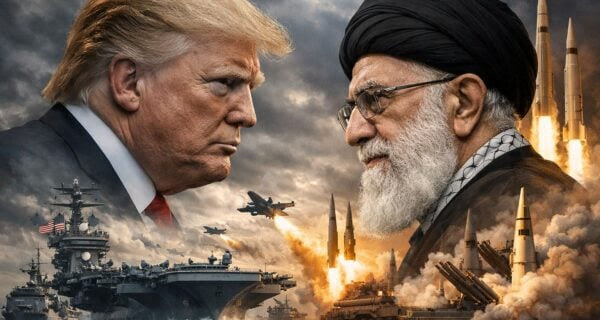
Middle East Region on the brink of war as diplomacy falters

Any American operation would not resemble a limited or short-term strike but rather a broad and sustained military campaign lasting several weeks.
The United States is approaching a potential military strike against Iran with what senior administration officials described as “90% certainty,” according to a report published Wednesday by the American news site Axios, as Washington continues to rapidly reinforce its military presence across the Middle East.
According to the report, any American operation would not resemble a limited or short-term strike but rather a broad and sustained military campaign lasting several weeks and targeting key components of the Islamic Republic’s military and strategic infrastructure.
Officials cited in the report said the operation would likely evolve into a joint U.S.-Israeli campaign significantly larger in scope than previous confrontations.
Sources told Axios that such a conflict could prove existential for the Iranian regime and would carry far-reaching consequences for the entire region, as well as major political implications for the remaining years of President Donald Trump’s term in office.
The report noted that Trump had already come close to authorizing military action in early January following the regime’s violent crackdown on domestic protests that resulted in thousands of deaths.
WATCH: ‘We have a massive fleet heading toward Iran — I hope we don’t have to use it,’ Trump says
After that window passed, the administration shifted to a dual-track strategy combining renewed nuclear negotiations with a rapid military buildup designed to maintain credible pressure on Tehran.
The military buildup has accelerated in recent days, with more than 150 U.S. cargo flights delivering weapons systems and ammunition to the region. Open-source flight tracking data also has shown a surge in American aircraft movements across the United States and Europe.
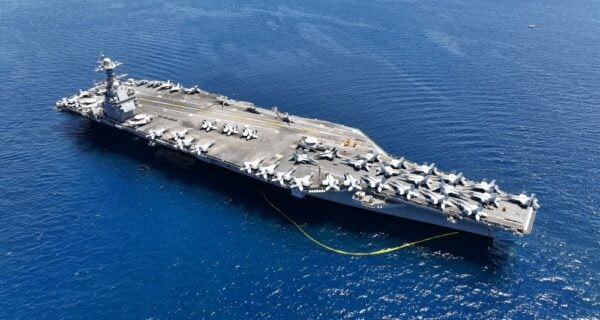
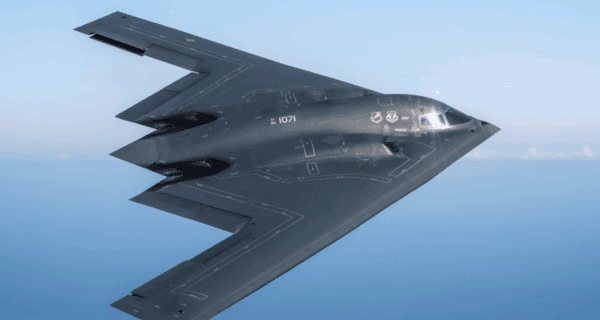
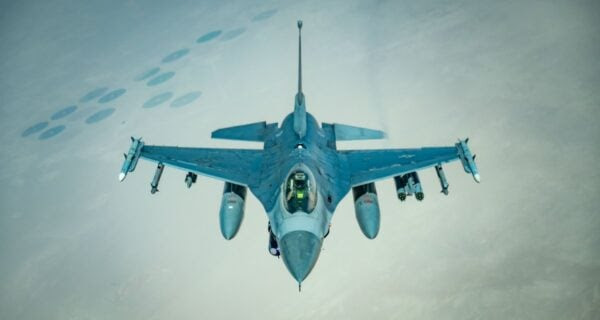
At the same time, more than 50 fighter jets, including F-35, F-22, and F-16 aircraft, have been repositioned to the Middle East, alongside two U.S. aircraft carriers, one already deployed and another en route, highlighting the scale of American preparations.
Despite ongoing nuclear talks, U.S. officials cited in the report expressed deep skepticism that diplomacy will produce a breakthrough, signaling that the window for negotiations may be rapidly closing. “The boss is getting fed up,” one Trump adviser said, reflecting growing frustration inside the administration.
After years of escalating tensions, the confrontation with Iran has become a familiar backdrop for many observers. But officials warn that the current moment may be different, with the risk of conflict approaching faster and on a far larger scale, than much of the public fully recognizes.
Peace with Everyone = The Antichrist
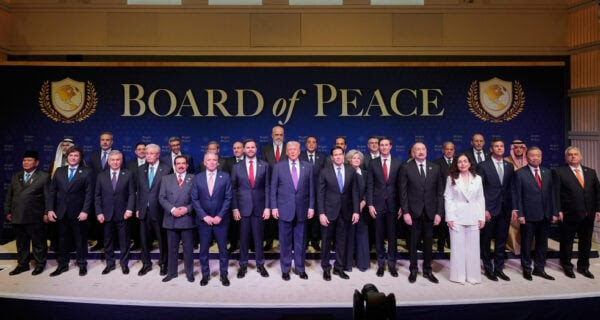
Trump gets billions in pledges from nine countries at ‘Board of Peace’ meeting
Indonesia, Morocco, Kazakhstan, Kosovo and Albania made pledges to send troops for a Gaza stabilization force, while Egypt and Jordan committed to train police.
President Donald Trump announced Thursday at the inaugural Board of Peace meeting that nine members have agreed to pledge $7 billion toward a Gaza relief package and five countries have agreed to deploy troops as part of an international stabilization force for the war-battered Palestinian territory.
While lauding the pledges, Trump faces the unresolved challenge of disarming Hamas, a sticking point that threatens to delay or even derail the Gaza ceasefire plan that his administration notched as a major foreign policy win.
The dollars promised, while significant, represent a small fraction of the estimated $70 billion needed to rebuild the territory decimated after two years of war between Israel and Hamas.
While Trump praised allies for making the commitments of funding and troops, he offered no detail on when the pledges would be implemented.
“Every dollar spent is an investment in stability and the hope of new and harmonious (region),” Trump said. He added, “The Board of Peace is showing how a better future can be built right here in this room.”
Trump also announced the U.S. was pledging $10 billion for the board but didn’t specify what the money will be used for. It also was not clear where the U.S. money would come from — a sizable pledge that would need to be authorized by Congress.
Trump touches on Iran and the United Nations
The board was initiated as part of Trump’s 20-point plan to end the conflict in Gaza.
But since the October ceasefire, Trump’s vision for the board has morphed and he wants it to have an even more ambitious remit — one that will not only complete the Herculean task of bringing lasting peace between Israel and Hamas but also help resolve conflicts around the globe.
WATCH: IDF destroys kilometer-long Hamas tunnel in Gaza
But the Gaza ceasefire deal remains fragile, and Trump’s expanded vision for the board has triggered fears the U.S. president is looking to create a rival to the United Nations.
Trump, pushing back against the criticism, said the creation of his board would help make the U.N. viable in the future.
“Someday I won’t be here. The United Nations will be,” Trump said. “I think it is going to be much stronger, and the Board of Peace is going to almost be looking over the United Nations and making sure it runs properly.”
Even as Trump spoke of the gathering as a triumph that would help bring a more persistent peace to the Middle East, he sent new warnings to Iran.
Tensions are high between the United States and Iran as Trump has ordered one of the largest U.S. military buildups in the region in decades.
One aircraft carrier group is already in the region and another is on the way.
Trump has warned Tehran it will face American military action if it does not denuclearize, give up ballistic missiles and halt funding to terror proxy groups, such as Hezbollah and Hamas.
“We have to make a meaningful deal. Otherwise bad things happen,” Trump said.
Which countries pledged troops and funding
Indonesia, Morocco, Kazakhstan, Kosovo and Albania made pledges to send troops for a Gaza stabilization force, while Egypt and Jordan committed to train police.
Troops will initially be deployed to Rafah, a largely destroyed and mostly depopulated city under full Israeli control, where the U.S. administration hopes to first focus reconstruction efforts.
Palestinian Authority balks at Hamas demands for place in Gaza police force, role in PA elections
The countries making pledges to fund reconstruction are Kazakhstan, Azerbaijan, the United Arab Emirates, Morocco, Bahrain, Qatar, Saudi Arabia, Uzbekistan and Kuwait, Trump said.
Maj. Gen. Jasper Jeffers, leader of the newly created international stabilization force, said plans call for 12,000 police and 20,000 soldiers for Gaza.
“With these first steps, we help bring the security that Gaza needs for a future of prosperity and enduring peace,” Jeffers said.
Some US allies remain skeptical
Nearly 50 countries and the European Union sent officials to Thursday’s meeting. Germany, Italy, Norway, Switzerland and the United Kingdom are among more than a dozen countries that have not joined the board but took part as observers.
Most countries sent high-level officials, but a few leaders — including Indonesian President Prabowo Subianto, Argentine President Javier Milei and Hungarian President Viktor Orbán — traveled to Washington.
“Almost everybody’s accepted, and the ones that haven’t, will be,” Trump offered. “And some are playing a little cute — it doesn’t work. You can’t play cute with me.”
Vatican Secretary of State Cardinal Pietro Parolin told reporters this week that “at the international level, it should above all be the U.N. that manages these crisis situations.”
French Foreign Minister Jean-Noël Barrot said in a post on X thatthe European Commission should never have attended the meeting as it had no mandate to do so.
More countries are “going through the process of getting on,” in some cases, by getting approval from their legislatures, Trump told reporters later Thursday.
“I would love to have China and Russia. They’ve been invited,” Trump said. “You need both.”
Official after official used their speaking turns at the gathering to heap praise on Trump for his ability to end conflicts.
Pakistani Prime Minister Shehbaz Sharif called him the “savior of South Asia,” while others said that years of foreign policy efforts by his predecessor failed to do what Trump has done in the past year.
Trump inaugurates Board of Peace, demands Hamas return last hostage
Turkish Foreign Minister Hakan Fidan said Trump and others there deserved thanks for their collective efforts on Gaza. But Fidan, who said Turkey also was prepared to contribute troops to the stabilization force, cautioned that the situation remains precarious.
“The humanitarian situation remains fragile and ceasefire violations continue to occur,” Fidan said. “A prompt, coordinated and effective response is therefore essential.”
Questions about disarming Hamas
Central to Thursday’s discussions was assembling an international stabilization force to keep security and ensure the disarming of the terrror Hamas group, a key demand of Israel and a cornerstone of the ceasefire deal.
Hamas has provided little confidence that it is willing to move forward on disarmament.
The administration is “under no illusions on the challenges regarding demilitarization” but has been encouraged by what mediators have reported back, according to a U.S. official who was not authorized to comment publicly and spoke on condition of anonymity.
Israeli Prime Minister Benjamin Netanyahu, speaking in southern Israel, repeated his pledge that “there will be no reconstruction” of Gaza before demilitarization.
His foreign minister, Gideon Saar, said during Thursday’s gathering that “there must be a fundamental deradicalization process.”
Trump said Hamas has promised to disarm and would be met “very harshly” if it fails to do so. But he gave few details on how the difficult task would be carried out.
Secretary of State Marco Rubio acknowledged that there is a “long ways to go” in Gaza.
“There’s a lot of work that remains that will require the contribution of every nation state represented here today,” Rubio said.
Abomanation of Desolation
China’s Robots Just Stunned The World – The One-Year Leap Is Unbelievable

It takes a lot to blow me away in this day and age, but the video footage of humanoid AI-powered robots in China that I am about to share with you truly blew me away. During the CCTV Spring Festival gala, humanoid AI-powered robots built by Unitree performed an incredibly complex martial arts routine that was simply jaw-dropping.
I never thought that we would get to a point where robots could move like that. I am literally in awe of what the Chinese have been able to accomplish. What made the performance even more incredible is that large numbers of human children were also involved in the performance…
Dozens of Unitree bots took to the stage at the CCTV Spring Festival gala, which is China’s most–watched TV show.
Wearing red vests, the robots performed kicks, flips, and even moves with nunchucks, swords, and poles.
Amazingly, their daring performance took place just metres away from human children performers.
If even one of the robots had made a mistake while swinging a weapon around, the child performers could have potentially been seriously hurt.
But there were no mistakes.
The footage that is posted below looks like it could have come out of a science fiction movie, but I assure you that this is very real…
What a spectacular performance. Unitree says the bots were synced to the beat down to the split second.
Needless to say, U.S. companies haven’t built anything remotely similar yet.
Last year, Unitree rolled out a bunch of clunky robots that twirled handkerchiefs around, and that was considered to be impressive at the time.
But the jump in sophistication that we witnessed in this year’s performance was truly monumental…
The contrast with last year’s show was clear. In 2025, Unitree’s humanoids performed a folk Yangko dance, twirling handkerchiefs. This year, the machines executed aerial flips, table-vaulting parkour, continuous single-leg flips, and a 7.5-rotation airflare spin.
“It’s been just one year — and the performance jump is striking,” Georg Stieler, Asia managing director and head of robotics and automation at technology consultancy Stieler, told NBC News. He added that the robots’ motion control reflects advances in their AI “brains,” enabling fine motor skills useful in real-world factory settings.
Unitree says the bots moved up to 10 times faster than last year.
If AI “brains” are this sophisticated now, what would they be like five or ten years in the future?
The Chinese already use more robots in their factories than the rest of the world combined.
As AI-powered robots become even more proficient at a whole host of tasks, where do human workers fit into the equation?
We might want to start thinking about that.
We also might want to start thinking about what future wars will look like.
It is getting easier to imagine entire armies of AI-powered robots killing everything in sight.
And the advances that China is making in drone warfare are truly impressive…
Central to drone warfare is the ability to orchestrate mass sorties of UAVs. Known as swarm attacks, the tactic is particularly difficult to defend against using conventional weapons systems, forcing militaries to experiment with novel defense systems ranging from high powered microwave weapons to advanced laser guns. In addition to evolving defense tactics, swarm technologies poses difficult questions for engineers looking to better coordinate drones. A key question concerns organizing their behavior, namely, how to create a sense of awareness between weapons systems. According to a January 2026 report by The Wall Street Journal, researchers in China have turned towards the animal kingdom to teach drones how to hunt and evade potential targets, soliciting the behavior of hawks, wolves, and coyotes into their AI systems.
The development points to broader trends in Beijing’s drone development program. With dual-purpose economic and research infrastructure, Beijing has utilized its robust manufacturing wing to generate high-tech drones efficiently and more cost-effectively than other countries. With a chokehold on global commercial drone production, China is leading this global revolution, potentially posing major consequences for both its rivals and warfare more broadly.
How can you defend against vast numbers of ultra-sophisticated AI-powered drones that hunt in large swarms?
All of the old paradigms are going out the window.
The conflicts of the future will look completely different from the conflicts of the past.
Just this week Ukraine published another video of a drone coordinating with a type of armed robot gun to take out a Russian soldier . This is becoming more and more common as Ukraine becomes a sort of testing ground for these new technologies.
If we fall behind, we are going to be in so much trouble.
Right now, the United States and China are engaged in a frenzied race for AI dominance.
What OpenAI and Anthropic have been able to achieve over the past year has been amazing, but Chinese tech companies continue to roll out brand new AI models as well…
China is ringing in the Lunar New Year with a flurry of new artificial intelligence (AI) model launches. Tech companies, such as Alibaba, ByteDance, and Zhipu, have all announced new product launches in the weeks leading up to China’s biggest holiday, while industry watchers expect a new Deepseek model soon.
China is widely regarded as a major competitor to the United States in the race to adopt and develop artificial intelligence models.
Some experts are suggesting that as we are so focused on winning the race for AI dominance, we are missing the larger threat.
One expert is warning that if AI technology continues to grow at an exponential rate, we could soon be facing a scenario in which ultra-intelligent AI entities rebel against humanity and overpower us…
Tech CEOs are locked in an artificial intelligence “arms race” that risks wiping out humanity, top computer science researcher Stuart Russell told AFP on Tuesday, calling for governments to pull the brakes.
Russell, a professor at the University of California, Berkeley, said the heads of the world’s biggest AI companies understand the dangers posed by super-intelligent systems that could one day overpower humans.
Ten years ago, anyone that said anything like this would have been considered a loon.
But not anymore.
Russell really does believe that we are allowing these AI companies to “essentially play Russian roulette with every human being on earth”…
“For governments to allow private entities to essentially play Russian roulette with every human being on earth is, in my view, a total dereliction of duty,” said Russell, a prominent voice on AI safety.
Of course we shouldn’t just be concerned about an AI rebellion.
A human could potentially use ultra-advanced AI entities to impose global tyranny on a scale that we have never seen before in human history.
In a world where AI can literally watch, monitor, track and control everything that is going on in society, where could you hide?
We have truly entered very dangerous territory, but there is no way that the tech companies are going to turn back now.
The War Clock Is Ticking: Inside the Gathering Storm Over Iran
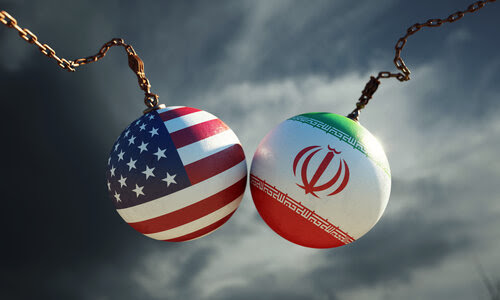
The world is once again holding its breath as the drums of war echo across the Middle East — and this time, the sound is unmistakably louder. What is unfolding is not routine posturing or diplomatic theater. It is the deliberate assembly of military force, political will, and strategic timing that historically precedes a major conflict. With Donald Trump signaling readiness to strike Iran and Israel bracing for retaliation, the region appears closer to a large-scale confrontation than at any point since the brief but volatile “12-day war” last year.
Officials close to Benjamin Netanyahu say Israel’s defense establishment has moved to its highest alert level amid growing expectations that Washington could launch a broad strike within days. The reasoning is blunt: U.S. negotiators believe Tehran is deliberately stalling nuclear talks and attempting to mislead the United States. According to diplomatic sources cited by Al‑Jazeera, American patience “may run out faster than Tehran thinks.” That assessment alone would be alarming. But what truly signals escalation is the scale of military movement now underway.
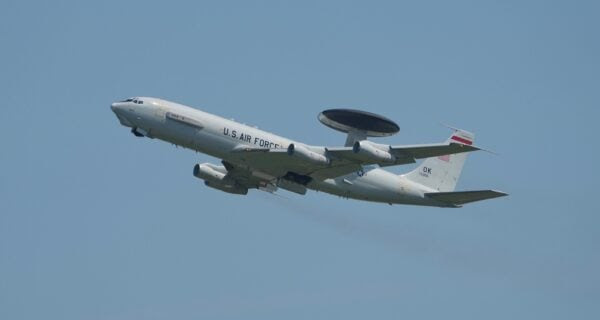
Flight trackers show waves of American airpower heading east — stealth fighters, refueling aircraft, surveillance planes, and airborne command systems. This is not symbolic force. This is operational force. The presence of advanced aircraft such as F-22s and F-35s, along with AWACS command planes and high-altitude reconnaissance platforms, forms the backbone of sustained air campaigns, not one-night strikes. Analysts note that this is precisely the type of buildup that preceded previous U.S. operations designed to cripple enemy air defenses and command infrastructure.
At sea, the U.S. Navy now has an unusually dense concentration of assets in the region, while more than 30,000 American troops remain stationed across Middle Eastern bases. Two carrier groups operating simultaneously provide Washington with a level of flexibility and firepower that signals preparation for prolonged engagement rather than a quick punitive strike. Even without official confirmation, the strategic message is unmistakable: this is a war-ready posture.
Tehran is responding in kind. The Islamic Revolutionary Guard Corps — Islamic Revolutionary Guard Corps — has launched live-fire drills in the Strait of Hormuz, the narrow maritime chokepoint through which roughly one-fifth of global oil supply passes. Closing or even threatening this corridor is one of Iran’s most powerful leverage tools. Energy markets understand that a single missile fired in that channel could send oil prices soaring overnight.
Meanwhile, Iran’s Supreme Leader Ali Khamenei has issued direct threats against U.S. warships, boasting of weapons capable of sinking them. Such rhetoric is not merely propaganda. In military signaling, public threats often function as strategic warnings — a way of shaping expectations before hostilities begin.
What makes this moment especially volatile is the widening battlefield that could erupt instantly if a strike occurs. Israeli planners expect that Iran would retaliate against Israel regardless of whether Israeli forces participate in the attack. That means multiple fronts could ignite simultaneously. The Iranian-backed Hezbollah in Lebanon and Houthis in Yemen are widely expected to launch missiles and drones. Israeli officials believe such escalation is not hypothetical but probable.
The strategic calculus is chilling: any U.S. strike would not be a single blow but a campaign lasting weeks. American planners reportedly understand that crippling Iran’s military infrastructure — or even pursuing regime destabilization — would require sustained operations. The possibility that regime change could become an objective dramatically raises the stakes, because such goals historically transform limited conflicts into prolonged wars.
Diplomacy, for now, remains alive but fragile. Negotiators meeting in Switzerland have agreed only on vague “guiding principles,” according to Iranian officials quoted by The New York Times. That lack of detail is telling. Progress in nuclear talks is usually accompanied by concrete frameworks, not abstract optimism. Even Fox News reported comments from U.S. Ambassador to NATO Matt Whitaker warning that failure to reach a deal would be “a very bad day for Iran.
History suggests such language is rarely idle. Washington has often used negotiations as both diplomatic channels and strategic cover while positioning forces. The pattern is well known to military historians: diplomacy buys time, deployments create leverage, and deadlines compress decision-making until confrontation becomes almost inevitable.
The most sobering reality is this — wars do not usually begin with declarations. They begin with movements. Aircraft reposition. Ships deploy. Allies coordinate. Civil defense agencies activate. All of those things are happening now.
This does not guarantee war. Massive buildups can still function as coercive pressure designed to force concessions at the last moment. It is entirely possible that Tehran could agree to stricter nuclear limits to avoid catastrophe. But if that were the direction events were heading, we would expect to see de-escalation signals, not the largest regional force concentration in years.
The world therefore stands at a decisive hinge point. Either the current show of force succeeds in compelling a diplomatic breakthrough — or it becomes the prelude to a regional war with global consequences. Oil markets, shipping lanes, and international alliances all hang in the balance.
Moments like this test not only leaders but history itself. Because once the first strike is launched, events rarely unfold according to plan. And if the missiles do fly, what follows may not be a short conflict measured in days — but a defining geopolitical struggle measured in years.
The Dragon is Stockpiling ??!!?? – Stockpiling For Showdown: Why China’s Oil Buying Spree Has Analysts Worried

There are moments when numbers stop being statistics and start becoming warnings. The latest figures on oil accumulation by China may be one of those moments. On paper, Beijing’s massive crude stockpiling spree looks like smart economics — buying low while prices remain relatively soft. But in the language of geopolitics, stockpiles of fuel have always meant something more. They mean preparation. They mean insulation. And sometimes, they mean anticipation of conflict.
Over the past two years, China has quietly added hundreds of millions of barrels of crude to its reserves, building inventories equivalent to roughly three months of imports. Analysts told the U.S.-China Economic and Security Review Commission that large-scale energy stockpiling has historically functioned as a “strategic warning indicator.” That phrase should not be brushed aside. Nations do not spend billions warehousing fuel simply because it is convenient. They do so because they believe they may someday need to operate without access to global markets.
To understand why this matters, consider China’s vulnerability. The country imports more than 70% of its crude, much of it traveling along sea lanes effectively secured by the United States and its allies. In a hypothetical crisis over Taiwan, those routes could be restricted or blockaded. Oil, therefore, is not merely a commodity for Beijing — it is a strategic lifeline. If that lifeline were cut, its military, manufacturing base, transportation grid, and chemical industries would all feel the shock simultaneously.
History shows this pattern clearly. Governments preparing for major conflict have always stockpiled critical resources. Before and during the early twentieth century, the United Kingdom treated oil reserves as a matter of national survival, especially once the Royal Navy shifted from coal to petroleum. Strategic fuel access became synonymous with military readiness. The same lesson was reinforced repeatedly throughout modern industrial warfare: armies march on logistics, not ideology.
China’s defenders argue that what Beijing is doing is normal. Indeed, many advanced economies maintain emergency petroleum reserves coordinated through the International Energy Agency. Those stockpiles exist precisely to cushion supply shocks, natural disasters, or geopolitical disruptions. Even so, the scale, secrecy, and persistence of China’s buildup set it apart. Most countries publish detailed reserve data. China treats its numbers as a state secret. That opacity is what transforms routine preparedness into a source of global suspicion.
The sheer size of recent accumulation raises eyebrows. Analysts estimate China added the equivalent of more than a million barrels per day to storage during 2025 alone, on top of similar increases the previous year. This was not passive growth tied to consumption needs. In fact, domestic fuel demand has been slowing due to electric vehicles and alternative fuels. Instead, imports continued to exceed refinery processing, leaving tens of millions of tonnes unaccounted for — oil that appears to have gone straight into storage tanks.
That buying spree has already reshaped global markets. By absorbing surplus supply, China has helped prevent a deeper collapse in prices even as producers like Saudi Arabia and partners in OPEC increased output. In effect, Beijing has become an unofficial buffer for the world oil market. But this stabilizing role comes with a catch: if China ever stops buying — or worse, starts releasing reserves strategically — prices could swing violently in the opposite direction.
Supporters of Beijing’s policy insist the explanation is simple risk management. From their perspective, a nation dependent on imported fuel would be irresponsible not to prepare for worst-case scenarios. They point out that three months of reserves is roughly consistent with historical benchmarks used by other import-dependent economies. In that sense, China may merely be catching up to standards long adopted elsewhere.
Yet context matters. Stockpiling alone is not proof of hostile intent. But stockpiling combined with military expansion, assertive regional policy, and increasingly confrontational rhetoric does send a signal. Strategic analysts do not evaluate indicators in isolation; they look for patterns. And the pattern emerging from Beijing is one of long-term resilience planning — the kind a state undertakes when it expects to operate under sanctions, embargoes, or wartime disruption.
There is also a psychological dimension. Energy security can make leaders more cautious because they feel protected from external pressure. But it can also make them more confident in taking risks. If policymakers believe their economy can withstand isolation for months, they may be less deterred by threats of economic retaliation. In that sense, oil reserves can function not only as shields but as enablers.
The greatest concern is not that China is storing oil. It is that the world cannot clearly see how much it is storing, how fast it is adding to reserves, or under what conditions it would use them. Transparency builds trust; secrecy breeds suspicion. Right now, Beijing’s energy policy is opaque enough that outside observers are left guessing. In geopolitics, guessing is dangerous. Misinterpretation has started wars before.
None of this means conflict is inevitable. Nations prepare for crises that never come all the time. But it does mean policymakers, investors, and citizens alike should pay attention. Oil has always been more than fuel. It is leverage, insurance, and sometimes a silent declaration of intent.
When a global power quietly amasses strategic energy stockpiles at record speed, the question is not whether it has a reason. The question is what reason it anticipates. And that is a question the world cannot afford to ignore.
Doctrines of Demons are causing Christain Worries = The Pulpit Trust Crisis: Why Americans Are Losing Faith In Clergy

Every week it seems another pastor or prominent spiritual leader is splashed across headlines for sexual immorality, abuse, or moral hypocrisy. The pattern has become so tragically familiar that many believers no longer react with shock–but with a weary sigh. What was once unthinkable has become expected. And now the data confirms what the headlines have been whispering for years: public trust in clergy is collapsing.
A new survey from Gallup reveals that only 27% of Americans rate clergy as “high” or “very high” in honesty and ethics–the lowest level recorded in the organization’s half-century of tracking public perception. As recently as 2013, nearly half of Americans still viewed clergy as ethically trustworthy. Before 1999, pastors and pharmacists routinely ranked among the most trusted professions in the nation. Today, that moral credibility has eroded so severely that clergy now sit closer to the bottom tier of trusted professions than the top.
This collapse did not happen overnight. It came drip by drip–scandal by scandal, cover-up by cover-up, apology by apology. The public has watched story after story unfold: leaders preaching purity while living double lives, churches silencing victims to “protect the ministry,” and institutions prioritizing reputation over repentance. Each incident chips away at trust not only in individual leaders, but in the office of spiritual leadership itself.
Another study reinforces this sobering trend. Research from Barna Group found that fewer than half of American adults consider pastors “very reliable” for spiritual guidance, and only 23% of adults say pastors are definitely trustworthy sources of wisdom. Among non-Christians, that number plunges to 4%–essentially statistical collapse. Even among Christians, confidence reaches only 31%, hardly a ringing endorsement from the very people clergy are called to shepherd.
The generational implications may be even more alarming. Barna’s 2025 State of the Church study, conducted with Gloo, shows that younger Americans increasingly hesitate to trust church leaders at all. Only 28% of Gen Z adults say pastors are their most trusted source for spiritual questions. More trust their mothers (34%), and even more trust the Bible itself (39%). Among teenagers, family guidance eclipses clergy influence entirely, with 53% turning first to their mothers for spiritual direction.
In one sense, that shift reflects something healthy: Scripture and family should never be replaced by clergy authority. But the broader pattern signals a crisis. When shepherds lose credibility, sheep scatter. When spiritual authority is distrusted, discipleship weakens. When moral leaders fall publicly, faith itself is questioned privately.
The consequences extend far beyond church attendance numbers. A culture that stops trusting spiritual leadership often stops listening to moral guidance altogether. That vacuum rarely stays empty. It gets filled by influencers, algorithms, celebrities, or ideologies with no accountability and no grounding in timeless truth. Distrust in clergy can quietly become distrust in faith itself.
Yet the proper response is not denial–it is reform.
Churches must stop pretending scandals are rare anomalies and start treating them as serious threats requiring real safeguards. Healthy ministries now implement accountability structures: independent oversight boards, transparent financial systems, mandatory reporting policies, counseling requirements, and shared leadership models that prevent any single personality from becoming untouchable. These safeguards are not signs of distrust; they are signs of wisdom. Scripture itself warns that leaders will be judged more strictly. Oversight is not a lack of faith–it is obedience.
Equally important is how churches respond when sin does occur. Cover-ups destroy more trust than the original wrongdoing. History shows that congregations are often willing to forgive fallen leaders who repent honestly–but they rarely forgive institutions that lie. Transparency, confession, restitution, and cooperation with civil authorities are not public-relations strategies; they are moral obligations.
Still, amid this sobering landscape, believers must remember a vital truth: Christianity was never built on the perfection of its messengers. It was built on the perfection of the One they proclaim. Pastors are human. Priests are flawed. Ministers are fallible. Christ is not.
If faith rests on a personality, it will collapse when that personality falls. But if faith rests on Christ, it stands even when leaders fail. The tragedy of declining trust in clergy is real–but it should also serve as a spiritual recalibration. Our confidence was never meant to be in men with pulpits, titles, or platforms. It was meant to be in God.
The current crisis, painful as it is, may ultimately purify the church. Exposure can lead to repentance. Accountability can lead to integrity. Humility can lead to renewal. And perhaps, if churches choose honesty over image and holiness over hype, trust can slowly be rebuilt–not through marketing campaigns, but through lives that match the message.
Because in the end, the world is not longing for flawless pastors. It is longing for authentic ones.
Gog and Magog Update
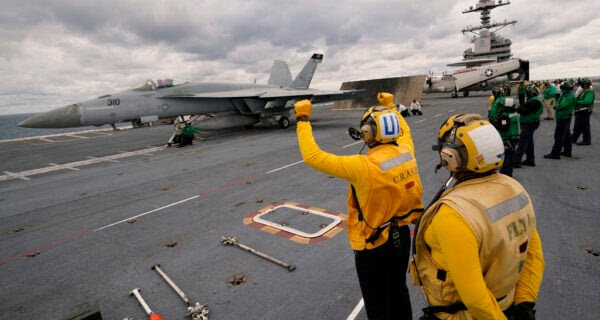
Report: US military ready for Iran war, Trump could launch strikes this week.
The US could strike Iran as soon as this week if Trump decides on military intervention, top national security officials say.
The United States military has effectively completed the preparations needed to begin a sustained military campaign against Iran, with the US able to initiate an air campaign as soon as this week, CBS News reported .
Citing multiple sources familiar with President Donald Trump’s briefings by top national security officials, the report said that the US military could begin striking Iran as early as Saturday, following the large-scale deployment of air units to the Middle East this week.
President Trump has yet to make a final decision on the matter, the officials told CBS News, emphasizing that the discussions in the White House are ongoing.
Over the past two days, the U.S. has deployed at least 125 additional aircraft to the region, including 12 F-22s and 19 F-35s, 48 F-16 fighter jets, 40 refueling aircraft, six E-3G Sentry AWACS aircraft and at least one RC-135 strategic reconnaissance aircraft.
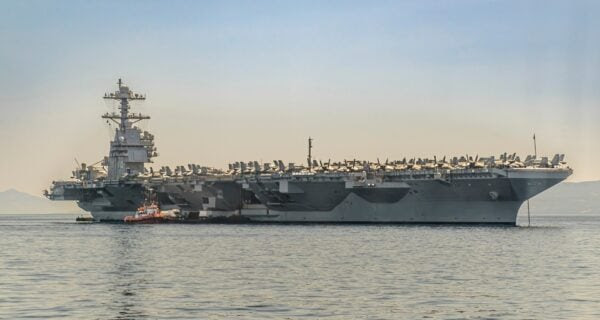
One nuclear-powered aircraft carrier, the USS Abraham Lincoln, and its battle group are already in the Persian Gulf, with a second carrier battle group, centered around the USS Gerald R. Ford en route to the Mideast.
Will the US attack Iran? Here’s Trump’s answer
The Pentagon has ordered some personnel currently stationed in the Middle East to evacuate, multiple officials said, with the transfers expected to be wrapped up by Saturday. The personnel are being redeployed to Europe and the United States as part of what sources said was a standard pre-operation practice that does not necessarily signal an imminent attack.
The US and Iran held a second round of talks in Geneva on Tuesday, with both sides reporting progress, though Vice President JD Vance told Fox News that it appears Iran is still refusing to acknowledge America’s red lines in talks.
On Wednesday, White House Press Secretary Karoline Leavitt said that “There are many reasons and arguments that one could make for a strike against Iran,” while adding that for Trump, “diplomacy is always his first option.”
LATEST UPDATE = GOG AND MAGOG BATTLE
Magog / IRGC takes control of Hezbollah, prepares for war with Iran and Israel
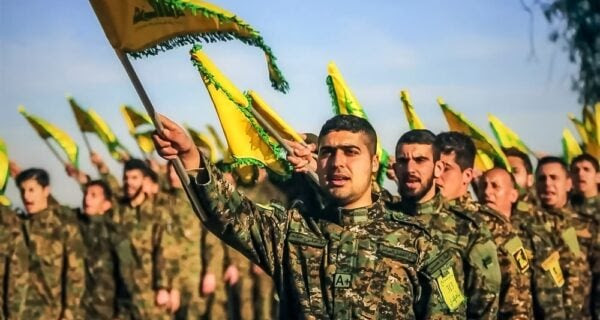
Iran has been pressuring Hezbollah to fight alongside it should hostilities erupt with Israel.
Iran-backed Hezbollah is now operating under the direct control of officers from Tehran’s Islamic Revolutionary Guard Corps, according to sources cited by Saudi outlet Al-Arabiya, as Israel carried out airstrikes in Lebanon and regional tensions continue to rise.
The sources told Al-Arabiya that IRGC officers, some of whom recently arrived in Lebanon from Iran, have assumed responsibility for restructuring Hezbollah’s military capabilities. They said the officers have been briefing fighters across the country as Iran prepares for a potential war with the United States and Israel.
According to the report, IRGC personnel were meeting with members of Hezbollah’s missile unit at a location in Lebanon’s Beqaa Valley that was struck by Israel overnight. The strikes were part of a wave of Israeli air attacks that wounded at least 50 people and killed 12, including a senior Hezbollah officer, targeting what the Israel Defense Forces said were Hamas and Hezbollah command centers in Lebanon.
The Hezbollah-aligned sources cited by Al-Arabiya said a broader Israeli military offensive against Hezbollah is inevitable and “only a matter of time.”
Hezbollah almost invaded northern Israel on Oct. 7, experts say
Separately, the Lebanese outlet Nidaa al-Watan, which is critical of Hezbollah, cited what it described as “prominent political sources” calling on Beirut to declare neutrality in the event of a war between the United States and Iran.
The sources said Lebanon should refuse to allow Hezbollah to draw the country into a conflict with Israel.
The Ynet news site reported earlier this week that Iran has been pressuring Hezbollah to fight alongside it should hostilities erupt with Israel. The report added to growing signs of coordination between Tehran and the Lebanese group amid escalating regional tensions.
Hezbollah leader Naim Qassem addressed the issue last month, saying the group would not remain neutral in the event of a war. While his remarks stopped short of an explicit threat against Israel, they underscored Hezbollah’s alignment with Iran in a broader regional confrontation.
The latest reports come as Israel continues to target Hezbollah infrastructure and command sites in Lebanon, with the IDF saying the strikes are aimed at preventing attacks and degrading the operational capabilities of Iran-backed groups operating along Israel’s northern border.
US-Iran war inevitable, Israel preparing for joint attack with US
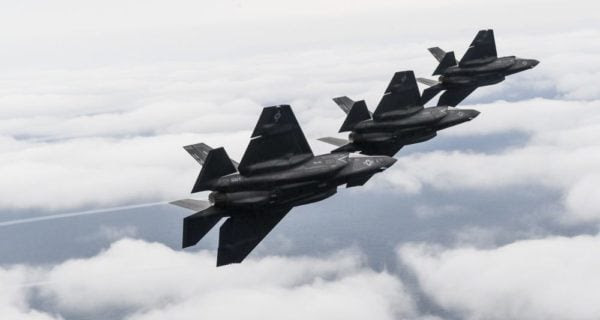
Talks between Iran and the United States have stalled after two rounds failed to resolve disputes over uranium enrichment, missiles and sanctions relief.
Iran and the United States are moving closer to military confrontation as diplomatic efforts over Tehran’s nuclear program stall and Washington expands its military presence in the Middle East, according to officials and diplomats cited by Reuters.
Officials from Iran, the United States, Gulf countries, Europe and Israel told Reuters that expectations for a negotiated settlement are fading, with regional actors now viewing conflict as more likely than compromise.
Israeli officials said they believe the gaps between Washington and Tehran are unbridgeable and that the likelihood of near-term escalation is high.
One source familiar with Israeli planning said Israel is preparing for potential joint military action with the United States, though no decision has been made.
The buildup would mark the second time the United States and Israel have attacked Iran in less than a year, following US and Israeli airstrikes on Iranian military and nuclear facilities last June.
Regional officials said oil-producing Gulf states are making contingency plans for a confrontation they fear could spiral and destabilize the region, as rising tensions push oil prices higher.
IAEA chief meets Iranian FM ahead of US nuclear talks in Geneva
Talks between Iran and the United States have stalled after two rounds failed to resolve disputes over uranium enrichment, missiles and sanctions relief.
A source familiar with the negotiations said Iranian Foreign Minister Abbas Araqchi declined to open and returned a US proposal on missiles delivered by Omani mediators.
After talks in Geneva on Tuesday, Araqchi said the sides had agreed on “guiding principles,” while the White House said significant differences remained.
A US official said Iran is expected to submit a written proposal soon, and Araqchi said Friday he anticipated a draft counterproposal within days.
President Donald Trump has warned Iran it must reach a deal or face consequences, saying on Thursday that “really bad things” would happen otherwise.
He appeared to set a 10-15 day window, prompting threats from Tehran to retaliate against US bases if attacked. Trump later said he was weighing limited military action, telling reporters, “I guess I can say I am considering that.”
US officials said Trump has not yet decided on the use of force. Secretary of State Marco Rubio is scheduled to meet Israeli Prime Minister Benjamin Netanyahu on February 28, and a senior US official said it would be mid-March before all US forces are fully in place.
Former US diplomat Alan Eyre told Reuters that progress is unlikely unless both sides retreat from entrenched positions, warning that “if he attacks, it’s going to get ugly quickly.”
TruLight Ministries Daily Entertainment

TruLight TV – Popcorn and Movie Time – Amazing Love: The Story of Hosea
A Youth Pastor (Sean Astin) and his wife (Erin Bethea) take 5 teens on a weekend camping trip. A conflict results between two of them and creates tension in the camp. To try and resolve this, the Youth Pastor tells the teens the story of the Old Testament prophet, Hosea. At first the teens don’t want to hear it, but as he proceeds with the story, they become more interested. The story flashes back to Israel and shows Hosea’s great commitment to God and unconditional love for his wife. This movie offers real inspiration through the character of Hosea and also has a touching gospel presentation showing the great love of Christ.
Today on TruLight Radio XM
TruLight Radio XM 24/7
Program
GMT / UTC +2
Monday To Fridays
00:15 Words to Live By Testimonies
01.15 Science Scripture and Salvation
02.15 Ground Works
04.00 Gospel Concert of the Day
05.00 The Daren Streblow Comedy Show
5:55 It is Today devotional
6:00 Gaither Homecoming Morning Show
7:15 Discover the Word
8.15 Destined for Victory
8:55 Science Scripture and Salvation
9:00 Holy Spirit Hour – Normally Sermons
10:15 Hope of the Heart
11:15 Unshackled
11.45 Words to Live By
12:15 Truth for Life
13:15 Living on the Edge with Chip Ingram
14:15 Focus on the Family
15:00 Kids Hour
16:00 In Touch with Dr. Charles Stanley
16:30 Groundwork
17:15 Live in the Light
18:15 Renewing your Mind
19:00 Gaither Homecoming Show
20:15 Growing Hope
21:15 Adventures in Odyssey Radio Drama
21:45 Bible Reading
22:15 Night-sounds
23.00 Good Old Country Gospel / Rhema Gospel Express
VISIT THE WEBSITE
TruLight Ministry News

TruLight Ministries orders from God since 2012 . Teach Them , Comfort Them and Warn Them!
a Gospel Group blessed us with a Radio / TV Liner
Healing Truths
End Time Articles
Share this Feeding of Manna with your Friends and Family. just click on the Social Media icon and share !