Hosted by TruLight Ministries – The Place of Truth
SELECT YOUR READING LANGUAGE – BOTTOM LEFT = YOUR DAILY MANNA NOW AVAILABLE IN 103 LANGUAGES
Today we Finalize this Study ! The Armor of God.
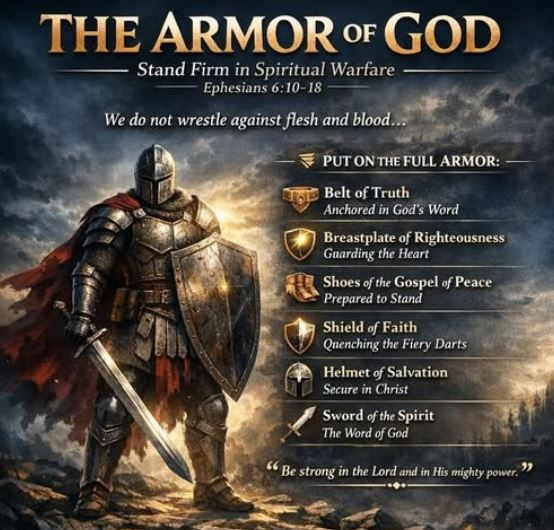
The Sword of the Spirit = The Word of God
The phrase “sword of the Spirit” is found only once in Scripture, in Ephesians 6:17. The sword is one of the pieces of spiritual armor Paul tells the Ephesian Christians to put on as part of the “full armor of God” that will enable us to stand our ground against evil (Ephesians 6:13).
The sword is both an offensive and defensive weapon used by soldiers or warriors. In this case it is a weapon belonging to the Holy Spirit. Swords were used to protect oneself from harm or to attack the enemy to overcome or kill him. In both cases it was necessary for a soldier to get rigid training on the proper use of the sword to get maximum protection. All Christian soldiers need the same rigid training to know how to properly handle the Sword of the Spirit, “which is the word of God.” The sword that Paul refers to here is the Holy Scriptures. We know from 2 Timothy 3:16–17 that the word of God is from the Holy Spirit and written by men. Since every Christian is in a spiritual battle with the satanic and evil forces of this world, we need to know how to handle the Word properly. Only then will it be an effective defense against evil, but it will also be an offensive weapon we use to “demolish strongholds” of error and falsehood (2 Corinthians 10:4–5).
God refers to His Word as a sword in Hebrews 4:12. Here the Word is described as living and active and sharper than a double-edged sword. The Roman sword was commonly made in this manner. The fact that it had two edges made it easier to penetrate, as well as to cut in every way. The idea is that of piercing, or penetrating; the Word of God reaches the “heart,” the very center of action, and lays open the motives and feelings of those it touches.
The purpose of the sword of the Spirit—the Bible—is to make us strong and able to withstand the evil onslaughts of Satan, our enemy (Psalm 119:11, 33–40, 99–105). The Holy Spirit uses the power of the Word to save souls and then to give them spiritual strength to be mature soldiers for the Lord in fighting this corrupt and evil world we live in. The more we know and understand the Word of God, the more useful we will be in doing the will of God and the more effective we will be in standing against the enemy of our souls.

Bible Verse and Prayer for Today
No temptation has seized you except what is common to man. And God is faithful; he will not let you be tempted beyond what you can bear. But when you are tempted, he will also provide a way out so that you can stand up under it.
—1 Corinthians 10:13
TEMPTATION… We’ve all faced it. We know it is the evil one’s carefully crafted weapon, specifically designed to ensnare us mortals. We can sometimes even hear the voice of the evil one in our heads, saying, “No one will ever know. Besides, it won’t hurt anyone!” But in our hearts, we know that to cave in to temptation matters because we’ve allowed ourselves to give in to what is wrong and given away part of ourselves. Thankfully, we can defeat temptation if we do what this verse reminds us:
To recognize temptation when it presents itself.
To know this specific temptation we face is common to mortals, so I can overcome it because others have.
To remember that God is faithful. My Father in heaven won’t let me be tempted above what I can handle.
To believe that God will provide a way of escape, so I need to look for it, and resist the evil one behind it, as I draw near to God (James 1:13-15, 4:7-8).
Prayer
Righteous and loving Father, guard my heart from temptation and my life from sin. I want to serve you with wholehearted devotion. Forgive me for my past sin, and by your grace and through your word, strengthen me with your Holy Spirit so that I may overcome the temptations the evil one uses to separate me from you. Through my Protector and Redeemer, Jesus, I pray with confidence. Amen and Amen
Bible Teaching of the Day
Perhaps one of the best-known statements from the writer of Hebrews is that “the word of God is living and active, sharper than any two-edged sword,” and that the Word of God divides even soul and spirit (Hebrews 4:12, ESV). The “Word” here is the written True Word of God—the Bible.
It is the sharpness, the keenness, of the Bible that the writer of Hebrews emphasizes: “Sharper than any double-edged sword, it penetrates even to dividing soul and spirit, joints and marrow; it judges the thoughts and attitudes of the heart” (Hebrews 4:12). The other passage where the Word is compared to a sword is Ephesians 6:17, which admonishes Christians to take up “the sword of the Spirit, which is the word of God.” Just as a physical sword can cut through a person’s body, so the spiritual sword (the Word) can penetrate to the very depths of the human heart. In fact, the Word of God is even more effectual in its cutting power than the most expertly honed double-edged blade.
What God has revealed is so precise and so accurate as to make the minutest of judgments and to be able to discern where the soul and spirit begin and end. It can even expose “our innermost thoughts and desires” (Hebrews 4:12, NLT).
Many passages of Scripture mention both “soul” and “spirit.” When this occurs in Hebrew poetry (e.g., 1 Samuel 1:15; Job 7:11; Isaiah 26:9), the parallelism would seem to equate the two terms. Other passages, such as 1 Thessalonians 5:23, however, seem to treat the soul and spirit as if they were distinct from each other. But the division is never defined or explained. Neither does the writer of Hebrews expound; he only asserts that the Word of God “pierces even to dividing soul and spirit” (Hebrews 4:12, BSB). We can’t discern that division, but God can.
So, if the Word of God can divide soul and spirit, what is the difference between the soul and the spirit? One way to look at it is that the soul is the “life force” of a person; it is the essence of humanity’s being. The spirit is related to the soul but is more specifically the immaterial part of humanity that connects with God. As commentary puts it, the Word of God reaches “even to the separation of the animal soul, the lower part of man’s incorporeal nature, the seat of animal desires, which he has in common with the brutes; compare the same Greek, 1Co 2:14, ‘the natural [animal-souled] man’ (Jude 19), from the spirit (the higher part of man, receptive of the Spirit of God, and allying him to heavenly beings)” (Jamieson, R.; Fausset, A.; and Brown, D.; A Commentary, Critical, Practical, and Explanatory on the Old and New Testaments, 1882, entry for Hebrews 4:12).
There is another way to see this passage, however. Some Bible scholars consider the soul and spirit to be one and the same thing. Instances of the phrase soul and spirit are simply a writer’s way of emphasizing the totality of the inner person. As Heinrich Meyer puts it, the reference to “soul and spirit” (and “joints and marrow”) is “a figurative expression to denote the innermost, most hidden depth of the rational life of man” (New Testament Commentary, 1880, entry for Hebrews 4:12). And John MacArthur says, “These terms [soul and spirit] do not describe two separate entities (and more than “thoughts and intentions” do) but are used as one might say “heart and soul” to express fulness. . . . Elsewhere these two terms are used interchangeably to describe man’s immaterial self, his eternal inner person” (The MacArthur Study Bible, English Standard Version, Crossway, 2010, p. 1,853).
Whether the soul and spirit actually have a dividing line, the written Word of God is living, sharp, and powerful and has the ability to judge our thoughts. Scripture has a way of laying open our innermost feelings and desires, exposing our secrets, and forcing honesty before the God who created us.
Today’s Devotional
Before Jesus ascended to heaven, He told His disciples that He would send one who would teach and guide all those who believe in Him (Acts 1:5; John 14:26; 16:7). Jesus’ promise was fulfilled less than two weeks later when the Holy Spirit came in power on the believers at Pentecost (Acts 2). Now, when a person believes in Christ, the Holy Spirit immediately becomes a permanent part of his life (Romans 8:14; 1 Corinthians 12:13; Ephesians 1:13–14).
The Holy Spirit has many functions. Not only does He distribute spiritual gifts according to His will (1 Corinthians 12:7–11), but He also comforts us (John 14:16, KJV), teaches us (John 14:26), and remains in us as a seal of promise upon our hearts until the day of Jesus’ return (Ephesians 1:13; 4:30). The Holy Spirit also takes on the role of Guide and Counselor, leading us in the way we should go and revealing God’s truth (Luke 12:12; 1 Corinthians 2:6–10).
But how do we recognize the Spirit’s guidance? How do we discern between our own thoughts and His leading? After all, the Holy Spirit does not speak with audible words. Rather, He guides us through our own consciences (Romans 9:1) and other quiet, subtle ways.
One of the most important ways to recognize the Holy Spirit’s guidance is to be familiar with God’s Word. The Bible is the ultimate source of wisdom about how we should live (2 Timothy 3:16), and believers are to search the Scriptures, meditate on them, and commit them to memory (Joshua 1:8). The Word is the “sword of the Spirit” (Ephesians 6:17), and the Spirit will use it to speak to us (John 16:12–14) to reveal God’s will for our lives; He will also bring specific Scriptures to mind at times when we need them most (John 14:26).
Knowledge of God’s Word can help us to discern whether or not our desires come from the Holy Spirit. We must test our inclinations against Scripture—the Holy Spirit will never prod us to do anything contrary to God’s Word. If it conflicts with the Bible, then it is not from the Holy Spirit and should be ignored.
It is also necessary for us to be in continual prayer with the Father (1 Thessalonians 5:17). Not only does this keep our hearts and minds open to the Holy Spirit’s leading, but it also allows the Spirit to speak on our behalf: “In the same way, the Spirit helps us in our weakness. We do not know what we ought to pray for, but the Spirit himself intercedes for us through wordless groans. And he who searches our hearts knows the mind of the Spirit, because the Spirit intercedes for God’s people in accordance with the will of God” (Romans 8:26–27).
Another way to tell if we are following the Spirit’s leading is to look for signs of His fruit in our lives (Galatians 5:22–23). If we walk in the Spirit, we will continue to see these qualities grow and mature in us, and they will become evident to others as well.
It is important to note that we have the choice whether or not to accept the Holy Spirit’s guidance. When we know the will of God but do not follow it, we are resisting the Spirit’s work in our lives (Acts 7:51; 1 Thessalonians 5:19), and a desire to follow our own way grieves Him (Ephesians 4:30). The Spirit will never lead us into sin. Habitual sin will cause us to miss what the Holy Spirit wants to say to us through the Word. Being in tune with God’s will, turning from and confessing sin, and making a habit of prayer and the study of God’s Word will allow us to recognize—and follow—the Spirit’s leading.

Bible Prophecy, Signs of the Times and Gog and Magog Updates with Articles in the News
Genetics Helping Restore Priestly Lineage Of Levites For Third Temple Service
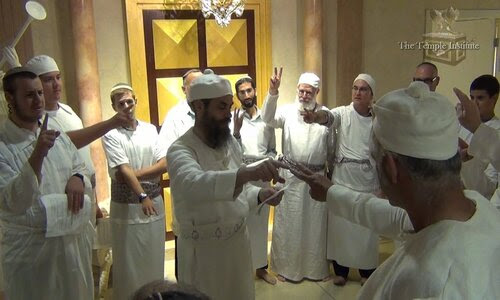
The wind cuts down from the Mount of Olives as three Jewish men named Cohen hunch their shoulders against the cold and start up the wooden ramp to the Temple Mount, breath clouding in the Jerusalem air.
In a scene that could stand in for countless real family journeys, their grandparents’ stories trace lines through Poland, Tunisia and Iran, but here the paths merge: walking the worn stone their Israelite forefathers once crossed in white linen, lips shaping the same psalms those priests sang when the Temple still stood and the smoke of offerings climbed into the winter sky.
If this trio had wanted more than a symbolic ascent–if they had wanted to learn how to bless, to sing and to serve as their ancestors once did–they could now find a place to do it.
An emerging effort to revive the Aaronite priests and Levitical assistants of ancient Israel has grown into a nearly 100-strong professional community of Kohanim and Levites in just a month, led by a young Israeli doctor and Temple Mount activist.
Nathan Huberman, 32, a Canadian-born physician, Israel Defense Forces veteran and longtime Temple Mount guide who lives outside Jerusalem, recently talked to JNS about his work turning ancient hereditary roles into a concrete program of training, identity and public engagement.
“These communities are professional communities, founded on four principles,” Huberman said. “Identity, an identity that comes with responsibility, knowing the actions you are meant to perform, and setting professional standards for those actions.”
Huberman is building two separate but related professional communities rooted in priestly and Levitical identity, each with its own focus and infrastructure.
The Kohen community operates under Mamlechet Kohanim, which runs a basic training course using life-sized replicas of Temple vessels–including an altar and menorah–and brings in specialists to teach practical workshops. The aim is to grow both the number of participants and their level of professional preparedness for traditional priestly functions.
The Levite community is organized through the Beyadenu organization and is centered on the Temple Mount, where members ascend to areas permitted under Jewish law and sing, echoing the role of Levites in the ancient Temple ensemble. Huberman is working to formalize this track as well, consulting musicologists and performers from Levitical families to design a dedicated course in Levite liturgical song that is still in development
Because both groups are identity-based ethnic communities, Huberman says there is significant work to be done in structuring them along traditional lines. He notes that biblical, rabbinic and archaeological sources describe how the Temple workforce was divided, and that some families today claim descent from the Second Temple-era mishmarot, or service divisions.
In theory, he adds, modern genetic research could be used to help sort contemporary priests and Levites into their ancestral family lines, further refining how the two communities are organized.
“I’m here just connecting dots,” said Huberman. “There are people out there doing great work, and these communities invite people to take part in those dots that are already there and connect to them.”
The Levi project rests on what Huberman calls a quiet revolution in Jewish access and religious expression on the Temple Mount over the past decade. Where once Jews risked being expelled or even arrested for closing their eyes too long or appearing to pray, he says it is now possible to sing and even dance openly under the eyes of Israeli police without interference.
As a board member of Beyadenu, Huberman works to ease access and improve the experience for non-Muslims, arguing that a broader cross-section of Israeli society now ascends the Mount, including religious Zionists, haredim and others.
He points to a growing, if often discreet, roster of rabbis who halachically permit ascent under strict guidelines, citing figures such as the late chief rabbis Mordechai Eliyahu and Shlomo Goren and promising to publish a detailed list of supportive authorities.
“Most of the people going up are not very homogenous,” he said. “It’s shared among many different demographics, which is very interesting.”
The communities’ development coincides with cutting-edge research into the Y chromosome of Kohens that, in Huberman’s view, could transform how priestly families organize themselves for renewed Temple service. A recent high-resolution sequencing study, currently available as a preprint, found that roughly 80 percent of tested Kohens cluster into nine major paternal lineages, with about 20% remaining unassigned–an echo, he notes, of Second Temple-era records describing a group called Hakot that was sidelined from service due to unclear lineage.
While stressing that halachic Kohen status cannot rest on DNA alone, Huberman sees enormous potential in using genetics to reconstruct detailed family trees and revive the 24 “mishmarot,” or family shifts, into which King David and the prophet Samuel divided the priestly workforce. He hopes to work with researchers to map well-documented Kohen dynasties–from families in Israel and Tunisia to Middle Eastern clans that preserve scrolls tracing their ancestry back to biblical figures such as Ezra and Eli the High Priest–onto these genetic lines for practical division of future Temple labor.
“You can use the genetic code to recreate family trees,” Huberman emphasized. “You can prove that a Kohen from Algeria and a Kohen from Eastern Europe actually descend from the same person, and that has huge implications for how the Temple service could be organized.”
Huberman situates his initiative within a larger theological and national conversation in Israel about what Jewish sovereignty is ultimately for beyond physical protection from antisemitism. Drawing inspiration from Bar-Ilan University’s professor Hillel Weiss, whose writings on practical steps toward Temple restoration deeply influenced him, he argues that the Temple and its priestly institutions are meant to expand Judaism’s contribution to the world, socially and spiritually.
To that end, the communities collaborate with groups such as the Temple Institute, whose altars and ritual equipment could, in Huberman’s telling, be deployed rapidly if circumstances allowed, making a pool of trained Kohens and Levites a strategic religious asset.
He emphasizes readiness and professionalism over messianic rhetoric, inviting skeptics and supporters alike to visit courses in person and watch Levites sing on the Temple Mount, in the hope that transparency will build trust and normalize what he sees as a grassroots return to Temple-centered Jewish identity.
“The Israeli population in general, Jewish people in general, are grappling with the question,” said Huberman. “We get it, we have a country that’s supposed to protect us from antisemitism, but beyond just protection and creating a country, what are we supposed to do with this country?”
Although still in their earliest stages, the communities already mimic aspects of Chabad-style outreach, with Huberman fielding daily calls from Kohens in Israel and abroad who want to join, including those who are not observant. He portrays the project as a way to “fix historical fractures,” including his own complicated Levitical family story in the shadow of the Holocaust, by rebuilding broken chains of memory and practice.
Next steps include expanding course offerings, formalizing workshops with academic and ritual partners, and building an international network of identity-based priestly and Levitical communities.
Huberman encourages any self-identified Kohen or Levi interested in reconnecting with this heritage to reach out directly through his existing contact details, promising that the door is open to all who wish to turn an inherited status into lived responsibility.
“I want it to be the most inviting that it can be to every Kohen,” Huberman said. “It’s sort of like an outreach movement, like a Chabad for priestly families, bringing this part of Judaism back to Jews all over.”
The War Everyone Is Preparing For – And No One Wants To Start
The aircraft carriers are already in motion.
Missile defenses are quietly repositioned. Intelligence flights sweep the region night after night. Money is moving in Tehran. Commanders are relocating. Safe houses are activated. This is what the final days before a war look like — except the war hasn’t come.
Yet.
For weeks, the United States has positioned itself as if a strike on Iran could happen at any moment. And then, just as suddenly, President Trump’s tone softened. The threats grew less specific. The red lines blurred. The world noticed.
This isn’t hesitation. It’s something more calculated — and more unsettling.
Because behind closed doors, nearly everyone is saying the same thing: don’t pull the trigger.
The Strange Coalition Against War
Saudi Arabia doesn’t want Iran struck. Israel’s Benjamin Netanyahu has reportedly warned against it. Gulf states hosting U.S. bases have pleaded for restraint. Even countries that have spent decades fearing Iranian power are suddenly arguing that weakening Tehran could make everything worse.
That should make us take pause.
Iran is not Iraq. It is not Libya. It is a regime built to survive strikes, absorb pain, and retaliate asymmetrically. Its power doesn’t rest in one bunker or one leader, but in a sprawling network designed for one moment only: the moment Iran believes it is facing extinction.
That is the moment everyone fears.
Because once Iran believes it has nothing left to lose, every restraint disappears. Missiles toward Israel. Proxies unleashed across the region. U.S. bases targeted. Oil lanes disrupted. Markets collapse. A regional war could become global in hours.
Saudi Arabia understands this. Israel understands this. And Washington understands it too — even if it doesn’t say so publicly.
A strike wouldn’t end Iran’s influence. It would detonate it.
The Silent Front: Sleeper Cells and Terror at Home
There is another reason the word “retaliation” sends chills through intelligence circles — and it has nothing to do with missiles.
Iran’s reach does not stop at borders.
For decades, U.S. and allied intelligence agencies have warned that Iran and its proxies maintain sleeper networks across Europe, Latin America, and potentially the United States. These are not standing armies. They are dormant assets — individuals, logistics channels, financial conduits — activated only when Tehran believes it is under existential threat.
A U.S. strike could flip that switch.
Unlike conventional warfare, terror operations don’t require air superiority or supply chains. They require patience, anonymity, and timing. Targets are soft. Attribution is murky. Fear spreads faster than facts.
From cyber sabotage and infrastructure disruption to coordinated attacks on symbolic or civilian targets, Iran has long viewed asymmetric warfare as its most effective response to superior military power. In such a scenario, the American homeland — long insulated from Middle Eastern conflict — would no longer feel distant from the war.
This possibility weighs heavily on U.S. decision-makers. Once unleashed, such networks are difficult to track, harder to dismantle, and politically devastating if even one attack succeeds. The risk is not hypothetical. It is baked into Iran’s doctrine.
War with Iran would not stay overseas.
Why Americans Are Pulling Back
At home, the public mood is clear: most Americans oppose intervention. Not because they sympathize with the Iranian regime — they don’t — but because they recognize a familiar trap.
A strike would be dramatic. It would dominate headlines. It would feel decisive.
And then what?
Without regime change, the U.S. would own the consequences without owning the outcome. Retaliation would be guaranteed. Victory would be undefined. The risk would be permanent.
Americans have lived through this before. They know what happens when military action outruns political reality. They’ve learned that the most dangerous wars are the ones that begin with confidence and end with no exit.
This time, the public is ahead of the politicians.
The Intelligence Game Behind the Curtain
Here is the part rarely discussed.
The threat of war itself may have already delivered something more valuable than missiles ever could: visibility.
With an attack appearing imminent, Iran has begun acting accordingly. Assets have moved. Leaders have shifted locations. Financial networks have been activated. Contingency plans have come alive.
And intelligence agencies have been watching.
In preparing for the worst, Iran may have exposed its survival blueprint — how it expects to ride out a strike, where it hides, how it intends to respond. In chess terms, Tehran revealed its endgame strategy before the first move was made.
That alone may explain the sudden restraint.
When you know your enemy’s escape plan, patience becomes power.
But What About the Iranian People?
And this is where the moral tension tightens.
Are we abandoning them?
For years, Iranians have protested their rulers, risking imprisonment and death. They have watched their economy crumble under corruption and sanctions. They have looked outward, wondering if the West would ever help break the grip of a regime that does not represent them.
Now, as the threat of U.S. action fades, that question hangs heavy: Was this their moment — and did we walk away?
It’s a painful question, and there is no easy answer.
A U.S. strike might weaken the regime — or it might strengthen it by rallying nationalism and crushing dissent under the banner of survival. History suggests authoritarian regimes often emerge more brutal, not less, after external attacks.
Yet restraint carries its own cost. When America pulls back, hope can collapse with it.
The tragedy is this: there may be no military path that truly liberates the Iranian people without destroying the country they live in.
The Pause Before History Turns
This moment is not resolution. It is suspension.
The war is prepared. The intelligence is gathered. The consequences are understood. And for now, the most powerful weapon in America’s arsenal may be the one it hasn’t used.
But pauses don’t last forever.
Iran knows it is being watched. The region knows how close it came. And the Iranian people are left waiting — again — wondering whether silence means patience… or abandonment.
In geopolitics, the most dangerous sentence is never spoken aloud:
“We’ll decide later.”
Because later always comes — and when it does, it rarely looks like the plan anyone imagined.
Open Doors 2026 Report Reveals Christian Persecution At Historic Highs
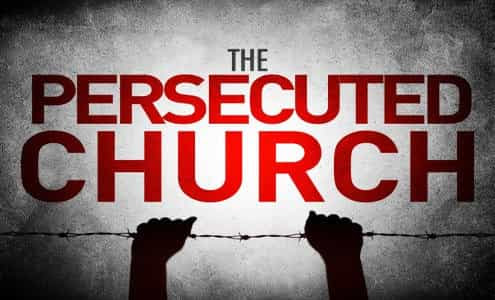
The latest World Watch List from Open Doors is not merely an annual report–it is a global alarm bell. According to the nonprofit’s newly released findings, 388 million Christians worldwide now live under high levels of persecution and discrimination for their faith. That is more than one in seven believers across the globe, and the highest number ever recorded. Behind that staggering figure are stories of churches burned, families displaced, believers surveilled, imprisoned, beaten, or killed–often simply for gathering to pray.
Open Doors CEO Ryan Brown described the trend as both expanding and intensifying. Persecution is not only spreading to new regions, but growing more severe where it already exists. Sub-Saharan Africa remains a particular flashpoint, accounting for the majority of faith-related killings worldwide. Yet the report also highlights how persecution is evolving beyond visible violence into more subtle–but equally destructive–forms of repression through technology, law, and social pressure.
At the top of the World Watch List are ten countries where following Christ is considered especially dangerous. Each represents a distinct face of persecution–and a sobering reminder of what faith can cost in today’s world.
1. North Korea
For the 23rd consecutive year, North Korea ranks as the most dangerous place on earth to be a Christian. Faith in Christ is viewed as treason against the state and its supreme leader. Believers worship in absolute secrecy; discovery can mean imprisonment in brutal labor camps or execution. The regime has increasingly turned to surveillance technology and artificial intelligence to identify “suspicious” behavior–such as private prayer or refusal to venerate government idols–making even silent faith perilous.
2. Somalia
Somalia remains one of the deadliest environments for Christians, particularly converts from Islam. Al-Shabaab militants enforce a rigid form of Islamic law, and even suspicion of Christian belief can lead to immediate execution. One former Muslim cleric who converted to Christianity described living in constant fear, knowing that public discovery could mean beheading in broad daylight. There is virtually no church presence left–only isolated believers clinging to Christ in secrecy.
3. Libya
In Libya, lawlessness fuels persecution. Migrant Christians–particularly from sub-Saharan Africa–are frequent targets for kidnapping, forced labor, and execution by extremist groups. Libyan Christians face pressure from family, community, and militias, while the collapse of central authority has created fertile ground for Islamic extremists to operate with impunity.
4. Eritrea
Often called the “North Korea of Africa,” Eritrea strictly controls religious life. Only a handful of state-approved denominations are permitted, and unregistered churches are raided regularly. Hundreds of Christians remain imprisoned without charge, some held in shipping containers under extreme heat. Many are jailed simply for hosting prayer meetings in their homes.
5. Yemen
Years of civil war have devastated Yemen’s tiny Christian population. Converts face threats from family members as well as Islamist groups like al-Qaeda. Humanitarian collapse has compounded persecution, leaving believers without access to aid if their faith becomes known. For Yemeni Christians, survival itself is often a daily miracle.
6. Nigeria
Nigeria stands at the epicenter of global Christian violence. According to the report, 3,490 of the 4,849 Christians killed worldwide for their faith last year were Nigerian. Islamist militants, Fulani extremists, and criminal gangs target Christian villages, churches, and pastors–often with little response from authorities. Entire communities have been wiped out, turning worship into an act of courage.
7. Pakistan
In Pakistan, harsh blasphemy laws are frequently weaponized against Christians. False accusations can lead to mob violence, lengthy prison sentences, or death. Christian families often live segregated lives, trapped in poverty and denied opportunity. Yet underground churches continue to grow, fueled by believers willing to endure suffering for the sake of Christ.
8. Iran
The Iranian regime views Christianity–especially house churches–as a threat to Islamic rule. Converts from Islam are routinely arrested, interrogated, and imprisoned on national security charges. Despite this, Iran has one of the fastest-growing underground Christian movements in the world, a quiet revival unfolding beneath relentless pressure.
9. Afghanistan
Since the Taliban’s return to power, Afghanistan has become nearly impossible for Christians. Converts are hunted relentlessly, often betrayed by neighbors or even family members. Many have fled the country; those who remain live in constant fear. Public Christian worship is nonexistent, yet faith persists in whispers and hidden prayers.
10. India
India’s persecution is driven less by overt state violence and more by rising Hindu nationalism. Anti-conversion laws, church attacks, and social ostracization have surged in several states. Christians are frequently accused of betraying national identity, and pastors are arrested for “forced conversions” simply for sharing their faith.
Beyond the rankings, Open Doors warns of a troubling global shift from “smash persecution”–violent attacks–to “squeeze persecution,” where governments quietly restrict worship through surveillance, censorship, and legal pressure. China exemplifies this trend, with churches shuttered, Bible apps banned, and online Christian expression tightly controlled.
The World Watch List is not only a record of suffering, but a call to action. It is also a prayer resource–crafted from the voices of persecuted believers themselves. These Christians are not asking for comfort or escape, but for faithfulness, courage, and endurance.
In a world increasingly hostile to biblical Christianity, their witness stands as both a warning and an inspiration. The question now is whether the global Church will listen–and respond.
Trump may assassinate Khamenei this week, says ex-envoy
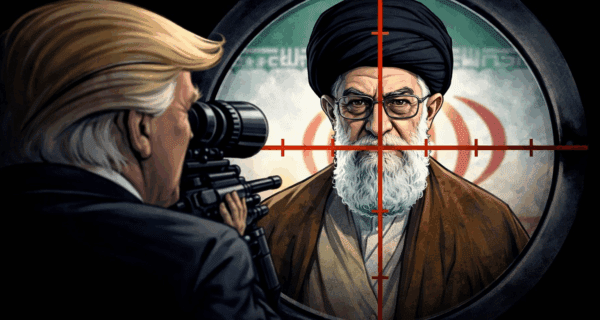
“Trump’s comments and Khamenei’s mindless baiting of Trump lead me to believe that Trump is going to try to kill the Supreme Leader this week.”
As confusion continues to swirl following last week’s non-strike on Iran, after multiple signs pointed to imminent U.S. military action, former U.S. Ambassador to Israel Dan Shapiro offered a blunt assessment of what President Donald Trump’s next move could be.
In a post on X, Shapiro argued that Trump’s recent public comments, combined with escalating rhetoric from Iran’s supreme leader, may point toward a dramatic shift in Washington’s posture, including the possibility of a direct attempt to target Iran’s top leader.
Shapiro’s remarks came after Trump lashed out at Iran’s Supreme Leader Ali Khamenei in comments reported by Politico, calling Khamenei “a sick man” and suggesting Iran should no longer be led by its current ruler.
“It’s time to look for new leadership in Iran,” Trump said.
Shapiro said Trump’s call for new leadership, along with what he described as Khamenei’s “mindless baiting” of Trump on X, led him to believe the president may be considering unprecedented action.
“Trump’s comments to @Politico on needing new leadership in Iran, and Khamenei’s mindless baiting of Trump on X, lead me to believe that Trump is going to try to kill the Supreme Leader this week,” Shapiro wrote.
He pointed to the expected arrival of a U.S. carrier strike group in the Middle East as a key factor that could enable broader operations, including extensive strikes and preparations for Iranian retaliation.
“There will soon be a US carrier strike group in the Middle East, making it easier for the US to carry out extensive strikes in Iran and be prepared to defend against Iranian response strikes,” he wrote.
Shapiro suggested that such a move could be paired with strikes on IRGC and Basij command-and-control nodes, allowing Trump to argue he is keeping faith with Iranian protesters he encouraged and fulfilling his threats to make the regime pay for massacring them.
But he cautioned that even eliminating Khamenei would not necessarily lead to regime change, warning it could instead be followed by an IRGC takeover and a continued aggressive and repressive regime.
Shapiro stressed that real change in Iran would ultimately be driven by the Iranian people and would require sustained focus and largely non-kinetic measures, not “a one-and-done strike.”
Shapiro’s analysis landed amid growing uncertainty over Trump’s Iran strategy, particularly after last week’s anticipated strike did not take place despite widespread expectation that military action was near.
The conflicting signals have fueled speculation about whether Washington is delaying a decision, recalibrating its approach, or intentionally projecting ambiguity to keep Tehran off balance.
Similar themes were echoed by U.S. Senator Lindsey Graham, who is currently visiting Israel and dismissed headlines questioning Trump’s resolve. Graham argued that the key issue is not whether Trump is serious, but whether U.S. operations will expand or narrow in the days ahead.
“The headlines you’re seeing about Trump lacking resolve are not accurate,” Graham said, according to remarks shared in Israel. “The question is whether these operations grow or shrink.”
Graham said he believes the Iranian regime’s “days are numbered,” adding that he is more optimistic now than at any point in recent months.
“Follow my activity over the next day or two and we’ll see,” he said.
He also framed the moment as historic, arguing that those who fail to recognize its scale are missing the magnitude of what may be unfolding.
“If you don’t understand that this is the greatest moment for change since the fall of the Berlin Wall, you’re missing a lot,” Graham said.
For now, however, the outcome remains unclear. Trump’s rhetoric has grown sharper, speculation continues to build, and the steady stream of conflicting reports shows no sign of slowing.
Whether the ambiguity reflects internal debate, shifting diplomatic calculations, or a deliberate effort to keep Tehran off balance, the next move may come with little warning.
TruLight Ministries Daily Entertainment

TruLight TV : The Impact of God’s Promises on Your Everyday Life:
Do you make promises you can’t keep? Has anyone ever promised you something they couldn’t deliver? The Israelites probably thought God wasn’t keeping His promises, but as we learn in Joshua, not one of the Lord’s promises to Israel failed. He will fulfill what He says, trust Him. And our sermon today from Dr. Charles Stanley (Guidance Through Godly Meditation) – If you meditate on God’s Word and listen to Him, He will show you the best path to walk through your circumstances. His answers may not come instantly or without effort on your part. But they have the power to save your finances, your relationships, your family—and possibly even your life. and later Mark shares the heart behind the song “Only Jesus” from the newest Casting Crowns album, Only Jesus!
Today on TruLight Radio XM
TruLight Radio XM 24/7
Program
GMT / UTC +2
Monday To Fridays
00:15 Words to Live By Testimonies
01.15 Science Scripture and Salvation
02.15 Ground Works
04.00 Gospel Concert of the Day
05.00 The Daren Streblow Comedy Show
5:55 It is Today devotional
6:00 Gaither Homecoming Morning Show
7:15 Discover the Word
8.15 Destined for Victory
8:55 Science Scripture and Salvation
9:00 Holy Spirit Hour – Normally Sermons
10:15 Hope of the Heart
11:15 Unshackled
11.45 Words to Live By
12:15 Truth for Life
13:15 Living on the Edge with Chip Ingram
14:15 Focus on the Family
15:00 Kids Hour
16:00 In Touch with Dr. Charles Stanley
16:30 Groundwork
17:15 Live in the Light
18:15 Renewing your Mind
19:00 Gaither Homecoming Show
20:15 Growing Hope
21:15 Adventures in Odyssey Radio Drama
21:45 Bible Reading
22:15 Night-sounds
23.00 Good Old Country Gospel / Rhema Gospel Express
VISIT THE WEBSITE
https://TruLightRadioXM.org.za
TruLight Ministry News

TruLight Ministries orders from God since 2012 . Teach Them , Comfort Them and Warn Them!
Kingdom Kidz TV (introduction video)
Are you concerned about the content of the Kids programs your child watches on TV? Well, worry no more because Kingdom Kids is here to put your mind at ease. With a focus on Bible-based teachings, this platform offers a wide range of educational and entertaining content for your children. From captivating kids shows to music videos, story time radio dramas, fun animated movies, and even downloadable coloring pages through e-books, Kingdom Kids has it all. What’s even better is that their media library is constantly updated, so there’s always something new and exciting for your little ones to enjoy. Don’t miss out on this opportunity to enrich your kids’ lives with Bible-based videos. Visit kingdomkidz.co.za today and give them access to a world of wholesome entertainment.
Visit the Website – www.kingdomkidz.co.za
Doctrine of Demons – Teaching for the Christian , Discerning the spirits
Share this Feeding of Manna with your Friends and Family. just click on the Social Media icon and share !