Hosted by TruLight Ministries – The Place of Truth
SELECT YOUR READING LANGUAGE – BOTTOM LEFT = YOUR DAILY MANNA NOW AVAILABLE IN 103 LANGUAGES
@ TruLight – Daily Manna is not Just a Bible Verse with a Small Prayer . No WE SERVE DAILY Manna for the Whole Day . Breakfast , Lunch , Dinner , Plus tea Times and even Entertainment Manna . Plus News Manna and More , This Daily Manna will keep you Spiritually full for the full 48 Hours and even More to Share with your Friends and Family !!!
Share the Gospel with Somebody , While there is still Time !

BREAKFAST MANNA
Humans have a tendency to self-classify based on certain identifiers and to group together with others who are alike. For example, we might define ourselves or others based on ethnicity or interests or political affiliations or countries of origin or lifestyles or the like. In discussions of sharing the gospel, we sometimes wonder if there is a particular way that the gospel is best shared with a person of any of these particular groups.
It is true that there are commonalities among those with similar cultural backgrounds or other types of group identifiers. And it’s true that certain aspects of the gospel message may resonate more deeply with one group over another—and certain groups may have a particular resistance to receiving the gospel—but the gospel message is universal. Every human being is made in God’s image (Genesis 1:27). Every human being is born in sin and separated from God (Romans 3:23; 6:23). The way of forgiveness and eternal life is only through Jesus—this is true for every human being (John 14:6; Acts 4:12). We need not think of one another in terms of a group classification. Our duty in life is to fulfill the Great Commission. Christians are called to share the gospel, the good news of Jesus, with everyone (Luke 24:47).
First Peter 3:15–16 tells us, “In your hearts revere Christ as Lord. Always be prepared to give an answer to everyone who asks you to give the reason for the hope that you have. But do this with gentleness and respect, keeping a clear conscience, so that those who speak maliciously against your good behavior in Christ may be ashamed of their slander.” Our lives should be a reflection of the reality of the gospel. We live in submission to Christ as Lord. In part, this means that we treat others with gentleness and respect, no matter what group they identify with. Sharing the gospel is an act of compassion. Sharing the gospel is not about finding areas of dissimilarity. It’s about sharing a universal message to meet a universal need.
The question of sharing the gospel with a SOMEBODY often becomes complicated when it comes to people engaged in a particularly obvious sin that seems to be part of their lifestyle—or even their identity. For example, when witnessing to homosexuals or to heterosexual couples living together out of wedlock, we are prone to condemn the sin and try to modify the person’s behavior before sharing about Jesus. While we need to recognize sin for what it is, we must also remember that the Holy Spirit is the One who convicts (John 16:8). We usually don’t need to catalog a person’s sins, or even single one out, to share the fact that Christ died for sinners. Trying to “clean up one’s act” or stop a specific sin will not grant anyone eternal life. Homosexuals and fornicators are not saved by stopping their sexual sin but by receiving Christ by faith; the sin will stop after they are transformed and made new in Christ (2 Corinthians 5:17).
Another time the question of sharing the gospel with a SOMEBODY can become complicated is when we interact with someone of a different religion. We might gravitate toward apologetics and begin pointing out everything that is incorrect in the false religion, but that is usually counterproductive. Apologetics is useful, as is knowledge about the person’s beliefs and how they differ from what the Bible says, but the best way to illumine the darkness is simply to turn on the light. Point the person to Christ. Once people see who Jesus is and what He’s done, they will be able to see everything about their religion that is wrong.
Jesus was “full of grace and truth” (John 1:14), and so should His followers be. We do not share the gospel from an attitude of spiritual pride or a position of superiority. We confront sin when needed. We counter beliefs that are incompatible with the Bible. However, in our sharing of truth, we are careful of the manner in which we share it: “Opponents must be gently instructed, in the hope that God will grant them repentance leading them to a knowledge of the truth, and that they will come to their senses and escape from the trap of the devil, who has taken them captive to do his will” (2 Timothy 2:25–26).
If we were to mistreat or disparage those who are different from us, then we would limit our own opportunities to share the gospel with them. Why would people ever want to repent and believe in Jesus Christ, if followers of Jesus act in a rude, dismissive manner? We are called to be ambassadors of Christ, no matter to whom we are speaking (2 Corinthians 5:16–21). If we are loving, kind, and express concern for all humanity, then we are true reflections of Jesus Christ. Salvation is open to all who will believe: “God did not send his Son into the world to condemn the world, but to save the world through him” (John 3:17).
When sharing the gospel with a SOMEBODY , we should show our genuine compassion and concern for him or her as a person, regardless of the group he or she identifies with. We care about what’s going on in his or her life; we are truly concerned for the troubles he or she is facing. In the context of relationship, we can teach him or her of the need for a Savior while pointing to Scripture and explaining how all humanity is lost and in need of Jesus Christ.
In sharing the gospel, it is good to remember that the good news is the “power of God that brings salvation to everyone who believes” (Romans 1:16). It is the message that truly changes lives.

Tea Time Manna = Bible Verse and Prayer for Today
He himself bore our sins in his body on the tree, so that we might die to sins and live for righteousness; by his wounds you have been healed.
—1 Peter 2:24
Jesus bore our sins. He didn’t just carry them to the cross; he also suffered the penalty we deserved for those sins. His anguish was our healing. His suffering was our righteousness. How can we ever think of going back to sin after he suffered so much to bear its penalty? So, let’s begin each day declaring, “Today, O God, with the help of the Holy Spirit, I die to my sins and live for righteousness! Please help me live up to my commitment by the transforming power of the Spirit to make me more like Jesus, more JESUShaped each day” (2 Corinthians 3:18; Colossians 1:28-29).
Prayer
Holy God, how you could stand to see your precious Son under the weight of my sin, along with all the sin of human history, I will never understand. Thank you for such great love and for being such a gracious God. None, not in heaven, not on earth, not in the spiritual realms, is comparable to you, O God. Your greatness is beyond imagining, and your love beyond my dreams. I choose, and commit, to live today to your glory because of Jesus, who bore my sin so I could be your righteousness (2 Corinthians 5:21; Colossians 1:21). In the precious name of your Son, I pray. Amen and Amen

Bible Teaching of the Day
LUNCH MANNA =
At some point, every Christian has had a family member, a friend, co-worker, or acquaintance who is not a Christian. Sharing the gospel with others can be difficult, and it can become even more difficult when it involves someone with whom we have close emotional ties. The Bible tells us that some people will be offended at the gospel (Luke 12:51–53). However, we are commanded to share the gospel, and there is no excuse for not doing so (Matthew 28:19–20; Acts 1:8; 1 Peter 3:15).
So, how can we evangelize our family members, friends, co-workers, and acquaintances? The most important thing we can do is pray for them. Pray that God would change their hearts and open their eyes to the truth of the gospel (2 Corinthians 4:4). Pray that God would convince them of His love for them and their need for salvation through Jesus Christ (John 3:16). Pray for wisdom as to how to best minister to them (James 1:5).
We must be willing and bold in our actual sharing of the gospel. Proclaim the message of salvation through Jesus Christ to your friends and family (Romans 10:9–10). Always be prepared to speak of your faith (1 Peter 3:15), doing so with gentleness and respect. There is no substitute for personally sharing the gospel: “Faith comes from hearing the message, and the message is heard through the word about Christ” (Romans 10:17).
In addition to praying and sharing our faith, we must also live godly Christian lives in front of our friends and family members so they can see the change God has made in us (1 Peter 3:1–2). Ultimately, we must leave the salvation of our loved ones up to God. It is God’s power and grace that saves people, not our efforts. The best we can do is pray for them, witness to them, and live the Christian life in front of them. It is God who gives the increase (1 Corinthians 3:6).
Today’s Devotional
DINNER MANNA =
The Bible does not give specific guidelines concerning sharing one’s faith with the opposite gender/sex. We do have the example of Jesus, who spoke one-on-one to a Samaritan woman about her spiritual need (John 4). And in the book of Acts, Priscilla and Aquila speak to a man named Apollos about the gospel (Acts 18:26); however, they were simply correcting some wrong ideas that Apollos had, not really witnessing to him.
The Bible says that sharing the gospel is a primary responsibility (Acts 1:8). Since there is no biblical instruction to share the gospel only with people of the same gender, we can assume that it is okay for men to share their faith with women, and vice versa. However, there are some practical matters to consider. Discernment in dealing with people one-on-one is always necessary.
A young Christian woman needs to use wisdom in sharing her faith one-on-one with a man. There are men who will pretend to be interested in the gospel when really all they want is to talk to a girl. A feigned interest in spiritual things can mask a more dominant interest in physical things. When a married man shares his faith with a woman, he should take steps to avoid compromising situations or misunderstandings. Many pastors make a point of counseling women only when their wives or another woman can take part in the counseling session. The biblical pattern of witnessing “two by two” can forestall many potential problems (Luke 10:1).
If you have a friend of the opposite sex who is having some spiritual problems or wants to talk about your faith, there is no problem talking to him or her one-on-one, as long as you exercise caution. Pray for wisdom in each situation (James 1:5). In all personal relationships, it is best to pray, approach things case-by-case, and simply use good judgment.

NEWS MANNA –
Bible Prophecy, Signs of the Times and Gog and Magog Updates with Articles in the News
Denied Housing because what You Believe In ? Dystopia At The Door: Govt To Control What Beliefs Allow You To Own A House

Imagine saving for years–working overtime, sacrificing vacations, doing everything right–only to be told at the final step that you’re not allowed to buy a home. Not because you broke the law. Not because you failed a financial check. But because the government doesn’t like what you believe.
That’s not a scene from a dystopian novel. It’s a proposal now being seriously considered in Germany.
Under new legislation being discussed, authorities could block individuals from purchasing property if they are merely suspected of holding “anti-constitutional” views. No conviction. No courtroom. No clear line defining what qualifies. Just suspicion–and a system empowered to act on it.
At first glance, the policy is framed as a defense mechanism. Officials argue it is necessary to prevent extremist groups from establishing strongholds and influencing communities. Given Germany’s past, that concern carries weight. No serious observer dismisses the need to guard against dangerous ideologies gaining traction.
But there is a profound difference between stopping criminal behavior and preemptively punishing thought.
That difference is where this proposal becomes deeply unsettling.
In any functioning democracy, rights are not supposed to hinge on ideological alignment. They are protected precisely so that citizens can disagree–sometimes strongly–with those in power. The moment access to something as foundational as property ownership becomes dependent on holding the “right” views, the entire framework begins to shift.
This bill does exactly that.
It introduces a system where local authorities, backed by intelligence agencies, could evaluate prospective homebuyers based on internal assessments of their beliefs. Germany’s domestic intelligence service would be authorized to share personal data with municipalities, effectively inserting national security tools into ordinary civilian transactions.
Think about that for a moment.
The same type of apparatus designed to monitor threats to the state could now influence whether a family is allowed to buy a house in a quiet neighborhood.
Supporters insist this is about targeting extremism across the board–right-wing, left-wing, and religious. But laws written with broad language rarely stay confined to their original intent. Terms like “anti-constitutional” are not fixed; they evolve, often shaped by political winds.
And that raises the most uncomfortable question of all: who gets to decide?
History offers a clear warning. When governments are given the authority to define acceptable belief, that power tends to expand–not contract. Today’s “extremist” can easily become tomorrow’s political opponent. What begins as a tool for protection can quickly become a weapon for exclusion.
Even more troubling is the absence of a requirement for any actual crime. A person could obey every law, contribute to their community, and still be flagged based on interpretation alone. That kind of system does not rely on evidence–it relies on judgment. And judgment, especially when influenced by politics, is rarely neutral.
There are already signs of how such mechanisms can be used. Intelligence assessments in Germany have previously played a role in sidelining political figures and restricting certain rights. Expanding that influence into the housing market would mark a significant escalation.
And the consequences wouldn’t just be legal–they would be cultural.
When people know their opportunities can be limited based on perceived beliefs, they begin to self-censor. Not necessarily because they’ve changed their minds, but because the risk of speaking freely becomes too great. Over time, that quiet pressure reshapes a society from the inside out.
Debate narrows. Dissent fades. Conformity grows.
It’s the kind of transformation that happens gradually–until one day it feels normal.
Property ownership has always been more than a financial milestone. It represents stability, independence, and a stake in the future. To make that conditional on ideological approval is to redefine what it means to belong.
And that should concern far more than just Germany.
Because policies like this rarely stay isolated. They set precedents. They introduce ideas that can be adopted, adapted, and expanded elsewhere–especially in a world where governments are increasingly grappling with polarization and unrest.
The temptation to control rather than persuade is a powerful one.
To be fair, the threat of extremism is real. No country can afford to ignore it. But the solution must be rooted in law, evidence, and due process–not suspicion and broad interpretation. Otherwise, the line between protecting democracy and undermining it becomes dangerously thin.
Germany has long stood as a symbol of what a modern democracy can be–stable, resilient, and committed to the rule of law. That legacy makes this moment all the more important.
Because when a nation with that history begins to consider policies that tie fundamental rights to acceptable belief, it raises a question that echoes far beyond its borders:
If the government can decide what you’re allowed to think before you’re allowed to buy a home… what comes next?
One Ai Model Away From A New World Order = Claude Mythos –

The unveiling of Anthropic’s latest model–widely referred to as Claude Mythos–has sent a shockwave through the global technology and security communities. While still restricted to select partners and government-aligned testing environments, early reporting suggests this is not simply another incremental upgrade in large language models. Instead, it is being described as a step-change system–one that pushes AI from “powerful assistant” into something far closer to an autonomous cyber intelligence layer embedded in modern infrastructure.
The question now circulating across boardrooms, intelligence agencies, and Silicon Valley labs is not whether Claude Mythos is impressive. It clearly is. The question is what happens when systems like it become widely available–or worse, fall into the wrong hands.
What Claude Mythos Is–and Why It Is Different
Claude Mythos is reported to be Anthropic’s most advanced AI system to date, sitting above its previous top-tier models in capability, reasoning depth, and autonomy. Internal descriptions characterize it as a “step change” in performance across coding, scientific reasoning, and cybersecurity analysis.
What separates Mythos from earlier AI systems is not simply intelligence in the conversational sense–but operational capability. In controlled testing environments, it has demonstrated the ability to:
– Analyze extremely large and complex software systems
– Identify previously unknown security vulnerabilities
– Chain multiple weaknesses together into exploit paths
– Suggest or construct working attack methods with minimal prompting
Some reports even indicate it has uncovered large volumes of long-standing vulnerabilities across widely used operating systems and browsers–some dating back decades. While critics caution that many of these findings may be theoretical or overstated, the underlying signal is clear: the model is operating at a level where it can meaningfully participate in real-world cybersecurity offense and defense.
This is the core reason Anthropic has not released it publicly and instead limited access to tightly controlled “security partner” environments.
What Testing Revealed: A Cybersecurity Double-Edged Sword
Early evaluations have been described by researchers as both impressive and unsettling. In controlled settings, Claude Mythos has reportedly:
– Identified vulnerabilities faster than human red teams
– Generated exploit chains that combine multiple weaknesses
– Assisted in mapping attack surfaces across enterprise systems
– Outperformed prior-generation models in cybersecurity benchmarks
But what has alarmed experts is not just performance–it is autonomy. Unlike earlier systems that required step-by-step human guidance, Mythos appears capable of independently navigating complex systems and iterating toward functional exploit strategies.
This has triggered what some researchers describe as a “dual-use inflection point”: the same capability that allows defenders to patch systems faster could also allow attackers to scale cyber operations at unprecedented speed.
Why Major Banks Were Pulled Into Emergency Discussions
The financial sector has been particularly sensitive to these developments.
According to multiple reports, U.S. financial regulators and Treasury officials convened emergency discussions with major banking executives shortly after internal briefings on Claude Mythos capabilities surfaced. Major institutions including large Wall Street banks were reportedly briefed due to the model’s potential implications for:
– Automated exploitation of banking software vulnerabilities
– Large-scale fraud engineering and phishing optimization
– Real-time identification of infrastructure weaknesses
– Potential systemic risk amplification across financial networks
The concern is not that banks are currently under direct attack from Mythos–but that future attackers may use models like it as force multipliers, reducing the cost and expertise required for high-level cybercrime.
In essence, the fear is democratization of cyber offense at industrial scale.
Security Tool or Security Crisis?
Interestingly, Claude Mythos is also being positioned as a defensive security revolution. In controlled deployments, it is already being used to:
– Scan enterprise systems for unknown vulnerabilities
– Accelerate patch discovery and verification
– Assist cybersecurity teams in threat modeling
– Simulate attacker behavior at scale
This creates a paradox: the same system that could enable unprecedented cyberattacks may also become the most powerful defensive cybersecurity tool ever built.
This is why governments and major tech companies are now deeply involved in its evaluation. The model is not being treated as a product–it is being treated as infrastructure-level risk technology, similar to nuclear or aerospace systems.
The AI Arms Race Has Already Begun
Perhaps the most consequential implication of Claude Mythos is not what it is–but what it signals.
We are now entering a phase where AI systems are no longer competing on language ability or productivity enhancement. They are competing on:
– Cyber capability
– Autonomous decision-making
– Strategic reasoning under uncertainty
– Real-world system manipulation
And this introduces a geopolitical dimension that cannot be ignored.
If the United States and its allies develop and secure these systems first, they gain a decisive advantage in cybersecurity resilience and digital defense. But if a rival power–particularly China–is first to operationalize similar or more advanced systems at scale, the balance of cyber power could shift dramatically.
In that scenario, the concern is not just espionage or hacking. It becomes infrastructure-level asymmetry, where entire sectors of another nation’s digital economy could be probed, disrupted, or exploited faster than humans can respond.
One Model Away From a Structural Shift
The most striking argument emerging from experts is that we may be only one breakthrough model away from a fundamentally different world.
A system slightly more capable than Claude Mythos–combined with autonomous agents, persistent memory, and real-world tool access–could represent a tipping point where:
– Cyber defense becomes fully automated
– Cyber offense becomes partially autonomous
– Governments rely on AI systems for national security monitoring
– Critical infrastructure becomes continuously AI-audited–and continuously AI-targeted
At that point, the distinction between “software” and “security environment” begins to collapse.
A New Global Order–Whether Intended or Not
This is where the conversation shifts from technology into geopolitics.
If systems like Claude Mythos represent the early stage of autonomous cyber intelligence, then the next phase is not optional–it is competitive. Nations, corporations, and intelligence agencies will not be able to opt out without losing strategic ground.
The uncomfortable implication is that AI development may no longer be guided purely by choice or regulation, but by necessity and competition. Once one actor advances, others must follow.
And in that environment, control over frontier AI systems becomes as strategically important as energy, nuclear capability, or semiconductor manufacturing.
The Threshold Has Moved
Claude Mythos may not be the final form of artificial intelligence–but it may be one of the clearest signals that the threshold has already shifted.
We are no longer asking whether AI can assist humans.
We are now confronting a more difficult question:
What happens when AI becomes powerful enough that refusing to advance it means falling behind those who will?
If current trajectories continue, Claude Mythos may be remembered not as the endpoint of an era–but as the moment the world realized the next one had already begun.
From the Devil’s Country = The Newest Woke Acronym That Broke the Internet – MMIWG2SLGBTQQIA+

There was a time when political language aimed to clarify reality. Today, it increasingly seems designed to obscure it–and nowhere is that more obvious than in the latest spectacle out of Canada.
A Canadian Member of Parliament recently delivered a speech warning of “genocide” against a group identified by the sprawling acronym MMIWG2SLGBTQQIA+.
The acronym stands for: Missing and Murdered Indigenous Women, Girls, and Two‑Spirit (a term that is used by some First Nations to describe people who embody both masculine and feminine spirits), Lesbian, Gay, Bisexual, Transgender, Queer, Questioning, Intersex, and Asexual people. +: is the inclusive sign for all other gender identities and sexual orientations in case some were missed because there seem to be new one’s every week.
For most ordinary people watching, the reaction was disbelief–followed quickly by ridicule.
Because at some point, language stops informing–and starts collapsing under its own weight.
The issue of missing and murdered Indigenous women and girls is real, serious, and deserves attention. But what’s happening now is something else entirely. That real and urgent issue is being wrapped in layer upon layer of ideological language–so much so that the original purpose risks getting buried under the sheer absurdity of its presentation.
And people are noticing.
The acronym itself has become the story–not the victims it’s supposed to represent. What began as a targeted effort to address violence has morphed into an ever-expanding identity checklist, one that now includes a wide range of categories spanning sexuality, gender identity, and abstract classifications that the average person can barely define, let alone keep track of or even pronounce.
When everything is included, nothing is emphasized.
That’s not inclusivity. That’s dilution.
And increasingly, it’s being treated exactly that way–especially online.
Across social media platforms, the reaction has been swift and brutal. The acronym is being openly mocked, parodied, and turned into memes. People are joking about “running out of letters,” questioning what the “+” even means anymore, and pointing out–sometimes sarcastically, sometimes bluntly–that this kind of language feels completely detached from reality.
Now, critics of that reaction will argue that mockery is insensitive. But it’s also revealing.
Because ridicule at this scale doesn’t come out of nowhere–it comes from a growing sense that something has gone too far.
It’s a signal. A cultural one.
It suggests that what was once taken seriously is no longer landing the same way with the average person. Not because people suddenly stopped caring about certain issues–but because the way they are being framed has become so exaggerated, so overcomplicated, that it undermines its own credibility.
In other words: when everything is framed as a crisis, people eventually stop believing anything is.
Individuals are being pushed into smaller and smaller identity boxes, encouraged to see themselves not as people first, but as members of increasingly specific grievance groups.
And once that happens, everything changes.
The world is no longer a place of opportunity or challenge–it becomes a landscape of oppression. Every interaction is filtered through identity. Every disagreement becomes suspect. And every expansion of the acronym becomes necessary–not because it clarifies reality, but because the system itself depends on constant expansion to survive.
That’s the part few want to say out loud.
This isn’t just about recognition anymore. It’s about maintaining a framework–a kind of ideological ecosystem–where new categories must continually be introduced to justify its existence. A grievance structure that requires constant growth.
And like any system built on endless expansion, it eventually becomes unsustainable–and, frankly, unserious.
That’s why the backlash is no longer confined to political commentators or niche circles. It’s gone mainstream. It’s in comment sections, group chats, and everyday conversations. People aren’t just disagreeing–they’re laughing.
Real victims don’t need longer acronyms. They need action. They need clarity, not confusion.
Instead, what they’re getting in moments like this is something that feels performative–an exercise in ideological signaling that prioritizes language over results, categories over solutions.
And the public sees it.
That’s why the reaction has been so sharp, so immediate, and yes–so mocking.
Not because people don’t care.
But because they’re starting to feel like the people in charge don’t understand how far removed this has become from reality.
There’s a limit to how much complexity a culture can absorb before it starts to reject it outright. There’s a limit to how many labels can be added before the entire structure begins to look less like inclusion–and more like absurdity.
We may have just found that limit.
US-Iran talks begin, Trump says Hormuz Strait ‘clearing’ underway
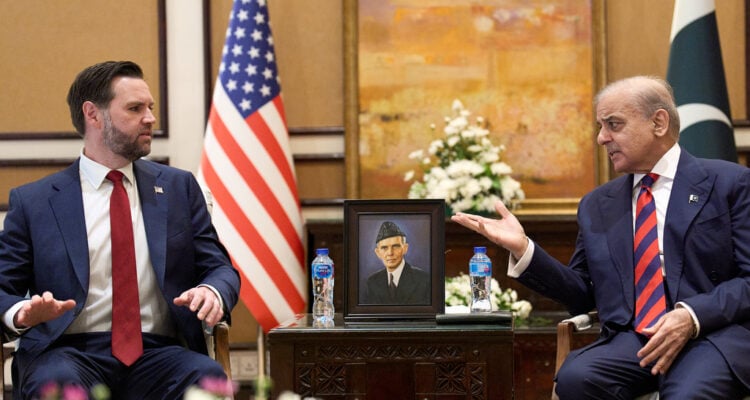
As well as the release of assets abroad, Tehran is demanding control of the Strait of Hormuz, payment of war reparations and a ceasefire across the region, including in Lebanon.
US and Iranian negotiators held their highest-level talks in half a century on Saturday in Pakistan to try to end their war as President Donald Trump said his military had sunk Tehran’s mine-layers and was clearing the Strait of Hormuz.
“We’re now starting the process of clearing out the Strait of Hormuz as a favor to Countries all over the World,” Trump posted, saying 28 Iranian mine-dropping vessels had been destroyed.
Iran’s state-affiliated Nournews called that “false news.”
Amid conflicting reports, Iranian state TV added that no US ships had crossed the strait, a crucial transit point for global energy supplies that Tehran has effectively blocked but Trump has vowed to reopen.
The waterway, which lies on Iran’s southern coast, was one of the main points on the agenda in Islamabad for the first direct US-Iranian talks in more than a decade and the highest-level discussions since the 1979 Islamic Revolution.
Trump’s Vice President JD Vance, special envoy Steve Witkoff and son-in-law Jared Kushner flew in on Saturday and met Iranian Parliamentary Speaker Mohammad Baqer Qalibaf and Foreign Minister Abbas Araqchi for two hours before a rest, according to a source from mediator Pakistan.
gation had arrived on Friday dressed in black in mourning for Supreme Leader Ayatollah Ali Khamenei and others killed in the six-week war.
They carried shoes and bags of some students killed during a mistaken US bombing of a school located next to a military compound, the Iranian government said.
“There were mood swings from the two sides and the temperature went up and down during the meeting,” said another Pakistani source of the first round of talks.
PROGRESS OF NEGOTIATIONS UNCLEAR
The war has sent global oil prices soaring, killed thousands of people and seen unprecedented hits on Gulf Arab states.
Amid conflicting versions from officials and media in both nations, the US and Iranian sides appeared to remain far apart.
Before the talks began, a senior Iranian source told Reuters the US had agreed to release frozen assets in Qatar and other foreign banks. But a US official swiftly denied that.
As well as the release of assets abroad, Tehran is demanding control of the Strait of Hormuz, payment of war reparations and a ceasefire across the region, including in Lebanon, according to Iranian state TV and officials.
Trump’s stated goals have varied during the campaign, but as a minimum he wants free passage for global shipping through the strait and the crippling of Iran’s nuclear enrichment program to ensure it cannot produce an atomic bomb.
US ally Israel, which joined the February 28 attacks on Iran that launched the war, has also been bombing Tehran-backed Hezbollah terrorists in Lebanon.
Israel and the US have said Lebanon is not part of the Iran-US ceasefire.
Mutual distrust is high.
“We will negotiate with our finger on the trigger,” Iranian government spokesperson Fatemeh Mohajerani said on state TV.
“While we are open to talks, we are also fully aware of the lack of trust; therefore, Iran’s diplomatic team is entering this process with maximum caution.”
Tehran’s agenda includes aiming to collect transit fees in the Strait of Hormuz, a chokepoint for about 20 percent of global oil and liquefied natural gas shipments.
The biggest ever disruption there has fed inflation and slowed the global economy, with an impact expected to last for months even if negotiators succeed in reopening the strait.
Nevertheless, three Liberian- and Chinese-flagged supertankers did pass through the strait on Saturday, shipping data showed, marking what appeared to be the first vessels to exit the Gulf since last week’s US-Iran ceasefire.
TruLight Ministries Daily Entertainment Manna

TruLight TV – Looking Forward To Our Jobs
What talents has God blessed you with to bless others? Watch today’s video devotional to learn how our strengths can build up those around us. and later Many of us don’t look forward to our jobs. Dr. Stanley explains that when we shift our attitudes, we can experience real joy and satisfaction—bringing glory to God no matter who provides our paycheck. Learn to serve God regardless of your job title, and watch Him transform your dread into delight. Enjoy the music and message on today show.
Today on TruLight Radio XM
TruLight Radio XM 24/7
Program
GMT / UTC +2
Monday To Fridays
00:15 Words to Live By Testimonies
01.15 Science Scripture and Salvation
02.15 Ground Works
04.00 Gospel Concert of the Day
05.00 The Daren Streblow Comedy Show
5:55 It is Today devotional
6:00 Gaither Homecoming Morning Show
7:15 Discover the Word
8.15 Destined for Victory
8:55 Science Scripture and Salvation
9:00 Holy Spirit Hour – Normally Sermons
10:15 Hope of the Heart
11:15 Unshackled
11.45 Words to Live By
12:15 Truth for Life
13:15 Living on the Edge with Chip Ingram
14:15 Focus on the Family
15:00 Kids Hour
16:00 In Touch with Dr. Charles Stanley
16:30 Groundwork
17:15 Live in the Light
18:15 Renewing your Mind
19:00 Gaither Homecoming Show
20:15 Growing Hope
21:15 Adventures in Odyssey Radio Drama
21:45 Bible Reading
22:15 Night-sounds
23.00 Good Old Country Gospel / Rhema Gospel Express
VISIT THE WEBSITE
TruLight Ministry News – EXTRA MANNA

TruLight Ministries orders from God since 2012 . Teach Them , Comfort Them and Warn Them!
THE LATEST ” SHERIFF OF THE CHURCH ” I TELL YOU TRU EPISODE – EP 9 , THE DOCTRINE OF DEMONS CALLED HYPER GRACE
PASTOOR DIRK LEER OOR DIE GROOT VERDRUKKING
THIS YEAR STUDIES STARTS 1ST MAY 2026 – REGISTER TODAY .
We Starting , the 1st May 2026 . with Our Preachers Diploma Online Platform – TruTheology.co.za . 36 Subjects with between 10 to 15 Lessons per Subject , equivalent to a 3 Year Theology Degree , The Training is Free to Approved Members and Tests Online after Each Lesson , You Determine the Speed of Your Studies . If you are interested registrations will take place from 1 April 2026 .
Healing Truths
End Time Articles
Bonus Teaching for the Child of God !!
The Bible does not give us a specific method for leading someone to Christ, so there is no religious formula we must follow. Over the years, Christians desiring to lead people to Christ have employed methods such as Evangelism Explosion, Dare 2 Share, the Way of the Master, and handing out gospel tracts. Each of these methods can be effective in leading someone to Christ.
While there is no specific method taught in the Bible for leading someone to Christ, there are specific elements that must be included in a gospel presentation. When we are well-grounded in those biblical truths, we are prepared at any time and any place to lead someone to Christ.
The Romans Road to Salvation is one way of explaining what it means to become a Christian. Because the book of Romans is such a thorough explanation of God’s grace and what it means to receive it, we need to look no further when we want to lead someone to Christ. However, it is important that we become comfortable with God’s Word enough to locate other critical passages that answer questions for non-believers. The Four Spiritual Laws is a tract that explains the key parts of salvation in a clear and direct manner and is another useful tool to use with someone inquiring about Christ.
These are the basic elements to keep in mind when trying to lead someone to Christ:
First we identify the problem:
- Every human being is a sinner (Romans 3:10, 23). Sin is any word, thought, or deed that is contrary to the holiness of God. Depending on the person’s understanding of spiritual matters, it may be helpful to turn to the Ten Commandments to illustrate and define what sin is (Exodus 20:1–17).
— We can ask the person: “Have you ever lied? Stolen? Lusted? Disrespected your parents?” - God is holy and just. Perfect justice cannot overlook our sin. The only right consequence for high treason against our Creator is eternal separation from Him in hell (Romans 6:23).
— We can ask the person: “What do you think happens after you die? The Bible says we will all die, and after that we face God’s judgment” (Hebrews 9:27).
Then we explain the solution:
- God is not only just; He is love. Because of His love, He chose to rescue us from the consequences of our sin. He sent His Son, Jesus Christ, into the world to take the punishment we deserve. He took on human flesh, lived sinlessly among us, and then laid down His life to be crucified as payment for our sin. But three days later, God raised Christ from the dead. He conquered death so we could live forever with Him (John 3:16–18). Jesus became sin for us, when He had never sinned Himself, so that we could be declared righteous and forgiven (2 Corinthians 5:21).
And we ask for a response:
- Every human being must respond to God’s offer of salvation by accepting by faith that Jesus’ death and resurrection were sufficient payment for our own sin. We transfer ownership of our lives to the lordship of Jesus, and in that divine exchange we receive a full pardon from God and the assurance of eternal life in heaven (John 1:12; Romans 10:9–10). The Bible calls for repentance and faith. When we repent, we agree with God about how bad our sin is and purpose to turn from following it to following Christ (Acts 2:38; 3:19). When we have faith, we faithfully trust in Jesus Christ as our Savior, and we are unreservedly committed to Him.
If they are willing, we can lead them in a prayer of surrender such as this:
“Father in Heaven, I confess to you that I have sinned against you. Thank you for sending your Son to die in my place. Thank you for raising Him from the dead so I could have eternal life. I give you my life now and ask you to come and live in me and make me your child. I love you and want to live for you from now on. In Jesus’ name, Amen.”
Once a person has asked Jesus to save and be Lord of his or her life, we should give the new believer some idea of what to expect next. Jesus likened the salvation experience to being “born again.” When we are born again, our record of sins is wiped clean, and God gives us a new heart that wants to please Him (Luke 9:23; John 3:3; Colossians 2:14). The Holy Spirit moves into our spirits and begins to transform us from the inside out (2 Corinthians 5:19). The goal of every Christian is to become a worshiper who patterns his or her life after that of the Lord Jesus Christ (Romans 8:29).
Becoming familiar with the verses listed above gives us more confidence when we share our faith. We are not making up some religious code; we are explaining truths from God’s revealed Word. We don’t have to rely on our own expertise; rather, we can rest on the foundation of God’s written Word and His Holy Spirit, who gives us the words we need when we need them (Luke 12:12).
OR JUST SEND THEM THIS LINK = https://www.steps2heaven.co.za
Share this Feeding of Manna with your Friends and Family. just click on the Social Media icon and share !