Hosted by TruLight Ministries – The Place of Truth
SELECT YOUR READING LANGUAGE – BOTTOM LEFT = YOUR DAILY MANNA NOW AVAILABLE IN 103 LANGUAGES
a New Study : for the Next 12 Daily Manna Days
In My Control vs Out of My Control
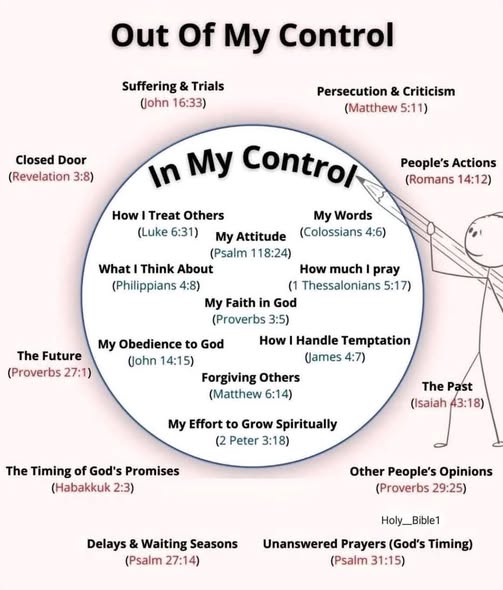
In My Control = My Effort to Grow Spiritually ::: Spiritual growth is the process of becoming more and more like Jesus Christ. When we place our faith in Jesus, the Holy Spirit begins the process of making us more like Him, conforming us to His image. Spiritual growth is perhaps best described in 2 Peter 1:3-8, which tells us that by God’s power we have “everything we need” to live lives of godliness, which is the goal of spiritual growth. Notice that what we need comes “through our knowledge of Him,” which is the key to obtaining everything we need. Our knowledge of Him comes from the Word, given to us for our edification and growth.
There are two lists in Galatians 5:19-23. Verses 19-21 list the “acts of the flesh.” These are the things that identified our lives before we came to Christ for salvation. The acts of the flesh are the activities we are to confess, repent of, and, with God’s help, overcome. As we experience spiritual growth, fewer and fewer of the “acts of the flesh” will be evident in our lives. The second list is the “fruit of the Spirit” (verses 22-23). These are what should characterize our lives now that we have experienced salvation in Jesus Christ. Spiritual growth is identified by the fruit of the Spirit becoming increasingly evident in a believer’s life.
When the transformation of salvation takes place, spiritual growth begins. The Holy Spirit indwells us (John 14:16-17). We are new creatures in Christ (2 Corinthians 5:17). The old, sinful nature begins to give way to the new, Christlike nature (Romans 6-7). Spiritual growth is a lifelong process that depends on our study and application of God’s Word (2 Timothy 3:16-17) and our walk in the Spirit (Galatians 5:16-26). As we seek spiritual growth, we should pray to God and ask for wisdom concerning the areas He desires us to grow in. We can ask God to increase our faith and knowledge of Him. God desires for us to grow spiritually, and He has given us all we need to experience spiritual growth. With the Holy Spirit’s help, we can overcome sin and steadily become more like our Savior, the Lord Jesus Christ.

Bible Verse and Prayer for Today
I am convinced that neither death nor life, neither angels nor demons, neither present nor the future, nor powers, neither height nor depth, nor anything else in all creation, will be able to separate us from the love of God that is ours in Christ Jesus our Lord.
—Romans 8:38-39
Separation is a primal fear, whether it is separation from something we fear, whether it’s separation from a child, a parent, a sibling, a spouse, a friend, but especially separation from God is a deep fear for those of us who love him. Jesus endured separation from God by becoming a human and by going to the cross. As Paul put it so eloquently:
God made him who had no sin to be sin for us, so that in him we might become the righteousness of God (2 Corinthians 5:21).
Because of Jesus’ sacrifice, and our faith that he did it for us, we are in Christ. We know we’ll never have to be separated from God’s love. He bore the separation so we would never have to fear it. Nothing in all creation can separate us from God’s love for us in Jesus!
Prayer
Gracious and loving Father of all peoples, thank you for loving us in Jesus and adopting us as your children in Christ to bring us close to you. Thank you for promising that nothing can separate us from your love. Use the Spirit to help us know, deep inside, making us experientially aware of your accompanying presence in our lives as you live with us, in us, and make your home with us as we live for you (John 14:19-23). We pray this in Jesus name. Amen and Amen

Bible Teaching of the Day
Spiritual maturity is achieved through becoming more like Jesus Christ. After salvation, every Christian begins the process of spiritual growth, with the intent to become spiritually mature. According to the apostle Paul, it’s an ongoing process that will never end in this life. In Philippians 3:12–14, speaking of full knowledge of Christ, he tells his readers that he himself has not “already obtained all this, or have already been made perfect, but I press on to take hold of that for which Christ Jesus took hold of me. Brothers, I do not consider myself yet to have taken hold of it. But one thing I do: Forgetting what is behind and straining toward what is ahead, I press on toward the goal to win the prize for which God has called me heavenward in Christ Jesus.” Like Paul, we have to press continually toward deeper knowledge of God in Christ.
Christian maturity requires a radical reordering of one’s priorities, changing over from pleasing self to pleasing God and learning to obey God. The key to maturity is consistency, perseverance in doing those things we know will bring us closer to God. These practices are referred to as the spiritual disciplines and include things such as Bible reading/study, prayer, fellowship, service, and stewardship. No matter how hard we might work on those things, however, none of this is possible without the enabling of the Holy Spirit within us. Galatians 5:16 tells us that we’re to “walk by the Spirit.” The Greek word used here for “walk” actually means “to walk with a purpose in view.” Later in the same chapter, Paul tells us again that we’re to “walk by the Spirit.” Here, the word translated “walk” has the idea of taking things “step by step, one step at a time.” It is learning to walk under the instruction of another—the Holy Spirit. Being filled with the Spirit means we walk under the Spirit’s control. As we submit more and more to the Spirit’s control, we will also see an increase in the fruit of the Spirit in our lives (Galatians 5:22–23). This is characteristic of spiritual maturity.
When we become Christians, we are given all we need for spiritual maturity. Peter tells us that “[God’s] divine power has granted to us all things that pertain to life and godliness, through the knowledge of Him who called us to His own glory and excellence” (2 Peter 1:3). God alone is our resource, and all growth comes by grace through Him, but we are responsible to make the choice to obey. Peter again helps us in this area: “For this very reason, make every effort to supplement your faith with virtue, and virtue with knowledge, and knowledge with self-control, and self-control with steadfastness, and steadfastness with godliness, and godliness with brotherly affection, and brotherly affection with love. For if these qualities are yours and are increasing, they keep you from being ineffective or unfruitful in the knowledge of our Lord Jesus Christ” (2 Peter 1:5–8). Being effective and fruitful in the knowledge of the Lord Jesus is the essence of spiritual maturity.
Today’s Devotional
We are commanded in Scripture to “grow in the grace and knowledge of our Lord and Savior Jesus Christ” (2 Peter 3:18). This growth is spiritual growth, growing in faith.
At the moment we receive Christ as our Savior, we are born again spiritually into God’s family. But just as a newborn baby requires nourishing milk for growth and good development, so also a baby Christian requires spiritual food for growth. “Like newborn babies, crave pure spiritual milk, so that by it you may grow up in your salvation, now that you have tasted that the Lord is good” (1 Peter 2:2-3). Milk is used in the New Testament as a symbol of what is basic to the Christian life.
But as a baby grows, its diet changes to also include solid foods. With this in mind, read how the writer of Hebrews admonished the Christians: “In fact, though by this time you ought to be teachers, you need someone to teach you the elementary truths of God’s word all over again. You need milk, not solid food! Anyone who lives on milk, being still an infant, is not acquainted with the teaching about righteousness. But solid food is for the mature, who by constant use have trained themselves to distinguish good from evil” (Hebrews 5:12-14). Paul saw the same problem with the Corinthian believers; they had not grown in their faith, and he could only give them “milk” because they were not ready for solid food (1 Corinthians 3:1-3).
The analogy between a human baby and a spiritual baby breaks down when we realize how each baby matures. A human baby is fed by his parents and growth is natural. But a baby Christian will only grow as much as he purposefully reads and obeys and applies the Word to his life. Growth is up to him. There are Christians who have been saved many years, but spiritually they are still babies. They cannot understand the deeper truths of the Word of God.
What should a Christian’s diet consist of? The Word of God! The truths taught in the Bible are rich food for Christians. Peter wrote that God has given us everything we need for life through our (growing) knowledge of Him. Read carefully 2 Peter 1:3-11 where Peter lists character qualities that need to be added to our beginning point of faith in order for maturity to take place and to have a rich welcome into the eternal kingdom of our Lord and Savior Jesus Christ.

Bible Prophecy, Signs of the Times and Gog and Magog Updates with Articles in the News
Ash Wednesdays – Is it Biblical?
Ash Wednesday is the first day of Lent. Its official name is “Day of Ashes,” so called because of the practice of rubbing ashes on one’s forehead in the sign of a cross. Since it is exactly 40 days (excluding Sundays) before Easter Sunday, it will always fall on a Wednesday—there cannot be an “Ash Thursday” or “Ash Monday.” The Bible never mentions Ash Wednesday—for that matter, it never mentions Lent.
Lent is intended to be a time of self-denial, moderation, fasting, and the forsaking of sinful activities and habits. Ash Wednesday commences this period of spiritual discipline. Ash Wednesday and Lent are observed by most Catholics and some Protestant denominations. The Eastern Orthodox Church does not observe Ash Wednesday; instead, they start Lent on “Clean Monday.”
While the Bible does not mention Ash Wednesday, it does record accounts of people in the Old Testament using dust and ashes as symbols of repentance and/or mourning (2 Samuel 13:19; Esther 4:1; Job 2:8; Daniel 9:3). The modern tradition of rubbing a cross on a person’s forehead supposedly identifies that person with Jesus Christ.
Should a Christian observe Ash Wednesday? Since the Bible nowhere explicitly commands or condemns such a practice, Christians are at liberty to prayerfully decide whether or not to observe Ash Wednesday.
If a Christian decides to observe Ash Wednesday and/or Lent, it is important to have a biblical perspective. Jesus warned us against making a show of our fasting: “When you fast, do not look somber as the hypocrites do, for they disfigure their faces to show others they are fasting. Truly, they have received their reward in full. But when you fast, put oil on your head and wash your face, so that it will not be obvious to others that you are fasting, but only to your Father, who is unseen” (Matthew 6:16-18a). We must not allow spiritual discipline to become spiritual pride.
It is a good thing to repent of sinful activities, but that’s something Christians should do every day, not just during Lent. It’s a good thing to clearly identify oneself as a Christian, but, again, this should be an everyday identification. And it is good to remember that no ritual can make one’s heart right with God.
Glitter Ash Sacrilege: Progressive Church Mocks Ash Wednesday With LGBTQ Ritual

Ash Wednesday is meant to be a solemn day of reflection, humility, and penitence–a ritual that has been observed for centuries as the gateway to Lent. It is a sacred moment in the Christian calendar, marked by ashes applied in the sign of the cross with the words: “Remember that you are dust, and to dust you shall return.”
The ashes are not decoration. They are not political statements. They are a call to repentance, a reminder of human mortality, and a summons to turn toward God. Yet an Atlanta-based progressive church, The Church at Ponce and Highland, has decided to upend all of that with what can only be described as sacrilegious glitter ashes.
The church’s website proudly announces that congregants attending its Ash Wednesday service will have a choice between traditional ashes and ashes mixed with purple glitter. The stated purpose of these glittery ashes? To show “remorse at straight Christian cruelty to our LGBTQ siblings” and affirm LGBTQ identity. In other words, this church has hijacked a deeply spiritual ritual, repurposing it as a platform for ideological affirmation rather than repentance before God. Glitter, of all things, is now the vehicle for moral instruction. It is hard to imagine a more blatant distortion of a centuries-old tradition.
Ash Wednesday has always been about confronting our own sin and acknowledging our dependence on God. It is a moment that calls the faithful to self-examination, humility, and recognition of human frailty. The ritual is stark, austere, and sobering–designed to unsettle the ego, not dazzle it. Glitter ashes, by contrast, celebrate identity and affirm personal pride, supplanting repentance with performative virtue signaling. The symbolism is inverted: the ashes no longer mark the soul’s need for redemption but the congregation’s alignment with a social agenda.
This is not a one-off misstep but part of a broader pattern of activist politics infiltrating church rituals. The Church at Ponce and Highland openly rejects traditional frameworks, stating that “Christianity has gotten off track” and promoting a faith centered on doubt, inclusivity, and rejection of eternal punishment. It emphasizes “Jesus’s love” over the salvific significance of his death and frames historic Christianity as an oppressive institution responsible for colonialism, slavery, and violence. Within this worldview, Lent becomes less about turning toward God and more about signaling ideological virtue to the world. Ash Wednesday, in short, is no longer an invitation to repentance; it is a platform for social apology.
The glitter ashes initiative is a glaring example of how certain progressive churches reinterpret centuries-old practices through the lens of contemporary culture wars. It is not just a distortion of Ash Wednesday–it is a rejection of the theological foundations that give the ritual meaning.
By offering glitter ashes alongside traditional ashes, the church presents two competing visions of Christianity: one grounded in repentance and redemption, the other in affirmation of human identity and a secular moral framework. Only one of these is faithful to the historic observance. The other is a performative spectacle masquerading as spirituality.
It is also worth noting that this is not an isolated incident. In recent years, various progressive churches across the country have experimented with “inclusive” rituals, substituting traditional observances with ideologically driven versions. Some have rewritten liturgies to align with political causes, or offered communion in non-traditional forms meant to symbolize social justice rather than Christ’s sacrifice. The glitter ashes phenomenon is the logical extreme of that trend: the hollowing out of faith in favor of social signaling.
The worldview underpinning these changes is unmistakable. Moral authority is no longer derived from God or Scripture but from contemporary cultural movements and the approval of marginalized groups. Rituals are evaluated not by their spiritual truth but by their ability to demonstrate ideological alignment. In this context, Ash Wednesday becomes a canvas for progressive virtue, rather than a somber call to repentance. The result is both the trivialization of a sacred ritual and a dangerous redefinition of Christianity itself.
Churches have always served as a moral compass, guiding believers toward humility, confession, and transformation. But when rituals are repurposed to advance secular agendas, the compass spins wildly, and the faithful are left confused about what, exactly, they are celebrating. Glitter ashes are not a symbol of remorse for sin; they are a symbol of a worldview that elevates identity politics over divine truth. They mock centuries of Christian devotion and replace the soul’s reckoning with performative sparkle.
Ash Wednesday deserves better than glitter. Christianity deserves better than a church that rebrands penitence as political apology. True repentance is about acknowledging God’s standards, confronting personal sin, and seeking reconciliation with Him. Glitter ashes are a distraction, a spectacle, and a sacrilege. They should be condemned–not celebrated–as yet another example of activist ideology corrupting sacred tradition.
Trans Violence Is Escalating-Political Correctness Wants To Ignore It
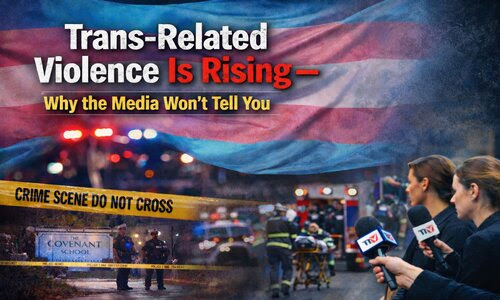
Across America and Canada, shocking acts of violence continue to be committed by individuals identifying as transgender or gender-fluid, yet much of the mainstream media seems unwilling–or unable–to fully report the reality. In an era when public safety should be paramount, ideological caution has begun to conflict with factual reporting, leaving the public in the dark about an emerging pattern of risk.
Monday’s tragedy at a high-school hockey game in Pawtucket, Rhode Island, is the latest, most horrifying example. Robert Dorgan, who identified as “Roberta Esposito” and “Roberta Dorgano,” shot and killed two family members and injured three others before taking his own life. Just days earlier, 18-year-old Jesse Van Rootselaar, identifying as a woman, murdered six people and critically injured two at a school in British Columbia, Canada, after first killing two family members at home. These violent acts are not isolated incidents–they are part of a troubling trend that spans schools, churches, and public spaces across North America.
Yet as these events unfold, left-wing media outlets often struggle to even describe the perpetrators accurately. Reports hesitate over what pronouns to use, whether to refer to a shooter as a “man” or “woman (the CBC decided to use ‘gunperson’ to describe the shooter,” and how to frame the story without appearing biased. While sensitivity is important, this overcaution can obscure critical facts about appearance, behavior, and prior criminal or mental health history–information that is vital for public safety. When news reports leave out these details, communities cannot properly assess risk or respond effectively.
Prominent commentators have begun to call out this silence. Conservative writer Clay Travis noted, “Left-wing media refuses to inform its readers of the basic facts when trans shooters are involved. This isn’t journalism, it’s anti-journalism–a willful and intentional avoidance of facts in favor of protecting orthodoxy.” Matt Walsh, author and filmmaker, warned that the rising rate of violence linked to transgender-identifying individuals could escalate unless society treats trans ideology as a public safety concern. Ann Coulter echoed this concern, highlighting how a mass shooting in Rhode Island received far less coverage than a similar event perpetrated by a cisgender man, reflecting a broader unwillingness to confront uncomfortable truths.
The statistics tell a stark story. From the Colorado Springs school shooting to the Covenant School attack in Nashville, and more recently in Minneapolis, Tumbler Ridge, and Rhode Island, many perpetrators identified as transgender or gender-fluid. In several cases, these individuals had prior mental health issues and histories of drug or hormone use associated with gender transitions.
Public health experts have long warned that early, intensive medical interventions in cases of unresolved psychological distress can sometimes exacerbate underlying instability. The repeated emergence of violence in these cases raises urgent questions about the intersection of mental health, gender identity treatments, and societal messaging.
Acknowledging these patterns does not mean vilifying all transgender individuals but ignoring these cases in the name of ideological purity undermines safety. When mental health issues are left untreated, or when confusion about identity is compounded with social reinforcement and pharmacological intervention, some individuals may reach a breaking point with tragic consequences. These are individuals in desperate need of help, not encouragement toward paths that could intensify confusion or instability.
Recent high-profile cases demonstrate the urgency. Jesse Van Rootselaar killed multiple family members and classmates, Dorgan massacred relatives in a public arena, and Audrey Elizabeth Hale committed a mass shooting in Nashville. Other cases include threats of sexual violence, school attacks, and attempted assassinations–all linked to individuals navigating gender dysphoria or related conditions. Experts and commentators increasingly argue that careful examination of the contributing psychological, social, and medical factors is essential to prevent future tragedies.
It is time for society to separate ideology from public safety. Families, schools, and communities need accurate information to protect themselves. Journalists must report facts clearly, including a perpetrator’s biological sex, mental health history, and behaviors prior to the attack, without fear of accusations of “transphobia.”
Policymakers, medical professionals, and educators must prioritize evidence-based strategies to support vulnerable individuals while mitigating risk. And society must recognize that ignoring or suppressing information in the name of political correctness can cost lives.
The debate is no longer abstract. These tragedies are real, and they demand a sober, fact-driven response. We must provide help for those struggling with mental health and identity confusion, while acknowledging patterns that affect public safety. To protect communities, silence cannot be an option. The challenge is delicate, but the stakes are clear: inaction in the face of violent trends is not compassion–it is neglect.
America’s Fiscal Time Bomb Is Ticking-And It’s Set to Explode In Your Lifetime

America has Two Biblical Roles in the End Times . One being The Eagle Wings , Friend and Saviour to Israel and the Other Being Mystery Babylon . Well the Mystery Babylons Time Bomb is Ticking !
The latest long-term budget outlook from the Congressional Budget Office should have triggered emergency hearings, prime-time presidential addresses, and wall-to-wall media coverage. Instead, it landed with a dull thud. No urgency. No alarm. No real action. Yet buried inside that report is a blunt mathematical truth: the United States is speeding toward a debt crisis that will not be theoretical, political, or abstract. It will be personal. And when it arrives, it will reach straight into your wallet, your retirement, your job, and your family’s future.
This year alone, the federal government is expected to spend $7.4 trillion while collecting just $5.6 trillion. That’s a $1.8 trillion deficit added to the national credit card in a single year. According to projections, deficits will surpass $3 trillion annually by the mid-2030s, with a staggering $24.4 trillion added to the debt over the next decade. That number is so large it almost stops feeling real. But make no mistake: it is real. And someone will pay it.
Here’s the part most Americans don’t realize. The biggest threat isn’t military spending, foreign aid, or government salaries. The real driver of future debt is built into the system itself. Mandatory spending programs that run on autopilot will consume nearly $50 trillion over the next ten years. Add income-security programs, veterans’ benefits, and federal retirement obligations, and you’re looking at another $8 trillion. That averages nearly $6 trillion every year before Congress even votes on a single new policy.
Even more alarming: interest payments on the national debt are exploding. They already exceed military spending today. Within a decade, interest alone is projected to cost as much as all discretionary spending combined–every soldier, every park ranger, every air traffic controller, every federal investigator. Imagine running your household where your credit-card interest equals your entire living expenses. That’s not a budget. That’s a countdown.
Some lawmakers argue that cutting government workers will fix the problem. But even after roughly 270,000 federal employees were reduced, deficits barely budged. Why? Because payroll isn’t the main driver. The structural imbalance is baked into the system. You could eliminate all discretionary spending tomorrow–shut down agencies, close parks, halt defense–and the government would still run a massive deficit.
Let that sink in. Even extreme cuts wouldn’t balance the books.
What makes this situation especially dangerous is that official projections rely on rosy assumptions. Inflation, for example, is expected to settle around 2 percent for most of the next decade. But the math behind the debt suggests the opposite. If the government must borrow $24 trillion, someone has to lend it. Foreign buyers are already stepping back from U.S. Treasuries, diversifying reserves into other assets. Domestic savings aren’t large enough to fill the gap. That leaves one primary buyer: the Federal Reserve.
When the central bank buys government debt, it effectively creates new money. We saw what happened the last time trillions were created quickly–prices surged, savings lost value, and everyday Americans paid more for food, housing, and fuel. If future borrowing requires even larger money creation, inflation won’t just tick up. It could surge again, quietly eroding purchasing power year after year.
And this is where it becomes personal.
If you’re young, this crisis threatens your future wages, job opportunities, and ability to build wealth. If you’re middle-aged, it jeopardizes your retirement timeline and the value of your savings. If you’re retired, it risks the purchasing power of fixed income and benefits. Inflation is not just an economic statistic–it is a silent tax that punishes savers, workers, and families living on budgets.
History is clear about what happens when governments ignore debt arithmetic. Nations don’t collapse overnight. They drift. They inflate. They stagnate. Then suddenly, borrowing becomes expensive, confidence falters, and crisis arrives faster than anyone expected.
What is most unsettling is not the numbers themselves but the indifference surrounding them. Fiscal crises are preventable when addressed early. They become catastrophic when ignored. Right now, Washington is still in the early phase. But the window is closing.
The warning signs are flashing. The math is published. The trajectory is clear.
The only remaining question is whether Americans will demand action before the bill comes due or whether we will wait until the markets, the currency, and reality force it upon us.
Because one way or another, that bill is coming.
And when it does, it won’t arrive in Washington first.
It will arrive in your life.
Satellite images show Magog / Iran reinforcing military and nuclear sites hit in Israeli and U.S. strikes
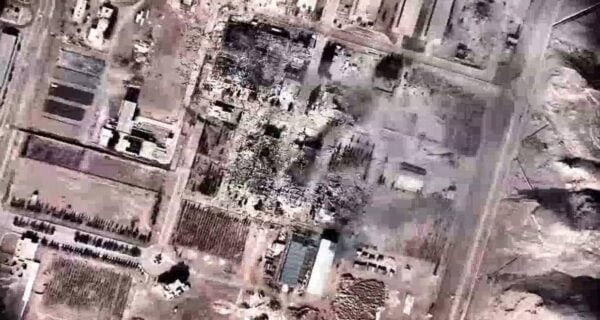
At the Parchin military complex, imagery indicates that a structure reportedly hit by Israel in October 2024 has been sealed beneath a concrete layer and covered with soil, effectively masking it from aerial observation.
Satellite images show Iran has moved to reinforce a range of military and nuclear-related facilities damaged in Israeli and U.S. strikes, undertaking construction and repair projects that analysts say are intended to shield key infrastructure as diplomatic engagement with Washington continues.
At the Parchin military complex, imagery indicates that a structure reportedly hit by Israel in October 2024 has been sealed beneath a concrete layer and covered with soil, effectively masking it from aerial observation.
Specialists assessing the site say the design may incorporate a high-explosives containment vessel, a type of installation relevant to both conventional weapons testing and nuclear-related research.
“Stalling the negotiations has its benefits: Iran has been busy burying the new Taleghan 2 facility … It may soon become a fully unrecognizable bunker, providing significant protection from aerial strikes,” wrote David Albright on X.
Elsewhere, imagery points to defensive work at nuclear facilities previously targeted by the United States.
Tunnel entrances at the Isfahan nuclear complex, bombed last year, appear to have been filled in with earth. At the Natanz uranium enrichment site, entrances to underground passages are being strengthened. Analysts say such measures are aimed at limiting exposure to airstrikes and hindering any potential ground-based operations.
The satellite data also document repair activity at missile installations struck during last year’s fighting.
At the Shiraz South missile base, rebuilding is visible at structures linked to command and logistics functions.
Separately, a missile base near Qom shows a newly installed roof over buildings that had been damaged. Experts caution that while reconstruction is underway, available imagery suggests the facilities have not yet regained full operational capability.
In a recent report, the Institute for Science and International Security said the activity reflects a broader Iranian approach to hardening sensitive locations and preserving leverage amid negotiations.
The institute cited satellite imagery showing concrete shielding and soil coverage added at a military site described as sensitive and reportedly bombed by Israel in 2024.
Independent experts who monitor Iran’s nuclear and missile programs reached similar conclusions in an analysis by The New York Times. That review examined roughly two dozen sites struck by Israel or the United States during the 12-day conflict last June and found evidence of construction or repair work at more than half the locations.
Eagle Wings are Ready for War / Middle East Braces as US Expands Military Presence

Such a conflict could evolve into a joint U.S.-Israeli operation significantly larger than previous confrontations.
The United States is rapidly expanding its military presence across the Middle East as officials weigh the possibility of a strike on Iran, with senior administration sources estimating the likelihood of military action at “90 percent certainty,” according to a report published Wednesday by Axios.
The growing preparations come despite ongoing nuclear negotiations between Washington and Tehran, which U.S. officials increasingly doubt will produce a breakthrough.
Vice President JD Vance said following this week’s Geneva talks that Iran has not yet acknowledged several of President Donald Trump’s key “red lines,” particularly regarding its nuclear program.
“In some ways it went well,” Vance told Fox News. “But it was very clear that the President has set some red lines that the Iranians are not yet willing to actually acknowledge and work through.”
Iranian Foreign Minister Abbas Araghchi described the negotiations more positively, saying Tehran and Washington reached understandings on “key principles” and would move toward drafting potential agreement texts.
Omani Foreign Minister Badr Albusaidi, whose country mediated the indirect talks, called the discussions constructive but cautioned that “much work remains ahead.”
Behind the diplomatic track, however, U.S. military preparations have intensified dramatically. Officials cited by Axios said any potential American operation would likely involve a broad and sustained campaign lasting several weeks, targeting key components of Iran’s military and strategic infrastructure rather than a limited strike.
Sources warned such a conflict could evolve into a joint U.S.-Israeli operation significantly larger than previous confrontations and could carry existential consequences for the Iranian regime.
According to the report, Trump came close to authorizing military action in early January following Iran’s violent crackdown on domestic protests that reportedly left thousands dead. The administration later shifted to a dual-track strategy combining renewed negotiations with a rapid military buildup intended to maintain maximum pressure on Tehran.
That buildup has accelerated in recent days. More than 150 U.S. military cargo flights have transported weapons systems and ammunition into the region, while open-source flight tracking data shows a surge in American aircraft movements across the United States and Europe.
Dozens of U.S. Air Force aircraft have been observed operating across transatlantic routes, including aerial refueling tankers, transport aircraft, and E-3 airborne warning and control system planes used to coordinate large-scale air operations.
Two AWACS aircraft deployed from Elmendorf Air Force Base in Alaska to RAF Mildenhall in the United Kingdom, while four others flew from Tinker Air Force Base in Oklahoma to Ramstein Air Base in Germany.
At the same time, more than 50 American fighter jets, including F-22, F-35, and F-16 aircraft, have been repositioned to the Middle East. The deployments accompany two U.S. aircraft carriers, one already operating in the region and another en route, underscoring the scale of American preparations.
Despite continued diplomatic engagement, officials quoted in the Axios report expressed growing frustration with the pace of negotiations. “The boss is getting fed up,” one Trump adviser said.
The simultaneous advance of negotiations and large-scale military deployments has left the region approaching a decisive moment, with diplomacy continuing under mounting pressure from an increasingly visible U.S. military buildup.
TruLight Ministries Daily Entertainment

TruLight TV – Kids Hour – Dot Learns About Spiritual Warfare.
In the previous episode of “Way Out West”, Dusty and Dallas have been on a long journey, facing challenges and avoiding a cunning bandit. They are now close to reaching Tumbleweed Canyon, hoping to find wealth there so they can save the residents of Rowdy Town from their corrupt mayor. Tune in to see what unfolds next! Meanwhile at Konnect HQ, Dot learns about the spiritual war going on around us and panics when she thinks Konnect HQ is under attack. Join us for an hour of pure entertainment that you won’t want to miss.
Today on TruLight Radio XM
TruLight Radio XM 24/7
Program
GMT / UTC +2
Monday To Fridays
00:15 Words to Live By Testimonies
01.15 Science Scripture and Salvation
02.15 Ground Works
04.00 Gospel Concert of the Day
05.00 The Daren Streblow Comedy Show
5:55 It is Today devotional
6:00 Gaither Homecoming Morning Show
7:15 Discover the Word
8.15 Destined for Victory
8:55 Science Scripture and Salvation
9:00 Holy Spirit Hour – Normally Sermons
10:15 Hope of the Heart
11:15 Unshackled
11.45 Words to Live By
12:15 Truth for Life
13:15 Living on the Edge with Chip Ingram
14:15 Focus on the Family
15:00 Kids Hour
16:00 In Touch with Dr. Charles Stanley
16:30 Groundwork
17:15 Live in the Light
18:15 Renewing your Mind
19:00 Gaither Homecoming Show
20:15 Growing Hope
21:15 Adventures in Odyssey Radio Drama
21:45 Bible Reading
22:15 Night-sounds
23.00 Good Old Country Gospel / Rhema Gospel Express
VISIT THE WEBSITE
TruLight Ministry News
TruLight Ministries orders from God since 2012 . Teach Them , Comfort Them and Warn Them!
Healing Truths
End Time Articles
Share this Feeding of Manna with your Friends and Family. just click on the Social Media icon and share !