Hosted by TruLight Ministries – The Place of Truth
SELECT YOUR READING LANGUAGE – BOTTOM LEFT = YOUR DAILY MANNA NOW AVAILABLE IN 103 LANGUAGES
@ TruLight – Daily Manna is not Just a Bible Verse with a Small Prayer . No WE SERVE DAILY Manna for the Whole Day . Breakfast , Lunch , Dinner , Plus tea Times and even Entertainment Manna . Plus News Manna and More , This Daily Manna will keep you Spiritually full for the full 48 Hours and even More to Share with your Friends and Family !!!
a Constant Battle Rage over Your Soul !!
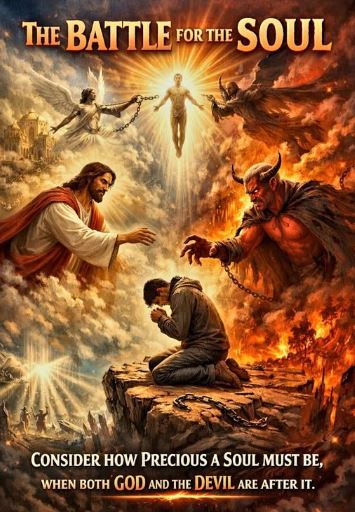
There are two primary errors when it comes to spiritual warfare—over-emphasis and under-emphasis. Some blame every sin, every conflict, and every problem on demons that need to be cast out. Others completely ignore the spiritual realm and the fact that the Bible tells us our battle is against spiritual powers. The key to successful spiritual warfare is finding the biblical balance. Jesus sometimes cast demons out of people; other times He healed people with no mention of the demonic. The apostle Paul instructs Christians to wage war against the sin in themselves (Romans 6) and warns us to oppose the schemes of the devil (Ephesians 6:10–18).
Ephesians 6:10–12 says, “Finally, be strong in the Lord and in his mighty power. Put on the full armor of God so that you can take your stand against the devil’s schemes. For our struggle is not against flesh and blood, but against the rulers, against the authorities, against the powers of this dark world and against the spiritual forces of evil in the heavenly realms.” This text teaches some crucial truths: we can only stand strong in the Lord’s power, it is God’s armor that protects us, and our battle is ultimately against spiritual forces of evil in the world.
Ephesians 6:13–18 is a description of the spiritual armor God gives us. We are to stand firm with the belt of truth, the breastplate of righteousness, the gospel of peace, the shield of faith, the helmet of salvation, the sword of the Spirit, and by praying in the Spirit. What do these pieces of spiritual armor represent in spiritual warfare? We are to know the truth, believe the truth, and speak the truth. We are to rest in the fact that we are declared righteous because of Christ’s sacrifice for us. We are to proclaim the gospel no matter how much resistance we face. We are not to waver in our faith, trusting God’s promises no matter how strongly we are attacked. Our ultimate defense is the assurance we have of our salvation, an assurance that no spiritual force can take away. Our offensive weapon is the Word of God, not our own opinions and feelings. And we are to pray in the power and will of the Holy Spirit.
Jesus is our ultimate example of resisting temptation in spiritual warfare. Observe how Jesus handled direct attacks from Satan when He was tempted in the wilderness (Matthew 4:1–11). Each temptation was combatted with the words “it is written.” The Word of the living God is the most powerful weapon against the temptations of the devil. “I have hidden your word in my heart that I might not sin against you” (Psalm 119:11).
A word of caution concerning spiritual warfare is in order. The name of Jesus is not a magic incantation that causes demons to flee from before us. The seven sons of Sceva are an example of what can happen when people presume an authority they have not been given (Acts 19:13–16). Even Michael the archangel did not rebuke Satan in his own power but said, “The Lord rebuke you!” (Jude 1:9). When we start talking to the devil, we run the risk of being led astray as Eve was (Genesis 3:1–7). Our focus should be on God, not demons; we speak to Him, not them.
In summary, what are the keys to success in spiritual warfare? We rely on God’s power, not our own. We put on the whole armor of God. We draw on the power of Scripture—the Word of God is the Spirit’s sword. We pray in perseverance and holiness, making our appeal to God. We stand firm (Ephesians 6:13–14); we submit to God; we resist the devil’s work (James 4:7), knowing that the Lord of hosts is our protector. “Truly he is my rock and my salvation; he is my fortress, I will never be shaken” (Psalm 62:2).

Tea Time Manna
Since the creation of the world, God’s invisible qualities — his eternal power and divine nature — have been clearly seen, being understood from what has been made, so that men are without excuse.
—Romans 1:20
The touch of the Master’s hand is all around us. We can see it in the order, beauty, specificity, and dazzling variety of creation. The great expanse of space, with its billions of stars, along with the incredible world of the microscopic, is all testimony to an Orderer of great creativity and inestimable power. Our heavenly Father has left his fingerprints all over his world, his creation, his universe, so we can know that he has been here and will not abandon the work of his hands. But, will we respond to this beauty in creation by seeking to live by the ways of the Great Orderer, the Creator of the universe, or will we choose for ourselves, or something else, to replace God? Will we choose to reflect his righteous character, gracious compassion, and loving justice over asserting our human arrogance and destructive self-will? God has revealed himself, and we are without excuse. Will we choose our own way, or God’s?
Prayer
O God, thank you for your creation. Thank you for its beauty and variety. Thank you for the changing seasons and the beauty of Spring and Autumn. Most of all, thank you for choosing to show yourself to us, your creatures, in the things you have created. We pledge to respond to such bountiful grace with loving obedience. We commit our lives and this prayer of thanks to you, in the name of Jesus. Amen and Amen
Bible Teaching of the Day
LUNCH MANNA =
The key to victory in our struggles with sin lies not in ourselves, but in God and His faithfulness to us: “The LORD is near to all who call on Him, to all who call on Him in truth” (Psalm 145:18; see also Psalm 46:1).
There’s no getting around it: we all struggle with sin (Romans 3:23). Even the great apostle Paul lamented over his ongoing struggle with sin in his life: “For I know that nothing good dwells in me, that is, in my flesh. For I have the desire to do what is right, but not the ability to carry it out. For I do not do the good I want, but the evil I do not want is what I keep on doing. Now if I do what I do not want, it is no longer I who do it, but sin that dwells within me” (Romans 7:18-20). Paul’s struggle with sin was real; so much so that he cried out, “What a wretched man I am! Who will rescue me from this body that is subject to death?” (Romans 7:24).
Yet in the next breath, he answers his own question, as well as ours: “Thanks be to God, who delivers me through Jesus Christ our Lord!” (Romans 7:25a). In this passage, Paul not only provides us with the very key to victory when struggling with sin, but explains the never-ending conundrum between our sinful nature and spiritual nature: “So then, I myself serve the law of God with my mind, but with my flesh I serve the law of sin” (Romans 7:25b).
Earlier, Paul said, “For we know that the law is spiritual, but I am of the flesh, sold under sin” (Romans 7:14). Paul is comparing our sinful nature, our flesh, to a slave. Just as a slave obeys his master, so our flesh obeys sin. However, as believers in Christ, we have become spiritual beings under the law of Christ; our inner selves are under the influence and ownership of God’s grace and the life of Christ (Romans 5:21). As long as we are living in this world, our sinful nature and fleshly desire will remain with us. But we also have a new nature in Christ. This leads to a struggle between what we want to do and what we actually do, as sin continues to assault our earthly nature. This struggle is a normal part of living the Christian life.
It’s interesting to note that Paul, the greatest of the apostles, declared that, of all sinners, “I am the worst!” (1 Timothy 1:15). Paul affirms the struggles we all have as we battle with sin and temptation in our lives. The struggles are real, and they’re debilitating. We grow weary from the never-ending temptations and in falling short of God’s glory. Paul, in essence, is telling us that we need not pretend that we’re untouched by our struggles. He’s been there. He understands. Though our efforts to do right seem desperate, we do have hope “through Jesus Christ our Lord” (Romans 7:25; Hebrews 4:15). And He, in fact, is the key to our victory over sin.
A true Christian will war with Satan and his daily efforts to undermine us. The devil is the ruler of this world, and we are living “behind enemy lines” (Ephesians 2:2; Ephesians 6:12; John 12:31). With our focus on Christ, however, we will be able to cultivate a mindset that proclaims we’d rather die than do anything to hurt God. When we give ourselves to Christ totally (Matthew 16:24), Satan will flee from us. When we draw near to God, He, in turn, will draw near to us (James 4:7-8).
Our key to victory in our struggle with sin lies in the very promise of God Himself: “No temptation has overtaken you that is not common to man. God is faithful, and He will not let you be tempted beyond your ability, but with the temptation He will also provide the way of escape, that you may be able to endure it” (1 Corinthians 10:13).
As true believers in Christ, even when we “face trials far beyond our ability to endure” (2 Corinthians 1:8), we can echo the reassuring words of Paul, who declares, “God has delivered us and will continue to deliver us” (2 Corinthians 1:10). Finally, the psalmist gives us these words of encouragement: “Trust in the LORD, and do good; dwell in the land and befriend faithfulness. Delight yourself in the LORD, and He will give you the desires of your heart. Commit your way to the LORD; trust in Him, and He will act” (Psalm 37:3-5).
Today’s Devotional
DINNER MANNA =
In Romans 13:11–14, the apostle Paul turned his attention to the end times, encouraging Christians to “to wake up from your slumber, because our salvation is nearer now than when we first believed” (verse 11). With the end of the age in view, Paul concluded the segment with this summary: “But put on the Lord Jesus Christ, and make no provision for the flesh, to gratify its desires” (Romans 13:14, ESV). Instead of wasting precious time satisfying lustful and selfish cravings, Paul roused believers to clothe themselves in the righteousness of Jesus Christ.
In Ephesians 4:22–24, Paul gave a strikingly similar exhortation to make no provision for the flesh: “Since you have heard about Jesus and have learned the truth that comes from him, throw off your old sinful nature and your former way of life, which is corrupted by lust and deception. Instead, let the Spirit renew your thoughts and attitudes. Put on your new nature, created to be like God—truly righteous and holy” (NLT).
The “flesh” in Romans 13:14 refers to the physical, bodily aspects of a person as opposed to the immaterial soul or spirit. In Scripture, the flesh is often understood as the seat of sin and rebellion toward God.
The word for “provision” in the original language carries the idea of “thinking about what you will do in the event of something happening.” If we think about pleasing our flesh, we furnish the fuel to make it happen. It’s as though our thoughts gather the necessary provisions to move forward and act upon our lustful desires. Thus, “make no provision for the flesh” could be translated “do not think about how to gratify the desires of the flesh” (NIV), “don’t let yourself think about ways to indulge your evil desires” (NLT), or “forget about satisfying the desires of your sinful nature” (GW).
To make provision for the flesh is to expect to fail. It’s like an alcoholic who’s trying to stay sober but who tucks away a little liquor in a secret stash, “just in case.” He’s making provision for the flesh and will likely fail to remain sober. In a similar way, those who seek to live godly lives must identify their stumbling blocks and remove them.
Believers are to live and behave like Jesus Christ did. To do this, we must put fleshly thoughts out of our minds. Scripture explains that the battle over sin is fought in the mind (Romans 7:21–25). The apostle Peter urged the early disciples “to abstain from sinful desires, which wage war against your soul” (1 Peter 2:11). Sinful thinking influences our behavior to the point of gratifying the cravings of our flesh (Ephesians 2:3). When we dwell on sin, we follow its desires.
Scripture emphasizes the incredible power of the thought life. Making no provision for the flesh requires taking “captive every thought to make it obedient to Christ” (2 Corinthians 10:5). How do we do this? By guarding our hearts and thinking about worthy things: “Finally, brothers and sisters, whatever is true, whatever is noble, whatever is right, whatever is pure, whatever is lovely, whatever is admirable—if anything is excellent or praiseworthy—think about such things” (Philippians 4:8).
Colossians 3:1–2 suggests making no provision for the flesh as follows: “Since, then, you have been raised with Christ, set your hearts on things above, where Christ is, seated at the right hand of God. Set your minds on things above, not on earthly things” (NIV).
As new creatures in Christ (2 Corinthians 5:17), “we have the mind of Christ,” said Paul in 1 Corinthians 2:16. In Philippians 2:5, he taught Christians to “have the same mindset as Christ Jesus.” The mind of Christ is made known to believers by the indwelling Holy Spirit (John 14:26; 16:12–15; Romans 8:9; 1 Corinthians 2:11–13). As we yield to the Holy Spirit’s leading, we are transformed by the renewal of our minds and can better discern the will of God (Romans 12:1–2).
Paul told the Galatians to “walk by the Spirit, and you will not gratify the desires of the flesh” (Galatians 5:16). We make no provision for the flesh when we live in obedience to God and His Word and “keep in step with the Spirit” by crucifying “the flesh with its passions and desires” (Galatians 5:24–25). The only way to experience real abundant life in the Spirit is to die to the flesh: “Therefore, brothers and sisters, we have an obligation—but it is not to the flesh, to live according to it. For if you live according to the flesh, you will die; but if by the Spirit you put to death the misdeeds of the body, you will live” (Romans 8:12–13).

NEWS MANNA –
Bible Prophecy, Signs of the Times and Gog and Magog Updates with Articles in the News
A “Third Testament”? The Alarming Rise Of Pastors Who Reject God’s Word
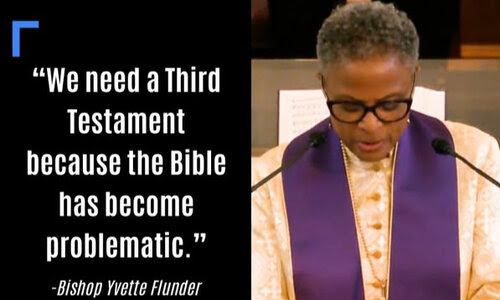
When Yvette Flunder stood before an audience connected to the Center for Public Theology & Public Policy, she didn’t hedge, soften, or qualify her words. She leaned into them. “This is a very dangerous thing that I’m about to say,” she admitted–before saying it anyway.
In her view, the Bible has become “problematic.” The New Testament is not the Word of God. And if certain passages offend? “We need to pull that page out.” Her conclusion: perhaps Christianity now needs a “Third Testament.”
Those statements weren’t abstract theology. They were direct, unambiguous, and rooted in a broader worldview she has long embraced.
Flunder is the senior pastor of the City of Refuge United Church of Christ (UCC) in Oakland, California and the presiding bishop of The Fellowship of Affirming Ministries. She of course identifies as a lesbian and is married to another female. She openly identifies with womanist and liberation theology frameworks–approaches that prioritize lived experience, social justice, and marginalized perspectives as interpretive lenses for faith.
In her remarks, that framework was unmistakable. Scripture, she argued, is not the Word of God itself, but merely “words about God”–and therefore open to revision.
That distinction may sound subtle. It is anything but.
Because once Scripture is reduced to human reflection rather than divine revelation, its authority collapses. It becomes negotiable–subject to editing, deletion, and reconstruction based on cultural or personal preference. In that framework, “pulling pages out” is not shocking. It is logical.
And that’s precisely what makes her comments so consequential.
For two millennia, Christianity has rested on a fundamentally different claim: that the Bible–Old and New Testaments alike–is inspired, authoritative, and binding, even when it confronts human desires or cultural norms. From the early church through the upheaval of the Protestant Reformation, debates over interpretation have been fierce. But the authority of Scripture itself was the common ground.
Flunder’s position removes that ground entirely.
If the Bible is not the Word of God, but merely human commentary, then it carries no inherent authority. It becomes one voice among many–useful when it affirms, disposable when it challenges. The result is not a reinterpreted Christianity. It is a reinvented one.
And this is not happening in isolation.
Across segments of the United Church of Christ and similar progressive spaces, there has been a growing willingness to move beyond reinterpretation into outright revision. Some clergy have described biblical teachings on gender and sexuality as outdated constructs rather than enduring truths.
Others have reframed sin as a social category rather than a spiritual reality, or elevated personal identity above scriptural instruction. In certain sermons and public statements, the Bible is treated less as a foundation and more as a flexible resource–one that can be reshaped to align with contemporary values.
That trajectory leads somewhere.
Because if Scripture can be rewritten, then doctrine has no fixed form. If doctrine has no fixed form, then truth itself becomes fluid. And if truth becomes fluid, the church loses its ability to speak with clarity, authority, or conviction.
What remains is not historic Christianity–it is something else entirely.
To be clear, Christians have always wrestled with difficult passages. The tension between faith and culture is not new. Early believers faced persecution for refusing to conform to Roman norms. Reformers challenged corruption within the church at great cost. Every generation has had to decide whether to conform Scripture to the culture–or allow Scripture to confront the culture.
What feels different now is the openness with which some leaders are choosing the former.
Flunder didn’t present her view as a struggle. She presented it as a solution. If the text is difficult, change the text. If the doctrine is offensive, rewrite the doctrine. If the Bible no longer fits the moment, create a new one.
But that solution comes at a price.
It removes any stable foundation for belief. It fractures unity within the broader church. And perhaps most significantly, it leaves those listening–especially younger believers–with a faith that feels endlessly adjustable and ultimately uncertain.
There is, however, a kind of clarity in what she said.
Because it forces a question that many churches have tried to avoid: Is Christianity something we receive–or something we revise according to our own standards?
Those are not two paths to the same destination. They are entirely different roads.
One begins with the assumption that God has spoken, even when His words challenge us. The other begins with the assumption that we must speak for God, correcting what no longer aligns with our understanding.
Flunder chose her path–and stated it plainly.
The question now is whether the church is willing to recognize just how far that path leads.
Iran can’t make its own gasoline — A US naval blockade exploits that and will be painful

With every year, it gets harder for Iranian engineers to extract oil from their fields and mismanagement has only accelerated the process.
A U.S. Blockade of Iran Is the Right Move
Forty-seven years of mismanagement have left Iran a paradox. On paper, it should be one of the world’s wealthiest states.
It is not only the world’s third-largest holder of proven crude oil reserves but is also the second-largest holder of natural gas reserves.
At a minimum, its development should be on par with, if not far superior to, Dubai and Doha.
Both were dusty backwaters at the time of the Islamic Revolution.
Beyond oil, Iran had human capital that the Gulf Arab states could only salivate over. Iranians were the region’s engineers and scientists. Universities excelled across disciplines.
Whether for manual labor, management, or innovation, Iran had all the building blocks to be a first-world country.
Why Iran Isn’t Rich Like Dubai…or Better
Instead, the clerical regime squandered Iranian wealth.
Blaming sanctions is naïve. Foreign investors steered clear of Iran due to its corruption and lack of both commercial law and an independent judiciary.
Export of revolution and subsidies for proxy groups trumped basic infrastructure investment.
Netanyahu pressing Mossad over Iranian uprising: report
Sanctions did matter, of course.
In 2025, Saeed-Reza Ameli, former secretary of Iran’s Supreme Cultural Revolution Council, estimated sanctions had cost the Iranian economy $1.2 trillion since 2013.
Given that the Islamic Republic’s nuclear program extended back four decades, and factoring in the real cost is likely upwards of $2 trillion.
Iran Has An Oil Problem…As In Old Oil Fields
Both American and Iranian pundits and politicians can spin and ascribe blame, but certain facts remain indisputable.
First, Iran’s oil fields are in decline. Many are now more than half a century old, and some more than a century.
With every year, it gets harder for Iranian engineers to extract oil from the same fields. Mismanagement has only accelerated the process.
To compensate, the Islamic Republic injects gasoline into the fields to increase oil production.
This leads to the second problem: Even before the current war, the Islamic Republic lacked sufficient refining capacity to meet its own refined gasoline needs.
Accordingly, it has imported gasoline from China, the Netherlands, and Venezuela. Venezuela, of course, is no longer an option, and Operation Epic Fury has set the regime back further, especially after Israel’s bombing of Asaluyeh.
While Iran’s blanket infringement on freedom of navigation for non-combatants and its efforts to charge tolls for transiting ships are illegal, blockades during military campaigns are not. Seizing Iranian ships and blockading ports is legal.
1,500 missiles, drones fired at Israel; 6,000 IRGC troops killed
Why A Blockage Will Hurt Iran
Blockading Iranian vessels and ships destined for Iran would have several immediate military benefits.
First, seizing Iranian crude would deny the regime the ability to pay its salaries and those of its proxies.
Second, blockading Iranian ports would prevent the regime from importing gasoline.
This would both temporarily impede Iranian oil extraction and would also reduce the amount of fuel available to the Islamic Republic to move its military, the security forces, and proxies it uses to massacre civilians.
Blockading Iranian ports would also prevent the shipment of Chinese or Russian missiles, especially since the United States and Israel now control Iran’s airspace.
The U.S. Navy, however, could ensure the Strait remains open for everyone but Iran and its Russian, Chinese, North Korean, and Spanish patrons.
What History Teaches
In 1999, President Bill Clinton bombed Serbia to compel it to cease its operations in Kosovo.
Even though many Americans demanded regime change, Clinton left Serbian dictator Slobodan Milošević in power when he ended the campaign.
With many of his supporters dead and his economy in tatters, Milošević fell from power in a popular uprising the following year.
The key to replicating the Serbian precedent is to ensure Iran cannot rebuild in the interim.
Iran peace talks unlikely to succeed, Israel estimates
Many within Congress and the media today allow their hatred for President Donald Trump to outweigh their desire for the United States to achieve its war aims.
Iranian leaders may posture as strong for issuing maximalist demands, but the world should see them for what they are: Buffoons who missed an opportunity to spare their regime more pain.
Time For Iran to Feel the Pain
The negotiation was not one between equals, but rather between a giant about to stomp and the mouse underfoot.
While the media frames the survival of a few top leaders as a defeat for Trump, the reality is different:
The United States has decimated most of Iran’s military infrastructure. The United States and Israel control Iran’s airspace.
The regime has little ability to recover economically, absent external investment. The mouse may now be crushed.
Cutting off strategic imports and lucrative exports will be essential, however, to avoid snatching defeat from the jaws of victory.
Frankly, the real question now is why the Pentagon has been so reticent to do what was so obviously necessary on the first day of the war.
TruLight Ministries Daily Entertainment Manna

TruLight TV & Kingdom Kidz : God’s Gift to Creationists: Mount St. Helens Explored
Today’s guest artist on Gospel Music USA The Dixie Echoes, for over 60 years, The Dixie Echoes have been delivering the gospel message in song across America through their spiritually uplifting music ministry. Considered to be one of the pioneer gospel groups, the Dixie Echoes have returned to their roots singing around two microphones with just a piano. And in this episode of Awesome Science, Noah travels to one of the few active volcanoes in the contiguous United States to find out why it’s called, “God’s gift to creationists.” Through cataclysmic events back in the 1980s, similar geologic features worldwide can now be explained by the Flood using Mount St. Helens as a scale model. Noah explores each of these features at the mountain, including a huge lava cave and lava cast forests. The features found here can help us understand catastrophic processes that were thought by secular scientists to take millions of years taking only hours or days.
Today on TruLight Radio XM
TruLight Radio XM 24/7
Program
GMT / UTC +2
Monday To Fridays
00:15 Words to Live By Testimonies
01.15 Science Scripture and Salvation
02.15 Ground Works
04.00 Gospel Concert of the Day
05.00 The Daren Streblow Comedy Show
5:55 It is Today devotional
6:00 Gaither Homecoming Morning Show
7:15 Discover the Word
8.15 Destined for Victory
8:55 Science Scripture and Salvation
9:00 Holy Spirit Hour – Normally Sermons
10:15 Hope of the Heart
11:15 Unshackled
11.45 Words to Live By
12:15 Truth for Life
13:15 Living on the Edge with Chip Ingram
14:15 Focus on the Family
15:00 Kids Hour
16:00 In Touch with Dr. Charles Stanley
16:30 Groundwork
17:15 Live in the Light
18:15 Renewing your Mind
19:00 Gaither Homecoming Show
20:15 Growing Hope
21:15 Adventures in Odyssey Radio Drama
21:45 Bible Reading
22:15 Night-sounds
23.00 Good Old Country Gospel / Rhema Gospel Express
VISIT THE WEBSITE
TruLight Ministry News – EXTRA MANNA
TruLight Ministries orders from God since 2012 . Teach Them , Comfort Them and Warn Them!
THIS YEAR STUDIES STARTS 1ST MAY 2026 – REGISTER TODAY .
We Starting , the 1st May 2026 . with Our Preachers Diploma Online Platform – TruTheology.co.za . 36 Subjects with between 10 to 15 Lessons per Subject , equivalent to a 3 Year Theology Degree , The Training is Free to Approved Members and Tests Online after Each Lesson , You Determine the Speed of Your Studies . If you are interested registrations will take place from 1 April 2026 .
Healing Truths
End Time Articles
Bonus Teaching for the Child of God !!
The first problem that comes up with this question is one of semantics. For example, many prefer “sin nature,” others prefer “sinful nature,” and still others prefer the ambiguous “flesh.” Whatever the specific names used for the warring parties, what is relevant is that an ongoing battle rages within the Christian.
The second problem is the actual definition of “nature.” How this significant word is defined determines how one sees the distinction between the “old man” and the “new man” and its relevant outworking in the life of the Christian. One way to view “nature” is to understand it as a “capacity” within a believer. Thus, the old man is interpreted as the former way of life, that of an unbeliever. In this sense, the Christian has two competing capacities within him—the old capacity to sin and the new capacity to resist sinning. The unbeliever has no such competition within; he does not have the capacity for godliness because he has only the sin nature. That’s not to say he cannot do “good works,” but his motivation for those works is always tainted by his sinfulness. In addition, he cannot resist sinning because he doesn’t have the capacity to not sin.
The believer, on the other hand, has the capacity for godliness because the Spirit of God lives within him or her. He still has the capacity for sin as well, but he now has the ability to resist sin and, more importantly, the desire to resist and to live godly. When Christ was crucified, the old man was crucified with Him, resulting in the Christian’s no longer being a slave to sin (Romans 6:6). We “have been set free from sin and have become slaves to righteousness” (Romans 6:18).
At the moment of conversion, the Christian receives a new nature. It is instantaneous. Sanctification, on the other hand, is the process by which God develops our new nature, enabling us to grow into more holiness through time. This is a continuous process with many victories and defeats as the new nature battles with the “tent” in which it resides—the old man, old nature, flesh.
In Romans 7, Paul explains the battle that rages continually in even the most spiritually mature people. He laments that he does what he doesn’t want to do and, in fact, does the evil he detests. He says that is the result of “sin living in me” (Romans 7:20). He delights in God’s law according to his “inner being,” but he sees another law at work in “the members of my body, waging war against the law of my mind and making me a prisoner of the law of sin at work within my members” (v. 23). Here is the classic example of the two entities, whatever terms they may carry. The point is that the battle is real, and it is one Christians will wage throughout their lives.
This is why believers are encouraged to put to death the deeds of the body (Romans 8:13), to put to death that which makes a Christian sin (Colossians 3:5), and to put aside other sins such as anger, wrath, malice, etc. (Colossians 3:8). All this to say that the Christian has two natures—the old and the new—but the new nature needs continual renewing (Colossians 3:10). This renewing, of course, is a lifetime process for the Christian. Even though the battle against sin is constant, we are no longer under the control of sin (Romans 6:6). The believer is truly a “new creation” in Christ (2 Corinthians 5:17), and it is Christ who will ultimately “rescue [us] from this body of death. Thanks be to God—through Jesus Christ our Lord!” (Romans 7:24–25).
Share this Feeding of Manna with your Friends and Family. just click on the Social Media icon and share !