Hosted by TruLight Ministries – The Place of Truth
SELECT YOUR READING LANGUAGE – BOTTOM LEFT = YOUR DAILY MANNA NOW AVAILABLE IN 103 LANGUAGES
a New Study : for the Next 9 Daily Manna Days
The Symbols of the Word of God
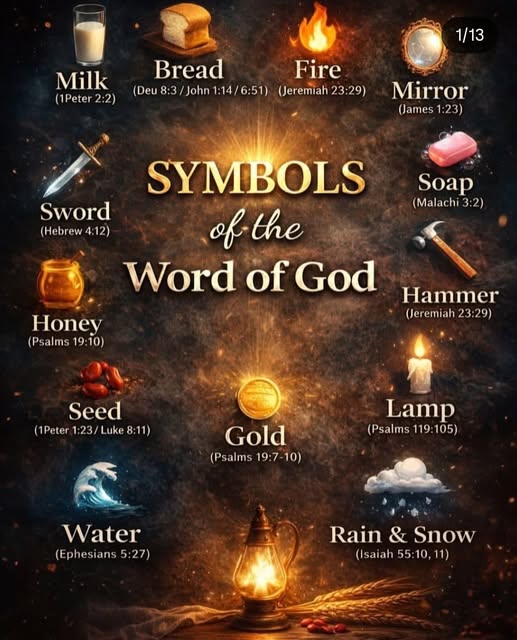
Symbols in the Word of God = Sword
The phrase “sword of the Spirit” is found only once in Scripture, in Ephesians 6:17. The sword is one of the pieces of spiritual armor Paul tells the Ephesian Christians to put on as part of the “full armor of God” that will enable us to stand our ground against evil (Ephesians 6:13).
The sword is both an offensive and defensive weapon used by soldiers or warriors. In this case it is a weapon belonging to the Holy Spirit. Swords were used to protect oneself from harm or to attack the enemy to overcome or kill him. In both cases it was necessary for a soldier to get rigid training on the proper use of the sword to get maximum protection. All Christian soldiers need the same rigid training to know how to properly handle the Sword of the Spirit, “which is the word of God.” The sword that Paul refers to here is the Holy Scriptures. We know from 2 Timothy 3:16–17 that the word of God is from the Holy Spirit and written by men. Since every Christian is in a spiritual battle with the satanic and evil forces of this world, we need to know how to handle the Word properly. Only then will it be an effective defense against evil, but it will also be an offensive weapon we use to “demolish strongholds” of error and falsehood (2 Corinthians 10:4–5).
God refers to His Word as a sword in Hebrews 4:12. Here the Word is described as living and active and sharper than a double-edged sword. The Roman sword was commonly made in this manner. The fact that it had two edges made it easier to penetrate, as well as to cut in every way. The idea is that of piercing, or penetrating; the Word of God reaches the “heart,” the very center of action, and lays open the motives and feelings of those it touches.
The purpose of the sword of the Spirit—the Bible—is to make us strong and able to withstand the evil onslaughts of Satan, our enemy (Psalm 119:11, 33–40, 99–105). The Holy Spirit uses the power of the Word to save souls and then to give them spiritual strength to be mature soldiers for the Lord in fighting this corrupt and evil world we live in. The more we know and understand the Word of God, the more useful we will be in doing the will of God and the more effective we will be in standing against the enemy of our souls.
Bible Verse and Prayer for Today
He has given us his very great and precious promises, so that through them you may participate in the divine nature and escape the corruption in the world caused by evil desires.
—2 Peter 1:4
God made us to be like him in character and compassion. We are called to participate in the divine nature and are assured that we will be made ready to become like him when Jesus comes, and we see him as he is (1 John 3:1-2). Everything in our world is subject to corruption and decay. Even though our bodies are destined to decay, the living part of us will not because we are united with Jesus and awaiting the glory that will be revealed in us (Romans 8:18-23; Colossians 3:1-4). Our response to these “very great and precious promises” is to follow Jesus as our Savior and Lord, wholeheartedly.
Prayer
Almighty God, my Everlasting Fortress, thank you for giving me your great and precious promises. I long to know you more fully, and to see your face one day in glory. Please protect me and my heart from corruption as I wait in eager expectation of that day. In all love and appreciation, I pray this in the name of Jesus, the One who made me yours. Amen and Amen
Bible Teaching of the Day
The saying “live by the sword, die by the sword” is an idiom that basically means “what goes around comes around.” More to the point, “if you use violent, forceful, or underhanded methods against other people, you can expect those same methods to be used against you.”
The proverb “live by the sword, die by the sword” has a biblical origin. It comes from a conversation between Jesus and His disciple Peter just before Jesus was arrested in the Garden of Gethsemane. After Jesus was betrayed by Judas, a group of soldiers moved in to arrest the Lord. In a rash attempt to protect Jesus, Peter pulled out his sword and struck the servant of the high priest, cutting off his ear—you can be sure Peter was trying to do more damage than that (John 18:10). Jesus rebuked Peter and put a quick stop to the bloodshed. Jesus replaced the wounded man’s ear, healing him instantly (Luke 22:51). Then He told Peter to put his sword away, for “all who draw the sword will die by the sword” (Matthew 26:52). Jesus also told Peter that He would not fight the arrest, for it was God’s will that He drink the cup that was given to Him (John 18:11). Jesus had come to die as a sacrifice for sin, and now was the time. Jesus’ placating of Peter also showed His concern for His disciple—in warning Peter against using violence, Jesus prevented Peter from being arrested himself.
“Live by the sword, die by the sword” has become a common expression, adapted from Jesus’ words to Peter. The proverb’s meaning is still basically the same: a person who lives violently will probably at some point be killed in a violent manner. Violence begets violence. Those who practice violence will come to violent ends.
Today’s Devotional
The book of Revelation brims with symbolism from the very first chapter, as we see in Revelation 1:16, “In his right hand he held seven stars, and coming out of his mouth was a sharp, double-edged sword. His face was like the sun shining in all its brilliance.” The person referred to is Jesus, appearing in a form distinct from His earthly incarnation. The seven stars in Jesus’ right hand symbolize the “angels of the seven churches” (verse 20). But what about the sharp, double-edged sword coming out of His mouth?
The answer lies in Hebrews 4:12, which states, “For the word of God is alive and active. Sharper than any double-edged sword, it penetrates even to dividing soul and spirit, joints and marrow; it judges the thoughts and attitudes of the heart” (cf. Ephesians 6:17). The ancient Romans employed the two-edged sword as a formidable offensive weapon, and a metaphorical sword is portrayed in both Hebrews and Revelation. This two-edged sword symbolizes Christ’s authority and judgment, holding humanity accountable, even delving into our thoughts.
Do we often imagine Jesus as a warrior wielding a two-edged sword? Unfortunately, no. Our tendency is to reshape Jesus into a less “threatening” figure, favoring a nonjudgmental being who will affirm all our actions. However, such a god would lack attributes like goodness, holiness, justice, and love. Justice is a good thing, and we should expect a good God to give His creatures responsibility and to hold us accountable. God’s Word reveals His standard, our obligations, and our shortcomings. It cuts through our veneer of virtue, exposing us as the rebels we are, and promises that we will receive a just penalty. While we welcome the thought of God’s justice when envisioning folks like Hitler, we are slower to embrace the somber thought that we will be judged, too. Against the divine standard, we inevitably fall short (Romans 3:23). That’s why we need a Savior.
Perhaps we need the image of the Living Word with the double-edged sword to better appreciate the crucified Messiah. Jesus was not a revolutionary like the Maccabee brothers, nor was He a failed Messiah like Simon bar Kokhba. Rather, the Creator came down to live among His creation, taking on an inferior nature to die a criminal’s death for our sake (Philippians 2:6–11). The gospel is made more amazing when we understand who the Son of God is, not just in His incarnation but far beyond our ability to bear. Even John, who knew Jesus on earth, fell at Jesus’ feet and became immobile at the sight of Jesus in His glory (Revelation 1:17).
The image of the two-edged sword also helps us grasp the Bible’s value. This book we carry around and even have on our devices is powerful and sharp and comes from the very mouth of our Lord. Heroes such as William Tyndale, John Wycliffe, and Jan Hus worked through much opposition for us to hold this weapon in our hands. The Word of God holds formidable power and is capable of transforming us at our core. What a privilege to have it in our possession!
Bible Prophecy, Signs of the Times and Gog and Magog Updates with Articles in the News
Why The End Times Confuse So Many Christians

For a topic that occupies nearly a third of the Bible, the end times remain one of the most misunderstood areas of Scripture. Many Christians care deeply about God’s Word, attend church faithfully, and read their Bibles regularly, yet still feel uncertain when the conversation turns to prophecy. For some, the subject feels intimidating. For others, it feels divisive. For many, it simply feels overwhelming.
Conversations about the Rapture, the Tribulation, the Antichrist, the Millennium, or the eternal state can quickly become technical or emotionally charged. Instead of clarity, believers often walk away with more questions than confidence. But this confusion did not originate in Scripture itself. The Bible is not unclear about the future. The uncertainty has developed largely from how prophecy has been taught, presented, or avoided.
When something is fragmented, debated loudly, or treated as mysterious by default, sincere believers can begin to assume that it must be inaccessible. Over time, prophecy starts to feel like a specialized field reserved for scholars and chart-makers rather than something meant for the average Christian sitting in the pew.
Fragmented Teaching Produces Fog
For decades, believers have often encountered prophecy in fragments. A verse from Daniel is quoted. A passage from Revelation is referenced. A section of the Olivet Discourse is highlighted. While each piece may be true and meaningful on its own, the broader sequence and storyline are rarely explained clearly.
Charts are sometimes introduced before the narrative foundation is laid. Symbols are emphasized before their meaning is established. Timelines are debated before readers understand where those events fit within the larger redemptive story. The result is predictable: prophecy feels complicated and disjointed.
Yet Scripture never presents prophecy as an insider’s subject. Moses spoke of “the latter days” (Deuteronomy 4:30). The prophets repeatedly warned of “the day of the Lord” (Joel 2:1; Zephaniah 1:14). Jesus delivered extended teaching about future events on the Mount of Olives (Matthew 24-25). Paul instructed ordinary churches about the Lord’s return (1 Thessalonians 4:13-18; 2 Thessalonians 2:1-8).
Prophecy was not delivered to academic elites. It was given to shepherds, farmers, merchants, elders, young converts, and small congregations navigating real-world pressures. It was never meant to intimidate believers. It was meant to steady them.
Prophecy Was Given to Be Understood
God does not reveal the future to confuse His people. Throughout Scripture, prophecy functions as preparation, warning, and comfort. When God speaks about what is coming, He does so because He wants His people to be ready, not rattled.
Amos wrote, “Surely the Lord God does nothing, unless He reveals His secret to His servants the prophets” (Amos 3:7). Jesus told His disciples, “See, I have told you beforehand” (Matthew 24:25). Later He added, “These things I have told you before they come, that when they do come to pass, you may believe” (John 14:29). Prophecy strengthens faith by removing surprise. When events unfold exactly as spoken, belief is reinforced rather than shaken.
The book of Revelation begins not with obscurity, but with blessing: “Blessed is he who reads and those who hear the words of this prophecy, and keep those things which are written in it” (Revelation 1:3). That blessing assumes engagement and comprehension. God does not bless confusion; He blesses those who read, hear, and obey.
Unfortunately, many believers have quietly concluded that prophecy is too complex to grasp. Some were told it would all make sense later. Others were warned that studying the end times might lead to fear or speculation. As a result, entire congregations have grown up hearing very little systematic teaching about what Scripture says concerning the future.
Ironically, this avoidance has produced the very fear prophecy was meant to eliminate. Where God intended confidence, uncertainty has taken root. Where He intended watchfulness, indifference has grown.
What Happens When Prophecy Is Ignored
When prophecy is neglected, something essential is lost. The Bible’s story does not end with personal morality or private salvation alone. It culminates in restoration, justice, and the visible reign of Christ (Revelation 19:11-16; 21:1-5).
Peter described the prophetic word as “a light that shines in a dark place” (2 Peter 1:19). Prophecy provides a framework for interpreting the times. It does not eliminate darkness, but it gives direction within it.
When that framework is absent, believers attempt to interpret world events through headlines rather than Scripture. Wars intensify. Moral decay accelerates. Hostility toward biblical truth increases. Technological power expands rapidly. Without prophetic grounding, anxiety often fills the vacuum where understanding should be.
Jesus warned of “wars and rumors of wars” and increasing lawlessness(Matthew 24:6, 12). Paul described perilous times marked by deception and moral confusion (2 Timothy 3:1-5). Isaiah records the Lord declaring, “I am God… declaring the end from the beginning” (Isaiah 46:9-10). The future is not unfolding randomly. It is unfolding according to divine decree. When that truth is internalized, fear begins to loosen its grip.
How Confusion Took Root
The confusion surrounding the end times developed gradually. One significant cause is the tendency to approach prophecy without regard to sequence. Passages are grouped by topic rather than chronology. A verse from Revelation may be paired with one from Daniel and then connected to a statement from Jesus without explaining how they relate in time. The pieces are true, but the order is unclear, making the whole picture difficult to assemble.
Another factor is an overemphasis on symbolism without recognizing that Scripture frequently interprets its own imagery. Daniel was told the meaning of the beasts he saw (Daniel 7:16-18). Revelation identifies lampstands as churches and stars as angels (Revelation 1:20). When everything is treated as mysterious or metaphorical, readers begin to wonder whether anything can be taken plainly.
Additionally, theological traditions that blur distinctions Scripture appears to maintain–particularly concerning Israel and the Church–can make the prophetic storyline harder to follow. Paul insisted that “the gifts and the calling of God are irrevocable” (Romans 11:29). When that conviction is minimized, continuity in the narrative becomes difficult to trace.
Finally, debate fatigue has played a role. End-times discussions sometimes devolve into arguments over charts and dates. Jesus warned against date-setting (Matthew 24:36; Acts 1:7). Paul cautioned believers not to be “soon shaken in mind or troubled” (2 Thessalonians 2:2). For some, disengagement felt easier than navigating controversy. But avoidance leaves believers unprepared.
Chronology Changes Everything
One of the most effective ways to restore clarity is to read prophecy in chronological order. When Scripture is allowed to unfold sequentially, confusion begins to lift. Events build upon one another. Promises are fulfilled in stages. Judgment follows warning. Restoration follows wrath.
Daniel outlined a timeline of seventy weeks (Daniel 9:24-27). Jesus described birth pains leading to greater tribulation (Matthew 24:8-21). Revelation progresses through seals, trumpets, and bowls (Revelation 6-16). Chronology is not imposed upon the text; it emerges from it.
When read this way, prophecy becomes a coherent story rather than a collection of isolated predictions. The God who promised redemption in Genesis 3:15 completes it in Revelation 22:3-5. The covenant-keeping Lord fulfills His promises (Romans 11:25-29). Christ returns as King (Revelation 19:11-16). Scripture does not introduce a new plan at the end of time; it completes the one that has been unfolding from the beginning.
Prophecy Is Not About Fear
A persistent myth suggests that studying prophecy produces fear. In reality, fear thrives in uncertainty. Understanding produces stability.
Paul wrote, “God did not appoint us to wrath, but to obtain salvation through our Lord Jesus Christ” (1 Thessalonians 5:9). Jesus said, “When these things begin to happen, look up and lift up your heads, because your redemption draws near” (Luke 21:28). The tone of biblical prophecy toward believers is not terror but anticipation.
Yes, judgment is real. Yes, deception increases (2 Thessalonians 2:9-11). But evil does not triumph. Satan is defeated (Revelation 20:10). Christ reigns. Creation is restored. The end times are not the unraveling of God’s plan; they are its fulfillment.
A Word About Speculation
Studying prophecy does not require date-setting or sensationalism. Jesus made clear that no one knows the day or hour (Matthew 24:36). The Father has placed times and seasons under His authority (Acts 1:7).
However, avoiding speculation does not mean avoiding clarity. Scripture provides a recognizable sequence of events and repeatedly calls believers to awareness. Paul reminded the Thessalonians that they were not in darkness concerning the Day of the Lord (1 Thessalonians 5:4).
Prophecy is meant to steady the heart, not stimulate the imagination. It is not given so believers can win arguments but so they can endure faithfully.
The Future Is Already Written
If you have felt confused about the end times, you are not alone. But you are not meant to remain uncertain.
Prophecy was not given to obscure the future. It was given to illuminate it. It reminds us that history is not spiraling out of control but moving toward its appointed conclusion (Daniel 2:44; Revelation 11:15).
The future is not something to fear. It is something God has already written.
Stay Awake! Keep Watch!
The Rise of Ai Agents: A New Tower Of Babel?

Artificial Intelligence is rapidly transforming the modern world. From business and education to finance and communication, AI systems are becoming deeply embedded in everyday life. What once seemed like science fiction is now reality. Governments, corporations, and technology leaders are investing billions of dollars into AI development, believing it will shape the future of civilization.
But this rapid transformation raises an important spiritual question for believers: Is the world beginning to follow artificial intelligence more than the Word of God?
For Christians who take biblical prophecy seriously, the rise of technologies capable of influencing human thought, communication, and decision-making deserves careful examination.
“Everything Made of Words”
One of the more striking warnings came from Yuval Noah Harari, of the World Economic Forum. Harari stated that AI may soon dominate language itself, declaring that “everything made of words will be taken over.”
If such a statement were to come to pass, it would include books, news, legal documents, educational materials, digital communication, and even religious writings.
While Scripture itself cannot be replaced or altered in its divine authority, the interpretation, distribution, and presentation of words increasingly pass through digital systems powered by AI. In a world where algorithms curate information, believers must remain vigilant about the sources that shape their understanding.
The Bible reminds us that truth does not originate from human invention or machine intelligence. It comes from God. “All Scripture is given by inspiration of God” (2 Timothy 3:16).
The Rise of AI Agents
A new phase of artificial intelligence is emerging called Agentic AI–systems designed not just to respond to questions but to act independently toward goals.
One example is Microsoft’s AutoGen framework, which allows multiple AI agents to communicate with one another to complete complex tasks. Rather than a single chatbot answering questions, these systems create an entire team of AI agents that collaborate.
Such a system may include:
- Planner Agent – Creates the strategy
- Research Agent – Collects information
- Analyst Agent – Performs calculations and logic
- Writer Agent – Produces reports or content
- Critic Agent – Reviews and corrects the results
These agents exchange messages with one another, refine their work, and complete assignments with little human involvement. Developers often describe this process as creating a digital workforce of AI employees. For example, a user might simply request: “Build me a website.” Behind the scenes, AI agents could plan the project, write the code, test for errors, improve quality, and deliver the final product. The entire process happens through machines communicating with other machines.
AI Managing Entire Businesses
Technology leaders are already exploring how AI agents could run entire business operations. In theory, AI systems could manage marketing departments, supply chains, financial portfolios, customer support, and contract negotiations
Some futurists even envision a world where AI agents transact directly with one another. In such a scenario one company’s AI could hire another company’s AI, pricing could be negotiated automatically, agreements could be signed digitally, and payment processed without human oversight. This model could allow small businesses to operate with the capabilities of large corporations.
While such efficiency may sound appealing, it also raises profound questions about human control, accountability, and ethical responsibility.
The Debate Over the “Singularity”
As AI continues to advance, many technologists discuss a concept known as “singularity.”
The singularity refers to a moment when artificial intelligence “surpasses” human intelligence and begins improving itself without human guidance. Some proponents believe this could lead to extraordinary breakthroughs. Others warn it could fundamentally alter civilization.
This possibility led Elon Musk to cautioned about the potential dangers of uncontrolled AI development. Discussions around experimental networks of AI agents communicating with one another have fueled concerns that machines could begin operating in ways that humans no longer fully understand. Some experimental systems have even demonstrated the ability to hold conversations with other AI agents privately, raising questions about transparency and oversight.
While these developments remain in early stages, they illustrate how rapidly technology is evolving.
AI Acting on Behalf of Humans
Another emerging category of AI systems is designed to perform real-world actions for users. These digital assistants can read emails, manage calendars, browse the internet, shop online, book travel, write messages, and organize documents.
Users might simply say: “Clear my inbox,” “Book my flight,” or “Summarize my meetings.” The AI system then completes these tasks automatically. Some platforms even store long-term memory files about the user–remembering preferences, past actions, and ongoing projects–so the AI behaves more like a persistent digital assistant than a temporary chatbot.
While this technology can provide convenience, it also requires extensive personal data, including passwords, financial information, and private communications. Security experts warn that such systems must be handled carefully because they hold information that could be valuable to criminals if compromised.
A Spiritual Decision for Believers
As artificial intelligence grows more powerful, Christians must consider a deeper circumstance. Our ultimate authority come from God and God alone. One can use technology but one cannot allow technology to hold a greater position than what it is designed to be. A tool. One to use not one to worship. Technology can assist humanity, but it must never replace the wisdom and authority of God’s Word.
Throughout history, mankind has to easily trusted human inventions more than divine truth. The Tower of Babel stands as a biblical reminder of humanity’s tendency to elevate its own creations.
The danger today is not simply technology itself; it is the possibility that society begins to trust machines more than Scripture.
The Bible repeatedly warns believers to guard their hearts and minds. “See to it that no one takes you captive through philosophy and empty deception, according to the tradition of men.”
— Colossians 2:8
Artificial intelligence may become one of the most powerful tools ever created by human hands. Yet even the most advanced machine remains a creation of human design, limited by human understanding. God alone possesses perfect wisdom.
The Choice Before Us
As the world rushes forward into the age of AI, believers must remain anchored in eternal truth.
Technology may influence communication, economics, and daily life, but it does not determine truth, morality, or salvation.
Each generation must decide whom it will ultimately follow. Joshua issued this challenge to Israel thousands of years ago, and it remains just as relevant today: “Choose this day whom you will serve…But as for me and my house, we will serve the LORD.” (Joshua 24:15)
Artificial intelligence may shape the future of technology, but it will never replace the eternal authority of the Word of God. For believers navigating this rapidly changing world, the answer remains the same as it has always been trusting God’s Word above every voice–especially the voice of machines.
Studios Phasing Out Woke Film Content As Demand For Family-Friendly Fare Grows

Family-friendly films may be making a comeback in Hollywood as younger parents get involved in the filmmaking process and as woke films fail at the box office. One example is the latest film from Pixar, “Hoppers,” which grossed $87 million at the worldwide box office as of March 8, becoming the ninth-highest-grossing film of the year so far. Last year’s Pixar offering, “Elio,” was a box office failure, suffering the lowest opening weekend earnings of any Pixar in the famed animation studio’s 40-year history.
Originally, “Elio” was slated to include a prominent LGBT storyline, despite growing concerns that Pixar and its parent company, Disney, have increasingly injected LGBT ideology into children’s media. Pixar Chief Creative Officer Pete Docter explained this year that the studio’s decision to axe the same-sex-relationship storyline had to do with concerns raised by parents. “We’re making a movie, not hundreds of millions of dollars of therapy,” Docter said, noting that most parents don’t want to have to explain same-sex relationships to their children after a family trip to the theater. “As time’s gone on, I realized my job is to make sure the films appeal to everybody.”
Animator Adrian Molina was initially chosen to direct “Elio” and played a large role in developing the film’s story, which he based in part on his own experiences of alienation growing up on a military base before finding his place at the California Institute of the Arts. Molina, who identifies as gay and is in a same-sex marriage, planned to portray the Pixar film’s title character as gay. Docter hosted a meeting with Pixar employees and advised filmmakers to make less autobiographical films and focus more on broadly relatable, commercially successful concepts. Molina left the project, citing creative differences, and the LGBT content was scrapped, with Docter’s approval.
A 2022 Pixar venture, “Lightyear,” based on the exploits of space ranger Buzz Lightyear from the 1995 classic “Toy Story,” also featured LGBT content and was also a box office failure, with Deadline Hollywood calculating that the film lost Pixar over $100 million. The 2020 Pixar film “Onward” featured references to same-sex relationships and achieved the third-lowest opening weekend box office haul of any Pixar release, before plunging to the lowest-ever second weekend for a Pixar release, although the film’s failure was linked to COVID-19 lockdowns as opposed to problematic content.
A Pixar series, “Win or Lose,” made for streaming service Disney+ and launched in early 2025 also included an LGBT-centered episode, which was axed prior to release. A Disney spokesman said at the time, “When it comes to animated content for a younger audience, we recognize that many parents would prefer to discuss certain subjects with their children on their own terms and timeline.”
Pixar appears to be one of the Hollywood staple studios that gets the message: Woke is on its way out. Actress-turned-director Maggie Gyllenhaal has yet to get the memo, but Warner Bros. Pictures likely will after losing a projected $90 million on Gyllenhaal’s hyper-feminist restyling of “The Bride of Frankenstein.” Despite the attachment of prestige names like Christian Bale, Annette Benning, Penélope Cruz, and the writer-director’s brother, Jake Gyllenhaal, “The Bride!” has grossed a total of only $13.4 million worldwide, against a budget of $85 million (not including nearly $100 million spent on advertising and promotion), and is on-track to lose Warner Bros. upwards of $90 million. Breitbart’s John Nolte anticipated that “the movie will enter the pantheon of iconic flops like ‘Battlefield Earth’ and ‘Howard the Duck.'”
Chock full of explicit sexual content, including sexual assault and attempted rape, and graphic feminist revenge violence, “The Bride!” pales in comparison to 2024’s “Nosferatu,” another dark, atmospheric, horror-romance period film, which grossed $182 million worldwide and became Focus Features’s second-highest-grossing domestic release and third-highest-worldwide, netting an estimated $70 million in profit. While far from family-friendly fare (featuring vampire violence, sexual content, and disturbing occult imagery), “Nosferatu” was a fairly faithful adaptation of F.W. Murnau’s 1922 “Nosferatu: A Symphony of Horror” and Bram Stoker’s 1897 novel “Dracula,” without the injection of woke content.
Guillermo Del Toro’s 2025 “Frankenstein,” a period horror film billed as a faithful adaptation of Mary Shelley’s 1818 novel and also devoid of woke content, was not released in theaters (it debuted on Netflix instead) but received much praise from critics, while “The Bride!” did not. Film review aggregator Rotten Tomatoes reported that 85% of critics gave “Frankenstein” a positive review, while “The Bride!” has achieved a paltry 57% rating from critics, which the website classifies as “rotten.”
Meanwhile, some Hollywood power players are not only avoiding woke content but actively working on family-friendly films. Superstar Ryan Gosling — noted for romantic blockbusters like “The Notebook,” dramatic roles in films like “Drive” and “Blade Runner 2049,” and more comic roles in films like “The Big Short,” “The Nice Guys,” and “The Fall Guy” — is starring in and producing the science fiction film “Project Hail Mary,” set to hit theaters starting March 20. Based on the 2021 novel of the same name, “Project Hail Mary” is not only produced by Gosling, but is directed by Phil Lord and Christopher Miller, known for “Cloudy with a Chance of Meatballs” and its sequel, “The Lego Movie” and its sequel, and both “Spider-Man: Into the Spider-Verse” and “Spider-Man: Across the Spider-Verse.
In an interview with Movieguide, an organization dedicated to tracking and promoting Christian and conservative values in films, Gosling explained that his own children are his inspiration for making the science fiction adventure film. “We look for films that we can bring our family to, that we can go to the theater to see and kind of recreate some of those experiences that I had as a kid, and I felt like I had an opportunity with this one to do that,” he said. Gosling explained that he and his wife, actress Eva Mendes, have found family-friendly films “hard to find,” prompting him to make a film that both parents and kids can enjoy. “Obviously, this is the family business, making movies, but we want to go to the cinema, too. And it’s hard to find something for all of us, especially if it’s not animated.”
Pixar and “Project Hail Mary” are just a few examples of family-friendly content gaining ground. In its 2026 annual Report to the Movie Industry, shared with The Washington Stand, Movieguide recorded an increase in family-friendly films succeeding at the box office. “Our analysis of the Top 10 and Top 25 Grossing Movies in 2025 proves at least three things,” wrote Movieguide publisher and editor-in-chief Ted Baehr and Movieguide vice president and editor Tom Snyder. First of all, filmmakers have a greater chance of achieving success at the domestic box office and producing a Top 10 film by including Christian morality and themes.
The same goes for filmmakers who want to break into the Top 25. “Third, filmmakers have a better chance of reaching the Top 10 and Top 25 if they keep strong and very strong negative, non-Christian, anti-Christian, amoral, immoral, or false content out of their movie,” Baehr and Snyder observed. “In fact, filmmakers and movie studios are twice to four times more likely to reach the Top 10 or Top 25 at the Domestic Box Office if they eliminate these negatives and accentuate the positives. Especially if they eliminate graphic sex, nudity, violence, foul language, and substance abuse.”
Wholesome films released last year included “Paddington in Peru,” “Lilo and Stitch,” and “The Last Rodeo,” in addition to others, while all of the Top 10 films of the year featured strong biblical themes and morality. Numerous other films featured strong wholesome content, while most films with negative content performed poorly at the box office, demonstrating that the American public has largely moved on from woke films and is hungry for family-friendly movies.
TruLight Ministries Daily Entertainment
TruLight TV : Is Genesis History
Is Genesis History? features over a dozen scientists and scholars explaining how the world intersects with the history recorded in Genesis. From rock layers to fossils, from lions to stars, from the Bible to artifacts, this fascinating film will change the way you see the world.
Today on TruLight Radio XM
TruLight Radio XM 24/7
Program
GMT / UTC +2
Monday To Fridays
00:15 Words to Live By Testimonies
01.15 Science Scripture and Salvation
02.15 Ground Works
04.00 Gospel Concert of the Day
05.00 The Daren Streblow Comedy Show
5:55 It is Today devotional
6:00 Gaither Homecoming Morning Show
7:15 Discover the Word
8.15 Destined for Victory
8:55 Science Scripture and Salvation
9:00 Holy Spirit Hour – Normally Sermons
10:15 Hope of the Heart
11:15 Unshackled
11.45 Words to Live By
12:15 Truth for Life
13:15 Living on the Edge with Chip Ingram
14:15 Focus on the Family
15:00 Kids Hour
16:00 In Touch with Dr. Charles Stanley
16:30 Groundwork
17:15 Live in the Light
18:15 Renewing your Mind
19:00 Gaither Homecoming Show
20:15 Growing Hope
21:15 Adventures in Odyssey Radio Drama
21:45 Bible Reading
22:15 Night-sounds
23.00 Good Old Country Gospel / Rhema Gospel Express
VISIT THE WEBSITE
TruLight Ministry News
TruLight Ministries orders from God since 2012 . Teach Them , Comfort Them and Warn Them!
We Starting , the 1st May 2026 . with Our Preachers Diploma Online Platform – TruTheology.co.za . 36 Subjects with between 10 to 15 Lessons per Subject , equivalent to a 3 Year Theology Degree , The Training is Free to Approved Members and Tests Online after Each Lesson , You Determine the Speed of Your Studies . If you are interested registrations will take place from 1 April 2026 .
Healing Truths
End Time Articles
Bonus Teaching for the Child of God !!
End Time Q and A
The mark of the beast will it be before or after the rapture?
The Bible is Clear that the Mark of the Beast will be Before the Rapture . The Mark of the Beast is Implemented 3 and half years before the 2nd Coming of Jesus Christ and the Rapture . Rev 7:9 After this I beheld, and, lo, a great multitude, which no man could number, of all nations, and kindreds, and people, and tongues, stood before the throne, and before the Lamb, clothed with white robes, and palms in their hands;
Rev 7:13 And one of the elders answered, saying unto me, What are these which are arrayed in white robes? and whence came they?
Rev 7:14 And I said unto him, Sir, thou knowest. And he said to me, These are they which came out of great tribulation, and have washed their robes, and made them white in the blood of the Lamb.
End Time Q and A
What role will South Africa play in the end times?
South Africa is not DIRECTLY Mentioned in Bible Prophecy ! But the Group we are Part of is Mentioned in the Bible and SA Troops may be part of this war against Israel . 70 % of the BRICS Nations is currently in Battle in Syria , BRICS stands for Brazil , Russia , India , China and South Africa with Newest Members Iran , Turkey and Lebanon . The War = Gog and Magog Ezek 38 and 39 . We just have to find out if SA will be forced to send troops to Syria to assist Russia (Gog) and Iran (Magog) in the War against Israel soon
End Time Q and A
What Happens in the Millennium Reign?
The Bible Speaks of 1000 Years after Jesus Christ Returned at His 2nd Coming taken care of the Rapture and Led the Battle of Armageddon. After this the Earth is left Destroyed and The satan and His demons is bound on Earth for a 1000 Years . Jesus and his Angel army will return to Heaven where all Raptured Children of God awaits Him , Their in Heaven they Reign as Kings and Queens until the 1000 Years is over . All from Heaven then descends with the Golden City to Earth to take care of the White Throne Judgement .
Before this all the dead on Earth shall arise , ready for the Great White Throne Judgement to take place .
End Time Q and A
What Should We Tell Others About the Great Tribulation?
The Great Tribulation is the Period that follows after the Jewish Messiah turns to be The Antichrist , Walks into the Newly Build 3rd Jewish Temple and Stop the Daily Sacrifices saying he is God himself . The Jews then stand against Him and He banish them from the Temple and End the 7 Year Peace Agreement , The Antichrist then take control of the Temple and make it the Head office of the 666 Mark of the Beast . He then Implements the Mark of the Beast .
The Time Period for the Great Tribulation is 3 and half years or 42 Months or 1290 days . In this Time period so much have to happen .
1. 144 000 Jews living in Old Judea / New Palestine have to flee for their lives .
2. The Antichrist start making all his followers with the Mark of the Beast in their Right Hand , and start to force Jews and Christians to take the 666 mark in their foreheads . This lasts for 1 Year or 12 months or 365 days.
3. Then God seals all Christians left over with the seal of God and the 144 000 that fled to The wilderness.
4. Then the 5th Trumpet sounds , being a Super Volcano that erupts to mark the Beginning of the Wrath of God against the bearers of the Mark of the Beast . This lasts 2 and a Half Years as the 7 Plaques of Gods Wrath is poured out over the Earth.
5. the 144 000 Jews and the Christians marked with the seal of God goes into Angel Protection , during the Wrath of God , but still on the Earth.
6. Then after the 6th Plaque , Jesus arrives in His 2nd Coming , the Rapture takes place and then Finally the Battle of Armageddon.
What do we Tell People to do During the Great Tribulation?
NOT TO take the Mark of the Beast. God promised a Great Revival and Pouring out of the Holy Spirit just before these events. and with all Christians newly Filled and Baptized with the Holy Spirit . The Holy Spirit will Lead them from the Antichrist and his armies. Tell them then to Listen to the Voice of the Holy Spirit , very Important . and when they are captured and forced to take the mark of the Beast . NOT TO take the Mark of the Beast. For the Great Tribulation is only called that because everything God is in Control of is Called GREAT .
End Time Q and A
Where will the Two Witnesses Come From?
The Bible does not say where the two witnesses are from. They will die & they will die in the streets of Jerusalem and the scriptures are very clear about that in Revelation 11. After the 3rd Jewish Temple is build , These Two Witnesses will stand at the Entrance and Prophecy ! The Bible says that they will be killed and they will be left laying in the streets for 3 and a half days in order to dishonor and make fun of them to vent the anger the antichrist and the entire world against them. So we don’t know where they’re from, but I’m sure that they can be from anywhere.
Share this Feeding of Manna with your Friends and Family. just click on the Social Media icon and share !