SELECT YOUR READING LANGUAGE – BOTTOM LEFT = YOUR DAILY MANNA NOW AVAILABLE IN 103 LANGUAGES
@ TruLight – Daily Manna is not Just a Bible Verse with a Small Prayer . No WE SERVE DAILY Manna for the Whole Day . Breakfast , Lunch , Dinner , Plus tea Times and even Entertainment Manna . Plus News Manna and More , This Daily Manna will keep you Spiritually full for the full 48 Hours and even More to Share with your Friends and Family !!!
The Gospel is Foolishness for the LOST !!!
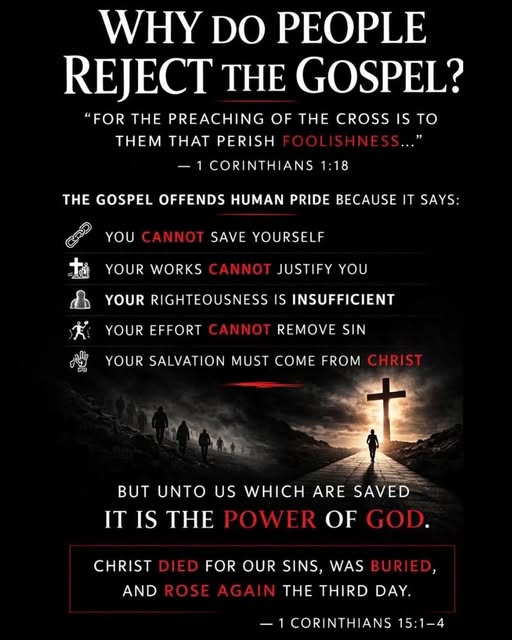
The decision to accept or reject Jesus as Savior is the ultimate life decision. Why do many people choose to reject Jesus as Savior? There are perhaps as many different reasons for rejecting Christ as there are people who reject Him, but the following four reasons can serve as general categories:
1) Some people do not think they need a savior. These people consider themselves to be “basically good” and do not realize that they, like all people, are sinners who cannot come to God on their own terms. But Jesus said, “I am the way, the truth, and the life. No one comes to the Father except through me” (John 14:6). Those who reject Christ will not be able to stand before God and successfully plead their own case on their own merits.
2) The fear of social rejection or persecution deters some people from receiving Christ as Savior. The unbelievers in John 12:42-43 would not confess Christ because they were more concerned with their status among their peers than doing God’s will. These were the Pharisees whose love of position and the esteem of others blinded them, “for they loved the approval of men rather than the approval of God.”
3) For some people, the things that the present world has to offer are more appealing than eternal things. We read the story of such a man in Matthew 19:16-23. This man was not willing to lose his earthly possessions in order to gain an eternal relationship with Jesus (see also 2 Corinthians 4:16-18).
4) Many people are simply resisting the Holy Spirit’s attempts to draw them to faith in Christ. Stephen, a leader in the early church, told those who were about to murder him, “You stiff-necked people, with uncircumcised hearts and ears! You are just like your fathers: You always resist the Holy Spirit!” (Acts 7:51). The apostle Paul made a similar statement to a group of gospel rejecters in Acts 28:23-27.
Whatever the reasons why people reject Jesus Christ, their rejection has disastrous eternal consequences. “There is no other name under heaven given to men by which we must be saved” than the name of Jesus (Acts 4:12), and those who reject Him, for whatever reason, face an eternity in the “outer darkness” of hell where there will be “weeping and gnashing of teeth” (Matthew 25:30).

Tea Time Manna
God is not unjust; he will not forget your work and the love you have shown him as you have helped his people and continue to help them.
—Hebrews 6:10
The Holy Spirit offers us great assurance in today’s verse! God is not unjust. Oh, that is such an understatement: God furnished the atoning sacrifice for our sins by sending Jesus (1 John 2:1-2). When we seek after him, Jesus promised we could find him (Matthew 7:7-8; Acts 17:27). God will not forget the work and love we share with others. God has removed our sins as far from us as the east is from the west (Psalm 103:10-12). He chooses to keep an eternal record of the good we have done. We are his people. He claims us. He is gracious and loving, remembering the good we have done to others while forgiving and forgetting our sins. Wow! What great motivation for us to keep maturing into the likeness of Jesus Christ as we become more JESUShaped (2 Corinthians 3:18).
Prayer
God, you are so gracious. Thank you. Words cannot express my joy at hearing such a simple and profound statement describing your virtues: God is not unjust; he will not forget your work and the love you have shown him as you have helped his people and continue to help them. I am so glad, dear Father, that I am your child. Through my gracious brother, Jesus, I thank you. Amen and Amen.
Bible Teaching of the Day
LUNCH MANNA =
The Jews rejected Jesus because He failed, in their eyes, to do what they expected their Messiah to do—destroy evil and all their enemies and establish an eternal kingdom with Israel as the preeminent nation in the world. The prophecies in Isaiah 53 and Psalm 22 describe a suffering Messiah who would be persecuted and killed, but the Jews chose to focus instead on those prophecies that discuss His glorious victories, not His crucifixion.
The commentaries in the Talmud, written before the onset of Christianity, clearly discuss the Messianic prophecies of Isaiah 53 and Psalm 22 and puzzle over how these would be fulfilled with the glorious setting up of the kingdom of the Messiah. After the church used these prophecies to prove the claims of Christ, the Jews took the position that the prophecies did not refer to the Messiah, but to Israel or some other person.
The Jews believed that the Messiah, the prophet which Moses spoke about, would come and deliver them from Roman bondage and set up a kingdom where they would be the rulers. Two of the disciples, James and John, even asked to sit at Jesus’ right and left in His kingdom when He came into His glory. The people of Jerusalem also thought He would deliver them. They shouted praises to God for the mighty works they had seen Jesus do and called out, “Hosanna, save us,” when He rode into Jerusalem on a donkey (Matthew 21:9). They treated Him like a conquering king. Then, when He allowed Himself to be arrested, tried, and crucified on a cursed cross, the people stopped believing that He was the promised prophet. They rejected their Messiah (Matthew 27:22).
Note that Paul tells the church that the spiritual blindness of Israel is a “mystery” that had not previously been revealed (Romans chapters 9–11). For thousands of years, Israel had been the one nation that looked to God while the Gentile nations generally rejected the light and chose to live in spiritual darkness. Israel and her inspired prophets revealed monotheism—one God who was personally interested in mankind’s destiny of heaven or hell, the path to salvation, the written Word with the Ten Commandments. Yet Israel rejected her prophesied Messiah, and the promises of the kingdom of heaven were postponed. A veil of spiritual blindness fell upon the eyes of the Jews, who previously were the most spiritually discerning people. As Paul explained, this hardening on the part of Israel led to the blessing of the Gentiles who would believe in Jesus and accept Him as Lord and Savior.
Two thousand years after He came to the nation of Israel as their Messiah, Christ is still (for the most part) rejected by the Jews. Many Jews today (some say at least half of all living Jews) identify themselves as Jewish but prefer to remain “secular.” They identify with no particular Jewish movement and have no understanding or affiliation with any Jewish biblical roots. The concept of Messiah as expressed in the Hebrew Scriptures or Judaism’s “13 Principles of Faith” is foreign to most Jews today.
But one concept is generally held as universal: Jews must have nothing to do with Jesus! Most Jews today perceive the last 2,000 years of historical Jewish persecution to be at the hands of so-called “Christians.” From the Crusades, to the Inquisition, to the pogroms in Europe, to Hitler’s Holocaust—Jews ultimately believe that they are being held responsible for the death of Jesus Christ and are being persecuted for that reason. They, therefore, reject Him today.
The good news is that many Jews are turning to Christ today. The God of Israel has always been faithful to keep a “remnant” of believing Jews to Himself. In the United States alone, some estimates say that there are over 100,000 Jewish believers in Jesus, and the numbers are growing all the time.
Today’s Devotional
DINNER MANNA =
The question of why God gave humans a free will often comes up in a discussion about the problem of evil. Someone will ask why there is so much evil in the world, and the answer is that human beings have chosen to do evil things. God is not to blame. The follow-up question is, if God knew all the evil things that people would choose to do, why would He give us free will?
The “standard” answer seems to be that, for love to be real, it must not be coerced. If we did not have the ability to reject God, then neither would we have the ability to truly love Him. Some theologians even go so far as to say that human freedom is the highest good and that even God will not violate it. Genuine love and genuine good can only exist in a world where there is an opportunity for genuine rejection and genuine evil. Some add that, since God knows all possibilities past, present, and future (foreknowledge), the world He created must be the one where the greatest amount of good would result. Out of all possible worlds, the one He made is the best. The problem with this line of thinking is that, although it may be somewhat satisfying intellectually, it is never articulated in Scripture.
What follows are a few more thoughts that may help us formulate some conclusions as to why God gave us a free will. At least they will give us the full weight to the biblical evidence.
First, we have to admit that “free will” is limited by physical possibilities. “Free will” cannot mean we are free to do anything we want to do. Probably a lot of people would like to fly like Superman or be as strong as Samson or teleport from one location to another, but physical limitations prohibit them from doing it. On one level, this may not seem to be an issue of free will, but it is not completely extraneous, because God created a world in which people desire to do these things but have no ability to do them. In this sense, God has curtailed “free will”—it is not truly free as popularly defined.
When we pray for something, we often are praying that another’s “free will” will be curtailed by outside circumstances and physical limitations. If a brutal dictator invades a neighboring country, and we pray for his defeat, we are certainly praying that the dictator will be unable to do what he wants to do. In this case, the person praying is asking God to intervene with another person’s will to prevent a person from accomplishing what he has chosen to do. In the way God created the world, He has built in many limitations that stymie our wills and limit our choices. Likewise, He may intervene to further limit our choices by circumstances beyond our control.
With this in mind, perhaps we might define free will as the ability to choose whatever we want, within the bounds of physical limitations. This brings up the second problem, which has to do with what we want. To deal with this issue, Martin Luther wrote his treatise The Bondage of the Will. The problem is not that we are not free to choose what we want, but that what we choose is severely limited by our desires. We freely choose to disobey God because that is all we want to do. Just as we cannot fly like Superman due to our physical limitations, we cannot obey God due to our spiritual limitations. We are free to choose all sorts of ways to disobey God, but we simply cannot choose to obey God without having our desires radically reorganized (some would say regenerated)—and we are powerless to do this on our own. Apart from God and left to our sinful selves, we will choose sin (Psalm 14:1-3, 53:1-3; Romans 3:10-12).
Romans 8:5–8 identifies the spiritual limitations to our “free will”: “Those who live according to the flesh have their minds set on what the flesh desires; but those who live in accordance with the Spirit have their minds set on what the Spirit desires. The mind governed by the flesh is death, but the mind governed by the Spirit is life and peace. The mind governed by the flesh is hostile to God; it does not submit to God’s law, nor can it do so. Those who are in the realm of the flesh cannot please God” (emphasis added). From the context, it is clear that those who “live according to the flesh” are unbelievers. Their wills are in bondage to sin, and so sin is all they want to do. They cannot submit to God’s law.
If this is the case, who then can be saved? “All things are possible with God” (Mark 10:27). The Lord so works in some to energize their spirits and give them a desire to repent and believe (see Acts 16:14). Sinners do not do this on their own but only under the convicting power of the Spirit. If it were otherwise, the saved could boast that they possessed some wisdom or moral superiority that caused them to choose to repent and believe when confronted with the facts, even while so many others continue to reject the gospel. But we are saved by grace, and no one can boast (Ephesians 2:8–9). God is not obligated to save anyone (He has free will), yet He desires that all would be saved and come to repentance (1 Timothy 2:4, 2 Peter 3:9). He offers salvation to everyone (Titus 2:11) yet He will not force anyone to come to Him. By His sovereignty, unchanging character (Malachi 3:6), foreknowledge (Romans 8:29, 11:2), love (Ephesians 1:4-5), and plan and pleasure (Ephesians 1:5) He predestines some to salvation. Others He allows to continue in rebellion—which is exactly what they want to do. In either case, people make real, uncoerced choices.
Coming to faith in Christ frees our will to obey God, to desire the things of God, yet Christians still have an old nature that pulls them in the other direction. Romans 6:12–14 says, “Therefore do not let sin reign in your mortal body so that you obey its evil desires. Do not offer any part of yourself to sin as an instrument of wickedness, but rather offer yourselves to God as those who have been brought from death to life; and offer every part of yourself to him as an instrument of righteousness. For sin shall no longer be your master, because you are not under the law, but under grace.” One day, believers will be confirmed in holiness (glorified) and will no longer be able to sin—yet their love for God will be genuine. They will be free to do what they want, but they will not want to do anything that displeases God.
Prior to the fall, man could be said to have had a “free” will in that he was free to obey God or disobey God. After the fall, man’s will was corrupted by sin to the point where he fully lost the ability to willingly obey God. This doesn’t mean that man can’t outwardly obey God. Rather, man cannot perform any spiritual good that is acceptable to God or has any salvific merit. The Bible describes man’s will as “dead in transgressions and sins” (Ephesians 2:1) or as “slaves to sin” (Romans 6:17). These phrases describe man as both unable and unwilling to submit to God’s sovereign authority; therefore, when man makes choices according to his desires, we must remember that man’s desires are depraved and corrupted and wholly rebellious toward God.
God created a world where people could choose to disobey, and He allows people today to continue to rebel against Him In the process, God’s power and forbearance are clearly seen: “What if God, although choosing to show his wrath and make his power known, bore with great patience the objects of his wrath—prepared for destruction? What if he did this to make the riches of his glory known to the objects of his mercy, whom he prepared in advance for glory?” (Romans 9:22–23). The whole plan of redemption is to the praise of God’s glory (Ephesians 1:14). As should be expected, this doctrine is wholly unsatisfying to those who are in rebellion against God and have no desire to give Him glory. When we engage in evangelism or apologetics, we are often tempted to offer another, more “satisfying” answer that focuses salvation on the benefit to humanity. We should resist that temptation and keep the focus on God’s glory.
God does not coerce people to reject Him; He simply allows them to do the only thing they want to do (sin), and He allows them to do it with a great deal of variety and creativity. God does not coerce people to accept Him, but He persuades them with tactics that cannot be refused. God is in control, but humans make real choices. Somehow, God’s control and human freedom are perfectly compatible.
In the final analysis, there are questions that simply cannot be fully answered or fully understood, and we must never put ourselves in the place of judging God by declaring what a loving God “should do” or a just God “should have done.”
After finishing a long section on God’s control and human choice (Romans 9—11), Paul concludes with this:
“Oh, the depth of the riches of the wisdom and knowledge of God!
How unsearchable his judgments,
and his paths beyond tracing out!
‘Who has known the mind of the Lord?
Or who has been his counselor?’
‘Who has ever given to God,
that God should repay them?’
For from him and through him and for him are all things.
To him be the glory forever! Amen” (Romans 11:33–36).
And Paul ends the letter to the Romans with this: “To the only wise God be glory forever through Jesus Christ! Amen” (Romans 16:27).
God created the world as He did and gave humans the freedoms they have in order to bring glory to Himself. The glorification of God is the greatest possible good.

NEWS MANNA –
Bible Prophecy, Signs of the Times and Gog and Magog Updates with Articles in the News
Isaiah called it. Trump made it official. On Friday night, it happened. (The Doctrine of Demons called Christian Zionism Had there National Sabbat day )

Dalia Boteach did not expect to spend Friday night explaining two thousand years of Jewish practice to her Christian dinner guests. But that is what happened — and nobody planned it.
The evening started the way every traditional Shabbat does. Boteach lit the candles, blessed the wine, and led her guests through the hymns that welcome the Sabbath, prayer booklets in Hebrew and English open in front of them so they could follow along. Then came the meal: challah, chicken soup, brisket, kugel. And then the conversation took a turn.
Every Israeli soldier is sworn into the army with a hand on the Hebrew Bible, yet most have never opened the books of Jewish law that grew out of it. That contradiction came up at the table, and before long, Boteach pulled one of those volumes off the shelf and set it down in front of her guests. Her Christian guests have heard plenty about these books online — most of it negative, slanderous, and inaccurate. What they saw at Boteach’s table was not a secret. It was an argument: generations of Jewish sages debating, disagreeing, and illuminating each other across two thousand years.
“Jews don’t shy away from hard topics,” Boteach told them. “Every question gets brought to the table.”
This is what it looks like when Christians actually sit together with Jews at the Shabbat table, rather than simply admiring it from a distance. And it happened because of two things coming together at exactly the right moment.
President Trump’s call for Americans to observe Shabbat on May 15-16 was the first in American history. Israel365 Action had spent months building the Shabbat Table, a program that brings Christian families into traditional Jewish homes for an authentic Friday night experience, and timed its launch to coincide with this moment. This past weekend, Jewish families in ten communities across America — Fort Lauderdale, Hollywood, Atlantic Beach, Dallas, Nashville, Columbus, and more — opened their doors to Christian guests for Friday night Shabbat dinner.
None of this surprised Rabbi Tuly Weisz, founder of Israel365. In his book Universal Zionism, he argues that we are living through the third stage of Zionism — the stage in which Israel turns outward toward the nations, fulfilling the promise God made to Abraham: “In you all the families of the earth shall be blessed” (Genesis 12:3). The Jewish-Christian alliance, in his reading, is not a feel-good interfaith project. It is a civilizational partnership, and it is built not at conferences but around tables. “The Jewish-Christian alliance that is essential to Israel’s future cannot be sustained by conferences and newsletters. It is built around tables, and Shabbat has been setting those tables for three thousand years.”
The prophet Isaiah saw this moment coming. “As for the Nations who attach themselves to the Lord… all who observe the Sabbath and do not desecrate it… I will bring them to My sacred mountain… For My House shall be called a house of prayer for all peoples” (Isaiah 56:6-7). For millennia, that was a promise. Last Friday night, in ten cities across America, it was a dinner.

Ahad Ha’am, the great early Zionist thinker, wrote that more than the Jews kept the Shabbat, the Shabbat has kept the Jews. What happened last Friday suggests something more: that the table Jews have been setting for three thousand years may be exactly what Christians need now.
The Jews , want their 3rd Jewish Temple . will a Synagogue fill the Gap == Thirty Years After His Father’s Call, Rabbi Eliyahu Renews Fight for Temple Mount Synagogue
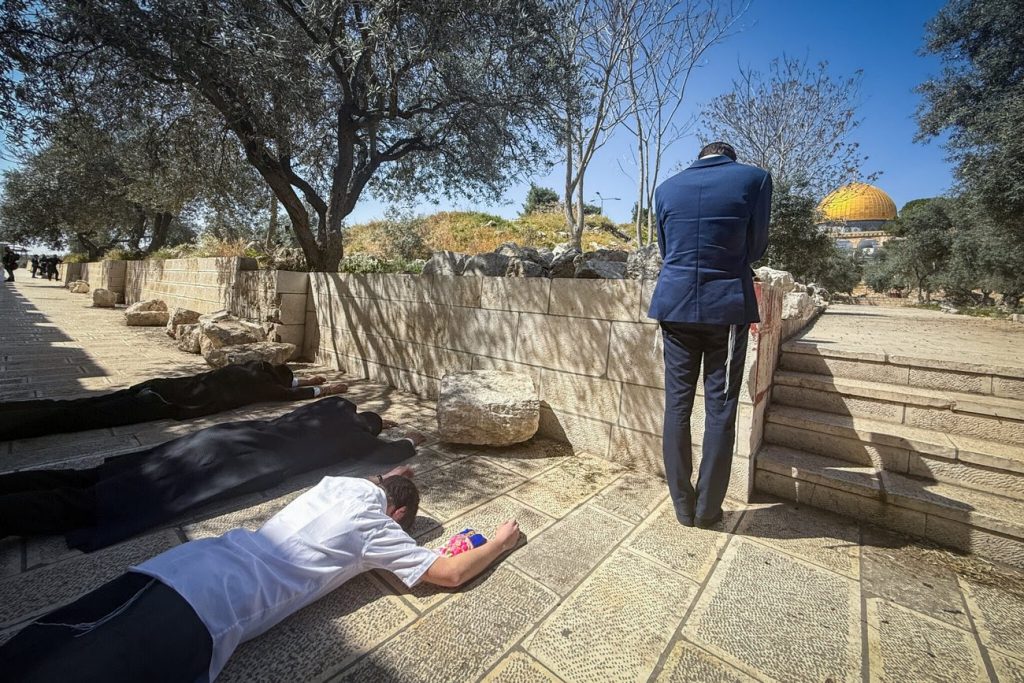
On Yom Yerushalayim (Jerusalem Day), Rabbi Shmuel Eliyahu, Chief Rabbi of Tzfat (Safed), stood opposite Har HaBayit (the Temple Mount) and declared what Israeli law already mandates but Israeli governments have refused to enforce: Jews have the right to pray at their holiest site, and it is time to build a synagogue there.
“You see here the (black-domed) mosque that is behind me, Al-Aqsa — that is from the exile,” Rabbi Eliyahu said. “For 2,000 years, we were in exile, so they built this structure here, but in truth, the First Temple and Second Temple were here, and the Third Temple will be here. That is a fact.”
Rabbi Shmuel Eliyahu and Jewish children take part in a special prayer for rain at the Kinneret, the Sea of Galilee, in northern Israel, October 29, 2025. Photo by Michael Giladi/Flash90
The call was a direct challenge to a policy that contradicts Israel’s own law.
The Protection of Holy Places Law, passed by the Knesset on June 27, 1967 — the same day Israel extended its jurisdiction over unified Jerusalem — guarantees that Holy Places shall remain accessible to all faiths without interference, and explicitly criminalizes acts that violate the freedom of access of members of different religions to places sacred to them. Violators face up to seven years for desecrating a holy place and five years for obstructing access. The law applies to Jews and Muslims alike — in theory.
In practice, the law has never been applied equally. Jews are afforded limited access to visit the Temple Mount, restricted to certain hours and barred on Fridays and Shabbat and weekdays at night. Jews are frequently barred from praying there and may not perform Jewish rituals at the site. Muslims are permitted 24/7 access, and all Muslim prayer is permitted. Israel entrusted the internal religious administration of the Mount to the Islamic Waqf, a Jordanian-controlled religious trust. The result is a legal absurdity: the state that passed a law guaranteeing religious access to all faiths actively enforces the denial of that right to Jews. Christians are also restricted and barred from praying or displaying religious symbols. Israeli police also prohibit the display of Israeli flags.
Israeli courts have periodically acknowledged this contradiction. In May 2022, Jerusalem Magistrate’s Court Justice Zion Saharay ruled that bowing and reciting Shema — “Hear O Israel, the Lord is our God, the Lord is One” — does not constitute a reasonable suspicion of conduct likely to cause a breach of peace, overturning a 15-day ban imposed on three Jewish teenagers who had prayed on the site. Saharay cited remarks by Israel Police Chief Kobi Shabtai himself, who had publicly stated that officers would ensure freedom of religion for “all residents of the country” at the site. The Jerusalem District Court ultimately reversed the magistrate’s ruling under government pressure, with the state invoking security concerns to override both the law and its own police chief’s stated policy.
The Israeli government’s response was telling. The Prime Minister’s Office issued a statement insisting that no change to the status quo was planned and that the magistrate’s ruling “does not establish anything regarding the permissibility of Jewish prayer in general at the Temple Mount.” In other words, the courts may rule what they will; Jews still cannot pray.
This is not a new battle. It is a decades-long one, and it has a history the Israeli government would prefer to forget.
The actions of the Israeli police and the statements by Netanyahu contradict the Prophet Isaiah who declared: “Ki veiti beit tefillah yikarei l’chol ha’amim” — “For My house shall be called a house of prayer for all peoples” (Isaiah 56:7).
Rabbi Eliyahu’s father, the late Sephardi Chief Rabbi Mordechai Eliyahu, took that verse seriously. In the early 1990s, Chief Sephardi Rabbi Mordechai Eliyahu began advocating the construction of a synagogue on the Temple Mount in Solomon’s Stables — a large underground space constructed by King Herod that had remained largely empty. It seemed an ideal solution, allowing Jewish access that was separate from Muslim entrances.
The Waqf’s was a wanton demolition of Judaism’s holiest site and a site Muslims claimed to revere. The Waqf began construction on Solomon’s Stables in 1996, without a permit and in gross violation of the status quo agreement signed two years earlier, in which Israel granted custodianship to Jordan. The builders used heavy equipment to clear the site, destroying artifacts of immense archaeological importance and damaging the structural integrity of the southern wall of the Temple Mount. The Waqf announced its intention to build the country’s largest mosque, capable of accommodating 10,000 worshippers. Later that year, the El-Marwani Mosque was inaugurated. The underground mosque is always open to Muslims, but prayers are only held there on Muslim holidays when rain or heat makes outdoor prayer uncomfortable.
WATCH: Dramatic mid-air collision between US fighter jets
TruLight Ministries Daily Entertainment Manna

TruLight TV – Tim Lovelace: From Comedy to Music
Struggling to love those who have caused you pain? You’re not alone. Luckily, the Bible sheds light on the importance of loving even those who may seem unlovable. Check out today’s video to gain insight on the life-changing effects of love. On Gospel Music USA, we have Tim Lovelace, a talented comedian and musician who has been honored with Grammy and Dove nominations. His clean humor and versatility make him a crowd-pleaser for all ages. Thanks for watching and enjoy the show!
Today on TruLight Radio XM
TruLight Radio XM 24/7
Program
GMT / UTC +2
Monday To Fridays
00:15 Words to Live By Testimonies
01.15 Science Scripture and Salvation
02.15 Ground Works
04.00 Gospel Concert of the Day
05.00 The Daren Streblow Comedy Show
5:55 It is Today devotional
6:00 Gaither Homecoming Morning Show
7:15 Discover the Word
8.15 Destined for Victory
8:55 Science Scripture and Salvation
9:00 Holy Spirit Hour – Normally Sermons
10:15 Hope of the Heart
11:15 Unshackled
11.45 Words to Live By
12:15 Truth for Life
13:15 Living on the Edge with Chip Ingram
14:15 Focus on the Family
15:00 Kids Hour
16:00 In Touch with Dr. Charles Stanley
16:30 Groundwork
17:15 Live in the Light
18:15 Renewing your Mind
19:00 Gaither Homecoming Show
20:15 Growing Hope
21:15 Adventures in Odyssey Radio Drama
21:45 Bible Reading
22:15 Night-sounds
23.00 Good Old Country Gospel / Rhema Gospel Express
VISIT THE WEBSITE
TruLight Ministry News – EXTRA MANNA
TruLight Ministries orders from God since 2012 . Teach Them , Comfort Them and Warn Them!
Healing Truths.
End Time Articles.
Bonus Teaching for the Child of God !!
The command to “shake the dust off your feet” appears only four times in the New Testament. In each case the command is spoken by Jesus to His disciples when He sent them out two by two (Matthew 10:14; Luke 9:5). In Mark 6:11 Jesus says, “And if any place will not welcome you or listen to you, leave that place and shake the dust off your feet as a testimony against them.” In the Matthew 10 account, Jesus clarifies His meaning: “Truly I tell you, it will be more bearable for Sodom and Gomorrah on the day of judgment than for that town” (verse 15).
Shaking the dust off one’s feet conveys the same idea as our modern phrase “I wash my hands of it.” Shaking the dust off the feet is a symbolic indication that one has done all that can be done in a situation and therefore carries no further responsibility for it. In the scriptural examples, Jesus was telling His disciples that they were to preach the gospel to everyone. Where they were received with joy, they should stay and teach. But where their message was rejected, they had no further responsibility. They were free to walk away with a clear conscience, knowing they had done all they could do. Shaking the dust off their feet was, in effect, saying that those who rejected God’s truth would not be allowed to hinder the furtherance of the gospel. Even the dust of those cities that rejected the Lord was an abomination and would not be allowed to cling to the feet of God’s messengers.
Embedded within this symbolic gesture was the implication that God also saw the dust-shaking and would judge people accordingly. There was a spiritual significance to a disciple of Jesus shaking the dust off his feet. It was a statement of finality about people who had been given the truth and who had rejected it. On their first missionary journey, Paul and Barnabas put Jesus’ words into practice. They had been preaching in Pisidian Antioch, but some of the Jewish leaders of that city stirred up persecution against the missionaries and had them expelled from the region. “So they shook the dust off their feet as a warning to them and went to Iconium” (Acts 13:51). Antioch may not have welcomed the gospel as they should have, but that didn’t keep the message from spreading to other areas. Paul and Barnabas had done all they were sent to do, and the responsibility was now on the shoulders of those in Antioch. The apostles had proclaimed truth boldly. Some had accepted it eagerly; some had rejected it with violence. The apostles were not responsible for the Antiochians’ level of acceptance, only for their own obedience to God.
There are situations in our lives where God calls us to stand firm, proclaim truth, and give patient testimony. Sometimes we need to continue until we see the results of that testimony. Other times God gives us the freedom to move on. We figuratively “shake the dust off our feet” when, under the Holy Spirit’s direction, we surrender those people to the Lord and emotionally let go. We have the freedom then to move into the next phase of ministry. Jesus’ instruction to “shake the dust off our feet” reminds us that we are only responsible for our obedience to God, not for the results of that obedience.
Share this Feeding of Manna with your Friends and Family. just click on the Social Media icon and share !