Hosted by TruLight Ministries – The Place of Truth
SELECT YOUR READING LANGUAGE – BOTTOM LEFT = YOUR DAILY MANNA NOW AVAILABLE IN 103 LANGUAGES
Every I AM is not just a HIS Name , It’s a Promise over your Life !!!
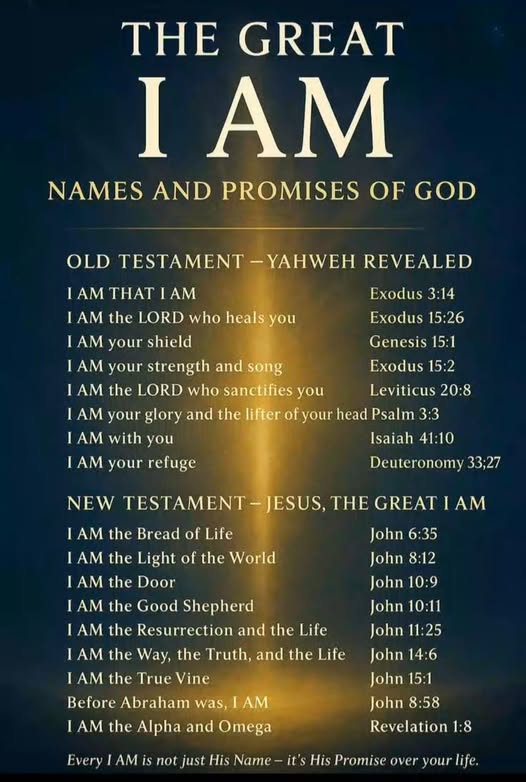
Jesus, in response to the Pharisees’ question “Who do you think you are?” said, “‘Your father Abraham rejoiced at the thought of seeing my day; he saw it and was glad.’ ‘You are not yet fifty years old,’ the Jews said to him, ‘and you have seen Abraham!’ ‘I tell you the truth,’ Jesus answered, ‘before Abraham was born, I am!’ At this, they picked up stones to stone him, but Jesus hid himself, slipping away from the temple grounds” (John 8:56–59). The violent response of the Jews to Jesus’ “I AM” statement indicates they clearly understood what He was declaring—that He was the eternal God incarnate. Jesus was equating Himself with the “I AM” title God gave Himself in Exodus 3:14.
If Jesus had merely wanted to say He existed before Abraham’s time, He would have said, “Before Abraham, I was.” The Greek words translated “was,” in the case of Abraham, and “am,” in the case of Jesus, are quite different. The words chosen by the Spirit make it clear that Abraham was “brought into being,” but Jesus existed eternally (see John 1:1). There is no doubt that the Jews understood what He was saying because they took up stones to kill Him for making Himself equal with God (John 5:18). Such a statement, if not true, was blasphemy and the punishment prescribed by the Mosaic Law was death (Leviticus 24:11–14). But Jesus committed no blasphemy; He was and is God, the second Person of the Godhead, equal to the Father in every way.
Jesus used the same phrase “I AM” in seven declarations about Himself. In all seven, He combines I AM with tremendous metaphors which express His saving relationship toward the world. All appear in the book of John. They are I AM the Bread of Life (John 6:35, 41, 48, 51); I AM the Light of the World (John 8:12); I AM the Door of the Sheep (John 10:7, 9); I AM the Good Shepherd (John 10:11,14); I AM the Resurrection and the Life (John 11:25); I AM the Way, the Truth and the Life (John 14:6); and I AM the True Vine (John 15:1, 5).

Bible Verse and Prayer for Today
For Christ’s love compels us, because we are convinced that one died for all, and therefore all died. And he died for all, that those who live should no longer live for themselves but for him who died for them and was raised again.
—2 Corinthians 5:14-15
What are you living for?
What drives your life?
What is the compelling motivation for your life?
While these are all important questions, the most important question, however, is this:
“Who am I living for?”
Only one person can ensure that my life will count in meaningful ways after my body quits working (1 Corinthians 15:57-58). Only Jesus enables me to confidently know that I will never die (John 11:25-26). He has already died for me and conquered death! If my body fails, the living part of me will go to be with Jesus, awaiting the resurrection (1 Thessalonians 4:13-18; Philippians 1:19-24). If he was willing to do all of this for me, then I’m for sure going to live for him as long as we have breath in our lungs!
Prayer
Victorious Lord, thank you for giving me triumph over death through Jesus, my Savior. Thank you for giving me victory over sin through his sacrificial death. Thank you for giving me victory today in my life, as I live for him based on his resurrection. Through the precious name of Jesus, I pray. Amen and Amen

Bible Teaching of the Day
The 7 I AM Statements
In the Gospel of John, Jesus makes seven statements beginning with the words I am. Each of these “I am” proclamations furthers our understanding of Jesus’ ministry in the world. They also link Jesus to the Old Testament revelation of God.
In the Old Testament, God revealed His name to Moses: “I AM WHO I AM. This is what you are to say to the Israelites: ‘I AM has sent me to you’” (Exodus 3:14). Thus, in Judaism, “I AM” is unquestionably understood as a name for God. Whenever Jesus made an “I am” statement in which He claimed attributes of deity, He was identifying Himself as God.
Here are the seven metaphorical “I am” statements found in John’s gospel:
“I am the bread of life” (John 6:35, 41, 48, 51). In this chapter, Jesus establishes a pattern that continues through John’s gospel—Jesus makes a statement about who He is, and He backs it up with something He does. In this case, Jesus states that He is the bread of life just after He had fed the 5,000 in the wilderness. At the same time, He contrasts what He can do with what Moses had done for their ancestors: “Your ancestors ate the manna in the wilderness, yet they died. But here is the bread that comes down from heaven, which anyone may eat and not die” (verses 49–50).
“I am the light of the world” (John 8:12; 9:5). This second of Jesus’ “I am” statements in John’s gospel comes right before He heals a man born blind. Jesus not only says He is the light; He proves it. Jesus’ words and actions echo Genesis 1:3, “And God said, ‘Let there be light,’ and there was light.”
“I am the door” (John 10:7 and 9, ESV). This “I am” statement stresses that no one can enter the kingdom of heaven by any other means than Christ Himself. Jesus’ words in this passage are couched in the imagery of a sheepfold. He is the one and only way to enter the fold. “Truly, truly, I say to you, he who does not enter the sheepfold by the door but climbs in by another way, that man is a thief and a robber” (verse 1, ESV).
“I am the good shepherd” (John 10:11, 14). With this “I am” statement, Jesus portrays His great love and care. He is the One who willingly protects His flock even to the point of death (verses 11 and 15). When Jesus called Himself the good shepherd, He unmistakably took for Himself one of God’s titles in the Old Testament: “The Lord is my shepherd” (Psalm 23:1).
“I am the resurrection and the life” (John 11:25). Jesus made this “I am” statement immediately before raising Lazarus from the dead. Again, we see that Jesus’ teaching was not just empty talk; when He made a claim, He substantiated it with action. He holds “the keys of death and the grave” (Revelation 1:18, NLT). In raising Lazarus from the dead, Jesus showed how He can fulfill Yahweh’s promise to ancient Israel: “[God’s] dead shall live; their bodies shall rise” (Isaiah 26:19, ESV). Apart from Jesus, there is neither resurrection nor eternal life.
“I am the way and the truth and the life” (John 14:6). This powerful “I am” statement of Christ’s is packed with meaning. Jesus is not merely one way among many ways to God; He is the only way. Scripture said that “The very essence of [God’s] words is truth” (Psalm 119:160, NLT), and here is Jesus proclaiming that He is the truth—confirming His identity as the Word of God (see John 1:1, 14). And Jesus alone is the source of life; He is the Creator and Sustainer of all life and the Giver of eternal life.
“I am the true vine” (John 15:1, 5). The final metaphorical “I am” statement in the Gospel of John emphasizes the sustaining power of Christ. We are the branches, and He is the vine. Just as a branch cannot bear fruit unless it is joined in vital union with the vine, only those who are joined to Christ and receive their power from Him produce fruit in the Christian life.
There are two more “I am” statements of Jesus in the Gospel of John. These are not metaphors; rather, they are declarations of God’s name, as applied by Jesus to Himself. The first instance comes as Jesus responds to a complaint by the Pharisees. “I tell you the truth,” Jesus says, “before Abraham was born, I am!” (John 8:58, NLT). The verbs Jesus uses are in stark contrast with each other: Abraham was, but I am. There is no doubt that the Jews understood Jesus’ claim to be the eternal God incarnate, because they took up stones to kill Him (verse 59).
The second instance of Jesus applying to Himself the name I AM comes in the Garden of Gethsemane. When the mob came to arrest Jesus, He asked them whom they sought. They said, “Jesus of Nazareth,” and Jesus replied, “I am he” (John 18:4–5). Then something strange happened: “When Jesus said, ‘I am he,’ they drew back and fell to the ground” (verse 6). Perhaps explaining the mob’s reaction is the fact that the word he has been provided by our English translators. Jesus simply said, “I am.” Applying God’s covenant name to Himself, Jesus demonstrated His power over His foes and showed that His surrender to them was entirely voluntary (see John 10
Today’s Devotional
The Bible says, “Sin entered the world through one man, and death through sin, and in this way death came to all men, because all sinned” (Romans 5:12). It was through Adam that sin entered the world. When Adam sinned, he immediately died spiritually—his relationship with God was broken—and he also began dying physically—his body began the process of growing old and dying. From that point on, every person born has inherited Adam’s sin nature and suffered the same consequences of spiritual and physical death.
We are born physically alive but spiritually dead. This is why Jesus told Nicodemus, “You must be born again” (John 3:7). Physical birth provides us with a sinful human nature; spiritual rebirth provides us with a new nature, “created to be like God in true righteousness and holiness” (Ephesians 4:24).
It may not seem fair to be saddled with Adam’s sin nature, but it’s eminently consistent with other aspects of human propagation. We inherit some physical characteristics such as eye color from our parents, and we also inherit some of their spiritual characteristics. Why should the passing on of spiritual traits be any different from the transmission of physical traits? We may complain about having brown eyes when we wanted blue, but our eye color is simply a matter of genetics. In the same way, having a sin nature is a matter of “spiritual genetics”; it’s a natural part of life.
However, the Bible says we are sinners by deed as well as by nature. We are sinners twice over: we sin because we are sinners (Adam’s choice), and we are sinners because we sin (our choice). “All have sinned and fall short of the glory of God” (Romans 3:23). We are more than potential sinners; we are practicing sinners. “Each one is tempted when, by his own evil desire, he is dragged away” (James 1:14). A driver sees the speed limit sign; he exceeds the limit; he gets a ticket. He can’t blame Adam for that.
“I did not eat the fruit.” True, but Scripture says that we, individually and as a human race, were all represented by Adam. “In Adam all die” (1 Corinthians 15:22). A diplomat speaking at the United Nations may do or say things that many of his countrymen disapprove of, but he is still the diplomat—he is the officially recognized representative of that country.
The theological principle of a man representing his descendants is called “federal headship.” Adam was the first created human being. He stood at the “head” of the human race. He was placed in the garden to act not only for himself but for all his progeny. Every person ever born was already “in Adam,” represented by him. The concept of federal headship is clearly taught elsewhere in Scripture: “One might even say that Levi himself, who receives tithes, paid tithes through Abraham, for he was still in the loins of his ancestor when Melchizedek met him” (Hebrews 7:9-10, ESV). Levi was born several centuries after Abraham lived, yet Levi paid tithes to Melchizedek “through Abraham.” Abraham was the federal head of the Jewish people, and his actions represented the future twelve tribes and the Levitical priesthood.
“I did not eat the fruit.” True, but all sin has consequences beyond the initial wrongdoing. “No man is an island, entire of itself,” John Donne famously wrote. This truth can be applied spiritually. David’s sin with Bathsheba affected David, of course, but it also had a ripple effect that affected Uriah, David’s unborn child, the rest of David’s family, the whole nation, and even Israel’s enemies (2 Samuel 12:9-14). Sin always has undesirable effects on those around us. The ripples of Adam’s momentous sin are still being felt.
“I did not eat the fruit.” True, you were not physically present in the actual Garden of Eden with the juice of forbidden fruit staining the corners of your guilty mouth. But the Bible seems to indicate that, if you had been there instead of Adam, you’d have done the same thing he did. The apple, as they say, doesn’t fall far from the tree.
Whether or not we think it’s “fair” to have Adam’s sin imputed to us doesn’t really matter. God says that we have inherited Adam’s sinful nature, and who are we to argue with God? Besides, we are sinners in our own right. Our own sin probably makes Adam look like a puritan in comparison.
Here’s the good news: God loves sinners. In fact, He has acted to overcome our sin nature by sending Jesus to pay for our sins and offer us His righteousness (1 Peter 2:24). Jesus took the death that was our penalty upon Himself, “so that in him we might become the righteousness of God” (2 Corinthians 5:21). Note the words “in him.” We who were once in Adam can now be in Christ by faith. Christ is our new Head, and “in Christ all will be made alive” (1 Corinthians 15:22).

Bible Prophecy, Signs of the Times and Gog and Magog Updates with Articles in the News
The Christian Cohabitation Crisis Is Real

A Texas church recently took a bold stand against one of the church’s quietly growing compromises: cohabitation among Christian couples.
Not with another vague sermon about “relationships.”
Not with another watered-down message about “finding your person.”
Not with another Christian influencer reel telling young believers to “just pray about it.”
This time, a pastor stood up, told the truth plainly, and 52 couples responded in a public ceremony with something our culture almost never celebrates anymore: repentance, obedience, and covenant.
While the focus is often on Gen Z — because they are just starting out in life and navigating relationships in a culture that normalizes cohabitation — this is not solely a Gen Z problem. Christians of all ages struggle with delaying covenant, rationalizing compromise, and confusing convenience with God’s design.
It is important to note these couples did not rush from conviction to ceremony without pastoral guidance. Lakepointe Church leaders made it clear that the church was ready to counsel and walk alongside each couple, helping them discern whether they were truly ready for marriage. While many couples acted quickly, others who initially expressed interest were advised to take more time, deepen their pastoral support, or reconsider before committing. This approach reflects a healthy church that prioritizes true covenant readiness over impulsive vows.
Because one of the easiest ways to dismiss what happened is to caricature it. Critics will say it was emotional excess. But the truth is far more compelling: Lakepointe provided a pathway — counsel, interviews, and support — for couples already acting like husband and wife to finally enter the covenant they had been postponing. That is not legalism. That is discipleship.
This Did Not Happen in a Vacuum
The viral moment began with the testimony of Colton and Kaylee, a young couple who admitted they had been “Christians in name but not in how they lived.” During premarital counseling, they were confronted with a simple truth: either honor God and get married, or stop living together. That confrontation cut through the haze of compromise. They chose obedience. They got baptized — and then, just an hour later, got married. That testimony sparked dozens of others living in the same gray zone.
Conviction, when not softened into therapy-speak, forces a choice. And someone finally said the quiet part out loud in church.
Many young Christians drift into compromise, not because they reject marriage, but because no one ever clearly challenges them. Shared rent. Shared bed. Shared bills. Shared pets. Shared future plans. Everything but covenant.
Previous polls indicate that a significant number of evangelicals already view cohabitation as acceptable under certain circumstances. For example, a majority of white evangelicals have indicated that living together is acceptable if a couple plans to marry. Among younger believers, views become noticeably less aligned with biblical teaching: many in their 20s report cohabitation is acceptable even without plans to marry, and nearly half of evangelical Protestants aged 15–22 who are not currently married or cohabiting say they would probably or definitely cohabit in the future.
Who Is Josh Howerton — and Why Are People Listening?
Howerton has built a large online footprint through short, viral sermon clips, cultural commentary, and direct answers to controversial questions. His style is not sleepy, polished church-speak. It is confrontational enough to get attention, but accessible enough to travel online. He asks hard questions, names cultural idols, and speaks in a format Gen Z and Millennials actually consume. Lakepointe Church describes him as “a trusted and compelling voice on the cultural issues of our day.”
Social media amplifies his reach, but it is truth, not clips, that produces conviction. People are starving for moral courage in a culture built on excuse-making.
The Christian Cohabitation Crisis
Cohabitation is no longer just a secular issue — it’s the church’s quietly tolerated compromise. Young Christians often have excuses ready:
“We’re basically married in God’s eyes.” No — marriage is a public, binding covenant.
“We’re saving money.” Practicality is no exemption for sin.
“We’re trying it out first.” Covenant was never test-driven like a used car.
“We’re already engaged.” A ring is not a vow.
“We’re serious / we’ll marry eventually / it’s not that big a deal.”
The last is most revealing: the church has lowered the standard so much that delayed obedience seems acceptable.
What Marriage Actually Means
When the Pharisees questioned Jesus about marriage, He took them back to creation:
“But from the beginning of creation, ‘God made them male and female’ … ‘the two shall become one flesh.'”
Marriage is not social convenience. It is holy covenant, reflecting the relationship between Christ and His Church. Cheapening or delaying it distorts God’s design.
Why This Matters Beyond One Church
Stable, intact families are still among the strongest predictors of flourishing: lower poverty, lower instability, and lower social dysfunction. Weak marriage = fragile communities. What happened at Lakepointe is bigger than a viral story: it shows revival is sometimes quiet, messy, and deeply practical. It looks like couples deciding to stop making excuses and churches refusing to normalize sin.
This is love with a backbone, not cruelty.
The Challenge to Christians
If believers want to rebuild trust, family, faith, and stability, it begins in homes — and with young and older Christians alike stopping borrowed relationship habits while still asking for God’s blessing.
The question is not whether 52 couples married, but whether thousands more are still sitting in churches, sharing beds, and telling themselves obedience can wait. It can’t.
Deep down, those couples knew: delayed obedience is still disobedience.
Grace still welcomes the repentant. The church should cheer those who step forward. Pastors must not fear preaching clearly.
If more churches recover the courage to speak truth about cohabitation — and then provide pathways toward repentance, counsel, and covenant — they might discover what Lakepointe did: people are still willing to obey God. They may just need someone brave enough to ask them to.
Christians That Taking A Stand Will Cost You Something

There was a time when Christians in America were told they were imagining things.
No one is targeting your faith, they said. No one is trying to silence biblical truth. No one is punishing believers for simply standing on what Scripture teaches.
Then a story like Jaden Ivey’s comes along–and the mask slips.
The Chicago Bulls did not waive Jaden Ivey because he committed a crime. He was not arrested. He was not accused of violence. He was not cut for some drunken scandal, sexual misconduct, or disgraceful off-court behavior that so often gets excused in professional sports. He was waived after publicly speaking about his Christian faith and criticizing the NBA’s Pride activism.
And that should send a chill through every believer in America.
Because what happened to Ivey is not really about basketball. It is about the growing cost of speaking biblical truth in a culture that claims to celebrate diversity–unless that diversity includes Christians who still believe the Bible means what it says.
And now the fallout could be spreading to other sports as some NFL fans are calling for the Patriots to release running back TreVeyon Henderson for showing his support to Jaden Ivy after this incident. Instead of defending his player’s right to free speech, Patriots head coach Mike Vrabel threw Treyveon under the woke bus by suggesting that Henderson needs to be inclusive and get educated.
Vrabel has simply stated what the average liberal thinks of Christians in this country and we should not forget it.
The Culture Still Tolerates “Christianity”–As Long As It Stays Vague
Let’s be honest about what America still permits.
You can wear a cross necklace.
You can thank God after a game.
You can post a Bible verse if it is vague enough and doesn’t offend the spirit of the age.
That kind of Christianity is still tolerated.
But the second a believer moves beyond generic spirituality and begins speaking clearly about sin, repentance, righteousness, and the Lordship of Jesus Christ, everything changes.
That is when the room turns cold.
Because the problem was never “faith.” The problem is biblical clarity.
The world does not mind a Christian who is inspirational. It cannot stand a Christian who is specific.
And that is why this story matters.
Jaden Ivey did not simply say he loves Jesus. He reportedly challenged why the NBA promotes Pride messaging while treating biblical morality like a problem. In other words, he did what faithful Christians have done for 2,000 years: he measured culture against God’s Word–and culture did not like the verdict.
The Hypocrisy Is Stunning
And this is where the outrage becomes fully justified.
Because if “conduct detrimental to the team” is now grounds for getting cut, then Christians have every right to ask a simple question:
Where has that standard been for players involved in actual disgraceful behavior?
Professional sports has shown again and again that there is often room for players tied to assault allegations, domestic violence, sexual scandal, reckless behavior, and public moral collapse. Time after time, we are told these men deserve support, second chances, grace, and understanding.
And to be clear–Christians believe in redemption.
But here is the hypocrisy: the modern sports world seems to have categories for mercy when it comes to vice, but almost none when it comes to biblical conviction.
A man can bring shame to women, dishonor his family, and wreck his own reputation–and still find a path back.
But speak publicly about Jesus, sin, and sexual morality?
That, apparently, is where the line is now drawn.
That is not moral consistency.
That is cultural corruption.
If a Muslim Athlete Said the Same Thing, Would They React This Way?
And here is the question almost nobody in mainstream sports media will ask honestly:
What would happen if a Muslim athlete publicly quoted the Quran in similar moral terms?
What if he said his faith teaches that homosexual behavior is sinful?
What if he criticized a Pride-themed event on religious grounds?
What if he said his beliefs do not allow him to celebrate that message?
Would the sports world react the same way?
Would the media instantly portray him as dangerous?
Would coaches imply he needed help?
Would analysts suggest he was mentally spiraling?
Or would we suddenly hear words like “religious sensitivity,” “cultural understanding,” and “respect for deeply held beliefs”?
We all know the answer.
Because in modern elite culture, Christianity is the one faith they feel especially safe mocking, punishing, and pathologizing.
Now Biblical Christianity Is Being Treated Like a Mental Health Problem
And perhaps the darkest part of this entire story is how quickly the conversation shifted from disagreement to diagnosis.
Instead of simply saying, “We disagree with his views,” the reaction from many corners has carried a far more sinister implication: that anyone who speaks this boldly about biblical truth must somehow be unstable, unwell, or in need of help.
That should deeply concern every Christian.
Because once biblical conviction is reframed as a mental health issue, it no longer has to be debated. It only has to be managed.
And that is exactly where much of the modern Left is heading.
They no longer just say Christians are wrong.
Now they increasingly imply Christians are psychologically defective for refusing to affirm LGBT ideology.
That is not tolerance.
That is not compassion.
That is ideological control wearing the language of therapy.
Today, if you reject Pride ideology, you are not “convicted”–you are “concerning.”
If you preach repentance, you are not “faithful”–you are “spiraling.”
If you say Jesus is the only way, you are not standing on truth–you are suddenly a “problem.”
The old strategy was to call Christians hateful.
The new strategy is to call them mentally unwell.
And that should alarm the church.
This Is What Soft Persecution Looks Like
Some Christians still hesitate to use the word persecution in America.
They imagine persecution only as prison cells and martyrdom.
But persecution often begins long before that.
It begins when biblical truth becomes professionally dangerous.
It begins when Christians are told they are free to worship–so long as they do not publicly oppose the idols of the age.
It begins when believers are taught to whisper what God has said plainly.
That is exactly what this moment reveals.
The message is clear:
You may be a Christian.
You may even talk about faith.
But if you dare speak with biblical clarity on the moral issues the culture has declared untouchable, you may pay for it.
That is not freedom.
That is pressure.
And the church needs to stop pretending otherwise.
The Church Must Decide Whether It Wants Comfort or Courage
That is why the Jaden Ivey story matters.
Because this is no longer just about one athlete.
It is about whether Christians in America are willing to remain faithful when faithfulness begins to cost something.
The church now faces a choice.
We can keep sanding down the sharp edges of Scripture to remain culturally acceptable.
Or we can tell the truth in love and accept that the world will hate us for it.
One road leads to comfort.
The other leads to courage.
Only one of them leads to faithfulness.
And maybe that is what God is exposing in this hour.
Not just the hostility of the culture–but the weakness of a church that has grown too comfortable being liked.
Because faith is not proven when it is safe.
Faith is proven when truth becomes expensive–and you still refuse to be silent.
When Christians Look Up: Victor Glover, NASA And The Glory Of God In Space

A man climbs on top of a rocket, straps himself into a machine packed with explosive force, rises beyond the atmosphere, looks down on the blue curve of Earth, and says something many in our “enlightened” age would rather laugh away than seriously consider: “There aren’t any atheists on top of rockets.” For Victor Glover, that was not a throwaway line. It was a confession of reality. And in a culture that often treats faith as childish and science as its replacement, his words landed with unusual force.
They matter even more now because Glover is not speaking from the sidelines. He is the pilot of NASA’s Artemis II mission, the first crewed Artemis flight and the first mission to send astronauts around the moon in more than 50 years. NASA says the approximately 10-day mission launched on April 1 and has now departed Earth orbit on its way around the moon, with Glover serving as pilot aboard Orion. He is also making history as part of the first crewed lunar mission of the Artemis era.
That alone would make him notable. But what makes his story powerful for Christians is not simply that he is brilliant enough to fly a spacecraft or courageous enough to trust his life to one. It is that he has refused to accept the false choice our culture keeps trying to force on believers: either trust God or trust science.
Glover has said plainly that he believes in both faith and science, and that he does not find them to be in conflict. He has also spoken openly about praying before risky work, saying that his career, military service, and faith are deeply “interwoven.” That is not intellectual weakness. That is wholeness.
And frankly, Christians need to hear that.
For too long, many believers have been subtly bullied into acting as though serious faith belongs only in church pews, Bible studies, and private devotionals — but not in laboratories, engineering bays, flight simulators, operating rooms, boardrooms, or mission control. We have allowed a secular myth to take root: that the closer one gets to knowledge, the further one must move from God.
Victor Glover’s life stands as a living rebuke to that lie.
He is not a man who worships ignorance. He is not suspicious of discovery. He is not hiding from the complexity of the universe. He has spent his life learning how things work — how aircraft move, how systems respond, how the laws of physics behave under pressure. And after all that study, all that training, all that exposure to the astonishing order of creation, he has not concluded that God is unnecessary. He has concluded the opposite.
That should stir something in us.
Because the Christian faith has never truly been anti-science. It has been anti-idolatry. And those are not the same thing.
Science is a tool. A remarkable one. It can measure motion, map galaxies, analyze DNA, and reveal breathtaking patterns in the natural world. But science cannot tell you why beauty moves you. It cannot explain why moral truth presses on the conscience. It cannot answer why the human heart aches for meaning, eternity, forgiveness, and glory. It can tell you what stars are made of. It cannot tell you why the heavens feel like they are preaching.
Scripture can.
“The heavens declare the glory of God, and the sky above proclaims his handiwork.”
That is not anti-scientific poetry. That is the deepest possible interpretation of reality.
And when Glover talks about seeing the beauty of creation while working in space, he is touching something Christians have always known: that the created world does not merely exist — it testifies. He has noted that at NASA, when he refers to the “beauty of creation,” people react to that word. Of course they do. “Creation” is a dangerous word in a world trying very hard to pretend everything is accidental. But perhaps that is precisely why believers should say it more often.
Not obnoxiously. Not superficially. But boldly.
Because if the universe is truly God’s handiwork, then every field of honest study becomes, in some sense, a place of worship. Astronomy can become awe. Biology can become wonder. Engineering can become stewardship. Medicine can become mercy. Teaching can become service. Parenting can become discipleship. Business can become integrity. Art can become praise.
That may be one of the most encouraging parts of Glover’s witness. Before one of his earlier space missions, he said he wanted to use the abilities God had given him to do his job well and support his crewmates and mission. That is such a simple sentence, but it carries enormous spiritual weight.
Because many Christians are still waiting for permission to be “used by God” in some dramatic, visibly religious way, while quietly overlooking the gifts already sitting in their hands.
What if your calling is not behind a pulpit?
What if your faithfulness looks like doing excellent work in a place where almost no one expects to see Christ honored?
What if your mission field is a school, a hospital, a newsroom, apolice car, a software company, a courtroom, a construction site, or yes — even a spacecraft?
The point is not that every Christian must become famous or extraordinary in the eyes of the world. Victor Glover’s story is not inspiring because he became an astronaut. It is inspiring because he appears to understand something many believers forget: your gifts are not random, and your work is not spiritually neutral.
If God has given you a sharp mind, use it for His glory.
If He has given you leadership, lead with holiness.
If He has given you creativity, build things that reflect truth and beauty.
If He has given you endurance, spend it in service.
If He has given you influence, do not waste it on yourself.
That is the deeper challenge hidden inside Glover’s testimony.
His words about rockets are memorable, but the more searching question is this: What do you do with your life when you realize you are living under the gaze of God?
Some people only ask eternal questions when danger is immediate — in foxholes, hospital rooms, funerals, crashes, diagnoses, and moments of terror. And yes, crisis has a way of stripping away illusion. But mature faith does not wait for catastrophe to become reverent. It learns to see God in the ordinary, the gifted, the disciplined, and the beautiful.
Victor Glover looked at the universe and saw not emptiness, but majesty.
May more Christians do the same.
And may his witness remind the church of something we desperately need to recover: you do not have to choose between a serious mind and a serious faith. You do not have to apologize for believing that science can reveal mechanism while Scripture reveals meaning. And you do not have to shrink your Christianity to fit inside a sanctuary.
God is Lord of the sanctuary, yes. But He is also Lord of the launchpad.
And if He can be honored on top of a rocket, He can certainly be honored through your life.
The Original Plan . before the War and the Reason for the Middle East War . Make Isreal Great Again = Gulf states eye Israeli pipeline to bypass Strait of Hormuz.

Gulf Arab states look to Israel’s port of Haifa as part of an alternative energy shipping route as Iran continues its closure of the Strait of Hormuz.
Gulf Arab states are mulling a plan to open an alternative route for oil exports that could rely on a strategically important Israeli port on the Mediterranean Sea, the Financial Times reported.
The long-delayed plans for an alternative to the Strait of Hormuz, which prior to the current war with Iran was used for the export of roughly a quarter of the world’s oil supply, call for pipelines, rail links, and road corridors to reduce global reliance on the Persian Gulf chokepoint.
While a number of options are on the table for a land-based route for moving oil from the Persian Gulf to the Mediterranean, the US has for years backed a plan to create a broad “economic corridor” from India to Western Europe, running through Saudi Arabia, the United Arab Emirates, Jordan, and Israel.
The planned route, dubbed the India–Middle East–Europe Economic Corridor, or IMEC, would utilize the Israeli port of Haifa to handle energy shipments to Europe and the Western Hemisphere.
Other iterations of the plan center on a broader approach that goes beyond a single pipeline: officials and industry figures are reportedly looking at an integrated network of pipelines, railways and roads that could give Gulf exporters a land bridge to western ports and reduce Iran’s leverage over seaborne traffic out of the Gulf.
The proposed route from the Gulf to Haifa is not the only one under consideration.
Saudi Arabia already has a pipeline from the Persian Gulf to the Red Sea, from Jubail to Yanbu, spanning 1,200 kilometers (750 miles).
The Kirkuk–Ceyhan oil pipeline already links northern Iraq to the Mediterranean via the Port of Ceyhan in Turkey.
Neither of these routes, however, could fully replace the Strait of Hormuz as an exit point for exported oil.
But any Haifa-linked corridor would likely require Saudi buy-in, sustained regional security cooperation, and would force Arab governments to balance immediate commercial needs against domestic and regional sensitivities around overt infrastructure links involving Israel.
TruLight Ministries Daily Entertainment

TruLight TV – Feeling unloved?
Do you know how loved you are? In this video, you’ll be reminded that before the creation of the world, God knew your name. He knew when you would live and where, and He wrote a beautiful story for you. The next time you feel unloved, think about the love God has for you. Our sermon today from Chip Ingram (Love Love Obeys, Part 1) – Do you believe love is just a feeling? Is that feeling how you measure your love for God? Listen now to find out how you can know what it looks like to love God and others according to the Bible. Enjoy today’s show and thanks for watching.
Today on TruLight Radio XM
TruLight Radio XM 24/7
Program
GMT / UTC +2
Monday To Fridays
00:15 Words to Live By Testimonies
01.15 Science Scripture and Salvation
02.15 Ground Works
04.00 Gospel Concert of the Day
05.00 The Daren Streblow Comedy Show
5:55 It is Today devotional
6:00 Gaither Homecoming Morning Show
7:15 Discover the Word
8.15 Destined for Victory
8:55 Science Scripture and Salvation
9:00 Holy Spirit Hour – Normally Sermons
10:15 Hope of the Heart
11:15 Unshackled
11.45 Words to Live By
12:15 Truth for Life
13:15 Living on the Edge with Chip Ingram
14:15 Focus on the Family
15:00 Kids Hour
16:00 In Touch with Dr. Charles Stanley
16:30 Groundwork
17:15 Live in the Light
18:15 Renewing your Mind
19:00 Gaither Homecoming Show
20:15 Growing Hope
21:15 Adventures in Odyssey Radio Drama
21:45 Bible Reading
22:15 Night-sounds
23.00 Good Old Country Gospel / Rhema Gospel Express
VISIT THE WEBSITE
TruLight Ministry News

TruLight Ministries orders from God since 2012 . Teach Them , Comfort Them and Warn Them!
5 Minute na die Dood

We Starting , the 1st May 2026 . with Our Preachers Diploma Online Platform – TruTheology.co.za . 36 Subjects with between 10 to 15 Lessons per Subject , equivalent to a 3 Year Theology Degree , The Training is Free to Approved Members and Tests Online after Each Lesson , You Determine the Speed of Your Studies . If you are interested registrations will take place from 1 April 2026 .

Healing Truths
End Time Articles
Bonus Teaching for the Child of God !!
Scripture is clear that God hates discord and fighting among His children (2 Corinthians 12:20; Galatians 5:15; James 3:14, 4:1-3). Philippians 2:3-4 says, “Do nothing from rivalry or conceit, but in humility count others more significant than yourselves. Let each of you look not only to his own interests, but also to the interests of others.” If every believer lived by that rule, arguing would virtually disappear. Any parent frowns upon bickering between siblings, and God is a Father who also frowns on it. However, there are three key words in this question that deserve attention: Christians, always, and arguing.
First, the term Christians has been badly misused in recent years. Anyone who celebrates Christmas or who attends church occasionally can claim to be a “Christian.” However, according to Jesus, “Not everyone who calls me ‘Lord, Lord’ will enter the kingdom of heaven, but only those who do the will of my Father in heaven” (Matthew 7:21). Much of the fighting and ugliness we hear about is between people who might go by the name of “Christian” but who are not true followers of Christ. Selfish ambition, pride, and greed can rule within a church full of unbelievers just as in the rest of the world. There are whole denominations that are so far from the truth detailed in the Bible that they can hardly be classified as Christian (see Revelation 3:17-18). So, we should keep in mind that much of the arguing is between unsaved people posing as believers.
Second, the term always is a bit misleading. If we weed out those who are not truly born again and look only at the relationships among the real disciples of Christ, there is much to celebrate. Thousands of charitable organizations have been created by Christians working together in harmony. They are not “always” arguing. Most Spirit-filled churches have a large core of solid Christians who unselfishly use their time, talents, and money to serve their church and community without bickering. The media are quick to showcase anything negative within the church but are strangely silent about the thousands of praiseworthy deeds done every day by Christians working together in love.
The church of Jesus Christ is a family. Those who have placed their faith in Christ are allowing His Spirit to transform them and have been adopted into the family of God (Ephesians 1:5; Romans 8:15). And, as with any family, there are disagreements. There are personality clashes, differing opinions, and ideas that won’t work together. When each is convinced that his or her way is the only right way, the clash can be permanent. However, differences of opinion do not always produce negative results. Even the apostles had disagreements. In Acts 15:36-41, we read of Paul and Barnabas having such a sharp contention that they split up, chose new ministry partners, and went separate ways. The result was that even more churches were planted and God’s message was spread to more people. Paul and Barnabas eventually reconciled and continued together to spread the gospel.
The third term, arguing, also needs to be addressed. A discussion between sharply contrasting viewpoints is not necessarily an argument. The deity of Christ, salvation through faith, and the need for repentance are not negotiable. But some secondary issues in God’s Word leave room for differences of opinion. Some common disagreements pertain to end-times prophecy, gifts of the Spirit, baptism, and church organization. While there is only one accurate interpretation of everything in the Bible, a human being’s ability to discern that one interpretation can be faulty. Two godly men can see the same issue differently. Most church denominations arose out of these contrasting interpretations. But those denominations are not necessarily embroiled in an “argument” with each other.
Paul addresses this in Romans 14. He warns believers to welcome those new to the faith who may have convictions that differ from those of the seasoned saint. Verse 5 says, “One person esteems one day as better than another, while another esteems all days alike. Each one should be fully convinced in his own mind.” In other words, there are some issues that are not weighty matters, and we need to practice grace in accepting the sincerely held convictions of other believers. Doing so consistently would eliminate much of the arguing that taints the reputation of the body of Christ. We must study God’s Word and express what we believe it teaches (2 Timothy 2:15), but we must do so with humility and love, giving grace to other believers who see things differently (1 Corinthians 13:1-2).
Ultimately, we all answer to our Father for how we treat each other (Matthew 12:36). Every child of God should remember that our Father places far more importance on our showing love than He does on our being “right” on every issue (1 John 4:20-21).
Share this Feeding of Manna with your Friends and Family. just click on the Social Media icon and share !