Hosted by TruLight Ministries – The Place of Truth
SELECT YOUR READING LANGUAGE – BOTTOM LEFT = YOUR DAILY MANNA NOW AVAILABLE IN 103 LANGUAGES
@ TruLight – Daily Manna is not Just a Bible Verse with a Small Prayer . No WE SERVE DAILY Manna for the Whole Day . Breakfast , Lunch , Dinner , Plus tea Times and even Entertainment Manna . Plus News Manna and More , This Daily Manna will keep you Spiritually full for the full 48 Hours and even More to Share with your Friends and Family !!!
The Danger of an Uncontrolled Tongue !!!
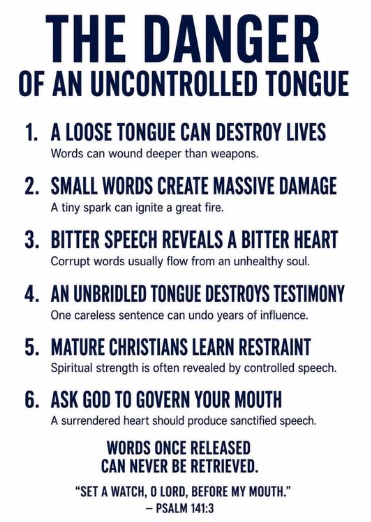
“The tongue” is used throughout Scripture in both literal and metaphorical ways, especially in Psalms, Proverbs, and James. The tongue is a “small part of the body” (James 3:5), yet Proverbs 18:21 says it “has the power of life and death.” This holds true whether we’re speaking of spiritual, physical, or emotional “life and death.”
First, we should keep in mind that the word tongue is often a reference to the spoken word. This is a special kind of figure of speech called metonymy, in which one word stands in for another, closely related word. A common example of metonymy is seen in this sentence: “The White House issued a statement.” Of course, the White House, as a building, cannot issue statements; however, in this instance, White House refers to the President, who lives there. In the same way, when Proverbs 15:4 states, “A deceitful tongue crushes the spirit,” tongue is a metonymy. Obviously, a literal, fleshly tongue cannot crush the human spirit, but the words the tongue produces can.
Spiritual:
What our tongue produces has eternal implications, for it reveals what is in our heart. Jesus said that “the good man brings good things out of the good stored up in him, and the evil man brings evil things out of the evil stored up in him” (Matthew 12:35). Isaiah places words on par with actions for displaying a sinful heart (Isaiah 59:2-3). “Men will have to give account on the day of judgment for every careless word they have spoken” (Matthew 12:36). In and of ourselves, we are utterly unable to “tame the tongue” because “it is a restless evil, full of deadly poison” (James 3:8). A tongue under control is a mark of the Spirit’s power. Apart from accepting Jesus’ atonement on the cross, we will be judged according to our words: “For by your words you will be acquitted, and by your words you will be condemned” (Matthew 12:37).
Physical:
In order to take Proverbs 18:21 literally – that the tongue can cause physical life and death – we do not need to tax our imagination. Words create actions, good and bad. A judge or jury, by simply saying a word, can cause a person to be killed or to live. Words often save lives: a doctor advises surgery, a weatherman issues a tornado warning, a counselor gives hope to a suicidal person. Conversely, words can also kill: murders are often initiated because of arguments or verbalized hatred. In the sense of causing action, then, the tongue does indeed have the power of life and death.
Emotional:
Emotions are powerfully affecting, yet they are vulnerable to injury. James describes the tongue as “a fire” (James 3:6) – and who has not been burned by it? Proverbs 15:4 describes a “healing” tongue as “a tree of life.” As much as love is an action, what would romance be without words? Encouragement often comes through spoken words. So does discouragement. “Reckless words pierce like a sword” (Proverbs 12:18). The wound is emotional, and it is deep. What we say can have a profound effect on others.
Conclusion:
God made us expressive beings, so we are nearly lost without communication. That is why we have audio recordings and Braille for the blind, sign language for the deaf, and writing for anyone who has something to say from afar. Indeed, speech has enormous implications, especially as a vehicle for sharing the gospel (Romans 10:14). Therefore, we are commanded to control the tongue, to “keep [it] from evil and your lips from speaking lies” (Psalm 34:13). A Christian’s speech should consistently honor the Lord: with the tongue “we praise our Lord and Father, and with it we curse men, who have been made in God’s likeness. Out of the same mouth come praise and cursing. My brothers, this should not be” (James 3:9-10).

Tea Time Manna
My dear brothers, take note of this: Everyone should be quick to listen, slow to speak and slow to become angry.
—James 1:19
Let’s just put this in cornbread English: “We must pump the brake on our speech and hit the throttle for our ears.” When possible, we should let our emotional temperature cool for a few days before responding, pray to determine whether we need to respond, craft a response (written or verbal) with care, and then carefully edit and filter it before delivering our message — especially when we’ve had a zinger come our way. We keep our mouths shut, our hearts pure, and our ears open. Now, if we would all obey what James 1:19-21 teaches in this whole passage, we’d all be more blessed:
My dear brothers and sisters, take note of this: Everyone should be quick to listen, slow to speak and slow to become angry, because human anger does not produce the righteousness that God desires. Therefore, get rid of all moral filth and the evil that is so prevalent and humbly accept the word planted in you, which can save you.
Prayer
Mighty and Holy God, you are incredible — beyond my comprehension. How you put up with all the drivel, senseless verbal barbs, gossip, and hurtful speech that your other children spew out is beyond my understanding. I ask you, dear Father, to release the Holy Spirit to convict my heart and guard my lips from any form of hurtful speech. So, dear Father, we ask that you develop the fruit of the Spirit (Galatians 5:22-23) and a genuine Christ-likeness in us (2 Corinthians 3:18) so that our words and hearts reflect you and bless others in the ways you desire. We pray this to treat others more as Jesus did. Amen and Amen
Bible Teaching of the Day
LUNCH MANNA =
James 3:6 compares our tongues to fire. To understand this metaphor in context, we need to begin in verse 5: “Consider what a great forest is set on fire by a small spark. The tongue also is a fire, a world of evil among the parts of the body. It corrupts the whole body, sets the whole course of one’s life on fire, and is itself set on fire by hell.” Fire can be either constructive or destructive depending upon its containment. So it is with the tongue.
Fire is one of God’s greatest gifts to humanity. With fire we cook food, heat our homes, and destroy garbage that would otherwise overwhelm us. Likewise, the gift of speech is of great benefit. With our tongues we communicate information, express affection, and praise God. A tongue under control can speak life and truth into our world, bless and discipline our children, and transfer the wisdom God has given us (Proverbs 18:21). But, like fire out of bounds, our tongues can also do great damage.
James 3:9–10 says, “With the tongue we praise our Lord and Father, and with it we curse human beings, who have been made in God’s likeness. Out of the same mouth come praise and cursing. My brothers and sisters, this should not be.” A tongue out of control can tear down self-worth, destroy relationships, and order the execution of evil plans. Like a grassfire touched by a sudden breeze, our words can take off, spreading far and wide in ways we never imagined. Gossip, slander, cursing, and lies are all symptoms of a wildfire tongue (Exodus 23:1; Leviticus 19:16; Proverbs 16:27; 2 Corinthians 12:20). One has but to witness the rapid spread of a scandalous rumor to see that the tongue is like a fire.
James 3:8 warns that the tongue’s fire easily becomes unmanageable: “No human being can tame the tongue. It is a restless evil, full of deadly poison.” So what are we to do? If the tongue cannot be tamed, how are we to control it? The fruit of the Spirit includes self-control (Galatians 5:22–23), which is exactly what we need to put out the fire of the tongue. Colossians 4:6 says, “Let your speech always be with grace, as though seasoned with salt, so that you will know how you should respond to each person.” When we consider the members of our bodies as instruments of righteousness (Romans 6:13), we know that our tongues belong to Him. Bitter words, hateful words, and foul words must be crucified with the flesh (Galatians 2:20; 5:24), or they will dominate our speech. Our flesh does not have the power to tame the tongue; only the Holy Spirit can.
Whatever good gift God creates, Satan perverts. The tongue is one such area Satan has corrupted, which is why the Bible says the tongue has been “set on fire by hell” (James 3:6). We defy Satan’s evil attempts to destroy our lives through the tongue when we commit ourselves daily to the lordship of Jesus. We can offer ourselves every day as living sacrifices (Romans 12:1), and we can specifically focus on giving our tongues over to the Lord. “Set a guard over my mouth, LORD; keep watch over the door of my lips” (Psalm 141:3). We can ask the Lord to make us more conscious of the words we speak and quickly repent of any comment that dishonors Him.
Our tongues can be compared favorably to fire when we use our words to warm hearts, spread truth, and destroy lies. To keep our tongues under control, we can start every day with the prayer David prayed: “Let the words of my mouth and the meditation of my heart be acceptable in Your sight, O LORD, my rock and my Redeemer” (Psalm 19:14).
Today’s Devotional
DINNER MANNA =
The tongue is a bodily organ humans use to form words. Thus, James applies the tongue as a metaphor for speech. He informs Bible readers that “no one can tame the tongue” (James 3:8, NLT). This statement is part of James’ teaching on the challenging problem of controlling our speech (James 3:1–12).
Although a relatively small organ, the tongue is powerful, with far-reaching effects and great potential to produce both good and evil (see James 3:3–6, 9–10). Wisdom literature informs, “The tongue can bring death or life; those who love to talk will reap the consequences” (Proverbs 18:21, NLT). James compares the tongue to a tiny bit in a large horse’s mouth, able to make the animal go wherever the rider chooses; and to a small rudder on a huge ship, capable of steering the vessel in any direction, even in strong winds (James 3:3–5). For such a small thing, the tongue’s power and influence seem all out of proportion.
James emphasizes the destructive nature of the tongue, calling it a “flame of fire” able to “set a great forest on fire” with one tiny spark and “a whole world of wickedness, corrupting your entire body. It can set your whole life on fire, for it is set on fire by hell itself” (James 3:6, NLT). Sadly, most of us recognize the truth in this passage when we look back at the devastation and ruin some of our ill-spoken words have caused.
James makes it clear that taming the tongue is a task beyond human capability: “People can tame all kinds of animals, birds, reptiles, and fish, but no one can tame the tongue. It is restless and evil, full of deadly poison” (James 3:7–8, NLT). However, he does not suggest that believers are helpless and should give up on the prospect of controlling our speech. Despite its difficulty, taming the tongue is imperative: “If you claim to be religious but don’t control your tongue, you are fooling yourself, and your religion is worthless” (James 1:26, NLT).
No person can tame the tongue and gain mastery over his speech in his own strength or by mere willpower. But Christians are called in obedience to God to say only what is good and helpful, to exercise self-control, to get rid of unkind speech, and to speak wholesome, life-affirming words (Ephesians 4:29; 5:4; Galatians 5:22–23; Colossians 3:8; 1 Peter 2:1; Titus 3:2). Jesus said that on the day of judgment believers will have to give an account for every idle word they speak (Matthew 12:36).
Christ’s followers must yield to God and rely on the Holy Spirit’s power to overcome sin and the terrible evil that our tongues can produce. While perfect victory over sin is not possible in this life, we can make significant progress by God’s grace (Romans 6; 8:2–3; Hebrews 7:25; 1 Peter 2:24; Titus 2:14).
Left to our own devices, none of us can tame the tongue. But thanks to God and Christ’s resurrection power that lives within us, we can put to death the deeds of our sinful nature (Romans 8:10–14). We can offer ourselves as living and holy sacrifices to God and give Him control of our tongues (Romans 12:1). What we humans are incapable of doing, God can do supernaturally in us.
James wrote, “No one can tame the tongue,” because he knew believers would need to remain vigilant, depending on God and His Word in this area (see Psalm 39:1; Proverbs 21:23). Our tongues are restless; they are prone to gossip, criticize, and complain. They can spread destruction rapidly and uncontrollably, like a raging fire. Therefore, the tongue must be kept in check by the Holy Spirit. If we fail in this area, we must repent and ask for forgiveness and the Spirit’s help, guidance, and strength. The psalmist’s prayer should be our own: “Set a guard over my mouth, Lord; keep watch over the door of my lips” (Psalm 141:3). When the Lord has control of our tongues, then we know He has control over our hearts and whole lives (Matthew 12:34; 15:18–19).

NEWS MANNA –
Bible Prophecy, Signs of the Times and Gog and Magog Updates with Articles in the News
Magog / Iran’s top officials land in Qatar for secret nuclear talks as Tehran tightens grip on Strait of Hormuz

Iran’s state broadcaster reported that 32 vessels received permission in the past 24 hours to pass through the Strait of Hormuz.
Senior Iranian officials are currently in Doha for talks with Qatar’s prime minister regarding a possible US-Iran deal, Reuters reported, citing an official briefed on the visit.
Iranian Parliament Speaker Mohammad Baqer Qalibaf and Foreign Minister Abbas Araghchi are leading the delegation.
According to Reuters, the Doha discussions are focused primarily on the Strait of Hormuz and Iran’s highly enriched uranium, though Iran has denied that uranium is on the agenda.
Iran’s Central Bank Governor Abdolnaser Hemmati is also part of the delegation, traveling to Qatar to discuss the possible release of frozen Iranian funds as part of a final agreement between the two countries.
Iran’s state media confirmed his participation, and the Tasnim news agency, which is close to the Revolutionary Guards, verified the delegation’s visit.
In a parallel development, Iran’s state broadcaster reported that 32 vessels received permission in the past 24 hours to pass through the Strait of Hormuz after contacting the Revolutionary Guards Navy and other maritime authorities in the area.
Iran reopens main airport, restarts flights amid truce uncertainty
Five supertankers also crossed the strategic waterway with special authorization from the Revolutionary Guards Navy.
The assessment is that the vessels received passage approval after paying fees to Iranian authorities, with Iran apparently working to establish this payment model as a new facts-on-the-ground reality in the strait.
Trump Seeks to Reshape Middle East with Massive Abraham Accords Expansion

President Donald Trump is pushing for a sweeping expansion of the Abraham Accords as part of a broader framework tied to ongoing negotiations with Iran, describing the effort as a potential turning point for the Middle East.
In a lengthy post, Trump said talks with Iran are “proceeding nicely,” but made clear that any agreement would be contingent on broader regional alignment.
“It will only be a Great Deal for all or, no Deal at all,” he wrote, warning that failure could mean “back to the battlefront… bigger and stronger than ever before.”
Trump said he raised the issue directly in discussions with leaders from Saudi Arabia, the United Arab Emirates, Qatar, Pakistan, Turkey, Egypt, Jordan, and Bahrain, calling for many of them to formally join the Abraham Accords as part of the emerging framework.
He argued that simultaneous participation would elevate any agreement with Iran into a far more significant and historic development.
“It should be mandatory that all of these Countries, at a minimum, simultaneously, sign onto the Abraham Accords,” Trump wrote, singling out Saudi Arabia and Qatar as key countries that should “immediately” join.
Trump pointed to what he described as the success of the accords, calling them a “financial, economic, and social BOOM” for current members, and said their expansion would bring “true power, strength, and peace to the Middle East for the first time in 5,000 years.”
He also suggested that countries unwilling to join should be excluded from the broader deal, writing that refusal would signal “bad intention.”
Trump also raised the possibility that Iran itself could eventually be included in the framework.
“It would be an Honor to have them also be part of this unparalleled world coalition,” he wrote, adding that such a development “would be something special.”
Trump emphasized that negotiations are ongoing and not yet finalized while reiterating that any deal would sharply differ from the Obama-era nuclear agreement, which he again criticized as a “direct path” to a nuclear weapon.
The proposal to link a potential Iran deal with a major expansion of the Abraham Accords signals an ambitious attempt to reshape regional alliances, tying normalization, security, and diplomacy into a single framework as talks continue.
TruLight Ministries Daily Entertainment Manna

TruLight TV – He’ll Find A Way
In today’s show, we start off with The Story Behind the Song – He’ll Find A Way By The Collingsworth Family, Whatever situation you may find yourself in, know that He is still in control and has a way for you to make it through! May this song be an encouragement to you. in our Video Devotional called (Where the Holy Spirit Moves: Go!) How are you making your decisions? Are you weighing the pros and cons? Are you predicting the possible outcomes? It’s important to be thorough, but Romans also tells us we should be “led by the Spirit of God.” Grammy-nominated singer-songwriter Britt Nicole explains to us today how we shouldn’t be afraid to go where God is leading us. and later on Gospel Music USA the group called Down East Boys – Since Their Inception in 1985, The Down East Boys Have Been Making Great Music. A Mainstay In The Gospel Industry, Their Name is Synonymous with Classic Quartet Harmony and Songs That Have Stood the Test of Time. Their Goal Remains the Same as it Was When They Started—To Take the Gospel of Jesus to All the World. Watch now and Enjoy!
Today on TruLight Radio XM
TruLight Radio XM 24/7
Program
GMT / UTC +2
Monday To Fridays
00:15 Words to Live By Testimonies
01.15 Science Scripture and Salvation
02.15 Ground Works
04.00 Gospel Concert of the Day
05.00 The Daren Streblow Comedy Show
5:55 It is Today devotional
6:00 Gaither Homecoming Morning Show
7:15 Discover the Word
8.15 Destined for Victory
8:55 Science Scripture and Salvation
9:00 Holy Spirit Hour – Normally Sermons
10:15 Hope of the Heart
11:15 Unshackled
11.45 Words to Live By
12:15 Truth for Life
13:15 Living on the Edge with Chip Ingram
14:15 Focus on the Family
15:00 Kids Hour
16:00 In Touch with Dr. Charles Stanley
16:30 Groundwork
17:15 Live in the Light
18:15 Renewing your Mind
19:00 Gaither Homecoming Show
20:15 Growing Hope
21:15 Adventures in Odyssey Radio Drama
21:45 Bible Reading
22:15 Night-sounds
23.00 Good Old Country Gospel / Rhema Gospel Express
VISIT THE WEBSITE
TruLight Ministry News – EXTRA MANNA

TruLight Ministries orders from God since 2012 . Teach Them , Comfort Them and Warn Them!
Healing Truths.
End Time Articles.
Bonus Manna = Bonus Teaching for the Child of God !!
The Sword of Anger
Ephesians 4:26 warns against allowing anger to descend into sin. Many Bible passages offer similar warnings. The Wisdom literature frequently connects uncontrolled anger with foolishness (Proverbs 12:16; 14:29; 19:11; 29:11; Ecclesiastes 7:9). Similar counsel is given throughout the New Testament. In the Beatitudes, Jesus warns about the harsh judgment for those who act on their anger (Matthew 5:21–26). The writings of other Old Testament saints also differentiate feeling anger with acting on it. Paul’s letter to believers in Ephesus acknowledges that they will become angry at times, but he advises them not to allow it to fester but to resolve it the very day they feel it (Ephesians 4:26). James offers similar advice about controlling our anger so we don’t vent it unrighteously. The writer of Hebrews talks about striving to leave at peace with everyone (Hebrews 12:14–15). An important clarification is the difference between our anger and what the Bible describes as God’s wrath. God’s anger is always righteous, just as He is (Psalm 7:11; 103:8; John 2:13–17; Romans 1:18). As Scripture teaches, we will all feel angry at times, but we should always address it in righteousness.
from the old testament
Psalm 4:4 says, “Be angry, and do not sin; ponder in your own hearts on your beds, and be silent.” David likely wrote these words when he was fleeing for his life from his own son, Absalom, who attempted to usurp David’s kingdom. If anyone had the right to be angry, David did. But David recognized that to feel anger is different from acting on it. The latter causes us to sin.
Many of the proverbs, such as Proverbs 29:11, speak of the foolishness of venting one’s anger: “A fool gives full vent to his spirit, but a wise man quietly holds it back.” Later the New Testament book of Galatians confirms this teaching by listing “self-control” as one of the fruits of the Spirit (see Galatians 5:23). Anger should be addressed but not expressed unrighteously.
from the new testament
In Paul’s letter to believers in Ephesus, he includes this advice: “Be angry and do not sin; do not let the sun go down on your anger” (Ephesians 4:26). This verse addresses how we choose to handle our anger. We will all be angry at one time or another, but we must handle it in God-honoring and constructive ways. Dwelling on it can lead to bitterness, slander, gossip, unforgiveness, and hatred. As Paul implies, the longer we hold onto it, the more likely we are to give the devil a foothold in our lives (Ephesians 4:27).
In Matthew 5:23–24, Jesus presents the way to handle anger among believers: “So if you are offering your gift at the altar and there remember that your brother has something against you, leave your gift there before the altar and go. First be reconciled to your brother, and then come and offer your gift.” The teaching here is to not allow anger to fester and, in doing so, allow Satan the opportunity to sow dissension among believers. Instead, anger should be addressed in a way that honors the Lord.
But it isn’t just among brothers that we should control our anger, as explained in Hebrews 12:14–15: “Strive for peace with everyone, and for the holiness without which no one will see the Lord. See to it that no one fails to obtain the grace of God; that no ‘root of bitterness’ springs up and causes trouble, and by it many become defiled.” Our witness to nonbelievers is damaged when we allow our anger free reign.
James 1:19–20 offers sage advice: “Know this, my beloved brothers: let every person be quick to hear, slow to speak, slow to anger; for the anger of man does not produce the righteousness of God.” Anger is opposed to righteousness. Listening more and speaking less, especially when angry, is wise.
implications for today
The Bible teaches us not to vent our anger but to instead address it righteously. A good rule of thumb when dealing with anger is to ask, “Will what I’m about to do/say glorify God?” When we coarsely gesture, scream at others, or shun those who irritate us, we aren’t showing the love of Christ. Allowing anger to fester offers Satan an opportunity to sow disunity and strife in the body of believers (Ephesians 4:27). Uncontrolled anger doesn’t rightly reflect God or serve His purposes; it also leads to a bad witness. Imagine what nonbelievers think when they see Christians treating one another or strangers in ways that dishonor the Lord. They may wonder how what we’re offering differs from what the world is offering. We need to show them the distinction by acknowledging our anger and addressing the cause of it, but with self-control and kindness. We should never allow anger to grow into something Satan can use against us. As Scripture teaches, we will all feel angry at times, but we should always address it in righteousness.
Share this Feeding of Manna with your Friends and Family. just click on the Social Media icon and share !