Hosted by TruLight Ministries – The Place of Truth
SELECT YOUR READING LANGUAGE – BOTTOM LEFT = YOUR DAILY MANNA NOW AVAILABLE IN 103 LANGUAGES
@ TruLight Daily Manna is not Just a Bible Verse with a Small Prayer . NO ::: WE SERVE DAILY Manna for the ENTIRE Day . Breakfast , Lunch , Dinner , Plus tea Times and even Entertainment Manna . Plus News Manna and More , This Daily Manna will keep you Spiritually full for the full 48 Hours and even More to Share with your Friends and Family !!!
The Brightest Light is a Life that Reflects Jesus !!!
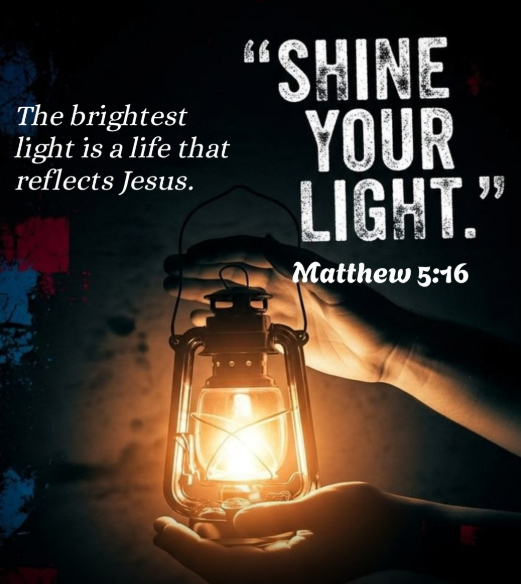
In Matthew 5:16, Jesus says, “Let your light shine before others, so that they may see your good works and give glory to your Father who is in heaven.” Of course, it is not technically our light that should shine before others. It is the light of Christ, entrusted to believers as light-bearers (cf. John 1:8). In other words, we do not produce the light within us. God does. And through our good works, people may glorify the One who gives that light.
One of the ways to let our light shine before others is to show compassion to others. Jesus expressed deep compassion for all people, regardless of their ethnic background, social status, gender, or personal beliefs (Matthew 9:36; 15:32; Mark 6:34). As Christians, we should follow His example by showing compassion and kindness to everyone.
Another way to let our light shine before others is to practice humility (Philippians 2:1–11). Christians are called to be humble in all things, knowing that it is only through the grace of God that we “live and move and have our being” (Acts 17:28). Humility also means the willingness to confess our sins before God and others (Luke 15:21; James 5:16). In doing so, we demonstrate our receptivity to correction and guidance (Proverbs 15:32).
Generosity is another means of letting our light shine before others. Christians are called to be generous with their money, time, resources, and love (Romans 12:13; Hebrews 13:16). After all, everything that we have belongs to God (Deuteronomy 10:14). So, we should share our God-given blessings with those in need and give without expecting anything in return (Luke 6:30).
Forgiveness, too, is a means of letting our light shine before others. Jesus taught that we should forgive others as we have been forgiven (Matthew 18:15–20; cf. Ephesians 4:32). Thus, we should seek reconciliation with those who have wronged us—and with those whom we have wronged—to promote peace and unity (cf. Ephesians 2:14).
There are many ways to let our light shine before others. We can volunteer at a soup kitchen or homeless shelter, donate money to a charity, or be kind and compassionate to someone in need. We can also lend an ear to a friend who is going through a tough time and offer words of encouragement, or we can simply smile and say, “Hello,” to a stranger on the street (cf. Hebrews 13:2).
Perhaps the best way to let our light shine before others is to share the gospel, the “good news,” with others. The good news is that God redeems sinners through the death and resurrection of His Son, Jesus Christ (John 3:16; Romans 5:8). If we believe in the person and work of Christ (who He is and what He did), then we are saved from eternal condemnation. We should not keep this message to ourselves; good news is meant to be shared, and we should make it visible for everyone to see (Matthew 28:19).
The ultimate purpose of letting our light shine before others is not to draw attention to ourselves or to promote our own interests; rather, it is about living in such a way that others will glorify our Father in heaven. Of course, this is not an easy task. It can be difficult to maintain a spirit of compassion, humility, generosity, and forgiveness in a world that is often characterized by hatred, anger, and division. We may even be met with resistance and opposition (Matthew 10:16; John 15:18). But we are not alone. We have the Holy Spirit within us, and He empowers and guides us to reflect the glory of God.

Tea Time Manna
I will bow down toward your holy temple and will praise your name for your love and your faithfulness, for you have exalted above all things your name and your word.
—Psalm 138:2
For Christians, God’s temple is one of two related things: either the Christian’s physical body (1 Corinthians 6:19-20) or the group of people who make up his Church gathered together (1 Corinthians 3:16; 1 Peter 2:4-5). Because of the flaws in the people who make up our churches, many are overly critical of our bouts with hypocrisy and weakness. The problem with most churches is that they are made up of people like the one we see in the mirror each day. Despite our flaws and failures as God’s people, his Church is precious to him. We should also value the Church, the temple of God, as precious. Anyone who destroys the Lord’s Church, the Lord’s temple, through division will be utterly destroyed (1 Corinthians 3:16-17). God has demonstrated his faithfulness to his people by preserving the Church through the ravages and persecutions of history, and by sustaining it through the failures of some of its most significant leaders. He has done this by his patience with the flawed people in his Church. God is still the center of the Church, the place where he chooses to dwell. So, dear friend in Jesus, we must value the Church, our congregations, the people that we share faith with, as we obey the word and will of God, and as we praise God and exalt him for his love, grace, and faithfulness.
Prayer
Holy and incomparable God, I praise you for your steadfast love and faithfulness revealed in your preservation of your Church through all the years and centuries of history. I will cherish your Church and do all I can to help it grow and mature into the bodily presence of Jesus. Through Jesus, I pray. Amen and Amen
Bible Teaching of the Day
LUNCH MANNA =
“God is light,” says 1 John 1:5. Light is a common metaphor in the Bible. Proverbs 4:18 symbolizes righteousness as the “morning sun.” Philippians 2:15 likens God’s children who are “blameless and pure” to shining stars in the sky. Jesus used light as a picture of good works: “Let your light shine before others, that they may see your good deeds” (Matthew 5:16). Psalm 76:4 says of God, “You are radiant with light.”
The fact that God is light sets up a natural contrast with darkness. If light is a metaphor for righteousness and goodness, then darkness signifies evil and sin. First John 1:6 says that “if we claim to have fellowship with him and yet walk in the darkness, we lie and do not live out the truth.” Verse 5 says, “God is light; in him there is no darkness at all.” Note that we are not told that God is a light but that He is light. Light is part of His essence, as is love (1 John 4:8).The message is that God is completely, unreservedly, absolutely holy, with no admixture of sin, no taint of iniquity, and no hint of injustice.
If we do not have the light, we do not know God. Those who know God, who walk with Him, are of the light and walk in the light. They are made partakers of God’s divine nature, “having escaped the corruption in the world caused by evil desires” (2 Peter 1:4).
God is light, and so is His Son. Jesus said, “I am the light of the world. Whoever follows me will never walk in darkness, but will have the light of life” (John 8:12). To “walk” is to make progress. Therefore, we can infer from this verse that Christians are meant to grow in holiness and to mature in faith as they follow Jesus (see 2 Peter 3:18).
God is light, and it is His plan that believers shine forth His light, becoming more like Christ every day. “You are all children of the light and children of the day. We do not belong to the night or to the darkness” (1 Thessalonians 5:5). God is the Creator of physical light as well as the Giver of spiritual light by which we can see the truth. Light exposes that which is hidden in darkness; it shows things as they really are. To walk in the light means to know God, understand the truth, and live in righteousness.
Believers in Christ must confess any darkness within themselves – their sins and transgressions – and allow God to shine His light through them.
Christians cannot sit idly by and watch others continue in the darkness of sin, knowing that those in darkness are destined for eternal separation from God. The Light of the World desires to banish the darkness and bestow His wisdom everywhere (Isaiah 9:2; Habakkuk 2:14; John 1:9). In taking the light of the gospel to the world, we must by necessity reveal things about people that they would rather leave hidden. Light is uncomfortable to those accustomed to the dark (John 3:20).
Jesus, the sinless Son of God, is the “true light” (John 1:9). As adopted sons of God, we are to reflect His light into a world darkened by sin. Our goal in witnessing to the unsaved is “to open their eyes and turn them from darkness to light, and from the power of Satan to God” (Acts 26:18).
Today’s Devotional
DINNER MANNA =
Jesus Christ began His great Sermon on the Mount by teaching the Beatitudes, a list of blessings that define the inner character of a genuine servant of God (Matthew 5:1–12). These verses also illustrate God’s kingdom principles, which are directly opposite of the world’s value system. To the casual listener, this countercultural teaching could suggest that Christ expects His disciples to withdraw from the world. But in Matthew 5:13–16 Jesus follows up immediately with an illuminating segment, leaving His true followers with no doubt as to His intended meaning: “You are the light of the world. A city set on a hill cannot be hidden” (verse 14, NASB95).
Jesus compared Christians to a city on a hill that cannot be hidden because kingdom people are meant to be a beacon in the night, providing spiritual light to a lost and dying world. Jesus said in John 9:5, “While I am in the world, I am the light of the world.” To His disciples, He explained, “I am the light of the world. Whoever follows me will never walk in darkness, but will have the light of life” (John 8:12). Jesus is the light that illuminates our lives. Everyone who puts their faith and trust in Him “will no longer remain in the dark” (John 12:46).
As long as we live on this earth, we are meant to have an influence on the people around us. The apostle Paul taught, “For you were once darkness, but now you are light in the Lord. Live as children of light” (Ephesians 5:8).
The purpose of light is to give direction by making it possible to see. At night, a city on a hill shines its light in all directions from an elevated position. The light can be seen far and wide, illuminating the way for many travelers and showing them which way to go. Jesus said, “I am the way and the truth and the life. No one comes to the Father except through me” (John 14:6). Toward Jesus, and ultimately into a relationship with God the Father, is the direction in which people ought to walk.
The apostle John said of Jesus, “In him was life, and that life was the light of all mankind. The light shines in the darkness, and the darkness has not overcome it” (John 1:4–5). As Christians we are to make the light of truth visible—by sharing the gospel of salvation in Jesus, and through the way we live our lives—thereby providing direction and guidance for those who are lost and living in darkness.
Isaiah foresaw the coming of Jesus Christ as the dawning of a great light seen by “people walking in darkness . . . those living in the land of deep darkness” (Isaiah 9:2; cf. Matthew 4:16). Saul of Tarsus had been walking in profound spiritual darkness, persecuting Christians. When Jesus Christ appeared to him, Saul saw “a light from heaven, brighter than the sun, blazing around me” (Acts 26:13).
The Lord allowed Saul to remain temporarily blinded by the light, as a symbol of his sightless spiritual state. That day God told Saul, “I have appeared to you to appoint you as a servant and as a witness of what you have seen and will see of me. I will rescue you from your own people and from the Gentiles. I am sending you to them to open their eyes and turn them from darkness to light, and from the power of Satan to God, so that they may receive forgiveness of sins and a place among those who are sanctified by faith in me” (Acts 26:16–18). From the moment God removed the blinders from his eyes, Saul began to preach the truth that Jesus is the Son of God (Acts 9:17–31).
Saul, who later went by the name of Paul, went on to become one of Christianity’s most zealous messengers. Everywhere he went, Paul taught Christians to “live clean, innocent lives as children of God, shining like bright lights in a world full of crooked and perverse people” (Philippians 2:15, NLT).
The Christian life is meant to have a visible impact and not to be lived in secret, hidden from the world. Jesus said, “No one lights a lamp and then puts it under a basket. Instead, a lamp is placed on a stand, where it gives light to everyone in the house. In the same way, let your good deeds shine out for all to see, so that everyone will praise your heavenly Father” (Matthew 5:15–16, NLT). There is no such thing as covert Christianity or clandestine discipleship.
Paul advised Timothy, “Never be ashamed to tell others about our Lord” (2 Timothy 1:8, NLT). We must not hide our devotion to Christ. Instead, we are to remain humble while doing everything we can to attract, influence, and guide others toward the truth: “For the Lord gave us this command when he said, ‘I have made you a light to the Gentiles, to bring salvation to the farthest corners of the earth’” (Acts 13:47, NLT).
When we live as true disciples of Jesus Christ, obeying the principles of God’s kingdom, we become like a city on a hill that cannot be hidden. In fact, as new creatures in Christ (2 Corinthians 5:17), it is now part of our nature as kingdom servants to be the light in the world. The light we shine does not come from us but instead is a reflected light coming from our source—“the Lord, who is the Spirit” (2 Corinthians 3:18).

NEWS MANNA –
The Purge Begins: Biblical Pastors Need Not Apply

The Presbyterian Church has spent decades debating sexuality, marriage, and biblical authority. But its latest decision may represent something far more consequential than another policy change. It creates a system that allows churches to screen pastors based on their views of LGBTQ theology before they are ever seriously considered for ministry.
Supporters call it efficiency.
Critics see the beginning of a theological purge.
At the 227th General Assembly, commissioners approved GEN-06, directing the denomination’s Church Leadership Connection to add an optional feature to its Ministry Discernment Profile—the official database churches use when searching for pastors.
The new feature allows congregations to indicate their openness to calling an LGBTQIA+ pastor and enables search committees to filter candidates according to several positions, including whether they identify as LGBTQIA+, whether they will perform same-sex marriages, and whether they support the ordination of LGBTQ elders, deacons, and ministers.
On paper, the proposal sounds reasonable. Churches can more easily find pastors who share their convictions, avoiding lengthy interviews that were never likely to result in a match.
But that assumes the denomination remains theologically balanced.
The Presbyterian Church (USA) has spent years steadily embracing progressive positions on sexuality. It has rewritten its constitution to include LGBTQIA+ protections, approved same-sex marriage, and opened ordination to openly LGBTQ ministers. This new filtering system doesn’t create a new direction—it accelerates one already well underway.
And that’s why many conservatives aren’t fooled by the language of “choice.”
In today’s institutional culture, formal requirements are often unnecessary. Hiring committees, search tools, and screening questions quietly accomplish what official policies never have to say out loud.
The question becomes remarkably simple:
Do you affirm our theology on sexuality?
If the answer is yes, your application moves forward.
If the answer is no—even because you sincerely believe Scripture teaches otherwise—your profile may never receive another look.
That is why many view this less as a matching tool and more as a litmus test.
Supporters insist conservative churches remain free to call pastors who hold traditional biblical convictions. Technically, that remains true.
But denominations are ecosystems. Seminaries shape future pastors. Committees shape leadership. Search systems shape opportunity. Once a denomination overwhelmingly moves in one theological direction, these kinds of screening tools inevitably reinforce that movement.
The result is predictable. Progressive churches can quickly identify affirming pastors, while pastors holding historic Christian beliefs find themselves considered by fewer and fewer congregations. No formal expulsion is necessary. The filtering quietly accomplishes the same outcome.
The irony is difficult to miss.
For years, progressives have championed diversity and inclusion. Yet one of Christianity’s oldest and most universally held doctrines—that marriage is between one man and one woman—is increasingly treated not as a legitimate theological conviction but as evidence that someone is unfit for ministry.
For nearly two thousand years, Christians across traditions held this understanding of marriage. Today, within parts of mainline Protestantism, that historic belief is becoming the position that must be defended.
Ultimately, this debate isn’t merely about sexuality.
It is about authority.
Will the church allow Scripture to shape its beliefs, even when those beliefs collide with the culture? Or will cultural expectations become the lens through which Scripture is reinterpreted?
The Apostle Paul warned Timothy that a time would come when people would no longer endure sound doctrine but would instead seek teachers who told them what they wanted to hear. Those words were written not about the world, but about pressures arising within the church itself.
Every generation of believers faces moments when faithfulness carries a cost. Increasingly, that cost may simply be holding to what Christians have believed since the beginning.
Policies like this clarify the choice.
The question is no longer whether the Presbyterian Church is changing.
The question is whether pastors who continue to believe the Bible’s teaching on marriage still have a place within it.
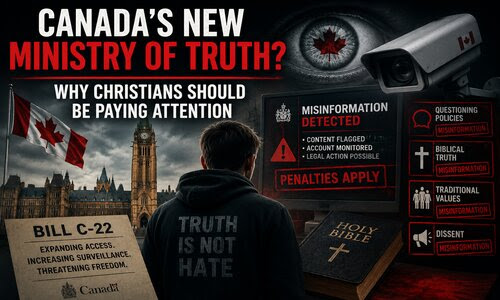
Canada’s New Ministry of Truth? Why Christians Should Be Paying Attention
There was a time when governments claimed they needed more access to our data to fight terrorism, organized crime, or foreign espionage. Canadians were assured that extraordinary powers would only be used in extraordinary circumstances.
Now comes the next question: once government has greater access to your information, what will it do with it?
The answer should concern every Canadian.
In recent weeks, the federal government has found itself at the center of two separate but deeply connected controversies. First came Bill C-22, which significantly expands Canada’s lawful-access framework by requiring electronic service providers to be capable of complying with judicial orders and creating new mechanisms for obtaining digital information.
Government officials insist the legislation merely modernizes existing investigative powers rather than creating new surveillance authorities. Critics, however, argue it expands the state’s practical ability to collect and access Canadians’ digital information while raising significant privacy concerns.
Then came reports from internal government documents, obtained through Access to Information requests, showing officials exploring legal action against Canadians who post what the government determines to be “false and misleading information” on social media. According to the reported documents, the objective is not simply responding to objectionable content but moving toward “prevention and early detection.”
Taken separately, each initiative raises legitimate questions.
Taken together, they paint a far more troubling picture.
The obvious question is one Canadians themselves have already asked: who decides what qualifies as misinformation?
That question is no longer theoretical.
History has repeatedly demonstrated that “misinformation” is often defined by those holding power. During COVID, Canadians watched scientific opinions evolve dramatically. Ideas once condemned as conspiracy theories–including debates surrounding vaccine effectiveness, lockdown policies, school closures, and the possibility of a laboratory leak–later became accepted topics of legitimate public discussion.
If governments had possessed even broader authority to silence those views during their earliest stages, would the truth ever have emerged?
That is precisely why free speech exists–not to protect popular opinions, but unpopular ones.
Government officials naturally insist these measures are intended to combat foreign disinformation campaigns, fraud, and harmful online manipulation. Those are worthy goals. But granting government the authority to determine truth while simultaneously expanding its ability to monitor digital activity creates an inherent conflict of interest that should concern Canadians of every political persuasion. Christians, in particular, should recognize where this road can lead.
The Bible has never promised believers cultural approval. Quite the opposite. Scripture repeatedly warns that truth will increasingly be labeled error while error is celebrated as truth.
Today, biblical convictions regarding sexuality, gender, marriage, abortion, or religious exclusivity are increasingly described as harmful, hateful, or dangerous. While Canada still maintains constitutional protections for freedom of religion and expression, cultural pressure has already demonstrated how quickly orthodox Christian beliefs can be portrayed as socially unacceptable.
If future governments determine that certain biblical teachings constitute “misinformation” or contribute to societal harm, what prevents regulatory mechanisms from eventually targeting Christian ministries, churches, podcasts, or individual believers?
Perhaps today’s government has no intention of doing so.
But laws rarely remain confined to the intentions of those who first pass them.
Every expansion of governmental authority eventually lands in someone else’s hands.
Canadians have already witnessed how extraordinary powers can be used during moments of national crisis. Many still remember the Freedom Convoy protests, where emergency measures extended beyond protesters themselves to include financial actions against participants and supporters. Whether one supported the convoy or opposed it politically, the episode reminded the nation that governments possess enormous leverage once exceptional powers are available.
That experience permanently changed how many Canadians think about state authority.
Now imagine combining greater digital access with government-directed determinations of acceptable speech.
That is a combination deserving far more scrutiny than it has received.
Privacy advocates, civil liberties organizations, and cybersecurity experts have likewise warned that aspects of Bill C-22 could weaken privacy protections, increase opportunities for government access to digital information, and even create broader implications for encryption and secure communications if improperly implemented.
None of this means Canada has suddenly become an authoritarian state.
It does mean Canadians should pay close attention whenever governments seek additional surveillance capabilities while simultaneously positioning themselves as arbiters of acceptable public discourse.
Free societies depend upon an independent citizenry capable of questioning authority without fearing legal consequences for expressing unpopular opinions.
For Christians, the issue extends beyond politics.
Jesus warned His followers that the truth would often be rejected by the world. Throughout history, governments have repeatedly attempted to regulate ideas before eventually regulating people.
The church’s calling has never been to speak only when government approves.
It has been to speak truth faithfully, graciously, and courageously–even when doing so carries a cost.
Whether these recent proposals ultimately become sweeping enforcement mechanisms or are significantly revised remains to be seen. Canadians should debate them vigorously and insist upon meaningful safeguards, judicial oversight, and clear limits.
Because once government claims both the power to watch and the authority to decide what may be said, liberty no longer rests upon the rights of the citizen.
It rests upon the restraint of the state.
History suggests that is not a place free people should ever be comfortable living.

TruLight TV – Nature Documentary – Kings of the skies
So you love Jesus as your Savior, but are you surrendering your life to Him as Lord? Is the way you’re living reflecting His authority over your life? When we obey and follow Him, there’s no storm strong enough to take us out. To learn why, watch this video. in today’s Nature Documentary in title (Eagles – Hunters of the Sky) – Whether in Alaska or in the Dolomites, eagles are generally seen as Kings of the skies. This film devotes itself on the one hand to the bald eagle, the heraldic bird of the United States, and on the other, the Golden Eagle, Europe’s largest predatory bird. Many bald eagles live in the Chilkoot State Park in Alaska’s south. In fact, more than 400 pairs reside there for the entire year. With a wingspan of some 2.5 metres, they are amongst the largest of their species. The offspring have to leave the eyrie by September at the latest, as then, winter sets in. The point of this Nature Documentary is based on the Bible Verse in Psalm 91;1 – The Heavens Declare the Glory of God; The Skies Proclaim the Work of His Hands. Enjoy today’s show and thanks for watching.
Today on TruLight Radio XM
TruLight Radio XM 24/7
Program
GMT / UTC +2
Monday To Fridays
00:15 Words to Live By Testimonies
01.15 Science Scripture and Salvation
02.15 Ground Works
04.00 Gospel Concert of the Day
05.00 The Daren Streblow Comedy Show
5:55 It is Today devotional
6:00 Gaither Homecoming Morning Show
7:15 Discover the Word
8.15 Destined for Victory
8:55 Science Scripture and Salvation
9:00 Holy Spirit Hour – Normally Sermons
10:15 Hope of the Heart
11:15 Unshackled
11.45 Words to Live By
12:15 Truth for Life
13:15 Living on the Edge with Chip Ingram
14:15 Focus on the Family
15:00 Kids Hour
16:00 In Touch with Dr. Charles Stanley
16:30 Groundwork
17:15 Live in the Light
18:15 Renewing your Mind
19:00 Gaither Homecoming Show
20:15 Growing Hope
21:15 Adventures in Odyssey Radio Drama
21:45 Bible Reading
22:15 Night-sounds
23.00 Good Old Country Gospel / Rhema Gospel Express
VISIT THE WEBSITE
TruLight Ministry News – EXTRA MANNA
TruLight Ministries orders from God since 2012 . Teach Them , Comfort Them and Warn Them!
Healing Truths.
End Time Articles.
Bonus Manna = Bonus Teaching for the Child of God !!
The opening verses of John’s Gospel introduce us to Jesus Christ as the incarnation of God. John wants his readers to know that Jesus is fully God in human form. John then reveals the purpose of God coming to earth as a human: “In him was life, and that life was the light of all mankind. The light shines in the darkness, and the darkness has not overcome it” (John 1:4–5). Jesus Christ came to bring the light of God’s life into a spiritually dark and dying world.
In Genesis, the creation of light was God’s first creative move (Genesis 1:3). In the process of generating life, light was God’s initial instrument for illuminating the dark and formless void. It was the inaugural instance of God shining light in the darkness.
When John spoke of the Incarnation, he was echoing the creation account. Scripture tells us over and again that God is the source of life and light: “For you are the fountain of life, the light by which we see” (Psalm 36:9, NLT; see also Acts 17:28; Psalm 27:1). “God is light; in him there is no darkness at all” (1 John 1:5). Jesus Christ is God’s light sent down to earth to pierce through the darkness. That light is God’s life, both physical and eternal. Jesus said, “I am the resurrection and the life. The one who believes in me will live, even though they die” (John 11:25; see also John 14:6). The life within Christ is the life of God: “For as the Father has life in himself, so he has granted the Son also to have life in himself” (John 5:26).
The Bible tells us that the life of Christ serves as a light to all people. That life is the light of truth—the message of Christ’s salvation and eternal life with God: “God has given us eternal life, and this life is in his Son” (1 John 5:11). The brilliance of Christ’s life and truth shine like a light into the darkness of this world.
In the New Testament, light and darkness are common symbols of good and evil. It’s clear that light in John 1:5 represents life, and ultimately, eternal life with God in His heavenly kingdom. Darkness is the absence of light—the lack of God. It represents the power of evil, sin, and unbelief in this world, all of which lead to eternal death (John 3:19; Job 10:22; 38:15; 1 Samuel 2:9).
John continues to focus on the theme of light and darkness throughout his gospel. In John 8:12, Jesus proclaims to the people, “I am the light of the world. If you follow me, you won’t have to walk in darkness, because you will have the light that leads to life” (NLT). John 1:5 says the darkness “has not overcome” the light because evil cannot overpower Jesus Christ, who states, “I have come into the world as a light, so that no one who believes in me should stay in darkness” (John 12:46).
Jesus declared that those who believe in the light become sons and daughters of the light: “Put your trust in the light while there is still time; then you will become children of the light” (John 12:36, NLT). According to the apostle Paul, Christians have passed from darkness into light: “For once you were full of darkness, but now you have light from the Lord. So live as people of light!” (Ephesians 5:8, NLT).
By loving one another, believers shine light into the darkness: “Yet I am writing you a new command; its truth is seen in him and in you, because the darkness is passing and the true light is already shining. Anyone who claims to be in the light but hates a brother or sister is still in the darkness. Anyone who loves their brother and sister lives in the light, and there is nothing in them to make them stumble. But anyone who hates a brother or sister is in the darkness and walks around in the darkness. They do not know where they are going, because the darkness has blinded them” (1 John 2:8–11).
The nature of light is to shine, and darkness cannot exist in the presence of light. Just as a bright street lamp discourages criminal mischief at night, so the light of Christ dispels the darkness of sin in the world. Just as the first rays of dawn pierce the blackness of night, God’s light and truth carry spiritual awakening to darkened hearts.
The light shines in the darkness means Jesus Christ has come into the world, bringing the good news of God’s salvation to every person. As Isaiah foretold, “The people walking in darkness have seen a great light; on those living in the land of deep darkness a light has dawned” (Isaiah 9:2). The life of Jesus, which is the life of the Creator God Himself, is the light of the world. No power of darkness can defeat or snuff out this light (Matthew 16:18; John 16:33).
Jesus is the giver of life and bearer of light. The Son of God continues to shine His light to humankind through His church, the body of Christ (Philippians 2:15). Whoever believes in Him receives eternal life (John 3:15; see also Psalm 112:4).
Share this Feeding of Manna with your Friends and Family. just click on the Social Media icon and share !