Hosted by TruLight Ministries – The Place of Truth
SELECT YOUR READING LANGUAGE – BOTTOM LEFT = YOUR DAILY MANNA NOW AVAILABLE IN 103 LANGUAGES
@ TruLight Daily Manna is not Just a Bible Verse with a Small Prayer . NO ::: WE SERVE DAILY Manna for the ENTIRE Day . Breakfast , Lunch , Dinner , Plus tea Times and even Entertainment Manna . Plus News Manna and More , This Daily Manna will keep you Spiritually full for the full 48 Hours and even More to Share with your Friends and Family !!!
You are in a VERY DANGEROUS PLACE , once you lose The CONVICTION of the Holy Spirit !!!
The Bible tells us that the Holy Spirit will convict the world of sin (John 16:8). To help us understand what the conviction of sin is, we can look at what it is not. First, it is not simply a guilty conscience or even shame over sin. Such feelings are naturally experienced by almost everyone. But this is not true conviction of sin.
Second, conviction of sin is not a sense of trepidation or a foreboding of divine punishment. These feelings, too, are commonly experienced in the hearts and minds of sinners. But, again, true conviction of sin is something different.
Third, conviction of sin is not merely knowledge of right and wrong; it is not an assent to Scripture’s teaching about sin. Many people read the Bible and are fully aware that the wages of sin is death (Romans 6:23). They may know that “no immoral, impure or greedy person . . . has any inheritance in the kingdom of Christ and of God” (Ephesians 5:5). They may even agree that “the wicked go down to the realm of the dead, all the nations that forget God” (Psalm 9:17). Yet, for all their knowledge, they continue to live in sin. They understand the consequences, but they’re far from being convicted of their sins.
The truth is, if we experience nothing more than a pang of conscience, anxiety at the thought of judgment, or an academic awareness of hell, then we have never truly known the conviction of sin. So, what is real conviction, the kind the Bible speaks of?
The word convict is a translation of the Greek word elencho, which means “to convince someone of the truth; to reprove; to accuse, refute, or cross-examine a witness.” The Holy Spirit acts as a prosecuting attorney who exposes evil, reproves evildoers, and convinces people that they need a Savior.
To be convicted is to feel the sheer loathsomeness of sin. This happens when we’ve seen God’s beauty, His purity and holiness, and when we recognize that sin cannot dwell with Him (Psalm 5:4). When Isaiah stood in the presence of God, he was immediately overwhelmed by his own sinfulness: “Woe to me! . . . I am ruined! For I am a man of unclean lips . . . and my eyes have seen the King, the LORD Almighty” (Isaiah 6:5).
To be convicted is to experience an utter dreadfulness of sin. Our attitude toward sin becomes that of Joseph who fled temptation, crying out, “How could I do this great evil and sin against God?” (Genesis 39:9).
We are convicted when we become mindful of how much our sin dishonors God. When David was convicted by the Holy Spirit, he cried out, “Against you, you only, have I sinned and done what is evil in your sight” (Psalm 51:4). David saw his sin primarily as an affront to a holy God.
We are convicted when we become intensely aware of the wrath it exposes to our souls (Romans 1:18; Romans 2:5). When the Philippian jailer fell at the apostles’ feet and cried, “Sirs, what must I do to be saved?” he was under conviction (Acts 16:30). He was certain that, without a Savior, he would die.
When the Holy Spirit convicts people of their sin, He represents the righteous judgment of God (Hebrews 4:12). There is no appeal of this verdict. The Holy Spirit not only convicts people of sin, but He also brings them to repentance (Acts 17:30; Luke 13:5). The Holy Spirit brings to light our relationship to God. The convicting power of the Holy Spirit opens our eyes to our sin and opens our hearts to receive His grace (Ephesians 2:8).
We praise the Lord for the conviction of sin. Without it, there could be no salvation. No one is saved apart from the Spirit’s convicting and regenerating work in the heart. The Bible teaches that all people are by nature rebels against God and hostile to Jesus Christ. They are “dead in trespasses and sins” (Ephesians 2:1). Jesus said, “No one can come to Me unless the Father who sent Me draws him” (John 6:44). Part of that “draw” to Jesus is the conviction of sin.

Tea Time Manna
[Job declared,] “Therefore I will not keep silent; I will speak out in the anguish of my spirit, I will complain in the bitterness of my soul.”
—Job 7:11
We sometimes think of God as too fragile, distant, or brooding to speak honestly with him about our dilemmas. Others want to never appear to doubt, be angry, or be disappointed with God, thinking it might appear irreverent. Job, however, was not so shy. He did not live in denial about his anguish, pain, and disappointment with God. He spoke honestly out of life that was honorable and reverent before his great God (Job 1:1). Job is our great reminder that God prefers us to maintain our relationship with him, even if it is stormy and we are weary and confused. No matter where you are in your struggles, be honest with God. Speak openly with him about your emotions. Be real about the current chapter of your life, acknowledging that pain and disappointment overwhelm you. Let him minister to your truest hurts, deepest frustrations, and greatest fears. The Psalms offer many words of honest complaint and confusion to God. Job is honest about his suffering and life’s unfairness. So, you can be honest with God. You can refuse to use trite, sanitized, and cliched words that are untrue to your heart. The Holy Spirit intercedes to help clean up your words and speak the unspeakable emotions of your heart (Romans 8:26-27). Don’t be silent; speak out of the anguish of your spirit and the bitterness of your soul to your Father, who hears and cares how you feel.
Prayer
Abba Father, thank you for listening to my words and my heart. Thank you for providing the Holy Spirit and my Savior, Jesus, as my intercessors before your throne. Thank you for wanting me in your presence even when my heart is full of conflict, anger, and pain. Thank you for loving me through my brokenness and strife. Most of all, thank you for your promise to deliver me through this time of agony and bring me home to you to share in your glory. In Jesus’ name, I yearn to experience your deliverance. Amen and Amen
Bible Teaching of the Day
LUNCH MANNA =
Conviction from the Holy Spirit vs Condemnation from satan.
I am going to be applying tough love by addressing areas of sin in your life because I want to see you healed and set free. I’m going to touch the very fabric of your lives and will be addressing issues where you are most sensitive and vulnerable. I trust that as you read and learn about your disease, the conviction of the Holy Spirit will come. If you feel conviction, that’s good! That’s the Holy Spirit, don’t ignore it! It is God knocking on the door of your heart and talking to you and that is exciting because it means He is about to do a work in your life. When you feel convicted, do you know that you are so close to victory because you are about to defeat your disease or prevent a disease developing that was heading your way?
If you don’t feel conviction, you are in trouble because that means that the Holy Spirit has withdrawn from you. In his prayer of repentance in Psalm 51, King David said “Take not Your Holy Spirit from me!” Why did David say that? Because he had seen what had happened to his predecessor King Saul. Saul hardened his heart to the conviction of the Holy Spirit and refused to repent. As a result the Holy Spirit withdrew from him. When the spirit of God departed from King Saul, a spirit of insanity came and King Saul went mad.
The Holy Spirit brings conviction because God loves you and wants to see you set free from sin so you can enjoy the abundant life, which includes divine health, that Jesus paid such a high price to give you.
Hebrews 12 v 5-6 and 10-11: ”5 My son, do not think lightly or scorn to submit to the correction and discipline of the Lord, nor loose courage and give up and faint when you are reproved or corrected by Him; 6 For the Lord corrects and disciplines everyone whom He loves, and He punishes, even scourges, every son whom He accepts and cherishes… 10 For [our earthly fathers] disciplined us for only a short period of time and chastised us as seemed proper and good to them; but He disciplines us for our good, that we may become sharers in His holiness. 11 For the time being no discipline brings joy, but seems grievous and painful; but afterwards it yields a peaceful fruit of righteousness to those who have been trained by it [a harvest of fruit which consists in righteousness – in conformity to God’s will in purpose, thought, and action, resulting in right living and right standing with God].”
When the Word is taught, the Holy Spirit brings conviction which is letting you know that an area of your life and thinking needs to be changed. However, the devil then likes to come in and use that conviction which was meant for your good and he beats you over the head with it as condemnation.
The Bible says that the devil is the accuser of the brethren.
Revelations 12 v 10: “The accuser of our brethren, he who keeps bringing before our God charges against them day and night, has been cast out!” As you read through this book there may be sin in your life that is going to be brought to your attention but please do not respond to that by feeling judged and condemned. Condemnation comes from the devil.
It is important to understand the difference between conviction and condemnation. God brings the conviction of the Holy Spirit and that conviction goes something like this, “Daughter or son, I want to show you something in your life.” And when you look at it you go, “Oh! I see it! I understand it, help me!”
But condemnation comes like this, “Look at what you are doing! You sinner! You Scum! I thought you were a Christian! You better fix that!” Condemnation brings with it feelings of worthlessness and failure and makes us want to give up. Condemnation drives us away from God because it makes us feel unworthy.
If you feel conviction, God is knocking on the door of your heart and
talking to you. That is exciting because it means He is about to do a work in your life.
Conviction reaffirms our value in God and brings to the place of wanting to get right with God. Conviction makes us want to be closer to Him. One thing you must understand about the Bible is that it sets the standard of what we should grow into, but don’t be condemned by the standard. I want to help you understand that nothing is black or white – everything is grey.
I am grey and you are grey. White represents perfection as far as God is concerned.
Black represents everything that is negative or evil as far as the devil is concerned. People get caught in this black or white where they feel so bad about themselves because they are not all white and they become condemned with their black.
When you were saved you were a dark shade of grey – you had a little white in you, but a lot of black. When it comes to black paint, the more white you add to it, the more grey it becomes and that is what sanctification is all about. White which represents God’s nature and character is being added as the darkness in your life is removed by a work of the Holy Spirit, as long as you co operate with Him. If you find some black in your life or you are a dark shade of grey at the moment, don’t be hard on yourself and feel guilty. That is the devil accusing you to yourself – he is reminding you that he is there and then blaming you for it.
It’s ok to see your sin list but then you roll it back up and give it back to God and say, “OK, when You’re ready Father, I’m ready to work with You to get this out of my life.” But the enemy will say, “Today you better deal with every single thing and boy you better do it or else!” That is not God. That’s the enemy trying to drive you where the Holy Spirit is not leading you. The voice of the Holy Spirit is gentle because He is a gentleman. He leads us and He guides us but the devil drives us. So if you feel driven today to get rid of whatever sin it is, that is not God. However, if you have this tugging, excitement and hope then know that God is working with you. That is the hope that spurs in your heart the faith that is going to kick that sin out of your life.
Most Diseases are a Result of Sin and Separation on One of Three Levels Isaiah 59 v 2: “But your iniquities have made a separation between you and your God, and your sins have hidden His face from you, so that He will not hear.”
We see from Isaiah 59 v 2 that sin separates us from God. Most of the time disease can be traced back to sin and thus separation on one of the following three levels:
1. Separation from God.
2. Separation from yourself.
3. Separation from others.
These are the three main roots or sin issues that cause most of disease known to mankind and which manifest through the human body in various ways. The foundation of the Kingdom of God is relationship.
Therefore the foundation of satan’s attack is to destroy your relationship with God, yourself and others. These are the three areas where satan destroys our peace. When you are not at peace, you are not at ease – you are in a state of dis-ease which eventually leads to disease.
Today’s Devotional
DINNER MANNA =
In John 16:8, Jesus promised to send the Holy Spirit: “When [the Spirit] comes, he will convict the world concerning sin and righteousness and judgment” (ESV). In this verse, we see a three-fold ministry the Spirit will perform in relation to the unsaved world. He will “convict” the world; that is, He will reprove it or show it to be wrong. This reproof will target three areas in which the world needs admonishing: sin, righteousness, and judgment.
Jesus went on to explain: “Concerning sin, because they do not believe in me; concerning righteousness, because I go to the Father, and you will see me no longer; concerning judgment, because the ruler of this world is judged” (John 16:9–11, ESV).
The world is a sinful place, and one of the Holy Spirit’s tasks is to convict the world of its sin. No amount of preaching, pleading, or pointing of fingers will bring about the conviction of sin, unless the Holy Spirit is at work in the sinner’s heart. It is the Spirit’s job to convict. And what is the most basic sin of which the world is guilty? Jesus specifies it as unbelief. The convicting power of the Holy Spirit is at work in the world “because they believe not in [Christ].” Once a person responds to the Spirit’s conviction and turns to faith in Christ, the other sins he practiced will be taken care of. It is the sin of unbelief—a refusal to trust in Jesus—that is primary.
The world must also be convicted of righteousness, and this, too, is something the Holy Spirit does. There is a righteous standard we are all held to, despite the world’s stubborn denial of absolute truth. And who is the standard-bearer of righteousness? Jesus points to Himself as that standard: “Because I go to the Father.” There is only one Person who came down from heaven, lived a life of sinless perfection, and who ascended back to heaven—the Son of Man, who lives to be our Intercessor (John 3:13; 1 Timothy 2:5). The righteousness that the world tries to deny is found demonstrated in Christ. Everything He ever said and did was the consummate expression of God the Father (John 8:28; Colossians 2:9). He is righteousness personified, and none can measure up to Him (Romans 3:23).
The world is facing judgment, and the Holy Spirit also convicts them of this truth. There is a day of reckoning scheduled—a day in which the holy God will mete out justice and rid His creation of sin. In fact, this judgment has already begun. With whom did it begin? Jesus identifies Satan as the one on whom judgment fell: “Because the ruler of this world is cast out.” Jesus had earlier indicated that His death on the cross was when “the prince of this world will be driven out” (John 12:31). It was on the cross that Jesus redeemed sinners for God and utterly vanquished Satan. “That by his death he might break the power of him who holds the power of death—that is, the devil” (Hebrews 2:14). Three days later Jesus rose from the dead, showing to all the world that Satan’s rule has been overthrown. All who reject Christ and remain in their sin will be condemned along with Satan, and this is the warning that the Holy Spirit sounds in the hearts of the unsaved.
The influence of the Holy Spirit in an unsaved person’s life will lead that person to the realization that he is guilty, that God is just, and that all sinners are deserving of judgment. Once a sinner has been awakened to his soul’s great need, the Spirit will point him to Christ, the one and only Savior and Refuge from judgment (John 16:14). In all of this, the Spirit uses His “sword,” the Word of God (Ephesians 6:17), and the result is a regenerated heart. “Faith comes from hearing the message, and the message is heard through the word about Christ” (Romans 10:17).

NEWS MANNA –
The Dragon VS The Eagle Wings – China Is Rehearsing For War-And America Is Already Part Of The Script
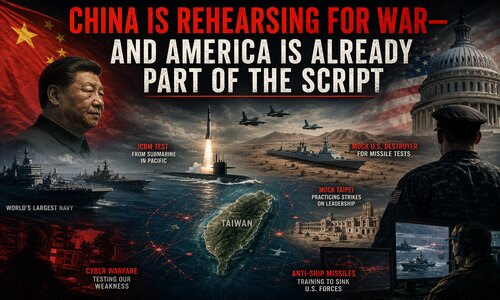
For years, many Americans have viewed rising tensions over Taiwan as a distant geopolitical dispute–something happening on the other side of the Pacific with little bearing on daily life. But recent military developments suggest that China is no longer merely preparing to defend its interests. It is openly rehearsing how to defeat America’s military should a conflict erupt.
That should get our attention.
In just the past year, China has accelerated military activities that paint a troubling picture. It recently conducted a rare intercontinental ballistic missile (ICBM) launch into the Pacific from a nuclear-powered submarine–the first such publicly known submarine-based test in roughly four decades and only the second long-range Pacific demonstration in modern history.
Although the missile reportedly carried a dummy warhead, the message was unmistakable: China wants the world to know its nuclear deterrent is becoming increasingly mobile, survivable, and capable of reaching targets across the globe.
At nearly the same time, newly released satellite imagery revealed China constructing yet another replica of a U.S. Navy Arleigh Burke-class destroyer deep in the Taklamakan Desert. This wasn’t built for tourism or propaganda. Analysts believe it is another target used to refine China’s anti-ship missile capabilities.
In other words, Beijing isn’t simply talking about defeating American warships–it is practicing.
And it isn’t stopping there.
Over recent years, China has also built mock versions of Taiwan’s Presidential Office, government buildings, and city streets for military exercises. These facilities allow the People’s Liberation Army (PLA) to rehearse urban assaults, command seizures, and precision strikes against Taiwan’s political leadership.
Military planners often say armies fight the way they train.
China is training for Taiwan.
A Navy Built for More Than Defense
China now possesses the world’s largest navy by number of warships, with well over 370 battle force ships and submarines–a number expected to continue growing. While the United States still enjoys advantages in global reach, carrier aviation, and combat experience, China’s naval expansion has been breathtaking.
Over the past year alone, Beijing has continued commissioning advanced destroyers, frigates, amphibious assault ships, and nuclear-powered submarines while expanding its aircraft carrier program. The sea trials of its next-generation carrier, *Fujian*, represent another milestone. Unlike China’s earlier carriers, *Fujian* employs electromagnetic catapults similar to those used by the U.S. Navy, allowing heavier aircraft and more efficient launch operations.
China has also dramatically expanded its coast guard and maritime militia–civilian-looking vessels that increasingly serve strategic military purposes by harassing Philippine, Vietnamese, and Taiwanese ships without technically triggering open warfare.
These are not isolated developments.
They form part of a comprehensive strategy.
Why Now?
Timing matters.
China’s economy has slowed considerably compared to the explosive growth that fueled its rise over the past two decades. Domestic challenges–from youth unemployment to real estate instability–have increased pressure on Beijing’s leadership.
History shows governments facing internal difficulties sometimes emphasize external threats to rally national unity.
At the same time, President Xi Jinping has repeatedly declared that “reunification” with Taiwan cannot be postponed indefinitely. U.S. intelligence officials have stated that Xi has instructed the PLA to be capable of conducting an invasion of Taiwan by 2027–not that war is inevitable by then, but that the military should be ready if ordered.
Readiness requires rehearsal.
The missile tests.
The mock American warships.
The simulated Taiwanese government buildings.
The massive naval exercises surrounding Taiwan.
These pieces fit together.
Taiwan Isn’t “Their Problem”
Many Americans understandably ask: Why should we care?
Because if Taiwan falls, the consequences won’t stay in Asia.
Taiwan manufactures roughly 90% of the world’s most advanced semiconductors. Those tiny chips power nearly everything–smartphones, automobiles, hospital equipment, artificial intelligence systems, financial networks, military hardware, and electrical infrastructure.
Disruption to Taiwan’s semiconductor industry would ripple through the global economy almost immediately.
Beyond economics lies credibility.
The United States has spent decades building alliances throughout the Indo-Pacific. Japan, South Korea, Australia, and the Philippines all rely upon American security commitments. If China successfully seized Taiwan without meaningful resistance, allies across the region would inevitably question whether America’s security guarantees still carry weight.
That uncertainty could trigger a regional arms race–or encourage other authoritarian powers to pursue territorial ambitions of their own.
The Testing Never Stops
China’s military pressure rarely makes front-page news because much of it happens incrementally.
Nearly every week, Chinese aircraft cross Taiwan’s air defense identification zone.
Chinese naval vessels circle the island.
Cyberattacks probe Taiwanese infrastructure.
Spy balloons, underwater cables, satellite surveillance, electronic warfare, and increasingly sophisticated artificial intelligence are becoming integral parts of Beijing’s strategy.
Each operation gathers intelligence.
Each exercise identifies weaknesses.
Each test conditions the world to accept a slightly higher level of aggression than before.
This is sometimes called the “boiling frog” strategy–not one dramatic act, but a steady escalation that gradually normalizes behavior once considered extraordinary.
Christians Should Watch Carefully
Scripture does not tell believers to panic over headlines, but it does repeatedly instruct us to remain watchful and discerning. Jesus warned that nations would rise against nations and that increasing global instability would characterize the period leading to His return.
Whether today’s events ultimately lead to a Taiwan conflict remains unknown. Wise leaders can still preserve peace through strength, diplomacy, and deterrence.
But pretending these military preparations are merely symbolic would be dangerously naïve.
China isn’t simply building ships.
It is building options.
It isn’t merely testing missiles.
It is testing resolve.
And every replica warship in the desert, every missile launched into the Pacific, every carrier launched to sea, and every simulated attack on Taiwan sends the same unmistakable message:
Beijing is preparing for a conflict it hopes never comes–but intends to be ready if it does.
The question is whether the free world is preparing with the same seriousness.
When Every Smart Item on you becomes a Tracking Device

When Every Device Becomes A Tracking Device – There was a time when leaving home meant leaving a trail only if someone happened to see you. Today, without ever touching your phone, sending a text, or making a call, you may already be broadcasting your location to dozens of nearby sensors.
And now, a new surveillance technology promises to stitch all those electronic breadcrumbs together.
It is called SignalTrace, and while its name may be unfamiliar today, the technology behind it offers a revealing glimpse into where modern surveillance is heading. Developed by global defense and security giant Leonardo, SignalTrace is designed to help law enforcement identify not merely vehicles, but the people traveling inside them.
Rather than relying solely on license plates, it correlates the unique wireless signals emitted by smartphones, Bluetooth devices, vehicle systems, RFID tags, tire-pressure monitoring sensors, and other electronic devices to create what the company describes as an “electronic fingerprint.”
Unlike Hollywood hacking scenes, the system is not reading your text messages or listening to your phone calls. Instead, it collects the identifiers constantly emitted by many of the wireless devices we carry every day. Individually, those signals reveal very little. But together they create a remarkably distinctive signature—one that can potentially be associated with a specific vehicle, tracked over time, and recognized again and again.
In many ways, SignalTrace represents the next evolution of automated license plate readers. Those systems were originally introduced to identify stolen vehicles and locate wanted criminals. Few objected. Catching dangerous offenders seemed a reasonable use of technology.
But surveillance technologies rarely remain confined to their original purpose.
Over the past two decades, governments have quietly assembled an increasingly interconnected web of digital observation. Security cameras became high-definition networks. License plate readers expanded from isolated police departments into nationwide databases. Smartphones evolved into constant sources of location information. Facial recognition became capable of identifying individuals within seconds. Financial transactions, online activity, and digital identities have become increasingly centralized.
Each advancement was introduced independently, usually accompanied by assurances that it would only be used for limited, legitimate purposes.
Yet taken together, they paint a very different picture.
SignalTrace is noteworthy not simply because of what it can do today, but because of what it represents. It seeks to bridge the gap between vehicles and occupants, allowing investigators to associate recurring collections of electronic devices with specific people rather than merely tracking a license plate. A car can change owners. A license plate can be replaced. But the combination of your smartphone, smartwatch, wireless earbuds, vehicle electronics, and other nearby devices creates a much more persistent digital signature.
The technology itself is impressive.
The broader implications are sobering.
Artificial intelligence has dramatically accelerated those implications. A decade ago, even if governments collected billions of data points, making sense of them required enormous human effort. Today, AI systems can rapidly analyze vast quantities of information, identify recurring patterns, uncover associations, and reconstruct what security professionals call a “pattern of life.”
Imagine asking a computer:
Who regularly visits this church?
Which vehicles consistently travel together?
Who attended a political rally and then met with certain individuals afterward?
Which electronic fingerprints appeared near a crime scene multiple times over six months?
These are precisely the kinds of questions modern AI excels at answering.
Supporters rightly point out that such capabilities could solve crimes, locate missing persons, dismantle trafficking networks, and improve public safety. There is no doubt these technologies possess legitimate investigative value.
The concern has never been whether surveillance tools can be used for good.
History demonstrates they often can.
The concern is whether governments consistently resist expanding their use once the infrastructure exists.
Experience suggests otherwise.
Whether it was counterterrorism authorities following the attacks of September 11, expanding license plate databases, or the growing use of facial recognition, surveillance powers have often broadened beyond their original scope over time. Civil liberties organizations have repeatedly warned that technologies introduced for exceptional circumstances frequently become normalized for routine investigations.
That phenomenon has a name: mission creep.
The question Christians—and indeed all citizens—should be asking is not simply whether today’s officials can be trusted. It is whether every future Government , every future administration, and every future bureaucracy should inherit an infrastructure capable of reconstructing nearly every movement, association, and relationship of ordinary citizens.
Technology itself is morally neutral.
The same tools that locate kidnapped children could also be used to identify political dissidents. The same systems that help solve violent crimes could one day reveal where citizens worship, which rallies they attend, what organizations they support, or whom they regularly meet.
That is why safeguards matter before capabilities become routine.
For Christians, these developments also serve as a reminder that the technological foundations for unprecedented governmental oversight are no longer the stuff of science fiction. Scripture describes a future in which economic activity, identification, and governmental control become deeply intertwined on a global scale. SignalTrace illustrates how rapidly the technological infrastructure capable of comprehensive tracking is being assembled.
One invention rarely changes the world overnight.
Rather, history advances one seemingly reasonable innovation at a time.
A license plate reader there.
A facial recognition database.
A digital ID.
An AI analytics engine.
An electronic fingerprint.
Individually, each appears manageable. Collectively, they form something previous generations could scarcely have imagined—a society in which anonymity steadily disappears and nearly every movement leaves a searchable digital trail.
Perhaps that is why the title of Leonardo’s latest system is so revealing.
The vehicle was never really the destination.
The destination was always the person.
And in a world filled with connected technology, every device is quietly becoming a tracking device.
Preach what we Tell you or Get NO FUNDING

Government Funding Comes With A Price: Surrender Your Christian Beliefs – You can believe the Bible… just don’t act like you believe it.
That increasingly appears to be the government’s definition of religious freedom.
Across America, Christians are repeatedly assured that no one is trying to take away their faith. They are free to attend church, own a Bible, pray before meals, and believe whatever they wish. Religious liberty, we’re told, is alive and well.
But there is an increasingly important condition attached to that promise.
Believe what you want—as long as those beliefs don’t shape how you live, how you run your business, how you educate your children, or how your institutions operate.
Faith is tolerated… until it becomes visible.
The moment biblical convictions influence hiring decisions, codes of conduct, school policies, or public life, the government increasingly steps in and says, “Not like that.”
That troubling reality was reinforced once again by a recent federal appeals court ruling involving Bangor Christian School in Maine.
The court ruled that while the school is free to teach biblical beliefs regarding sexuality and gender, families cannot benefit from Maine’s tuition assistance program unless the school complies with the state’s LGBT nondiscrimination policies. The judges rejected the school’s argument that requiring it to abandon conduct consistent with its beliefs violated its constitutional right to freely exercise its religion.
Think carefully about what that means.
The court essentially acknowledged that Christians may hold biblical beliefs—but ruled those beliefs need not be accommodated when they are actually put into practice.
But what exactly is Christianity if not a faith that is lived?
Jesus never called His followers simply to agree with Him intellectually. He called them to obey Him. Scripture repeatedly teaches that genuine faith transforms both belief and behavior. Christianity has never been confined to Sunday worship services or private opinions. It shapes every aspect of life—including how Christians educate their children and operate their schools.
Separating belief from conduct fundamentally misunderstands the very nature of religious freedom.
Imagine telling an environmental organization it may believe in protecting forests but cannot refuse to participate in logging. Or telling a vegetarian society it may promote vegetarianism but must serve meat at its official events.
The belief becomes meaningless if it cannot influence conduct.
Yet that is precisely the direction many governments now appear to be heading with Christianity.
Supporters of Maine’s policy argue that the rules are neutral because every school must follow them equally. But “equal” treatment does not always produce equal outcomes.
A secular private school that already embraces the state’s gender ideology sacrifices nothing by complying with these requirements. A Christian school committed to biblical teaching faces a completely different reality. It must either violate deeply held religious convictions or lose access to a public benefit available to others.
That is not neutrality.
It is pressure.
The state is effectively saying, “You may remain Christian—but only if your Christianity never conflicts with our ideology.”
Perhaps even more revealing were the comments made by Maine Attorney General Aaron Frey after the U.S. Supreme Court’s 2022 decision in Carson v. Makin. Although the Supreme Court ruled that parents could not be excluded from Maine’s tuition assistance program simply because they chose a religious school, Frey insisted Bangor Christian School should still remain ineligible because its biblical views on sexuality and gender were, in his words, “inimical to a public education.”
That statement should concern every American.
Not because everyone agrees with Bangor Christian School’s beliefs, but because it reflects a growing assumption that historic Christianity itself is somehow incompatible with participation in public life.
Notice the double standard.
Governments celebrate diversity when it comes to race, ethnicity, language, culture, gender identity, and sexual orientation. Society is constantly reminded that differing viewpoints strengthen democracy.
But increasingly, one viewpoint seems exempt from that celebration.
Traditional biblical Christianity.
Christian schools are expected to accommodate the moral convictions of the surrounding culture, while the surrounding culture is never expected to accommodate theirs.
Universities require faculty to support institutional values.
Advocacy organizations hire people who believe in their mission.
Political groups openly expect ideological agreement from employees.
No one considers that unusual.
But when Christian schools ask teachers and staff to uphold biblical standards that have been part of Christian teaching for two thousand years, those same convictions are increasingly described as discrimination.
That is a remarkable shift.
The debate is no longer simply about preventing discrimination.
It is about determining which belief system will ultimately define society’s moral boundaries.
History shows that governments rarely begin by outlawing religion altogether. Instead, they regulate it. They attach conditions to funding, accreditation, licensing, and participation in public programs. One requirement follows another until religious institutions face an increasingly difficult choice: remain faithful to Scripture or receive the benefits available to everyone else.
The pressure is subtle.
But it is real.
And it grows with every court ruling that tells Christians they may believe whatever they want—as long as they don’t organize their lives around those beliefs.
For Christians, this should not come as a surprise. Jesus warned His followers that obedience to Him would often place them at odds with the world. The apostles themselves declared, “We ought to obey God rather than men.”
That principle has not changed.
Religious liberty was never intended to protect only those beliefs that happen to align with the prevailing political or cultural consensus. It exists precisely to protect the beliefs that challenge it.
The question facing America is becoming increasingly clear.
Will Christian schools remain free to operate as genuinely Christian institutions?
Or will they simply be permitted to keep the name “Christian” while government officials dictate which biblical convictions they are allowed to practice?
Because in the end, a faith that may be believed but not lived is not genuine religious freedom at all.

TruLight TV –Dottie Rambo Collection
Hundreds of Gospel music classics have been born in the heart of Dottie Rambo. Now, through this timeless DVD honoring the songs of Dottie Rambo, everyone can enjoy a moving compilation of unforgettable moments from the Homecoming video series. and later Is your light visible for all to see? Dr. Stanley offers counsel on how to be a godly influence in the lives of others. Enjoy ! and thanks for watching.
Today on TruLight Radio XM
TruLight Radio XM 24/7
Program
GMT / UTC +2
Monday To Fridays
00:15 Words to Live By Testimonies
01.15 Science Scripture and Salvation
02.15 Ground Works
04.00 Gospel Concert of the Day
05.00 The Daren Streblow Comedy Show
5:55 It is Today devotional
6:00 Gaither Homecoming Morning Show
7:15 Discover the Word
8.15 Destined for Victory
8:55 Science Scripture and Salvation
9:00 Holy Spirit Hour – Normally Sermons
10:15 Hope of the Heart
11:15 Unshackled
11.45 Words to Live By
12:15 Truth for Life
13:15 Living on the Edge with Chip Ingram
14:15 Focus on the Family
15:00 Kids Hour
16:00 In Touch with Dr. Charles Stanley
16:30 Groundwork
17:15 Live in the Light
18:15 Renewing your Mind
19:00 Gaither Homecoming Show
20:15 Growing Hope
21:15 Adventures in Odyssey Radio Drama
21:45 Bible Reading
22:15 Night-sounds
23.00 Good Old Country Gospel / Rhema Gospel Express
VISIT THE WEBSITE
https://trulightradioxm.org.za
TruLight Ministry News – EXTRA MANNA
TruLight Ministries orders from God since 2012 . Teach Them , Comfort Them and Warn Them!
Healing Truths.
End Time Articles.
Bonus Manna = Bonus Teaching for the Child of God !!
While certain ministries of the Holy Spirit may involve a feeling, such as conviction of sin, comfort, and empowerment, Scripture does not instruct us to base our relationship with the Holy Spirit on how or what we feel. Every born-again believer has the indwelling Holy Spirit. Jesus told us that when the Comforter has come He will be with us and in us. “And I will ask the Father, and he will give you another advocate to help you and be with you forever—the Spirit of truth. The world cannot accept him, because it neither sees him nor knows him. But you know him, for he lives with you and will be in you” (John 14:16-17). In other words, Jesus is sending one like Himself to be with us and in us.
We know the Holy Spirit is with us because God’s Word tells us that it is so. Every born-again believer is indwelt by the Holy Spirit, but not every believer is controlled by the Holy Spirit, and there is a distinct difference. When we step out in our flesh, we are not under the control of the Holy Spirit even though we are still indwelt by Him. The apostle Paul comments on this truth, and he uses an illustration that helps us to understand. “Do not get drunk on wine, which leads to debauchery. Instead, be filled with the Spirit” (Ephesians 5:18). Many people read this verse and interpret it to mean that the apostle Paul is speaking against wine. However, the context of this passage is the walk and the warfare of the Spirit-filled believer. Therefore, there is something more here than just a warning about drinking too much wine.
When people are drunk with too much wine, they exhibit certain characteristics: they become clumsy, their speech is slurred, and their judgment is impaired. The apostle Paul sets up a comparison here. Just as there are certain characteristics that identify someone who is controlled by too much wine, there should also be certain characteristics that identify someone who is controlled by the Holy Spirit. We read in Galatians 5:22-24 about the “fruit” of the Spirit. This is the Holy Spirit’s fruit, and it is exhibited by the born-again believer who is under His control.
The verb tense in Ephesians 5:18 indicates a continual process of “being filled” by the Holy Spirit. Since it is an exhortation, it follows that it is also possible to not be filled or controlled by the Spirit. The rest of Ephesians 5 gives us the characteristics of a Spirit-filled believer. “Speaking to one another with psalms, hymns and spiritual songs. Sing and make music in your heart to the Lord, always giving thanks to God the Father for everything, in the name of our Lord Jesus Christ. Submit to one another out of reverence for Christ” (Ephesians 5:19-21).
We are not filled with the Spirit because we feel we are, but because this is the privilege and possession of the Christian. Being filled or controlled by the Spirit is the result of walking in obedience to the Lord. This is a gift of grace and not an emotional feeling. Emotions can and will deceive us, and we can work ourselves up into an emotional frenzy that is purely from the flesh and not of the Holy Spirit. “So I say, walk by the Spirit, and you will not gratify the desires of the flesh…Since we live by the Spirit, let us keep in step with the Spirit” (Galatians 5:16, 25).
Having said that, we cannot deny that there are times when we can be overwhelmed by the presence and the power of the Spirit, and this is often an emotional experience. When that happens, it is a joy like no other. King David “danced with all his might” (2 Samuel 6:14) when they brought up the Ark of the Covenant to Jerusalem. Experiencing joy by the Spirit is the understanding that as children of God we are being blessed by His grace. So, absolutely, the ministries of the Holy Spirit can involve our feelings and emotions. At the same time, we are not to base the assurance of our possession of the Holy Spirit on how we feel.
Share this Feeding of Manna with your Friends and Family. just click on the Social Media icon and share !