Hosted by TruLight Ministries – The Place of Truth
SELECT YOUR READING LANGUAGE – BOTTOM LEFT = YOUR DAILY MANNA NOW AVAILABLE IN 103 LANGUAGES
@ TruLight Daily Manna is not Just a Bible Verse with a Small Prayer . NO ::: WE SERVE DAILY Manna for the ENTIRE Day . Breakfast , Lunch , Dinner , Plus tea Times and even Entertainment Manna . Plus News Manna and More , This Daily Manna will keep you Spiritually full for the full 48 Hours and even More to Share with your Friends and Family !!!
God not my Will , But let YOUR WILL be done !!!

The life of Jesus Christ exemplified obedience. He came to earth to fulfill His heavenly Father’s will no matter how painful the task set before Him. Nonetheless, Jesus spoke honestly with God when faced with His crucifixion: “Father, if you are willing, please take this cup of suffering away from me” (Luke 22:42, NLT). In His human state, Jesus did not want to endure a torturous death. Yet in the same breath, He prayed, “Not my will, but yours be done” (Luke 22:42).
This scene in Gethsemane records one of the most desperate hours of anguish in the life of Christ (Matthew 26:36–46; Mark 14:32–42; Luke 22:40–46). He told His disciples, “My soul is overwhelmed to the point of death” (Mark 14:34). Worse than the thought of death, Jesus, in His humanity, must have dreaded the thought of bearing the sins of the world (1 Peter 2:24). In the garden, the Lord fell to the ground flat on His face and offered God this desperate cry of His soul: “My Father, if it is possible, may this cup be taken from me. Yet not as I will, but as you will” (Matthew 26:39).
Christ’s words and actions here serve as a great comfort to us, His followers. God wants His children to pour out their hearts to Him in sincerity (Psalm 62:8). He is our refuge, our safe haven. Like Jesus, we can reveal the deepest longings in our hearts to our loving heavenly Father. He knows what we are feeling, and we can trust Him to carry the burdens of our souls.
Facing the cross, Jesus was able to pray, “Not my will, but yours be done” because He was wholly submitted to His Father’s will. “My food,” He had said, “is to do the will of him who sent me and to finish his work” (John 4:34). “By myself I can do nothing,” explained Jesus, “for I seek not to please myself but him who sent me” (John 5:30).
Obedience to God’s will was central to Christ’s mission. He told His disciples, “For I have come down from heaven not to do my will but to do the will of him who sent me” (John 6:38). Hundreds of years before, Scripture foretold Christ’s destiny to come to earth and do God’s will (Hebrews 10:5–7; cf. Psalm 40:6–8).
For Christ’s followers, “Not my will, but yours be done” is the definitive prayer that never fails. According to 1 John 5:14–15, we can pray with confidence “if we ask according to his will.” Praying God’s will guarantees that He hears us and will grant what we ask. In fact, one of the primary purposes of prayer is to allow the will of God to be accomplished and to bring glory and honor to His name on earth. Jesus taught His disciples to pray, “Our Father in heaven, hallowed be your name, your kingdom come, your will be done, on earth as it is in heaven” (Matthew 6:9–10). Those who pray this way, desiring God’s will above all else, reveal that they are indeed Christ’s disciples (Matthew 7:21; see also Matthew 12:50; Mark 3:35; Luke 8:21; John 15:10; Ephesians 6:6).
The apostle Paul encouraged Christians to seek the Holy Spirit’s help to pray in agreement with God’s will: “And the Holy Spirit helps us in our weakness. For example, we don’t know what God wants us to pray for. But the Holy Spirit prays for us with groanings that cannot be expressed in words. And the Father who knows all hearts knows what the Spirit is saying, for the Spirit pleads for us believers in harmony with God’s own will” (Romans 8:26–27, NLT). Paul also urged believers to “learn to know God’s will” for their lives because God’s will “is good and pleasing and perfect” (Romans 12:2, NLT).
When Jesus said, “Not my will, but yours be done,” He surrendered His own will to God’s, fully convinced that His Father knew what was best. When we pray this way, we yield ourselves to God’s wisdom, trusting Him to work out what’s best for our lives, too (Romans 8:28).

Tea Time Manna
“If you obey my commands, you will remain in my love, just as I have obeyed my Father’s commands and remain in his love.”
—John 15:10
Love is much more than just a feeling. Love is action. Jesus told us as disciples, believers who seek to genuinely follow our Lord and Savior, that the action that most shows our love for Jesus is for us to be obedient to his words, his will, and his example, and to love each other. The foolish person is not just the one who disbelieves in God (Psalm 53:1), but also the one who knows Jesus’ words and maybe even claims to believe in Jesus, but doesn’t obey them (Matthew 7:21-23, 26-27). Let’s choose to be different, to be true disciples, to live our lives by abiding in the love of Jesus and by obeying what our Lord says, motivated by our love for him and for others (Matthew 22:36-40).
Prayer
Father, thank you for showing your love by sending Jesus, who faithfully lived out your will. Thank you, Lord Jesus, for showing us how to love our Father by obeying his will and honoring his words. Thank you, also, Lord Jesus, for your teaching and living as an example for us to follow so we can know how to honor God. I choose to live in conscious obedience to the Father’s will — just as you did, Lord Jesus — and I seek to follow your example and obey your teachings. Please receive my thoughts, words, and actions as my offering of loving praise to you. I pledge this obedience under the authority and in covenant with my Savior, Jesus of Nazareth, my Lord and Messiah. Amen and Amen
Bible Teaching of the Day
LUNCH MANNA =
“Thy will be done” is one of the requests in the Lord’s Prayer. In part, Jesus taught His disciples to pray, “Our Father in heaven, hallowed be your name, your kingdom come, your will be done, on earth as it is in heaven” (Matthew 6:9–10). Jesus Himself pleaded for God’s will to be done in the Garden of Gethsemane. Prior to His crucifixion, He prayed, “My Father, if it is possible, may this cup be taken from me. Yet not as I will, but as you will” (Matthew 26:39). Jesus was committed to seeing God’s will accomplished, and the prayer “Thy will be done” was a theme of His life.
Most simply, to pray, “Thy will be done,” is to ask God to do what He desires. Of course, we’re praying to the God who said, “Let there be light,” and there was light (Genesis 1:3), so we know that His sovereign decree will be accomplished, whether or not we pray for it. But there is another aspect of God’s will, which we call His “revealed” will or “preceptive” will. This is God’s “will” that He has revealed to us but that He does not force upon us. For example, it is God’s will that we speak the truth in love (Ephesians 4:15) and that we not commit adultery (1 Corinthians 6:18) or get drunk (Ephesians 5:18). When we pray, “Thy will be done,” we are asking God to increase righteousness in the world, to bring more people to repentance, and to further the cause of the kingdom of His Son.
When we pray, “Thy will be done,” we acknowledge God’s right to rule. We do not pray, “My will be done”; we pray, “Thy will be done.” Asking that God’s will be done is a demonstration of our trust that He knows what is best. It is a statement of submission to God’s ways and His plans. We ask for our will to be conformed to His.
The Lord’s Prayer begins by acknowledging God as Father in heaven. Jesus then models petition, presenting three requests to the Father: 1) That God would cause His name to be hallowed; in other words, as Albert Mohler explains, “that God would act in such a way that he visibly demonstrates his holiness and his glory” (The Prayer That Turns the World Upside Down: The Lord’s Prayer as a Manifesto for Revolution, p. 61). 2) That God would bring His kingdom to earth; that is, that the preaching of the gospel would convert sinners into saints who walk in the power of the Holy Spirit and that God would rid the world of evil and create the new heavens and new earth where God will dwell with His people and there will be no more curse and no more death (see Revelation 21—22). 3) That God’s will would be done “on earth as it is in heaven” (Matthew 6:10). In heaven, the angels perform God’s desire completely, joyfully, and immediately—what a world this would be if humans acted like that!
As a point of clarification, “Thy will be done” is not an impassive prayer of resignation. Jesus’ prayer in Gethsemane was not passive or fatalistic in the least; He bared His heart before the Father and revealed His ultimate desire: for God’s will to be accomplished. Praying, “Thy will be done,” acknowledges that God has more knowledge than we do and that we trust His way is best. And it is a commitment to actively work to further the execution of God’s will.
Romans 12:1–2 says, “Therefore, I urge you, brothers and sisters, in view of God’s mercy, to offer your bodies as a living sacrifice, holy and pleasing to God—this is your true and proper worship. Do not conform to the pattern of this world, but be transformed by the renewing of your mind. Then you will be able to test and approve what God’s will is—his good, pleasing and perfect will.” Understanding who God is, we submit ourselves to Him and allow Him to transform us. The more we know God, the more readily our prayers will align with His will and we can truly pray, “Thy will be done.” We can approach God in confidence that “if we ask anything according to his will, he hears us” (1 John 5:14–15).
By faith, we know that praying, “Thy will be done,” is the best thing we can ask for. “Now to him who is able to do immeasurably more than all we ask or imagine, according to his power that is at work within us, to him be glory in the church and in Christ Jesus throughout all generations, for ever and ever! Amen” (Ephesians 3:20–21).
Today’s Devotional
DINNER MANNA =
Man’s highest aim should be to bring glory to God (1 Corinthians 10:31), and this includes praying according to His will. First, we must ask for wisdom. “If any of you lacks wisdom, he should ask God, who gives generously to all without finding fault, and it will be given to him” (James 1:5). In asking for wisdom, we must also trust that God is gracious and willing to answer our prayers: “But when he asks, he must believe and not doubt” (James 1:6; see also Mark 11:24). So, praying according to the will of God includes asking for wisdom (to know the will of God) and asking in faith (to trust the will of God).
Here are seven biblical instructions that will guide the believer in praying according to God’s will:
1) Pray for the things for which the Bible commands prayer. We are told to pray for our enemies (Matthew 5:44); for God to send missionaries (Luke 10:2); that we do not enter temptation (Matthew 26:41); for ministers of the Word (Colossians 4:3; 2 Thessalonians 3:1); for government authorities (1 Timothy 2:1-3); for relief from affliction (James 5:13); and for the healing of fellow believers (James 5:16). Where God commands prayer, we can pray with confidence that we are praying according to His will.
2) Follow the example of godly characters in Scripture. Paul prayed for the salvation of Israel (Romans 10:1). David prayed for mercy and forgiveness when he sinned (Psalm 51:1-2). The early church prayed for boldness to witness (Acts 4:29). These prayers were according to the will of God, and similar prayers today can be as well. As with Paul and the early church, we should always be praying for the salvation of others. For ourselves, we should pray as David prayed, always aware of our sin and bringing it before God before it hinders our relationship with Him and thwarts our prayers.
3) Pray with the right motivation. Selfish motives will not be blessed by God. “When you ask, you do not receive, because you ask with wrong motives, that you may spend what you get on your pleasures” (James 4:3). We should also pray, not so our lofty words can be heard and we may be seen by others as “spiritual,” but mostly in private and in secret, so that our heavenly Father will hear in private and reward us openly (Matthew 6:5-6).
4) Pray with a spirit of forgiveness toward others (Mark 11:25). A spirit of bitterness, anger, revenge or hatred toward others will prevent our hearts from praying in total submission to God. Just as we are told not to give offerings to God while there is conflict between ourselves and another Christian (Matthew 5:23-24), in the same way God does not want the offering of our prayers until we have reconciled with our brothers and sisters in Christ.
5) Pray with thanksgiving (Colossians 4:2; Philippians 4:6-7). We can always find something to be thankful for, no matter how burdened we are by our wants or needs. The greatest sufferer that lives in this world of redeeming love, and who has the offer of heaven before him, has reason to be grateful to God.
6) Pray with persistence (Luke 18:1; 1 Thessalonians 5:17). We should persevere in prayer and not quit or be dejected because we have not received an immediate answer. Part of praying in God’s will is believing that, whether His answer is “yes,” “no,” or “wait,” we accept His judgment, submit to His will, and continue to pray.
7) Rely on the Spirit of God in prayer. This is a wonderful truth: “We do not know what we ought to pray for, but the Spirit himself intercedes for us with groans that words cannot express. And he who searches our hearts knows the mind of the Spirit, because the Spirit intercedes for the saints in accordance with God’s will” (Romans 8:26-27). We have the Spirit’s help in praying. At the times of our deepest depression or sorrow, those times when we feel that we “just cannot pray,” we have the comfort of knowing that the Holy Spirit is actually praying for us! What an amazing God we have!
What assurance we have when we seek to walk in the Spirit and not in the flesh! Then we can have confidence that the Holy Spirit will accomplish His work in presenting our prayers to the Father according to His perfect will and timing, and we can rest in the knowledge that He is working all things together for our good (Romans 8:28).

NEWS MANNA –
The Gay Cruise That Exposed An Impossible Alliance

They expected sunshine, ancient cities, and an unforgettable vacation.
Instead, thousands of passengers aboard an LGBTQ-themed cruise received an unexpected lesson in geopolitics.
When the ship was denied entry into Turkey, organizers scrambled to salvage the itinerary by arranging an alternative stop in Egypt. But that plan quickly unraveled as well. Two countries. Two closed ports. Two unmistakable messages. For many passengers, the biggest surprise wasn’t the inconvenience–it was the realization that being welcomed as tourists eager to spend money did not outweigh how those nations viewed the public identity of many aboard.
Some passengers expressed disbelief on social media. Why wouldn’t these countries welcome thousands of visitors bringing millions of tourism dollars?
The answer reveals something much bigger than a canceled vacation.
For years, Western progressives have built a broad coalition around causes they believe represent justice and equality. LGBTQ activism, pro-Palestinian demonstrations, democratic socialism, anti-colonial movements, and other left-wing causes have increasingly been presented as natural allies. Pride parades regularly feature Palestinian flags. “Queers for Palestine” has become a familiar slogan on college campuses and city streets.
But one simple question is rarely asked:
What do the people you’re marching beside actually believe?
The cruise answered that question more clearly than any political debate ever could.
Many Americans’ understanding of Islam comes through the lens of Western politics. They see progressive Muslim politicians, activists, and public figures who emphasize diversity, coexistence, and inclusion. Those voices certainly exist, and many sincerely advocate those values.
But they are not necessarily representative of traditional Islamic teaching or the legal and cultural realities that still exist across much of the Muslim world.
In numerous Muslim-majority countries, homosexual conduct remains illegal or is met with severe social stigma. Pride marches are not annual celebrations but unthinkable events. Public advocacy for LGBTQ causes can result in arrest, harassment, or worse depending on the country. Even where laws are less severe, social acceptance often remains extremely limited.
The assumptions many Western activists take for granted simply do not exist in large portions of the Islamic world.
The cruise passengers encountered that reality firsthand.
Ironically, conservative Christians are often portrayed as uniquely intolerant because they continue to uphold the historic biblical teaching that God’s design for sexual relationships is found within marriage between a man and a woman. Entire denominations have split over the issue, while many progressive churches have chosen instead to fully affirm LGBTQ relationships and even celebrate them.
Yet while Christians are frequently criticized for their beliefs, many of the same activists have enthusiastically embraced political movements whose traditional religious foundations are, in many respects, even less accepting of homosexuality.
That contradiction rarely receives serious attention.
The conflict becomes even more striking when Israel enters the conversation.
At many Pride events across the West, Palestinian flags are prominently displayed alongside rainbow flags. Yet Israel remains the one nation in the Middle East where LGBTQ individuals enjoy broad legal protections and where Tel Aviv hosts one of the world’s largest Pride celebrations. By contrast, Hamas has long rejected homosexuality, and many surrounding nations maintain laws or social norms that make open LGBTQ life extraordinarily difficult.
This raises an uncomfortable question: how did so many political alliances form without examining whether their members actually share the same core values?
Perhaps the answer is that many modern coalitions are built less on shared convictions than on shared opponents. If enough groups oppose the same perceived enemy–whether capitalism, conservatism, Israel, or Christianity–their profound differences are often overlooked.
Until reality intervenes.
The passengers aboard that cruise weren’t protesting. They weren’t demanding legal reforms. They weren’t attempting to export Western politics. They were simply arriving as openly LGBTQ tourists.
That alone was enough to close two ports.
The lesson isn’t really about one cruise ship.
It’s about the danger of assuming that political slogans accurately reflect the beliefs of the people standing beside us. A rainbow flag and a Palestinian flag may wave together at a rally in New York, Seattle, or London. But outside the Western political bubble, those symbols often represent worldviews that are fundamentally at odds with one another.
Sometimes it takes an unexpected detour to expose a contradiction that years of slogans have managed to conceal.
China’s War On Christianity: Why Xi Jinping Fears The Cross

For years, China has tried to convince the world that it respects religious freedom. Officially, the Chinese Communist Party recognizes Christianity as one of the country’s approved religions. But behind the carefully crafted propaganda lies a far darker reality.
Across China today, Christians are being arrested, churches are being demolished, pastors are disappearing, children are being separated from believing parents, and an entire faith is being reshaped to serve not Christ–but the Communist Party.
The latest reports coming out of China paint a chilling picture of a government that has become increasingly determined to eradicate any authority greater than the state itself.
One Christian identified only as “TJ” described hearing his electricity suddenly fail before police smashed through his front door in the middle of the night. His wife and three-year-old daughter were dragged into another room while officers restrained and interrogated him. His wife was later taken away and has still not been released. Their crime? Worshipping Jesus in a church not controlled by the Chinese government.
That story is no longer unusual.
It is becoming the new normal under Xi Jinping.
China officially allows worship only within state-approved churches–the Protestant Three-Self Patriotic Movement and the Chinese Patriotic Catholic Association. These churches operate under strict Communist Party oversight. Portraits of Xi Jinping hang prominently inside sanctuaries. Patriotic songs are often sung before worship services. Sermons are expected to reinforce Communist ideology, and pastors are forbidden from teaching anything that challenges Party authority.
For millions of believers, these are churches in name only.
Instead, they choose to gather quietly in homes, apartments, warehouses, or secret meeting places where Scripture–not the Communist Party–is treated as the highest authority. These “house churches” have existed for decades, but under Xi Jinping they have become primary targets of one of the most systematic crackdowns on Christianity in modern history.
Since taking power in 2012, Xi has accelerated what Beijing calls the “Sinicization of religion.” The goal is not merely to regulate religion but to transform it into something that serves socialism and absolute loyalty to the Communist Party.
That campaign has touched nearly every aspect of Christian life.
Crosses have been ripped from church buildings. Congregations have been forced to install surveillance cameras inside sanctuaries. Churches have been demolished with bulldozers. Bibles have faced increasing censorship and restrictions. Sunday schools and youth ministries have been shut down in many regions because authorities want children educated first in Communist ideology before learning about Christianity. Seminaries are expected to incorporate “Xi Jinping Thought” into ministerial training, while new Bible translations have been promoted that emphasize socialist values over traditional Christian teaching.
ChinaAid, an organization that monitors religious persecution, estimates that more than 10,000 Christians have been arrested during Xi’s tenure as authorities steadily intensify enforcement against unregistered churches.
Perhaps even more disturbing is how China’s legal system has become a weapon.
Pastors and church leaders are frequently charged with vague crimes such as “using superstition to undermine the law,” “illegal business operations,” fraud, or misuse of information networks. Human rights lawyers willing to defend Christians have themselves been disbarred, detained, or imprisoned. Justice has become whatever the Communist Party declares it to be.
None of this should surprise us.
Authoritarian governments have always viewed Christianity with suspicion because Christianity recognizes a King higher than Caesar.
The early Roman emperors demanded worship of the emperor.
The Soviet Union sought to replace faith with Marxism.
North Korea requires absolute devotion to the Kim dynasty.
Modern China is simply following the same pattern.
As Bob Fu of ChinaAid observed, Xi Jinping seeks exclusive loyalty. No authority–religious or otherwise–is permitted to rival the Communist Party.
Ironically, history repeatedly demonstrates that persecution rarely destroys Christianity.
It often strengthens it.
Despite decades of government suppression, scholars estimate that China may now have well over 100 million Christians, with some estimates placing the underground church population far above the officially registered churches. Several demographic studies have suggested that China could eventually become home to one of the world’s largest Christian populations if current long-term trends continue.
That reality helps explain why Beijing appears increasingly alarmed.
The Communist Party understands something many Western governments have forgotten: ideas are powerful.
Faith shapes culture.
Worldviews shape nations.
People whose ultimate allegiance belongs to Christ become difficult to intimidate.
This is why China’s persecution extends beyond churches. Advanced surveillance technology, facial recognition systems, digital monitoring, social credit mechanisms, and artificial intelligence increasingly give authorities unprecedented ability to identify religious gatherings and track believers. The same technological infrastructure developed to monitor political dissent can easily be directed against churches.
For Christians living comfortably in the West, these stories should serve as more than headlines.
They should be reminders.
The freedoms many believers enjoy today are neither universal nor guaranteed forever.
The Chinese church asks for prayer far more often than political intervention. They understand what the Apostle Paul understood–that the Gospel advances even through suffering.
History has shown that prisons cannot chain God’s Word.
Empires rise and fall.
Dictators come and go.
The Roman Empire tried to crush Christianity. It failed.
The Soviet Union tried. It failed.
Mao Zedong tried. He failed.
Xi Jinping is trying now.
He may imprison pastors, demolish church buildings, censor Bibles, and silence public worship. But Christianity has never depended upon government approval. It has always flourished wherever ordinary believers have been willing to stand faithfully for Christ regardless of the cost.
That may ultimately be the lesson China teaches the rest of the world–not about the power of authoritarianism, but about the remarkable resilience of a faith that no government has ever been able to extinguish.
The New Blacklist: Bible Believers
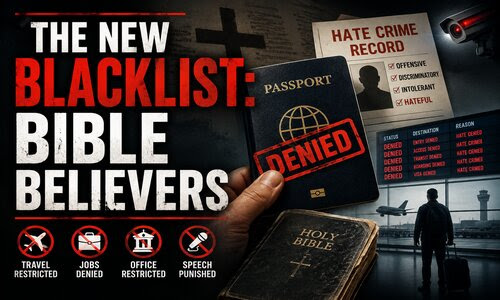
Imagine boarding an international flight.
The airline agent scans your passport, pauses, types a few more keys, then quietly picks up the phone. After a brief conversation, she returns with an apologetic smile.
*”I’m sorry, but you cannot transit through this country because of your criminal record.”*
You ask what crime you’ve committed.
“Hate speech.”
Your offense wasn’t assault. It wasn’t vandalism. It wasn’t inciting violence.
You publicly affirmed what Christians have believed for nearly 2,000 years–that marriage is between one man and one woman.
If that sounds like dystopian fiction, ask Finnish parliamentarian Päivi Räsänen.
After a seven-year legal battle, the physician, grandmother, former cabinet minister, and sitting member of Finland’s Parliament was convicted over a 22-year-old church booklet defending the biblical understanding of marriage. Although Finland’s Supreme Court unanimously acquitted her over a 2019 social media post quoting Scripture, it convicted her for the older publication, retroactively declaring her biblical teaching to be criminal “hate speech.”
Now the consequences are extending far beyond the courtroom.
According to author Rod Dreher and attorneys with Alliance Defending Freedom, Räsänen recently learned she could not even transit through London’s Heathrow Airport because British authorities considered her a convicted hate criminal.
She wasn’t traveling to campaign. She wasn’t organizing a protest. She wasn’t entering Britain to preach.
She simply wanted to change planes.
That should stop every Christian in their tracks.
Most believers assume persecution begins with pastors being arrested or churches being shut down. History suggests otherwise. It usually begins much more quietly–with labels.
First you’re “offensive.”
Then you’re “harmful.”
Then you’re “dangerous.”
Finally, society concludes that restricting your freedoms isn’t persecution at all. It’s simply protecting everyone else.
That is why Räsänen’s conviction matters far beyond Finland.
Across Europe, governments continue expanding hate speech legislation while the European Union explores broader standards for combating so-called hate crimes and online speech. Canada has spent years empowering human rights commissions to investigate speech complaints while proposing new online harms legislation and broader censorship measures.
Australia has expanded hate speech laws in several jurisdictions while pursuing misinformation regulations. In the United States, many progressive politicians have advocated stronger hate speech restrictions despite the significant protections afforded by the First Amendment.
The pattern should look familiar.
First, redefine traditional Christian teaching as discriminatory.
Next, classify it as harmful.
Then criminalize it.
Finally, ensure the consequences extend well beyond paying a fine.
That final step may prove the most dangerous.
If governments can officially declare biblical teaching to be hate speech, then the conviction itself becomes only the beginning.
Today, it may mean difficulties traveling internationally.
Tomorrow?
Could governments decide that people convicted of hate crimes should be barred from holding public office because they supposedly promote “extremism”?
Could professional licensing boards conclude that pastors, counselors, teachers, physicians, or attorneys convicted of hate speech are unfit to practice?
Could universities refuse to hire professors with hate crime convictions? Could churches face increasing financial scrutiny? Could charitable organizations lose tax benefits if their leaders have criminal records tied to biblical teaching? Could banks, insurers, or employers decide that someone officially labeled a “hate criminal” represents too great a reputational risk?
None of those possibilities require outlawing Christianity.
They simply require treating Bible-believing Christians as citizens who cannot be trusted with positions of influence.
That may sound speculative–but so did the idea of prosecuting a parliamentarian for publishing a biblical booklet twenty years before same-sex marriage was legalized in her country.
History offers an important warning.
Governments have always relied on labels before they relied on force. The Roman Empire branded Christians enemies of the state. The French Revolution labeled faithful clergy enemies of the people. Communist regimes called believers counter-revolutionaries. The terminology changes with each generation, but the strategy remains remarkably consistent: redefine virtue as danger, then justify punishment in the name of public safety.
Today’s preferred label is “hate.”
Once that label sticks, many people stop asking what was actually said.
Who wants to hire a hate criminal?
Vote for one?
Invite one to speak?
Trust one with children?
Allow one to travel freely?
The label itself often becomes more damaging than the original conviction.
Christians should be clear about one important distinction. Scripture commands believers to love every person because every individual bears the image of God. Genuine hatred has no place in the Christian life.
But loving people does not require abandoning biblical truth.
Nor should governments possess the authority to redefine historic Christian doctrine as criminal hatred.
Päivi Räsänen’s case is not simply about one Finnish grandmother or one unfortunate airport incident.
It is a glimpse into a much larger question every Christian should be asking.
What happens after the state officially labels biblical Christianity as hate?
The greatest danger may not be prison cells. It may be persuading ordinary citizens that faithful Christians deserve whatever restrictions come next.
Today it’s an airport.
Tomorrow it could be a profession.
One day it could simply be full participation in public life.
The question is no longer whether governments can make biblical Christianity unpopular.
The question is whether Christians will remain faithful when obedience to Scripture carries an ever-growing personal cost.

TruLight TV – More Than Gospel Music
When you are feeling burned out, where do you turn? Even our favorite vices can’t refuel us. We need to turn to God. Watch this in the middle of your busy day to be reminded of His love for you. and Today on The Josh and Ashley show, In 1975, Dennis Thompson began a career in music with the main emphasis being country music. He played with various groups for a number of years until starting his own band “Country Freedom”. He traveled to different locations locally and around the south playing country music, In the early 90’s, Dennis’s family and full-time job took precedence over his country music career and the band “Country Freedom” came to an end. Enjoy today’s show and thanks For watching and Share this Video With your Friends.
Today on TruLight Radio XM
TruLight Radio XM 24/7
Program
GMT / UTC +2
Monday To Fridays
00:15 Words to Live By Testimonies
01.15 Science Scripture and Salvation
02.15 Ground Works
04.00 Gospel Concert of the Day
05.00 The Daren Streblow Comedy Show
5:55 It is Today devotional
6:00 Gaither Homecoming Morning Show
7:15 Discover the Word
8.15 Destined for Victory
8:55 Science Scripture and Salvation
9:00 Holy Spirit Hour – Normally Sermons
10:15 Hope of the Heart
11:15 Unshackled
11.45 Words to Live By
12:15 Truth for Life
13:15 Living on the Edge with Chip Ingram
14:15 Focus on the Family
15:00 Kids Hour
16:00 In Touch with Dr. Charles Stanley
16:30 Groundwork
17:15 Live in the Light
18:15 Renewing your Mind
19:00 Gaither Homecoming Show
20:15 Growing Hope
21:15 Adventures in Odyssey Radio Drama
21:45 Bible Reading
22:15 Night-sounds
23.00 Good Old Country Gospel / Rhema Gospel Express
VISIT THE WEBSITE
Our Mission – Being the End Time Radio to the World! Shining our Light into all corners of the Globe with the Truth from the Bible. A Gospel Christian Radio Services broadcasting from South Africa to the World!
TruLight Ministry News – EXTRA MANNA
TruLight Ministries orders from God since 2012 . Teach Them , Comfort Them and Warn Them!
NEW RELEASE
THE LONG AWAITED : EPISODE 15 OF “THE SHERIFF OF THE CHURCH – I TELL YOU TRU “ The Doctrine of Demons called the Hebrew Sacred Names Cult
Healing Truths.
End Time Articles.
Bonus Manna = Bonus Teaching for the Child of God !!
The gospels contain an account of the time the disciples and Jesus spent in the Garden of Gethsemane, just before Jesus was arrested. In the garden Jesus prayed to his Father three times, saying, “My Father, if it is possible, may this cup be taken from me. Yet not as I will, but as you will”—the KJV says, “Let this cup pass from me” (Matthew 26:39). A little later, Jesus prays, “My Father, if it is not possible for this cup to be taken away unless I drink it, may your will be done” (Matthew 26:42). These prayers reveal Jesus’ mindset just before the crucifixion and His total submission to the will of God.
The “cup” to which Jesus refers is the suffering He was about to endure. It’s as if Jesus were being handed a cup full of bitterness with the expectation that He drink all of it. Jesus had used the same metaphor in Matthew 20:22 when prophesying of the future suffering of James and John. When Jesus petitions the Father, “Let this cup pass from me,” He expresses the natural human desire to avoid pain and suffering.
Jesus is fully God, but He is also fully human. His human nature, though perfect, still struggled with the need to accept the torture and shame that awaited Him; His flesh recoiled from the cross. In the same context, Jesus says to His disciples, “The spirit is willing, but the flesh is weak” (Matthew 26:41). In praying, “Let this cup pass from me,” Jesus was battling the flesh and its desire for self-preservation and comfort. The struggle was intense: Jesus was “overwhelmed with sorrow to the point of death” (Matthew 26:38), and Luke the physician observed that Jesus was sweating blood—a sign of extreme anguish (Luke 22:44). If anything shows that Jesus was indeed fully man, this prayer is it.
Jesus knew of what was to come (see Mark 8:31). The agony He faced was going to be more than physical; it would be spiritual and emotional, as well. Jesus knew that God’s will was to crush Him, to allow Him to be “pierced for our transgressions” and wounded for our healing (Isaiah 53:5–10). Jesus loves mankind, but His humanity dreaded the pain and sorrow He faced, and it drove Him to ask His Father, “Let this cup pass from me.”
Jesus’ prayer to “let this cup pass from me” contains two important qualifications. First, He prays, “If it is possible.” If there was any other way to redeem mankind, Jesus asks to take that other way. The events following His prayer show that there was no other way; Jesus Christ is the only possible sacrifice to redeem the world (John 1:29; Acts 4:12; Hebrews 10:14; Revelation 5:9). Second, Jesus prays, “Yet not as I will, but as you will.” Jesus was committed to the will of God, body, mind, and soul. The prayer of the righteous is always dependent on the will of God (see Matthew 6:10).
In Gethsemane, Jesus conquered the flesh and kept it in subjection to the spirit. He did this through earnest prayer and intense, willful submission to God’s plan. It is good to know that, when we face trials, Jesus knows what it’s like to want God’s will and yet not to want it; to act out of love yet dread the hurt that often results; to desire righteousness and obedience, even when the flesh is screaming out against it. This conflict is not sinful; it is human. Our Savior was “fully human in every way, in order that he might become a merciful and faithful high priest in service to God” (Hebrews 2:17). He had come “to seek and to save the lost” (Luke 19:10), and He accomplished His mission, even though it meant drinking the cup of suffering to the bitter end.
Share this Feeding of Manna with your Friends and Family. just click on the Social Media icon and share !