Hostested by TruLight Ministries – The Place of Truth
SELECT YOUR READING LANGUAGE – BOTTOM LEFT = YOUR DAILY MANNA NOW AVAILABLE IN 103 LANGUAGES
@ TruLight Daily Manna is not Just a Bible Verse with a Small Prayer . NO ::: WE SERVE DAILY Manna for the ENTIRE Day . Breakfast , Lunch , Dinner , Plus tea Times and even Entertainment Manna . Plus News Manna and More , This Daily Manna will keep you Spiritually full for the full 48 Hours and even More to Share with your Friends and Family !!!
There is a Thirst only JESUS can Satisfy !!!
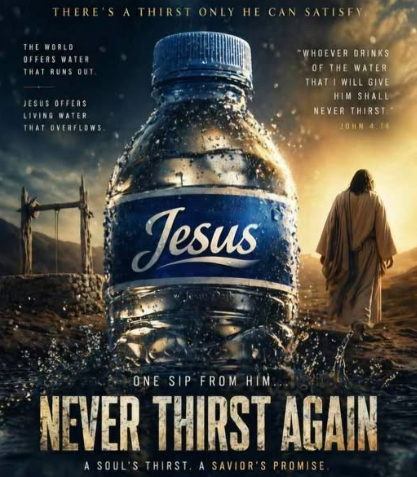
John 4 records a divine appointment between Jesus and a Samaritan woman. Weary from traveling, Jesus rests by a well when a woman from the nearby village arrives to draw water. Perceiving her desiccated spiritual condition and need for salvation, Jesus initiates a dialogue. In the course of the conversation, He says, “Everyone who drinks this water will be thirsty again, but whoever drinks the water I give them will never thirst. Indeed, the water I give them will become in them a spring of water welling up to eternal life” (John 4:13–14). At first, the woman thinks Jesus is offering natural water to quench her literal thirst. But He has something entirely different and otherworldly in mind.
Inside every human heart exists a God-induced craving—a spiritual thirst—that only He can satisfy (Ecclesiastes 3:11; Psalm 42:2; 63:1). He made us that way so we would seek to know Him. Physical thirst is used throughout the Bible to depict this profound human privation. Isaiah speaks of the Lord supplying flowing water to satiate this spiritual thirst: “The poor and the needy seek water, but there is none; their tongues are parched with thirst. I will answer them. I am the Lord, the God of Israel. I will not abandon them. I will open rivers on the barren heights, and springs in the middle of the plains. I will turn the desert into a pool and dry land into springs” (Isaiah 41:17–18, CSB; see also Isaiah 12:2–3; 35:6–7; 49:10; 58:11).
In the New Testament, Jesus Christ is revealed to be the fountain of living water (John 4:4–26; 7:37–39; cf. Jeremiah 2:13; 17:13; Zechariah 14:8–9). Early in His ministry, Jesus taught, “Blessed are those who hunger and thirst for righteousness, for they shall be satisfied” (Matthew 5:6, ESV). Then in the book of Revelation, we are given a glimpse of redeemed believers surrounding God’s throne in heaven. They “no longer thirst” because the Lamb of God guides “them to springs of the waters of life” (Revelation 7:13–17, CSB).
Jesus Christ is the only satisfactory source to quench our dry and thirsty souls (1 Corinthians 10:3–4). Faith is the key to partaking of the fountain of the water of life. Jesus told His disciples, “Whoever believes in me shall never thirst” (John 6:35, ESV). He explained in detail, “If anyone is thirsty, let him come to me, and drink. The one who believes in me, as the Scripture has said, will have streams of living water flow from deep within him” (John 7:38). This soul-quenching fountain of living water flows from Jesus Christ to us through the indwelling Holy Spirit (John 7:39).
Along with food, air, and light, water is one of the most essential elements to sustain physical life. On a spiritual level, Jesus is all of these—He is the “bread of life” (John 6:48), the “breath of life” (Genesis 2:7; John 3:8; 20:22), the “light of all mankind” (John 1:4), and the supplier of “living water” (John 4:10).
Jesus offers unlimited refills. Anyone who believes in Christ, receives His salvation, and abides in Him will never thirst again because that person drinks from an inexhaustible supply of pure and “living water” (John 4:10). The prophet predicted, “With joy you will draw water from the wells of salvation” (Isaiah 12:3). The living water Jesus spoke of represents eternal life, and Jesus Christ is its sole supplier (John 14:6; 17:3; 1 John 1:1–2; 5:20; 1 Corinthians 15:20–22). Later, Jesus told Martha, “I am the resurrection and the life. Anyone who believes in me will live, even after dying. Everyone who lives in me and believes in me will never ever die” (John 11:25–26, NLT).
John’s account of Jesus and the Samaritan woman emphasizes that Jesus “had to go through Samaria” (John 4:4). Jesus could have taken another route on His journey back to Galilee. Instead, He went through Samaria because of a divine appointment with a desperately thirsty woman who needed salvation. As a result of her encounter with Jesus, many Samaritans will never thirst again because they believed in Jesus, drank from His well of living water, and received the gift of eternal life (John 4:39–43).
At Scripture’s close, Christ’s invitation continues to ring out: “Both the Spirit and the bride say, ‘Come!’ Let anyone who hears, say, ‘Come!’ Let the one who is thirsty come. Let the one who desires take the water of life freely” (Revelation 22:17, CSB; see also Revelation 21:6). Through Christ’s redeeming sacrifice on the cross and subsequent outpouring of the Holy Spirit, believers can experience intimate and eternal fellowship with God. Only in a restored relationship with the Father is the soul’s craving satiated, allowing believers to never thirst again.

Tea Time Manna
Get rid of all moral filth and the evil that is so prevalent and humbly accept the word planted in you, which can save you.
—James 1:21
Isn’t it true! When we find ourselves caught in the clutches of the moral filth of our culture, we can find the Word of God boring and irrelevant. Yet even in those moments when the evil one uses sin to harden our hearts, God’s Spirit calls us to change at a level deeper than just the mere understanding of the words of Scripture. James, the brother of Jesus (Matthew 13:55; John 7:2-5), reminds us we’ve got stuff we must get rid of, even though it is all around us in our culture. We need to go back to the seed of faith, the good news of Jesus, that was planted in us. Through the Spirit, this seed calls us back to righteous living, and this repentance can save us! Thank God for his Spirit, who uses the Word that he inspired like a surgeon’s scalpel, and does the needed surgery on our hearts (Hebrews 4:12-13).
Prayer
Holy God, with the help of your Holy Spirit, today I willingly and decisively give up the immoral habits in my life. I recognize that these not only offend your holiness and grace, but they also harden me to your will, pull me away from your character, and blunt my witness to others. Please forgive me, please sustain me, as I seek to live a life wholly pleasing to you, empowered by the Holy Spirit. In Jesus’ name, I promise and pray to get rid of the moral filth that is so prevalent around me, and to humbly accept the message you have given me, and that calls me home to you. Amen and Amen
Bible Teaching of the Day
LUNCH MANNA =
Jesus’ Sermon on the Mount begins with the Beatitudes, a list of blessings that describe the inner character of those who are true servants of God and the kingdom of heaven. This teaching was part of Jesus Christ’s intensive discipleship training for His twelve chosen apostles. The fourth Beatitude states, “Blessed are those who hunger and thirst for righteousness, for they will be filled” (Matthew 5:6).
The Beatitudes offer solid truths for living as a disciple of Christ. While each Beatitude can stand on its own, they aren’t merely a collection of unrelated statements. They are linked in an unbroken chain, each one building on the previous truth. The first several Beatitudes deal with the condition of the heart; the second set pertains to our relationship with the Lord; the final grouping treats our relationships with others.
Jesus always begins with the heart. When He pronounced a blessing on those who hunger and thirst for righteousness, He touched on the inner state of our hearts.
Drawing from Old Testament passages that describe the downtrodden and oppressed (Psalm 10:17–18; 74:21; 109:22; 140:12; Proverbs 15:15 Job 5:17; Isaiah 30:18), Jesus used language and concepts in the Beatitudes that were familiar to His audience (Psalm 1:1; 34:8; 65:4; 128:1; Proverbs 14:21). Those listening were living under the oppressive rule of the Roman Empire. They were experiencing excessive taxation, denied freedoms, and persecution. The servants of God’s kingdom desperately needed the heavenly perspective and hope of an eternal inheritance that Christ presented in the Beatitudes.
The word blessed in the Beatitudes signifies deep, joy-filled contentment and an inner state of spiritual well-being. To hunger and thirst for righteousness is to possess an active spiritual longing: “My soul thirsts for God, for the living God. When can I go and meet with God?” (Psalm 42:2; see also Psalm 63:1; 143:6; Amos 8:11). This desire is not passive; it is a fervent seeking. The servant who hungers and thirsts for righteousness is the same as the one who seeks God’s kingdom and His righteousness before and above everything else (Matthew 6:33). This servant is blessed because he or she experiences a satisfied heart. This servant can say, “It is well with my soul.”
Righteousness speaks of right relationship with God and with other people. The idea of right relationships with others forms the link in the chain to the next section of the Beatitudes, while right standing with God is His gift of salvation given through faith in Jesus Christ to those who believe in Him (Romans 3:22).
Luke’s rendering of the fourth Beatitude holds only the notion of hunger: “Blessed are you who hunger now, for you will be satisfied” (Luke 6:21). But Matthew’s report intensifies the desire for righteousness with the addition of thirst. Those who thirst for righteousness receive the water Jesus offered to the woman at the well: “But those who drink the water I give will never be thirsty again. It becomes a fresh, bubbling spring within them, giving them eternal life” (John 4:14, NLT). The term filled or satisfied in the Beatitude means that the pangs of hunger and thirst will disappear. The verb is passive, indicating that God Himself will fulfill our intense desire for right relationship with Him. Salvation is His gift. We can’t earn it (Ephesians 2:8).
In summary, blessed are those who hunger and thirst for righteousness, for they will be filled could be paraphrased as follows: “Deeply joyful and spiritually whole are those who actively seek right relationship with God and, in so doing, discover that He alone can completely save and satisfy their souls.”
Today’s Devotional
DINNER MANNA =
Water is absolutely indispensable for human life. The average human body is more than 50 percent water. Water is also refreshing, whether it is used to drink or to bathe or swim in. In developed countries, water is often taken for granted. But in many nations the lack of clean water is the primary public health problem; even when clean water is available, it takes significant time and effort to get it. The concern for clean water was often primary in ancient times as well.
Water is so critical to our existence that it has become a symbol for life itself. There is a Brothers Grimm fairy tale called “The Water of Life” in which a dying king’s sons attempt to locate “the water of life” so that their father can live. Similar scenarios are common in literature. Spanish explorer Ponce de León is said to have been on a quest for the “Fountain of Youth” in the New World. Of course, he died without ever finding it. There is no “water of life,” that is, water that one can drink or bathe in which will grant eternal life, healing, or perpetual youth.
The Bible uses water as a metaphor in some places, and it does speak of “the water of life.” John 4:10–26 is sometimes called the Water of Life Discourse (the counterpart to the Bread of Life Discourse in John 6:22–59). In John 4, Jesus is sitting at a well in Samaria when a woman comes to draw water. This would have been a daily task for her and would have involved significant effort and time on her part. Jesus asks her for a drink. This simple request was significant because Jesus was publicly speaking to a woman (see John 6:27) and a Samaritan woman at that (John 4:9). The woman asks Jesus why He is willing to associate with her, assuming that most Jews would not stoop to ask a Samaritan for a drink. Jesus uses the occasion to turn the conversation in another direction.
Jesus answers the Samaritan woman at the well, “If you knew the gift of God and who it is that asks you for a drink, you would have asked him and he would have given you living water” (John 4:10).
The woman wonders how Jesus can provide this water, especially since He had no means to draw it. In fact, didn’t He just ask her for a drink?
Jesus answers, “Everyone who drinks this water will be thirsty again, but whoever drinks the water I give them will never thirst. Indeed, the water I give them will become in them a spring of water welling up to eternal life” (John 4:13–14).
The woman misunderstands, thinking that, if she could get this water, she would not have to spend any more time laboring to get water daily from the well. At this point, she is thinking that Jesus is talking about some kind of magical water that would meet her physical needs.
Jesus turns the conversation from physical needs to spiritual needs by telling the woman to go and get her husband. She responds that she does not have a husband. Jesus says, “You are right when you say you have no husband. The fact is, you have had five husbands, and the man you now have is not your husband. What you have just said is quite true” (John 4:17–18). In saying this, Jesus puts His finger on an area of sin and shame in this woman’s life. The water that He speaks of is not to quench a physical thirst, but a spiritual thirst—a thirst that has manifested itself in this woman’s life by a series of broken and sinful relationships. The conversation ends with Jesus telling her plainly that He is the promised Messiah, and she goes and tells the whole town to come out and listen to what Jesus has to say. The water of life that Jesus spoke of is a metaphor for spiritual washing and refreshment, which this woman needed more than she needed the water that she drew from the well each day.
In John 7, Jesus mentions this water of life or living water again. “Jesus stood and said in a loud voice, ‘Let anyone who is thirsty come to me and drink. Whoever believes in me, as Scripture has said, rivers of living water will flow from within them.’ By this he meant the Spirit, whom those who believed in him were later to receive” (verses 37–38). Once again, Jesus uses the physical to point to the spiritual. People need “living water” to give life to their spirits more than they need water to give life to their bodies. Here, we are told that the “living water” Jesus offered is really the Holy Spirit. He is the one who will be able to cleanse and satisfy the thirsty spirit.
Finally, the water of life is mentioned in Revelation 21—22, which tells of the blessings of those who will spend eternity with God in the new heavens and new earth. In Revelation 21:6 God says, “To the thirsty I will give water without cost from the spring of the water of life.” This is a picture of bountiful spiritual supply. Revelation 22:1 expounds further: “Then the angel showed me the river of the water of life, as clear as crystal, flowing from the throne of God and of the Lamb.” A final invitation is issued in Revelation 22:17, “Let the one who is thirsty come; and let the one who wishes take the free gift of the water of life.”
We need not understand the references to the “river” in the New Jerusalem literally. The picture is of a place where God lives with His people and meets all of their needs. In ancient times, a city with a continual supply of fresh, clean water would be considered a great place to live. The abode of God and of the believer for all eternity is pictured as having a pure, clear river running through the heart of it; in other words, it is a place where no need will be left unmet.
It is not necessary to wait for the new heavens and the new earth to experience the blessings of the water of life. Because the Holy Spirit comes to live within the believer, the Christian can experience a taste of this now. The Holy Spirit within the believer will quench every spiritual thirst, as long as the believer will simply take what the Spirit has to offer and follow the Spirit’s leading on a moment-by-moment basis.
In summary, the water of life is a metaphor that speaks of the Holy Spirit’s work in the life of the believer, providing spiritual cleansing and constant refreshment.

NEWS MANNA –
7 Ways Your Next Car Could Control More Than Just The Road

For more than a century, the automobile has represented one thing above all else: freedom.
It gave ordinary people something previous generations could only dream about—the ability to leave whenever they wanted, travel wherever they wished, and answer to no one but the rules of the road. The family road trip, the Sunday drive, the open highway—all became symbols of independence because once you held the keys, the destination was yours to choose.
That freedom may be entering a new era.
The latest controversy surrounding Subaru’s expanded EyeSight driver-monitoring system illustrates why. Owners have taken to social media describing a vehicle that constantly watches their eyes, issues alerts after brief glances toward the radio or scenery, and, under certain conditions, can conclude the driver is “unresponsive.” If that happens, the system is designed to issue escalating warnings and, if necessary, slow the vehicle, steer it toward the shoulder, and activate its hazard lights.
Subaru—and other automakers adopting similar technology—say these systems are intended to save lives. In many situations, they likely will.
But the larger question isn’t whether these technologies can improve safety.
It’s whether we’re quietly accepting a future where our cars don’t simply obey us anymore—they increasingly evaluate us.
Viewed individually, each innovation appears reasonable.
Viewed together, they reveal one of the most significant transformations in transportation since Henry Ford introduced the Model T.
1. Your Car Is Watching You
For most of automotive history, the only person watching your driving was the passenger sitting beside you.
Today, many new vehicles include inward-facing cameras that monitor eye movement, blinking, head position, and signs of distraction or fatigue. Cadillac’s Super Cruise, Ford’s BlueCruise, Mercedes-Benz, BMW, Volvo, and Subaru all employ various forms of driver-monitoring technology.
Manufacturers argue these systems reduce accidents by detecting drowsy or inattentive drivers before tragedy strikes. That’s a compelling goal.
Yet many Subaru owners say the latest EyeSight system can feel overly sensitive, issuing warnings after momentary glances to adjust the radio, check navigation, or even admire the scenery. What one driver sees as a harmless glance, the computer may interpret as dangerous distraction.
The issue isn’t simply that the vehicle is watching. It’s that every new camera and sensor creates another stream of highly personal data.
If these trends continue, one could imagine future systems becoming increasingly sophisticated—recognizing stress, illness, emotional state, or even identifying every individual who sits behind the wheel.
The question isn’t whether your car can watch you.
It’s who owns what it sees.
2. Your Car Knows More About You Than You Think
Modern vehicles remember far more than most drivers realize.
Navigation systems store destinations. GPS logs travel routes. Bluetooth identifies the phones that regularly ride in the vehicle. Connected apps remember favorite locations and travel habits.
Over time, your vehicle can quietly assemble an incredibly detailed picture of your life.
It knows where you work.
Where you worship.
Where your children go to school.
Where you receive medical treatment.
Even your favorite restaurants and vacation destinations.
This isn’t merely theoretical. General Motors faced widespread criticism after reports that driving data collected through its OnStar Smart Driver program had been shared with data brokers whose information was used in insurance risk assessments. GM later announced changes to the program following the controversy.
That episode demonstrated something important: driving data has real value.
Travel history could become one of the most valuable forms of personal information ever collected. Combined with smartphones, payment systems, and other connected devices, location data has the potential to reveal an extraordinary amount about a person’s daily life.
Technology has made that possible.
Society must decide how comfortable it is with the implications.
3. Your Driving Is Becoming A Digital Score
Insurance companies are increasingly measuring how we drive.
Programs such as Progressive Snapshot, State Farm Drive Safe & Save, and Allstate Drivewise reward drivers willing to share information about acceleration, braking, speed, mileage, and driving habits.
Participation is generally voluntary, and many safe drivers appreciate the discounts.
But these programs also reveal a larger trend.
Driving behavior is becoming measurable.
Searchable.
And valuable.
Today those scores primarily affect insurance premiums.
Driving profiles could be used in other settings as well—from fleet management and commercial driving to vehicle rentals or future transportation services.
Whether society ever chooses to move in that direction remains to be seen. The point is not that such outcomes are inevitable, but that technologies capable of creating detailed driving profiles already exist.
The automobile is no longer simply transporting people.
It is generating data.
4. You May Own The Car—But Not Control It
Buying a vehicle once meant owning everything it contained.
Increasingly, software has changed that relationship.
BMW has experimented with subscription services for features such as heated seats in certain markets. Mercedes-Benz offers software upgrades that unlock additional performance. Tesla routinely adds—or changes—vehicle capabilities through over-the-air software updates.
Imagine explaining to your grandfather that after buying a $70,000 automobile, you might still pay a monthly fee to activate equipment already installed inside it.
The shift is subtle but significant.
Ownership is becoming intertwined with software licenses.
Soon more vehicle functions will be governed not by mechanical components but by digital permissions. That doesn’t mean manufacturers intend to misuse such capabilities. It does mean consumers should think carefully about what ownership means in an era when software increasingly determines how products function.
5. Artificial Intelligence Is Starting To Make Driving Decisions
Automatic emergency braking.
Lane-keeping assistance.
Adaptive cruise control.
Emergency steering.
Subaru’s Emergency Stop Assist.
These innovations have undoubtedly prevented accidents and saved lives.
Yet they also represent something unprecedented.
For the first time in automotive history, vehicles are beginning to make decisions that once belonged exclusively to drivers.
Today’s systems intervene primarily during emergencies or when they believe a driver is incapacitated. In those circumstances, the technology can be a remarkable safeguard.
But if these trends continue, one could imagine future debates over where assistance ends and authority begins.
Should software intervene only to prevent collisions?
Should it prevent a fatigued driver from continuing?
Should it someday refuse to start if it determines the driver is impaired?
Those questions may sound futuristic today.
Then again, so did cars capable of steering themselves only a decade ago.
Every generation invents tools that help people.
This is one of the first generations creating tools that increasingly evaluate—and sometimes decide for—people.
6. Safety Today…Control Tomorrow?
History shows that many surveillance technologies begin with worthy objectives.
Airport screening followed terrorist attacks.
Traffic cameras sought to improve intersection safety.
License plate readers helped recover stolen vehicles.
Driver-monitoring systems aim to reduce distracted and impaired driving.
Each innovation addresses a legitimate concern.
Congress also directed the Department of Transportation through the 2021 Infrastructure Investment and Jobs Act to establish standards for advanced impaired-driving prevention technology in future vehicles. The details continue to evolve, but the broader conversation illustrates how technology is becoming increasingly central to automotive safety.
Meanwhile, transportation policy is changing elsewhere.
London has congestion pricing.
New York has implemented congestion pricing in parts of Manhattan.
Oregon has experimented with mileage-based road-use programs.
Supporters view such policies as practical responses to congestion or infrastructure funding. Critics worry they could gradually expand government oversight of personal travel.
Imagine a future where technology makes increasingly personalized transportation policies technically possible. Whether society embraces or rejects those possibilities will ultimately depend on the values citizens choose to protect.
7. The Automobile Is Quietly Redefining Freedom
In 1975, a car was primarily steel, rubber, gasoline, and mechanical parts.
Today it is increasingly a connected computer on wheels.
It communicates with smartphones, cloud services, navigation providers, charging networks, insurers, emergency responders, and software platforms. It receives updates over the internet. It continuously generates data. In some cases, it can even intervene when it believes something has gone wrong.
None of this means connected vehicles are inherently dangerous.
Many of these innovations genuinely improve safety and convenience.
But together they represent a profound shift in the relationship between people and the machines they drive.
Students of Bible prophecy have long recognized that Scripture describes a future in which unprecedented systems of economic and societal coordination become possible. The Bible does not identify the technologies involved, but each passing year reminds us how quickly ideas once confined to science fiction become everyday reality.
Connected vehicles are another reminder that the technological capability for widespread monitoring, digital verification, and interconnected systems is developing at remarkable speed.
Wise Christians need not fear every innovation.
Nor should we blindly embrace every convenience without considering its long-term implications.
George Orwell imagined a world where citizens were watched through screens mounted on the walls of their homes.
Few imagined we might voluntarily purchase those screens, mount them inside our own vehicles, and call them progress.
The automobile once symbolized freedom because it expanded where people could go.
Tomorrow’s vehicles may be remembered for expanding what others know about where we go—and perhaps, one day, how much influence technology has over the journey itself.
The Global War On Homeschooling Continues-Now With Prison Time For Parents

When did raising your own children become a crime?
That question is no longer hypothetical in Brazil.
In what is believed to be the country’s first criminal conviction of homeschooling parents, Audato and Ieda Denardi were sentenced by a court in São Paulo to 50 days in prison for what was described as “intellectual neglect.”
Their daughters were not illiterate, isolated, or academically behind. Quite the opposite. The girls speak multiple languages, study Latin, play piano at an advanced level, and read dozens of classic books every year. Even Brazil’s own prosecutor concluded there was no evidence of educational neglect and recommended acquittal. The judge convicted them anyway.
The ruling has shocked homeschool advocates around the world—not simply because parents face jail, but because of why.
The court criticized the family’s curriculum for not including state-approved instruction on gender and sex education, tolerance and diversity, and Afro-Brazilian cultural studies. It also faulted the girls’ preference for sacred and classical music rather than mainstream Brazilian genres such as funk and trap.
Whether one agrees with every aspect of the family’s educational choices is almost beside the point. The larger question is far more significant:
Who ultimately owns a child’s education—the parents or the state?
For centuries, Western civilization largely answered that question in favor of parents. Governments established schools to assist families, not replace them. Today, however, that relationship increasingly appears reversed.
Brazil’s case is particularly striking because prosecutors themselves found no evidence that the children had been intellectually abandoned. Yet the court still concluded that because the education did not sufficiently reflect government-approved cultural priorities, criminal punishment was appropriate.
This is not merely a debate over homeschooling. It is a debate over whether parents retain the freedom to shape their children’s worldview when that worldview differs from prevailing educational orthodoxy.
Nor is Brazil alone.
Germany has long maintained one of the strictest anti-homeschooling regimes in the democratic world. Families who homeschool have faced substantial fines, repeated court orders, and even the removal of children from parental custody. The well-known Romeike family fled Germany seeking asylum in the United States after authorities repeatedly penalized them for homeschooling based on their Christian convictions. Although their asylum claim was ultimately denied, Germany’s prohibition on homeschooling remains firmly in place.
Another widely discussed German case involved the Wunderlich family, whose children were temporarily removed by authorities after the parents refused to send them to public school. While some legal rulings later favored the family on procedural grounds, Germany continues to enforce compulsory school attendance rather than recognizing a broad parental right to homeschool.
These examples illustrate an important distinction. Around much of the world, homeschooling is not viewed as an educational alternative. It is viewed as an exception the state may narrowly permit—or prohibit altogether.
Contrast that with the United States.
Homeschooling has experienced extraordinary growth over the past several years. Following the COVID-19 pandemic, millions of American parents reconsidered traditional education. Many discovered that their children flourished in home-based learning environments, while others became increasingly concerned about curriculum, school safety, declining academic performance, or simply desired greater flexibility.
Today homeschooling has become one of America’s fastest-growing educational movements, crossing political, racial, and economic lines. It is no longer a fringe phenomenon but an increasingly mainstream educational choice.
Yet Americans should resist the temptation to assume these freedoms are permanently secure.
Several states have seen renewed efforts to increase oversight of homeschooling. Maine, for example, already requires notices of intent, annual filings, and instruction in specified subject areas, while lawmakers continue to debate additional reporting and accountability measures. Supporters argue such regulations protect children’s educational welfare. Critics worry they represent incremental steps toward expanding state control over family education.
History suggests that freedoms are rarely lost all at once.
They are usually narrowed gradually—one regulation, one reporting requirement, one mandatory curriculum, one prohibited topic at a time.
That is why Brazil’s case deserves international attention.
It demonstrates how rapidly disagreements over educational philosophy can become matters for criminal courts rather than parental discretion.
Christians, in particular, have long viewed parents as bearing primary responsibility for raising children in the instruction and discipline of the Lord. Governments undoubtedly have legitimate interests in ensuring children receive a meaningful education. But there is an enormous difference between ensuring literacy and mathematics and requiring ideological conformity as a condition of avoiding prosecution.
The Denardi family’s appeal will determine their immediate future. But the broader issue reaches far beyond one Brazilian courtroom.
Around the world, a growing struggle is emerging over who forms the next generation’s moral and intellectual foundations.
Parents? Or the state?
Americans who homeschool today still enjoy freedoms that millions of parents elsewhere can only dream about. The experiences of families in Brazil and Germany should serve as a reminder that educational liberty cannot simply be assumed. Like every other liberty, it survives only so long as citizens remain willing to defend the principle that parents—not governments—bear the primary responsibility for directing the upbringing and education of their own children.

TruLight TV & Kingdom Kidz TV = Godly Character
Mike and Chef Elaine teach Claire about godly character on Apple Pie Day at Konnect HQ. And Later we meet Nicolai, a 13-year-old from Norway, who is learning to help his family herd reindeer. In this episode we learn that even when life seems scary, God is good! This and some stunning kids’ songs. Enjoy!
Today on TruLight Radio XM
TruLight Radio XM 24/7
Program
GMT / UTC +2
Monday To Fridays
00:15 Words to Live By Testimonies
01.15 Science Scripture and Salvation
02.15 Ground Works
04.00 Gospel Concert of the Day
05.00 The Daren Streblow Comedy Show
5:55 It is Today devotional
6:00 Gaither Homecoming Morning Show
7:15 Discover the Word
8.15 Destined for Victory
8:55 Science Scripture and Salvation
9:00 Holy Spirit Hour – Normally Sermons
10:15 Hope of the Heart
11:15 Unshackled
11.45 Words to Live By
12:15 Truth for Life
13:15 Living on the Edge with Chip Ingram
14:15 Focus on the Family
15:00 Kids Hour
16:00 In Touch with Dr. Charles Stanley
16:30 Groundwork
17:15 Live in the Light
18:15 Renewing your Mind
19:00 Gaither Homecoming Show
20:15 Growing Hope
21:15 Adventures in Odyssey Radio Drama
21:45 Bible Reading
22:15 Night-sounds
23.00 Good Old Country Gospel / Rhema Gospel Express
VISIT THE WEBSITE
Our Mission – Being the End Time Radio to the World! Shining our Light into all corners of the Globe with the Truth from the Bible. A Gospel Christian Radio Services broadcasting from South Africa to the World!
TruLight Ministry News – EXTRA MANNA

TruLight Ministries orders from God since 2012 . Teach Them , Comfort Them and Warn Them!
NEW RELEASE
THE LONG AWAITED : EPISODE 15 OF “THE SHERIFF OF THE CHURCH – I TELL YOU TRU “ The Doctrine of Demons called the Hebrew Sacred Names Cult
Healing Truths.
End Time Articles.
Bonus Manna = Bonus Teaching for the Child of God !!
Scripture abounds with metaphors, allegories, and other figures of speech. For instance, in Jude 1:12, the author mentions “clouds without water” to describe false teachers who fail to deliver on their promises. To understand the significance of this expression, let us review the context of Jude 1:12.
Jude, the brother of James and half-brother of Jesus (see Matthew 13:55; Mark 6:3), addresses the ubiquity of false teachers and the consequent rise of apostates. Apostasy is defined as “the abandonment or renunciation of a religious or political belief.” Apparently, many believers had abandoned the truth of the gospel to embrace the lies of false teachers. For this reason, Jude urges believers to contend for the faith (Jude 1:3–4).
In Jude 1:11, the author compares false teachers to Cain (Genesis 4:5–8), Balaam (Numbers 22:5–7; 2 Peter 2:15), and Korah (Numbers 16:1–3, 31–35). That is, the false teachers are characterized by Cain’s hatred and jealousy, Balaam’s lust for selfish gain, and Korah’s rebellious spirit. Such qualities are antithetical to the gospel.
Next, Jude describes false teachers as “hidden reefs at your love feasts” (Jude 1:12). In the early church, love feasts were communal meals shared among Christians. The primary purpose of these meals was for the sake of fellowship (Acts 2:46–47; 1 Corinthians 11:17–34). Unfortunately, false teachers had infiltrated these love feasts and lurked unnoticed, like hidden reefs, ready to shipwreck souls without warning. Here, we are reminded of Judas, who shared a meal with the Lord and His disciples, even though he had already decided to betray Christ (John 13:2, 21–30). Although the disciples did not know who would betray the Lord, Jesus was not caught off guard by Judas’ spineless behavior.
These self-indulgent teachers “feast with [us] without fear” (Jude 1:12). Pretending to be “shepherds,” they feed only themselves. This is how Jesus spoke about false shepherds in John 10:12–13: “He who is a hired hand and not a shepherd, who does not own the sheep, sees the wolf coming and leaves the sheep and flees, and the wolf snatches them and scatters them. He flees because he is a hired hand and cares nothing for the sheep.” Jesus, however, is the good shepherd who lays down His life for the sheep (John 10:11, 14–15).
False teachers can also be likened to “waterless clouds” (Jude 1:12) and “waterless springs” (2 Peter 2:17). In other words, they cannot deliver on their promises. When we see a sky full of clouds bringing the promise of a refreshing rain, we expect some moisture. When the clouds pass by without so much as a drizzle, we are disappointed. The false teachers are like those waterless clouds. They talk a good talk, but there is nothing to show for it. They promise spiritual refreshment, but none ever comes. They make a show of their knowledge and gifts, but no one benefits. The ancient word of the wise applies to them: “Like clouds and wind without rain is one who boasts of gifts never given” (Proverbs 25:14).
When people set their expectation on “waterless clouds,” they will continue in their dry and parched condition. When they drink the “water” offered by the false teachers, they “will be thirsty again” (John 4:13). Only Jesus can provide thirst-quenching, soul-satisfying water unto eternal life (John 4:14). Only He provides the showers of blessing we need.
Because false teachers are disconnected from the true source of life, they are like “fruitless trees in late autumn, twice dead, uprooted” (Jude 1:12). Conversely, genuine believers produce fruit that leads to righteousness and eternal life (Galatians 5:22–23).
So, how do we spot false teachers? We look at the fruit they produce (or fail to produce). We look at the clouds and the rain they give (or fail to give). That tells us everything we need to know about them (Matthew 7:15–20).
Share this Feeding of Manna with your Friends and Family. just click on the Social Media icon and share !