Hostested by TruLight Ministries – The Place of Truth
SELECT YOUR READING LANGUAGE – BOTTOM LEFT = YOUR DAILY MANNA NOW AVAILABLE IN 103 LANGUAGES
@ TruLight Daily Manna is not Just a Bible Verse with a Small Prayer . NO ::: WE SERVE DAILY Manna for the ENTIRE Day . Breakfast , Lunch , Dinner , Plus tea Times and even Entertainment Manna . Plus News Manna and More , This Daily Manna will keep you Spiritually full for the full 48 Hours and even More to Share with your Friends and Family !!!
EVERYTHING ON EARTH HAPPENS TO WIN YOUR HEART !!!

The human soul or spirit is that part of a man or woman that is not physical. The soul is central to the personhood of a human being. It is the “true self”—who a person really is. The soul is the center of life, feeling, thought, and action in a human being.
The human soul, though created and not inherently immortal like God (1 Timothy 6:16), will never cease to exist because God sustains it (2 Corinthians 5:8; Hebrews 1:3). In contrast, the body is physical; the earthly body we now possess is subject to death.
The immortality of the soul is clearly seen in many places in Scripture. For example, in Psalm 23:6 David says, “I will dwell in the house of the Lord forever.” In Ecclesiastes 12:7 the Preacher mentions two things that happen at death: “The dust returns to the ground it came from, and the spirit returns to God who gave it.” In 2 Corinthians 5:8 Paul says that to be “absent from the body” is to be “present with the Lord” (NKJV). All these passages indicate that the soul is immortal.
What, then, are we to do with 1 Timothy 6:16, which says that God “alone is immortal”? We see this verse as teaching that God alone is immortal in and of Himself; that is, He alone possesses immortality as an essential part of His nature. Our soul’s immortality, on the other hand—and that of the angels—is derived from God. God is immortal in His being; our souls are immortal as a result of God’s creation. Commentator Albert Barnes put it this way: “God, in his own nature, enjoys a perfect and certain exemption from death. Creatures have immortality only as they derive it from him, and of course are dependent on him for it. He has it by his very nature, and it is in his case underived, and he cannot be deprived of it. It is one of the essential attributes of his being, that he will always exist, and that death cannot reach him” (Notes on the Bible, 1834).
In John 5:26 Jesus says, “The Father has life in himself.” This is another way of saying that God alone is immortal. The immortality of the human soul, that is, its quality of continuing forever, is a reflection of God’s nature in us. God alone is without a beginning or end. All of His creatures, animal, human, and angelic, had a beginning. Our souls came into being at a certain point in history, and there was a time when our souls did not exist. Only our Creator is eternal.
Other passages that indicate the immortality of the human soul include Luke 23:43, where Jesus promises one of the thieves who is dying beside Him, “Truly I tell you, today you will be with Me in Paradise.” Obviously, Jesus believed the soul of the repentant thief was going to survive physical death.
Daniel 12:2–3 says, “Multitudes who sleep in the dust of the earth will awake: some to everlasting life, others to shame and everlasting contempt. Those who are wise will shine like the brightness of the heavens, and those who lead many to righteousness, like the stars for ever and ever.” This passage promises a resurrection of both the just and the unjust. When we die, our bodies return to “dust” (cf. Genesis 3:19). From that dust the body will return to either “everlasting life” or “everlasting contempt.” We must assume the soul will be reunited with the body at that time—otherwise, the resurrected bodies would be soulless and therefore inhuman.
In Matthew 25:46 Jesus said that the wicked “will go away to eternal punishment, but the righteous to eternal life.” The same Greek word, translated “eternal,” is used to describe both “punishment” and “life.” Jesus clearly taught that both the wicked and the righteous will exist forever in one of two conditions. Thus, every human being has an immortal, everlasting soul.
The unmistakable teaching of the Bible is that all people, whether saved or lost, will exist eternally. The spiritual part of us does not cease to exist when our fleshly bodies pass away in death. Our souls will live forever, either in the presence of God in heaven or in punishment in hell. The Bible also teaches that our souls will be reunited with our bodies at the resurrection. This hope of a bodily resurrection is at the very heart of the Christian faith (1 Corinthians 15:12–19).
FREE EBOOK BY PASTOR DIRK

Tea Time Manna
In Christ, all the fullness of the Deity lives in bodily form, and you have been given fullness in Christ, who is the head over every power and authority.
—Colossians 2:9-10
If we had known Jesus’ address when he was a boy in Nazareth, we would have found him apprenticing as a carpenter, and could have said, “That boy with wood shavings in his hair is God come to live among us!”
I believe that the doctrine of Jesus being fully God and fully man is impossible to grasp completely, yet it is taught in the New Testament and is something we must believe. Beautiful explanations, like our verse today, exist. Another is the beautiful Christ-Hymn Paul quotes in Philippians 2:5-7. This song reminds us that Jesus was equal with God, but emptied himself of divine prerogatives and became human and suffered death on the cross. God taking on human flesh and being Immanuel, God with us (Matthew 1:23), is an awesome reality of grace. God chose to be like us because we could not make ourselves like him. God came to us because we could not go to him. In Jesus, God took on human flesh so we could be given fullness in Christ. By faith and in baptism, we were joined to Jesus in his death, burial, and resurrection (Colossians 2:12, 15). That faith experience means God’s victory in Jesus over sin, death, demons, and hell, and also delivered us from these things as well (Colossians 1:13-14). What’s more, our future glory with Christ is fully assured (Colossians 3:1-3). Jesus Christ is head over every power and authority for us!
Prayer
Almighty God, I acknowledge that you are too great for me to comprehend fully. You are far greater than my mind can grasp. Your grace amazes me. Thank you for sending Jesus so I can be forgiven, delivered from the evil one, and go home to you and live forever. In your name, Christ Jesus, I confidently pray. Amen and Amen

Bible Teaching of the Day
LUNCH MANNA =
John Knox (c. 1510–1572) was a Scottish clergyman, a leader of the Protestant Reformation, and a man who is considered to be the founder of the Presbyterian denomination in Scotland. Knox has been admired by contemporary theologians as someone who personified a zeal for God and a commitment to the truth of Scripture and holy living. Yet, as he grew close to death, this saint of God admitted his own personal battle with the sin nature he inherited from Adam (Romans 5:12). Knox said, “I know how hard the battle is between the flesh and the spirit under the heavy cross of affliction, when no worldly defense but present death doth appear. I know the grudging and murmuring complaints of the flesh…”
Knox’s statement sounds remarkably like that of the apostle Paul who openly acknowledged a personal struggle with his sin nature: “For we know that the Law is spiritual, but I am of flesh, sold into bondage to sin. For what I am doing, I do not understand; for I am not practicing what I would like to do, but I am doing the very thing I hate. But if I do the very thing I do not want to do, I agree with the Law, confessing that the Law is good. So now, no longer am I the one doing it, but sin which dwells in me. For I know that nothing good dwells in me, that is, in my flesh; for the willing is present in me, but the doing of the good is not. For the good that I want, I do not do, but I practice the very evil that I do not want. But if I am doing the very thing I do not want, I am no longer the one doing it, but sin which dwells in me. I find then the principle that evil is present in me, the one who wants to do good. For I joyfully concur with the law of God in the inner man, but I see a different law in the members of my body, waging war against the law of my mind and making me a prisoner of the law of sin which is in my members. Wretched man that I am! Who will set me free from the body of this death?” (Romans 7:14-24).
Paul states in his letter to the Romans that there was something “in the members” of his body that he calls “my flesh,” which produced difficulty in his Christian life and made him a prisoner of sin. Martin Luther, in his preface to the book of Romans, commented on Paul’s use of “flesh” by saying, “Thou must not understand ‘flesh,’ therefore, as though that only were ‘flesh’ which is connected with unchastity, but St. Paul uses ‘flesh’ of the whole man, body, and soul, reason, and all his faculties included, because all that is in him longs and strives after the flesh.” Luther’s comments point out that “flesh” equates to affections and desires that run contrary to God, not only in the area of sexual activity, but in every area of life.
To get a solid understanding of the term “flesh” requires examining its usage and definition in Scripture, how it manifests in the life of both believers and unbelievers, the consequences it produces, and how it can ultimately be overcome.
A Definition of the “Flesh”
The Greek word for “flesh” in the New Testament is sarx, a term that can often in Scripture refer to the physical body. However, A Greek-English Lexicon of the New Testament and Other Early Christian Literature describes the word this way: “the physical body as functioning entity; in Paul’s thought esp., all parts of the body constitute a totality known as flesh, which is dominated by sin to such a degree that wherever flesh is, all forms of sin are likewise present, and no good thing can live.”
The Bible makes it clear that humanity did not start out this way. The book of Genesis says that humankind was originally created good and perfect: “Then God said, ‘Let Us make man in Our image, according to Our likeness’ . . . God created man in His own image, in the image of God He created him; male and female He created them” (Genesis 1:26-27). Because God is perfect, and because an effect always represents its cause in essence [that is, a totally good God can only create good things, or as Jesus said, “A good tree cannot produce bad fruit” (Matthew 7:18)], both Adam and Eve were created good and without sin. But, when Adam and Eve sinned, their nature was corrupted, and that nature was passed along to their offspring: “When Adam had lived one hundred and thirty years, he became the father of a son in his own likeness, according to his image, and named him Seth” (Genesis 5:3, emphasis added).
The fact of the sin nature is taught in many places in Scripture, such as David’s declaration, “Behold, I was brought forth in iniquity, and in sin my mother conceived me” (Psalm 51:5). David does not mean he was the product of an adulterous affair, but that his parents passed along a sin nature to him. In theology, this is sometimes called the “Traducian” (from the Latin term meaning “from a branch”) view of human nature The Traducian view is that a person’s soul is created via his parents, with the child inheriting their fallen nature in the process.
The Bible’s view of human nature differs from that of Greek philosophy in that Scripture says the physical and spiritual nature of humankind was originally good. By contrast, philosophers such as Plato saw a dualism or dichotomy in humanity. Such thinking eventually produced a theory that the body (the physical) was bad, but a person’s spirit was good. This teaching influenced groups such as the Gnostics who believed the physical world was mistakenly created by a demi-god called the “Demiurge.” The Gnostics opposed the doctrine of Christ’s incarnation because they believed God would never take on a physical form, since the body was evil. The apostle John encountered a form of this teaching in his day and warned against it: “Dear friends, do not believe every spirit, but test the spirits to see whether they are from God, because many false prophets have gone out into the world. This is how you can recognize the Spirit of God: Every spirit that acknowledges that Jesus Christ has come in the flesh is from God, but every spirit that does not acknowledge Jesus is not from God” (1 John 4:1-3).
Further, the Gnostics taught that it did not matter what a person did in his body, since the spirit was all that mattered. This Platonic dualism had the same effect back in the first century as it does today—it leads either to asceticism or licentiousness, both of which the Bible condemns (Colossians 2:23; Jude 4).
So contrary to Greek thought, the Bible says that humanity’s nature, both the physical and spiritual, were good, yet both were adversely affected by sin. The end result of sin is a nature often referred to as the “flesh” in Scripture—something that opposes God and seeks sinful gratification. Pastor Mark Bubek defines the flesh this way: “The flesh is a built-in law of failure, making it impossible for natural man to please or serve God. It is a compulsive inner force inherited from man’s fall, which expresses itself in general and specific rebellion against God and His righteousness. The flesh can never be reformed or improved. The only hope for escape from the law of the flesh is its total execution and replacement by a new life in the Lord Jesus Christ.”
The Manifestation and Struggle with the Flesh
How does the flesh manifest itself in human beings? The Bible answers the question this way: “Now the deeds of the flesh are evident, which are: immorality, impurity, sensuality, idolatry, sorcery, enmities, strife, jealousy, outbursts of anger, disputes, dissensions, factions, envying, drunkenness, carousing, and things like these, of which I forewarn you, just as I have forewarned you, that those who practice such things will not inherit the kingdom of God” (Galatians 5:19-21).
Examples of the flesh’s outworking in the world are evident. Consider a few sad facts taken from a recent survey on the effect of pornography in America. According to the study, every second in the U.S.:
- $3,075.64 is being spent on pornography
- 28,258 Internet users are viewing pornography
- 372 Internet users are typing adult search terms into search engines
And every 39 minutes, a new pornographic video is being created in the United States. Such statistics underscore the statement made by the prophet Jeremiah who mourned that “the heart is more deceitful than all else and is desperately sick; who can understand it?” (Jeremiah 17:9).
The Consequences of the Flesh
The Bible says that living in the flesh produces a number of unfortunate consequences. First, Scripture states that those who live according to the flesh, and who never desire change or repent from their sinful behavior, will experience separation from God both in this life and the next:
- “Therefore what benefit were you then deriving from the [sinful practices] of which you are now ashamed? For the outcome of those things is death” (Romans 6:21)
- “For if you live according to the sinful nature, you will die; but if by the Spirit you put to death the misdeeds of the body, you will live” (Romans 8:13)
- “Do not be deceived, God is not mocked; for whatever a man sows, this he will also reap. For the one who sows to his own flesh will from the flesh reap corruption, but the one who sows to the Spirit will from the Spirit reap eternal life” (Galatians 6:7-8)
Further, a person also becomes a slave to his/her fleshly nature: “Do you not know that when you present yourselves to someone as slaves for obedience, you are slaves of the one whom you obey, either of sin resulting in death, or of obedience resulting in righteousness?” (Romans 6:16). This slavery always leads to a destructive lifestyle and deteriorated living. As the prophet Hosea said, “For they sow the wind and they reap the whirlwind” (Hosea 8:7).
The fact of the matter is that obeying the flesh always results in breaking God’s moral law. Nevertheless, in a very real sense, a person can never break God’s moral law, although he can certainly disobey it. For example, a person can climb up on a roof, tie a cape around his neck, and leap off the roof in hopes of breaking the law of gravity. However, he will quickly learn that he cannot fly; he cannot break the law of gravity, and the only thing he breaks in the end is himself, while proving the law of gravity in the process. The same is true of moral actions: a person may disobey God’s moral law through fleshly living, but he will only prove the moral law of God true by breaking himself in some way via his own behavior.
Overcoming the Flesh
The Bible provides a three-step process for overcoming the flesh and restoring oneself to a right relationship with God. The first step is a walk of honesty where a person acknowledges his sinful behavior before God. This involves agreeing with what the Bible says about everyone born of human parents: people are sinners and enter the world in a broken relationship with the God who made them:
- “If You, Lord, should mark iniquities, O Lord, who could stand?” (Psalm 130:3)
- “If we say that we have no sin, we are deceiving ourselves and the truth is not in us. . . . If we say that we have not sinned, we make Him a liar and His word is not in us” (1 John 1:8, 10)
The next step is a walk in the Spirit, which involves calling out to God for salvation and receiving His Holy Spirit who empowers a person to live rightly before God and not obey the flesh’s desires. This transformation and new walk of life is described in several places in Scripture:
- “I have been crucified with Christ; and it is no longer I who live, but Christ lives in me; and the life which I now live in the flesh I live by faith in the Son of God, who loved me and gave Himself up for me.” (Galatians 2:20)
- “Even so consider yourselves to be dead to sin, but alive to God in Christ Jesus.” (Romans 6:11)
- “But I say, walk by the Spirit, and you will not carry out the desire of the flesh.” (Galatians 5:16)
- “For all of you who were baptized into Christ have clothed yourselves with Christ.” (Galatians 3:27)
- “But put on the Lord Jesus Christ, and make no provision for the flesh in regard to its lusts.” (Romans 13:14)
- “And do not get drunk with wine, for that is dissipation, but be filled with the Spirit” (Ephesians 5:18)
- “Your word I have treasured in my heart, that I may not sin against You.” (Psalm 119:11)
The last step is a walk of death, where the flesh is starved of its desires so that it eventually dies. Even though a person is born again through the Spirit of God, he must understand he still possesses the old nature with its desires that war with the new nature and the desires that come from the Spirit. From a practical standpoint, the Christian purposely avoids feeding the old, fleshly nature and instead practices new behaviors that are driven by the Spirit:
- “But flee from [sinful actions], you man of God, and pursue righteousness, godliness, faith, love, perseverance and gentleness” (1 Timothy 6:11)
- “Now flee from youthful lusts” (2 Timothy 2:22)
- “But I discipline my body and make it my slave, so that, after I have preached to others, I myself will not be disqualified.“ (1 Corinthians 9:27)
- “Therefore consider the members of your earthly body as dead to immorality, impurity, passion, evil desire, and greed, which amounts to idolatry.” (Colossians 3:5)
- “Now those who belong to Christ Jesus have crucified the flesh with its passions and desires.” (Galatians 5:24)
- “Knowing this, that our old self was crucified with Him, in order that our body of sin might be done away with, so that we would no longer be slaves to sin” (Romans 6:6)
- “But you did not learn Christ in this way, if indeed you have heard Him and have been taught in Him, just as truth is in Jesus, that, in reference to your former manner of life, you lay aside the old self, which is being corrupted in accordance with the lusts of deceit, and that you be renewed in the spirit of your mind, and put on the new self, which in the likeness of God has been created in righteousness and holiness of the truth.” (Ephesians 4:20-24)
Conclusion
Susanna Wesley, mother to the great preachers and hymn writers John and Charles Wesley, described sin and the flesh this way: “Whatever weakens your reasoning, impairs the tenderness of your conscience, obscures your sense of God, or takes away your relish for spiritual things, in short—if anything increases the authority and the power of the flesh over the Spirit, that to you becomes sin however good it is in itself.” One of the goals of the Christian life is the victory of the Spirit over the flesh and a change of life, which manifests in righteous living before God.
Although the struggle will be very real (which the Bible makes clear), Christians have assurance from God that He will bring them eventual success over the flesh. “For I am confident of this very thing, that He who began a good work in you will perfect it until the day of Christ Jesus” (Philippians 1:6).
Today’s Devotional
DINNER MANNA =
In Matthew 16, Jesus asks what good it is for a man to gain the whole world but lose his soul (Matthew 16:26). To gain the whole world is to receive all the world has to offer—money, fame, pleasure, power, prestige, etc. To lose one’s soul is to die without a right relationship with Christ and spend an eternity in the lake of fire.
In the context of His rhetorical question, the Lord was predicting His suffering and death and resurrection (Matthew 16:21). When Peter resisted His teaching, Jesus rebuked him and said, “You do not have in mind the concerns of God, but merely human concerns” (verse 23). Jesus then spoke to the crowd and reminded them that there was nothing worth more than one’s own eternal soul. Rejecting Christ might mean temporary, earthly gains, but it comes at the worst possible price.
The Jewish people had been waiting for a Promised One for many centuries. Most expected that this Messiah would be a military leader or a king like David or Solomon. Jesus’ disciples recognized that He was the One whom the prophets had predicted. However, Jesus did not speak about conquering with an army or by taking over the government. Instead, Jesus taught that the Messiah would suffer and die at the hands of men.
Just before He asks, “What good will it be for someone to gain the whole world, yet forfeit their soul?” Jesus says that, in order to truly follow Christ, people must be willing to “deny themselves and take up their cross and follow me” (Matthew 16:24). To take up one’s cross is a reference to being condemned to die. Jesus’ statement is symbolic of a total, final commitment.
In other words, one needs to be willing to give up everything in order to be a follower of Jesus Christ. Worldly suffering shouldn’t be a deterrent. This is the context of Jesus’ question, “What good is it for someone to gain the whole world, yet forfeit their soul?” If a person rejects Jesus and becomes the richest, most powerful person on earth, he has still made a poor decision. Sooner or later, earthly things will fade away. And that person will have lost the only part of himself that lasts forever. The day of reckoning is coming: “For the Son of Man is going to come in his Father’s glory with his angels, and then he will reward each person according to what they have done” (Matthew 16:27).
There is nothing more valuable than a person’s soul. To trade that away is the epitome of foolishness. When a person chooses to embrace this world instead of heaven, he is forfeiting his soul. If a person rejects Christ for the sake of anything in this life, he will lose his soul. Esau despised his birthright, choosing stew instead; Judas sold the Savior for a few pieces of silver; Demas loved this present world and forsook the ministry. All three men thought they were gaining something but actually lost everything.

NEWS MANNA –
The Woke Church’s Latest Blasphemy: Rainbow Communion Bread
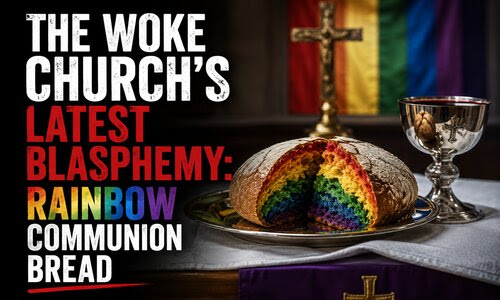
Imagine walking into church on Sunday morning. The pastor lifts the communion bread, and instead of the familiar loaf symbolizing Christ’s broken body, it has been dyed in the colors of the rainbow. Before a word is preached, one of Christianity’s most sacred ordinances has already become a cultural statement.
That wasn’t a hypothetical.
Christ Episcopal Church in Dayton recently used rainbow-colored communion bread during a Pride celebration, explaining that the colorful bread was intended to celebrate and include its LGBTQ members.
The reaction was swift. For many Christians, the issue wasn’t whether churches should welcome everyone—they should. The deeper question was whether the Lord’s Table should ever become a platform for promoting any cultural or political movement, regardless of the cause.
For nearly 2,000 years, Communion has occupied a unique place in Christian worship. On the night before His crucifixion, Jesus took ordinary bread, broke it, and gave it extraordinary meaning. “This is My body, which is given for you. Do this in remembrance of Me.”
From that moment forward, the bread pointed in only one direction—to the cross.
Its purpose has never been to celebrate our identity, affirm our causes, or reflect the values of the surrounding culture. It exists to proclaim the sacrifice of Jesus Christ until He comes again.
That is why this controversy reaches far beyond one church in Ohio.
Every generation faces pressure to reshape Christianity around the values of its age. Yet those changes rarely begin with someone openly rejecting Scripture. They usually begin much more subtly. A sacred symbol is reimagined. A long-held practice is given a new emphasis. A biblical truth is reframed to better fit contemporary expectations.
By the time doctrine changes, the symbols have often already paved the way.
Throughout Scripture, God repeatedly warned Israel against adapting His worship to mirror the surrounding culture. Again and again His people attempted to blend the worship of the true God with the customs, symbols, and priorities of neighboring nations. The result was never spiritual renewal—it was compromise.
The modern church faces a similar temptation.
The issue here is not food coloring.
The issue is what the rainbow represents.
For decades, the rainbow has unfortunately become the universally recognized symbol of the LGBTQ movement. Using that symbol on communion bread inevitably shifts the focus from Christ’s sacrifice toward a contemporary social cause. Whether intended or not, the symbolism changes the message.
Communion stops speaking exclusively about Christ and begins speaking about us.
That should concern Christians regardless of where they stand on countless political debates.
After all, if communion bread can be redesigned to celebrate Pride, what principle prevents another church from redesigning it to promote climate activism, immigration advocacy, nationalism, racial politics, or whichever cause dominates tomorrow’s headlines?
Once sacred symbols become vehicles for cultural messaging, every movement eventually wants a seat at the Lord’s Table.
History demonstrates just how seriously Christians have treated Communion. Entire councils, theological debates, and even martyrdoms centered on preserving the integrity of Christian worship.
They understood something our generation is in danger of forgetting: sacred things lose their meaning when we continually repurpose them to communicate something else.
Supporters of rainbow communion often argue that Jesus welcomed everyone.
That is absolutely true.
Jesus welcomed tax collectors, prostitutes, adulterers, thieves, religious hypocrites, and every other kind of sinner.
But He never confused welcome with affirmation.
His invitation was always accompanied by transformation.
To the woman caught in adultery He declared, “Neither do I condemn you; go, and from now on sin no more.”
Grace and truth walked together.
Unfortunately, many churches today seem increasingly willing to separate them.
Rather than calling people to surrender every area of life to Christ, some now reshape Christian teaching so people can keep those parts of life Scripture calls them to lay down. The result is a faith that becomes progressively less about dying to self and increasingly about affirming self.
Communion reminds us of exactly the opposite.
The cross confronts every one of us.
It confronts the proud, the greedy, the immoral, the dishonest, the self-righteous, and every sinner in between. No one approaches the Lord’s Table because they have been affirmed. We approach because we have been forgiven.
Every believer comes carrying sins that must be confessed, desires that must be surrendered, and a Savior they desperately need.
None of us comes to Communion to celebrate our identity.
We come to lay our identity at the feet of Christ.
That includes every Christian, regardless of which temptations they struggle with. The Gospel does not single out one category of sinners while excusing another. It calls every one of us to repentance because every one of us needs redemption.
This is why the larger trend unfolding across parts of the modern church deserves careful attention.
Churches rarely abandon biblical truth in one dramatic moment. More often they slowly redefine words, reshape symbols, soften uncomfortable teachings, and gradually adjust worship until Christianity begins reflecting the culture more than it reflects Christ.
The rainbow-colored communion bread in Dayton may seem like a small gesture. But symbols have always mattered in Christianity. That is precisely why Jesus chose bread and wine in the first place. They were never arbitrary. They pointed unmistakably to His broken body and His shed blood.
The Church has a sacred responsibility to preserve that message—not update it.
Christians are called to welcome every person who walks through the church doors. We are called to love our neighbors, extend grace, and proclaim the hope of the Gospel without partiality.
But loving people does not require rewriting the symbols Christ Himself established.
The bread should remind us of His broken body.
The cup should remind us of His shed blood.
And when believers leave the Lord’s Table, the image fixed in their hearts should never be the cause of the day, the politics of the moment, or the colors of a cultural movement.
It should be Calvary.
Because the Lord’s Table was never designed to point us toward ourselves.
It was always meant to point us to Christ.
The Robot Navy Has Arrived: America’s Sea Drone Strike Is Glimpse Of Future War

While headlines focused on the target of America’s recent strike against an Iranian port, military planners around the world were likely paying closer attention to something else entirely: the weapon that delivered it.
The United States didn’t simply attack a strategic facility. It publicly demonstrated that autonomous sea drones are no longer experimental concepts or futuristic prototypes. They have become operational weapons capable of striking valuable targets with precision while keeping human operators safely out of harm’s way.
If aerial drones transformed warfare over the past two decades, sea drones may be about to do the same for the world’s oceans.
The idea isn’t entirely new. Ukraine stunned military analysts by using inexpensive unmanned surface vessels to damage or destroy multiple Russian warships in the Black Sea. A nation with virtually no conventional navy forced one of the world’s largest fleets to retreat from its dominant position. The lesson was unmistakable: technological innovation can outweigh traditional military advantages.
Now the United States has signaled that it, too, is embracing this new era of naval warfare.
For generations, sea power has been measured by aircraft carriers, destroyers, submarines, and cruisers. Nations spent decades and trillions of dollars building fleets designed to project strength across the globe. Those ships remain formidable, but they now face a growing challenge from autonomous vessels that cost only a tiny fraction of the price.
The economics alone should command attention.
A billion-dollar warship may be forced to defend itself against a drone costing a few hundred thousand dollars—or less. Worse still, defenders may launch sophisticated interceptor missiles costing millions of dollars to destroy a target that is almost disposable by comparison.
That is not a sustainable equation.
Yet the greatest danger isn’t a single drone.
It’s a swarm.
Imagine not one autonomous boat approaching a naval base, but one hundred. Some travel on the surface. Others move beneath the water. Overhead, aerial drones provide surveillance while electronic warfare systems jam communications. Artificial intelligence helps coordinate the attack, adjusting routes in real time as defenses respond.
Even the most advanced naval defenses can become overwhelmed when forced to engage dozens or hundreds of simultaneous threats arriving from multiple directions.
This is where the conversation shifts from today’s headlines to tomorrow’s reality.
Military planners increasingly recognize that future wars will not be fought solely by soldiers, sailors, pilots, and Marines. They will also involve fleets of autonomous machines operating across land, sea, air, and under the ocean. Human operators will increasingly supervise battles rather than personally fight every engagement.
That reality changes political calculations as well. A nation can undertake riskier missions when it knows no crew members will become prisoners of war or casualties if an unmanned vessel is destroyed. The threshold for military action may become lower simply because the human cost appears smaller.
The implications stretch far beyond Iran.
Every major port in the world—from Norfolk and Pearl Harbor to Haifa, Singapore, and Yokosuka—must now consider how to defend against autonomous maritime threats. Commercial shipping lanes, energy terminals, bridges, offshore infrastructure, and naval bases all become potential targets in ways that were difficult to imagine only a decade ago.
History has repeatedly shown that the most devastating attacks often come from threats nations failed to take seriously.
Before December 7, 1941, many believed America’s geographic isolation and powerful fleet provided sufficient protection. Pearl Harbor shattered that illusion.
Before September 11, 2001, few imagined commercial airliners becoming strategic weapons capable of changing history.
Today another military revolution is quietly unfolding.
The danger is not simply that sea drones exist. The danger is assuming they will remain a niche capability confined to today’s regional conflicts. History suggests otherwise. Once a military innovation proves effective, others quickly copy it, refine it, and deploy it on a larger scale.
A future “Pearl Harbor 2.0” may not begin with bombers appearing over the horizon. It could begin with hundreds of autonomous vessels—some above the water, others below—moving silently toward ports, fuel depots, naval bases, bridges, and critical infrastructure before anyone fully recognizes what is happening.
That is no longer the stuff of science fiction. It is a capability being developed in real time.
The lesson of Pearl Harbor was never simply that America needed a bigger navy. It was that nations must recognize new forms of warfare before an adversary exploits them. Those who prepare only for yesterday’s battles often pay a terrible price tomorrow.
For Christians, these developments are another reminder that the world continues to move toward an era of rapidly accelerating technology, where innovation can be used for both tremendous good and profound destruction. Scripture reminds us that wars and rumors of wars will continue, but it also calls believers to be discerning about the times in which they live.
Ignoring revolutionary technologies because they seem novel or unlikely has never been a winning strategy. The nations that adapt will shape the future. Those that fail to recognize the changing character of warfare may discover—too late—that history has a way of repeating itself in forms no one expected.

TruLight TV : The Power Of Revival
Whether you’re married or not, you’ve probably heard all the mixed opinions about marriage, especially from the secular world. So, be reminded through this video who the Creator of marriage is and what His instructions are in order to have a joyful, Christ-centered marriage. and later on the Enjoying Life show with Dr. Jerry and Lil’ Jan Goff, Today’s guest artist (Charlie Sexton and Linda Foster; Selena Mangrum) – known as the group Charlie Sexton and Homecoming Of Atlanta, GA features 4 friends who individually have their own, separate avenues of ministry, but come together from time to time to sing at Revival Services, Concerts, and Sunday Night Singings. Enjoy today’s show and Listen to some great music. Thanks For watching.
Today on TruLight Radio XM
TruLight Radio XM 24/7
Program
GMT / UTC +2
Monday To Fridays
00:15 Words to Live By Testimonies
01.15 Science Scripture and Salvation
02.15 Ground Works
04.00 Gospel Concert of the Day
05.00 The Daren Streblow Comedy Show
5:55 It is Today devotional
6:00 Gaither Homecoming Morning Show
7:15 Discover the Word
8.15 Destined for Victory
8:55 Science Scripture and Salvation
9:00 Holy Spirit Hour – Normally Sermons
10:15 Hope of the Heart
11:15 Unshackled
11.45 Words to Live By
12:15 Truth for Life
13:15 Living on the Edge with Chip Ingram
14:15 Focus on the Family
15:00 Kids Hour
16:00 In Touch with Dr. Charles Stanley
16:30 Groundwork
17:15 Live in the Light
18:15 Renewing your Mind
19:00 Gaither Homecoming Show
20:15 Growing Hope
21:15 Adventures in Odyssey Radio Drama
21:45 Bible Reading
22:15 Night-sounds
23.00 Good Old Country Gospel / Rhema Gospel Express
VISIT THE WEBSITE
TruLight Ministry News – EXTRA MANNA
TruLight Ministries orders from God since 2012 . Teach Them , Comfort Them and Warn Them!
NEW RELEASE
THE LONG AWAITED : EPISODE 15 OF “THE SHERIFF OF THE CHURCH – I TELL YOU TRU “ The Doctrine of Demons called the Hebrew Sacred Names Cult
Healing Truths.
End Time Articles.
Bonus Manna = Bonus Teaching for the Child of God !!
How many of us, as children, were admonished with the self-evident truth that “life’s not fair”? It’s a hard lesson, but it’s one we all learned, usually before we got out of kindergarten. As adults, we are surrounded by evidence that life is not fair: in our ten- to twenty-year-old cars, we drive past multi-million-dollar homes with pristine lawns and ridiculously expensive sports cars parked in the driveway. We see people throwing money around as if it were confetti, while we struggle to pay the doctor bills and keep food on the table. We see those who flaunt the law yet get off scot-free, and we see others who are innocent yet are punished unjustly. Centuries ago, King Solomon noticed that life is not fair: “I have seen something else under the sun: The race is not to the swift or the battle to the strong, nor does food come to the wise or wealth to the brilliant or favor to the learned; but time and chance happen to them all” (Ecclesiastes 9:11). No, life “under the sun” is not fair, leading many to ask, “Why not?”
Before we give some reasons why life is not fair, we should probably define the term fair, because much hinges on that word. Some people define fair as “equal in every way.” But this is not an accurate picture of fairness; we cannot equate “fairness” with “sameness” or “congruency.” Some people have curly hair, which is not “fair” to straight-haired people who wish for curls. Some people possess a natural ability for athletics, which is not “fair” to those with poor muscle coordination or a congenital heart condition. Some people have inherited money through a family business, which is not “fair” to those whose parents were not entrepreneurs. In each of these cases, fairness is not truly the issue. God, who is eminently fair, gives different gifts to everyone: “Shall what is formed say to the one who formed it, ‘Why did you make me like this?’” (Romans 9:20). Our responsibility is to use the gifts God has given and “be content with what [we] have” (Hebrews 13:5).
Fairness, properly defined, is “freedom from bias, dishonesty, or injustice.” To be fair is to be just; that is, to be “guided by truth, reason, and justice.” Whatever our outward circumstances, we can always choose to treat others fairly and thus make life a little more fair for those around us.
The basic reason that life is not fair—that is, life is not guided by truth, reason, and justice—is that we live in a sinful world occupied by sinful people. When people are selfish, impatient, or greedy, then they tend to act in ways that secure an advantage for themselves, with no thought of others. As a result, people are treated unfairly. Jesus told the story about the unjust judge. This judge “neither feared God nor cared what people thought” (Luke 18:2). His rulings were not based on justice or anyone’s best interest except his own. He was a wicked judge, and Jesus called him “unjust” (verse 6). When unfair people are in positions of power, then life is unfair for the multitudes.
God is just, and He always acts in accordance with what is right (Deuteronomy 32:4; Revelation 15:3; 16:7). God has commanded that His people also act fairly (Leviticus 19:36; Deuteronomy 25:15; Proverbs 21:3; Isaiah 56:1), but people do not always obey God’s commands. He gives them the freedom to disobey, if that is their choice. Those who rebel against God do not seek justice, and that is one reason why life is not fair.
The psalmist Asaph dealt with the injustice of life when he began to envy the “prosperity” of the proud and wicked (Psalm 73:3). He goes on to describe how the wicked seem to be unfairly favored:
“They have no struggles;
their bodies are healthy and strong.
They are free from common human burdens;
they are not plagued by human ills.
Therefore pride is their necklace;
they clothe themselves with violence.
From their callous hearts comes iniquity;
their evil imaginations have no limits.
They scoff, and speak with malice;
with arrogance they threaten oppression. . . .
Always free of care, they go on amassing wealth” (Psalm 73:4–12).
When Asaph considered his own commitment to righteousness, he noticed a singular lack of reward, and he began to despair that life could ever be fair:
“Surely in vain I have kept my heart pure
and have washed my hands in innocence.
All day long I have been afflicted,
and every morning brings new punishments. . . .
When I tried to understand all this,
it troubled me deeply. . . .
My heart was grieved
and my spirit embittered” (Psalm 73:13–14, 16, 21).
“Life is not fair,” admitted Asaph, and the fact bothered him. How could it be that treacherous, evil scoundrels can prosper with all sorts of material blessings, while the godly suffer? Good question, especially if God is in charge. But then Asaph had a change of perspective when he “entered the sanctuary of God” (Psalm 73:17). With his eyes on the Sovereign Lord, Asaph could look beyond this temporal world to grasp an eternal view:
“Then I understood their final destiny.
Surely you place them on slippery ground;
you cast them down to ruin.
How suddenly are they destroyed,
completely swept away by terrors!” (Psalm 73:17–19).
Asaph’s conclusion was that the prosperity of the wicked, unfair as it is, is only temporary; the judgment of the wicked will be eternal. On the other hand, the suffering of the righteous, also unfair, is only temporary; the reward of the righteous will also be eternal (cf. 2 Corinthians 4:17).
A desire for life to be fair is a good thing. God is fair, and He “does not show favoritism” (Acts 10:34), so our yearning for fairness is a yearning for one of God’s attributes. A love of justice and an effort to establish a more fair experience for everyone is also good: “What does the LORD require of you? To act justly and to love mercy and to walk humbly with your God” (Micah 6:8). A balanced view of life necessitates an acknowledgement that life is not fair, at least in this world, along with a commitment to do what’s right and a firm reliance upon God, who will one day make all things right (Isaiah 40:4).
Share this Feeding of Manna with your Friends and Family. just click on the Social Media icon and share !