Hosted by TruLight Ministries – The Place of Truth
SELECT YOUR READING LANGUAGE – BOTTOM LEFT = YOUR DAILY MANNA NOW AVAILABLE IN 103 LANGUAGES
@ TruLight – Daily Manna is not Just a Bible Verse with a Small Prayer . No WE SERVE DAILY Manna for the Whole Day . Breakfast , Lunch , Dinner , Plus tea Times and even Entertainment Manna . Plus News Manna and More , This Daily Manna will keep you Spiritually full for the full 48 Hours and even More to Share with your Friends and Family !!!
Pray , Because God STILL answers Prayer !!!
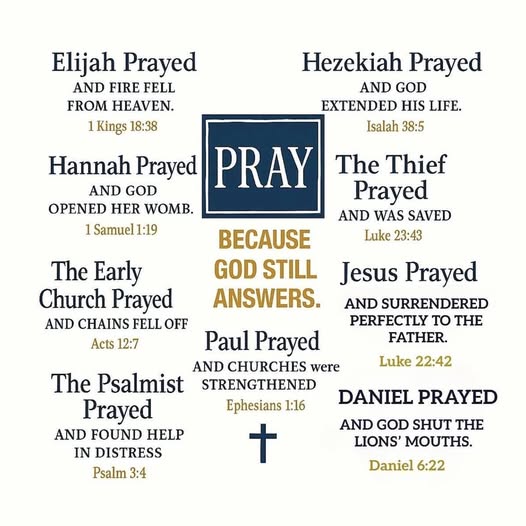
Does God answer prayers?
The short answer to this question is, “Yes!” God has promised that, when we ask for things that are in accordance with His will for our lives, He will give us what we ask for (1 John 5:14–15). However, there is one caveat to add to this: we may not always like the answer.
We pray for a lot of things—some good, some bad, some really pointless. But God listens to all of our prayers, regardless of what we ask (Matthew 7:7). He does not ignore His children (Luke 18:1–8). When we talk to Him, He has promised to listen and respond (Matthew 6:6; Romans 8:26–27). His answer may be some variation of “yes” or “no” or “wait, not now.”
Keep in mind that prayer is not our way of getting God to do what we want. Our prayers should be focused on things that honor and glorify God and reflect what the Bible clearly reveals God’s will to be (Luke 11:2). If we pray for something that dishonors God or is not His will for us, He is unlikely to give what we ask for. God’s wisdom far exceeds our own, and we must trust that His answers to our prayers are the best possible solutions.
Does God answer prayers? – When God says “yes.”
In the first two chapters of 1 Samuel, Hannah prays and asks God to give her a baby. She had been unable to conceive which, in biblical times, was considered a mark of shame for a woman. Hannah prayed fervently—so fervently that a priest who saw her praying thought she was drunk. But God heard Hannah, and He allowed her to give birth to a child.
Jesus said, “Whatever you ask in my name, this I will do, that the Father may be glorified in the Son” (John 14:13). If you have prayed specifically for something and God has granted it to you, then you can be assured that it is His will. Nothing happens without God allowing it to happen (Romans 8:28).
Does God answer prayers? – When God says “no.”
In John 11, Mary and Martha wanted Jesus to heal their dying brother, yet Jesus allowed Lazarus to die. Why did He say “no” to these grieving women who loved Him so much? Because He had greater things planned for Lazarus, things that no one could possibly have imagined.
“No” is one of the hardest answers we can receive. But, once again, it is important to remember that God is all-knowing and is aware of the entire timeline of history. He knows every possible outcome of every possible choice in every possible situation; we do not. He sees the “big picture”; we see a partial brushstroke. Proverbs 3:5 says to “trust in the LORD with all your heart, and do not lean on your own understanding.” When we get a “no” answer, we must trust that whatever we asked for was not God’s will.
Does God answer prayers? – When God says “wait, not now.”
Sometimes hearing “wait” is even harder than hearing “no” because it means we have to be patient (Romans 8:25). While waiting is difficult, we can be thankful God is in control and trust that His timing will be perfect (Romans 12:12; Psalm 37:7—9).
God wants the best for your life. He does not want you to suffer needlessly. Jeremiah 29:11 says, “For I know the plans I have for you, declares the Lord, plans for welfare and not for evil, to give you a future and a hope.” Be patient and know that He is your loving Father (Psalm 46:10).
Abide by Philippians 4:6 as you make your requests to God: “Do not be anxious about anything, but in everything by prayer and supplication with thanksgiving let your requests be made known to God.” Then, when God responds, be prepared to accept His wisdom—whether or not you agree with His answer.

Tea Time Manna
A gentle answer turns away wrath, but a harsh word stirs up anger.
—Proverbs 15:1
Why is it so hard to endure unjust and unfair criticism? Why do we feel that we have to defend ourselves regardless of how ridiculous or unfair the accusations against us are? Why do we have to have the last word in any argument, or look to get even if we don’t?
Often, the problems we have with others in an argument escalate because we do not choose “a gentle answer.”
So, why do we not choose “a gentle answer”? These are the excuses I hear from others, and sometimes I make them myself:
“I don’t want to appear to be weak!”
“I don’t like to lose at anything!”
“I don’t want that person to have the last word!”
“I resent the unfair things, the demeaning things, that person called me!”
When I look at these excuses — some of them are my excuses — the same pronoun appears again and again: the pronoun, “I.” And what is in the middle of all sin? A great big ol’ “I,” always — sIn! We lose sight of saying what is in “the interests of others” (Philippians 2:3-4) and poison our influence on others because of our selfish, “I”-infected speech. In place of the “I” problem, let’s focus on saying “only what is helpful for building others up according to their needs, that it may benefit those who listen” (Ephesians 4:29). To do that means that we use “a gentle answer”!
Prayer
Precious and Holy God, please help me more carefully guard my speech from things you despise, especially gossip, slander, rage, malice, and meanness. I know that those ways of speaking and treating my brothers and sisters grieve the Holy Spirit (Ephesians 4:30). I open my heart and close my mouth, inviting the Holy Spirit to produce the holy fruit of the Spirit in me. May this fruit be evident in me, especially when I speak and give “a gentle answer.” Thank you. In Jesus name and by Jesus’ grace, I pray. Amen and Amen

Bible Teaching of the Day
LUNCH MANNA =
Countless stories could be cited of diseases cured, exams passed, repentance and forgiveness granted, relationships restored, hungry children fed, bills paid and lives and souls saved through the efficacy of prayer. So, yes, there is plenty of evidence that God answers prayer. Most of the evidence is anecdotal and personal, however, and that bothers many who think of “evidence” only as that which is observable, measurable, and reproducible.
Scripture clearly teaches that prayers are answered. Sometimes the answer is “no”; sometimes the answer is “wait a while”; sometimes the answer is “yes,” as seen in James 5:16: “The prayer of a righteous person is powerful and effective.” Jesus taught His disciples that “if you remain in me and my words remain in you, ask whatever you wish, and it will be done for you” (John 15:7). First John 3:22 echoes this truth, saying that we “receive from him anything we ask, because we keep his commands and do what pleases him.”
Scripture, moreover, is replete with stories of answered prayer. Elijah’s prayer for fire from heaven (2 Kings 1:12), Hezekiah’s prayer for deliverance (2 Kings 19:19), and the apostles’ prayer for boldness (Acts 4:29) are just three examples. Since these accounts were written by eyewitnesses to the events, they constitute clear evidence of answered prayer. One might, of course, counter that Scripture does not present observable evidence in the “scientific” sense. However, no statement of Scripture has ever been conclusively disproved, so there is no reason to doubt its testimony. In fact, labeling some kinds of evidence as “scientific” and other kinds as “non-scientific” is a fuzzy and artificial distinction at best. Such a distinction can only be made a priori, i.e., prior to the evaluation of the data. In other words, the choice to evaluate the efficacy of prayer only in light of observable evidence is not a choice motivated by the data but by prior philosophical commitments. When this arbitrary restriction is relaxed, the biblical data speaks clearly for itself.
Occasionally, a group of researchers will conduct a scientific study on the efficacy of prayer. Their findings are usually that prayer has no effect (or possibly even a negative effect) on, for instance, the average recovery time of people in medical care. How are we to understand the results of studies such as these? Are there any biblical reasons for unanswered prayer?
Psalm 66:18 says, “If I regard wickedness in my heart, the Lord will not hear” (NASB). Likewise, 1 John 5:15 qualifies our receiving “anything we ask” with our obedience to God’s commands. James notes that “when you ask, you do not receive, because you ask with wrong motives” (4:3). So, a couple reasons for unanswered prayer are unconfessed sin and wrong motivations.
Another reason for unanswered prayer is lack of faith: “When you ask, you must believe and not doubt, because the one who doubts is like a wave of the sea, blown and tossed by the wind. That person should not expect to receive anything from the Lord” (James 1:6-7). Hebrews 11:6 also identifies faith as a necessary condition for a relationship with God, something always mediated by prayer in the name of Christ: “And without faith it is impossible to please God, because anyone who comes to him must believe that he exists and that he rewards those who earnestly seek him.” Faith, then, is necessary for answered prayer.
Finally, some critics of Christianity make the case that, since Jesus instructs His disciples to “ask whatever you wish,” all prayers should be answered. However, such criticisms completely ignore the conditions to the promise in the first part of the verse: “If you remain in me and my words remain in you.” This is clearly a prescription for praying within the will of God; in other words, genuine prayer which God always answers is, in fact, that sort which requests, explicitly or implicitly, that God’s will be accomplished. The will of the petitioner is secondary. Jesus Himself prayed this way in Gethsemane (Luke 22:42). The humble prayer of faith allows that the prayer may be answered with a “no”; anyone not offering such a prayer—anyone who demands to be answered—has no right to expect an answer.
Another reason why so many studies report the inefficacy of prayer is that it is impossible to eliminate the variables associated with the spiritual condition of those praying (is the petitioner even a believer?), the motivation for which they offer the prayer (is it to provide evidence or because the Holy Spirit has moved them to pray?), the way in which they offer their prayer (are they praying a formulaic expression or intentionally bringing requests to God?), and so on.
Even if all such lurking variables could be eliminated, one overarching problem would remain: if prayer could be tested empirically and forced to yield conclusive results, it would obviate the need for faith. We cannot “discover” God through empirical observations; we come to Him by faith. God is not so clumsy that He should reveal Himself in ways He did not intend. “He who comes to God must believe that He is” (that is, that He exists). Faith is the prerequisite and the priority.
Does God answer prayer? Ask any believer, and you will know the answer. Every changed life of every believer is proof positive that God answers prayer.
Today’s Devotional
DINNER MANNA =
Several times recently I have been reminded that God’s ways are not our ways (Isaiah 55:8). God’s ways and thoughts are indeed higher than ours (Isaiah 55:9). While I have ultimately surrendered to God and recognize that He is not obligated to explain His ways to me, I still often wonder why He so often works in mysterious ways. Why did He do that way? Why did He use method to accomplish this?
I do not question His judgment. I do not doubt His wisdom. I absolutely do not think I could fully understand His ways even if He explained them to me. But, I sometimes still wonder why He accomplished something a certain way.
Why did He use a bunch of misunderstandings, personality conflicts, and bad attitudes to close a door, leading to a different door, which was the right door all along? Why not just divert us from the first door to begin with? Why not move us away from the wrong door earlier in the process? Why not convince us that it was the wrong door without us having to slam the door shut due to our own sinful attitudes and choices?
Why does God sometimes use a conflict over the color of carpet in a church building to split a church, creating a new growing and thriving church in a different area, instead of simply motivating some people in the church to go plant a new church?
Why did God allow Paul and Barnabas to split, apparently in anger, over a disagreement, instead of simply causing them to recognize that their outreach could be multiplied if they went separate directions (Acts 15:36-41)?
Why does God answer with “wait” to a continual prayer request over 20+ years of time and then grant the prayer request once the person isn’t even 100% certain he/she wants it anymore?
Why does God seem to provide a great solution to a difficult situation, with everyone agreeing that it is the perfect solution, only to later unravel the solution to everyone’s dismay?
Why does God sometimes work in mysterious ways?
As I said earlier, the answer, ultimately, is “I don’t know.” Learning to trust God when you don’t understand why He allowed something or why He chose a particular means to accomplish something is a key spiritual growth issue in the Christian life. Are you, like Job, able to praise the Lord whether He gives or takes away (Job 1:21)?
“Hindsight is 20/20” is not a biblical saying, but it is very true. There are many things God has done that I used to wonder about, that I now understand, or at least think I understand. There are numerous other things, though, that I definitely still do not understand and cannot imagine how the mysterious way in which God worked was the best way.
Yes, of course, God works all things together for good (Romans 8:28). Yes, absolutely, God uses the mysterious things that happen in our lives to mold us into the image of Christ and transform/renew our minds (Romans 12:1-2). But I still wonder why, when it was within His power to do so, God didn’t accomplish the same thing without using a plan that resulted in physical, emotional, and spiritual scars that won’t be fully healed this side of eternity.
Whether I ever receive the answers, whether such things ever make sense to me, I will continue to trust God and His Word. Why? If you think God’s ways are mysterious, just imagine what things would be like if I was in charge!

NEWS MANNA –
Bible Prophecy, Signs of the Times and Gog and Magog Updates with Articles in the News
From Scouts to Swarms: The evolution of five generations of Israeli drones
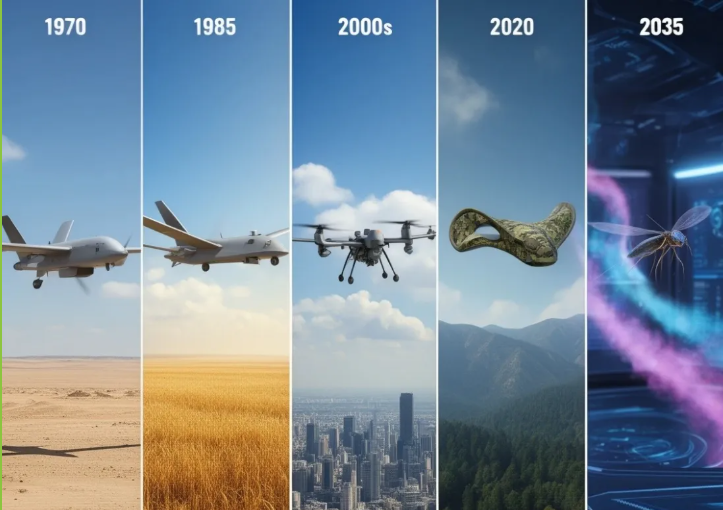
First‑generation Israeli drones emerged in the 1970s with the IAI Scout (1979) and Tadiran Mastiff (1973), simple reconnaissance platforms with analog cameras, line‑of‑sight control, and flight endurance of only 2–3 hours.
Israel’s drone industry is one of the most advanced in the world, with platforms exported to more than 50 countries and developed by companies such as Israel Aerospace Industries (IAI), Elbit Systems, and Rafael.
The evolution from first‑generation UAVs of the 1970s to today’s fifth‑generation autonomous systems reflects a rapid technological leap unmatched in most defense sectors.
First‑generation Israeli drones emerged in the 1970s with the IAI Scout (1979) and Tadiran Mastiff (1973), simple reconnaissance platforms with analog cameras, line‑of‑sight control, and flight endurance of only 2–3 hours.
These early UAVs proved decisive during the 1982 Lebanon War, where real‑time imagery helped neutralize Syrian SAM batteries.
Second‑generation drones appeared in the 1990s with systems like the IAI Searcher (1992) and Elbit Hermes 450 (1998), offering digital sensors, GPS navigation, and endurance of 12–20 hours, enabling persistent surveillance over Lebanon and Gaza.
Third‑generation UAVs arrived in the early 2000s with the IAI Heron (2005) and Heron TP/Eitan (2007), featuring satellite communications, all‑weather capability, and payloads exceeding 1,000 kg, allowing strategic missions including maritime patrol and long‑range intelligence collection.
Fourth‑generation drones expanded into multi‑mission roles with platforms such as the Elbit Hermes 900 (2012) and IAI Harop loitering munition (2009), integrating synthetic‑aperture radar, autonomous target recognition, and strike capability, used extensively in Operations Protective Edge (2014) and Breaking Dawn (2022).
Fifth‑generation Israeli drones, emerging after 2020, include the IAI Ghost, Elbit Skylark 3 Hybrid, and Rafael FireFly, emphasizing AI‑driven autonomy, swarming behavior, vertical‑takeoff capability, and man‑portable precision strike.
These systems use onboard machine learning to classify targets, avoid obstacles, and operate in GPS‑denied environments, reflecting a shift from remote‑controlled aircraft to semi‑independent robotic teammates.
Future sixth‑generation Israeli drones are expected to integrate full autonomous swarms, quantum‑resistant communications, and cooperative engagement with armored vehicles and fighter jets, while seventh‑generation concepts may include bio‑inspired micro‑UAVs, laser‑powered endurance systems, and fully distributed sensor‑strike networks.
The pace of change is accelerating: Israeli UAV capability has doubled roughly every five to seven years, driven by battlefield demand, export competition, and rapid advances in AI, propulsion, and miniaturized sensors.
From the analog Scout to AI‑enabled swarms, Israel’s drone evolution demonstrates how technological adaptation has become central to national defense and global UAV leadership.
IS THIS NOT WHAT THE BIBLE SAID WILL HAPPEN ?
Rev 9:4 And it was commanded them that they should not hurt the grass of the earth, neither any green thing, neither any tree; but only those men which have not the seal of God in their foreheads.
5 And to them it was given that they should not kill them, but that they should be tormented five months: and their torment was as the torment of a scorpion, when he striketh a man.
6 And in those days shall men seek death, and shall not find it; and shall desire to die, and death shall flee from them.
7 And the shapes of the locusts were like unto horses prepared unto battle; and on their heads were as it were crowns like gold, and their faces were as the faces of men.
8 And they had hair as the hair of women, and their teeth were as the teeth of lions.
9 And they had breastplates, as it were breastplates of iron; and the sound of their wings was as the sound of chariots of many horses running to battle.
10 And they had tails like unto scorpions, and there were stings in their tails: and their power was to hurt men five months.
11 And they had a king over them, which is the angel of the bottomless pit, whose name in the Hebrew tongue is Abaddon, but in the Greek tongue hath his name Apollyon.
12 One woe is past; and, behold, there come two woes more hereafter.
The Robot Soldier Is No Longer Science Fiction

For decades, the idea of humanoid robots fighting wars belonged to the realm of science fiction. Hollywood filled our screens with mechanical armies, autonomous killing machines, and futuristic battlefields where humans struggled to maintain control over the technologies they had created. Movies such as The Terminator, Robocop, and The Matrix were entertaining precisely because they seemed so distant from reality.
That distance is shrinking faster than most people realize.
According to a report from Popular Mechanics, humanoid robots are now moving from research laboratories and industrial warehouses onto actual battlefields. What once seemed like fantasy is rapidly becoming military doctrine.
The implications are enormous.
Ukraine’s 2024 all-robot assault may one day be remembered as a historic turning point. The operation involved wheeled and tracked robotic systems equipped with machine guns and explosives conducting combat missions without direct human participation on the battlefield. While the technology had limitations, it demonstrated something revolutionary: warfare was beginning to separate the soldier from the fight itself.
Now attention is shifting toward humanoid robots capable of moving through environments traditionally reserved for human infantry.
The Phantom MK1, developed by Foundation, stands nearly six feet tall and weighs 176 pounds. Unlike traditional ground robots that struggle with stairs, doorways, debris, and urban obstacles, humanoid designs can navigate environments built for human beings. They can enter buildings, climb stairwells, move through rubble, and potentially perform many of the same tasks currently assigned to soldiers.
Military planners are paying close attention.
The U.S. Army is reportedly evaluating these systems for breaching operations–among the most dangerous assignments in warfare. Minefields, fortified positions, tunnels, and kill zones often produce horrific casualties. A robot that can carry explosives, clear obstacles, absorb enemy fire, and open pathways for advancing troops offers an obvious military advantage.
From a purely tactical standpoint, the logic is difficult to ignore.
Why send a soldier when a machine can do the job?
That question is likely to drive military spending for decades to come.
But today’s battlefield robots are only the beginning.
Around the world, nations are already investing heavily in artificial intelligence, autonomous drones, robotic vehicles, machine learning, computer vision systems, and battlefield networking technologies. The United States, China, Russia, Israel, and several European powers are racing to gain an advantage in what many experts view as the next great military revolution.
The battlefield of the future may look radically different from today’s wars.
Imagine swarms of thousands of drones coordinating attacks simultaneously. Picture robotic infantry advancing without fear, fatigue, hunger, or morale problems. Consider autonomous logistics systems delivering ammunition and supplies without drivers. Envision robotic medics evacuating wounded soldiers while AI systems identify targets faster than any human commander could.
Much of this technology already exists in primitive form.
The question is no longer whether it can be developed.
The question is how quickly it will mature.
What makes humanoid robots particularly significant is that they represent a bridge between machines and traditional soldiers. Drones dominate the skies, but humanoid robots could eventually dominate the ground. They are designed to operate in human environments because our cities, buildings, tunnels, roads, and infrastructure were built for human bodies.
A robot that can run, climb, jump, open doors, carry equipment, and use tools has enormous military potential.
Future versions may be stronger than humans.
They may be faster.
They may possess perfect night vision.
They may communicate instantly with every other robotic unit on the battlefield.
They may never experience fear.
They may never need sleep.
And unlike human soldiers, they can be mass-produced.
This is where the conversation becomes more unsettling.
Military experts today emphasize that these robots remain under human control. Human operators make the decisions. Human commanders authorize the missions. Human beings remain responsible for lethal force.
For now.
History suggests that military technologies rarely remain static.
The same arguments once used for remotely piloted drones are now being used for autonomous systems. Advocates point to efficiency, reduced casualties, faster decision-making, and operational advantages.
But as artificial intelligence continues to advance, pressure will inevitably grow to give robots increasing levels of autonomy.
After all, if an AI system can identify threats faster than a human operator, military planners will ask why they should slow the process down.
If autonomous systems outperform human-controlled systems in combat, competitors will feel compelled to follow.
This creates a dangerous technological arms race.
What begins as human-controlled robots could gradually evolve into increasingly independent battlefield systems making life-and-death decisions at machine speed.
That possibility has prompted warnings from scientists, ethicists, military leaders, and technology experts alike.
The images from science fiction may not be as unrealistic as they once seemed.
No, tomorrow’s battlefields are unlikely to feature time-traveling cyborg assassins. But armies of AI-enabled robotic soldiers working alongside human forces are becoming increasingly plausible with each passing year.
The technological pieces are falling into place.
Artificial intelligence continues advancing at breathtaking speed. Robotics improves every year. Sensors become smaller and more capable. Batteries last longer. Computer processing grows more powerful. Military budgets continue pouring billions into these technologies.
The trajectory is unmistakable.
The broader lesson extends beyond warfare.
Humanity is entering an age in which machines increasingly perform tasks once considered uniquely human. The battlefield may simply be one of the first places where that transformation becomes visible.
The challenge facing future generations may not be whether humanity can build robotic soldiers.
It may be whether humanity possesses the wisdom to control them.
As artificial intelligence and robotics continue their rapid advance, one thing is becoming clear: the line between science fiction and reality is disappearing. What seemed impossible twenty years ago is being tested today. What seems futuristic now may become commonplace tomorrow.
And the robot soldiers once confined to movie screens may soon be marching onto battlefields around the world.
Finland: Singing About God At School Is Now ‘Discrimination’
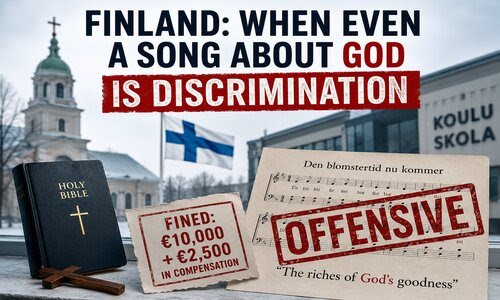
How far can a nation go in protecting people from being offended before it starts criminalizing its own heritage?
That question is becoming increasingly difficult to avoid in Finland, where authorities appear determined to ensure that Christian beliefs remain safely locked away from public view–lest someone hear them, disagree with them, or worse yet, be offended by them.
The warning signs have been flashing for years.
Many Christians around the world first became aware of Finland’s growing hostility toward biblical speech through the case of Päivi Räsänen, a grandmother, medical doctor, former Interior Minister, and long-serving member of parliament.
Her offense?
Quoting the Bible.
Räsänen found herself dragged through years of investigations, interrogations, court hearings, and legal battles because she publicly defended the historic Christian understanding of marriage and sexuality. Among the evidence cited against her were social media posts quoting Scripture, radio comments discussing Christian doctrine, and a pamphlet explaining biblical teaching.
Think about that for a moment.
A politician in a Western democracy was investigated and ultimately convicted because she expressed beliefs that Christians have held for nearly 2,000 years.
The message could not have been clearer: certain opinions are still allowed in Finland–as long as they align with the approved cultural narrative.
But if you thought the Räsänen case was an isolated incident, Finland’s latest controversy suggests otherwise.
The new target is not a politician.
It is not a pastor.
It is not even a church.
It is a school song.
Yes, really.
The Finnish Discrimination and Equality Board has fined the city of Espoo €10,000 and ordered it to pay an additional €2,500 in compensation to a student who was allegedly discriminated against after being exposed to Christian-themed songs during school celebrations.
The songs in question were not fiery sermons.
They were not evangelistic altar calls.
They were traditional songs sung by generations of Finnish schoolchildren.
One included the apparently offensive lyric: “God shall reward him who is a friend of the poor.”
Another referenced “the riches of God’s goodness” while celebrating the beauty of spring.
That’s it.
No threats.
No condemnation.
No political activism.
No coercion.
Just gratitude to God and encouragement to care for the poor.
Yet somehow this became a discrimination case worthy of government intervention.
The student claimed that hearing such songs over a six-year period violated his religious beliefs. The board agreed.
One cannot help but wonder what exactly those beliefs were.
The ruling never explains why hearing that God rewards kindness toward the poor was so harmful. Neither did authorities explain how thanking God for nature’s beauty constituted discrimination.
Apparently, merely hearing such ideas was enough.
And that is where this story moves from absurd to deeply troubling.
Because this is no longer about protecting freedom of religion.
It is about protecting freedom from religion.
There is a profound difference.
A free society allows people to believe–or reject–whatever they choose. It protects both the Christian who sings a hymn and the atheist who declines to join in.
But modern secularism increasingly demands something else entirely. It insists that religious ideas must disappear from public spaces altogether.
The goal is no longer coexistence.
The goal is sterilization.
Christian references must be removed. Historic traditions must be rewritten. Public ceremonies must be stripped clean of anything that reminds people of the faith that shaped the civilization around them.
Ironically, this campaign is being carried out in a country whose national identity was profoundly shaped by Christianity.
Finland’s churches, holidays, literature, customs, architecture, and moral foundations all emerged from centuries of Christian influence.
Trying to remove God from Finnish culture is a little like trying to remove the sea from Finland’s coastline.
At some point, you are no longer preserving neutrality.
You are erasing history.
What makes this trend especially alarming is that it never seems to end where it begins.
First it was pastors.
Then politicians.
Now school songs.
Tomorrow?
Will Christian artwork become offensive?
Will Bible verses in historical monuments be considered discriminatory?
Will Christmas programs need government approval to ensure nobody hears an unauthorized reference to God?
These questions sound ridiculous–until one remembers that many people would have considered the current case ridiculous just a few years ago.
The deeper issue is that Western societies are increasingly treating Christianity as uniquely dangerous. A faith that built hospitals, universities, charities, orphanages, and countless institutions of compassion is now viewed with suspicion whenever it appears outside church walls.
Meanwhile, the student at the center of this case has been awarded compensation because he heard a song mentioning God’s goodness.
Previous generations endured wars, economic collapses, and genuine persecution.
This generation receives financial compensation because someone sang about God rewarding kindness to the poor.
That contrast says far more about the state of modern Western culture than it does about Christianity.
The tragedy is that Finland once stood as a nation where faith and freedom coexisted. Today, it increasingly appears to be a place where faith must remain silent if freedom is to be preserved.
And when a society reaches the point where a school song becomes a human-rights violation, it may be worth asking whether the problem is Christianity–or whether the culture has simply forgotten how to tolerate beliefs it no longer shares.
TruLight Ministries Daily Entertainment Manna

TruLight TV – I Stopped Chasing Human Approval and This Happened
Today’s guest on Babbie’s House, Christian recording artist and music evangelist, BJ Pons, has been singing gospel music since she was five years old. She is a dynamic singer and speaker who has the ability to reach audiences with her powerful testimony and music. Dr. Charles Stanley shares why God’s love and approval are so much more satisfying as seeking the approval of others and later a Testimony from Nate, Nate and Rose were married as 18 year olds, but Nate’s involvement with drugs, alcohol, and crime turned them against each other. When he was sentenced to prison, Rose didn’t care. But God became real to them, and He reunited their hearts and lives through what seemed like impossible circumstances.
Today on TruLight Radio XM
TruLight Radio XM 24/7
Program
GMT / UTC +2
Monday To Fridays
00:15 Words to Live By Testimonies
01.15 Science Scripture and Salvation
02.15 Ground Works
04.00 Gospel Concert of the Day
05.00 The Daren Streblow Comedy Show
5:55 It is Today devotional
6:00 Gaither Homecoming Morning Show
7:15 Discover the Word
8.15 Destined for Victory
8:55 Science Scripture and Salvation
9:00 Holy Spirit Hour – Normally Sermons
10:15 Hope of the Heart
11:15 Unshackled
11.45 Words to Live By
12:15 Truth for Life
13:15 Living on the Edge with Chip Ingram
14:15 Focus on the Family
15:00 Kids Hour
16:00 In Touch with Dr. Charles Stanley
16:30 Groundwork
17:15 Live in the Light
18:15 Renewing your Mind
19:00 Gaither Homecoming Show
20:15 Growing Hope
21:15 Adventures in Odyssey Radio Drama
21:45 Bible Reading
22:15 Night-sounds
23.00 Good Old Country Gospel / Rhema Gospel Express
VISIT THE WEBSITE
TruLight Ministry News – EXTRA MANNA
TruLight Ministries orders from God since 2012 . Teach Them , Comfort Them and Warn Them!
FREE PRAYER EBOOK . GRATIS GEBEDS EBOEK
Healing Truths.
End Time Articles.
Bonus Manna = Bonus Teaching for the Child of God !!
But how are we to respond when He says “no”?
We love the truth that God answers prayer (1 John 5:14–15). But what we love most is when He agrees with our requests and says “yes.” But sometimes God’s answer is “no” or “not yet.” As a good Father, God will not grant us that which is not in our long-term best interest, even when we plead. God’s “yes” answers build our faith and confidence in prayer. But how are we to respond when He says “no”?
Accepting God’s “no” can be a sticky situation. There are verses that seem to indicate that whatever we ask for in faith we receive (e.g., Mark 11:24; Matthew 21:22). If we isolate those verses and build a theology around them, it can be faith-shattering when things do not happen as we anticipated. It is wiser to take a step back and consider the “whole counsel of God” (Acts 20:27). Any time we build a whole doctrine around one or two verses, we are headed for trouble.
Several times in Scripture, God did not do as someone asked. He is God, and He can see things we can’t see. King David pleaded with the Lord for the life of his and Bathsheba’s infant son. David fasted and prayed for days, but, on the seventh day, the child died (2 Samuel 12:16, 18). God said “no.” David responded in a way that is a model for us all. He accepted that what God had done was right and good, “and he went into the house of the Lord and worshiped” (verse 20, NKJV). He had hoped for a different outcome. But God is God, and He has the right to make life-and-death decisions. In his grief, David did not become bitter toward the Lord or turn away. David’s response to God’s “no” was deeper worship and surrender, even in his heartache.
The New Testament gives more examples of times when God said “no” to His servants. The apostle Paul was set to travel throughout Asia Minor to preach, but God said “no” (Acts 16:6–9). Paul thought he had understood the plan of God. He believed he was to continue in Asia. But the Holy Spirit said “no.” Because Paul’s desire was to listen and obey, regardless of what it cost, he left Asia Minor and went to Macedonia instead. There he started churches that impacted the whole world. His response to God’s “no” was instant obedience and a change of direction.
In his personal life, Paul was plagued by what he called a “thorn in the flesh, a messenger of Satan to torment me” (2 Corinthians 12:7). Paul pleaded with the Lord on three separate occasions to take this “thorn” from him, but God said “no.” In this trial, Paul learned to appropriate greater measures of God’s grace and to live for the glory of God through the difficulty. His response to God’s “no” was to glory in his weakness (verse 9). Instead of giving up in frustration or deciding God did not care, Paul chose to “delight in weaknesses, in insults, in hardships, in persecutions, in difficulties. For when I am weak, then I am strong” (verse 10).
What we learn from the biblical examples is that God never stops being God. He is sovereign: “I am God, and there is no other; I am God, and there is none like me. I make known the end from the beginning, from ancient times, what is still to come. I say, ‘My purpose will stand, and I will do all that I please.’ . . . What I have said, that I will bring about; what I have planned, that I will do” (Isaiah 46:9–11).
There are many times when God can say “yes” to our requests because they fit into the plan He is working out in our lives (Romans 8:28). He said “yes” to Moses’ request to see His glory (Exodus 33:17). He said “yes” to Solomon’s request for wisdom (1 Kings 3:11–13). And Jesus said “yes” to everyone who asked Him for healing and help (Matthew 8:16). But our faith-filled requests do not supersede God’s sovereign rule. If He was bound by our prayers, as some teach, He would, in effect, cease to be God. We would be gods by dictating His actions. Nowhere in Scripture do we see such a precedent.
God will often say “no” to things we yearn to see happen. Those with immature faith sometimes use this as an excuse to abandon Him altogether: “God didn’t heal my baby.” “God didn’t save my marriage.” “God didn’t give me that job I needed.” If our view is that God is obligated to grant our requests like a genie grants wishes, then we will be dismayed when God does not “perform” for us. We choose whether to allow a “no” from God to shatter our faith or build it up; a “no” from God can teach us to endure—even when we don’t understand (James 1:3).
It is often in the seasons when God says “no” that we are forced to pursue God more earnestly. God’s “nos” often shatter the tiny box in which we tried to keep Him and allow the real God to reveal Himself to us. He says “no” when it is part of His grander plan. He says “no” when our lack of faith indicates that we do not truly believe He is who He says He is (Hebrews 11:6). He says “no” when our requests are rooted in selfishness (James 4:3) or when a “yes” would harm us. And He says “no” when, like Paul, we must learn that His grace is sufficient for us. The biblical examples of servants of God who experienced God’s “no” help us learn the right response when God says “no” to us.
Share this Feeding of Manna with your Friends and Family. just click on the Social Media icon and share !