Hosted by TruLight Ministries International – The Place of Truth
SELECT YOUR READING LANGUAGE – BOTTOM LEFT = YOUR DAILY MANNA NOW AVAILABLE IN 103 LANGUAGES
@ TruLight Daily Manna is not Just a Bible Verse with a Small Prayer . NO ::: WE SERVE DAILY Manna for the ENTIRE Day . Breakfast , Lunch , Dinner , Plus tea Times and even Entertainment Manna . Plus News Manna and More , This Daily Manna will keep you Spiritually full for the full 48 Hours and even More to Share with your Friends and Family !!!
It is Finished !!!
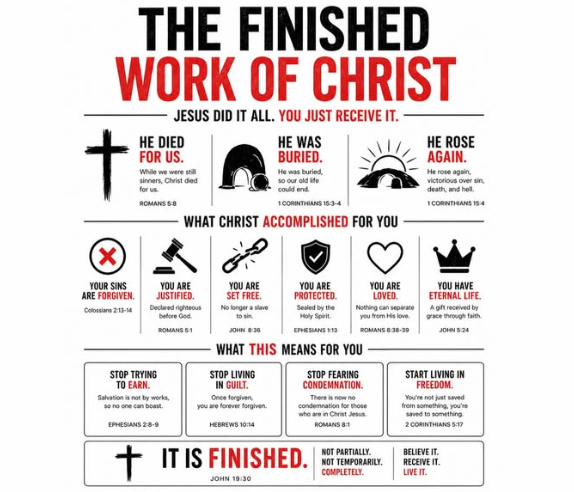
Of the last sayings of Christ on the cross, none is more important or more poignant than, “It is finished.” Found only in the Gospel of John, the Greek word translated “it is finished” is tetelestai, an accounting term that means “paid in full.” When Jesus uttered those words, He was declaring the debt owed to His Father was wiped away completely and forever. Not that Jesus wiped away any debt that He owed to the Father; rather, Jesus eliminated the debt owed by mankind—the debt of sin.
Just prior to His arrest by the Romans, Jesus prayed His last public prayer, asking the Father to glorify Him, just as Jesus had glorified the Father on earth, having “finished the work you have given me to do” (John 17:4). The work Jesus was sent to do was to “seek and save that which is lost” (Luke 19:10), to provide atonement for the sins of all who would ever believe in Him (Romans 3:23-25), and to reconcile sinful men to a holy God. “All this is from God, who reconciled us to himself through Christ and gave us the ministry of reconciliation: that God was reconciling the world to himself in Christ, not counting men’s sins against them. And he has committed to us the message of reconciliation” (2 Corinthians 5:18-19). None other but God in the flesh could accomplish such a task.
Also completed was the fulfillment of all Old Testament prophecies, symbols, and foreshadowing of the coming Messiah. From Genesis to Malachi, there are over 300 specific prophecies detailing the coming of the Anointed One, all fulfilled by Jesus. From the “seed” who would crush the serpent’s head (Genesis 3:15), to the Suffering Servant of Isaiah 53, to the prediction of the “messenger” of the Lord (John the Baptist) who would “prepare the way” for the Messiah, all prophecies of Jesus’ life, ministry, and death were fulfilled and finished at the cross.
Although the redemption of mankind is the most important finished task, many other things were finished at the cross. The sufferings Jesus endured while on the earth, and especially in His last hours, were at last over. God’s will for Jesus was accomplished in His perfect obedience to the Father (John 5:30; 6:38). Most importantly, the power of sin and Satan was finished. No longer would mankind have to suffer the “flaming arrows of the evil one” (Ephesians 6:16). By raising the “shield of faith” in the One who completed the work of redemption and salvation, we can, by faith, live as new creations in Christ. Jesus’ finished work on the cross was the beginning of new life for all who were once “dead in trespasses and sins” but who are now made “alive with Christ” (Ephesians 2:1, 5).
In John 19:30, the apostle records these words: “When Jesus had received the sour wine, he said, ‘It is finished,’ and he bowed his head and gave up his spirit” (ESV). John’s comment that Jesus “gave up his spirit,” or as the KJV has it, “gave up the ghost,” simply means that Jesus experienced physical death. His spirit was separated from His body.
Just before Jesus gave up His spirit, He received the sour wine to quench His thirst (John 19:28). This fulfilled the prophecy of Psalm 69:21—“They gave me poison for food, and for my thirst they gave me sour wine to drink” (cf. Matthew 27:34, 48; see also Psalm 22:15). The wine that was offered to Jesus here is different from the “wine mixed with myrrh”—a weak narcotic that Jesus refused (Mark 15:23). At any rate, the wine that Jesus accepted wet His throat enough to allow Him to proclaim His triumph and the completion of His mission (Mark 15:37; cf. John 19:30).
In Greek, Jesus’ cry in John 19:30 is one word, tetelestai. The English translation (“it is finished”) captures part of the meaning, the part that focuses on the completion of Jesus’ redemptive work:
Day after day every priest stands and performs his religious duties; again and again he offers the same sacrifices, which can never take away sins. But when this priest had offered for all time one sacrifice for sins, he sat down at the right hand of God, and since that time he waits for his enemies to be made his footstool. For by one sacrifice he has made perfect forever those who are being made holy. (Hebrews 10:11–14).
On the cross, Jesus completed His assigned task. Hence, this was not a cry of defeat, nor was it an announcement of His imminent death. This was simply a way to express that He had fulfilled His obligation to the Father: “I glorified you on earth, having accomplished the work that you gave me to do” (John 17:4, ESV).
The “work” Jesus accomplished was His atonement for the sins of humanity: “God made him who had no sin to be sin for us, so that in him we might become the righteousness of God” (2 Corinthians 5:21; cf. 1 John 2:2). Having atoned for the sins of the world, “he bowed his head and gave up his spirit” (John 19:30).
The expression gave up (Gk. paredōken) means that Jesus “handed over” His spirit (cf. Matthew 27:50; Luke 23:46). The idea is that He died. But the expression is worded in such a way that implies Jesus was in control. His spirit did not just “depart”; He gave it up. That is, no one took His life from Him; He voluntarily laid it down: “For this reason the Father loves me, because I lay down my life that I may take it up again. No one takes it from me, but I lay it down on my own accord. I have authority to lay it down, and I have authority to take it up again. This charge I have received from my Father” (John 10:17–18, ESV). His death, then, was a deliberate act of obedience to the Father’s redemptive plan (cf. John 8:29, 14:31; Philippians 2:5–11).
Some commentators have suggested that He gave up His spirit means that Jesus handed over the Holy Spirit to His disciples. A better interpretation is that this was Jesus’ human spirit. The Holy Spirit was given later (see Acts 1:8). Also, Luke 23:46 says that Jesus committed His spirit into the Father’s hands, not the disciples’ hearts. John’s focus is the finished work of Christ and His unflinching obedience to the Father (John 19:30).
A poem by S. W. Gandy summarizes the significance of Jesus’ death:
He hell in hell laid low;
Made sin, he sin o’erthrew;
Bowed to the grave, destroyed it so,
And death, by dying, slew.
Galatians 3:26-28 gives us insight into the phrase “in Christ” and what it means. “In Christ Jesus you are all children of God through faith, for all of you who were baptized into Christ have clothed yourselves with Christ. There is neither Jew nor Gentile, neither slave nor free, nor is there male and female, for you are all one in Christ Jesus.” Paul is speaking to the Christians in Galatia, reminding them of their new identity since they placed their faith in Jesus Christ. To be “baptized into Christ” means that they were identified with Christ, having left their old sinful lives and fully embracing the new life in Christ (Mark 8:34; Luke 9:23). When we respond to the Holy Spirit’s drawing, He “baptizes” us into the family of God. First Corinthians 12:13 says, “For we were all baptized by one Spirit so as to form one body—whether Jews or Gentiles, slave or free—and we were all given the one Spirit to drink.”
Several places in Scripture refer to the believer’s being “in Christ” (1 Peter 5:14; Philippians 1:1; Romans 8:1). Colossians 3:3 says, “For you have died, and your life is hidden with Christ in God.” God is perfect justice. He cannot simply overlook or excuse our sin; that would not be just. Sin had to be paid for. All the wrath God holds toward evil was poured out on His own Son. When Jesus took our place on the cross, He suffered the punishment our sin deserves. His last words before He died were, “It is finished” (John 19:30). What was finished? Not merely His earthly life. As He proved three days later, that was not finished (Matthew 28:7; Mark 16:6; 1 Corinthians 15:6). What He finished on the cross was God’s plan to redeem His fallen world. When Jesus said, “It is finished,” He was stating that He had successfully paid in full for every act of rebellion, past, present, and future.
To be “in Christ” means we have accepted His sacrifice as payment for our own sin. Our rap sheets contain every sinful thought, attitude or action we have ever committed. No amount of self-cleansing can make us pure enough to warrant forgiveness and a relationship with a holy God (Romans 3:10-12). The Bible says that in our natural sinful state we are enemies of God (Romans 5:10). When we accept His sacrifice on our behalf, He switches accounts with us. He exchanges our list of sins for His perfect account that is totally pleasing to God (2 Corinthians 5:21). A Divine Exchange takes place at the foot of the cross: our old sin nature for His perfect one (2 Corinthians 5:17).
To enter the presence of a holy God, we must be hidden in the righteousness of Christ. To be “in Christ” means that God no longer sees our imperfections; He sees the righteousness of His own Son (Ephesians 2:13; Hebrews 8:12). Only “in Christ” is our sin debt cancelled, our relationship with God restored, and our eternity secured (John 3:16-18, 20:31).

Tea Time Manna
To me, to live is Christ and to die is gain.
—Philippians 1:21
The truth is often as simple as it is sweet — if Jesus is our life, then our lives have no end. In faith, we shared with Jesus in his saving death, burial, and resurrection (1 Corinthians 15:3-7) through our baptism as we called on the name of the Lord to save us (Colossians 2:12). Our lives — our eternal essence and identity — are hidden with Christ and will be fully revealed when we share with Jesus in his eternal glory (Colossians 3:3-4). Death does not strip life from us, but ushers us into life in Jesus’ very presence, where no power or event, not even death, can steal us from his grasp (Romans 8:38-39).
Prayer
O Eternal God, thank you for sending Jesus to show us your love, and thank you for sending him again in the future. Jesus is our anchor in the storms of life and our light in our darkest nights, reminding us that you love us with an undying love. In the name of Jesus, the Resurrection and the Life, and the one in whom we find life that never ends,* we pray. Amen and Amen
NEWS MANNA –
The Biometric Trap: AI Fraud Is Creating The Perfect Excuse For Digital Identity
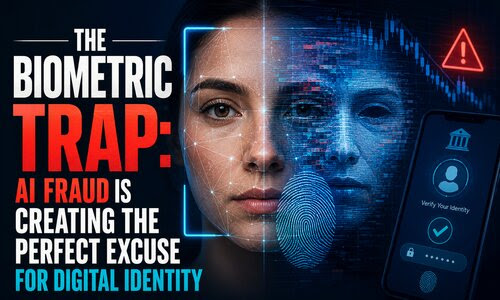
Artificial intelligence is rapidly changing the meaning of a simple question: How do you prove that you are really you?
For decades, passwords, identification cards, security questions and PIN numbers were considered sufficient for most transactions. But AI is beginning to undermine that entire system.
Faces can be generated. Voices can be cloned. Documents can be fabricated. Video calls can be manipulated with deepfakes. Synthetic identities can be created at enormous scale.
And governments and financial institutions are responding with a solution that could fundamentally change the relationship between individuals and the digital world:
Your body may become your identity credential.
Mexico has just provided a glimpse of where this could be headed.
The country’s banking regulator has expanded biometric requirements for financial institutions, requiring facial biometrics alongside existing fingerprint verification and giving banks just 90 days to implement liveness detection designed to distinguish an actual person from photographs, videos or artificial replicas.
The reason is understandable.
AI-powered identity fraud is becoming increasingly sophisticated, forcing banks to determine not merely whether someone possesses the correct credentials, but whether an actual human being is physically present behind them.
This is not simply Mexico’s problem.
Financial institutions around the world are increasingly confronting deepfakes, synthetic identities and cross-platform attacks, driving interest in continuous and networked biometric verification.
And that creates an uncomfortable paradox.
AI may create the very crisis necessary to make widespread biometric identity politically acceptable.
When Passwords Are No Longer Enough
Consider where the technology is leading.
A criminal attempting to access your bank account once needed your password.
Today he may be able to imitate your voice.
Tomorrow he may reproduce your face during a video verification process.
Soon an artificial intelligence system may be capable of constructing an entire convincing digital identity around stolen personal information.
The predictable response will be stronger verification.
Fingerprint scans.
Facial recognition.
Iris scans.
Liveness checks.
Government-backed digital credentials.
And perhaps eventually continuous authentication proving that the person interacting with a system is still the authorized individual.
Even the U.S. National Institute of Standards and Technology, which develops widely used cybersecurity and digital identity standards, warns that biometric characteristics such as faces and fingerprints are not secret information in the same way a password is. Its guidelines recommend using biometrics as only one part of a broader multi-factor authentication system and treating biometric data as highly sensitive personal information.
There is a very important reason for that caution.
You can change a stolen password. You cannot change your face.
From Banking To The Internet
The larger issue is what happens when biometric identity moves beyond the bank.
Online age verification is already expanding, while biometric age estimation, device-based verification and privacy-preserving identity technologies are increasingly converging with digital services.
The progression is easy to imagine.
First:
Prove your identity to access your money.
Then:
Prove your age to access certain websites.
Then:
Prove you are a human being before creating an account.
And eventually:
Verify who you are before participating in significant parts of the digital economy.
That final step is not yet reality, nor is it inevitable.
But the technological infrastructure required to make it possible is clearly developing.
And every major AI fraud incident will provide another powerful argument for expanding it.
Convenience Can Become Control
There is nothing inherently sinister about using Face ID to unlock a phone or fingerprints to protect a bank account.
The danger appears when previously separate systems become interconnected.
Imagine one authenticated digital identity working across banking, government services, employment, travel, healthcare and online platforms.
Such a system could be enormously convenient.
It could also create an unprecedented concentration of power.
A centralized identity infrastructure can potentially answer not only who you are, but also what services you are authorized to access.
That distinction matters.
Identification says:
“This person is who they claim to be.”
Authorization says:
“This person is permitted to do this.”
When identity and authorization become tightly connected, whoever controls access to the system gains enormous influence over participation in society.
That does not mean governments building biometric systems today intend to create such control.
It means the infrastructure itself deserves scrutiny.
History repeatedly demonstrates that technologies introduced for one legitimate purpose can gradually expand into others.
Fraud prevention can become identity verification.
Identity verification can become access control.
Access control can become surveillance.
And centralized surveillance can eventually become something much more powerful.
The Prophetic Question
For Christians who study Bible prophecy, this development deserves particular attention.
Revelation 13 describes an economic system in which individuals ultimately cannot buy or sell without authorized participation in that system.
Scripture does not tell us exactly what technology will make such control possible.
For most of human history, administering something like that on a global scale would have been extraordinarily difficult.
Today it is becoming technologically conceivable.
Digital payments, artificial intelligence, biometric authentication and digital identity are rapidly converging.
That does not mean facial recognition is the Mark of the Beast.
It does not mean every digital identity program is prophetic.
And fighting financial fraud is certainly legitimate.
But Christians would be foolish to ignore a world in which identity, money and permission are increasingly capable of being connected through a single digital infrastructure.
Perhaps the greatest irony is that society may not be forced into such a system.
We may ask for it.
When AI-generated fraud becomes frightening enough, people will naturally demand something safer.
“Prove that isn’t a deepfake.”
“Prove that isn’t a bot.”
“Prove that person really exists.”
“Prove that you are really you.”
And slowly, almost inevitably, the answer may become:
Give us your biometrics.
The technology promises security.
It promises convenience.
It promises protection from a world increasingly filled with artificial identities.
But the question Christians should be asking now, before that infrastructure becomes indispensable, is much larger:
What happens when proving who you are also determines what you are allowed to do?
The Future Of The Temple Mount: The Most Explosive Flashpoint In The Middle East
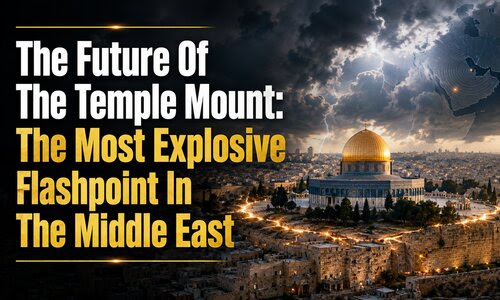
The 37-acre Temple Mount in Jerusalem is ground zero for the events of the end times, and it’s back in the headlines as the most explosive flashpoint in the Middle East–and probably the whole world.
The Temple Mount is the previous location of two Jewish temples. Solomon’s Temple was built there 3,000 years ago until 586 BC, when it was destroyed by the Babylonians. When the Jewish people returned from exile, they built a second temple, which the Romans destroyed in AD 70.
It is considered the third holiest site in Islam–even though Jerusalem is not mentioned specifically in the Quran. The Dome of the Rock is a Muslim shrine that marks the site from which Muhammad supposedly ascended to heaven. In addition, the Al-Aqsa Mosque sits at the southern end of the Temple Mount.
In recent days, there have been “dust-ups” at the Temple Mount that have threatened to escalate into a wider conflict.
Newsweek published a fascinating headline reading, “The Middle East’s Most Dangerous Chokepoint Has No Oil.”
“If months of war between the U.S. and Iran have taught us anything, it’s the importance of choke-points,” Newsweek Editor David Averre wrote. “The world now understands why the Strait of Hormuz is so powerful: whoever controls passage can disrupt economies and compel governments far beyond the waterway.”
“There is another chokepoint in the region through which no oil or goods pass,” he continued. “Control over it is changing, though, and that change brings potential for yet more conflict. Jerusalem’s holiest and most contested religious site, known as Temple Mount to Jews and the Noble Sanctuary to Muslims–or the ‘Al-Aqsa compound’ after the mosque built there–has for decades been at the center of a delicate, unwritten arrangement between Israel and Jordan.
“Israel holds overall sovereignty and security of the site, but a Jordanian-funded Islamic trust called the Jerusalem Islamic Waqf manages day-to-day religious administration and maintenance,” Averre detailed. “The Temple Mount in Jerusalem is controlled by Israel. It was captured from Jordan in the 1967 Six-Day War. However, under a long-standing status quo agreement and the 1994 Israel-Jordan peace treaty, Israel recognizes Jordan’s special administrative role and custodianship through the Jerusalem Waqf to manage Islamic holy sites like the Al-Aqsa mosque.”
Since the Six-Day War in 1967, Muslims have had administrative authority to manage the Temple Mount according to their laws, traditions, and practices–but Israel technically has control. This “status quo” provides all of the ingredients to ignite into a conflict.
I have had the privilege of going to the Temple Mount on several occasions, and if you have visited, you know that the Israeli police manage the site, with guards positioned at the entrance and exit.
It is the location of a spiritual and political tug of war between Israel and Jordan, and in many ways the entire Muslim world.
The Temple Mount has frequently been the location of violent flashpoints. The Hamas-led massacre of Israelis on October 7th, 2023, was called “Operation Al-Aqsa Flood” by the Iranian terror proxy. Hamas commanders stated that the operation was a direct response to Israeli raids, tensions, and perceived threats regarding the Al-Aqsa mosque compound in Jerusalem on the Temple Mount. Though this was the stated excuse, I believe this was nothing more than camouflage for their real murderous motivations. Nevertheless, it aptly demonstrates the flashpoint of the Temple Mount.
In recent days, the status quo has been imperiled. Rumblings on the Temple Mount threaten to spread into a wider conflict.
A Guardian article was recently published with this shocking headline, “Jerusalem’s most important Muslim religious site facing ‘imminent’ threat of Israeli takeover, says Jordan.”
“Jordan is convening an emergency meeting of foreign ministers from the Arab and Islamic world over what it says is an ‘imminent; threat of an Israeli takeover of the most important Muslim site in Jerusalem, with the potential to ‘trigger a religious conflict,'” Guardian senior international correspondent Julian Borger highlighted. “The meeting on Wednesday – and the Jordanian warning – follow an escalating pattern of government-backed incursions by Jewish religious extremists on the compound around al-Aqsa mosque and Dome of the Rock, in violation of a status quo treaty overseen by Jordan’s Hashemite monarchy, by which only Muslims can pray at the site.”
Tourists to the Temple Mount experience the unease of being followed by Muslim Guards whose objective is to prevent Jewish/Christian prayer and the reading of the Bible. In other words, only reading the Quran and Islamic prayer are acceptable.
“On 23 July, more than 2,000 Israelis from the religious right – mostly settlers led by the national security minister, Itamar Ben Gvir – stormed the area, known to Jews as the Temple Mount,” according to the Guardian report. “They prayed and performed rituals all around the compound in what Jordanian officials said was the worst violation in modern history.”
Jordan’s foreign minister, Ayman Safadi, went on to tell the Guardian, “We warn that tampering with the status quo … could trigger a religious conflict that will reverberate beyond Palestine and Jordan into the whole Muslim world.”
NBC News reported that “Simmering tensions over ancient Jerusalem site [are] nearing a boil.” The news group called the situation an “explosive mix of prophecy and politics” that could explode any moment. They may not be aware of how true that statement is!
The Bible tells us that in the end times, there will be a rebuilt third Jewish temple on the 37-acre Temple Mount in Jerusalem.
Israel is the epicenter of the world, Jerusalem the epicenter of Israel, and the Temple Mount–Mount Moriah–the epicenter of Jerusalem. This location is also the place where Abraham was prepared to offer Isaac before God stayed his hand in Genesis 22.
There are three main New Testament texts that speak of a third rebuilt Jewish temple.
Matthew 24:15 says, “Therefore when you see the ‘abomination of desolation,’ spoken of by Daniel the prophet, standing in the holy place (whoever reads, let him understand).”
Scripture tells us that there will be an “abomination of desolation,” like what happened in the second century BC, when Antiochus Epiphanes placed an idol resembling himself in the Holy of Holies of the Temple.
This future “abomination of desolation” will occur when the Antichrist stands in the rebuilt Holy of Holies declaring himself to be God. Of course, the fulfillment of this prophecy necessitates the construction of a third Jewish Temple.
In 2 Thessalonians 2:3-4 we read, “Let no one deceive you by any means; for that Day will not come unless the falling away comes first, and the man of sin is revealed, the son of perdition, who opposes and exalts himself above all that is called God or that is worshiped, so that he sits as God in the temple of God, showing himself that he is God.”
The Antichrist will sit in the temple of God, but he’s not going to sit there 24-7! According to the Bible, he will erect an image in the holy place that he will command the world to worship.
Revelation 11:1-2 says, “Then I was given a reed like a measuring rod. And the angel stood, saying, Rise and measure the temple of God, the altar, and those who worship there. But leave out the court which is outside the temple, and do not measure it, for it has been given to the Gentiles. And they will tread the holy city underfoot for forty-two months.”
If a temple is going to be measured in the end times, one obviously has to exist! The big question is, how will this temple be rebuilt?
There are several theories believed among the Jewish world. The famous Jewish rabbi, Ammonides, who lived in the 12th century, taught that the Messiah will build the temple. Others teach that in the Messianic era, the temple will miraculously descend ready-built from heaven. Many Jews today believe that they must rebuild the temple.
In Israel, there is a place called the “Temple Institute” working diligently to complete the furnishings and priestly garments. In fact, in the Jewish quarter stands a huge menorah that they believe will be inside the temple.
Needless to say, there is a massive obstacle standing in the way of rebuilding the temple: the Dome of the Rock and the Al-Aqsa Mosque.
It is possible that these two Islamic sites could be destroyed–maybe by an earthquake, or even a wayward rocket or a missile inadvertently striking the area from Iran or one of its proxies.
Some believe that the temple can be built just south of the Dome of the Rock and that the two structures can stand side by side–but I don’t think that is a solution that will be satisfying to either Jews or Muslims. Another challenge to this option is the evidence showing that the Jewish temple stood on the very spot where the Dome of the Rock stands today.
Another belief is that the Antichrist, when he comes on the scene, is going to have such power that he will force Islam to accept the rebuilding of the temple.
There is also a possible theory surrounding the Battle of Gog and Magog. If this war occurs before the tribulation period, or very early in, there will be a significant shift in the Islamic world. Ezekiel 38 describes Islamic forces being wiped out in the battle. In this scenario’s timing, the Islamic world would be unable to oppose the Jewish people rebuilding a temple on the Temple Mount.
The truth of the matter is that we cannot say with certainty how the Jewish Temple will be built–but we do know with certainty that it will happen.
Over a hundred years ago, no one had any idea how the Jewish people would be regathered to their land. It looked impossible. But on May 14th, 1948, there was a spectacular miracle on the Mediterranean and the ancient nation was reestablished. The same will be true of rebuilding their temple. A third Jewish temple will be rebuilt in God’s time there upon the Temple Mount.
These tremors today are just a faint foreshadowing of what’s coming. Those 37 acres are the epicenter of the end times–and we already see it shaking.

TruLight TV – Storms In Our Lives
Today On TruLight TV – a story behind Joel Vaughn’s song Called Already Done. and Later Matthew 8 tells about the time when Jesus Christ and His disciples were on a boat in a raging storm. The disciples’ fear and Jesus’ response remind us that God will help His followers survive the tumultuous times in our lives. In the message “Our Anchor in Times of Storm” from the classic Life Principles series, Dr. Stanley highlights Life Principle #3 and discusses that the key to surviving any difficult situation is to cling to God. Enjoy the music and message.
Today on TruLight Radio XM
TruLight Radio XM 24/7
Program
GMT / UTC +2
Monday To Fridays
00:15 Words to Live By Testimonies
01.15 Science Scripture and Salvation
02.15 Ground Works
04.00 Gospel Concert of the Day
05.00 The Daren Streblow Comedy Show
5:55 It is Today devotional
6:00 Gaither Homecoming Morning Show
7:15 Discover the Word
8.15 Destined for Victory
8:55 Science Scripture and Salvation
9:00 Holy Spirit Hour – Normally Sermons
10:15 Hope of the Heart
11:15 Unshackled
11.45 Words to Live By
12:15 Truth for Life
13:15 Living on the Edge with Chip Ingram
14:15 Focus on the Family
15:00 Kids Hour
16:00 In Touch with Dr. Charles Stanley
16:30 Groundwork
17:15 Live in the Light
18:15 Renewing your Mind
19:00 Gaither Homecoming Show
20:15 Growing Hope
21:15 Adventures in Odyssey Radio Drama
21:45 Bible Reading
22:15 Night-sounds
23.00 Good Old Country Gospel / Rhema Gospel Express
VISIT THE WEBSITE
TruLight Ministry News – EXTRA MANNA
TruLight Ministries orders from God since 2012 . Teach Them , Comfort Them and Warn Them!
Healing Truths.
End Time Articles.
Share this Feeding of Manna with your Friends and Family. just click on the Social Media icon and share This Manna with your Friends and Family. just click on the Social Media icon and share !