Hosted by TruLight Ministries – The Place of Truth
SELECT YOUR READING LANGUAGE – BOTTOM LEFT = YOUR DAILY MANNA NOW AVAILABLE IN 103 LANGUAGES
@ TruLight Daily Manna is not Just a Bible Verse with a Small Prayer . NO ::: WE SERVE DAILY Manna for the ENTIRE Day . Breakfast , Lunch , Dinner , Plus tea Times and even Entertainment Manna . Plus News Manna and More , This Daily Manna will keep you Spiritually full for the full 48 Hours and even More to Share with your Friends and Family !!!
Most Misinterpreted Bible Verses !!! Study Day 2
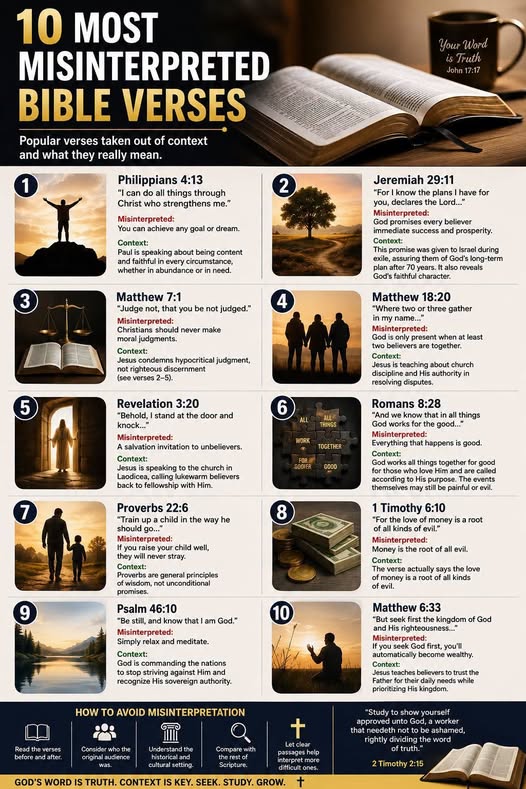
Matthew 18 v 20
Matthew 18:20 is often used to give legitimacy to a small prayer meeting or church service. The pastor might say something like “There are just a few of us here tonight, but we are glad that we don’t have to have a huge crowd for God to listen to us. After all, Jesus promises, ‘Where two or more are gathered in my name, I am there.’” This sounds comforting until it is analyzed and taken to its logical conclusion. What if there are not two? What if there is only one who is praying in isolation? Does that mean Jesus is not there? If the answer is “no,” that raises the question, “What does Matthew 18:20 really mean?”
Let’s take a look at the context of “where two or three are gathered.” The NIV groups Matthew 18:15–20 together as one paragraph. The paragraph divisions, of course, are not an inspired part of the text, as the originals were written without any spaces. However, the NIV paragraph division is based on the content of the passage and seems to be right on target in this case.
Matthew 18:15–17 tells how to deal with sin in the church; it is a passage on what is commonly called “church discipline”: “If your brother or sister sins, go and point out their fault, just between the two of you. If they listen to you, you have won them over. But if they will not listen, take one or two others along, so that ‘every matter may be established by the testimony of two or three witnesses.’ If they still refuse to listen, tell it to the church; and if they refuse to listen even to the church, treat them as you would a pagan or a tax collector.”
Verse 18 then gives assurance that, when this process is followed, God is working in it: “Truly I tell you, whatever you bind on earth will be bound in heaven, and whatever you loose on earth will be loosed in heaven.”
And then, verses 19–20 give a final assurance: “Again, truly I tell you that if two of you on earth agree about anything they ask for, it will be done for them by my Father in heaven. For where two or three gather in my name, there am I with them.”
The context of “where two or three are gathered together in my name” (Matthew 18:20, KJV) has to do with church discipline and the confrontation of the wayward sinner. In verse 16, the principle has been invoked of needing “two or three witnesses” in making an accusation (cf. Deuteronomy 19:15). It seems that the mention of “two or three” in verse 20 echoes that principle; the “two or three” are confronting sin in the church.
Jesus cites the Old Testament Law that said an accusation from a single individual is insufficient to bring action in a criminal case. However, two or three witnesses who agree are sufficient to establish a matter. The law in Deuteronomy regulated a human court. Jesus applies this to the “heavenly court.” When the erring brother or sister in the church is confronted by “two or three witnesses” and refuses to repent, these witnesses bring the matter before the church. Jesus assures us that, when this happens, it is not just the witnesses who are bringing action against the wrongdoer, but He is there with them. Church discipline is sanctioned by both the Father and the Son. This is important because we live in an age when it is not fashionable to confront or “judge” anyone’s lifestyle as sinful. Those who do step forward to call out sin in the church can take heart in the fact that they are not acting alone; Christ is with them in the endeavor.
The process of church discipline calls for “two or three,” and this seems to be the best application for this verse. The two or three who gather in Jesus’ name are not coming together in a prayer meeting or a worship service but in a matter of church discipline. The two or three witnesses have confronted the sinner in a spirit of humility (see Galatians 6:1), and the sinner has not repented. So the two or three take the matter to the Lord in prayer and then confidently move forward with the process outlined in Scripture, knowing that they are not being bullies or busybodies, for God endorses their efforts—Jesus is “with them.”
Revelation 3 v 20
Through the apostle John in Revelation 2—3, Jesus addressed seven letters to seven churches in Asia Minor. They were individualized letters of instruction, rebuke, and encouragement to the local congregations. To the last church, the lukewarm church in Laodicea, Jesus made this urgent plea: “Here I am! I stand at the door and knock. If anyone hears my voice and opens the door, I will come in and eat with that person, and they with me” (Revelation 3:20).
The idea of Jesus standing at a door and knocking is often used as an illustration of Jesus’ offer of salvation to individuals: if you would only “open your heart’s door” and let Jesus into your life, all will be well. But in Revelation 3:20, Jesus is not pleading with an individual to be saved; He’s seeking admittance to a church! It’s alarming to think of Jesus standing outside of the church and knocking, but that’s the position He was in. The Laodicean church had shut the door on the Head of the church; they were smug in their prosperity, but Jesus was left standing in the cold. He was an outsider to the hearts of the entire congregation.
Most of the seven letters contained a compliment, a complaint or criticism, a command, and a commitment from Jesus. But the church of Laodicea, like their spiritually dead sister church in Sardis, merited no words of approval from Jesus. The Laodiceans were guilty of self-reliance, self-righteousness, and spiritual indifference. Even worse, the church was unaware of their wretched condition.
To the congregation at Laodicea, Jesus issued this scathing criticism: “I know your deeds, that you are neither cold nor hot. I wish you were either one or the other! So, because you are lukewarm—neither hot nor cold—I am about to spit you out of my mouth. You say, ‘I am rich; I have acquired wealth and do not need a thing.’ But you do not realize that you are wretched, pitiful, poor, blind and naked’” (Revelation 3:15–17).
In their proud, self-satisfied, and spiritually blind state, the church of Laodicea was useless in God’s kingdom. Using figurative language, Jesus issued His command, beckoning the members of the church to exchange their counterfeit righteousness for genuine righteousness (Revelation 3:18). He called the church to be zealous and repent (verse 19).
Christ’s appeal was heartfelt and urgent: “Listen! I am standing at the door and knocking! If anyone hears my voice and opens the door I will come into his home and share a meal with him, and he with me” (Revelation 3:20, NET). The Lord’s plea was also personal. He spoke to individuals using singular words like anyone, his, him, and he. He was inviting everyone in the church to experience intimate fellowship with Him. And even though His desire was for the whole church to respond and open the door to Him, ultimately it was up to the individual to decide.
Jesus knows that not everyone will answer His invitation and open the door to a relationship with Him. Many, like those living in Laodicea, will choose to reject His call. Lukewarm, and with hardened hearts, they will remain blind to the fact that they have accepted a false righteousness (Hebrews 3:7–8). To these Jesus will say, “I never knew you, depart from me” (Matthew 7:23). Sadly, they will not enter the kingdom of heaven.
During His ministry on earth, Jesus went to great lengths to demonstrate that righteousness comes to us as a gift through faith alone. Having Christ’s righteousness, by grace through faith, is the only way to enter the kingdom of heaven (Romans 3:24–25; 2 Corinthians 5:21; Ephesians 2:4–8).
When Jesus said, “I stand at the door and knock,” He was inviting the members of the Laodicean church to recognize their miserable spiritual condition and receive His authentic gift of salvation. Like the apostle Paul, the Laodiceans needed to realize their absolute dependence on Christ: “What is more, I consider everything a loss because of the surpassing worth of knowing Christ Jesus my Lord, for whose sake I have lost all things. I consider them garbage, that I may gain Christ and be found in him, not having a righteousness of my own that comes from the law, but that which is through faith in Christ—the righteousness that comes from God on the basis of faith” (Philippians 3:8–9).
To those who would open the door, Jesus promised a close fellowship, pictured as enjoying a meal together. And He offered this great reward: “To the one who is victorious, I will give the right to sit with me on my throne, just as I was victorious and sat down with my Father on his throne” (Revelation 3:21). These words were Christ’s commitment to the Laodicean church.
Today Jesus continues to say, “I stand at the door and knock!” To churches who are filled with nominal Christians, He sends out His earnest invitation for full fellowship. The One who holds the keys to the kingdom of heaven (Matthew 16:19; Revelation 1:18; 3:7) calls us all to hear His voice and open the door so that He can come in and share an intimate union with us. To those who respond, Jesus Christ guarantees the open door of eternal life and the reward of ruling with Him in heaven.
Romans 8 v 28
When a Christian utters the phrase all things work together for good, he or she is referring to a portion of one of the most quoted, claimed verses in the New Testament, Romans 8:28: “And we know that in all things God works for the good of those who love him, who have been called according to his purpose.” Or, as the KJV translates it, “And we know that all things work together for good to them that love God, to them who are the called according to his purpose.”
God works all things together for good—both His good and our good. As God is glorified, His people benefit.
In Romans 8, Paul contrasts a life lived in selfish pursuits (the flesh) and one lived in league with, or in accordance with, God (the Spirit). He impresses upon readers that our sovereign God is all-knowing, all-wise, and all-powerful.
Those who love God can trust His goodness, His power, and His will to work out all things for our good. We journey together with Him.
The promise that God works all things together for good does not mean that all things, taken by themselves, are good. Some things and events are decidedly bad. But God is able to work them together for good. He sees the big picture; He has a master plan.
Neither does the promise that God works all things together for good mean we will acquire all that we want or desire. Romans 8:28 is about God’s goodness and our confidence that His plan will work out as He sees fit. Since His plan is always good, Christians can take confidence that, no matter our circumstances or environments, God is active and will conclude things according to His good and wise design. With this knowledge we can learn to be content (see Philippians 4:11).
The fact that God works all things together for good means God’s plan will not be thwarted. In fact, we are part of His plan, having been “called according to his purpose” (Romans 8:28). When we trust God and His way, we can be sure that He is active and powerful on our behalf (see Ephesians 3:20).
God knows the future, and His desires will be accomplished. “I make known the end from the beginning, from ancient times, what is still to come. I say, ‘My purpose will stand, and I will do all that I please’” (Isaiah 46:10). Even when things seem chaotic and out of control, God is still in charge. We sometimes worry about what’s happening to us because we do not know what is best for us. But God does.
The principle of God working all things together for good is well illustrated in the Old Testament account of Joseph’s life. Early in Joseph’s life, Joseph’s jealous brothers sold him into slavery. In Egypt, Joseph rises to a position of responsibility. Then, he is unjustly imprisoned and forgotten about by his friends. God gifts him the ability to interpret dreams, and through that ability Joseph is once again raised to a place of honor and power. When drought forces Joseph’s brothers to seek food elsewhere, they travel to Egypt and encounter Joseph, who eventually saves them from starvation and grants them a livelihood in his new land.
Throughout his life, Joseph trusted God no matter his good or bad circumstances. Joseph experienced plenty of bad things: kidnapping, slavery, false accusations, wrongful imprisonment, rejection, and famine. But in the end God brought things to a wonderful, life-affirming conclusion. God blessed Joseph’s entire family through those painful circumstances and through Joseph’s faith. (You can read about Joseph’s life beginning in Genesis 37.)
Paul’s life is another testament to how God works all things together for good. Paul suffered shipwrecks, beatings, imprisonment, murder attempts, temporary blindness, and more—all within God’s plan to spread the gospel (see Acts 9:16 and 2 Corinthians 11:24–27). Through it all, God was steadfastly working to bring about good and glorious results.
After promising that God works all things together for our good, Romans 8 concludes with the wonderful fact that God trumps everything that comes against Him and those who belong to Him. The Christian is assured that nothing can ever separate us from God’s love: “Who shall separate us from the love of Christ? Shall trouble or hardship or persecution or famine or nakedness or danger or sword? . . . No, in all these things we are more than conquerors through him who loved us. For I am convinced that neither death nor life, neither angels nor demons, neither the present nor the future, nor any powers, neither height nor depth, nor anything else in all creation, will be able to separate us from the love of God that is in Christ Jesus our Lord” (Romans 8:35–39). God’s love is everlasting, and His wisdom is infinite. It doesn’t matter who or what attempts to thwart God’s plan; no one and nothing can. God will work all things together for the good of those who love Him. Our decision to align our will with God’s and to always trust Him will be rewarded.

Tea Time Manna
“What about you?” Jesus asked. “Who do you say that I am?” Simon Peter answered, “You are the Christ, the Son of the living God.”
—Matthew 16:15-16
There is no other name under heaven that can save us other than Jesus (Acts 4:12). He is the way, the truth, and the life — the only way to the Father (John 14:6). We are to confess Jesus before people, knowing that when we do, we can be sure he will confess us before the Father and his angels in heaven (Matthew 10:32-33). Jesus Christ is the Son of God, our Savior and Lord. We may not know all the theological gravity of those words — after all, Peter didn’t when he confessed Jesus as the Christ, the Son of God — but we can commit to knowing Jesus and following him until we know more of what those words mean. Jesus asks us to open our hearts to his lordship and begin the journey toward fuller knowledge and experience of him as the Holy Spirit informs us (1 Corinthians 2:9-10, 14-15) and conforms us to Christlikeness (2 Corinthians 3:18)!
Prayer
Living God and Holy Father, I believe you sent Jesus, your Son, Immanuel, God in human flesh, to save me. I confess to you that I want Jesus to be my Lord, and Lord of all of my life because I believe him to be your Son and Messiah, my Savior. It is through this Jesus, your Son, the Christ you promised to send in the Scriptures, that I pray. Amen and Amen

Bible Teaching of the Day
LUNCH MANNA =
Romans 8:31 says, “What, then, shall we say in response to these things? If God is for us, who can be against us?” The “things” are the dozens of amazing proofs of God’s unfailing love listed in the preceding verses. Romans 8 contains many of the cherished verses that comfort us, such as “Therefore, there is now no condemnation for those who are in Christ Jesus” (verse 1). And the one that gets us through difficult times: “We know that in all things God works for the good of those who love him, who have been called according to his purpose” (verse 28). Verse 31 of Romans 8 is a culmination of all those wonderful promises. It reminds us who God is and how He helps us. When we grasp the truth that God is for us, we have nothing to fear.
God is “for” us in the sense that He is on our side; He is working on our behalf and for our good. He has proved His benevolence in that He has adopted us (Romans 8:15), He has given us His Spirit (verses 16–17, 26–27), and He has determined to save us (verses 29–30).
The follow-up question, “who can be against us?” is rhetorical. It’s another way of saying, “There is no one who could possibly be more powerful than God” or “No one can destroy us.” The idea is not that we will never face opposition; it’s simply that our opposition is doomed to failure. They may be against us, but not successfully against us. Since God is on our side, we have nothing to worry about.
Romans 8:31 is an echo of other passages that say something similar:
- Psalm 118:6 says, “The Lord is with me; I will not be afraid. What can mere mortals do to me?”
- 2 Kings 6:16: “‘Don’t be afraid,’ the prophet [Elisha] answered. ‘Those who are with us are more than those who are with them.’”
- Psalm 56:9: “My enemies will turn back when I call for help. By this I will know that God is for me.”
- Hebrews 13:6: “So we say with confidence, ‘The Lord is my helper; I will not be afraid. What can mere mortals do to me?’”
- Psalm 27:1: “The Lord is my light and my salvation—whom shall I fear? The Lord is the stronghold of my life—of whom shall I be afraid?”
Sometimes our hearts respond to verses like this with consternation: “I’ll tell you who can be against me! The IRS, my in-laws, terrorists, corrupt politicians—” and the list goes on. Our real-life enemies seem to overshadow the ideas conveyed in Romans 8. Despite spiritual promises, we still have to endure physical, mental, and emotional struggles—so much so that we may wonder if God is truly for us.
The man who penned Romans 8:31 (Paul) faced the same struggles we face and many more. He lists some of his sufferings in 2 Corinthians 11:22–28 as proof that he did not write from a plastic bubble of ethereal peace. However, his intimate relationship with the risen Christ had become his all-consuming passion. He said he considered everything else “garbage” compared to knowing Christ (Philippians 3:7–9). He had learned the secret of contentment, whether he was celebrated or imprisoned, and he stated that secret: “I can do all things through Christ who gives me strength” (Philippians 4:13, BSB).
So, when Paul writes, “If God is for us, who can be against us,” he is comparing earthly opposition to the eternal power and presence of Almighty God—and he declares the winner. No one can overcome God’s love for us.
Jesus taught the same thing. In Luke 12:4–5, Jesus said, “I tell you, my friends, do not be afraid of those who kill the body and after that can do no more. But I will show you whom you should fear: Fear him who, after your body has been killed, has authority to throw you into hell. Yes, I tell you, fear him.” His point, as was Paul’s, is that, no matter what may happen to us here on earth, there is a higher reality. There is a bigger war than the one we think we face, and God is the ultimate winner (Ephesians 6:12). If we are on His side, then we will win, too (Revelation 21:7–8, 27).

NEWS MANNA –
Could Iran’s Next Weapon Be American Hostages?
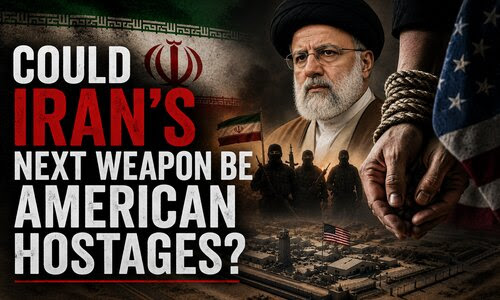
In every war, there comes a point where the battlefield expands beyond missiles, fighter jets and tanks. It becomes psychological. The objective is no longer simply to destroy your opponent’s military capability, but to break their political will.
That is why recent comments from members of Iran’s parliament deserve far more attention than they have received.
According to reports circulating from Iran, some lawmakers have openly discussed the possibility of invading neighboring Kuwait, seizing American military personnel stationed there, transporting them back to Iran and using them as human shields against future U.S. attacks.
Could they actually accomplish something like that?
Probably not.
The United States maintains one of the world’s most heavily defended military networks throughout the Middle East. American bases in Kuwait are protected by layered security, rapid-response forces, intelligence assets and overwhelming airpower. Any conventional attempt to overrun a U.S. installation would almost certainly end in disaster for the attackers.
But that may not be the right question.
The more important question is whether Iran–or one of its proxy groups–believes that capturing even a handful of Americans somewhere in the region could fundamentally change the political dynamics of a wider conflict.
Hostages Can Be More Valuable Than Territory
The proposal itself may never advance beyond political rhetoric. It may simply be an attempt to project strength, rally domestic support, or unsettle Western observers.
Yet even if the military concept itself is unrealistic, the strategic objective deserves serious consideration.
What if the goal isn’t occupying Kuwait at all?
What if the real objective is simply obtaining American hostages?
Modern warfare has repeatedly demonstrated that hostages possess strategic value far beyond their numbers.
One hostage can influence diplomacy.
Ten hostages can alter military planning.
Hundreds of hostages can reshape an entire conflict.
The October 7 Hamas attack illustrated this painful reality. Israel’s military campaign was repeatedly complicated by the presence of Israeli hostages inside Gaza. Military operations had to account for the possibility of harming their own citizens. Rescue missions consumed enormous resources. Public pressure mounted with every passing week.
Hostages became strategic assets.
Iran has undoubtedly studied those lessons.
If just a handful of American soldiers were captured alive, the consequences inside the United States would be immediate.
Television coverage would become nearly nonstop.
Families would dominate news broadcasts.
Political pressure would intensify.
Military decisions would suddenly carry another painful layer of complexity.
Every strike against Iranian territory would risk retaliation against captured Americans.
That is exactly why hostage-taking has remained one of terrorism’s most effective psychological weapons for decades.
They Wouldn’t Need Hundreds
One common misconception is that Iran would need to capture large numbers of Americans for such a strategy to matter.
History suggests otherwise.
The 1979 seizure of the U.S. Embassy in Tehran involved 52 American hostages, yet it dominated American politics for 444 days, contributed significantly to President Jimmy Carter’s electoral defeat, and fundamentally reshaped U.S.-Iran relations for generations.
Sometimes a relatively small number of captives can produce enormous political effects.
That makes even isolated attempts worth considering.
The Easier Targets Aren’t Military Bases
If capturing Americans truly became an objective, heavily fortified U.S. military bases would probably be among the least attractive options.
American civilians, contractors, aid workers, journalists, tourists and business travelers spread throughout the Middle East present far softer targets for terrorist organizations or Iranian proxy militias than a direct assault on a fortified installation.
That possibility helps explain why the U.S. government has repeatedly warned Americans traveling or living overseas to exercise heightened caution as regional tensions continue to rise.
Those advisories are not issued casually.
They reflect the reality that civilian Americans can become strategic targets during periods of escalating conflict.
If anything, the comments from Iran’s parliament serve as another reminder that every American abroad should pay close attention to official travel warnings. If the strategic objective truly is to obtain hostages, military bases may not be where adversaries ultimately look.
The Psychological Battlefield
Wars today are increasingly fought in the minds of populations as much as on physical battlefields.
Iran understands that America possesses overwhelming conventional military superiority.
But military superiority does not always translate into political freedom of action.
Democracies are uniquely vulnerable to emotional pressure.
Images of captured soldiers.
Videos of frightened civilians.
Families pleading for their loved ones.
These become weapons every bit as powerful as missiles.
The objective is simple: force political leaders to hesitate.
Delay military decisions.
Create divisions within the public.
Turn military success into political paralysis.
In that sense, hostages become instruments of information warfare every bit as much as human bargaining chips.
Planning For The Unthinkable
None of this means Iran is preparing such an operation.
The parliamentary discussion may amount to nothing more than inflammatory rhetoric. It could be domestic political posturing, an attempt to intimidate the West, or even deliberate deception designed to distract intelligence agencies from entirely different plans.
But responsible security planning has never been about preparing only for what is most likely.
It is about preparing for what could prove most damaging.
Military planners routinely analyze scenarios they hope never materialize. That is not fearmongering. It is prudence.
History repeatedly reminds us that many of the world’s greatest intelligence failures occurred because leaders dismissed unlikely possibilities as impossible.
Before September 11, few imagined commercial airliners being turned into guided missiles.
Before October 7, many believed Hamas had been sufficiently deterred.
The lesson is not that every alarming statement becomes reality. It is that wise nations examine uncomfortable possibilities before they are forced to react to them.
A Warning Beyond The Battlefield
Whether these parliamentary discussions represent genuine strategic thinking or simply political theater, they highlight a sobering reality.
Today’s wars no longer have clearly defined front lines.
The battlefield can include airports, hotels, embassies, commercial flights, tourist destinations and civilian workplaces.
Americans abroad are no longer merely observers of international crises. Under the wrong circumstances, they can become strategic leverage.
That should concern every American traveling overseas while tensions with Iran remain elevated.
Ultimately, the discussion coming out of Iran may prove to be nothing more than empty rhetoric. But it also serves as a reminder that America’s enemies are constantly looking for ways to offset overwhelming U.S. military superiority. If they cannot win on the battlefield, they will seek other means to influence Washington’s decisions.
Sometimes that means cyberattacks.
Sometimes terrorism.
Sometimes propaganda.
And sometimes, the most powerful weapon isn’t a missile at all.
Sometimes, it is a prisoner.
The Coming AI Iron Curtain: The Battle For The World’s Digital Mind Has Begun

For decades, the world’s superpowers measured their strength in aircraft carriers, nuclear warheads, and economic output. The Cold War was fought through military alliances, espionage, and competing political systems. Today, another global contest is rapidly taking shape–but this one will not be decided primarily by bombs or bullets.
It will be decided by artificial intelligence.
Recent developments out of China have sent another clear signal that the AI race is entering a far more consequential phase. While much of the media has focused on stock prices, market valuations, or whether one AI model performs slightly better than another, those are merely the surface-level story.
The real battle is over something much larger: who will control the world’s digital intelligence.
This is beginning to resemble a new Cold War–except instead of competing over missiles, nations are competing to become the default source of knowledge, reasoning, and decision-making for billions of people.
That is a level of influence history has never witnessed.
The New Cold War
During the twentieth century, countries chose sides between Washington and Moscow. Military alliances largely determined the balance of power. Today, nations may increasingly find themselves choosing between competing AI ecosystems instead.
Will governments rely primarily on American-developed AI?
Chinese-developed AI?
Or attempt the costly challenge of building their own?
This may sound like a technical question, but it is actually one of national sovereignty.
Artificial intelligence is steadily moving beyond chatbots. It is becoming the operating system for modern civilization. Businesses are using it to make financial decisions. Hospitals are beginning to rely on it for diagnostics. Schools are integrating it into classrooms. Governments are exploring its use for public services. Militaries are incorporating it into intelligence analysis, logistics, and battlefield planning.
Whoever supplies that intelligence infrastructure gains tremendous long-term influence.
That is why this race matters far beyond Silicon Valley.
Intelligence Is Becoming Infrastructure
Previous technological revolutions changed how people worked.
Artificial intelligence may change how societies think.
Increasingly, people will ask AI not merely for facts, but for advice, analysis, recommendations, legal guidance, medical explanations, financial planning, and even moral opinions.
That raises an uncomfortable question.
If millions–or eventually billions–of people rely on an AI system every day, whose values are shaping the answers?
Artificial intelligence is often presented as objective. In reality, every system reflects choices made by its creators. Decisions about what information is prioritized, what viewpoints are considered acceptable, how controversial issues are framed, and what content is filtered all reflect human judgment somewhere in the process.
In other words, AI is never completely neutral.
That reality makes this global competition far more significant than simply building the fastest or cheapest model.
It becomes a competition over influence itself.
The Quiet Rise Of Digital Colonization
History is filled with examples of powerful nations extending their influence through military conquest or economic leverage.
Artificial intelligence introduces another possibility.
Digital colonization.
Instead of occupying territory, nations can become indispensable through technology.
Imagine developing countries building their education systems, healthcare networks, government services, banking infrastructure, and business operations around AI provided by a foreign power.
No soldiers arrive.
No borders change.
Yet dependence quietly grows.
Eventually, replacing that technology becomes extraordinarily expensive and disruptive. The provider gains influence not because anyone was forced to accept it, but because it became the easiest, cheapest, and most practical option.
History offers several examples of industries where this strategy proved successful. Artificial intelligence has the potential to magnify that dynamic exponentially because it touches nearly every sector of society.
This is not merely exporting software.
It is exporting the digital brain that increasingly helps societies function.
That is precisely why China’s strategy deserves close attention. Offering powerful AI models at little or no cost may appear generous on the surface, but history teaches that nations rarely invest billions in strategic technologies without expecting long-term returns. If countries across Africa, Asia, South America, and the Middle East build their digital infrastructure on Chinese AI, Beijing’s influence could extend far beyond trade agreements or diplomatic partnerships.
The first nation to become indispensable often becomes the hardest to replace.
An AI Iron Curtain?
One expert recently suggested that today’s open approach to AI could eventually evolve into something much more strategic.
That possibility deserves attention.
What if today’s freely available AI becomes tomorrow’s indispensable infrastructure?
What if nations, businesses, and institutions gradually build their entire digital ecosystems around one country’s technology?
The original Iron Curtain divided East and West through ideology, politics, and military power.
The next Iron Curtain may not be visible at all.
Instead of concrete walls and barbed wire, it could consist of competing AI ecosystems that rarely communicate with one another.
Different answers.
Different rules.
Different values.
Different definitions of acceptable speech.
Different versions of history.
Different political assumptions.
Rather than one open internet, the world could slowly fracture into separate digital spheres of influence, each shaped by the priorities of its dominant AI provider.
That prospect would have enormous consequences for global commerce, diplomacy, cybersecurity, and even freedom of expression.
More Than A Technology Story
Many people still view artificial intelligence primarily as a faster search engine or a helpful workplace assistant.
That dramatically understates what is unfolding.
This is becoming a geopolitical contest over influence, culture, economics, and national security. The countries that establish trusted AI platforms today may shape education, commerce, communication, healthcare, financial systems, and public policy for decades to come.
The stakes are not simply about which company earns the largest profits.
They concern who writes the invisible operating system of the future.
The Next Iron Curtain May Be Invisible
When Winston Churchill warned that an “Iron Curtain” had descended across Europe, he wasn’t describing a physical wall stretching across the continent. He was describing an ideological divide that eventually manifested itself in borders, barriers, and, most famously, the Berlin Wall.
That wall did far more than separate East from West. It divided families, restricted information, controlled movement, and symbolized two competing visions of how society should function.
Today’s world may be witnessing the early stages of a different kind of divide.
This time, there may be no concrete barriers, guard towers, or barbed wire. Instead, the separation could be built from algorithms, AI platforms, competing digital ecosystems, and entirely different versions of reality.
One group of nations may rely primarily on AI systems developed in the United States. Others may increasingly adopt Chinese platforms because they are cheaper, open-source, or more readily available. Over time, those competing systems may shape how billions of people receive information, conduct business, educate their children, and even understand history and current events.
The Berlin Wall eventually fell because physical walls cannot permanently suppress the human desire for freedom.
Digital walls, however, are far less obvious.
Most people will not notice them being built.
They will simply choose the cheapest software, the most capable assistant, or the easiest platform to use. Years later, they may discover that entire nations have become dependent on technologies developed according to someone else’s priorities, values, and strategic interests.
The battle now unfolding is not simply about who builds the smartest artificial intelligence.
It is about who earns the trust of the world–and in doing so, quietly shapes how the world thinks.
The original Iron Curtain divided continents.
The next one may divide minds.

TruLight TV : From Painful Past to Healing Present
Hearing our own name can give us a boost of energy as it is a personal and intimate way of addressing someone. It shows that the person knows us and acknowledges our presence. Remember that God, the good shepherd, calls us by name and sees us as His own. In the latest episode of “Vindication,” Detective Travis learns about Katie’s painful past while Kris uncovers a bigger scheme related to her story. and later discover the inspiration behind the song “Faithful God” by I AM THEY.
Today on TruLight Radio XM
TruLight Radio XM 24/7
Program
GMT / UTC +2
Monday To Fridays
00:15 Words to Live By Testimonies
01.15 Science Scripture and Salvation
02.15 Ground Works
04.00 Gospel Concert of the Day
05.00 The Daren Streblow Comedy Show
5:55 It is Today devotional
6:00 Gaither Homecoming Morning Show
7:15 Discover the Word
8.15 Destined for Victory
8:55 Science Scripture and Salvation
9:00 Holy Spirit Hour – Normally Sermons
10:15 Hope of the Heart
11:15 Unshackled
11.45 Words to Live By
12:15 Truth for Life
13:15 Living on the Edge with Chip Ingram
14:15 Focus on the Family
15:00 Kids Hour
16:00 In Touch with Dr. Charles Stanley
16:30 Groundwork
17:15 Live in the Light
18:15 Renewing your Mind
19:00 Gaither Homecoming Show
20:15 Growing Hope
21:15 Adventures in Odyssey Radio Drama
21:45 Bible Reading
22:15 Night-sounds
23.00 Good Old Country Gospel / Rhema Gospel Express
VISIT THE WEBSITE
TruLight Ministry News – EXTRA MANNA
TruLight Ministries orders from God since 2012 . Teach Them , Comfort Them and Warn Them!
NEW RELEASE
THE LONG AWAITED : EPISODE 15 OF “THE SHERIFF OF THE CHURCH – I TELL YOU TRU “ The Doctrine of Demons called the Hebrew Sacred Names Cult
Healing Truths.
End Time Articles.
Share this Feeding of Manna with your Friends and Family. just click on the Social Media icon and share !