
Man of God – Characteristics
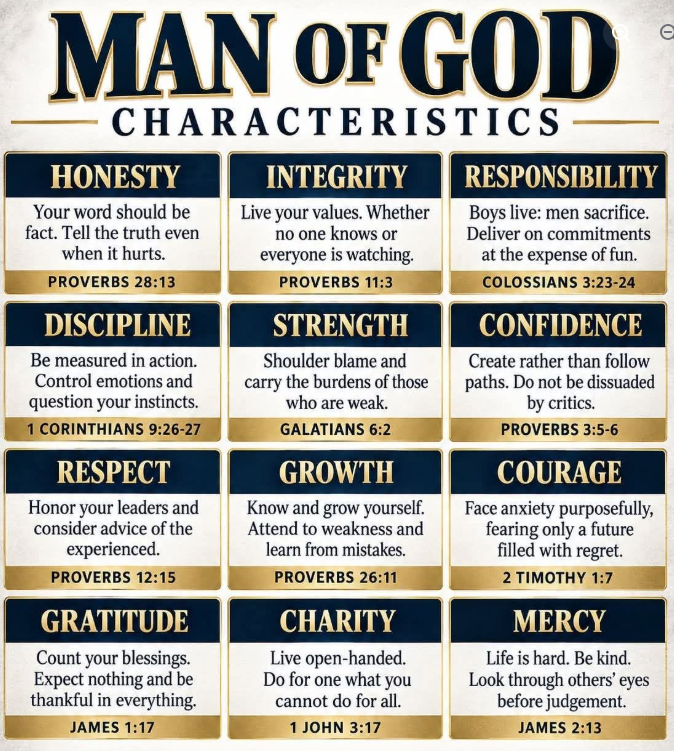
The Bible is a handbook for anyone who desires to be a godly man or woman. God created man and woman after His own image (Genesis 1:27), and part of being in His image is that we are to reflect His character. However, sin marred that image in us and distorted that character (Romans 5:12). God’s choice of Abraham to be the father of a new nation (Genesis 17:5–8) was made, in part, to establish a people group through which He could once again see His character reflected (Leviticus 26:11–12). Reflecting the heart, wisdom, and nature of God is the goal of everyone who seeks to be a godly man or woman.
The first step in becoming a godly man is to surrender to the lordship of Jesus Christ (John 14:6). Anyone can learn rules, follow laws, and judge themselves harshly. Many false religions require that of their subjects. But we cannot become godly without the Holy Spirit empowering us to do so (Acts 1:8). Godliness is more than external behaviors; it is the continual seeking after God’s heart (Isaiah 55:6–7). The term godly refers to having an inward devotion for God that is outwardly displayed. So a godly man is one who has received Jesus’ sacrifice on the cross as payment for his and has accepted the righteousness purchased for him there (2 Corinthians 5:21). By faith in Christ’s death and resurrection, the godly man has declared Jesus the Lord of his life, and his heart is set toward obedience (Romans 10:9–10).
With God’s Spirit inside him (1 Corinthians 6:19–20), the godly man is able to understand the deep things of the Spirit (1 Corinthians 2:9–10). He begins to see life differently. Life is no longer about pleasing himself but about pleasing his Lord (Romans 13:12–14; Hebrews 12:28). The godly man knows he will still stumble as he strives toward holiness (James 3:2), but his goal is to be holy as His Lord is holy (1 Peter 1:16). He learns early that his fleshly attempts at holiness only result in pride and failure. The godly man learns that, as he surrenders his will to the Holy Spirit and relies upon Him for strength to overcome temptation, he can withstand more temptation and accomplish greater eternal goals than he ever thought possible (Philippians 4:13).
A godly man is one who has died to his flesh (Galatians 5:24). This does not mean he no longer faces temptation. It means that, when he is tempted, the decision about whether to give in has already been made. He relies on the power of the Holy Spirit to help him say “no” to his flesh and “yes” to the Spirit (1 Corinthians 10:13; Galatians 5:16). As he regularly opposes sin, he finds that his spirit grows stronger and temptation becomes easier to resist (Hebrews 10:23).
The godly man:
- repents when he sins (1 John 1:9)
- considers himself dead to sin but alive to God (Romans 6:1–4, 11)
- seeks to remain humble rather than exalt himself (Proverbs 27:2)
- is a servant rather than demanding that he be served (Mark 10:45)
- leads by example (1 Timothy 4:12)
- (if married) loves his wife as Christ loves the church (Ephesians 5:25)
- lives in sexual purity, honoring God with his body (1 Corinthians 6:18; Romans 12:1–2)
- seeks to be continually filled with the Holy Spirit (Ephesians 5:18; Act 13:52; Galatians 5:25)
- desires to please the Lord more than himself (2 Corinthians 5:9)
- bears fruit for the kingdom of God (John 15:5–8)
A godly man is not a perfect man. We will never reach perfection until we are in the physical presence of Jesus (1 Corinthians 13:12; 1 John 3:2). But the godly man embraces his manhood and knows that Jesus, not the world, has set the standard for what it means to be a real man. So he strives daily to model his life after Jesus. He does not excuse the sins and weaknesses he finds in himself but continually surrenders those areas to God and asks for His help in overcoming them (Romans 6:11–14). Regardless of physical appearance, social status, or economic standing, any man can be a godly man if he loves God with all his heart and seeks to obey Him in every area of his life (Luke 10:27; Galatians 2:20).
12 Characteristics of a Man of God
1. Honesty: The Foundation of Trust
- The Principle: A godly man speaks the truth plainly and rejects deceit. His word is his bond, and he does not use manipulation or lies to protect his reputation or gain an advantage.
- Bible Example: Samuel. From his youth, Samuel learned to speak God’s truth, even when it was difficult. When God gave him a heavy, distressing prophecy concerning the downfall of Eli’s house, Samuel did not hide anything. He told Eli the exact truth without holding back a single word (1 Samuel 3:18).
- The Blueprint: True manhood requires the bravery to speak the truth in love, even when the truth is uncomfortable or costly.
2. Integrity: The Anchor of Character
- The Principle: Integrity is doing what is right when no one is watching. It is the alignment of your public life, your private life, and your thought life under the standard of God’s Word.
- Bible Example: Joseph. Stranded in Egypt and serving in Potiphar’s house, Joseph was pursued by his master’s wife. With no family around to judge him and absolute privacy in the house, he refused her advances, stating, “How then can I do this great wickedness and sin against God?” (Genesis 39:9).
- The Blueprint: A man of integrity bases his moral compass on God’s presence, not public approval. He protects his character more than his comfort.
3. Responsibility: The Weight of Stewardship
- The Principle: A man does not make excuses; he takes ownership of his actions, his family, his calling, and his mistakes. He steps up to shoulder burdens rather than shifting blame to others.
- Bible Example: Nehemiah. Upon hearing that the walls of Jerusalem were broken down and his people were in distress, Nehemiah did not wait for someone else to act. He wept, prayed, left his comfortable position as the king’s cupbearer, and took personal responsibility to lead the rebuilding effort (Nehemiah 2).
- The Blueprint: Leadership begins with ownership. A man looks at the broken areas around him—in his home, community, or workplace—and says, “I will help rebuild this.”
4. Discipline: The Master of Impulse
- The Principle: Discipline is the ability to choose what you want most over what you want now. It involves governing your appetite, emotions, time, and desires rather than being ruled by them.
- Bible Example: Daniel. As a young captive in Babylon, Daniel was surrounded by the temptation to compromise. Rather than indulging in the royal luxuries that violated his faith, Daniel “purposed in his heart that he would not defile himself” (Daniel 1:8). He maintained a strict, disciplined routine of prayer three times a day, even when it became illegal.
- The Blueprint: A man without self-control is like a city with broken-down walls. Daily discipline builds the fortresses that protect your destiny.
5. Strength: The Shield of the Weak
- The Principle: True strength is not defined by physical dominance or aggressive posturing. Biblical strength is the quiet capacity to endure hardship, carry heavy burdens, and use your power to protect and uplift others.
- Bible Example: Samson vs. David’s Mighty Men. While Samson had physical muscle but lacked the internal strength to govern himself, men like Benaiah (2 Samuel 23:20-21) used their immense courage and strength to defend the kingdom, slaying lions and giants in service of a greater purpose.
- The Blueprint: Use your strength to build, protect, and provide—never to intimidate or diminish those around you.
6. Confidence: The Assurance of Identity
- The Principle: A man’s confidence does not come from arrogance, wealth, or self-sufficiency. It stems from knowing exactly who he is in God and trusting in God’s promises.
- Bible Example: Joshua. Tasked with leading millions of people into a hostile Promised Land after the death of Moses, Joshua faced immense pressure. God commanded him to “be strong and courageous” because his success was guaranteed not by his own skill, but by God’s presence: “for the Lord your God is with you wherever you go” (Joshua 1:9).
- The Blueprint: Root your confidence in your identity as a son of God. When you know who walks with you, you can face any unknown future without fear.
7. Respect: The Standard of Honor
- The Principle: A godly man shows honor to everyone, regardless of their social status, gender, or how they treat him. He respects authority and treats the vulnerable with dignity.
- Bible Example: David toward King Saul. Even though Saul was unjustly hunting David down out of blind jealousy, David had multiple opportunities to kill him. Instead, David refused to harm him and cut only a corner of Saul’s robe, feeling immediately struck with guilt for disrespecting the position of God’s anointed king (1 Samuel 24:5-6).
- The Blueprint: Respect is a reflection of your character, not the other person’s worthiness. Honor others to honor God.
8. Growth: The Pursuit of Maturity
- The Principle: A man never stops learning. He actively seeks wisdom, accepts constructive criticism, corrects his course, and strives to mature spiritually, emotionally, and intellectually.
- Bible Example: Peter. Peter started as an impulsive, loud, and sometimes reckless fisherman who denied Jesus three times out of fear. However, through grace, correction, and Holy Spirit guidance, he grew into the mature, grounded, and wise pillar of the early church who authored books filled with deep spiritual maturity (1 & 2 Peter).
- The Blueprint: Complacency is the enemy of manhood. Be willing to admit what you do not know, accept godly counsel, and continually transform.
9. Courage: The Triumph over Fear
- The Principle: Courage is not the absence of fear; it is the judgment that something else is more important than fear. It is stepping forward to do what is right even when your knees are shaking.
- Bible Example: Jonathan. Armed with only his armor-bearer and an unshakable faith, Jonathan climbed a steep cliff to confront an entire garrison of Philistines. He declared, “Nothing can hinder the Lord from saving, whether by many or by few” (1 Samuel 14:6). His brave act sparked a massive victory for his entire nation.
- The Blueprint: Do not wait for fear to disappear before you act. Step out in faith, and let your actions dictate your feelings.
10. Gratitude: The Guardian of the Heart
- The Principle: Gratitude is a conscious choice to acknowledge God’s goodness in all circumstances. It keeps a man free from bitterness, envy, and the toxic trap of entitlement.
- Bible Example: David. Throughout the Psalms, even when running for his life in caves or facing betrayal, David constantly trained his soul to give thanks. He wrote, “Bless the Lord, O my soul, and forget not all his benefits” (Psalm 103:2).
- The Blueprint: A grateful man is a content man. Count your blessings intentionally to starve out resentment and greed.
11. Charity: The Overflow of Love
- The Principle: Charity (agape love) is sacrificial, active benevolence. A man of charity does not just feel pity; he expends his time, resources, and energy to serve and provide for the needs of others without expecting anything in return.
- Bible Example: The Good Samaritan. While religious leaders walked past a beaten, dying man on the side of the road, the Samaritan stopped. He bandaged the man’s wounds, put him on his own animal, took him to an inn, and paid for his medical care out of his own pocket (Luke 10:33-35).
- The Blueprint: True strength is measured by how much you pour out, not by how much you accumulate. Live with open hands.
12. Mercy: The Extension of Grace
- The Principle: Mercy is choosing not to hit back when you have the power to do so. It is withholding punishment or retaliation from those who have wronged you, reflecting the exact mercy God showed to you.
- Bible Example: The Prodigal Son’s Father. When the rebellious son returned home after squandering his father’s hard-earned wealth in wild living, the father did not demand repayment, lecture him, or banish him to the servant quarters. Instead, filled with compassion, he ran to him, threw his arms around him, and kissed him (Luke 15:20).
- The Blueprint: A weak man demands vengeance; a strong man extends mercy. Let your capacity to forgive be a testament to the grace you have received.
Share this Feeding of Manna with your Friends and Family. just click on the Social Media icon and share This Manna with your Friends and Family. just click on the Social Media icon and share !