Hosted by TruLight Ministries International – The Place of Truth
SELECT YOUR READING LANGUAGE – BOTTOM LEFT = YOUR DAILY MANNA NOW AVAILABLE IN 103 LANGUAGES
@ TruLight Daily Manna is not Just a Bible Verse with a Small Prayer . NO ::: WE SERVE DAILY Manna for the ENTIRE Day . Breakfast , Lunch , Dinner , Plus tea Times and even Entertainment Manna . Plus News Manna and More , This Daily Manna will keep you Spiritually full for the full 48 Hours and even More to Share with your Friends and Family !!!
Leave any Revenge to God !
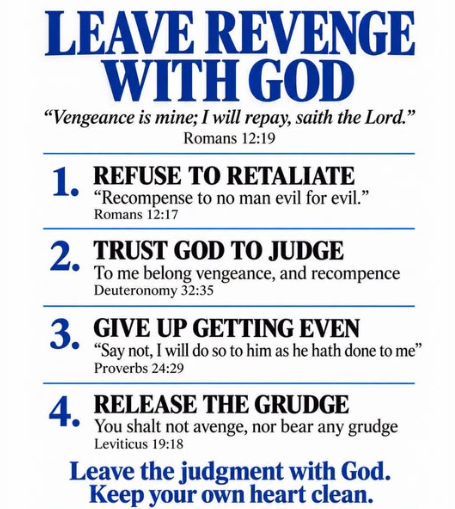
The Freedom of Surrender: Why Leaving Revenge to God Changes Everything
Choosing to refuse retaliation, give up getting even, and release a grudge is not an act of weakness; it is the ultimate expression of trust in a sovereign God. When we step aside and stop playing judge and jury, we protect our own peace and clear the way for God’s perfect justice.
When someone wrongs us deeply, our natural human instinct is to strike back or harbor bitterness. However, Scripture offers a radically different command that acts as a spiritual release valve for our anger and hurt.
🕊️ 1. Step Aside and Leave Room for God
The foundational blueprint for overcoming the urge to get even is found in Romans 12:19:
“Dear friends, never take revenge. Leave that to the righteous anger of God. For the Scriptures say, ‘I will take revenge; I will pay them back,’ says the Lord.”
The phrase “leave room” or “give place unto wrath” means to explicitly step out of the way. When we try to settle scores ourselves, we effectively tell God that we do not trust His timing, His methods, or His authority. Leaving it to God means acknowledging that He sees the full picture and is the only accurate, all-knowing Judge.
🛑 2. Refuse to Retaliate (Breaking the Cycle)
Retaliation acts like gasoline on a fire. If we pay back evil with evil, we allow the wrongdoing of another person to dictate our character and conquer our spirit.
- Conquer Evil with Good: The Apostle Paul challenges believers to do something counter-intuitive: if your enemy is hungry, feed them. This completely diffuses the destructive cycle of conflict.
- Protecting Your Promotion: Taking matters into your own hands actually hinders your spiritual maturity and personal growth. When you refuse to open “burner accounts” or hit back, you allow God to bless and elevate you through your patience.
⚖️ 3. Trust God to Judge Safely
Human justice is often flawed, driven by blind rage, and limited by our lack of perspective. God’s justice, however, is flawless.
As noted by biblical insights on Desiring God, knowing that God is God means you can rest assured that no wrong against you will go unrighted. Absolute justice will be served—either through the repentance of the wrongdoer at the cross of Jesus Christ, or through divine accounting. You do not have to carry the heavy burden of enforcing fairness in a broken world.
🔓 4. Release the Grudge to Find True Freedom
Holding a grudge does not punish the person who hurt you; it constructs a self-made emotional prison that locks you inside.
- Let Go of the Jury Duty: When you nurse a grudge, you are perpetually acting as the judge, jury, and executioner in your mind.
- The Healing Power of Forgiveness: Forgiveness means releasing that person from the debt they owe you and handing the ledger over to God. In doing so, you protect your own personal peace and allow the Holy Spirit to heal your wounds.
💡 The Ultimate Verdict
Giving up the desire to get even is not about letting someone “get away with it.” It is about recognizing that vengeance belongs exclusively to the Lord, and He is fully capable of handling it. By releasing your grudge today, you stop focusing on your enemy’s punishment and start stepping into the divine peace, promotion, and healing that God has waiting for you.
If you are walking through a tough situation, would you like me to share specific prayers for releasing bitterness, or perhaps some additional Bible verses focused on finding peace after betrayal?

Tea Time Manna
“Come now, let us reason together,” says the Lord. “Though your sins are like scarlet, they shall be as white as snow; though they are red as crimson, they shall be like wool.”
—Isaiah 1:18
Nothing stains and leaves a foul spiritual residue on our hearts quite like sin and rebellion against God. However, God’s grace is lavish when we turn our hearts to him — when we hear his call to reason with him and receive his grace. When we confess our sins, God doesn’t just forgive them; he doesn’t just forget them; he cleanses us and removes both the sin and its residue (1 John 1:9, 2:1-2). Our sins are gone forever. Sin’s stain is removed; our guilt is taken away. We are cleansed by his grace (Romans 5:6-11). “Come … let us reason together,” says the Lord. Well, let’s listen to reason and submit to his grace!
Prayer
OH, the glorious joy your grace gives us, dear God! We can never thank you or praise you enough for rerouting our lives away from sin and destruction, and into your love and grace. We find our life, our hope, and our holiness in your grace. We do not take that grace for granted, but respond to that grace by living to honor your love, forgiveness, and redemptive purposes in our lives. In Jesus’ name, we thank you and pray to live to honor your grace. Amen and Amen
Truth Article by Pastor Dirk

Weapons burn for 7 Years
Israel will burn the Weapons of Gog and Magog for 7 Years ! and God allocated a Burial site for the fallen of Gog!
How do weapons burn for 7 years? Is it due to quantity or quality?
Does this give us a clue as to the type of war Ezekiel is describing?
When I first read Ezekiel 39:8-9,
Eze 39:9 And they that dwell in the cities of Israel shall go forth, and shall set on fire and burn the weapons, both the shields and the bucklers, the bows and the arrows, and the handstaves, and the spears, and they shall burn them with fire seven years:
10 So that they shall take no wood out of the field, neither cut down any out of the forests; for they shall burn the weapons with fire: and they shall spoil those that spoiled them, and rob those that robbed them, saith the Lord GOD.
11 And it shall come to pass in that day, that I will give unto Gog a place there of graves in Israel, the valley of the passengers on the east of the sea: and it shall stop the noses of the passengers: and there shall they bury Gog and all his multitude: and they shall call it The valley of Hamongog.
I had a hard time imagining Israel taking 7 years to burn “shields, bucklers, bows and arrows, and javelins and spears.”
I could see a few weeks or months, if there were many, but not 7 years. And why burn them? Why not keep them for its own use?
I then tried to imagine the modern counterpart to these weapons, and their flammable properties, but I was still falling short. In ancient times, the weapons were made of metal or wood.
It seemed like most of the modern weapons were made of just metal, with only little or no flammable portion:
buckler –a small shield, worn on the body. = bullet proof vest?
Shields = tanks, helmet ??
Bows and arrows = guns?
Javelins and spears = missiles?
What kind of weapons would the attackers use, in the Ezekiel war?
I then studied the history of flammable weapons, and realized that it would not take 7 years to burn all of them, not only because they were so numerous, but also because the contents and fumes were toxic, that only a little could be burned at one time, to protect the local residents from harm.
The basis for most flammable weapons is gasoline, which could have other ingredients mixed in with it.
Gasoline is a witch’s brew of organic chemicals, many of which are toxic, but whose major danger is that it is an extremely flammable substance.
– napalm bombs
Napalm
Napalm is a mixture of benzene (21%), gasoline (33%), and polystyrene (46%). Benzene is a normal component of gasoline (about 2%).
…
Heated polystyrene softens at about 185 F. At higher temperatures it turns back into styrene, the chemical from which it was made.
Styrene has been tested as toxic to rats.
In air, polystyrene melts and burns with a yellow, sooty flame.
Styrene itself has a sharp, unpleasant smell that is easy to recognize.
White Phosphorous is included also. This is what is used to produce SMOKE.
Modern napalm is composed primarily of benzene and polystyrene, and is known as napalm-B.
The substance is formulated to burn at a specific rate and adhere to surfaces.
This later variant, napalm-B, also called “super napalm”, is a mixture of low-octane gasoline with benzene and polystyrene.
It was used in the Vietnam War.
Unlike conventional napalm, which burns for only 15–30 seconds, napalm B burns for up to 10 minutes with fewer fireballs, sticks better to surfaces, and offers improved destruction effects.
It is not as easy to ignite, which reduces the number of accidents caused by soldiers smoking.
When it burns, it develops a characteristic smell.
Also, the flammable substances can reach up to 1,200 °C (2,200 °F). Such a high heat indicates a need to only burn small quantities at a time as well.
Shields and bucklers describe equipment worn on or carried with the body.
Bows, arrows, javelins, and spears describe projectile weapons.
It does not seem that this Ezekiel war will be nuclear, but with cruder weapons, like flame throwers.
We are looking at chemical warfare, and this has a long history. It is crude, but effective.
Another useful (and dangerous) effect of napalm, primarily involving its use in bombs, is that it “rapidly deoxygenates the available air” as well as creating large amounts of carbon monoxide causing suffocation.
Incendiary Weapons
The purposes of incendiaries are to cause maximum fire damage on flammable materials and objects and to illuminate.
Incendiary agents are used to burn supplies, equipment, and structures.
Initial action of the incendiary munition may destroy these materials, or the spreading and continuing of fires started by the incendiary may destroy them.
Even experienced troops may suffer increased battle fatigue when confronted with a surprise enemy weapon, tactic, or attack. Examples include napalm bombs
The use of flame weapons, such as Fougasse, the M202A1 Flash, white phosphorous, thermobaric, and other incendiary agents, against military targets is not a violation of current international law.
Flame weapons are characterized by both physical (flame and overpressure) and psychological casualty-producing abilities.
Flame weapons can be used against fortified positions, interior buildings, tunnels (to include subways and sewers), and open areas.
They can also be used to control avenues of approach for personal and lightly armored vehicles.
Incendiaries produce intense, localized heat designed to ignite adjacent combustible target materials.
The true incendiary produces no fireball and relatively little flame.
The basic damage mechanism of firebomb weapons comes from the fireball and burning residual fuel globules, impact momentum of the fuel and container, and damage from fires started by the weapon.
Incendiary Munitions
The main incendiary agents are thermite (TH), magnesium (MG), WP, and combustible hydrocarbons (including oils and thickened gasoline).
Thermite incendiaries are a mixture of powdered aluminium metal and ferric oxide and are used in bombs for attacks on armoured fighting vehicles.
Thermite burns at about 2000°C and scatters molten metal, which may lodge in the skin producing small multiple deep burns.
Magnesium (Mg) burns at about 2000ºC with a scattering effect similar to that of thermite. Its particles produce deep burns.
At ordinary temperatures, white phosphorus (WP) is a solid which can be handled safely under water.
When dry, it burns fiercely in air, producing a dense white smoke.
Fragments of melted particles of the burning substance may become embedded in the skin of persons close to a bursting projectile, producing burns which are multiple, deep and variable in size.
The fragments continue to burn unless oxygen is excluded by flooding or smothering.
–
Combustible hydrocarbons fall into two categories:
1. flame-throwers, oil incendiary bombs.
During a flame-thrower attack, as flame and burning fuel fills an enclosed fortification, the oxygen content of the air is reduced and a hot toxic atmosphere containing large amounts of carbon monoxide, unburned hydrocarbons and smoke is produced.
2. fire bombs containing thickened gasoline.
A fire-bomb is a large tank containing thickened (gelled) gasoline that is air dropped.
When it strikes the ground, the fuel is ignited by phosphorus igniters and a large fireball of intense heat is produced, lasting about 4 to 6 seconds.
Also, a wide area of ground is covered with burning thickened gasoline, which may continue to burn for as long as 10 to 12 minutes.
The Marine Corps uses flame weapons systems, such thermobaric systems, that belong to a new class of fuel-rich compositions that release energy over a longer period of time (more so than standard explosives).
When detonated in confined spaces, a chemical reaction causes a vigorous evolution of heat, pressure, and flame or spattering of burning particles as the warhead cloud expands.
The result is a deflagration, a rapid [though sub-sonic] combustion process that gives off heat and light [in contrast to a detonation, which produces a super-sonic shock wave]. –
Interesting Fact ! Russian Nuclear Weapons has a 7 Year Expiration date.
Final Thoughts
Apparently, nuclear weapons will not be either available, or considered ideal for the Ezekiel war.
With all the nuclear detection devices, the enemies may not want to be apprehended as they sneak into place.
So they are willing to use more primitive, but effective weapons, especially if there is a large number of them.
Also, this may mean that Israel has destroyed nuclear weapon storage, and manufacturing sites, of its enemies by then, and those kinds of weapons are no longer available to use.
Current threats against Israel may push it into action, to disable its enemies, in a pre-emptive attack.
Most likely enraged, the enemies will retaliate with what weapons they have left.
This of course, does not make Israel the aggressor, since the enemies were planning to attack Israel anyhow, with more lethal, nuclear weapons to begin with.
If only rogue nations would understand the series of battles leading up to Armageddon, and realize that they will be the source of the most horrific wars ever predicted.
NEWS MANNA
Trump Ends Military Aid To Israel: America Walking Away Or Setting Israel Free?
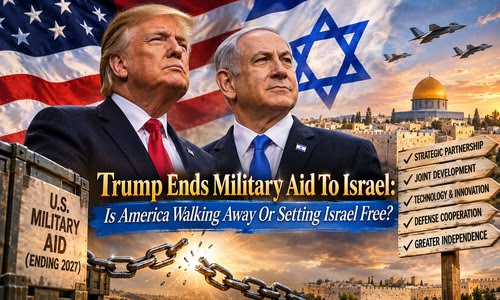
For decades, American military aid to Israel has been presented as one of the strongest symbols of Washington’s commitment to the Jewish state. Now President Donald Trump says that arrangement is coming to an end.
The United States, Trump announced, will stop providing Israel with approximately $3.8 billion in annual military assistance beginning in 2027. His explanation was surprisingly simple: Israel has become so successful that it no longer needs the money.
For some, the announcement raises troubling questions. Is America distancing itself from Israel? Is the political alliance weakening? Could Israel find itself increasingly isolated as hostility toward the Jewish state grows within both American political parties?
But there is another possibility worth considering.
What if ending American military aid actually makes Israel stronger, more independent, and less vulnerable to political pressure from Washington?
The answer may be more complicated than either supporters or critics initially realize.
The Aid That Was Never Really Free
One of the most misunderstood aspects of American assistance to Israel is where the money actually goes.
Under the existing agreement, most military financing must be spent purchasing American-made weapons and defense equipment. In 2026, approximately 92% of that financing is designated for American products, rising to 100% by 2028.
That means billions flow back into American defense companies, supporting American manufacturing, jobs, technological development, and production capacity.
Israel receives sophisticated military equipment, certainly. But the United States receives substantial economic benefits while strengthening a strategically important ally.
This is not simply American generosity. It is an arrangement serving both countries’ interests.
There is another benefit to Washington, however, that rarely receives the same attention: influence.
When one country depends upon another for military assistance, the supplying nation gains considerable leverage over its ally’s decisions.
And Israel knows firsthand what that leverage can look like.
The Golden Handcuffs Of American Support
During the Biden administration, Washington paused a shipment of heavy bombs to Israel in 2024 over concerns about Israeli military operations in Rafah.
The administration argued that its actions were necessary to protect Palestinian civilians. Israeli officials, meanwhile, faced the reality that crucial military supplies could become entangled in disagreements over how Israel conducted its war against Hamas.
Regardless of one’s assessment of the Rafah operation, the underlying vulnerability was unmistakable.
An Israeli government could determine that a military operation was essential to national security, only to discover that an American administration disagreed and was willing to use weapons deliveries as leverage.
This raises a fundamental question: Should Israel’s ability to defend itself depend upon the political preferences of whoever occupies the White House?
Ending annual military grants would not eliminate American influence. Israel would still depend on U.S. suppliers for aircraft, spare parts, munitions, and other advanced systems. Washington could still restrict arms sales or delay export approvals.
But reducing financial dependency could remove one important instrument of political pressure.
For a nation surrounded by enemies and facing recurring threats to its existence, greater freedom to make its own security decisions has considerable value.
Israel Is No Longer The Israel Of Yesterday
Trump’s statement that Israel no longer needs American assistance reflects an extraordinary transformation.
Israel was once a relatively poor nation struggling to survive against much larger regional adversaries.
Today, it possesses one of the world’s most sophisticated military forces, a highly developed technology sector, advanced intelligence capabilities, and a globally competitive defense industry.
Israeli innovations in missile defense, cybersecurity, drones, intelligence systems, and battlefield technology have benefited not only Israel but American national security as well.
The relationship increasingly resembles a partnership between two technologically advanced military powers rather than a wealthy patron supporting a helpless dependent.
Nevertheless, there are legitimate concerns about ending assistance too quickly.
Israel faces extraordinary defense expenses, particularly after years of regional conflict. Replacing billions in annual financing would place additional pressure on its defense budget. American aircraft and weapons systems cannot simply be replaced overnight with Israeli alternatives.
A sudden cutoff could also complicate long-term procurement planning and raise questions about future joint missile-defense funding.
These concerns deserve answers, not dismissal.
The strongest argument for greater Israeli independence is not that American military assistance has become worthless. It is that Israel should develop the capacity to defend itself without depending on the continued generosity of an increasingly unpredictable American political system.
Why Does Israel Receive So Much Criticism When Other Nations Receive Aid?
Here is where the debate becomes particularly interesting.
Israel’s critics on both the political left and right frequently point to American military assistance as evidence that Israel enjoys preferential treatment.
But Israel is hardly the only foreign country receiving American support.
Egypt, for example, received $1.375 billion in military financing under the fiscal 2026 appropriations agreement.
Jordan received approximately $2.1 billion in American economic and military assistance for fiscal 2026, while countries such as Pakistan have also received U.S. assistance for security, counterterrorism, and other strategic purposes.
These are hardly isolated examples. Washington provides billions in foreign assistance to numerous countries, including governments whose policies, human rights records, and relationships with America have generated considerable controversy.
Washington justifies that assistance partly through regional stability, military cooperation, counterterrorism, and diplomatic interests.
That is a legitimate foreign-policy argument.
But shouldn’t similar strategic considerations apply to Israel?
Israel provides intelligence cooperation, advanced defense technologies, military innovation, and a strategically significant partnership in a region where American interests face serious challenges.
Why, then, does Israeli assistance generate such extraordinary political controversy?
Some critics consistently oppose foreign military aid as a matter of principle. Others question the scale of Israeli assistance, particular military operations, or whether American taxpayers should subsidize a prosperous country. Those are legitimate subjects for debate.
But when critics single out Israel while ignoring comparable assistance elsewhere, it is reasonable to ask whether the same standards are being applied.
And when criticism crosses from examining Israeli government policies into conspiracy theories about Jewish control, collective blame, or accusations of hidden Jewish influence, it enters the territory of antisemitism.
Not every objection to aid for Israel is antisemitic. But neither should antisemitism be dismissed when it disguises itself as ordinary political criticism.
Ending the aid arrangement could remove one of the most frequently repeated complaints about the American-Israeli relationship.
It would not end hostility toward Israel. But it could force critics to explain their objections without relying so heavily on the familiar argument that American taxpayers are financing the Jewish state.
What Happens When Washington Becomes Less Friendly?
There is another issue Christians who love Israel should consider carefully.
American support for Israel can no longer be assumed to enjoy the same broad political consensus it once did.
Within the Democratic Party, significant factions have become increasingly critical of Israel, particularly over Gaza and the wider regional conflicts.
Meanwhile, portions of the political right have adopted a more isolationist approach, questioning foreign commitments and American involvement in Middle Eastern conflicts.
These developments do not mean every Democrat opposes Israel or every America First conservative wishes to abandon it. But they demonstrate how vulnerable Israel can become when its security depends upon political decisions made thousands of miles away.
What happens if a future American administration decides that Israel must accept territorial concessions, limit military operations, or make other decisions contrary to its own security assessments?
What happens if military financing becomes a bargaining chip in negotiations over Jerusalem, Judea and Samaria, or Iran?
A more financially independent Israel would still need American cooperation, but it could be better positioned to withstand political pressure.
And that independence could become increasingly important in the years ahead.
A Stronger Alliance Without Dependency?
The most constructive alternative is not to replace American friendship with Israeli isolation.
It is to transform the relationship.
Instead of annual military grants, the two nations could expand joint weapons development, missile-defense research, intelligence cooperation, cybersecurity partnerships, and mutually beneficial defense production.
American companies would continue selling advanced weapons to Israel. Israeli innovation would continue benefiting American military capabilities.
Both countries could gain from a relationship built increasingly around cooperation rather than financial dependency.
Of course, the details matter. Joint projects require funding, and Israeli sovereignty would still need to be protected through carefully negotiated agreements.
There is also an important distinction between eliminating routine annual military financing and refusing emergency assistance during a major war.
Even economically powerful allies sometimes require extraordinary help when confronting extraordinary threats.
Ending one form of assistance should not automatically mean abandoning the principle of mutual defense cooperation.
The Biblical Lesson Both Nations Must Remember
For Christians who understand Israel’s place in biblical history, there is a deeper lesson in this development.
Scripture repeatedly warns against placing ultimate confidence in human alliances and military strength.
Psalm 20:7 declares, “Some trust in chariots, and some in horses: but we will remember the name of the LORD our God.”
Israel’s prophets frequently confronted leaders who looked to foreign powers for security rather than trusting the Lord.
Isaiah 31:1 warns those who go down to Egypt for help, trusting in horses and chariots instead of looking to the Holy One of Israel.
That warning remains relevant.
Israel should appreciate American friendship, but America is not Israel’s ultimate protector. Neither military technology, financial independence, nor diplomatic agreements can replace dependence upon God.
And America should remember that supporting Israel is not merely a question of foreign aid budgets or defense contracts. For Christians, God’s promises concerning Israel and the Jewish people carry significance far beyond political calculations.
Genesis 12:3 remains an important part of that biblical understanding, even as Christians debate how its principles apply to modern foreign policy.
The announcement from Washington therefore presents both an opportunity and a warning.
Israel may gain greater freedom to defend itself. America may move toward a more commercially balanced strategic partnership. Both nations may benefit from reducing an arrangement that has become politically controversial.
But independence from American financial assistance must never be confused with independence from God.
The greatest question is not whether Israel can survive without America’s $3.8 billion. It is whether Israel and America will remember where their ultimate security comes from.
An alliance between nations can change. Administrations come and go. Political promises can be broken.
But the promises of God do not depend upon who occupies the White House.
Should Christians Fear The Noahide Movement? Biblical Truth Vs Conspiracy
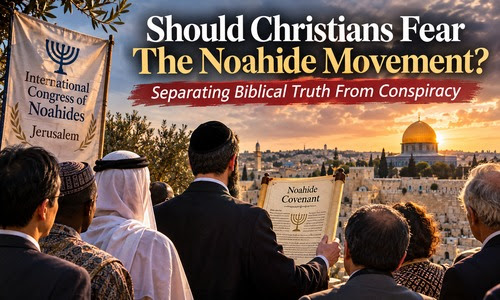
Something unusual happened in Jerusalem last week, and it is raising questions among Christians who follow Bible prophecy.
Delegates from more than 20 countries, including Japan, India, Nigeria, Colombia and the United States, gathered in Jerusalem for the First International Congress of Noahides. On the Mount of Olives overlooking the Temple Mount, they signed a covenant affirming the God of Israel and recognizing Jerusalem as the place where humanity converges with its Creator.
For supporters, it was a historic step toward uniting humanity under biblical moral principles. For some Christians, however, it raised an unsettling question: Could this movement eventually become part of the global religious system described in Revelation?
Before jumping to prophetic conclusions, Christians need to understand what the Noahide movement actually believes, why it concerns some believers, and whether the alarming claims circulating online have any basis in reality.
What Exactly Is The Noahide Movement?
The Noahide movement is based on an ancient Jewish teaching that God established seven universal commandments for humanity through Adam and Noah. Unlike the 613 commandments traditionally associated with Jewish religious law, these seven principles are understood in rabbinic Judaism as obligations for all people.
They prohibit idolatry, blasphemy, murder, theft, sexual immorality and eating flesh taken from a living animal. The seventh requires establishing courts of justice.
Most Christians would recognize considerable moral agreement with these principles. Murder, theft and sexual immorality are clearly condemned throughout Scripture.
But the movement goes beyond encouraging good behavior.
Its followers believe non-Jews can worship the God of Israel and live righteously without converting to Judaism or accepting Jesus Christ as Messiah.
This is where a fundamental theological disagreement begins.
The New Testament teaches that salvation comes through Jesus Christ, not adherence to a universal moral code. Jesus declared in John 14:6 that no one comes to the Father except through Him. Acts 4:12 similarly teaches that salvation is found in no other name.
For Christians, morality matters, but morality cannot replace the Savior.
Why Are Some Christians Alarmed?
Concerns generally fall into three categories: rejection of Christian theology, potential connections to end-times prophecy, and claims that Noahide laws could eventually become mandatory worldwide.
The first concern has a legitimate theological foundation.
Traditional rabbinic Judaism rejects the Christian doctrine of the Trinity and does not recognize Jesus as the divine Messiah. Some Jewish authorities consequently regard Christian worship as incompatible with strict Jewish monotheism, although interpretations differ.
A religious framework that recognizes the God of Abraham while rejecting the deity and saving work of Jesus Christ is incompatible with historic Christian teaching.
The second concern involves Bible prophecy.
Revelation 13 describes a future religious and political system demanding allegiance to the Antichrist. It also describes a false prophet who directs humanity toward false worship.
Because the Noahide movement promotes universal religious principles and international cooperation, some prophecy watchers wonder whether it could contribute to a future system of global religious unity.
It is reasonable to examine religious movements in light of Scripture. But examining a possibility is not the same as establishing prophetic fulfillment.
No biblical passage identifies the Seven Noahide Laws as the religious system of the Antichrist. Nor is there credible evidence that this small movement is secretly preparing to enforce the mark of the beast.
Prophecy should make Christians discerning, not careless with evidence.
What About Claims Of A Coming Noahide World Government?
This is where fact and fiction frequently become tangled.
Some online commentators claim Noahide laws will eventually be imposed worldwide, with Christians persecuted or even executed for worshiping Jesus.
These theories often point to historical rabbinic writings discussing severe penalties for religious violations. Such passages exist, and some traditional interpretations envision enforcement under particular religious circumstances.
Those teachings deserve examination rather than dismissal.
But ancient religious legal discussions are not evidence that modern Noahide organizations possess the political power or practical means to impose those penalties.
The international court established at the Jerusalem congress is especially important to understand. Organizers describe it as a rabbinical body offering religious guidance, not a criminal court with governmental authority.
Another frequently circulated claim involves the United States Congress.
In 1991, Congress passed Public Law 102-14, recognizing the Seven Noahide Laws as historical ethical principles while designating a national Education Day in honor of Rabbi Menachem Mendel Schneerson.
That recognition is real.
What is not real is the claim that Congress secretly made Noahide religious law enforceable throughout America. The resolution established no criminal code and granted no religious court jurisdiction.
There is also the question of numbers.
The Jerusalem gathering included fewer than 100 delegates. Organizers report communities across six continents, but reliable worldwide membership figures remain limited.
This is a relatively small religious movement attempting to build an international identity, not an established worldwide political force.
Its ambitions to spread its beliefs are genuine. Claims that it already controls governments or is positioned to take over the world lack credible evidence.
Are Christians Falling Into An Old Trap Of Fearing Jewish Influence?
There is another danger Christians must confront, particularly those who strongly support Israel.
Throughout history, Jewish communities have repeatedly been accused of secretly controlling governments, manipulating world events or plotting to dominate nations. Such accusations have often flourished without evidence and sometimes produced terrible consequences.
Christians should be careful not to revive those suspicions under the language of Bible prophecy.
Disagreeing with rabbinic Judaism is not antisemitism. Questioning Noahide theology or investigating documented political ambitions is entirely legitimate.
But suggesting Jewish people collectively are orchestrating a secret global religious takeover is something altogether different.
The Apostle Paul provides an important model in Romans 9–11. He passionately disagreed with Jewish rejection of Jesus as Messiah, yet expressed profound love for his people and affirmed God’s continuing purposes for Israel.
Christians can defend the exclusivity of Christ while rejecting unfounded accusations against the Jewish people.
Those who claim to love Israel should be especially careful about distinguishing documented facts from sensational speculation.
Could The Movement Still Have Prophetic Significance?
Possibly, but that requires an important qualification.
The Jerusalem gathering illustrates a broader religious trend worth watching: growing interest in universal spiritual identity, shared moral principles and international religious cooperation.
Such developments can raise legitimate questions about how future religious movements might interact with Revelation’s prophetic events.
But Christians should resist turning every international religious conference into another supposed fulfillment of prophecy.
The Bible identifies the central spiritual deception of the last days as rejection of God’s truth and worship of a false messiah. It does not instruct believers to identify every Jewish religious organization as a potential enemy.
There is also a remarkable irony.
The prophets describe a future when the nations recognize the God of Israel and Jerusalem occupies a central place in God’s purposes. Isaiah 2 and Zechariah 14 are particularly significant.
Yet the New Testament makes clear that God’s ultimate plan centers on Jesus Christ, Israel’s Messiah and the Savior of the world.
A movement that honors Jerusalem and the God of Israel while rejecting Jesus cannot be regarded by Christians as the fulfillment of that ultimate redemptive hope.
The Real Danger Is Not What Many Think
The greatest concern about the Noahide movement is not that a relatively small group of religious adherents is preparing to seize control of the world.
It is the theological proposition that humanity can find acceptance with God through a universal religious framework that does not require faith in Jesus Christ.
That is a serious issue regardless of whether the movement ever gains significant political influence.
But the Christian response should be biblical clarity, not conspiracy.
Scripture calls believers to test the spirits (1 John 4:1), examine everything carefully (1 Thessalonians 5:21), and speak the truth in love (Ephesians 4:15).
Those commands require both spiritual discernment and intellectual honesty.
The Noahide movement may grow, remain small or ultimately prove historically insignificant. Time will tell.
Christians need not fear every movement that rejects Christ, nor embrace every theory claiming to expose a secret prophetic conspiracy.
The real question is not whether the Noahide movement will someday rule the world. It is whether Christians understand their own faith well enough to recognize that no universal moral code, however appealing, can ever replace Jesus Christ.

TruLight TV – Working On A Building
Today’s Concert – (The Singing Contractors: Working On A Building) – Hard-working, hammer-wielding Aaron Gray and Josh Arnett—The Singing Contractors—began harmonizing while building houses. Those blends, which have offered hope to millions of listeners via social networks and media platforms, can now be heard on this debut gospel DVD, which features the duo’s spin on some of today’s most popular church standards and gospel classics. Enjoy! and Thanks for watching.
Today on TruLight Radio XM
TruLight Radio XM 24/7
VISIT THE WEBSITE
https://trulightradioxm.org.za
TruLight Ministry News – EXTRA MANNA

TruLight Ministries orders from God since 2012 . Teach Them , Comfort Them and Warn Them!
a TruQuestion for the Day
True or False: God chose to save us because of our own righteous acts and personal merit. ( Titus 3 v 5)
Our TruPlay website is coming together – Stunning Music , Plays and Podcasts , Easy Radio Player and More https://truplay.co.za

TruLight News

A PLAY A DAY !


🏛️ The Hardest Truth in the Book of Exodus: God Demands Total Surrender, Not Just Comfort
The ultimate “hard truth” of the Book of Exodus is that God does not rescue His people to give them an easy, comfortable life; He rescues them to completely possess them.
Many read Exodus as a triumphant story of political liberation—slaves breaking free from an oppressive empire. While it is a story of freedom, it quickly transitions into a story of absolute law, strict obedience, and a terrifyingly holy God. God did not deliver Israel so they could live however they pleased in the desert; He delivered them to bind them to a covenant that demanded their total allegiance, entire lifestyle, and immediate obedience.
🐪 The Illusion of Freedom
When the Israelites crossed the Red Sea, they cheered for their newfound independence. However, they quickly realized that freedom from Pharaoh did not mean freedom from authority.
- From One Master to Another: In the Hebrew text, the word for “serve” or “slave” (avad) used to describe Israel’s labor under Pharaoh is the exact same word used for how they are commanded to worship and serve God. They were not freed to be independent; they were transferred to a new Master.
- The Danger of the Desert: As soon as the initial excitement wore off, the reality of the wilderness set in. Facing hunger and thirst, the Israelites immediately began to grumble, even glorifying their time in Egypt because they preferred the security of slavery to the terrifying uncertainty of trusting a holy God.
⚡ The Terror of Sinai
The narrative shifts dramatically at Mount Sinai. God does not present Himself as a gentle, comforting deity, but as an consuming fire.
- A Boundary of Death: In Exodus 19, God warns the people that if anyone—even an animal—touches the foot of the mountain, they must be put to death.
- The Weight of Covenant: The giving of the Ten Commandments and the Mosaic Law reveals that God cares about every microscopic detail of human life, from moral laws to civil dietary guidelines. The hard truth here is that God’s love is not synonymous with modern definitions of tolerance. He demands absolute holiness, and the cost of entering His presence is the death of self-will.
🐂 The Golden Calf and Immediate Judgement
Perhaps the most brutal demonstration of this hard truth occurs in Exodus 32. While Moses is receiving the law, the people grow impatient and build a golden calf to worship.
- The Illusion of “Safe” Worship: The Israelites didn’t necessarily think they were abandoning God; they were trying to manage Him by creating a visible, predictable idol they could control.
- The Brutal Consequence: God’s response to this compromise is fierce. Moses breaks the tablets, grinds the calf into powder, forces the people to drink it, and commands the Levites to execute 3,000 of their own brothers, companions, and neighbors. Exodus reveals that partial obedience or self-styled worship is viewed by God as outright rebellion.
💡 The Takeaway for the Modern Reader
Exodus shatters the myth of a transactional God who exists simply to fix our problems and make our lives smooth.
The book forces us to confront a uncomfortable reality: Redemption is costly. God will ruthlessly dismantle our comfort zones, our safety nets, and our cultural idols in order to make us holy. He rescues us not to make us comfortable, but to make us His.
Artist Liners
Picture Manna to Share
From God –

From Jesus –

From the Holy Spirit –

Share this Feeding of Manna with your Friends and Family. just click on the Social Media icon and share !