Hosted by TruLight Ministries International – The Place of Truth
SELECT YOUR READING LANGUAGE – BOTTOM LEFT = YOUR DAILY MANNA NOW AVAILABLE IN 103 LANGUAGES
@ TruLight Daily Manna is not Just a Bible Verse with a Small Prayer . NO ::: WE SERVE DAILY Manna for the ENTIRE Day . Breakfast , Lunch , Dinner , Plus tea Times and even Entertainment Manna . Plus News Manna and More , This Daily Manna will keep you Spiritually full for the full 48 Hours and even More to Share with your Friends and Family !!!
7 Psalms for when your Mind are Under Attack !!! Psalm 143
My Soul Thirsts for You
Psa 143:1 A Psalm of David. Hear my prayer, O LORD, give ear to my supplications: in thy faithfulness answer me, and in thy righteousness.
Psa 143:2 And enter not into judgment with thy servant: for in thy sight shall no man living be justified.
Psa 143:3 For the enemy hath persecuted my soul; he hath smitten my life down to the ground; he hath made me to dwell in darkness, as those that have been long dead.
Psa 143:4 Therefore is my spirit overwhelmed within me; my heart within me is desolate.
Psa 143:5 I remember the days of old; I meditate on all thy works; I muse on the work of thy hands.
Psa 143:6 I stretch forth my hands unto thee: my soul thirsteth after thee, as a thirsty land. Selah.
Psa 143:7 Hear me speedily, O LORD: my spirit faileth: hide not thy face from me, lest I be like unto them that go down into the pit.
Psa 143:8 Cause me to hear thy lovingkindness in the morning; for in thee do I trust: cause me to know the way wherein I should walk; for I lift up my soul unto thee.
Psa 143:9 Deliver me, O LORD, from mine enemies: I flee unto thee to hide me.
Psa 143:10 Teach me to do thy will; for thou art my God: thy spirit is good; lead me into the land of uprightness.
Psa 143:11 Quicken me, O LORD, for thy name’s sake: for thy righteousness’ sake bring my soul out of trouble.
Psa 143:12 And of thy mercy cut off mine enemies, and destroy all them that afflict my soul: for I am thy servant.
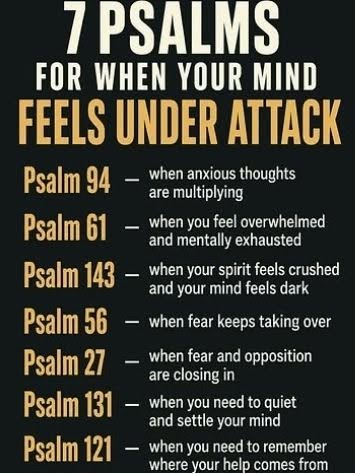
We all feel overwhelmed at times. Sometimes it is a result of taking on too much work or responsibility; other times it is caused by things we cannot control, like physical illness or emotional trauma. Sometimes we can feel overwhelmed when everything is normal and we don’t see any reason for feeling that way. Even things we enjoy can leave us feeling overwhelmed if there is too much to do. We face daily pressures from jobs or school, from friends and family, and from temptations to sin. These can pile up and seem completely unmanageable. Fortunately, the Bible speaks to us about feeling overwhelmed.
In the Gospels Jesus shows us a way to prevent stress and the feeling of being overwhelmed. He was the sinless Son of God, but He often went away by Himself to get away from large crowds—even from those that needed His help and healing (Mark 1:35). At times He retreated even from His disciples. Other times, He retreated with His disciples: “Because so many people were coming and going that they did not even have a chance to eat, he said to them, ‘Come with me by yourselves to a quiet place and get some rest’” (Mark 6:31). It was not selfish of Jesus to get away from people and commune with God. It was wise of Him to seek time for His disciples to rest, as well. We can rightly assume it is okay for us to spend some time alone, too, if we are feeling overwhelmed by people and responsibilities. It is interesting to note that Jesus also enjoyed great inner peace because of His trust in God. Even in the midst of a storm, He could sleep (Matthew 8:23–24).
There was one occasion when Jesus described Himself as feeling overwhelmed. It was in Gethsemane just before His arrest, trial, and crucifixion. “He began to be deeply distressed and troubled. ‘My soul is overwhelmed with sorrow to the point of death,’ he said to [his disciples]. ‘Stay here and keep watch.’ Going a little farther, he fell to the ground and prayed” (Mark 14:33–35). In considering the fact that we, too, can be overwhelmed by situations facing us, there are three things to note here: first, Jesus was completely honest about how He felt. Second, He solicited the help of friends. Third, He prayed. Jesus took His burden to His Father. What a good model for us.
God is the God of peace (Romans 15:33; 1 Corinthians 14:33). Peace is a fruit of the Holy Spirit and something we can ask God for any time, having complete faith that He will answer our prayer. It is clearly God’s will to give us good things (Matthew 7:11), and we know that His Spirit and the gifts He brings are good (Luke 11:13). We are told to set our minds on the Spirit, because to set the mind on the Spirit is life and peace (Romans 8:6).
David also dealt with the feeling of being overwhelmed. In two of his psalms, he suggests a specific course of action: prayer followed by remembering the past goodness of God. “My spirit grows faint within me; my heart within me is dismayed. I remember the days of long ago; I meditate on all your works and consider what your hands have done. I spread out my hands to you; I thirst for you like a parched land” (Psalm 143:4–6). And, “From the end of the earth will I cry unto thee, when my heart is overwhelmed: lead me to the rock that is higher than I. For thou hast been a shelter for me, and a strong tower from the enemy” (Psalm 61:2–3, KJV). Praise the Lord for His ready ear and His constant faithfulness. There is a rock higher than we.
When we are feeling overwhelmed, it may also help to remove ourselves from the situation, if possible. We may need to decrease our workload, knowing that it is not sinful to let go of some responsibilities for a while. In any case, we continue to rely on God’s strength and pray for peace, knowing that He has promised to help us. “God is our refuge and strength, an ever-present help in trouble. Therefore we will not fear, though the earth give way and the mountains fall into the heart of the sea” (Psalm 46:1–2).
Jesus’ Sermon on the Mount begins with the Beatitudes, a list of blessings that describe the inner character of those who are true servants of God and the kingdom of heaven. This teaching was part of Jesus Christ’s intensive discipleship training for His twelve chosen apostles. The fourth Beatitude states, “Blessed are those who hunger and thirst for righteousness, for they will be filled” (Matthew 5:6).
The Beatitudes offer solid truths for living as a disciple of Christ. While each Beatitude can stand on its own, they aren’t merely a collection of unrelated statements. They are linked in an unbroken chain, each one building on the previous truth. The first several Beatitudes deal with the condition of the heart; the second set pertains to our relationship with the Lord; the final grouping treats our relationships with others.
Jesus always begins with the heart. When He pronounced a blessing on those who hunger and thirst for righteousness, He touched on the inner state of our hearts.
Drawing from Old Testament passages that describe the downtrodden and oppressed (Psalm 10:17–18; 74:21; 109:22; 140:12; Proverbs 15:15 Job 5:17; Isaiah 30:18), Jesus used language and concepts in the Beatitudes that were familiar to His audience (Psalm 1:1; 34:8; 65:4; 128:1; Proverbs 14:21). Those listening were living under the oppressive rule of the Roman Empire. They were experiencing excessive taxation, denied freedoms, and persecution. The servants of God’s kingdom desperately needed the heavenly perspective and hope of an eternal inheritance that Christ presented in the Beatitudes.
The word blessed in the Beatitudes signifies deep, joy-filled contentment and an inner state of spiritual well-being. To hunger and thirst for righteousness is to possess an active spiritual longing: “My soul thirsts for God, for the living God. When can I go and meet with God?” (Psalm 42:2; see also Psalm 63:1; 143:6; Amos 8:11). This desire is not passive; it is a fervent seeking. The servant who hungers and thirsts for righteousness is the same as the one who seeks God’s kingdom and His righteousness before and above everything else (Matthew 6:33). This servant is blessed because he or she experiences a satisfied heart. This servant can say, “It is well with my soul.”
Righteousness speaks of right relationship with God and with other people. The idea of right relationships with others forms the link in the chain to the next section of the Beatitudes, while right standing with God is His gift of salvation given through faith in Jesus Christ to those who believe in Him (Romans 3:22).
Luke’s rendering of the fourth Beatitude holds only the notion of hunger: “Blessed are you who hunger now, for you will be satisfied” (Luke 6:21). But Matthew’s report intensifies the desire for righteousness with the addition of thirst. Those who thirst for righteousness receive the water Jesus offered to the woman at the well: “But those who drink the water I give will never be thirsty again. It becomes a fresh, bubbling spring within them, giving them eternal life” (John 4:14, NLT). The term filled or satisfied in the Beatitude means that the pangs of hunger and thirst will disappear. The verb is passive, indicating that God Himself will fulfill our intense desire for right relationship with Him. Salvation is His gift. We can’t earn it (Ephesians 2:8).
In summary, blessed are those who hunger and thirst for righteousness, for they will be filled could be paraphrased as follows: “Deeply joyful and spiritually whole are those who actively seek right relationship with God and, in so doing, discover that He alone can completely save and satisfy their souls.”
“O God, You are my God;
Early will I seek You;
My soul thirsts for You;
My flesh longs for You
In a dry and thirsty land
Where there is no water” (Psalm 63:1, NKJV).
The phrase translated “early will I seek You” in the King James Version is rendered differently in most modern translations. For example: “Earnestly I seek you” (NIV, ESV), “I eagerly seek you” (CSB), and “I earnestly search for you” (NLT). In the original Hebrew, the concept of seeking in Psalm 63:1 refers to diligent, wholehearted searching that involves a strong desire focused on developing a relationship with the desired object. Seeking the Lord early in the morning may result from our eager, earnest longing for fellowship with God, but there is no biblical requirement for when we must pursue Him.
On another occasion, David declares, “Seek the Lord and his strength; seek his presence continually!” (1 Chronicles 16:11, ESV). Seeking the Lord in prayer is something believers ought to do at all times, continually, and without ceasing (1 Thessalonians 5:17; see also Colossians 1:9–12). Epaphras prayed “always” and “earnestly” for the Colossians (Colossians 4:12). In Luke 18:1–8, Jesus tells the parable of the persistent widow to show His disciples that “they should always pray and never give up” (verse 1).
Seeking the Lord in prayer is not about checking all the right boxes. Instead, it’s about developing a living, vibrant, spontaneous relationship with God our Father. Many Christians get too caught up in rules. They want to know, “When should I pray? Should I pray early in the morning or late at night? How often do I pray? Should I sit down or stand up? What words are appropriate to say?” Jesus put an end to all these concerns when He answered the Samaritan woman’s questions about worship: “The time is coming—indeed it’s here now—when true worshipers will worship the Father in spirit and in truth. The Father is looking for those who will worship him that way. For God is Spirit, so those who worship him must worship in spirit and in truth” (John 4:23–24, NLT).
Seeking the Lord is not a matter of when, where, and how. It is a matter of the heart. Any time is the right time to draw near to God in prayer (Acts 17:27; James 4:8). If we pray and seek the Lord sincerely, from the heart, He promises to hear us (1 John 5:14–15). His invitation is always open. Jesus welcomes us to come, release our heavy burdens, and find rest in His presence (Matthew 11:28).
Unlike some religions that stipulate prayer at certain times and in specific postures, the Bible does not mention such formal regulations. Asking the question, “Do we have to seek the Lord early in the morning?” is similar to asking, “Do I have to talk to my spouse or children early in the morning?” We seek the Lord out of our desire for intimate fellowship with Him, just as we speak to our loved ones as part of our natural, interpersonal relations among family members.
We can seek the Lord early in the morning (Psalm 5:3; Genesis 28:18–22; 1 Samuel 1:19; 2 Kings 6:15–17; Psalm 88:13; 92:1–2; Mark 1:35), late at night (Psalm 141:1–2; Genesis 24:63; 2 Chronicles 7:11–12; Ezra 9:5–15; Psalm 42:8; Matthew 14:23; Luke 6:12), and any time in between (Psalm 55:17; Daniel 6:10; Acts 3:1; 1 Timothy 5:5). The apostle Paul said he prayed “often” and “day and night” (Romans 1:9–10, NLT; see also 2 Timothy 1:3). “Night and day we pray earnestly for you, asking God to let us see you again to fill the gaps in your faith,” wrote Paul to the believers in Thessalonica (1 Thessalonians 3:10, NLT).
Rather than viewing prayer as an obligation to fulfill, David reminds us in Psalm 63:1 to see our time in fellowship with the Lord as a profound privilege. Instead of asking, “Do I have to seek the Lord early in the morning?” we will begin to think, “Wow, I get to seek the Lord early in the morning!” or “I can’t wait to seek the Lord early in the morning!”
Many times in Scripture, God’s people are encouraged to seek the face of God. A familiar verse declares, “If my people, who are called by my name, will humble themselves and pray and seek my face and turn from their wicked ways, then I will hear from heaven, and I will forgive their sin and will heal their land” (2 Chronicles 7:14). If we can’t see God’s face, how do we seek God’s face?
The Hebrew word for “face” in the Old Testament is often translated “presence.” When we seek the face of God, we are seeking His presence. The call to seek God’s face was issued to His people because they had abandoned Him and needed to return to Him.
A person’s face reveals much about his or her character and personality. We see the inward emotions of a person expressed outwardly on the face. We recognize a person by looking at his or her face. In a sense, one’s face represents the whole person. For the writers of the Bible, the human face could represent the entire person.
In Psalm 105:4, God’s faithful ones were called to “seek his face always.” Even if we have not abandoned God, there are times when we neglect to pursue Him. God’s face, His holy character, is often obscured by our human condition and fleshly desires. That is why the Lord urges us to seek His face continually. The Lord desires to be our constant companion in every experience of life. He wants us to know Him through and through. If we draw close to Him, God will draw close to us: “Come close to God, and God will come close to you. Wash your hands, you sinners; purify your hearts, for your loyalty is divided between God and the world” (James 4:8, NLT).
When we approach God in prayer, we are seeking His face: “Who may ascend the mountain of the LORD? Who may stand in his holy place? The one who has clean hands and a pure heart, who does not trust in an idol or swear by a false god. They will receive blessing from the LORD and vindication from God their Savior. Such is the generation of those who seek him, who seek your face, God of Jacob” (Psalm 24:3–6).
The true nature of worship is to seek God’s face. The Christian walk is a life devoted to seeking God’s presence and favor. The Lord wants us to humbly and trustingly seek His face in our prayers and in our times in His Word. It requires intimacy to look intently into someone’s face. Pursuing God’s face is equivalent to developing an intimate relationship with Him: “O God, you are my God; I earnestly search for you. My soul thirsts for you; my whole body longs for you in this parched and weary land where there is no water. I have seen you in your sanctuary and gazed upon your power and glory. Your unfailing love is better than life itself; how I praise you!” (Psalm 63:1–3, NLT).
Having God’s face smile on us is an expression of His blessing, love, and favor: “May the LORD smile on you and be gracious to you” (Numbers 6:25, NLT; see also Psalm 80:3, 7, 19). When we draw close to God, we are blessed with His shining favor. We do not pursue Him only to give Him a list of wants and needs because we know God is already aware of what we need (Matthew 6:7–8, 32–33). We trust that He will take care of us.
Seeking God’s face means desiring to know His character and wanting Him—His presence—more than any other thing He can give us.

Tea Time Manna
And the Levites … said: “Stand up and praise the Lord your God, who is from everlasting to everlasting.”
—Nehemiah 9:5
“Stand up and shout it if you love my Jesus!” That’s a song our children love to sing! But what happens to our youthful exuberance and joy at worshiping the Lord? God doesn’t want us to lose it. Read through the Bible and highlight all the physical acts used to reverence and praise our awesome and eternal God — standing, bowing, kneeling, prostrating, lifting hands, clapping, shouting… and on and on we could go. In a world that regularly uses God’s name in vain, isn’t it time we stood up as believers and praised him for all he has done, is doing, and will do in the future? Shouldn’t we do this not only in church buildings (our private worship) but also in our daily devotional times (our personal worship) and in the way we live daily (our public worship)? Yes! Let’s “Stand up and praise the Lord [our] God, who is from everlasting to everlasting.”
Prayer
You alone are God and are worthy of all of my praise. Please receive my praise in my worship, whether I offer it in private with other Christians, in my daily personal worship times, or in my public worship, as I live as an example before my family, friends, and coworkers. Please receive the praise I seek to offer you in my life and through my words. In the name of Jesus, I praise you. Amen and Amen

NEWS MANNA –
Nothing New Under The Sun: Burning Man And The Return Of Ancient Spirituality
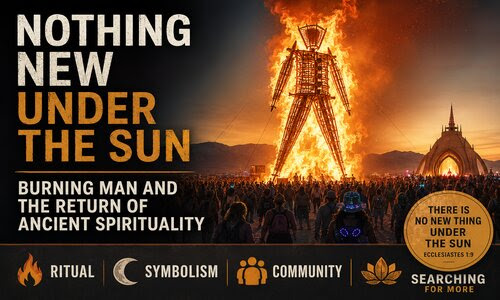
Right now, tens of thousands of people are gathered in Nevada’s Black Rock Desert for one of the strangest cultural events in America.
For one week, an empty stretch of desert becomes Black Rock City. Massive art installations rise from the dust as people wander through the desert in elaborate costumes, music continues deep into the night, and participants pursue everything from artistic expression and community to spiritual experiences and personal transformation. Eventually, enormous crowds will gather around a towering wooden figure known simply as “the Man” and watch as it is consumed by fire.
To much of the world, Burning Man is simply an eccentric celebration of art, freedom and radical self-expression. But perhaps Burning Man tells us something much deeper about modern Western civilization.
For decades we have been told that humanity is becoming increasingly secular. Traditional religion is supposedly fading because modern people have outgrown ancient beliefs, rituals and ideas about the sacred. Yet look at what is happening in the Nevada desert. Modern man may be abandoning Christianity, but he has certainly not abandoned his search for transcendence.
The Religion Of The Self
Burning Man began modestly in 1986 when a small group gathered on Baker Beach in San Francisco and burned an eight-foot wooden figure. By 1990, the gathering had migrated to Nevada, eventually becoming the enormous temporary city that exists today.
Burning Man is not officially a religion, nor should it be falsely characterized as one. Yet many of the impulses surrounding it are unmistakably spiritual. There is ritual, sacred-like space, communal experience, fire, symbolism, transformation and a search for something beyond ordinary existence.
At the center of Burning Man’s philosophy is also an idea thoroughly compatible with our modern age: the elevation of the individual self. Two of Burning Man’s famous principles are “Radical Self-expression” and “Radical Self-reliance.”
Contrast that with the message of Christianity. Jesus did not tell His followers to discover themselves, but to deny themselves: “If any man will come after me, let him deny himself, and take up his cross, and follow me.”
Our civilization increasingly tells us that identity comes from within. We determine who we are, define our own truth and pursue whatever brings fulfillment, until authenticity to ourselves becomes one of the highest virtues.
Scripture points in the opposite direction. Our identity begins with our Creator, and true freedom is found not by enthroning ourselves but by submitting ourselves to Him.
This struggle isn’t remotely new. It reaches all the way back to Genesis, where the serpent’s temptation was ultimately an invitation for humanity to step outside God’s authority and determine good and evil for itself. The setting changes, but the rebellion remains remarkably familiar.
Ancient Spirituality In Modern Clothing
When Christians hear the word “paganism,” they may picture ancient temples, carved idols and primitive civilizations gathered around fires. But why would pagan spirituality in the 21st century necessarily look like pagan spirituality from thousands of years ago?
Today it might involve electronic music, psychedelic experiences, sexual liberation, environmental spirituality, meditation, technology and elaborate interactive art. The outward appearance changes dramatically while many of the underlying spiritual impulses remain the same.
That makes this year’s Burning Man particularly fascinating.
The 2026 theme is “Axis Mundi,” an ancient concept referring broadly to a symbolic connection between heaven and earth. Burning Man’s organizers describe the theme in terms of interconnectedness, shared realities and humanity’s relationship with the natural world.
There is also this year’s Temple of the Moon. Inspired partly by lunar cycles, the structure incorporates themes of life, death, remembrance and release. Participants use Burning Man’s Temple as a deeply emotional space, leaving photographs, messages and memorials before the structure itself is eventually burned.
Think about the cultural contradiction. Western civilization supposedly moved beyond temples, sacred spaces, cosmic symbolism and religious ritual, yet thousands travel into a desert where they construct a Temple of the Moon beneath a theme called Axis Mundi, contemplate life and death, seek transformative experiences and ultimately watch enormous symbolic structures disappear into flames.
Solomon’s words seem remarkably appropriate: “There is no new thing under the sun,
We Haven’t Stopped Worshipping
Burning Man is only one manifestation of something much larger happening across Western society. Astrology is booming, tarot cards have returned to mainstream stores, and crystals, manifestation, witchcraft, psychedelics, goddess spirituality and various combinations of Eastern mysticism and New Age spirituality have all found receptive audiences.
Even some of the world’s most technologically sophisticated people have been fascinated by Burning Man. Silicon Valley entrepreneurs and technology executives have attended the gathering over the years, and there is something deeply revealing about that. The very people helping build humanity’s technological future are still searching for transcendence.
Artificial intelligence can answer questions, virtual reality can create worlds and technology can connect billions of people, but none of it can answer mankind’s oldest questions: Why am I here? Who am I? What happens when I die? Is there something beyond myself?
Human beings were created with an awareness that there is more to existence than material things. Removing Christianity from a culture doesn’t remove that hunger; it simply creates a vacuum waiting to be filled by something else.
Romans 1 describes humanity exchanging “the truth of God for a lie” and worshipping the creation rather than the Creator. That is the danger of a post-Christian culture. It does not necessarily become a culture without spirituality. Instead, it can become a culture filled with every spirituality except the truth.
Babel In The Desert
There is even something faintly reminiscent of Babel in what rises each year from Black Rock Desert. Thousands gather together in an empty landscape and construct an extraordinary temporary civilization where creativity, technology and human ingenuity combine to produce something genuinely impressive.
Burning Man is not literally Babel, of course, but Babel represents an enduring human temptation: mankind gathering together to establish meaning, identity and greatness apart from God. In that sense, Babel never really disappeared. Humanity simply keeps rebuilding it.
And that may be the most important lesson Christians should take from Burning Man.
The people gathering in Nevada are not simply objects of ridicule or condemnation. Many are searching for community, meaning, belonging and transcendence — things human beings have always desired. The tragedy is that so many in our increasingly post-Christian culture are searching everywhere except the One who created them.
The desert lights, electronic music, technology and spectacular artwork may all be thoroughly modern, but mankind’s desire to find meaning, identity and transcendence apart from God is ancient.
Burning Man may look like one of the most modern gatherings imaginable, but spiritually there truly is nothing new under the sun.
What John saw in Revelation 9 :
Autonomous drones revolutionize emergency response @ THE BLOW OF THE 5TH TRUMPET , these drones will be deployed

TruLight TV – Popcorn and Movie Time – Power of the Air
An African Missionary shares with a Christian man in the United States how he feels the church in America is in great danger. The Christian is very convicted by what he hears and then sets forth a plan to reach his city with the gospel.
Today on TruLight Radio XM
TruLight Radio XM 24/7
Program
GMT / UTC +2
Monday To Fridays
00:15 Words to Live By Testimonies
01.15 Science Scripture and Salvation
02.15 Ground Works
04.00 Gospel Concert of the Day
05.00 The Daren Streblow Comedy Show
5:55 It is Today devotional
6:00 Gaither Homecoming Morning Show
7:15 Discover the Word
8.15 Destined for Victory
8:55 Science Scripture and Salvation
9:00 Holy Spirit Hour – Normally Sermons
10:15 Hope of the Heart
11:15 Unshackled
11.45 Words to Live By
12:15 Truth for Life
13:15 Living on the Edge with Chip Ingram
14:15 Focus on the Family
15:00 Kids Hour
16:00 In Touch with Dr. Charles Stanley
16:30 Groundwork
17:15 Live in the Light
18:15 Renewing your Mind
19:00 Gaither Homecoming Show
20:15 Growing Hope
21:15 Adventures in Odyssey Radio Drama
21:45 Bible Reading
22:15 Night-sounds
23.00 Good Old Country Gospel / Rhema Gospel Express
VISIT THE WEBSITE
TruLight Ministry News – EXTRA MANNA

TruLight Ministries orders from God since 2012 . Teach Them , Comfort Them and Warn Them!
Artist Liners
Healing Truths.
End Time Articles.
Share this Feeding of Manna with your Friends and Family. just click on the Social Media icon and share This Manna with your Friends and Family. just click on the Social Media icon and share !