Hosted by TruLight Ministries International – The Place of Truth
SELECT YOUR READING LANGUAGE – BOTTOM LEFT = YOUR DAILY MANNA NOW AVAILABLE IN 103 LANGUAGES
@ TruLight Daily Manna is not Just a Bible Verse with a Small Prayer . NO ::: WE SERVE DAILY Manna for the ENTIRE Day . Breakfast , Lunch , Dinner , Plus tea Times and even Entertainment Manna . Plus News Manna and More , This Daily Manna will keep you Spiritually full for the full 48 Hours and even More to Share with your Friends and Family !!!
Taste and See the Lord is Good !!!

Psalm 34 is an acrostic poem; in this case, each line of verse begins with a different Hebrew letter, arranged in alphabetical order. The primary purpose of the psalm is to teach moral lessons about God. Its theme highlights God’s constant care for His people. In verse 8, the psalm’s author, David, invites readers to “taste and see that the Lord is good.” What does it mean to taste and see that the Lord is good?
To taste involves testing or sampling; to see involves understanding or perceiving. The phrase taste and see, then, means “try and experience.” David urges God’s people to discover the goodness of the Lord by personal trial and experience it for themselves. He doesn’t want readers to merely take his word for it that the Lord is good; he wants them to actively to experience and know for themselves the fact that God is good.
Humans associate taste with pleasure and satisfaction. Bible commentator Matthew Henry elaborates on this idea: “Let God’s goodness be rolled under the tongue as a sweet morsel.” When David says, “Taste and see that the Lord is good,” he is calling us to figuratively take a bite—to try for ourselves by our own experience—and find out exactly how satisfyingly good God is. The apostle Peter applies the same language in 1 Peter 2:3 when he says, “You have tasted that the Lord is good.”
Tasting must happen before seeing; that is, our spiritual experiences bring us to spiritual enlightenment and understanding. David desires others to “taste and see.” He wants them to experience what he has experienced so that they can know what he has come to know, the soul-sustaining goodness of the Lord.
Psalm 34 goes on to outline examples of God’s incredible goodness to those who take refuge in Him: He takes care of their every need (verses 8–10); He provides them with a good, long life (verses 11–15); He is with them through troubles and saves them from their enemies (verses 17–22). Those who taste and see that the Lord is good will know His provision.
Believers in Jesus experience tastes of God’s goodness and grace when we observe the beauty of His creation or recognize His blessings of provision, protection, and care. We taste and see His goodness when we contemplate His holiness and infinite righteousness. We delight in His goodness when we appreciate the cost of Christ’s sacrifice for our salvation.
To taste and see that the Lord is good, we must trust God and seek Him as our sole source of protection and provision. The only way to genuinely taste and see that the Lord is good is to put the matter to the test, to try and experience His goodness for ourselves.
Jesus declared, “No one is good—except God alone” (Luke 18:19). First John 1:5 tells us that “God is light; in him there is no darkness at all.” To say that God is good means that God always acts in accordance to what is right, true, and good. Goodness is part of God’s nature, and He cannot contradict His nature. Holiness and righteousness are part of God’s nature; He cannot do anything that is unholy or unrighteous. God is the standard of all that is good.
The fact that God is good means that He has no evil in Him, His intentions and motivations are always good, He always does what is right, and the outcome of His plan is always good (see Genesis 50:20). There is nothing unpleasant, evil, or dark in Him. The Bible teaches that God’s goodness extends from His nature to everything that He does (Psalm 119:68). “The Lord is good and his love endures forever; his faithfulness continues through all generations” (Psalm 100:5).
Everything that God made was originally good: “God saw all that He had made, and it was very good” (Genesis 1:31; cf. 1 Timothy 4:4). God’s goodness is showcased in the law He gave to Israel; the law is holy, righteous, and good (Romans 7:12). “Every good and perfect gift is from above” (James 1:17). God can create only what is good, because He is fully good.
God did not create evil (Habakkuk 1:13; 1 John 1:5). Rather, evil is the absence of goodness; it is whatever God is not. Because of His goodness, God abhors sin and will judge it some day (Romans 2:5). It is never the will of our good God for us to sin: “God cannot be tempted by evil, nor does he tempt anyone” (James 1:13).
God’s goodness should lead to thankfulness on our part: “Give thanks to the Lord, for he is good; his love endures forever” (Psalm 107:1; cf. 1 Chronicles 16:34; Psalm 118:1; 136). However, people do not naturally want to follow or thank God. Instead, “people loved darkness instead of light because their deeds were evil” (John 3:19). In the Old Testament, the Israelites repeatedly rejected God’s good law, forgot His goodness toward them, and were unfaithful to Him: “They forgot what he had done, the wonders he had shown them” (Psalm 78:11).
Ultimately, God’s goodness is seen in His plan to redeem us from sin. The gospel is “good news.” In His goodness, God sent His Son to become the perfect and blameless sacrifice so we could be forgiven of our sins. God does not want “anyone to perish, but everyone to come to repentance” (2 Peter 3:9), and it is “the goodness of God [that] leadeth thee to repentance” (Romans 2:4, KJV).
There is only One who is fully and truly good—God. This good God invites us to seek him and to “taste and see that the Lord is good; blessed is the one who takes refuge in him” (Psalm 34:8).
Generally speaking, a lord is someone with authority, control, or power over others; to say that someone is “lord” is to consider that person a master or ruler of some kind. In Jesus’ day the word lord was often used as a title of respect toward earthly authorities; when the leper called Jesus “Lord” in Matthew 8:2, he was showing Jesus respect as a healer and teacher (see also Matthew 8:25 and 15:25).
However, after the resurrection, the title “Lord,” as applied to Jesus, became much more than a title of honor or respect. Saying, “Jesus is Lord,” became a way of declaring Jesus’ deity. It began with Thomas’ exclamation when Jesus appeared to the disciples after His resurrection: “Thomas said to him, ‘My Lord and my God!’” (John 20:28). From then on, the apostles’ message was that Jesus is Lord, meaning “Jesus is God.” Peter’s sermon on the Day of Pentecost contained that theme: “Let all Israel be assured of this: God has made this Jesus, whom you crucified, both Lord and Messiah” (Acts 2:36). Later, in Cornelius’s house, Peter declared that Jesus is “Lord of all” (Acts 10:36). Note how in Romans 10:9 Jesus’ lordship is linked to His resurrection: “If you declare with your mouth, ‘Jesus is Lord,’ and believe in your heart that God raised him from the dead, you will be saved.”
The statement “Jesus is Lord” means that Jesus is God. Jesus has “all authority in heaven and on earth” (Matthew 28:18). He is Lord of the Sabbath (Luke 6:5). He is “our only Sovereign and Lord” (Jude 1:4). He is, in fact, the Lord of lords (Revelation 17:14).
Jesus referred to Himself as “Lord” many times (e.g., Luke 19:31; John 13:13). And when we compare the Old Testament with the New, we find several times when the “LORD” (Yahweh) of the Hebrew Bible is equated with the “Lord Jesus” by the apostles. For example, Psalm 34:8 says, “Taste and see that the LORD is good,” and that passage is alluded to in 1 Peter 2:3, except there Jesus is the “Lord” who is good. Isaiah 8:13 says that “the LORD Almighty is the one you are to regard as holy”; in 1 Peter 3:15 we are commanded, “In your hearts honor Christ the Lord as holy” (ESV).
Amazingly, the Lord Jesus left His exalted position in heaven and came to earth to save us. In His Incarnation, He showed us what true meekness looks like (see Matthew 11:29). Just before His arrest, Jesus used His power and authority to teach us humility: “Now that I, your Lord and Teacher, have washed your feet, you also should wash one another’s feet” (John 13:14). The last will be first, according to our Lord (Matthew 19:30).
In saying, “Jesus is Lord,” we commit ourselves to obey Him. Jesus asked, “Why do you call me, ‘Lord, Lord,’ and do not do what I say?” (Luke 6:46). An acknowledgement of Jesus’ lordship is logically accompanied by a submission to Jesus’ authority. If Jesus is Lord, then He owns us; He has the right to tell us what to do.
A person who says, “Jesus is Lord,” with a full understanding of what that means (Jesus is God and has supreme authority over all things) has been divinely enlightened: “No one can say, ‘Jesus is Lord,’ except by the Holy Spirit” (1 Corinthians 12:3). Faith in the Lord Jesus is required for salvation (Acts 16:31).
Jesus is Lord. It’s the truth, whether or not people acknowledge the fact. He is more than the Messiah, more than the Savior; He is the Lord of all. Someday, all will submit to that truth: “God exalted him to the highest place and gave him the name that is above every name, that at the name of Jesus every knee should bow, in heaven and on earth and under the earth, and every tongue acknowledge that Jesus Christ is Lord, to the glory of God the Father” (Philippians 2:9–11).

Tea Time Manna
Woe to those who make unjust laws, to those who issue oppressive decrees, to deprive the poor of their rights and withhold justice from the oppressed of my people, making widows their prey and robbing the fatherless.
—Isaiah 10:1-2
God wants us to be generous, compassionate, holy, and righteous. Why? Because that is who he is: holy and full of righteous character (1 Peter 1:13-16; 2 Peter 1:5-11) as well as full of gracious compassion (Exodus 34:6-7; Deuteronomy 10:18). This kind of well-rounded kind of godly character must show up in how we live our daily lives. We must be both holy and righteous as well as compassionate and gracious. Righteousness and holiness must not be compromised. Neither should compassion and grace be set aside. Many of us find this a difficult balance. Still, it is a balance we are called to keep as we seek to honor our God by reflecting his character in our lives and as the Holy Spirit increasingly transforms us into the character of Jesus (2 Corinthians 3:18; Galatians 5:22-23). After all, Jesus was the living demonstration of God’s righteous character and gracious compassion in human flesh (John 1:1-3, 14-18).
Prayer
O God, you are holy and righteous. You are also the God of compassion to the fatherless. Please increase our compassion and commitment to work for those who are forgotten, abused, disenfranchised, and pushed aside. Please move us to a deeper hunger for holiness that reflects your will. We want your full character, the character Jesus demonstrated, to be formed in our lives. In Jesus’ name, we pray. Amen and Amen
Truth Article by Pastor Dirk
Where will I open my eyes minutes after I Die?

My Spirit Filled Friend, I see you @ The Rapture & My Unsaved Friend I see you at the White throne Judgment! Pastor Dirk, Please explain your Statement!
As you know by now, TruLight Radio XM is all about Bible Prophecy, getting ready for the End Times and Bible Truth!
AND there is one more Truth that we need to Deal with, it’s been lying heavily on my heart.
The Misconception of People in Heaven and Hell right now!
I think it’s important to deal with this aspect from a Biblical Point of View and for us to receive this Truth sooner than later!
People tend to say: as soon as a loved one dies, that he or she is with Jesus in Heaven.
This is not correct and not according to the Bible!
Jesus said,
Joh 14:1-3 Let not your heart be troubled: ye believe in God, believe also in me.
In my Father’s house are many mansions: if it were not so, I would have told you. I go to prepare a place for you.
And if I go and prepare a place for you, I will come again, and receive you unto myself; that where I am, there ye may be also.
“I will come again, and receive you unto myself”
When will this be?
At the Second Coming of Jesus and during the Rapture!
As Jesus Ascended to Heaven Angels appeared to the Disciples and said!
Act 1:9-11 And when he had spoken these things, while they beheld, he was taken up; and a cloud received him out of their sight.
And while they looked stedfastly toward heaven as he went up, behold, two men stood by them in white apparel;
Which also said, Ye men of Galilee, why stand ye gazing up into heaven? this same Jesus, which is taken up from you into heaven, shall so come in like manner as ye have seen him go into heaven.
We see, both Jesus and the Angels Confirmed, We will see Him return from Heaven at His 2nd Coming AND will be Collected at the Rapture just before the Battle of Armageddon!
Paul Confirms This
1Th 4:13-18 But I would not have you to be ignorant, brethren, concerning them which are asleep, that ye sorrow not, even as others which have no hope.
For if we believe that Jesus died and rose again, even so them also which sleep in Jesus will God bring with him.
For this we say unto you by the word of the Lord, that we which are alive and remain unto the coming of the Lord shall not prevent them which are asleep.
For the Lord himself shall descend from heaven with a shout, with the voice of the archangel, and with the trump of God: and the dead in Christ shall rise first:
Then we which are alive and remain shall be caught up together with them in the clouds, to meet the Lord in the air: and so shall we ever be with the Lord.
Wherefore comfort one another with these words.
People will Argue this verses in the Bible about Lazarus and the Rich Man in Heaven and Hell, Please note that this was a Parable that Jesus used to explain! And not the fact of the matter!
Let’s Recap.
Jesus and the Angels said, That Jesus will return like He left and Collect us to be with Him in Heaven with His Father!
Paul Says. At the 2nd Coming of Jesus, God will bring the Dead in Christ that is asleep to the 2nd Coming, Paul describe these as the once asleep!
The Dead in Christ will arise with a Voice from an archangel and with the Sound of the 7th Trumpet. And then meet Jesus in the Air; we that are still alive at that Point will then change from mortal to immortal and meet Jesus in the air with the dead in Christ.
At this Point at the Rapture , Only the Once that Died in Christ will arise from the Grave , all the Unsaved will remain in the Grave until Just before the Great White Throne Judgment , 1000 Years after the Battle of Armageddon and the day satan and his demons was bound on earth for a 1000 Years.
Rev 20:5-8 But the rest of the dead lived not again until the thousand years were finished. This is the first resurrection.
Blessed and holy is he that hath part in the first resurrection: on such the second death hath no power, but they shall be priests of God and of Christ, and shall reign with him a thousand years.
And when the thousand years are expired, Satan shall be loosed out of his prison,
And shall go out to deceive the nations which are in the four quarters of the earth, Gog and Magog, to gather them together to battle: the number of whom is as the sand of the sea.
We need to understand that there are 3 Groups of the Dead and one person that were in the middle of the transmission period!
The 1st Group of Dead = the Saints of God.
This 1st Group was from Adam to the death of Jesus Christ! At the Death of Jesus he descended to the Place of Death and released all the dead from the stronghold of the Angel of Death and received the Keys of Hell.
He released all the Saints of God like, King David, Samuel, King Solomon, Jeremiah, Isaiah, Ezekiel and more. They were freed by Jesus and Taken to Heaven,
This was all the Dead of the 1st Covenant. (The Blood Sacrifice Covenant)
Only the Prophet Daniel was left from this Group, He was included to the 3rd Group to see the Rapture of the Christians!
Dan 12:13 But go thou thy way till the end be: for thou shalt rest, and stand in thy lot at the end of the days.
The 2nd Group of Dead = the 3 Year Ministry, Dead in Christ.
This Second Group was the Once that accepted Jesus during His 3 Year ministry on Earth, and that died in that 3 Years period and resurrected from the dead when Jesus descended to the Place of death after He died on the Cross, and released the saints of God.
He resurrected the dead in Christ from the grave as the Graves opened during the 3 hours of darkness after the death of Jesus. So everyone that accepted Christ during his 3 Years of Ministry, Lived again, as they resurrected from the graves as the graves opened!
Mat 27:50-53 Jesus, when he had cried again with a loud voice, yielded up the ghost.
And, behold, the veil of the temple was rent in twain from the top to the bottom; and the earth did quake, and the rocks rent;
And the graves were opened; and many bodies of the saints which slept arose,
And came out of the graves after his resurrection, and went into the holy city, and appeared unto many.
The Thief on the Cross. The one person that died during the transition period.
One person died during this process, just after Jesus released all the dead from the Place of Death, and that was the murderer on the cross with Him, The one that Jesus told, that he will be with Jesus in Paradise that very day.
Luk 23:42-43 And he said unto Jesus, Lord, remember me when thou comest into thy kingdom.
And Jesus said unto him, Verily I say unto thee, To day shalt thou be with me in paradise.
For this Thief Died after the 1st Covenant release of the Dead happened and was not included into the 1st or 2nd Group called The Saints of God or the Dead in Christ before the resurrection of Jesus Christ. And could not be Part of the 3rd Group, The Dead in Christ after the Resurrection of Jesus Christ.
The 3rd Group = the Dead in Christ after His resurrection.
This 3rd Group , is all the Dead in Christ , That accepted Jesus Christ, That was Baptized in water and The Holy Spirit , from the Day Jesus arose from the Grave, to Present and beyond until the Rapture at the 2nd Coming of Jesus Christ.
Joh 3:3-6 Jesus answered and said unto him, Verily, verily, I say unto thee, Except a man be born again, he cannot see the kingdom of God.
Jesus answered, Verily, verily, I say unto thee, except a man be born of water and of the Spirit, he cannot enter into the kingdom of God.
That which is born of the flesh is flesh; and that which is born of the Spirit is spirit.
So every person that will Enter the Kingdom of Heaven from +- 36AC to Present and Beyond until the 2nd Returning of Jesus Christ, Just before the Battle of Armageddon.
This Group is not in Heaven yet and will only see Jesus at the Rapture after His 2nd Coming.
What Happens to the Unsaved?
For the Unsaved in this Group will not awake during the Rapture and remain in the Grave until the Point that satan and his demons is released 1000 years after the battle of Armageddon.
So they will remain asleep from 36 AC to a point a few days before the White Throne Judgment.
For those unsaved that is still alive during the second coming of Jesus Christ, They all will die during the Battle of Armageddon. And stay asleep for 1000 Years to be resurrected for a last time, ready for the White Throne Judgment.
Rev 20:11-15 And I saw a great white throne, and him that sat on it, from whose face the earth and the heaven fled away; and there was found no place for them.
And I saw the dead, small and great, stand before God; and the books were opened: and another book was opened, which is the book of life: and the dead were judged out of those things which were written in the books, according to their works.
And the sea gave up the dead which were in it; and death and hell delivered up the dead which were in them: and they were judged every man according to their works.
And death and hell were cast into the lake of fire. This is the second death.
And whosoever was not found written in the book of life was cast into the lake of fire.
So all the Unsaved from +- 36 AC until after the Battle of Armageddon will remain asleep. Until the day satan and his demons is release 1000 years after the Battle of Armageddon. And face the White Throne Judgment, Just before they will be caste into Hell for eternity after the judgment!
To Recap.
The Time Period between the Day you die and the day you open your eyes, will not even feel like 3 Minutes. It will feel like you were asleep!
For Example of somebody died in Christ in the 1800 s he or she will only wake up at the Rapture!
The Reborn baptized in Water and Spirit Filled Christians will closes his or her eyes at his or her death and open them at the Rapture to see Jesus in the Air. This will be at the same time we that is still alive during the time of the 2nd Coming of Jesus Christ and the Rapture, will minutes later meet them in the Air with Jesus!
So all our Loved once that Died in Christ, and was baptized in water and Spirit will see Jesus just minutes before we will. They are not currently in Heaven. And our unsaved relatives are not currently in Hell.
The Unsaved will close their eyes at their Death and only open it up to be deceived by satan and his demons a last time to attack the Golden City , and when they arrive there , The White Throne Judgment will appear and the Judgment will take place.
As Paul said!
Wherefore comfort one another with these words. I will meet my Relatives and Friends again!
If they were saved before their Death, and you are saved, you will see them in the Air with Jesus at His 2nd Coming and the Rapture.
If they were unsaved at their death, you will see them standing in front of the White Throne Judgment, and if you are Unsaved too, you will be Joining them in front of the White Throne Judgments!
Are YOU Ready?
Article by Pastor Dirk – TruLight Ministries International
NEWS MANNA

The Pick-And-Choose Bible: A Generation Wants Scripture Without Its Authority
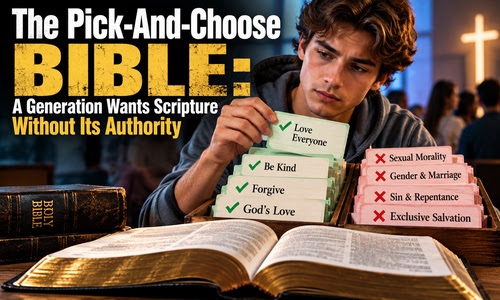
Something strange is happening among younger Christians.
They haven’t necessarily abandoned the Bible. Many are still attending church. Some are reading Scripture with renewed interest. They may quote it, discuss it, post verses from it and describe it as important to their faith.
But increasingly, they appear unwilling to let it have the final word.
That is the troubling picture emerging from new Lifeway Research findings showing a widening generational divide over biblical authority. Among Protestant churchgoers ages 18 to 29, 54% agreed that “as culture changes, some biblical truths become obsolete.”
Think about what that means.
These aren’t statistics drawn exclusively from atheists, agnostics or people who walked away from Christianity years ago. Lifeway surveyed Protestant Americans who attend church at least monthly.
Yet more than half of the youngest adult churchgoers surveyed believe cultural change can apparently place an expiration date on biblical truth.
And that may tell us more about the future of American Christianity than declining attendance ever could.
The Bible As Adviser Instead Of Authority
There is an enormous difference between struggling with something the Bible teaches and believing you possess the authority to discard it.
Christians have wrestled with difficult passages for two thousand years. They have debated interpretation, doctrine and application. Serious Christians can disagree about what particular passages mean.
But historically orthodox Christianity begins with a fundamentally different assumption: Scripture judges us. We don’t judge Scripture.
Increasingly, that relationship appears to be reversing.
Lifeway found that 34% of Protestant churchgoers say they accept some truths from the Bible while others “do not fit what they believe,” up from 30% in 2019.
Among churchgoers ages 18 to 29, that figure reaches 56%.
That wording is revealing.
The question is no longer simply, “What does the Bible teach?”
It becomes, “Does what the Bible teaches fit what I already believe?”
Once that happens, Scripture has ceased functioning as an authority. It has become an adviser. We consult it, appreciate the portions that affirm us and quietly dismiss those that don’t.
It is Christianity with an edit button.
Culture Gets The Deciding Vote
This helps explain what has happened inside portions of American Christianity.
The Bible hasn’t suddenly changed its teaching about marriage, sexuality, sin, repentance, judgment, salvation or the identity of Christ.
The surrounding culture has changed.
And wherever Scripture collides with the prevailing values of the age, Christians increasingly face a choice: allow Scripture to challenge the culture, or allow the culture to reinterpret Scripture.
The temptation to choose the latter is enormous.
It is much easier to announce that an uncomfortable biblical teaching belongs to another time than to tell friends, coworkers or children that Christianity places boundaries around human desires.
It is easier to redefine sin than call people to repentance.
It is easier to reinterpret Jesus than submit to Him.
And eventually Christianity can be reconstructed into something remarkably compatible with whatever society already believes.
The result may still have churches. It may still have worship music, clergy, crosses, Bible studies and Christian vocabulary.
But who actually has authority?
That is the question.
The Encouraging Part Of The Story
There is another development taking place that makes these findings even more fascinating.
Young Americans appear increasingly interested in the Bible.
Barna reported that weekly Bible reading among American adults climbed sharply in 2025, with particularly strong engagement among younger generations.
That should be encouraging.
After years of warnings about biblical illiteracy, a generation shaped by social media, political turmoil, loneliness and rapidly changing technology may be looking again for something deeper and more permanent.
But reading Scripture and submitting to Scripture are not necessarily the same thing.
A person can open the Bible searching for wisdom while still reserving the right to reject anything that conflicts with his worldview.
That may be the defining spiritual struggle of this generation.
Will young Christians approach Scripture asking, “What does God require of me?”
Or will they approach it asking, “How can this be reconciled with what I already believe?”
Those questions may sound similar.
They lead in opposite directions.
When Truth Becomes Personal
The Lifeway findings reveal another striking generational difference.
Among churchgoers ages 18 to 29, 87% agreed that the truth of God’s Word can mean different things to different people.
There is a legitimate sense in which Scripture applies differently to people in different circumstances. But if the underlying truth itself becomes personalized, Christianity enters dangerous territory.
Because Christianity makes claims that aren’t merely personal.
Christ rose from the dead or He didn’t.
Sin separates humanity from God or it doesn’t.
Christ is the way to the Father or He isn’t.
God established moral boundaries or He didn’t.
Those claims cannot simultaneously mean contradictory things simply because different people prefer different conclusions.
Jesus did not present truth as infinitely customizable.
He said, “I am the way, the truth, and the life.”
The Coming AI Bible
And now this struggle is arriving at exactly the moment artificial intelligence is becoming a powerful interpreter of information.
That combination deserves much more attention.
Barna reported in 2026 that large majorities of practicing Christians and pastors are concerned about AI misinterpreting Scripture. At the same time, AI is rapidly becoming a normal place for people to ask deeply personal questions about relationships, morality, purpose and spirituality.
Imagine where this leads.
For most of Christian history, someone wrestling with a biblical teaching might consult a pastor, commentary, theologian or mature Christian.
Now he can ask an algorithm.
And if he doesn’t like the first answer, he can rephrase the question.
Again.
And again.
Until he receives an interpretation comfortable enough to accept.
The danger isn’t merely that AI could misunderstand the Bible. The greater danger may be that humans will use AI to construct exactly the Bible they want.
A Christianity customized to the individual.
No uncomfortable doctrines. No unwanted restrictions. No difficult demands.
Just affirmation on demand.
The Question Every Generation Must Answer
Every generation encounters biblical teachings it would rather avoid.
Ours isn’t unique in that regard.
What is different is the growing assumption that cultural change itself can make biblical truth obsolete.
If that principle is accepted, there is ultimately no fixed point left.
Culture changes constantly. What society celebrates today may embarrass it fifty years from now. Moral fashions rise and fall. Political movements appear and disappear. Entire philosophies that once seemed unquestionably modern eventually end up in history books.
Christianity makes a radically different claim.
“Jesus Christ is the same yesterday and today and forever.”
The church therefore cannot measure Scripture against the culture and keep whichever one seems more modern.
It must decide which one possesses authority.
Because once Christians reserve the right to decide which biblical truths remain acceptable, the Bible may still sit on the nightstand.
It may still be carried into church.
It may still be quoted on Sunday morning.
But it is no longer really in charge.
And a generation that wants Scripture without its authority may eventually discover that it has kept the Bible while creating an entirely different religion.
Worship At Your Own Risk: Christianity Under Pressure Across The Muslim World
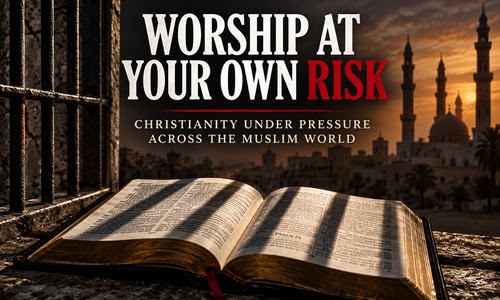
For millions of Christians, Sunday worship begins with a question most Americans have never had to ask: What could happen to me if someone discovers I am here?
Will the police come? Will the church be closed? Will my Bible be confiscated? Could I lose my job, be rejected by my family, be accused of blasphemy, or find myself sitting in a prison cell because I chose to follow Jesus Christ?
Across parts of the Muslim world, these are not hypothetical questions.
Christianity continues to survive — and in some places grow — under governments and societies where abandoning Islam, evangelizing Muslims, operating an unapproved church or publicly expressing Christian beliefs can bring consequences ranging from harassment and surveillance to arrest, imprisonment and violence.
The methods differ from country to country. Some governments use licensing laws and bureaucratic restrictions to squeeze churches out of existence. Others target converts and underground congregations as threats to the state. Elsewhere, blasphemy laws create an environment in which an accusation involving Islam can place a Christian’s freedom — and potentially life — in jeopardy.
Three recent cases illustrate the different faces of this pressure.
In Algeria, police raided a Christian worship gathering and seized Bibles and Christian literature.
In Iran, an intensified crackdown has swept Christians associated with underground churches into arrests and imprisonment, while one Christian ministry reports that dozens of its ministers have been killed.
And in Pakistan, Christians continue to face blasphemy prosecutions under laws carrying the possibility of a death sentence.
Three countries. Three different systems. One recurring reality: openly following Christ can come with a price.
And sometimes all it takes to discover that price is gathering together to worship.
Algeria: When A Worship Service Becomes A Police Matter
Twelve Christians gathered quietly for worship in an apartment connected to a humanitarian shelter in Algeria on September 4.
Then the special forces arrived.
Police raided the gathering at the House of Refuge in L’Ayaida, about 22 miles east of Oran. All 12 Christians present were detained. Christian literature was seized along with mobile phones and identity cards. The women were eventually released, while some of the men reportedly remained in custody until around 3 a.m.
Their alleged offense was not violence, extremism or plotting against the government.
They had gathered for Christian worship.
Christians fear the group could be prosecuted under Algeria’s Ordinance 06-03, the 2006 law governing non-Muslim worship. Among other provisions, the law restricts collective non-Muslim worship to approved locations and criminalizes certain attempts to persuade Muslims to embrace another religion.
Penalties for some violations can include years in prison.
The September raid also didn’t occur in isolation.
Open Doors reports that nearly all 47 churches associated with the Protestant Church of Algeria have received closure orders or have been sealed. More than 50 Christians have reportedly faced prosecution connected to their faith in recent years.
That creates an extraordinary dilemma: Christians are told they must worship within approved structures while churches themselves have been systematically closed.
The result is exactly what happened in L’Ayaida.
A small gathering of believers inside an apartment became a matter for police surveillance, detention and confiscated Christian literature.
Iran: Christianity Goes Underground
Several thousand miles east, the stakes become even higher.
Iran recognizes some historic Christian minorities, but converts from Islam and Christians associated with evangelical house churches operate in a dramatically different environment.
Texas-based Iran Alive Ministries recently reported that at least 33 Christian ministers associated with its network had been killed amid Iran’s recent unrest and crackdown. The ministry also reported that 131 Christians connected to its work had been arrested, with some detainees potentially facing extremely serious charges.
Those specific numbers come from Iran Alive’s network and have not all been independently verified. But Iran’s broader persecution of converts and underground Christian congregations has been extensively documented by religious-freedom organizations.
The pressure extends beyond church meetings.
Christian broadcasting has also come under intensified restriction, creating additional danger for Iranians seeking Christian teaching outside government-approved religious structures.
Yet something remarkable continues beneath the surface.
Christianity refuses to disappear.
Iran Alive says thousands of Iranians have responded to the Christian message this year despite the danger. Underground believers continue gathering. Converts continue sharing their faith. According to the ministry, some Christians who have been imprisoned have even viewed prison as another place to share the Gospel.
That exposes one of the great limitations of religious persecution.
A government can confiscate a Bible.
It can close a church.
It can arrest a pastor.
But stopping people from believing what is written inside that Bible is considerably harder.
Pakistan: When An Accusation Can Destroy A Life
Pakistan presents another form of pressure — one built around some of the world’s most severe blasphemy laws.
Christian laborer Amir Masih was arrested in August following allegations involving religious remarks and material reportedly circulated on social media. Police registered charges that included Section 295-C of Pakistan’s Penal Code, which deals with derogatory remarks concerning Islam’s prophet and carries the death penalty.
The allegations against Masih have not been proven in court, and Christian and human-rights organizations have called for an independent investigation into the evidence.
His case isn’t unique.
Twenty-six-year-old Christian Samuel Arif was arrested in Lahore later that month in another blasphemy case. His family disputes the allegations. He too reportedly faces charges under Section 295-C.
Pakistan has not carried out a state execution for blasphemy, but defendants have received death sentences and can spend years imprisoned while their cases move through the courts.
A July 2026 British government assessment cited USCIRF information showing at least nine Pakistani Christians serving death or life sentences for blasphemy and another nine detained on blasphemy allegations as of May.
But prison isn’t the only danger.
Blasphemy accusations in Pakistan have repeatedly triggered mob violence and threats against religious minorities. That means an accusation itself can have devastating consequences long before a court reaches a verdict.
Families flee.
Communities turn against the accused.
Christian neighborhoods can become targets.
Churches can require protection.
A few words attributed to the wrong person — whether accurately or falsely — can transform an ordinary life overnight.
Three Countries, Three Methods
Algeria, Iran and Pakistan are very different nations. Their governments, laws and Muslim populations should not be treated as interchangeable.
But the experiences of Christians within them reveal a disturbing pattern.
In Algeria, government regulation determines where Christians may legally worship and churches have been systematically closed.
In Iran, converts and underground evangelical congregations face intense scrutiny and the possibility that Christian activity will be treated as a threat to the Islamic state.
In Pakistan, blasphemy allegations can expose Christians to prosecution, imprisonment, death sentences and mob violence.
Control the worship.
Suppress the conversion.
Criminalize the alleged blasphemy.
Different mechanisms. Similar vulnerability.
And underneath each situation lies a question Christians in the West rarely have to contemplate:
What happens when following Christ becomes dangerous?
For Christians living under these pressures, Christianity isn’t merely an identity selected on a census form. Attending a worship gathering, possessing Christian literature, sharing the Gospel or publicly identifying with Jesus Christ can carry consequences most Western believers have never experienced.
Remember Those In Chains
It is easy for persecuted Christians to become statistics.
Twelve arrested.
Dozens reportedly killed or detained.
Christians sitting in Pakistani prisons under blasphemy convictions or accusations.
But behind every number is a person who has made the same decision believers have been making for nearly two thousand years: Christ is worth following even when following Him has a price.
Hebrews gives the Church an instruction that remains painfully relevant:
“Remember them that are in bonds, as bound with them.”
The persecuted Church isn’t a historical chapter belonging to Roman emperors and ancient martyrs.
It exists right now.
It meets in apartments when churches are closed.
It worships behind doors that may suddenly be opened by police.
It hides Christian literature.
It gathers in underground house churches.
It enters courtrooms accused of blasphemy.
And sometimes believers must decide whether worshipping Jesus Christ is worth the possibility that authorities — or an angry crowd — will discover what they are doing.
For much of the Western Church, worship remains something Christians schedule.
For millions of believers elsewhere, it remains something they risk.

TruLight TV Movie and Popcorn Time – The Book 0f Esther

Jewish girl Esther is chosen as the new queen consort to King Xerxes of Persia. Will she be able to stop the evil Lord Haman’s plot to exterminate the Jews?
Today on TruLight Radio XM
TruLight Radio XM 24/7
Program
GMT / UTC +2
Monday To Fridays
00:15 Words to Live By Testimonies
01.15 Science Scripture and Salvation
02.15 Ground Works
04.00 Gospel Concert of the Day
05.00 The Daren Streblow Comedy Show
5:55 It is Today devotional
6:00 Gaither Homecoming Morning Show
7:15 Discover the Word
8.15 Destined for Victory
8:55 Science Scripture and Salvation
9:00 Holy Spirit Hour – Normally Sermons
10:15 Hope of the Heart
11:15 Unshackled
11.45 Words to Live By
12:15 Truth for Life
13:15 Living on the Edge with Chip Ingram
14:15 Focus on the Family
15:00 Kids Hour
16:00 In Touch with Dr. Charles Stanley
16:30 Groundwork
17:15 Live in the Light
18:15 Renewing your Mind
19:00 Gaither Homecoming Show
20:15 Growing Hope
21:15 Adventures in Odyssey Radio Drama
21:45 Bible Reading
22:15 Night-sounds
23.00 Good Old Country Gospel / Rhema Gospel Express
VISIT THE WEBSITE
TruLight Ministry News – EXTRA MANNA

TruLight Ministries orders from God since 2012 . Teach Them , Comfort Them and Warn Them!
Artist Liners
Healing Truths.
End Time Articles.
Share this Feeding of Manna with your Friends and Family. just click on the Social Media icon and share This Manna with your Friends and Family. just click on the Social Media icon and share !