Hosted by TruLight Ministries International – The Place of Truth
SELECT YOUR READING LANGUAGE – BOTTOM LEFT = YOUR DAILY MANNA NOW AVAILABLE IN 103 LANGUAGES
@ TruLight Daily Manna is not Just a Bible Verse with a Small Prayer . NO ::: WE SERVE DAILY Manna for the ENTIRE Day . Breakfast , Lunch , Dinner , Plus tea Times and even Entertainment Manna . Plus News Manna and More , This Daily Manna will keep you Spiritually full for the full 48 Hours and even More to Share with your Friends and Family !!!
7 Psalms for when your Mind are Under Attack !!! Psalm 121
My Help Comes from the Lord
Psa 121:1 A Song of degrees. I will lift up mine eyes unto the hills, from whence cometh my help.
Psa 121:2 My help cometh from the LORD, which made heaven and earth.
Psa 121:3 He will not suffer thy foot to be moved: he that keepeth thee will not slumber.
Psa 121:4 Behold, he that keepeth Israel shall neither slumber nor sleep.
Psa 121:5 The LORD is thy keeper: the LORD is thy shade upon thy right hand.
Psa 121:6 The sun shall not smite thee by day, nor the moon by night.
Psa 121:7 The LORD shall preserve thee from all evil: he shall preserve thy soul.
Psa 121:8 The LORD shall preserve thy going out and thy coming in from this time forth, and even for evermore.
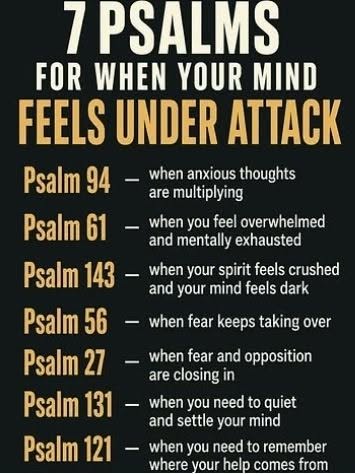
Psalm 121 is categorized as one of the “Songs of Ascent” sung by pilgrims traveling to Jerusalem. The opening two verses form a poetic question and answer: “I lift up my eyes to the mountains—where does my help come from? My help comes from the LORD, the Maker of heaven and earth” (Psalm 121:1–2). As the psalmist climbs upward through the hills on his approach toward Jerusalem, he affirms that the Lord who created the heavens and the earth is his sole source of help.
Jewish tradition claims that God’s people sang these pilgrim Songs of Ascent (Psalms 120—134) as they journeyed to the temple for one of the yearly worship festivals. Psalm 121 announces the worshiper’s confidence in God to watch over Israel and shelter His people from all harm. At the same time, this psalm is a general declaration of trust in God as the guardian and protector of life’s journey.
As the poet looks up to the mountains, it’s as if he sees Yahweh, God the Creator of heaven and earth, seated there on His heavenly throne. The Bible often refers to the heights of Jerusalem as the holy mountain where God dwells (Zechariah 8:3; Psalm 48:1–2; Isaiah 27:13). From this high place of God’s presence comes help from the Lord: “I call out to the LORD, and he answers me from his holy mountain” (Psalm 3:4; see also Psalm 20:2; 134:3). Likewise, from this sacred dwelling place of the Lord comes everlasting security: “As the mountains surround Jerusalem, so the LORD surrounds his people both now and forevermore” (Psalm 125:2).
Our help comes from the Lord through His vigilant, never wearying, sleepless protection: “He will not let your foot slip—he who watches over you will not slumber; indeed, he who watches over Israel will neither slumber nor sleep” (Psalm 121:3–4). In every danger, whether from sunstroke in the heat of the day or exposure to the cold of night, “the LORD himself watches over you! The LORD stands beside you as your protective shade” (Psalm 121:5–6, NLT; see also Psalm 91:1 ). Whether we face threats to the body or soul, in every situation of life, “God is our refuge and strength, always ready to help in times of trouble” (Psalm 46:1, NLT). Twenty-four hours a day, seven days a week, God has us covered.
The child of God can confidently say, “My help comes from the Lord,” because God keeps and protects His children at all times and in all dangers: “The LORD keeps you from all harm and watches over your life. The LORD keeps watch over you as you come and go, both now and forever” (Psalm 121:7–8, NLT).
The Bible is full of incredible promises of help from the Lord for those who hope and trust in Him: “You who fear him, trust in the LORD—he is their help and shield” (Psalm 115:11; see also Psalm 33:20). In Psalm 23, the Lord is our Shepherd, leading and guiding us through all of life’s hardships and joys. In the New Testament, believers in Jesus say, “My help comes from the Lord,” because Christ is their Good Shepherd who lays down His life for the sheep (John 10:11–15).
The Lord helps us in innumerable ways. He forgives our sins and cleanses us from all unrighteousness (1 John 1:9; Psalm 32:5). God gives us new life in Jesus Christ and sets us free from sin (Colossians 2:20—3:17; Romans 6:18). He grants us eternal life (1 John 2:25). The Lord is a faithful friend (John 15:13–14) who calms our fears, takes care of our needs, and supplies us with supernatural peace (2 Timothy 1:7; Philippians 4:6–7). He loves us perfectly and completely, and He never leaves us (1 John 4:18; Romans 8:31–38).
All believers of every generation can proclaim, “My help comes from the Lord!” No matter what trouble we face in this dark world, God is with us, shining His light into the darkness (John 1:4; 2 Corinthians 4:6) and providing everything we need for life and godliness (2 Peter 1:3). Whatever setbacks, hardships, or evil we encounter, our faithful God will transform these challenges to contribute toward our good (Romans 8:28). All of our days, He is our Helper and the God who sustains our lives (Psalm 54:4).
The Bible is awash with anguished cries for help from humans in need. While on a grueling, uphill pilgrimage to Jerusalem, the psalmist asked, “Where does my help come from?” (Psalm 121:1). Suffering in desolation and misery, Job wondered, “Does not one in a heap of ruins stretch out his hand, and in his disaster cry for help?” (Job 30:24, ESV). Job later acknowledged, “I stand up in the assembly and cry for help” (Job 30:28).
“From deep in the realm of the dead I called for help,” prayed Jonah from his underwater prison cell inside the belly of a great fish (Jonah 2:2). “Where can I go for help?” and “Where does my help come from?” These are universal appeals for help from within the heart of humanity.
The resounding answer to this widespread plea is, “My help comes from the LORD, the Maker of heaven and earth” (Psalm 121:2). Perhaps better than any other passage in the Bible, Psalm 121 illuminates how God, the all-powerful Creator and ever-present Protector, is the only real and trustworthy source of help for humankind.
This collective human call for help is proof that people need a Savior (Romans 3:23). We are born lost in our sin (Isaiah 59:2). Yet, within the soul of every person, God has placed an awareness of lack, of needing something more—an internal, eternal longing (Ecclesiastes 3:11). Deep inside, we know we cannot save ourselves (Romans 3:10–20; 4:1–12). Our hearts cry out to God, “Rise up; come to our help! Redeem us for the sake of your steadfast love!” (Psalm 44:26, ESV).
When the psalmist proffered the question, “Where does my help come from?” he was not asking from a place of perplexity or doubt. No, he spoke in prayerful expectation. He trusted that God the Creator was tirelessly watching over him, sleeplessly protecting him. He knew the help he longed for would come from the Lord: “He will not let your foot slip—he who watches over you will not slumber; indeed, he who watches over Israel will neither slumber nor sleep” (Psalm 121:3–4).
Sadly, the human tendency is to look for help in all the wrong places. We try to solve our problems in our own strength or according to the wisdom of the world. We phone our parents when we need someone to bail us out. We look to friends for companionship or a spouse to satisfy the longing in our souls. We seek success and self-esteem from our careers. We turn to drugs and alcohol to fill the emptiness inside. We attempt to find happiness or even just ways to cope by experimenting with everything this world offers. But all these solutions fall short. What we need most is to cry out, “Help me, LORD my God; save me according to your unfailing love” (Psalm 109:26).
Like the prophet Isaiah, we can stand firm knowing where our help comes from, or better Whom it comes from: “Because the Sovereign LORD helps me, I will not be disgraced. Therefore, I have set my face like a stone, determined to do his will. And I know that I will not be put to shame” (Isaiah 50:7, NLT).
The psalmist affirmed, “The LORD is your keeper; the LORD is your shade on your right hand. The sun shall not strike you by day, nor the moon by night” (Psalm 121:5–6). No matter what we face, day or night, the Lord stands over us as a protective shield. Through every trial and storm, God is our constant shelter and refuge (Psalm 46:1; 91:1; Proverbs 18:10). Our good and loving Lord will protect us from every evil (Psalm 121:7).
If a believer should ask you, “Where does my help come from?” You can offer them this remarkable assurance: At all times, no matter where you go, and for as long as you live, the Bible declares, “Your help comes from the Lord!” (Psalm 121:8).
The city of Jerusalem—the center of ancient Jewish worship—is perched high upon a hill. As worshipers traveled there for one of the three main yearly Jewish festivals, they traditionally sang “Songs of Ascent” while climbing the road into the city. The Jewish priests may have sung these Songs of Ascent (also called Pilgrim Songs) as they ascended the temple steps in Jerusalem. One such psalm states, “I lift up my eyes to the hills. From where does my help come? My help comes from the Lord, who made heaven and earth” (Psalm 121:1–2, ESV).
On his approach to Jerusalem, the pilgrim declared, “I lift my eyes to the hills,” the place where God dwells. Just as Isaiah saw the Lord “sitting on a throne, high and lifted up” (Isaiah 6:1, NKJV), the psalmist looked up to the mountains of Jerusalem and saw God the Creator of heaven and earth, seated on His heavenly throne in Mount Zion.
Scripture frequently refers to the heights of Jerusalem as the holy “Mountain of the Lord” where God dwells (Zechariah 8:3; Isaiah 27:13). One psalmist describes Jerusalem as “the city of our God, which sits on his holy mountain! It is high and magnificent; the whole earth rejoices to see it! Mount Zion, the holy mountain, is the city of the great King!” (Psalm 48:1–2, NLT). In Psalm 87:2, the same writer reports that God “loves the city of Jerusalem more than any other city in Israel.”
“I lift my eyes to the hills” was the worshiper’s declaration of trust and dependence upon God for help. He was going to meet with the Lord and offer sacrifices of praise because the Lord his God, Creator of the universe, was his singular source of help. From the elevated place of His holy presence, God would grant assistance and deliverance: “I call out to the Lord, and he answers me from his holy mountain” (Psalm 3:4; see also Psalm 20:2; 134:3). From His sacred dwelling place, the Lord would offer everlasting security: “As the mountains surround Jerusalem, so the Lord surrounds his people both now and forevermore” (Psalm 125:2).
In another song of ascent, the psalmist makes a similar pronouncement of trust and reliance on God for help: “To you I lift up my eyes, O you who are enthroned in the heavens! Behold, as the eyes of servants look to the hand of their master, as the eyes of a maidservant to the hand of her mistress, so our eyes look to the Lord our God, till he has mercy upon us” (Psalm 123:1–2, ESV). This time God is not perceived as dwelling in the hills of Jerusalem but enthroned in the heavens, and it is His mercy the psalmist seeks.
Directing our eyes toward God symbolizes our complete trust and reliance on Him for help: “But my eyes are toward you, O God, my Lord; in you I seek refuge; leave me not defenseless!” (Psalm 141:8, ESV). “My eyes are always on the Lord, for he rescues me from the traps of my enemies,” acknowledged King David (Psalm 25:15, NLT). The writer of Hebrews taught us to stay the course and finish the race of the Christian life by “fixing our eyes on Jesus, the pioneer and perfecter of faith” (Hebrews 12:2).
Lifting our eyes toward God is a biblical image of prayer. As a great multitude of enemies came against Jehoshaphat, he prayed to the Lord, “We do not know what to do, but our eyes are on you” (2 Chronicles 20:12). At his stoning, Stephen prayed and “looked up to heaven and saw the glory of God, and Jesus standing at the right hand of God” (Acts 7:55). Even Jesus Himself “lifted up his eyes to heaven” when He prayed to His Father (John 17:1).
When we say, “I lift my eyes to the hills,” we communicate a trust in God that can sustain us through every danger, hardship, and challenge along life’s journey until we are safely home in God’s eternal kingdom.

Tea Time Manna
Teach the older men to be temperate, worthy of respect, self-controlled, and sound in faith, in love, and in endurance.
—Titus 2:2
“Worthy of respect”: What a goal for our lives, whether we are a man or a woman!
Don’t you want your life to reflect the character of God because your faith expresses itself in a life that is temperate (reverent), self-controlled, faithful, loving, and steadfast? Paul wants Timothy to urge the older men to genuinely display these character qualities as they live in the presence of and have influence over others in the family of God. Such character is the work of the Spirit in our lives (Galatians 5:22-23) and manifests only as we dedicate ourselves to pursuing Christ-likeness and offering ourselves to the Holy Spirit for God’s transforming work in us (2 Corinthians 3:18). As we grow older, we often worry about securing our financial investments so we can live comfortably in our older years. The apostle Paul’s concern as we age is that we are yielded to Jesus, so that God’s transformative work in us makes us more valuable for his service and for those around us!
Prayer
Father, please strengthen my faith in Jesus as the Holy Spirit does your transforming work in me. Please help me gain better control of my passions, speech, example, temper, kindness, and habits. Help me put to death the things that would rob me of my spiritual passion and poison my influence for good for those around me. Please strengthen my faith as I seek to treat others lovingly and persevere in faith through difficult times. In Jesus’ name, and for my transformation to be more like him, I pray. Amen and Amen
Truth Article by Pastor Dirk
Religious history in South Africa of 374 years Summarized in a few paragraphs.
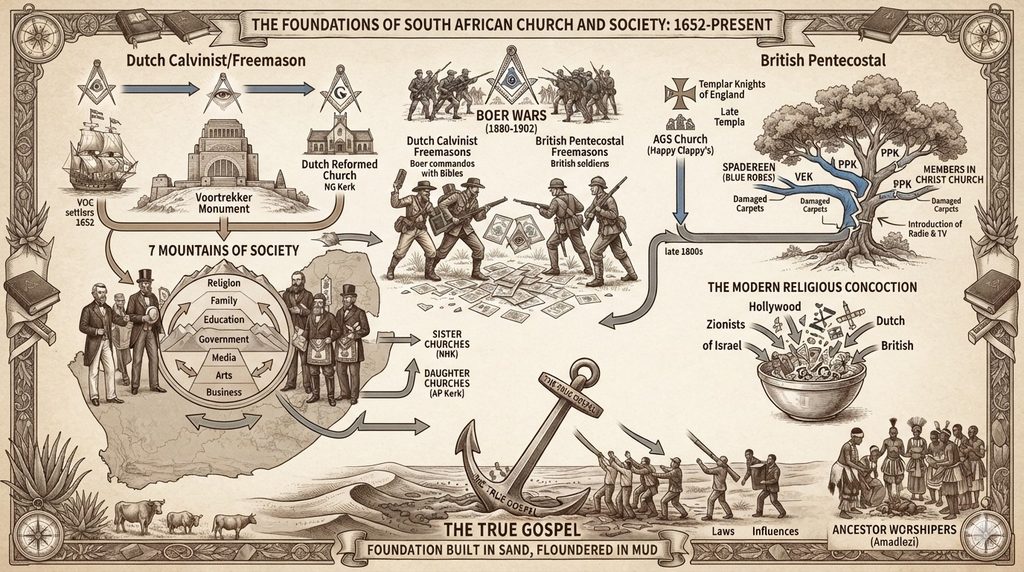
Of all the countries in the world, South Africa was the country with the greatest religious spiritual disadvantage in history.
Since the founding of South Africa in 1652, the spiritual religion / church in South Africa has been controlled by the Calvinists of the Netherlands (The religion of the Freemasons). For almost 250 years, Calvinism has controlled the religious culture of South Africa with the Dutch Reformed Church, Government, School Culture and secure all 7 mountains of society even Media and Entertainment and more than 50% of all white Afrikaners (which is just as many as Jews in Israel) are still trapped in the religion of the Dutch Freemasons and their Sister and Daughter Churches.
The Dutch Church with their New Apostolic secession from the Roman Catholic Church quickly took over and controlled the country as the Voortrekkers (99% Freemasons) established their religion in every town, one of the first buildings in every town was a Freemason Lodge and a Dutch Reformed Church, The religion of the Dutch Freemasons was the religion of the country until other religions also entered the country such as the Roman Catholic Church and English Calvinist Methodist church from Europe and after the two Boer wars (which were fought between two Freemason factions, Dutch Calvinist Freemasons and the British Pentecostal Freemasons) over the way the Freemason Lodges were set up all over SA,
In the late 1800s the 1ST British Pentecostal church of the Freemasons was established under the auspices of the Templar Knights of England as the AGS Church, At that time called the Happy Clappy’s, The Dutch Calvinists built their Freemason Temple (The Voortrekker Monument) built as promised at Blood River after they stole the Land from the Zulus who were and still are Before forefather worshipers .
From 1902 the Church religion of South Africa popped, The Dutch Calvinist Freemason Church (the NG Church) had several Uncomfortable secession’s and were called Sister Churches like the NHK and Later Daughter Churches like the AP Church to name just one.
Similarly the British Pentecostal Freemason Church also seceded, The Spadereen (Blue Robes) was the first to split and Later the VEK due to carpets that were damaged at a baptism service and the PPK, similarly the Spadereen (Latter-day Saints) seceded to the Members in Christ Church after Radio and TV were introduced in SA.
Then religious concoctions arose as churches split off and new religious doctrines were formed, a bit of this and a bit of that mixed with influences from Hollywood and the Zionists of Israel, so much so that there is no church with the true Gospel as the Bible brings it, On the contrary, the true Gospel has never and has not been brought to more than 98% of the inhabitants of SA or of the religious field of SA, and if we bring it it is suppressed as False Doctrine. SA is probably the most difficult country to evangelize the Truth, because the Foundation of the Church in SA was built in sand and floundered in Mud but controlled by laws and influences. And religion in SA is measured by the Churches of the Freemasons, the Church of the Boers and Englishmen and the overwhelming power of Ancestor worshipers.
Only God can bring a change in SA! We can only try!

NEWS MANNA –
Israel’s Election: Is The Third Temple Moving From Prophecy To Politics?

Israel goes to the polls on October 27 in an election that could reshape the country’s government and determine the future direction of the Israeli right.
But buried beneath the familiar election issues is something few would have imagined becoming part of Israel’s political conversation:
The Third Temple.
Moshe Feiglin, who has spent decades advocating Jewish sovereignty over the Temple Mount and the eventual rebuilding of the Temple, has just joined forces with Finance Minister Bezalel Smotrich’s Religious Zionism party. Feiglin is slated for the No. 2 position on their joint electoral list, and Prime Minister Benjamin Netanyahu has publicly welcomed the alliance.
Then came an extraordinary exchange.
Asked what would happen to the mosque on the Temple Mount when the Third Temple is built, Feiglin didn’t dismiss the question as fantasy. Instead, he predicted that Arabs would eventually voluntarily vacate the site and that the nations themselves would want to help Israel build the Temple.
Feiglin acknowledged that this sounds “far-fetched” and impossible under today’s conditions. But he pointed to something else that once appeared impossible: the Jewish people returning to their ancient homeland after nearly 2,000 years.
It is an extraordinary prediction.
But Feiglin’s comments aren’t occurring in isolation.
When The Impossible Becomes Possible
Consider how dramatically Israel’s circumstances have already changed.
For nearly 1,900 years there was no sovereign Jewish state. Jerusalem passed from empire to empire, while the Jewish people remained scattered throughout the nations.
Then came 1948.
Nineteen years later, Israeli soldiers captured Jerusalem’s Old City and the Temple Mount during the Six-Day War.
Yet Israel left administration of the Islamic holy sites with the Muslim Waqf, and for decades Jews visiting the Temple Mount were forbidden from praying there.
Even that is now changing.
In January, police began permitting specially prepared Jewish prayer sheets on the Mount. Then in August, Jewish worshipers were reportedly permitted to bring actual siddurim — Jewish prayer books — onto the site and openly pray from them. National Security Minister Itamar Ben-Gvir has himself openly prayed there.
The formal status quo has not been abolished. The Dome of the Rock and Al-Aqsa Mosque remain in place, and the Muslim Waqf continues administering Islamic religious activities.
But what happens on the ground has unquestionably changed.
Sacrifices Are No Longer Merely Theoretical
Something else is happening.
In May, Israeli police arrested 21 people suspected of trying to bring a young goat onto the Temple Mount for a sacrifice. Weeks later, another group was arrested attempting a Shavuot-related sacrifice.
These remain small activist movements, and police prevented the sacrifices.
But think about what that means.
Nearly 2,000 years after Temple sacrifices ceased, there are Jews not simply studying the sacrificial system but actively attempting to restore it.
For students of Bible prophecy, that deserves attention.
Three New Red Heifer Candidates
The red heifer story is also entering a new phase.
For several years, attention centered on red heifers imported from Texas. Now efforts are increasingly focused on producing qualifying animals inside Israel itself.
This year, reports have emerged of multiple red-heifer calves born in Israel and being examined as potential candidates.
A second calf was reported in July in the Golan Heights. Those raising it deliberately avoided attaching the normal ear tag because of concerns that doing so could affect its eligibility under the stringent requirements surrounding the Numbers 19 purification ceremony.
Subsequent reports have described a third candidate in the Jordan Valley.
None of these animals should yet be called “the red heifer.” They must mature while continuing to satisfy demanding biblical and rabbinical requirements.
But that misses the larger development.
The significance isn’t that Israel has found the red heifer.
It is that Israelis are increasingly building the infrastructure intended to make finding one less a matter of extraordinary chance.
Preparing For A Temple That Doesn’t Exist
Temple-oriented organizations have spent years researching vessels, priestly garments, ritual purity and the practical requirements of Temple worship.
Kohanim — men identified with the priestly line — have participated in training and study surrounding Temple service. Researchers and rabbis continue working through the practical and halachic questions that would arise if sacrifices were restored.
Once again, none of this means the Israeli government has decided to rebuild the Temple.
It hasn’t.
But the nature of the conversation is changing.
For centuries the question was theoretical: Could there ever be another Temple?
Increasingly, some Israelis are asking a different question:
What would actually be required to operate one?
Could The Nations Really Help Build It?
This brings us back to Feiglin’s remarkable prediction.
Could Arabs really voluntarily vacate the Temple Mount?
Could nations that today would fiercely oppose rebuilding the Temple someday help construct it?
From the perspective of September 2026, it sounds almost absurd.
But there is an interesting biblical precedent.
Hiram of Tyre supplied Solomon with materials and craftsmen for the First Temple. Centuries later, Cyrus of Persia authorized the Jewish exiles to return and rebuild the Temple destroyed by Babylon.
Foreign rulers assisting with Israel’s Temple is therefore not without precedent.
That doesn’t mean Feiglin has correctly predicted how the Third Temple will arise.
But Israel’s own history should make us cautious about assuming that today’s political realities determine tomorrow’s possibilities.
Scripture Says Something Must Change
Daniel 9:27 describes a coming ruler who, halfway through Daniel’s seventieth week, causes sacrifice and offering to cease.
Jesus points back to Daniel when He warns in Matthew 24:15 about the “abomination of desolation” standing in the holy place.
Paul describes the man of lawlessness taking his seat in the Temple of God in 2 Thessalonians 2.
And Revelation 11 describes John being instructed to measure the Temple, the altar and those worshiping there.
Taken together, these passages point toward renewed Jewish worship and a future sanctuary during the Tribulation.
Which leaves us with an enormous question:
How does Israel get from here to there?
Today, renewed sacrifices on the Temple Mount appear capable of igniting the Middle East.
But Scripture indicates that sacrifices will eventually be taking place.
Something changes.
Perhaps a future regional crisis transforms the Middle East. Perhaps an extraordinary agreement alters control of the Temple Mount. Perhaps the coming world leader of Daniel 9 brokers an arrangement that today’s governments would never contemplate.
Scripture doesn’t tell us enough to know the mechanism, and we shouldn’t manufacture details it doesn’t provide.
The Pieces Are Not The Prophecy
Three red-heifer candidates aren’t the fulfillment of Daniel.
Jewish prayer books appearing on the Temple Mount aren’t the fulfillment of Revelation.
Neither are attempted sacrifices or Moshe Feiglin’s political comeback.
But taken together, they reveal something difficult to ignore:
What once seemed impossible is becoming conceivable.
A restored Israel once appeared impossible.
Jewish sovereignty over Jerusalem appeared impossible.
Open Jewish prayer on the Temple Mount appeared impossible.
Yet here we are.
Now, on the eve of another Israeli election, a politician positioned near the top of a joint electoral slate is openly talking about Arabs leaving the Temple Mount, the nations helping construct the Third Temple and Israel eventually embracing its rebuilding.
The Temple hasn’t been rebuilt. Israel hasn’t decided to rebuild it. Enormous religious and geopolitical obstacles remain.
But something profound has changed.
For generations, students of Bible prophecy asked:
“Could there really be another Temple?”
Perhaps we are entering an era when the more relevant question becomes:
“How will it happen?”
China Readies Humanoid Robots For Combat

At the World Humanoid Robot Games in China last month, robots jumped, boxed and danced. Some fleet-footed bots ran faster than Usain Bolt over 100 meters. Spectators cheered the machines’ improving capabilities and their meme-worthy stumbles.
Two days after the Games ended, the People’s Liberation Army‘s official newspaper drew its own conclusions from the show. The PLA Daily called for researchers to accelerate the transfer of cutting-edge technologies from laboratories to military training grounds for robotic “combatants.”
China’s defense establishment is accelerating research into humanoids’ military uses and planning for their eventual wartime deployment, according to a Reuters review of more than 100 Chinese military procurement notices, academic studies, patents, official publications, government records and defense-company materials.
Military institutions are testing humanoids against battlefield requirements, seeking to acquire robots and technologies to train them, and studying how they might function alongside troops, the previously unreported records show. The work gained momentum in 2025 and 2026, focusing on robot perception, manipulation, and training data.
Chinese manufacturers accounted for about 95% of global humanoid shipments in 2025, according to BofA Global Research. That commercial dominance gives the PLA access to an expanding industry while developing its own military applications.
China’s robot defense research underscores how rapidly military technologies are evolving globally. In the Russia-Ukraine war, semiautonomous drones that use artificial intelligence for navigation and targeting have transformed reconnaissance and attack, while robots carry supplies and retrieve casualties. Reuters has previously documented the Chinese military’s efforts to learn from Europe’s deadliest conflict since World War II.
That evolution is driving worldwide military interest in autonomous systems.
“Going where we don’t want humans to go is one of the most compelling reasons to develop robots in the first place,” said Dennis Hong, a professor of mechanical and aerospace engineering at UCLA. “If losing a robot means avoiding the loss of a human life, then the robot can become expendable.”
China’s defense ministry and the National University of Defense Technology (NUDT), the PLA’s premier research institution, didn’t respond to requests for comment about humanoid robots’ military applications.
Reuters found no evidence that China has deployed an armed humanoid with an operational PLA unit. The robots remain energy-intensive and unreliable outside controlled demonstrations. Battlefield environments pose many variables and challenge robots’ abilities in unpredictable ways, said Aaron Johnson, a professor of mechanical engineering at Carnegie Mellon University.
Urban Assault Force
Already, China has a vision for humanoid robots in urban warfare.
Six “combat robots”—humanoids, robot dogs or unmanned vehicles—would be split up between two assault teams. Working with ground troops, the robots would clear an enemy-occupied building, floor-by-floor and room-by-room.
That scenario was described in an August 2025 paper by researchers at NUDT’s test center in Xi’an. The study modeled an urban assault force using equipment the authors projected could be available within five to 10 years. It didn’t specify the robots’ rules of engagement, the weapons they would carry, nor how they would handle civilian encounters.
Improvements in balance, perception and endurance could make humanoids useful in places including buildings, tunnels and ship interiors, said Juo-Min Chou, a researcher at Taiwan’s Institute for National Defense and Security Research. “Their two hands and two feet could, in theory, combine mobility, climbing and manipulation,” she said.
For simpler reconnaissance or logistics missions, however, quadruped, tracked or wheeled robots would generally be cheaper and easier to deploy at scale, Chou added.
Chinese military commentary envisions an expanding range of roles for humanoids. A July 2025 article in PLA Daily argued that humanoid missions could eventually evolve “from supporting combat toward primary combat” and discussed how robots might be authorized to fire on a living target that had been verified by a human.
In December, the PLA Eastern Theater Command released an AI-generated montage that showed military robots, including humanoids and quadrupeds, overwhelming Taiwan’s defenses in a hypothetical future conflict.
China isn’t alone in exploring battlefield uses for humanoids. Last year, the U.S. Army launched a competition to develop “militarized humanoid capabilities” that could eventually work alongside soldiers. The Army said potential roles included reconnaissance, security, obstacle clearing, hazardous-material operations and offensive and defensive missions in urban terrain. Up to 10 finalists were due to test their systems with U.S. military experts this year, with as much as $1.25 million available for follow-on contracts.
The U.S. robotics industry, however, trails far behind China in developing two-legged and four-legged machines. Reuters reported last month that China’s Unitree robots—among the world’s leading producers of humanoids and quadrupeds—based designs for its best-selling robot dogs on innovations financed by the U.S. military.
The Pentagon and the U.S. Army didn’t comment for this story.
Infiltrating Enemy Lines
Chinese interest in humanoid robots’ military applications began to pick up in 2024. That year, NUDT and China’s Academy of Military Sciences hosted a defense-technology forum that included a session on military applications for humanoid systems, according to NUDT’s website. Neither institution responded to Reuters’ questions.
A year later, NUDT explicitly framed humanoid robots as battlefield tools. A university competition in June 2025 featured an event that simulated “infiltration behind enemy lines,” requiring robots to enter an area, map it and locate targets, according to its website. Another envisioned robots conducting identity checks, discipline inspections and security patrols at military bases.
The military-research university described the competition in part as a proving ground for humanoids to eventually “move toward the battlefield.”
Procurement records around that time reflected that ultimate goal.
In May 2025, the PLA issued a tender to purchase a humanoid robot, including installation and technical training. Four months later, a procurement notice that listed an NUDT email as its contact address sought an “embodied humanoid robot intelligent perception and dexterous operation system.”
The records contained few specifics. Reuters couldn’t determine whether the tenders were filled, and if so, which companies won or which robot models were supplied.
In June this year, the PLA budgeted about $300,000 for a system to collect and label camera, radar and motion data for humanoids, including information about terrain they could traverse, according to another military procurement document.
The specifications show Chinese military interest is extending from robot bodies into the perception, manipulation and training systems that defense scholars say are essential for humanoids to move beyond controlled demonstrations.
Remote Operation
By 2026, humanoid development had spread beyond military academia into China’s defense industry.
The Fuxi robot made by Norinco, a state-owned defense conglomerate, is one example. Company materials published in August described the full-size humanoid as capable of sentry duty, all-weather reconnaissance, intelligent patrol and fulfilling dangerous roles.
Fuxi can be paired with Norinco’s teleoperation system, which allows a human operator to control a humanoid remotely, according to the company. Removing the need for a robot to make all decisions autonomously would address what many robotics experts say is the biggest challenge with humanoids.
Norinco didn’t respond to a request for comment.
Malcolm Davis, a senior analyst at the Australian Strategic Policy Institute, said he didn’t see humanoid robots as practical battlefield systems at present. “But in five to 10 years,” he said, “they could very well be.”
Even if remotely operated today, humanoid systems designed for autonomous deployment would eventually need to navigate ethical dilemmas. The laws of war require forces to distinguish combatants from civilians and to refrain from attacking wounded or surrendering fighters.
The International Committee of the Red Cross has cautioned that autonomous weapons may struggle to interpret signs of surrender reliably because such judgments can depend on context, conduct and intent.
The U.S. military requires autonomous weapons to undergo legal review and realistic testing and for commanders and operators to exercise appropriate judgment over the use of force. China’s defense ministry said in March that AI-powered weapons should remain under human control.
Those concerns haven’t deterred China’s exploration of humanoids’ military uses.
Wang Yonghua, a researcher at China’s Academy of Military Sciences, wrote in a November commentary that humanoids face unresolved problems in movement, perception and intelligence. Technical breakthroughs, lower manufacturing costs and industrial-scale production would be needed for humanoids to become widespread military systems.
If those conditions are met, Wang wrote, “humanoid robots will stream onto the battlefield.”

TruLight TV & Kingdom Kids TV – Learning from Peter’s Journey!
We have a new show for the Kids called (Flash Forward) – Join Zap at Hope Headquarters for week one of “Flash Forward!” Your preschooler will help robot, R1-2, discover how God gives us hope as they flashback to learn how God gave Peter hope! Meanwhile in Konnect HQ, EMERGENCY! All of the Konnection Transmissions have disappeared from the archives! Captain Ray brings the Konnect HQ crew together to live out their mission and fix the problem. learn more by watching today’s program. Enjoy!
Today on TruLight Radio XM
TruLight Radio XM 24/7
Program
GMT / UTC +2
Monday To Fridays
00:15 Words to Live By Testimonies
01.15 Science Scripture and Salvation
02.15 Ground Works
04.00 Gospel Concert of the Day
05.00 The Daren Streblow Comedy Show
5:55 It is Today devotional
6:00 Gaither Homecoming Morning Show
7:15 Discover the Word
8.15 Destined for Victory
8:55 Science Scripture and Salvation
9:00 Holy Spirit Hour – Normally Sermons
10:15 Hope of the Heart
11:15 Unshackled
11.45 Words to Live By
12:15 Truth for Life
13:15 Living on the Edge with Chip Ingram
14:15 Focus on the Family
15:00 Kids Hour
16:00 In Touch with Dr. Charles Stanley
16:30 Groundwork
17:15 Live in the Light
18:15 Renewing your Mind
19:00 Gaither Homecoming Show
20:15 Growing Hope
21:15 Adventures in Odyssey Radio Drama
21:45 Bible Reading
22:15 Night-sounds
23.00 Good Old Country Gospel / Rhema Gospel Express
VISIT THE WEBSITE
TruLight Ministry News – EXTRA MANNA

TruLight Ministries orders from God since 2012 . Teach Them , Comfort Them and Warn Them!
Artist Liners
Healing Truths.
End Time Articles.
Share this Feeding of Manna with your Friends and Family. just click on the Social Media icon and share This Manna with your Friends and Family. just click on the Social Media icon and share !