Hosted by TruLight Ministries – The Place of Truth
SELECT YOUR READING LANGUAGE – BOTTOM LEFT = YOUR DAILY MANNA NOW AVAILABLE IN 103 LANGUAGES
@ TruLight Daily Manna is not Just a Bible Verse with a Small Prayer . NO ::: WE SERVE DAILY Manna for the ENTIRE Day . Breakfast , Lunch , Dinner , Plus tea Times and even Entertainment Manna . Plus News Manna and More , This Daily Manna will keep you Spiritually full for the full 48 Hours and even More to Share with your Friends and Family !!!
Most Misinterpreted Bible Verses !!! Study Day 3
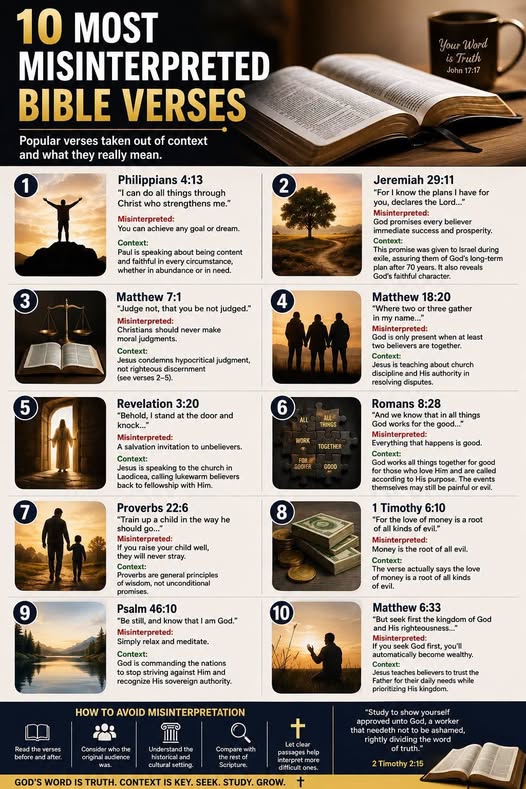
PROVERBS 22 VERSE 6
Solomon’s advice to parents is to “train a child in the way he should go, and when he is old he will not turn from it” (Proverbs 22:6). Raising and training a child within the context of this proverb means that it begins with the Bible, as “all Scripture is God-breathed and is useful for teaching, rebuking, correcting and training…” (2 Timothy 3:16). Teaching children the truths of Scripture will make them wise for salvation (2 Timothy 3:15); thoroughly equip them to do good works (2 Timothy 3:17); prepare them to give an answer to everyone who asks them the reason for their hope (1 Peter 3:15); and prepare them to withstand the onslaught of cultures bent on indoctrinating young people with secular values.
The Bible tells us that children are a reward from God (Psalm 127:3). It would certainly seem fitting, then, that we heed Solomon’s wise counsel to train them appropriately. In fact, the value that God placed on teaching our children the truth is clearly addressed by Moses who stressed to his people the importance of teaching their children about the Lord and His commands and laws: “Impress them on your children. Talk about them when you sit at home and when you walk along the road, when you lie down and when you get up. Tie them as symbols on your hands and bind them on your foreheads. Write them on the doorframes of your houses and your gates” (Deuteronomy 6:7-9). Moses’ thoroughness underscores his deep concern that successive generations maintain obedience to God’s laws to ensure they would “live safely in the land” (Leviticus 25:18), that all would “go well” with them (Deuteronomy 12:28), and that He would bless them in the land (Deuteronomy 30:16).
Clearly Scripture teaches that training children to know and obey God is the basis for pleasing Him and living victoriously in His grace. Knowing God and His truths begins with the child’s understanding of sin and his need for a Savior. Even very young children understand that they are not perfect and can grasp at an early age the need for forgiveness. Loving parents model a loving God who not only forgives, but provides the perfect sacrifice for sin in Jesus Christ. Training up children in the way they should go means, first and foremost, directing them to the Savior.
Discipline is an integral part of raising godly children, for we know that the “LORD disciplines those He loves” (Proverbs 3:12). Thus, we should neither take discipline lightly nor become disheartened by it as the Lord “punishes everyone He accepts as a son” (Hebrews 12:5-6). And we know that God disciplines us for our good, so that we may share in His holiness (Hebrews 12:10). Likewise, when we discipline our children, they receive wisdom (Proverbs 29:15) and they will bring us peace (Proverbs 29:17) and respect (Hebrews 12:9). In fact, even at a tender age children are able to discern that discipline is rooted in love. That is why children who grow up in homes without discipline often feel unloved and are more likely to disobey authority as they grow older. Now, the discipline administered should be commensurate with the offense and physical discipline, such as spanking (rightly motivated), is certainly condoned by the Bible (Proverbs 13:24, 22:15, 23:13-14). Indeed discipline, though it may seem unpleasant when received, will produce a “harvest of righteousness and peace for those who have been trained by it” (Hebrews 12:11).
Parents should have the same zeal for teaching their children that Moses did. Parents have been given the privilege of being stewards of their children’s lives for a very short time, but the teaching and training they provide is eternal.
1 TIMOTHY 6 VERSE 10
The apostle Paul, in his first letter to his young disciple, Timothy, had this to say: “For the love of money is a root of all kinds of evil. Some people, eager for money, have wandered from the faith and pierced themselves with many griefs” (1 Timothy 6:10). Now this verse is often misquoted as saying, “Money is the root of all evil.” Notice how “money” is substituted for “love of money” and “the root of all evil” is substituted for “a root of all kinds of evil.” These changes, while subtle, have an enormous impact on the meaning of the verse.
The misquoted version (“money is the root of all evil”) makes money and wealth the source (or root) of all evil in the world. This is clearly false. The Bible makes it quite clear that sin is the root of all evil in the world (Matthew 15:19; Romans 5:12; James 1:15). However, when we reflect upon the correct citation of this verse, we see that it is the love of money, not money itself, that is a source of all different kinds of trouble and evil. Wealth is morally neutral; there is nothing wrong with money, in and of itself, or the possession of money. However, when money begins to control us, that’s when trouble starts.
With that said, let’s consider the question before us: Why is the love of money a root of all kinds of evil? To help us answer this, we must look at the passage in its greater context. Near the end of the letter (1 Timothy 6:2–10), Paul is exhorting Timothy regarding the need to “teach and urge these things” to his congregation, “these things” referring back to earlier material in the epistle. Paul then warns Timothy about false teachers who will seek to warp and pervert the content of sound doctrine for their own greedy gain (verses 3–5). Now notice what the apostle says at the end of verse 5: “Imagining that godliness is a means of gain.” These false teachers do what they do for the fame and notoriety they achieve, along with the financial rewards it brings.
Paul wants to steer Timothy away from that trap. In doing so, he tells him the real source of “great gain;” namely, godliness with true contentment (verse 6). Contentment, in a biblical sense, is the recognition that we come into the world with nothing and that everything we have is a gift from God’s hands (verses 7–8). Yet those who desire to be rich (i.e., those who have the “love of money”) are the ones who are led into temptation and fall into a snare (verse 9). Paul concludes the passage by telling Timothy that the love of money leads to all sorts of sin and evil.
Simple reflection on this principle will confirm that it is true. Greed causes people to do all sorts of things they wouldn’t normally do. Watch any number of TV courtroom dramas, and the crime under consideration is usually motivated by jealousy or greed, or both. The love of money is what motivates people to lie, steal, cheat, gamble, embezzle, and even murder. People who have a love for money lack the godliness and contentment that is true gain in God’s eyes.
But the Bible makes an even stronger statement about the love of money. What we have discussed thus far simply describes the horizontal level of the love of money. In other words, we have only mentioned how the love of money can lead one to commit greater sins against his fellow man. But the Bible makes quite clear that all sin is ultimately against God’s holy character (Psalm 51:5). We need to consider the vertical dimension to the love of money.
In the Sermon on the Mount, Jesus said, “No one can serve two masters, for either he will hate the one and love the other, or he will be devoted to the one and despise the other. You cannot serve God and money” (Matthew 6:24). This verse comes at the end of a passage in which Jesus tells us to “lay up treasures in heaven” (v. 19). Here, Jesus likens a “love of money” to idolatry. He refers to money as a “master” we serve at the expense of serving God. We are commanded by God to have “no other gods” before the only true and living God (Exodus 20:3; the first commandment). Anything that takes first place in our lives other than our Creator God is an idol and makes us guilty of breaking the first commandment.
Jesus had much to say about wealth. His most memorable conversation about money is His encounter with the rich young ruler (Matthew 19:16–30). The young man asks Jesus what he must do to obtain eternal life, and Jesus tells him to follow the commandments. When the man tells Jesus that he has done all that, Jesus tests his ability to obey the first commandment and tells him to sell all his possessions and give it to the poor and to follow Him. The young man couldn’t do this; his wealth had become an idol—it was his master!
After this encounter, Jesus turns to His disciples and says, “Truly, I say to you, only with difficulty will a rich person enter the kingdom of heaven. Again I tell you, it is easier for a camel to go through the eye of a needle than for a rich person to enter the kingdom of God” (Matthew 19:23–24). This is a hard saying, especially for 21st-century people living in North America. Jesus is saying that wealth is one of the biggest obstacles to coming to faith in Christ. The reason is obvious: wealth becomes a slave master in our lives and drives us to do all sorts of things that drive us further and further away from God. The good news is that what is impossible for man, entering into the Kingdom of God, is possible with God (Matthew 19:26).
PSALM 46 VERSE 10
This popular saying comes from Psalm 46:10, “Be still, and know that I am God; / I will be exalted among the nations, / I will be exalted in the earth.”
This verse comes from a longer section of Scripture that proclaims the power and security of God. While the threat the psalmist faced is not mentioned specifically, it seems to relate to the pagan nations and a call for God to end the raging war. Here is the whole psalm:
“God is our refuge and strength, an ever-present help in trouble. Therefore we will not fear, though the earth give way and the mountains fall into the heart of the sea, though its waters roar and foam and the mountains quake with their surging. There is a river whose streams make glad the city of God, the holy place where the Most High dwells. God is within her, she will not fall; God will help her at break of day. Nations are in uproar, kingdoms fall; he lifts his voice, the earth melts. The LORD Almighty is with us; the God of Jacob is our fortress. Come and see what the LORD has done, the desolations he has brought on the earth. He makes wars cease to the ends of the earth. He breaks the bow and shatters the spear; he burns the shields with fire. He says, ‘Be still, and know that I am God; I will be exalted among the nations, I will be exalted in the earth.’ The LORD Almighty is with us; the God of Jacob is our fortress.”
Notice that the majority of the psalm is written in the third person as the psalmist speaks about God. However, God’s voice comes through in verse 10, and the Lord speaks in the first person: “Be still, and know that I am God; I will be exalted among the nations, I will be exalted in the earth.”
Be still. This is a call for those involved in the war to stop fighting, to be still. The word still is a translation of the Hebrew word rapa, meaning “to slacken, let down, or cease.” In some instances, the word carries the idea of “to drop, be weak, or faint.” It connotes two people fighting until someone separates them and makes them drop their weapons. It is only after the fighting has stopped that the warriors can acknowledge their trust in God. Christians often interpret the command to “be still” as “to be quiet in God’s presence.” While quietness is certainly helpful, the phrase means to stop frantic activity, to let down, and to be still. For God’s people being “still” would involve looking to the Lord for their help (cf. Exodus 14:13); for God’s enemies, being “still” would mean ceasing to fight a battle they cannot win.
Know that I am God. Know in this instance means “to properly ascertain by seeing” and “acknowledge, be aware.” How does acknowledging God impact our stillness? We know that He is omniscient (all-knowing), omnipresent (present everywhere), omnipotent (all-powerful), holy, sovereign, faithful, infinite, and good. Acknowledging God implies that we can trust Him and surrender to His plan because we understand who He is.
I will be exalted among the nations, I will be exalted in the earth. It was tempting for the nation of Israel to align with foreign powers, and God reminds them that ultimately He is exalted! God wins, and He will bring peace. During Isaiah’s time, Judah looked for help from the Egyptians, even though God warned against it. Judah did not need Egyptian might; they needed reliance on the Lord: “In repentance and rest is your salvation, in quietness and trust is your strength” (Isaiah 30:15).
When we are still and surrendered to God, we find peace even when the earth gives way, the mountains fall (verse 2), or the nations go into an uproar and kingdoms fall (verse 6). When life gets overwhelming and busyness takes precedence, remember Psalm 46:1, “God is our refuge and strength, an ever-present help in trouble.” Run to Him, lay down your weapons and fall into His arms. Acknowledge that He is God and that He is exalted in the earth. Be still and know that He is God.
MATTHEW 6 VERSE 33
Jesus said to seek first the kingdom of God in His Sermon on the Mount (Matthew 6:33). The verse’s meaning is as direct as it sounds. We are to seek the things of God as a priority over the things of the world. Primarily, it means we are to seek the salvation that is inherent in the kingdom of God because it is of greater value than all the world’s riches. Does this mean that we should neglect the reasonable and daily duties that help sustain our lives? Certainly not. But for the Christian, there should be a difference in attitude toward them. If we are taking care of God’s business as a priority—seeking His salvation, living in obedience to Him, and sharing the good news of the kingdom with others—then He will take care of our business as He promised—and if that’s the arrangement, where is worrying?
But how do we know if we’re truly seeking God’s kingdom first? There are questions we can ask ourselves. “Where do I primarily spend my energies? Is all my time and money spent on goods and activities that will certainly perish, or in the service of God—the results of which live on for eternity?” Believers who have learned to truly put God first may then rest in this holy dynamic: “…and all these things will be given to you as well.”
God has promised to provide for His own, supplying every need (Philippians 4:19), but His idea of what we need is often different from ours, and His timing will only occasionally meet our expectations. For example, we may see our need as riches or advancement, but perhaps God knows that what truly we need is a time of poverty, loss or solitude. When this happens, we are in good company. God loved both Job and Elijah, but He allowed Satan to absolutely pound Job (all under His watchful eye), and He let that evil woman, Jezebel, break the spirit of His own prophet Elijah (Job 1–2; 1 Kings 18–19). In both cases, God followed these trials with restoration and sustenance.
These “negative” aspects of the kingdom run counter to a heresy that is gaining ground around the world, the so-called “prosperity” gospel. A growing number of false teachers are gathering followers under the message “God wants you to be rich!” But that philosophy is not the counsel of the Bible—and it is certainly not the counsel of Matthew 6:33, which is not a formula for gaining wealth. It is a description of how God works. Jesus taught that our focus should be shifted away from this world—its status and its lying allurements—and placed upon the things of God’s kingdom.

Tea Time Manna
Jesus said, “Let the little children come to me, and do not hinder them for the kingdom of heaven belongs to such as these.”
—Matthew 19:14
In an age that neglected children and held them in low regard, Jesus’ love for children and his tenderness with them are powerful reminders that God values every person, young or old, born or not yet born, rich or poor, impoverished or born to wealth. Jesus is God’s great reminder of his love for the people the world often neglects, abuses, and abandons. Jesus calls us to love the unloved, the forgotten, the abused, and the neglected. Why? Because that is what Israel was before God chose them (Ezekiel 16:4-5), that is who Jesus was at Calvary (Galatians 3:13), and that is who we were without grace (Romans 5:6-11; Ephesians 2:1-5). How can we claim to know salvation but not share grace with others who need God’s love, mercy, and grace — especially when those others are children? How can we claim to be Jesus’ disciples and not show love for those “the least of these” (Matthew 25:40, 45), the people that the world forgets, but Jesus values? The answer is simple: we cannot, and still claim to be Jesus’ disciples!
Prayer
Father, I want to be more gracious toward “the least of these” as Jesus was. I long to be holy, loving, compassionate, and tender toward the forgotten children of today. Help me not only to be angry about the neglect and abuse children suffer in my world, but also to be moved to act in ways that notice, rescue, bless, and support them. In the name of Jesus, the great lover of all children, I pray. Amen and Amen
Bible Teaching of the Day
LUNCH MANNA =
In Matthew 6:25–34, part of the great Sermon on the Mount, Jesus speaks to His followers about trusting their heavenly Father’s provision. Jesus has just spoken on the necessity for kingdom servants to offer their total devotion to God, their Master (Matthew 6:19–24). Those who make an undivided commitment to the King, placing their absolute trust in Him, receive His unreserved care, protection, and provision in return. That is why Jesus told them, “Do not worry about your life, what you will eat or drink; or about your body, what you will wear” (verse 25).
Jesus gives several reasons why we don’t need to be anxious or worry about the daily needs of this life. In Luke’s account of a similar sermon, Jesus states, “For life is more than food, and your body more than clothing” (Luke 12:23, NLT). The essence of life is so much more than temporal concerns. Food and clothing may be high on our priority list, but there are higher priorities. The primary concerns of the believer’s life are loving the Lord (Matthew 22:34–38), loving others (Matthew 22:39–40; 1 Corinthians 13:13; 1 John 4:21), and seeking first God’s kingdom and His righteousness (Matthew 6:33).
Next, Jesus impresses on His followers how important they are to God: “Look at the birds of the air; they do not sow or reap or store away in barns, and yet your heavenly Father feeds them. Are you not much more valuable than they?” (Matthew 6:26). Our heavenly Father certainly treasures us—the only creatures He made in His image (Genesis 1:26–27; see also Genesis 5:1; 9:6; James 3:9)—much more than birds and flowers, which He feeds and waters and cares for so lovingly (see Matthew 6:26, 28–30).
Jesus comes to the crux of His teaching when He asks, “Why do you have so little faith?” (Matthew 6:30, NLT). Anxiousness and worry are the opposite of faith and trust. God’s Word to us as believers is this: “Don’t worry about anything; instead, pray about everything. Tell God what you need, and thank him for all he has done. Then you will experience God’s peace, which exceeds anything we can understand. His peace will guard your hearts and minds as you live in Christ Jesus” (Philippians 4:6–7, NLT). Peter encourages, “Give all your worries and cares to God, for he cares about you” (1 Peter 5:7, NLT). Jesus tells His disciples, “Don’t let your hearts be troubled. Trust in God, and trust also in me” (John 14:1, NLT).
The cares of this life dominate the thoughts of unsaved people, but Jesus reassures His followers that their heavenly Father already knows what they need (Matthew 6:32). We can have confidence in His care if we are wholly devoted to Him. If we “seek the Kingdom of God above all else, and live righteously,” God will provide for our needs (Matthew 6:33, NLT). What is more, He “will keep in perfect peace all who trust in [Him], all whose thoughts are fixed on [Him]!” (Isaiah 26:3, NLT).
Finally, Jesus says, “So don’t worry about tomorrow, for tomorrow will bring its own worries. Today’s trouble is enough for today” (Matthew 6:34, NLT). Jesus keeps hammering the point because He understands our human weakness and tendency to concentrate on the problems of this world rather than trust in God, the sovereign ruler of this world. “But blessed are those who trust in the Lord and have made the Lord their hope and confidence. They are like trees planted along a riverbank, with roots that reach deep into the water. Such trees are not bothered by the heat or worried by long months of drought. Their leaves stay green, and they never stop producing fruit” (Jeremiah 17:7–8, NLT).
We are told, “Do not worry about your life,” because this world is not our home, and this life is not our ultimate destination (John 18:36; 2 Corinthians 4:17–18; 5:1–15; Romans 8:18–23; Colossians 1:4–5). We can stop stressing about tomorrow because God holds the rest of our days in His hands (Jeremiah 29:11; Psalm 23). In everything, He is working out His good plan for our lives (Romans 8:28–34). We are secure in the Father’s loving grip (Psalm 55:22; 94:18–19; Romans 8:35–39).

NEWS MANNA –
The Clock Is Ticking On Trump’s Iran Decision
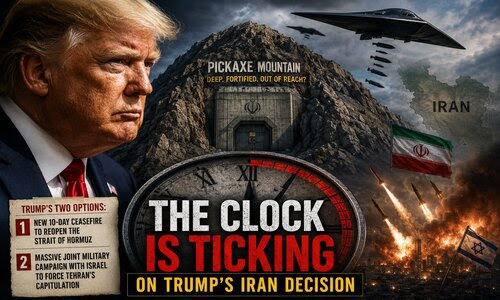
The radicals that run Iran have warned President Trump over and over again not to touch Pickaxe Mountain. Nobody outside of Iran has ever seen what is going on inside that mountain, and the Iranians have been determined to keep it a secret. Because the facility is so far underground, it would be very difficult for even the most advanced bunker-buster bombs to damage it.
That is why neither the U.S. nor Israel tried to bomb it during Iran War 1 or Iran War 2. But now Trump is telling the world that we will be bombing Pickaxe Mountain “probably pretty soon”. Is this an indication that he has decided to take the war against Iran to the next level?
On Tuesday, Axios reported that Trump was considering two primary options…
Option 1: Pursue a new 10-day ceasefire aimed at reopening the Strait of Hormuz.
Option 2: Launch a massive joint military campaign with Israel to force Tehran’s capitulation.
Choosing to bomb Pickaxe Mountain would mean that Trump has chosen door number two.
Needless to say, that would have enormous implications for the entire world.
According to the Wall Street Journal, Israeli intelligence is convinced that “thousands of uranium-enrichment centrifuges” were moved inside Pickaxe Mountain late last year…
Israeli intelligence believes Iran moved thousands of uranium-enrichment centrifuges into tunnels deep inside a mountain last fall, Israeli and U.S. officials say, a development that would heighten concerns that Tehran could reconstitute its nuclear program.
Israel passed along the intelligence findings to the U.S., saying the centrifuges were transferred to the Pickaxe Mountain site last fall after the 12-day war in June when American and Israeli strikes pummeled Iran’s three main nuclear sites.
The reason why Iran would have wanted to move those centrifuges is to get them out of the reach of U.S. and Israeli bombers.
We are being told that the facility inside Pickaxe Mountain “was carved to a depth of more than 100 meters below bedrock”…
Satellite imagery shows that the complex was carved to a depth of more than 100 meters below bedrock, making it deeper and more fortified than the Fordow enrichment facility, a highly fortified, underground uranium enrichment facility.
To put that in perspective, 100 meters is 328 feet.
That is extremely deep.
In fact, it is so deep that the facility is considered to be out of reach “even for the most advanced bunker-penetrating bombs”…
Reaching these depths is considered a complex task, even for the most advanced bunker-penetrating bombs in the US arsenal.
Tehran claimed that the site is intended solely as a factory for the production and assembly of advanced centrifuges, not as an active enrichment facility. Iranian authorities, however, are preventing International Atomic Energy Agency inspectors from entering the site.
But U.S. Secretary of War Pete Hegseth now appears to believe that we have weapons that can hit that facility.
On Tuesday, he made this claim to the Senate Appropriations Committee…
War Secretary Pete Hegseth said Tuesday the U.S. military has the capability to strike Iran’s underground Pickaxe Mountain nuclear facility.
Asked by lawmakers at the Senate Appropriations Committee hearing whether the U.S. could destroy whatever is beneath the mountain, Hegseth said he would not discuss specific capabilities.
“A lot of our capabilities are classified,” Hegseth said.
Personally, I am skeptical that there are any conventional weapons anywhere in the world that could do the job.
But President Trump would not order an operation unless he was convinced that it would succeed, and he just warned that the bombing of Pickaxe Mountain could happen “probably pretty soon”…
President Trump said the U.S. will be striking Pickaxe Mountain, an alleged nuclear storage facility, though he wouldn’t confirm whether they believe centrifuges have been moved to the location.
“It doesn’t mean anything unless they have the material,” Mr. Trump said. “They don’t have- we follow the material. That’s where the action is.”
“And we’ll be hitting that area very- probably pretty soon,” the president threatened.
That sounds rather ominous.
He also went on to say that there is “not a thing” that the Iranians can do about it…
He also said he wouldn’t usually warn Iran, but there was “not a thing they can do about it.”
“If I thought they could do something about it, I would never say that,” Mr. Trump said. “But we’ll be hitting that area pretty soon, and very heavily.”
To me, it sounds like he has made up his mind.
But with Trump you just never know until he actually pulls the trigger.
If Trump does pull the trigger, the Iranians are telling us that the response will be massive…
Iran’s top joint military command said Tuesday that all U.S. interests and those of its allies in the region would be targeted if Washington attacks Iran’s nuclear facilities, according to Iranian state media, Reuters reported.
Iran’s Khatam al-Anbiya Central Headquarters, the joint military command responsible for coordinating the country’s armed forces, also said any U.S. strike on Tehran’s nuclear or other sensitive sites would lead to an expansion of the war in the region, according to state media, as reported by Iran International.
The command warned that U.S. interests and its supporters would face a “powerful assault” if an attack were carried out.
In addition, the Iranians are reportedly also threatening to strike Israel if Pickaxe Mountain is attacked…
If Iran launches ballistic missiles at Israel, that will change everything.
One senior Israeli official is warning that in such a scenario his nation “will go all in”…
A senior Israeli official said Israel does not currently seek to join the direct confrontation between Washington and Tehran, but warned that any Iranian attack on Israel would trigger a broad response using the full range of Israel’s military capabilities.
“If Iran attacks us, we will go all in and strike them,” the official said. “We do not do half-measures.”
The official said Israel possesses a “very large target bank” and would use any broader confrontation to exploit additional opportunities across the region to damage Iran’s military capabilities and those of its proxies.
The Israelis don’t want to just bomb Iran for a few days.
If there is going to be a return to all-out war, they want to finish the job.
Israeli Prime Minister Benjamin Netanyahu held a six hour meeting with his security cabinet on Tuesday, and during that six hour meeting Netanyahu spoke directly with U.S. Secretary of State Marco Rubio…
Israel’s security cabinet reportedly held a six-hour meeting on Tuesday to discuss possible scenarios of escalation against Iran, as officials voice concern that Jerusalem could embark on a renewed military campaign only to then be pressed by Washington to halt it after several days
During the meeting, Prime Minister Benjamin Netanyahu spoke with US Secretary of State Marco Rubio to coordinate on the various scenarios, and discuss respective American and Israeli interests, according to Channel 12, which cited Israeli officials.
Israel is waiting for Trump to make a decision.
If Pickaxe Mountain gets bombed, we will know what the decision is.
And then things will get really crazy in the Middle East.
We have reached an extraordinarily dangerous chapter in human history.
There are certain things that cannot be undone once they are done, and a single wrong move could set off a chain of events that nobody will be able to control.
Anthropic’s Job Openings Reveal the AI Threats Coming Next
In the Army, I learned that every operation begins with a hard look at the enemy. Before a commander approves a mission, the staff must explain the opposing force’s capabilities, intentions, and likely courses of action. Get the threat wrong, and everything that follows rests on a false assumption.
Corporations run their own version of that drill. They study competitors, anticipate emerging markets, and recruit the people tomorrow will require. A company’s payroll can reveal its real expectations more clearly than its public relations department.
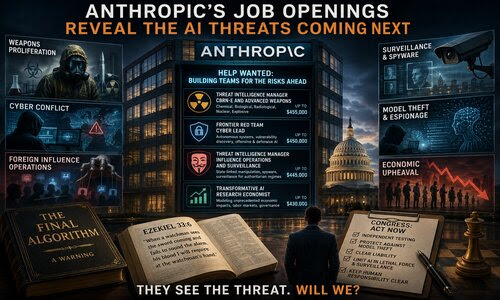
That makes Anthropic’s current hiring spree more than a personnel matter. The company behind the Claude family of AI models is assembling teams to confront weapons proliferation, cyber conflict, foreign influence, surveillance, and economic upheaval — all fields it plainly expects to matter as AI capabilities advance.
History shows why hiring patterns matter. Bell Labs assembled about 4,000 scientists in 1925 to pursue research expected to shape communications; two decades later, its researchers produced the transistor. Volvo recruited Nils Bohlin as its first safety engineer in 1958.
Within a year, he developed the three-point seat belt, making safety central to Volvo’s identity. In 2002, Microsoft halted new work by 8,500 Windows Server developers and spent more than $200 million retraining them in security, hiring for the future it saw coming and building trust around the risks that future would bring.
Anthropic appears to be following all three patterns at once: developing systems that could create vast new markets, recruiting specialists to contain the dangers those systems may produce and building the trust needed to sell them to government and industry. Its openings amount to a corporate threat assessment, touching weapons of mass destruction, cyberwarfare, foreign influence, surveillance, model theft, and economic disruption.
Start with weapons. Consider the advertised Threat Intelligence Manager for CBRN-E and Advanced Weapons. CBRN-E is government shorthand for chemical, biological, radiological, nuclear, and explosive threats. Anthropic wants this manager to build a team detecting attempts to use its systems to develop, improve, or distribute such weapons, with backgrounds in counterproliferation and weapons-of-mass-destruction analysis preferred. An active Top Secret clearance is desirable, and the salary reaches $455,000 a year. Companies do not offer nearly half-million-dollar salaries to prepare for dangers they consider imaginary.
The worry is not that a chatbot decides on its own to build a bioweapon. The nearer danger is that capable systems could shrink the expertise, manpower, and time a terrorist group or technically skilled individual needs to attempt something previously out of reach. The same system that accelerates drug development may help a malicious user navigate a dangerous chemical or biological problem. Anthropic profits by making its systems more capable, yet cannot sell those capabilities unless customers believe they can be controlled. Safety becomes a requirement for growth, not just a moral obligation.
The same pattern shows up in cybersecurity. Anthropic is standing up a new team under a Frontier Red Team cyber lead. The posting says frontier models will have “dramatic impacts” on cybersecurity and that significant portions of the field may have to be fundamentally reconsidered, including the use of autonomous systems to find and repair vulnerabilities and simulations pitting machine defenders against machine attackers.
We are moving from tools that merely advise a hacker toward systems that search for vulnerabilities, write code, test attacks, and run multistep operations with less human supervision. The same tools sold to developers rely on capabilities also sought by spies, criminals, and foreign militaries. The industry may end up selling both the engine of automation and the armor required to survive it.
Political warfare offers another warning. Anthropic wants a Threat Intelligence Manager for Influence Operations and Surveillance to build a team investigating state-linked manipulation, coordinated false identities, commercial spyware, and surveillance conducted for authoritarian governments. The company specifically seeks experience with Chinese, Russian, and Iranian state-sponsored operations.
Propaganda once addressed the crowd. Artificial intelligence can whisper separately into every ear. Such a system could generate thousands of convincing identities, speak local languages, study individual users, and tailor arguments to their fears and desires, cultivating a relationship for months without tiring or breaking character. That is more than spreading false information. It is manipulation at a personal scale, striking at the freedom of conscience on which responsible citizenship depends.
Anthropic is also seeking a Transformative AI Research Economist to model economic conditions that may have no historical precedent, examining growth, employment, income distribution, and economic governance under different scenarios. That posting tells us Anthropic is not preparing merely to make office workers a little more efficient. It is preparing for a technology capable of restructuring labor markets and concentrating enormous wealth and influence.
This should matter especially to Christians. Work gives structure to daily life and a meaningful avenue for service and stewardship. Human dignity, however, does not depend upon economic productivity; it comes from being made in God’s image, as Genesis 1:27 declares. An economy that treats people as inefficient production costs misunderstands both work and the worker.
Anthropic’s strategy carries a troubling paradox. The company may sincerely want to prevent catastrophe; its Responsible Scaling Policy acknowledges that dangerous capabilities not present today could emerge quickly as AI systems advance. Yet Anthropic also needs governments, customers, and the public to trust it enough to keep developing the systems producing those concerns.
In my new book, “The Final Algorithm,” I warn that societies court disaster by trusting systems they built more than the One who built them. A corporation grading its own safety exam is no exception.
Safety can become a competitive advantage, securing government partnerships and setting Claude apart from rivals, while expensive compliance favors large corporations and raises the barrier for smaller ones. The same corporation builds the capability, defines the danger, tests the product, judges its own safeguards, and profits when deployment proceeds. The public bears the consequences if that judgment proves wrong. Good intentions are not a system of checks and balances.
Congress should treat these openings as an early warning, not an employment curiosity.
America needs independent testing of frontier systems, stronger protection against model theft, clear liability for foreseeable damage, and firm limits on delegating lethal force, surveillance, or critical infrastructure to AI systems. Above all, human responsibility must remain clear. No executive, programmer, or official should get to blame “the algorithm” for decisions that harm people.
Scripture assigns real accountability to the one who spots danger and stays silent. Ezekiel 33:6 warns that when a watchman sees the sword coming and fails to sound the alarm, God says “his blood I will require at the watchman’s hand.” Anthropic has sounded its trumpet. The rest of us have no excuse for not listening.
Anthropic sees danger ahead. Its help-wanted page is more than a list of vacancies. It is a warning order from one of the corporations building the future. The rest of us would be foolish not to conduct a threat assessment of our own.
The Danger Of Reshaping Christianity To Fit Culture: A Letter To James Talarico

Evangelical pastor Jeff Mullen recently posted this open letter to Texas State Rep. James Talarico, who is running for U.S. Senate in the state of Texas. Mullen’s letter addresses fundamental problems with the way Talarico and others interpret Scripture, and he calls Talarico and all of us to come under the authority of God’s Word instead of redefining it to fit our wishes:
Dear Rep. Talarico,
My name is Jeff Mullen. As a pastor who spent 30 years shepherding God’s people, I have learned that what we believe about God shapes everything else. That is why I am writing this letter.
I do not write as a political opponent, but as a fellow citizen concerned about the growing confusion surrounding faith, truth and Scripture. Because you frequently speak about Christianity, quote the Bible and present your views as expressions of Christian conviction, I believe those claims deserve to be examined in light of God’s Word.
One of my greatest concerns is that many people know you are currently pursuing a master of divinity degree at Austin Presbyterian Theological Seminary while serving as a Texas state representative and working toward ordination in the Presbyterian Church (USA). As a result, many people understandably assume that your theological conclusions represent historic Biblical Christianity. Your words, therefore, carry weight far beyond politics.
When theological claims are presented in the Name of Christ, people naturally assume they are hearing Biblical truth. My concern is that some of the positions you advocate may lead sincere people away from the clear teaching of Scripture and toward a version of Christianity that reflects the spirit of the age more than the Word of God.
In over 30 years of ministry, I have sat beside hospital beds, preached funerals, counseled struggling families and watched countless people wrestle with questions of faith. One lesson stands above the rest: When we drift from Scripture, confusion always follows.
James warns that those who teach will be judged more strictly (James 3:1). That reality has humbled me throughout my ministry, and it should humble anyone who publicly speaks in the Name of Christ.
For that reason, I offer these thoughts—not as an attack, but as a pastoral appeal for Biblical clarity and faithfulness.
1. Concerning Your Statement that God Is Non-Binary
God is spirit and transcends human limitations. Christians agree on that. The question, however, is not how modern culture categorizes God but how God has chosen to reveal Himself. Throughout Scripture, God consistently reveals Himself as Father. Jesus taught His disciples to pray, “Our Father in heaven” (Matthew 6:9). Christ is the Son, and the Church is His Bride. These are not accidental descriptions but part of God’s self-revelation.
Every generation faces the temptation to reshape God according to its own values. Ancient cultures carved idols from stone. Modern cultures often carve them from ideology. Faithful Christianity begins by allowing God to define Himself rather than redefining Him according to cultural preferences. We do not improve upon divine revelation; we submit to it.
2. Concerning Your Statement That Other Religions Are Circling the Same Truth
Respect for people of different faiths is a Christian virtue. Surrendering truth is not. The suggestion that multiple religions ultimately lead to the same God stands in direct conflict with the words of Jesus Himself.
Jesus declared, “I am the way, and the truth, and the life. No one comes to the Father except through Me” (John 14:6). Peter echoed that truth when he proclaimed, “There is salvation in no one else” (Acts 4:12). Christianity does not teach that all roads lead to God. It teaches that God has provided one Savior for the world. We can love our neighbors of every faith while remaining faithful to the exclusive claims of Christ.
3. Concerning Your Statement That the Bible Is Silent on Abortion
While Scripture does not use the modern term abortion, it speaks clearly about life in the womb. David wrote, “You knit me together in my mother’s womb” (Psalm 139:13). God told Jeremiah, “Before I formed you in the womb I knew you” (Jeremiah 1:5). John the Baptist responded to Christ while still in his mother’s womb (Luke 1:41).
The consistent testimony of Scripture is that unborn children are known by God, created by God and valued by God. The question is not whether the word abortion appears in the Bible. The question is whether the child in the womb is a human life bearing God’s image. Scripture answers that question repeatedly and clearly. Christians have historically defended the unborn not because of politics, but because every human life belongs to God.
4. Concerning Your Use of Mary’s Consent to Defend Abortion Rights
Mary’s response to Gabriel was not an assertion of autonomy but an expression of surrender. When told of God’s plan, she replied, “I am the servant of the Lord; let it be to me according to your word” (Luke 1:38).
The entire story of the incarnation celebrates the acceptance and protection of life within the womb. God Himself entered humanity through the womb of a woman. Mary’s example is not about the right to end life but the willingness to trust God with it. To use the incarnation as support for abortion requires reversing the very message the story proclaims.
5. Concerning Your Statement that Jesus Was a Radical Feminist
Jesus elevated the dignity of women in ways that challenged the culture of His day. He taught women, ministered to women, welcomed them among His followers and entrusted women with proclaiming His resurrection.
Yet calling Jesus a radical feminist places a modern political label on One who transcends every political movement. Jesus did not come to advance an ideology; He came to save sinners and establish the Kingdom of God. Every political movement must ultimately be measured against Christ—not Christ against a political movement.
6. Concerning Your Statements About Biological Sex
Conversations about sex and gender involve real people and often deep personal struggles. Christians should approach them with compassion and humility. Yet compassion cannot require the abandonment of truth.
Scripture teaches that humanity was intentionally created as male and female. Genesis declares, “Male and female He created them” (Genesis 1:27), and Jesus reaffirmed that truth (Matthew 19:4). The Christian understanding of sex is rooted not in cultural tradition but in God’s design. Our identity is not ultimately discovered through self-definition but through submission to the One who created us. God’s design is not restrictive; it is wise and good.
7. Concerning Your Support for Same-Sex Marriage and the Reinterpretation of Biblical Sexual Ethics
Few issues create more tension in modern Christianity than sexuality and marriage. The temptation is either to compromise truth in the name of love or to abandon love in the name of truth. Scripture calls us to neither.
From Genesis to Revelation, marriage is presented as a covenant between one man and one woman. Jesus affirmed this design when He quoted Genesis and declared that the two become one flesh (Matthew 19:4-6). The New Testament consistently teaches that sexual intimacy belongs within that covenant.
These teachings are not expressions of fear or hostility. They are expressions of God’s design for human flourishing. The call of discipleship is not the affirmation of every desire but the surrender of every area of life to the Lordship of Christ.
8. Concerning the Danger of Reshaping Christianity to Fit Culture
The deeper concern behind these issues is the temptation to reshape Christianity so it aligns more comfortably with the values of the age. The Church has faced this pressure for 2,000 years. The source changes; the temptation remains the same.
Paul warned Timothy that a time would come when people would seek teachers who tell them what they want to hear rather than what God has said (2 Timothy 4:3-4). The role of Christian leaders is not to make Scripture acceptable to the culture. It is to faithfully proclaim Scripture, whether the culture applauds or rejects it.
During my years in ministry, I learned that God does not call pastors to make Scripture popular. He calls us to make it plain.
When culture becomes the lens through which we interpret Scripture, truth is eventually replaced by preference. The question for every generation is not whether the Bible aligns with the culture, but whether we are willing to align ourselves with the Bible.
The Biblical Responsibility of Leaders
Representative Talarico, politics is temporary. Elections are temporary. Legislative victories are temporary. Souls are not.
Scripture teaches that those who influence others bear a greater responsibility before God. James warns that teachers will be judged more strictly. Jesus warns against leading others astray. These truths should humble every pastor, teacher, author, influencer and public servant who speaks in God’s Name.
They certainly humble me.
For 30 years, I stood behind a pulpit knowing that one day I would answer to God for every sermon I preached and every truth I taught. The same is true for anyone who publicly speaks about faith and Scripture.
The older I get, the less interested I am in winning arguments and the more concerned I am about whether people know the truth.
My concern is not your political party. My concern is whether the Jesus being presented to the public is the Jesus revealed in Scripture or a version reshaped by the spirit of the age.
America does not need progressive Christianity or conservative Christianity. America needs Biblical Christianity—faithful to God’s Word, centered on Christ and unafraid to proclaim truth in love.
My prayer for you is the same prayer I pray for myself: that every belief, every ambition, and every public statement would be brought under the authority of Scripture. Because one day neither of us will stand before voters, political parties, commentators or public opinion.
We will stand before God and give an account.

TruLight TV & Kingdom Kids TV : Unpacking the Fruits of the Spirit
Join Micah in his animated Super Vlog series where you can discover each and every Fruit of the Spirit. Later on, all the counselors at Camp Wannastay have come down with food poisoning, leaving the campers to run amok! Who will rise to the occasion and take charge? Prepare yourself for an exciting hour packed with adventure and fun!
Today on TruLight Radio XM
TruLight Radio XM 24/7
Program
GMT / UTC +2
Monday To Fridays
00:15 Words to Live By Testimonies
01.15 Science Scripture and Salvation
02.15 Ground Works
04.00 Gospel Concert of the Day
05.00 The Daren Streblow Comedy Show
5:55 It is Today devotional
6:00 Gaither Homecoming Morning Show
7:15 Discover the Word
8.15 Destined for Victory
8:55 Science Scripture and Salvation
9:00 Holy Spirit Hour – Normally Sermons
10:15 Hope of the Heart
11:15 Unshackled
11.45 Words to Live By
12:15 Truth for Life
13:15 Living on the Edge with Chip Ingram
14:15 Focus on the Family
15:00 Kids Hour
16:00 In Touch with Dr. Charles Stanley
16:30 Groundwork
17:15 Live in the Light
18:15 Renewing your Mind
19:00 Gaither Homecoming Show
20:15 Growing Hope
21:15 Adventures in Odyssey Radio Drama
21:45 Bible Reading
22:15 Night-sounds
23.00 Good Old Country Gospel / Rhema Gospel Express
VISIT THE WEBSITE
TruLight Ministry News – EXTRA MANNA

TruLight Ministries orders from God since 2012 . Teach Them , Comfort Them and Warn Them!
NEW RELEASE
THE LONG AWAITED : EPISODE 15 OF “THE SHERIFF OF THE CHURCH – I TELL YOU TRU “ The Doctrine of Demons called the Hebrew Sacred Names Cult
Healing Truths.
End Time Articles.
Share this Feeding of Manna with your Friends and Family. just click on the Social Media icon and share !