Hosted by TruLight Ministries – The Place of Truth
SELECT YOUR READING LANGUAGE – BOTTOM LEFT = YOUR DAILY MANNA NOW AVAILABLE IN 103 LANGUAGES
@ TruLight Daily Manna is not Just a Bible Verse with a Small Prayer . NO ::: WE SERVE DAILY Manna for the ENTIRE Day . Breakfast , Lunch , Dinner , Plus tea Times and even Entertainment Manna . Plus News Manna and More , This Daily Manna will keep you Spiritually full for the full 48 Hours and even More to Share with your Friends and Family !!!
MISINTERPRETED BIBLE VERSES !!!
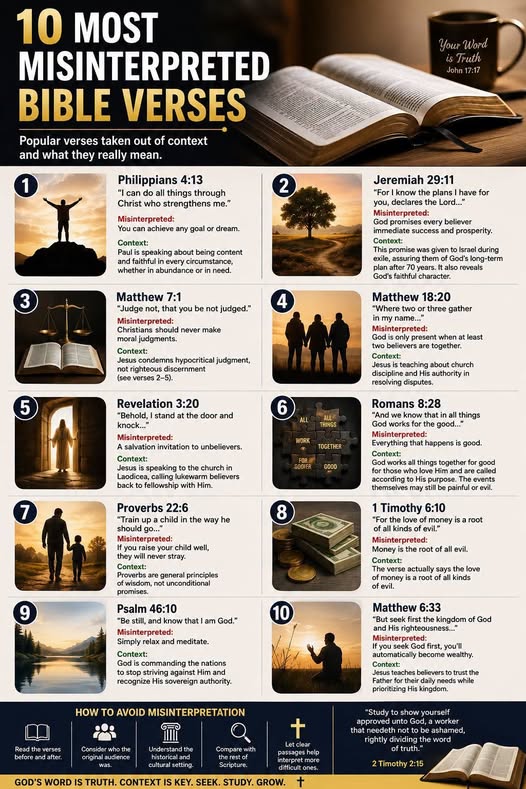
A 3 PART STUDY OVER THE NEXT 3 DAYS
Second Peter 3:16 states, “There are some things in them that are hard to understand, which the ignorant and unstable twist to their own destruction, as they do the other Scriptures” (ESV). In this verse, Peter is referring to Paul’s letters (see verse 15), which, importantly, he categorizes as “Scripture.” Peter also says that Paul’s epistles contain some things that are “hard to understand” (verse 16). Some people were taking these difficult statements and twisting and distorting them. Peter warns that twisting and distorting Scripture will lead to destruction.
The purpose of 2 Peter is to warn believers about false teachers who challenge the truth of the gospel. In chapter 3, Peter specifically deals with “the day of the Lord” (2 Peter 3:10), which he also calls “the day of God” (verse 12). That day is coming, despite what scoffers said (verse 3). It is in this context that Peter warns against the distortions of “ignorant and unstable people” (verse 16). Peter urges all believers to remain steadfast, growing in the grace and knowledge of Christ (2 Peter 3:18).
Peter’s acknowledgement that some of Paul’s writings are difficult to understand (2 Peter 3:16) is significant. It shows that the early church recognized both the depth of special revelation and the complexity of some theological doctrines. The difficulty of some portions of Scripture might lead to misinterpretation, so readers must take care. This is especially true when the Scriptures are being handled by those who are “ignorant and unstable.” The term ignorant suggests a lack of knowledge or understanding (see Ephesians 4:18), while unstable indicates a lack of firm grounding in the faith (James 1:8). An ignorant and unstable person is susceptible to twisting the Scriptures to his own destruction. In the context of 2 Peter 3:16, Scripture-twisters were denying the coming day of judgment.
Twisting, or distorting, the Scriptures refers to the intentional or unintentional misinterpretation and misapplication of biblical texts. This is not merely about misunderstanding the text but also involves a manipulation of the text to serve personal agendas, justify sinful behaviors, or propagate false teachings. Peter warns that such “twisting” leads to destruction. We should understand this destruction in two ways: present and eternal. The present danger of twisting the Scriptures is that it leads others away from the truth of the gospel, causing disunity within the body of Christ. The eternal danger of twisting the Scriptures is eternal punishment in hell.
In Scripture, there are many instances of people who twisted the Scriptures to their own destruction. Jeremiah 23:36, for example, addresses those who were misrepresenting the Word of God: “Each one’s word becomes their own message. So you distort the words of the living God, the Lord Almighty, our God.” In Matthew 23:13–36, Jesus rebukes the Pharisees and teachers of the law for their misinterpretations and hypocritical applications of the Scriptures. They had added human traditions to God’s law, burdening people and obscuring the law’s true intent.
Paul personally contended with false teachers who had distorted his doctrine. Speaking to the Galatians, Paul says, “I am astonished that you are so quickly deserting him who called you in the grace of Christ and are turning to a different gospel—not that there is another one, but there are some who trouble you and want to distort the gospel of Christ” (Galatians 1:6–7, ESV). Paul says that anyone who distorts the gospel of Christ should be “accursed” (verse 8, ESV). This language is similar to Peter’s warning that twisting the Scriptures will lead to destruction.
When we intentionally or unintentionally distort the Word of God, we cause harm both to ourselves and others. For this reason, we must “present [ourselves] to God as one approved, a worker who has no need to be ashamed, rightly handling the word of truth” (2 Timothy 2:15, ESV).

Tea Time Manna
If we walk in the light, as he is in the light, we have fellowship with one another, and the blood of Jesus, his Son, purifies us from all sin.
—1 John 1:7
As we seek to please God and trust in his grace, more grace is supplied. As we walk openly, transparently, and bring who we are to the Light (John 3:19, 21), we are forgiven our sins and cleansed of their stains (1 John 1:8-9). This grace gives us an ongoing relationship with each other for fellowship, encouragement, and mutual support, and it also brings us into deeper fellowship with our Father in heaven. Jesus’ death was “once for all” (Hebrews 7:27, 9:12, 26, 10:10); its cleansing power goes on and on for each of us, as long as we tune our hearts to the Father’s grace, we are open about our sinful failures, and our hearts return to the path that seeks the Father’s will and live in the Light of Jesus.
Prayer
Loving Father, thank you for the gift of Jesus and the cleansing his death brings me. Help me live a more dedicated life each day. Thank you for the assurance that, as I seek your will and live your life, you are also forgiving me of my sins, cleansing me of their stains, and making me new. Through the intercession of Jesus, and in his mighty name, I offer these words of thanks. Amen and Amen
Bible Teaching of the Day
LUNCH MANNA =
PHILLIPPIANS 4 V 13
There is a tale of a king who suffered from a painful ailment. His counselors advised him of the only cure—to find a contented man, get his shirt, and wear it night and day. So, the king sent messengers to find such a man, with orders to bring back his shirt. After months of searching the kingdom, they returned empty-handed.
“Did you find a contented man in all my realm?” asked the king.
“Yes, O king, we found only one in all thy realm,” they replied.
“Then why did you not bring back his shirt?” the king demanded.
“Master, the man had no shirt.”
(Condensed from Tan, P. L., Encyclopedia of 7700 Illustrations, Bible Communications, Inc., 1996, pp. 272–273).
The story’s point is that contentment is a rarity, yet something we all desperately want and need. What, then, does it mean to be content? The apostle Paul seemed to have the insider’s scoop: “I have learned to be content whatever the circumstances. I know what it is to be in need, and I know what it is to have plenty. I have learned the secret of being content in any and every situation, whether well fed or hungry, whether living in plenty or in want” (Philippians 4:11–12).
Paul’s statement, “I have learned the secret of being content in any and every situation,” is truly astonishing considering the circumstances he endured and situations he encountered while serving the Lord. He was beaten, whipped, stoned, shipwrecked, tossed in the open sea, harassed by enemies, and betrayed by false believers. He endured hunger, thirst, and even nakedness, just like the man with no shirt (see 2 Corinthians 11:24–28).
The Greek term Paul used, translated as “content” in English, describes a state of being satisfied or satiated with things as they are. Paul had “learned the secret,” meaning he “learned the mystery” of contentment. This expression implies acquiring special information.
Contentment is learned, and we gain it through experience. Like Paul, James had learned to be joyful and optimistic through trials and testing because he understood them to be privileged occasions for growth—to become “mature and complete, not lacking anything” (James 1:2–4). Paul’s deficiency, his weakness in hardship, was an opportunity for God’s “all-surpassing power” to shine forth through him (2 Corinthians 4:7–9). He had discovered that the indwelling power of Christ supplied him with strength, grace, peace, and contentment no matter what life threw at him (Philippians 1:6; 4:13; 2 Corinthians 12:9; Ephesians 3:16). When Paul hit a roadblock or faced a storm, He drew on the deep well of resources springing from his faith in God and his life hidden in Christ (Philippians 1:21; 3:10; see also John 15:5).
The author of Hebrews described contentment as being satisfied with what we have, knowing God will never fail us or leave us (Hebrews 13:5). Paul told Timothy, “But godliness with contentment is great gain. For we brought nothing into the world, and we can take nothing out of it. But if we have food and clothing, we will be content with that” (1 Timothy 6:6–8).
Paul was content in every circumstance because his life was anchored in Christ and focused on eternity: “Therefore we do not lose heart. Though outwardly we are wasting away, yet inwardly we are being renewed day by day. For our light and momentary troubles are achieving for us an eternal glory that far outweighs them all. So we fix our eyes not on what is seen, but on what is unseen, since what is seen is temporary, but what is unseen is eternal” (2 Corinthians 4:16–18; see also Colossians 3:1–3).
To be content as believers, we must resist the temptation to become over-attached to the things of this world (1 Corinthians 7:31). The opposite of contentment is anxiousness and worry. Jesus told His followers, “Do not be anxious about your life, what you will eat or what you will drink, nor about your body, what you will put on. Is not life more than food, and the body more than clothing?” (Matthew 6:25, ESV). If our heavenly Father feeds and cares for the birds of the air and the flowers of the field, certainly He will take care of us, His treasured children. Jesus continued, “These things dominate the thoughts of unbelievers, but your heavenly Father already knows all your needs. Seek the Kingdom of God above all else, and live righteously, and he will give you everything you need” (Matthew 6:32–33, NLT; see also Philippians 4:6). Trusting God in everything, even if we are shirtless, is the secret of being content.
JEREMIAH 29 v 11
“‘For I know the plans I have for you,’ declares the Lord, ‘plans to prosper you and not to harm you, plans to give you hope and a future.’” This verse or portions of it are very popular. Jeremiah 29:11 is often displayed on posters, T-shirts, bumper stickers, etc. This verse is often spoken as a promise of hope to people who are grieving or discouraged. However, before it can be applied, it must first be understood in context.
When interpreting Scripture, we must keep in mind the distinction between a passage’s interpretation and the same passage’s application: a passage can have only one meaning, but it may have many applications. Jeremiah 29:11 is no different. The verse has only one meaning.
Jeremiah 29 is addressed to the exiles in Babylon. As punishment for the sins of Judah, God was going to send the Babylonians to destroy Jerusalem and the temple and to carry away many of the people to Babylon. (See Jeremiah 25:8–14 for one example.) At the time Jeremiah wrote Jeremiah 29, Nebuchadnezzar had already removed some Jews to Babylon (see verse 1), although the total destruction of Jerusalem and the temple was still to come. Jeremiah writes to the exiles to tell them that people would return to the land after 70 years (verse 10). Then he reassures them in verse 11 that God has not forsaken them. They will be restored. God’s plans for His Chosen People were “for good and not for disaster, to give you a future and a hope” (NLT).
In the primary application, Jeremiah 29:11 has nothing to do with any person living today. This verse applied only to the Jews who were in exile in Babylon during the sixth century BC. However, the sentiment expressed is so beautiful and encouraging, is there not any sense in which it applies today? The answer is, yes.
Jeremiah 29:11 has other applications. In particular, this verse reflects a more general principle of God’s grace and affections for those whom He loves, including the modern church. This more general application can be made because of the unchanging nature of God.
God had promised to bring Israel back; therefore, the exiles could be assured that they had a future and a hope. This promise was not made to all nations at the time, but only to Israel. Likewise, God has promised believers in Christ certain things that are not applicable to the human race in general. For those who are in Christ, God has promised that our sins are forgiven and we stand before God justified. God has plans for those in Christ, and those plans are good.
Shades of Jeremiah 29:11 are seen elsewhere in Scripture, such as in Romans 8:31–39: “If God is for us, who can be against us? He who did not spare his own Son, but gave him up for us all—how will he not also, along with him, graciously give us all things? Who will bring any charge against those whom God has chosen? It is God who justifies. Who then is the one who condemns? No one. Christ Jesus who died—more than that, who was raised to life—is at the right hand of God and is also interceding for us. Who shall separate us from the love of Christ? Shall trouble or hardship or persecution or famine or nakedness or danger or sword? . . . No, in all these things we are more than conquerors through him who loved us. For I am convinced that neither death nor life, neither angels nor demons, neither the present nor the future, nor any powers, neither height nor depth, nor anything else in all creation, will be able to separate us from the love of God that is in Christ Jesus our Lord.”
Believers in Christ can be confident that all things will work together for our good and that God has a future planned for us. We have hope that “does not put us to shame” (Romans 5:5). We have been given promises to rely on, just as Israel was. So, if by quoting Jeremiah 29:11 we are thinking of our security in Christ, then the wording is appropriate, even if the historical context does not apply.
A word of caution, however, that Jeremiah 29:11 can be misused as well. First, it is sometimes wrongly applied to humanity in general. Strictly speaking, the promise of Jeremiah 29:11 does not apply to every human being, but only those who are in Christ. Perhaps it could even be extended as part of the invitation to receive Christ: “If you come to Him, He promises you a future and a hope!” Outside of Christ, the only Savior, there is no future and no hope (see John 3:18). Too often, Jeremiah 29:11, quoted without context and applied universally, is made to give the impression that God is a doting grandfather who just wants to spoil us.
The second danger of using this verse without understanding the context is the same as the danger of taking Romans 8:28 out of context. Jeremiah 29:11 promised that the nation of Israel would be restored, but very few of the exiles lived to see the fulfillment of that prophecy 70 years later. Most of them died without seeing the future that God had planned. Likewise, the future and hope we have in Christ are not a guarantee that things will go well in this life. For most believers throughout history and in the world today, the world is a cold and dangerous place. In fact, the promise outlined in Romans 8:28 is specifically that, even though believers will face all sorts of dangers and persecutions in this life (trouble, hardship, persecution, famine, nakedness, danger, sword—see verse 35), Christ will never abandon them. In this life, believers have hope because of the work of the Holy Spirit in our hearts, but the future and the hope and the prosperity that God has planned for believers will be fully realized only after this life of suffering is over.
MATTHEW 7 V 1
“Judge not lest you be judged” is a snippet from Christ’s great Sermon on the Mount (Matthew 5:3—7:27). In Matthew 7, Jesus turns to the topic of judging others. Sadly, the passage is one of the most misunderstood and misapplied teachings in Scripture by believers and non-believers alike. In his commentary on Matthew, Stuart Weber gives this excellent summary of the correct meaning of Matthew 7:1: “Do not judge others until you are prepared to be judged by the same standard. And then, when you exercise judgment toward others, do it with humility” (Holman New Testament Commentary, Vol. 1, p. 96).
When Jesus said, “Judge not lest you be judged,” He wasn’t issuing a blanket rule that people are never to judge others. A closer look at the rest of the passage illuminates the real issue Christ wanted to address: “Do not judge others, and you will not be judged. For you will be treated as you treat others. The standard you use in judging is the standard by which you will be judged. And why worry about a speck in your friend’s eye when you have a log in your own? How can you think of saying to your friend, ‘Let me help you get rid of that speck in your eye,’ when you can’t see past the log in your own eye? Hypocrite! First get rid of the log in your own eye; then you will see well enough to deal with the speck in your friend’s eye” (Matthew 7:1–5, NLT).
Christ’s teaching was primarily directed to believers, but the principle can be applied to anyone. Jesus does expect us to “deal with the speck” in our friend’s eye, particularly our brothers and sisters in Christ. He wants us to discern sin in others so we can help them get rid of it. The purpose of judging someone else’s weakness is to help him or her walk in freedom (1 Corinthians 5:12). But how can we help someone else if we are not free? We must first be willing to look honestly at our own lives and exercise the same judgment toward ourselves. When we do this, we judge from a position of humility.
Jesus’s statement to “judge not lest you be judged” zeroed in on the problems of spiritual hypocrisy and self-centered pride. He compared these offenses to giant logs that blind us to our own faults while we laser in on shortcomings in others.
Humility is a mega theme throughout Christ’s Sermon on the Mount. It is impossible to carry out these kingdom teachings without maintaining authentic humbleness in our attitude toward others. In Matthew 5:7–11, Jesus encouraged His followers to show mercy, cultivate peace, and bless those who persecute them. To enter the kingdom of heaven, Jesus said that our righteousness had to exceed that of the teachers of the religious law and Pharisees (Matthew 5:20).
These Pharisees and teachers of the law were considered to be the pinnacle of moral integrity at the time. Jesus stopped this misconception right in its tracks. He saw through the outer veneer into the reality of their self-righteousness, spiritual pride, and moral bankruptcy.
Jesus challenged the people not to retaliate when someone wronged them (Matthew 5:39); to love their enemies and pray for those who persecuted them (verse 44); to model themselves after their heavenly Father’s perfection (verse 48); and to forgive those who sinned against them (Matthew 6:14–15).
A faithful servant of God will see himself as accurately as he sees others. He will recognize his own sinfulness and need for God’s mercy—a need he shares with his brothers and sisters in Christ. He will have no reason to consider himself better than others but will follow Paul’s teaching to the Philippians: “Do nothing out of selfish ambition or vain conceit. Rather, in humility value others above yourselves” (Philippians 2:3).
When Christ taught, “Judge not lest you be judged,” He countered the human tendency to take spiritual truth and twist it into hypocritical superiority as the Pharisees had done. Our pride makes us criticize and judge others so that we feel better about ourselves. James warned believers, “Don’t speak evil against each other, dear brothers and sisters. If you criticize and judge each other, then you are criticizing and judging God’s law. But your job is to obey the law, not to judge whether it applies to you. God alone, who gave the law, is the Judge. He alone has the power to save or to destroy. So what right do you have to judge your neighbor?” (James 4:11–12, NLT)
The apostle Paul cautioned, “You may think you can condemn such people, but you are just as bad, and you have no excuse! When you say they are wicked and should be punished, you are condemning yourself, for you who judge others do these very same things. And we know that God, in his justice, will punish anyone who does such things. Since you judge others for doing these things, why do you think you can avoid God’s judgment when you do the same things?” (Romans 2:1–3, NLT, see also Romans 14:4, 10–13).
Jesus requires true followers to apply His teachings first to themselves and then to others. When God reveals His truth to us, whether in Scripture or in some other way, our immediate response must be to say, “How does this apply to me? How do I appropriate this truth in my own life?” In following Jesus’ command to “judge not, that you be not judged” (Matthew 7:1, NKJV), we avoid drawing conclusions that are superficial, proud, hypocritical, or self-righteous.

NEWS MANNA –
Is Trump Preparing A Final Blow Against Iran? Signs Point To A Decisive Phase
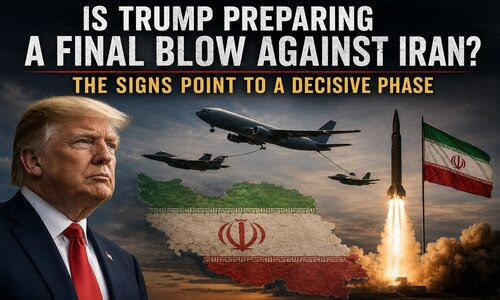
Wars rarely end by drifting quietly into history. More often, they conclude with one side deciding the cost of prolonging the fight has become greater than the risk of one final, overwhelming push.
That possibility is increasingly being discussed regarding the conflict with Iran.
No one outside the White House, the Pentagon, or Israel’s war cabinet knows precisely what President Donald Trump intends to do next. But recent military movements, diplomatic warnings, and strategic realities have fueled growing speculation that Washington may be preparing for a decisive phase designed not simply to punish Iran–but to end the conflict on terms favorable to the United States and its allies.
Whether that happens remains uncertain. Yet several developments suggest something larger could be unfolding.
One of the strongest indicators has been the reported movement of dozens of U.S. aerial refueling tankers into the region. Such aircraft dramatically extend the range and endurance of combat aircraft, enabling sustained long-range bombing campaigns rather than isolated strikes.
At the same time, the U.S. State Department has issued heightened security cautions warning Americans abroad that pro-Iranian groups could target U.S. interests should tensions escalate further.
Taken individually, these developments may not prove anything.
Taken together, they suggest planners are preparing for the possibility of a much larger confrontation.
The Political Clock Is Ticking
Military strategy and politics often move together.
If the Trump administration believes the conflict must ultimately be settled militarily, there are obvious incentives to do so sooner rather than later.
A prolonged war stretching toward the midterm elections would almost certainly create political complications.
Oil prices remain extraordinarily sensitive to every missile fired near the Strait of Hormuz. Continued instability threatens inflation, gasoline prices, financial markets, and consumer confidence–all issues that voters notice immediately.
A decisive military outcome, if successful, could remove much of that uncertainty.
An inconclusive conflict, on the other hand, risks months of economic volatility with no guarantee of improved security.
That does not mean military action is inevitable. It simply means the political calendar may favor resolving the conflict before it becomes an extended war of attrition.
The Pause Hasn’t Solved The Core Problems
Even after periods of reduced fighting, the strategic issues remain largely unresolved.
Iran continues demonstrating an ability to threaten shipping around the Strait of Hormuz. Questions also remain regarding the status of portions of Iran’s enriched uranium stockpile and underground nuclear infrastructure.
Simply pausing operations does not eliminate those realities.
From Washington’s perspective, unfinished objectives often become future crises.
A Modern “Shock And Awe”?
Anyone who remembers the opening days of the Iraq War remembers the phrase “Shock and Awe.”
That campaign sought to overwhelm an opponent through speed, precision, and sustained strikes that crippled command structures before organized resistance could fully respond.
Military technology has advanced dramatically since 2003.
Today’s version would likely rely far more heavily on stealth aircraft, drones, electronic warfare, cyber operations, long-range precision weapons, and real-time intelligence than massive armored columns.
Whether such an operation occurs remains speculative.
But the reported positioning of aerial refueling assets naturally raises questions because those aircraft are most valuable during sustained air campaigns rather than brief demonstrations of force.
If anyone has watched the recent film *Pressure*, they’ll appreciate another factor that rarely enters public discussion: weather. Military planners don’t simply ask whether they *can* launch an operation–they ask when environmental conditions give them the greatest advantage. Weather has shaped countless battles throughout history, and it still does today.
How Would Iran Respond?
This may be the greatest unknown.
Many analysts believe Iran’s conventional military has already suffered significant damage.
That does not mean Iran lacks dangerous options.
Instead of matching American military strength directly, Tehran could rely on asymmetric retaliation.
Possible scenarios include:
* Terror attacks against U.S. or Israeli interests overseas.
* Activation of sleeper networks already positioned abroad.
* Cyberattacks on financial institutions or critical infrastructure.
* Missile and drone strikes against regional energy facilities.
* Continued attacks on commercial shipping.
* Attempts to widen the conflict through regional proxy groups.
Ironically, terrorism–the tactic most associated with Iran’s regional network–has thus far remained more limited than many initially expected. That could reflect capability constraints, strategic restraint, or simply a decision to reserve those options for a larger confrontation
The Leadership Mystery
Another uncertainty surrounds Iran’s decision-making itself.
Various intelligence assessments have suggested unusual uncertainty within Tehran’s leadership following months of conflict. Some observers have even speculated about internal power struggles or a quiet leadership transition taking place behind closed doors.
If true, that presents its own dangers.
History shows that leadership uncertainty can make wars more–not less–dangerous.
Fragmented command structures increase the risk of miscalculation.
Competing factions sometimes escalate conflicts precisely because no single leader fully controls events.
If Israeli intelligence is still attempting to determine exactly who is making the final decisions inside Tehran, that alone illustrates how fluid the current situation may be.
Will The Entire “Axis” Enter The Fight?
Another question concerns Iran’s regional partners.
Could Hezbollah launch a full-scale northern war?
Could Hamas dramatically expand operations?
Will the Houthis intensify attacks in the Red Sea?
All remain possibilities.
Yet each organization has already paid significant military costs over the past year and faces its own domestic and operational constraints. While limited attacks remain likely, a fully coordinated regional offensive would represent a major escalation carrying enormous risks for every participant.
That possibility cannot be dismissed–but neither should it be assumed.
Could There Be A Ground Operation?
While air power can produce enormous destruction, history reminds us that bombing campaigns alone do not always achieve political objectives.
Could the United States eventually consider some form of limited ground operation?
Most military observers remain skeptical, at least in the near term.
Southern Iran’s extreme summer heat creates enormous logistical challenges for any amphibious landing or sustained ground campaign. Heat affects troops, equipment, maintenance schedules, and operational tempo.
For that reason, some analysts believe that if a ground component were ever contemplated, seasonal conditions alone would likely push such planning well beyond the current summer–and perhaps even beyond the midterm elections.
Air operations, however, face far fewer environmental constraints and could be expanded much sooner.
The Coming Days May Be Critical
The Middle East has entered one of its most unpredictable periods in years.
Additional U.S. military assets continue moving into the region.
Security warnings for Americans overseas remain elevated.
Iran continues demonstrating an ability to threaten regional stability while key questions surrounding its nuclear program remain unanswered.
Political pressure for a durable outcome continues to build.
Whether these developments culminate in negotiations or in a dramatically expanded military campaign remains unknown.
But history suggests one consistent lesson: prolonged wars rarely remain static. They either move toward settlement–or toward escalation.
If the current indicators reflect preparation rather than precaution, the next phase could look very different from what the world has witnessed so far. It could resemble a modern version of “Shock and Awe”–not necessarily identical in execution, but similar in its objective of delivering overwhelming force intended to end the conflict quickly.
If that moment arrives, the consequences will extend far beyond Iran and Israel. Global energy markets, regional alliances, terrorism, international security, and geopolitical stability could all be reshaped by what happens next.
The next few days may tell us whether the current pause is the beginning of peace–or simply the calm before a much larger storm.
Could The Backlash Against Artificial Intelligence Turn Violent?
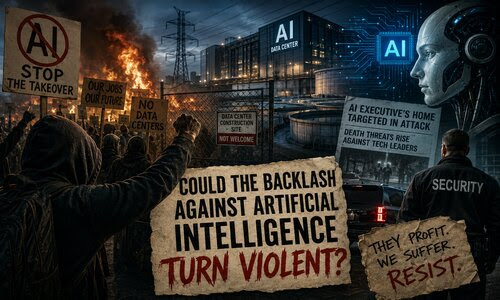
The warning signs are no longer hypothetical.
An alleged attempted firebombing of OpenAI CEO Sam Altman’s home. Death threats against executives at Anthropic. Online manifestos calling for the killing of AI leaders. Security teams escorting tech executives with armed protection. Threat-monitoring firms reporting a dramatic surge in violent rhetoric aimed at artificial intelligence companies and their massive data centers.
Just a few years ago, this would have sounded like science fiction.
Today, it is becoming reality.
Artificial intelligence is advancing at breathtaking speed, promising medical breakthroughs, scientific discoveries, economic growth, and productivity gains unlike anything seen since the Industrial Revolution. But for a growing number of people, AI represents something far different–a direct threat to their jobs, their communities, and perhaps even the future of human society.
That growing divide is creating one of the most significant cultural and political battles of the coming decade.
Fear Is Fueling The Backlash
To dismiss AI critics as simply anti-technology would be a mistake.
Many of their concerns are legitimate.
Entire professions are already being transformed. Writers, programmers, graphic designers, customer-service representatives, legal researchers, translators, accountants, and even medical professionals are discovering that AI can now perform work that once required years of education and experience.
History tells us new technologies eventually create new industries and new opportunities.
It also tells us the transition can be painful.
When people believe their livelihoods are disappearing, they rarely celebrate progress. As Palantir CEO Alex Karp recently observed, tell someone their job is about to disappear, and “people go for the pitchfork.”
That may sound dramatic, but history offers plenty of examples. The Luddites of nineteenth-century England destroyed textile machinery they believed threatened their livelihoods. They failed to stop industrialization, but they demonstrated a timeless truth: when people feel technology is taking away their future, some eventually attack the technology itself.
The Data Center Wars
The conflict isn’t only about jobs.
It is increasingly about the enormous infrastructure required to power artificial intelligence.
Modern AI data centers consume staggering amounts of electricity and water. Proposed facilities have sparked opposition from residents worried about strained water supplies, increased electricity demand, environmental impacts, loss of farmland, and neighborhoods transformed by sprawling industrial campuses.
Some communities are also pushing back against rising property values fueled by tech investment, fearing they’ll be priced out of the very places they’ve called home for generations.
To AI companies, these facilities represent the foundation of tomorrow’s economy.
To many residents, they represent billion-dollar corporations consuming local resources while ordinary people bear the costs.
Those competing visions are setting the stage for increasingly bitter political battles.
A New Technology Divide
Supporters see AI as humanity’s next great leap forward.
They envision faster medical discoveries, safer transportation, personalized education, greater productivity, and economic growth that could improve billions of lives.
Critics see something else entirely.
They worry about mass unemployment, deepfake deception, surveillance, concentrated corporate power, autonomous weapons, and a future where humans become increasingly dependent on machines they neither understand nor control.
Neither side is entirely wrong.
AI is likely to produce extraordinary benefits while also creating extraordinary disruption.
The problem is that both are likely to happen at the same time.
Could The Conflict Escalate?
Most opposition to AI will remain peaceful.
But history reminds us that major technological revolutions rarely unfold without resistance.
Today it’s death threats and Molotov cocktails.
Tomorrow it could be sabotaged data centers, blocked construction projects, damaged power infrastructure, or organized campaigns designed to halt AI expansion altogether. Around the world, infrastructure projects–from pipelines to power plants–have become flashpoints for years of protests and, in some cases, vandalism. There is little reason to assume AI facilities will be immune.
Imagine entire regions losing thousands of white-collar jobs over just a few years. Imagine AI companies simultaneously announcing record profits while building massive campuses that consume local land, water, and electricity.
The ingredients for a long-term political movement–and perhaps a far more confrontational one–are already visible.
Some have even begun asking a once-unthinkable question: could AI someday contribute to a form of civil conflict?
That should not be understood as a prediction. There is no evidence society is on the brink of armed conflict over artificial intelligence.
But technological revolutions have repeatedly intensified existing social and political divisions. If millions of people conclude that AI has permanently eliminated their careers while concentrating wealth and power into the hands of a few companies, resentment could grow into something far larger than today’s isolated acts of violence.
Ironically, the conflict would never truly be humans versus robots.
It would be humans versus other humans, divided over what kind of civilization they want to build–and whether AI should define it.
More Than A Technology Debate
For Christians, this debate is about more than innovation.
Scripture consistently reminds us that human ingenuity is a gift, but also that wisdom must guide how every tool is used. Technology itself is neither righteous nor evil. The moral question has always been the human heart directing it.
Artificial intelligence may become one of the greatest tools humanity has ever created. It may also become one of the greatest sources of social disruption our generation has ever experienced.
The AI revolution is almost certainly coming.
The real question is not whether the technology will change civilization–it will. The question is whether society adapts, regulates, and benefits from that change, or whether fear, anger, and economic upheaval fuel an escalating backlash against those building it.
Every great technological revolution has created both winners and losers.
Artificial intelligence may create them faster than any revolution before it.
If that happens, the battle over AI may no longer be fought primarily in corporate boardrooms or legislative chambers–but in neighborhoods, at construction sites, and perhaps even in the streets.

TruLight TV : How Our Decisions Shape Our Lives
Our choices today have a great impact on our future. One of the most important choices we can make is who we choose to serve. Joshua dedicated himself and his household to serving God, a reflection of his trust in God’s faithfulness. Who will you choose to serve today? And later our sermon today from Dr. Charles Stanley (The Bible: More Than a Book): God demonstrates His love and concern for us by bestowing amazing promises and fulfilling them. The Bible is where we can find help for every circumstance of life. That plus a testimony from Sara: presented with the teachings of the Quran and the Bible, Sara had to decide which path she would choose.
Today on TruLight Radio XM
TruLight Radio XM 24/7
Program
GMT / UTC +2
Monday To Fridays
00:15 Words to Live By Testimonies
01.15 Science Scripture and Salvation
02.15 Ground Works
04.00 Gospel Concert of the Day
05.00 The Daren Streblow Comedy Show
5:55 It is Today devotional
6:00 Gaither Homecoming Morning Show
7:15 Discover the Word
8.15 Destined for Victory
8:55 Science Scripture and Salvation
9:00 Holy Spirit Hour – Normally Sermons
10:15 Hope of the Heart
11:15 Unshackled
11.45 Words to Live By
12:15 Truth for Life
13:15 Living on the Edge with Chip Ingram
14:15 Focus on the Family
15:00 Kids Hour
16:00 In Touch with Dr. Charles Stanley
16:30 Groundwork
17:15 Live in the Light
18:15 Renewing your Mind
19:00 Gaither Homecoming Show
20:15 Growing Hope
21:15 Adventures in Odyssey Radio Drama
21:45 Bible Reading
22:15 Night-sounds
23.00 Good Old Country Gospel / Rhema Gospel Express
VISIT THE WEBSITE
TruLight Ministry News – EXTRA MANNA

TruLight Ministries orders from God since 2012 . Teach Them , Comfort Them and Warn Them!
15 Episodes of our Radio Drama / Audio Movie is released , ” Sheriff of the Church – I Tell You Tru ”
Click on the Link and Listen
https://sheriffofthechurch.com/the-sheriff-of-the-church-i-tell-you-tru-radio-drama
Healing Truths.
End Time Articles.
Share this Feeding of Manna with your Friends and Family. just click on the Social Media icon and share !