Hosted by TruLight Ministries – The Place of Truth
SELECT YOUR READING LANGUAGE – BOTTOM LEFT = YOUR DAILY MANNA NOW AVAILABLE IN 103 LANGUAGES
@ TruLight Daily Manna is not Just a Bible Verse with a Small Prayer . NO ::: WE SERVE DAILY Manna for the ENTIRE Day . Breakfast , Lunch , Dinner , Plus tea Times and even Entertainment Manna . Plus News Manna and More , This Daily Manna will keep you Spiritually full for the full 48 Hours and even More to Share with your Friends and Family !!!
Faith the Next Step from Hope !!!
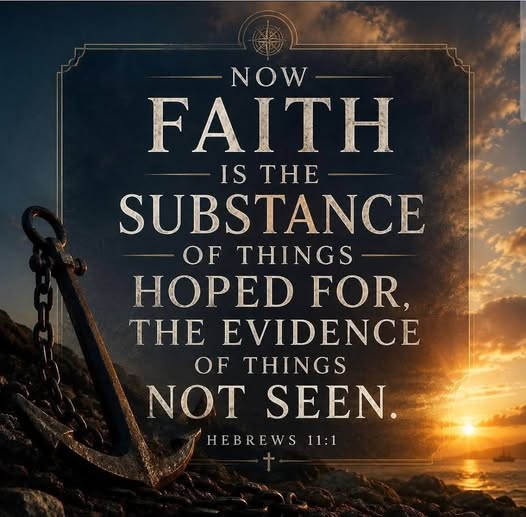
The things of this life that we can see with our eyes and touch with our hands seem like permanent realities. Yet the Bible says that earthly things and worldly experiences are only temporary. The apostle Paul urged believers to develop an eternal perspective so that even in suffering and affliction we can have hope: “So we fix our eyes not on what is seen, but on what is unseen, since what is seen is temporary, but what is unseen is eternal” (2 Corinthians 4:18).
In the original language, the term translated as “unseen” in 2 Corinthians 4:18 refers to invisible things that cannot be seen or perceived by sight. Eternal refers to that which is everlasting, perpetual, and continuing forever. The spiritual realities of heaven, which we cannot see now, are actually the only “real” things that will last forever.
Paul was determined not to fixate on his immediate surroundings or his troubles. He said, “For our present troubles are small and won’t last very long. Yet they produce for us a glory that vastly outweighs them and will last forever!” (2 Corinthians 4:17, NLT). Instead, Paul concentrated on God’s heavenly promises (Hebrews 11:13–14) and the hope of eternal life (Titus 1:2; 3:7).
In Romans 8:18–30, Paul expounded on the hope of heaven. He said that the things we suffer here on earth are not worth comparing to the glory of heaven (verses 18–22). The Holy Spirit—whom we receive through salvation—gives us a foretaste of heaven and fills us with longing and eager anticipation (verse 23) as we wait for the future redemption of our bodies in heaven (verse 23). Paul states, “For in this hope we were saved. But hope that is seen is no hope at all. Who hopes for what they already have? But if we hope for what we do not yet have, we wait for it patiently” (Romans 8:24–25).
Paul looked forward to his heavenly home (see 2 Corinthians 5:1–8), copying the example of the great Old Testament heroes of faith who looked “forward to a city with eternal foundations, a city designed and built by God” (Hebrews 11:10, NLT). Like Moses, Paul “kept his eyes on the one who is invisible” (Hebrews 11:27, NLT).
How do we fix our sights on the unseen, eternal realities? We must look with eyes of faith: “Faith shows the reality of what we hope for; it is the evidence of things we cannot see” (Hebrews 11:1, NLT). Likewise, we do this by locking our gaze “on Jesus, the champion who initiates and perfects our faith. Because of the joy awaiting him, he endured the cross, disregarding its shame. Now he is seated in the place of honor beside God’s throne” (Hebrews 12:2, NLT).
Paul urged the Colossians to set their sights on “the realities of heaven, where Christ sits in the place of honor at God’s right hand. Think about the things of heaven, not the things of earth. For you died to this life, and your real life is hidden with Christ in God. And when Christ, who is your life, is revealed to the whole world, you will share in all his glory” (Colossians 3:1–4, NLT).
Besides the trouble and corruption we see in this world, we can see our natural bodies experiencing decay (Romans 8:19–23). Yet when these earthly “tents” eventually give out and die, we will have new, glorious, resurrection bodies. Right now, our resurrection bodies are unseen but eternal, incorruptible, and glorious. When we reach heaven, our old, dying bodies will “be swallowed up by life” (2 Corinthians 5:1–10). The true reality for Christians is that “we are citizens of heaven, where the Lord Jesus Christ lives. And we are eagerly waiting for him to return as our Savior. He will take our weak mortal bodies and change them into glorious bodies like his own, using the same power with which he will bring everything under his control” (Philippians 3:20–21, NLT).
What is visible now is transient, fleeting, short-lived. But what is unseen is eternal and will never fade. We have “a living hope through the resurrection of Jesus Christ from the dead, and . . . an inheritance that can never perish, spoil or fade. This inheritance is kept in heaven for [us], who through faith are shielded by God’s power until the coming of the salvation that is ready to be revealed in the last time. In all this [we] greatly rejoice, though now for a little while [we] may have had to suffer grief in all kinds of trials” (1 Peter 1:3–6).

Tea Time Manna
Good will come to him who is generous and lends freely, who conducts his affairs with justice.
—Psalm 112:5
Generosity is love expressed in practical ways with joy. Generosity and justice are two character traits more needed in our selfish world — and these are also traits of God who characterized himself as having righteous character, gracious compassion, and justice with faithful lovingkindness (Exodus 34:6-7). Generosity and justice are traits that come into our world from hearts touched by our Father. They are people who have been transformed to more nearly reflect the nature of God. We see this in the Gentile Macedonian believers, who sacrificially and graciously helped their fellow believers in Jerusalem, who were Jewish. Paul describes it this way:
Entirely on their own, they urgently pleaded with us for the privilege of sharing in this service to the Lord’s people. And they exceeded our expectations: They gave themselves first of all to the Lord, and then by the will of God also to us (2 Corinthians 8:3-5).
Prayer
Loving Father, I know you will lead me to people today who need me to be generous with my love, time, forgiveness, and money. Please help me to treat them generously, fairly, and lovingly, just as you have treated me. May my life reflect your grace to others who need your love. In Jesus’ name, I pray. Amen and Amen
Bible Teaching of the Day
LUNCH MANNA =
The book of Hebrews is an excellent place to find answers to our questions about faith. Chapter 11 begins with this short definition of faith: “Now faith is being sure of what we hope for and certain of what we do not see” (Hebrews 11:1).
What, then, is a leap of faith? The term leap of faith is not found in the Bible. It is a common idiom, though. Usually, to take a leap of faith means “to believe in something with no evidence for it” or “to attempt an endeavor that has little chance of success.” Leap of faith actually originated in a religious context. Søren Kierkegaard coined the expression as a metaphor for belief in God. He argued that truth cannot be found by observation alone but must be understood in the mind and heart apart from empirical evidence. Since we cannot observe God with our eyes, we must have faith that He is there. We jump from material concepts to the immaterial with a “leap of faith.”
Continuing in Hebrews chapter 11, we find an impressive list of men and women in the Bible who took a “leap of faith,” as it were. These are just a few of the people mentioned who took God at His Word and trusted Him to do what He had promised:
By faith, Noah obeyed God and built an ark to save his family from the flood (Genesis 6:9 – 7:24). By faith, Abraham prepared to sacrifice his son, believing God would provide a lamb (Genesis 22:1–19). By faith, Moses chose to side with the Hebrews rather than stay in the Egyptian palace (Exodus 2 – 4). By faith, Rahab risked her life and sheltered enemy spies in her home (Joshua 2:1–24).
Throughout the rest of Scripture, the stories of the faithful continue. By faith, David confronted a giant with only a sling and a stone (1 Samuel 17). By faith, Peter stepped out of the boat when Jesus invited him to come (Matthew 14:22–33). The accounts go on and on, each story helping us to understand the biblical meaning of a leap of faith.
Exercising faith in God often requires taking a risk. Second Corinthians 5:7 tells us, “For we live by faith, not by sight.” But a biblical step of faith is not a “blind” leap. Our faith is backed by assurance and certainty. Faith is soundly supported by God’s promises in His Word. A leap of faith is not an irrational impulse that causes us to jump out into the great unknown without any foresight. According to the Word of God, believers are to seek counsel from godly leaders (Proverbs 11:14; 15:22; 24:6). Also, Christians are to acquire wisdom and direction from God’s Word (Psalm 119:105, 130).
The stories in the Bible exist for a reason. Our trust and faith grow stronger as we read these accounts of God’s powerful deliverance and rescue in times of need. God miraculously delivered Joseph from slavery and placed him in charge over all of Egypt. God transformed Gideon from a coward to a courageous warrior. These Bible characters took leaps of faith because they trusted in the God who was powerful enough to rescue them, hold them up, and not let them fall (see Jude 1:24).
Putting our faith into action may feel like a scary leap, but that is part of the testing and proving of our faith: “In all this you greatly rejoice, though now for a little while you may have had to suffer grief in all kinds of trials. These have come so that the proven genuineness of your faith—of greater worth than gold, which perishes even though refined by fire—may result in praise, glory and honor when Jesus Christ is revealed. Though you have not seen him, you love him; and even though you do not see him now, you believe in him and are filled with an inexpressible and glorious joy, for you are receiving the end result of your faith, the salvation of your souls (1 Peter 1:6–9; See Hebrews 11:17 also).
Stepping out in faith requires trusting God to do what He has already promised in His Word, even though we may not see the fulfillment of His promise yet. Genuine faith, belief, and trust will move us to action.
A leap of faith might mean leaving the safety of your comfort zone. Peter abandoned his safety and comfort when he jumped out of the boat to walk on water to Jesus. He could take that leap of faith because he knew his Lord and trusted that He was good: “The LORD is good to all; he has compassion on all he has made” (Psalm 145:9). When Jesus said, “Come,” Peter exercised childlike faith, the type of faith we are all called to possess: “But Jesus called the children to him and said, ‘Let the little children come to me, and do not hinder them, for the kingdom of God belongs to such as these’” (Luke 18:16).
When we demonstrate authentic trust in God, we know that our “leap of faith” is actually a leap into His all-powerful and loving arms. He delights in our trust and rewards those who earnestly pursue Him: “Without faith it is impossible to please God, because anyone who comes to him must believe that he exists and that he rewards those who earnestly seek him” (Hebrews 11:6).
DINNER TIME MANNA
First Corinthians 12 talks about spiritual gifts, which are distributed by the Holy Spirit (1 Corinthians 12:4). Thus one Christian may receive one type of gift while another receives a different gift. Chapter 13 goes one step further and mentions the three gifts that are common for all Christians: faith, hope, and love. Verse 13 says, “And now these three remain: faith, hope and love. But the greatest of these is love.”
In stating that faith, hope, and love remain, Paul does something interesting and unexpected: he uses a singular verb for a compound (and therefore plural) subject. His statement in 1 Corinthians 13:13 could be literally rendered “faith, hope, and love remains.” Paul’s point is that, essentially, faith, hope, and love are united; what happens to one happens to all. And what happens is that they “remain.”
The fact that faith, hope, and love remain must be understood in light of the broader context. Paul had just listed another set of three gifts that would not remain: “Where there are prophecies, they will cease; where there are tongues, they will be stilled; where there is knowledge, it will pass away” (1 Corinthians 13:8). So, the passage contains a contrast: three gifts of the Spirit that will cease, and three gifts that will never end. Faith, hope, and love will always remain.
The Corinthian church members were priding themselves on the fact that they could speak in tongues and demonstrate other attention-getting gifts. Paul reminds them of “the most excellent way” (1 Corinthians 12:31)—the way of love. The gifts that the Corinthians so desired were but temporary; faith, hope, and love, the foundational gifts, are permanent and therefore more to be desired.
Faith, hope, and love are gifts in the present age, and they will still be gifts in the age to come. The NLT translates the promise this way: “Three things will last forever—faith, hope, and love.” It’s easy to see how love will last forever, since love is an essential part of God’s nature (1 John 4:16). But what about faith and hope? Those two gifts will likewise last forever. Faith in the Son of God will not cease in the eternal state; we will not stop trusting Jesus just because our faith has become sight. If anything, our trust in Him will grow greater. Similarly, our hope will not cease just because our blessed hope has come. Our lives will continue in the eternal state, as will our expectation of other things in an infinite sequence of adventure. As commentator Alexander MacLaren explained, “That Future presents itself to us as the continual communication of an inexhaustible God to our progressively capacious and capable spirits. In that continual communication there is continual progress. Wherever there is progress there must be hope. And thus the fair form . . . will move before us through all the long avenues of an endless progress, and will ever and anon come back to tell us of the unseen glories that lie beyond the next turn, and to woo us further into the depths of heaven and the fulness of God” (MacLaren Expositions of Holy Scripture, 1 Corinthians).
Faith, hope, and love are the three gifts that will be ours throughout all eternity. And agape love is the ultimate gift. God in His goodness gives us the privilege of possessing these gifts today, and we look forward to having them remain with us forever.

NEWS MANNA –
Born Before Tisha B’Av: A Red Heifer And The Return Of The Temple Dream
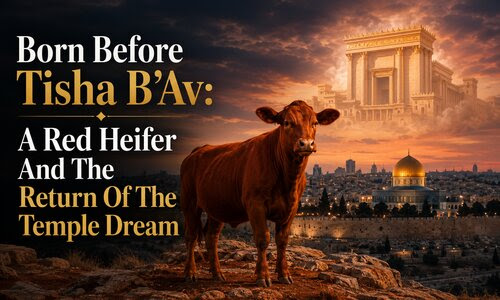
For nearly two thousand years, Tisha B’Av has been a day of mourning.
Jewish communities fast, pray and remember the destruction of the First and Second Temples–the sacred center of Israel’s national and religious life that once stood in Jerusalem. It is a day defined by loss, exile and the painful absence of something that has never been restored.
That makes the timing of a new red heifer’s birth especially striking.
Born in the Golan Heights shortly before Tisha B’Av, the calf is reportedly the second potential red heifer born in Israel within approximately six weeks. At the same time, two additional red heifers have been inseminated in Ancient Shiloh as part of a broader effort to develop a sustainable herd.
One calf does not mean the Third Temple is about to be built. But it does reveal something important: The Temple is no longer merely an ancient memory. For a growing number of Israelis, it is becoming a living dream.
According to Numbers 19, the ashes of an unblemished red heifer were used in a purification ritual connected to contact with the dead. Those ashes are considered essential by Temple advocates who believe the priesthood and sacred areas would need to be purified before full Temple worship could be restored. The Temple Institute describes producing the red-heifer ashes as a prerequisite for fully renewing the Temple service.
The standards are extraordinarily strict. A potential heifer must be examined for blemishes, disqualifying hairs and other physical abnormalities. Even this latest calf faces uncertainty because she was born as the female twin of a male calf, raising questions about whether an unseen reproductive abnormality could disqualify her.
That uncertainty illustrates why establishing a herd matters so much.
Previous red-heifer stories have often focused on one animal carrying the weight of enormous expectations. A single blemish could bring the entire effort to an abrupt end. But an organized breeding program inside Israel changes the equation. Instead of waiting for one extraordinarily rare animal to appear, Temple advocates are attempting to create the conditions in which qualifying animals could emerge repeatedly.
The real story, therefore, is not simply that another red calf has been born.
The real story is that an infrastructure is being assembled.
Red heifers are being bred. Priestly garments and sacred vessels have been recreated. Religious scholars are studying the requirements of ancient worship. Educational programs are introducing thousands of Israelis to the biblical laws surrounding purity, sacrifice and the Temple. The Temple Institute openly says its work includes reproducing vessels and garments, pursuing red-heifer ashes, reenacting Temple ceremonies and preparing for renewed worship.
Even the locations carry meaning.
The insemination of heifers in Ancient Shiloh connects today’s preparations with the place where the Tabernacle once stood before Jerusalem became the center of Israelite worship. From Shiloh to the Golan Heights and ultimately toward Jerusalem, the Temple movement is linking modern Israel with its biblical past.
For decades, much of Israeli society viewed discussion of a rebuilt Temple as a fringe religious obsession–politically dangerous, impractical and best kept far from the national conversation.
That may be changing.
The events of October 7, 2023, and the long war that followed produced more than a military and political reckoning. They also triggered a spiritual reexamination among a significant portion of Israeli society.
The shift has not been universal, but it is measurable. An Israel Democracy Institute survey conducted shortly after the attack found growing numbers of Israelis reporting that they felt closer to religion. A later Jewish People Policy Institute survey found that 27 percent of Jewish Israelis said they were observing more religious traditions than before the war, 31 percent were praying more and 20 percent were reading the Tanakh or Psalms more frequently.
Stories also emerged of soldiers wearing tzitzit, putting on tefillin, praying before battle and carrying Psalms into combat. Families traumatized by massacre, hostage-taking and war began asking questions that military power and political leadership alone could not answer.
Why had this happened? What held the Jewish people together? What did their survival mean? Was Israel merely a modern nation-state, or was it connected to a much older calling?
That renewed search for faith, identity and national purpose helps explain why interest in the Temple may be finding a larger audience.
Institute leaders are describing a growing public awakening. More Israelis are attending educational programs and asking questions about the Temple’s role in Jewish identity. After the trauma and upheaval of recent years, some Israelis appear to be looking beyond political survival toward deeper questions of national destiny.
What does it mean for the Jewish people to be back in their ancestral homeland? What unfinished chapters of their history remain? Was the return to Jerusalem simply about establishing another modern state, or is there a religious destiny still waiting to be confronted?
Those questions are becoming more difficult to dismiss.
Yet the return of the Temple dream also carries extraordinary danger.
A red heifer may seem harmless, but the ritual it represents leads directly toward the most contested piece of land on earth: the Temple Mount.
Any serious move toward renewed Jewish worship there would be portrayed throughout much of the Muslim world as an attack on the Al-Aqsa Mosque. Hamas has repeatedly invoked alleged threats against Al-Aqsa to justify violence. Iran, Hezbollah, Turkish leaders and Islamist movements across the region would almost certainly seize upon major Temple developments to inflame public anger.
What begins as a religious ceremony could quickly become a geopolitical crisis.
Riots could erupt in Jerusalem and the West Bank. Terrorist organizations could call for attacks against Israel and Jewish communities abroad. Muslim governments facing pressure from their own populations could reconsider cooperation with Israel. Regional adversaries could use the Temple issue as the spark for a much wider confrontation.
This does not mean Israel should surrender its history or biblical identity to threats of violence. But it does mean that every step toward the Temple Mount carries consequences far beyond the religious groups directly involved.
That is why the birth of a red heifer shortly before Tisha B’Av is so symbolic.
On the very days when the Jewish people were preparing to mourn the Temples that were destroyed, an animal connected to purification and restored Temple worship was born in the land of Israel.
Perhaps she will eventually be disqualified. Most potential red heifers are. Perhaps another will emerge later. The larger movement does not depend on one calf.
The deeper development is the return of the Temple to Israel’s imagination.
For Christians who watch biblical prophecy, this should be approached with both attention and humility. Scripture points toward a future in which Jerusalem, sacrifice and the Temple once again become central to world events.
Ideas once dismissed as impossible are being discussed. Rituals absent for nearly two millennia are being studied. Animals are being bred. Priests are being prepared. Israelis are being educated. And a nation shaken by October 7 is once again searching its ancient faith for answers about its future.
The Temple dream is moving slowly from the margins toward the national consciousness.
The most important question may not be whether this particular heifer qualifies.
It may be the question raised by the breeder himself.
Israel is increasingly gaining the knowledge, resources and opportunity to pursue the Temple dream.
But does the nation truly want to?
The answer could reshape Jerusalem, shake the Middle East and place the Temple Mount once again at the center of world history.
The Warning Lights Are Flashing: Is A Massive Strike On Iran Only Days Away?
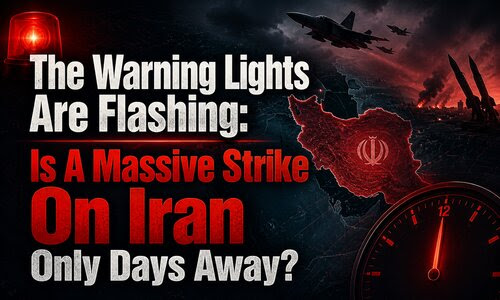
It is impossible for anyone outside the highest levels of the White House and Pentagon to know whether a massive attack on Iran will begin within the next 72 hours.
But something is clearly happening.
The evidence is no longer based merely on anonymous social-media accounts tracking aircraft or interpreting unusual military movements. President Donald Trump has publicly confirmed that he is close to deciding whether to launch an attack on Iran that could be “bigger than ever before.” American and Israeli officials have reportedly said expanded combat operations could begin within days.
Trump has also declared that the United States will attack Iran’s deeply buried Pickaxe Mountain facility “very soon.” The underground complex near Natanz is believed by Israeli intelligence to contain thousands of centrifuges moved into tunnels hundreds of feet beneath the mountain.
These are not vague warnings about unspecified future consequences. They are descriptions of targets, weapons and operations that appear to be under active consideration.
The Battlefield Is Being Prepared
For almost two weeks, American forces have conducted nightly attacks against Iranian air defenses, coastal radar installations, anti-ship missile positions, drone-launching facilities, military command centers and maritime infrastructure.
Reuters reported that these attacks were not simply retaliation for individual Iranian actions. They were also destroying capabilities the United States would want eliminated before undertaking more complicated operations deeper inside Iran.
That is what military planners call shaping the battlefield.
The arrival of the B-1B Lancer in the renewed campaign provides another important signal. A B-1 reportedly flew from a British base to strike Revolutionary Guard targets, marking its first use since the latest fighting began. The aircraft can carry up to 75,000 pounds of conventional weapons, including two dozen 2,000-pound bombs or up to 24 long-range JASSM cruise missiles.
A B-1 is not necessarily the weapon that would be used against Iran’s deepest underground chambers. Its importance is volume. It can deliver an enormous number of precision weapons against command centers, missile sites, aircraft shelters, military industries and infrastructure during a single mission.
A strike against Pickaxe Mountain would probably require a different package. During the earlier attack on Iran’s Fordow facility, the United States used B-2 stealth bombers carrying 30,000-pound Massive Ordnance Penetrators. Fighter aircraft suppressed Iranian air defenses while a submarine launched Tomahawk missiles against other targets. Decoy aircraft were sent in another direction to conceal the operation.
A new attack could follow a similar pattern, but on a much wider scale: stealth bombers attacking underground facilities, B-1s delivering large numbers of conventional weapons, fighters suppressing remaining air defenses, ships and submarines launching cruise missiles, and cyber and electronic-warfare operations attempting to blind Iranian communications.
Dozens of additional American refueling aircraft have also reportedly been positioned in Israel as the administration considers bombing Iran’s nuclear and strategic infrastructure. Refueling aircraft are essential when large numbers of combat aircraft must remain over distant targets for extended operations.
The United States may therefore be preparing for something considerably larger than another night of limited retaliatory strikes.
What Would America Target?
The most likely opening targets would be those capable of threatening American aircraft, bases and ships: air-defense batteries, ballistic-missile launchers, drone facilities, coastal missile sites, Revolutionary Guard command centers and military communications.
A second wave could strike Iran’s strategic infrastructure.
Trump has explicitly threatened to destroy an Iranian bridge or power plant for every additional commercial vessel attacked in the Strait of Hormuz. His administration has also discussed strikes against nuclear facilities, energy infrastructure and the fortified Pickaxe Mountain complex.
More dangerous options have reportedly included deploying American troops to seize Kharg Island, through which much of Iran’s oil historically flows. That would be far more escalatory than an air campaign because it could require amphibious forces, special-operations troops and the continuing defense of captured Iranian territory.
A ground invasion of Iran still appears highly unlikely. A concentrated campaign intended to destroy strategic assets, punish the leadership and force Tehran to reopen shipping routes is much more plausible.
The central danger is that Iran has already explained what it would do next.
Iran Could Attack The Gulf’s Lifelines
Tehran has warned Gulf governments that American attacks on Iran’s electrical grid would produce “unlimited retaliation” against countries hosting Americanmilitary forces.
Those threats cannot be dismissed as empty rhetoric. Earlier in the conflict, Iranian missiles and drones damaged Qatar’s enormous Ras Laffan energy complex, targeted Saudi facilities, set fires at Kuwaiti refineries and forced the United Arab Emirates to shut gas installations.
Iran could attempt to strike American bases in Jordan, Kuwait, Bahrain, Qatar, Saudi Arabia and the UAE. It could simultaneously target electrical plants, oil terminals, refineries, pipelines and water-desalination facilities belonging to those countries.
Desalination plants are particularly consequential because several Gulf nations depend heavily on them for drinking water. Even limited disruption could create panic, force emergency rationing and place enormous pressure on governments that want no part in the war.
Israel would almost certainly prepare for renewed ballistic-missile attacks. Municipalities including Ramat Gan, Eilat and Karmiel have opened public shelters after local assessments concluded that the danger of Iranian missile fire over the weekend was no longer negligible. Israeli officials reportedly believe that an American attack against strategic Iranian infrastructure or senior regime figures could cause Tehran to bring Israel directly back into the conflict.
The shelter openings are therefore meaningful. But they are precautionary indicators–not proof that Israel has received the exact time of an impending American attack.
Iran Is Opening A Second Shipping Front
Iran may also retaliate indirectly by attempting to choke the world’s energy arteries.
The Strait of Hormuz is already heavily disrupted. Now the Houthis are attempting to threaten Saudi shipping through the Red Sea and Bab el-Mandeb.
Reuters reports that Iran recently transported Revolutionary Guard commanders, military advisers and missile- and drone-related equipment into Houthi-controlled Yemen. Days later, the Houthis announced a blockade of Saudi shipping and attacked Saudi oil tankers.
That creates a potential two-chokepoint crisis: Iran threatening traffic through Hormuz while its Houthi allies threaten traffic between the Red Sea and Gulf of Aden.
Oil has already climbed above $100 per barrel. The two waterways together handle roughly one-quarter of global petroleum supplies, and insurers are sharply increasing the cost of sending ships through threatened areas.
A sustained shutdown could produce fuel shortages, inflation, disrupted supply chains and a major global recession. Predictions of an automatic worldwide depression, failed banks and the immediate collapse of civilization go well beyond what the evidence presently supports. But the economic danger is unquestionably severe.
What About Sleeper Cells?
The possibility of Iranian-directed attacks inside the United States and Europe must be discussed carefully.
Iran has spent years developing what counterterrorism officials have described as a “homeland option.” Researchers at the Combating Terrorism Center at West Point identified at least 17 Iranian-linked plots disrupted in the United States during a five-year period. The potential pathways include Iranian intelligence operatives, Hezbollah members, criminal organizations hired as proxies and individuals inspired to act independently.
The FBI says Iran’s global threat includes attempted terrorist attacks, kidnappings, assassination schemes, espionage, cyberattacks and operations against dissidents and current or former American officials.
Britain has faced a similar threat. British intelligence has reportedly tracked more than 20 Iranian-linked plots, often involving criminal networks hired to conduct surveillance or attacks against dissidents and Jewish or Israeli interests.
If Tehran wanted retaliation without leaving obvious Iranian fingerprints, using criminal intermediaries, proxy organizations or inspired lone actors would offer plausible deniability. The immediate danger would not necessarily resemble a centrally commanded military operation. It could instead appear as attempted assassinations, sabotage, attacks against diplomatic or religious institutions, or opportunistic violence encouraged by Iranian propaganda.
Cyberattacks may be even more likely. American authorities have repeatedly warned that Iranian actors target government networks, businesses and critical infrastructure. A recently listed federal advisory concerns Iranian-affiliated actors exploiting programmable industrial-control equipment used in American infrastructure.
The Next Few Days Could Be Decisive
No credible source can guarantee that a massive attack will occur this weekend.
Diplomatic communications are reportedly continuing through Qatar, Oman and other intermediaries. Some of the military buildup and public threats may be intended to frighten Tehran into reopening the Strait of Hormuz and accepting American nuclear demands without another enormous battle.
But the warning lights are flashing.
The president says he is close to a decision. B-1 bombers have entered the renewed campaign. Additional refueling aircraft have been positioned. Iranian air defenses and coastal systems are being systematically reduced. Pickaxe Mountain has been publicly identified as a coming target. Iran is reinforcing the Houthis, threatening Gulf infrastructure and warning Britain that an airbase used by American bombers is now a legitimate target.
Taken individually, any one of these developments might be dismissed as signaling or psychological warfare.
Taken together, they describe a region preparing for the possibility that the current war is about to enter its most dangerous phase yet.

TruLight TV : Evolution Solution
Being a follower of Christ doesn’t exempt you from experiencing bad things in life. But it does mean that even the bad things work out for your good! Watch today’s video to learn how. and later on 7th Street Theater the program in title “Evolution Solution” – Travis meets an old classmate who doesn’t believe in God, creation or any absolutes. The Cast comes up with an idea to change his mind. Enjoy and thanks for watching.
Today on TruLight Radio XM
TruLight Radio XM 24/7
Program
GMT / UTC +2
Monday To Fridays
00:15 Words to Live By Testimonies
01.15 Science Scripture and Salvation
02.15 Ground Works
04.00 Gospel Concert of the Day
05.00 The Daren Streblow Comedy Show
5:55 It is Today devotional
6:00 Gaither Homecoming Morning Show
7:15 Discover the Word
8.15 Destined for Victory
8:55 Science Scripture and Salvation
9:00 Holy Spirit Hour – Normally Sermons
10:15 Hope of the Heart
11:15 Unshackled
11.45 Words to Live By
12:15 Truth for Life
13:15 Living on the Edge with Chip Ingram
14:15 Focus on the Family
15:00 Kids Hour
16:00 In Touch with Dr. Charles Stanley
16:30 Groundwork
17:15 Live in the Light
18:15 Renewing your Mind
19:00 Gaither Homecoming Show
20:15 Growing Hope
21:15 Adventures in Odyssey Radio Drama
21:45 Bible Reading
22:15 Night-sounds
23.00 Good Old Country Gospel / Rhema Gospel Express
VISIT THE WEBSITE
TruLight Ministry News – EXTRA MANNA
TruLight Ministries orders from God since 2012 . Teach Them , Comfort Them and Warn Them!
Healing Truths.
End Time Articles.
Share this Feeding of Manna with your Friends and Family. just click on the Social Media icon and share !nna with your Friends and Family. just click on the Social Media icon and share !