Hosted by TruLight Ministries International – The Place of Truth
SELECT YOUR READING LANGUAGE – BOTTOM LEFT = YOUR DAILY MANNA NOW AVAILABLE IN 103 LANGUAGES
@ TruLight Daily Manna is not Just a Bible Verse with a Small Prayer . NO ::: WE SERVE DAILY Manna for the ENTIRE Day . Breakfast , Lunch , Dinner , Plus tea Times and even Entertainment Manna . Plus News Manna and More , This Daily Manna will keep you Spiritually full for the full 48 Hours and even More to Share with your Friends and Family !!!
The Great White Throne Judgement !!!
To give you a visual understanding of this significant biblical event, here is an exploration of how The Great White Throne Judgment is traditionally depicted in biblical teaching and prophetic artwork.
Key Visual Elements of the Judgment
Artistic representations of Revelation 20:11-15 universally emphasize a few breathtaking and sobering details:
- The Massive Radiant Throne: The central focus is a massive, elevated throne radiating brilliant, pure white light, representing the absolute holiness and justice of God. Earth and sky are often shown dissolving or fleeing from its overwhelming presence.
- The Standing Multitudes: A vast, endless sea of people from all generations and backgrounds stands assembled before the base of the steps, awaiting their individual trials.
- The Floating, Open Books: Massive celestial scrolls or books hover near the throne, symbolizing the unrolling records of human lives. The Book of Life is typically highlighted as a beautifully illuminated, golden volume standing apart from the books of Judgement.
The great white throne judgment is described in Revelation 20:11-15 and is the final judgment prior to the lost being cast into the lake of fire. We know from Revelation 20:7-15 that this judgment will take place after the millennium and after Satan is thrown into the lake of fire where the beast and the false prophet are (Revelation 19:19-20; 20:7-10). The books that are opened (Revelation 20:12) contain records of everyone’s deeds, whether they are good or evil, because God knows everything that has ever been said, done, or even thought, and He will reward or punish each one accordingly (Psalm 28:4; 62:12; Romans 2:6; Revelation 2:23; 18:6; 22:12).
Also at this time, another book is opened, called the “book of life” (Revelation 20:12). It is this book that determines whether a person will inherit eternal life with God or receive everlasting punishment in the lake of fire. Although Christians are held accountable for their actions, they are forgiven in Christ and their names were written in the “book of life from the creation of the world” (Revelation 17:8). We also know from Scripture that it is at this judgment when the dead will be “judged according to what they had done” (Revelation 20:12) and that “anyone’s name” that is not “found written in the book of life” will be “thrown into the lake of fire” (Revelation 20:15).
The fact that there is going to be a final judgment for all people, both believers and unbelievers, is clearly confirmed in many passages of Scripture. Every person will one day stand before Christ and be judged for his or her deeds. While it is very clear that the great white throne judgment is the final judgment, Christians disagree on how it relates to the other judgments mentioned in the Bible, specifically, who will be judged at the great white throne judgment.
Some Christians believe that the Scriptures reveal three different judgments to come. The first is the judgment of the sheep and the goats or a judgment of the nations (Matthew 25:31-36). This takes place after the tribulation period but prior to the millennium; its purpose is to determine who will enter the millennial kingdom. The second is a judgment of believers’ works, often referred to as the “judgment seat [bema] of Christ” (2 Corinthians 5:10). At this judgment, Christians will receive degrees of reward for their works or service to God. The third is the great white throne judgment at the end of the millennium (Revelation 20:11-15). This is the judgment of unbelievers in which they are judged according to their works and sentenced to everlasting punishment in the lake of fire.
Other Christians believe that all three of these judgments speak of the same final judgment, not of three separate judgments. In other words, the great white throne judgment in Revelation 20:11-15 will be the time that believers and unbelievers alike are judged. Those whose names are found in the book of life will be judged for their deeds in order to determine the rewards they will receive or lose. Those whose names are not in the book of life will be judged according to their deeds to determine the degree of punishment they will receive in the lake of fire. Those who hold this view believe that Matthew 25:31-46 is another description of what takes place at the great white throne judgment. They point to the fact that the result of this judgment is the same as what is seen after the great white throne judgment in Revelation 20:11-15. The sheep (believers) enter into eternal life, while the goats (unbelievers) are cast into “eternal punishment” (Matthew 25:46).
Whichever view one holds of the great white throne judgment, it is important to never lose sight of the facts concerning the coming judgment(s). First, Jesus Christ will be the judge, all unbelievers will be judged by Christ, and they will be punished according to the works they have done. The Bible is very clear that unbelievers are storing up wrath against themselves (Romans 2:5) and that God will “repay each person according to what they have done” (Romans 2:6). Believers will also be judged by Christ, but since Christ’s righteousness has been imputed to us and our names are written in the book of life, we will be rewarded, not punished, according to our deeds. Romans 14:10-12 says that we will all stand before the judgment seat of Christ and that each one of us will give an account to God.
The 5 Books that will be Opened for Judgement
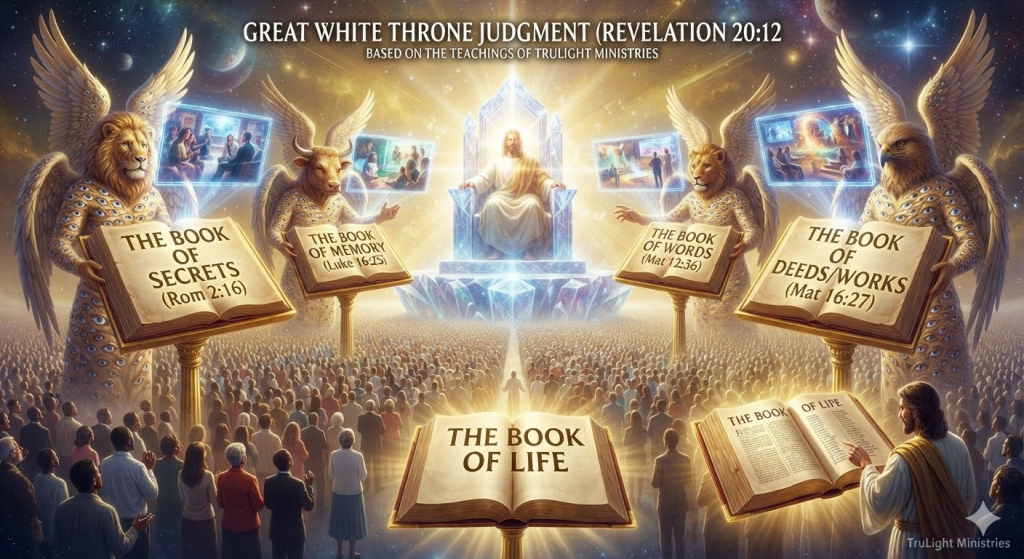
Based on the end-time teachings from TruLight Ministries and Pastor Dirk, here is a clear summary of how our lives are recorded and the 5 specific books opened at the Great White Throne Judgment:
The Recording Equipment
According to the teaching, the 4 Cherubim of the Holy Spirit (the Living Beings) act as the recorders. The “eyes” covering their bodies are highly advanced spiritual recording equipment. They capture every single second of our lives to play back as undeniable evidence during the final trial.
The 5 Books Opened on Judgment Day
When all deceased souls stand before the throne, they are judged out of five specific books based on scripture:
- Book 1: The Book of Secrets
- Focus: Unveils everything hidden from human eyes.
- Scripture: Romans 2:16 (“…when God will judge the secrets of men through Jesus Christ…”).
- Book 2: The Book of Memory
- Focus: Recalls the exact life experiences, comforts, and torments of an individual.
- Scripture: Luke 16:25 (“Son, remember that in your life you received your good things…”).
- Book 3: The Book of Words
- Focus: Tallies spoken language and holds people accountable for careless speech.
- Scripture: Matthew 12:36 (“…for every idle word that people speak, they must give an account…”).
- Book 4: The Book of Deeds/Works
- Focus: Details physical actions, operations, and behaviors to determine a reward or punishment.
- Scripture: Matthew 16:27 (“…he will reward each one according to his works.”).
- Book 5: The Book of Life
- Focus: The final, deciding directory that determines eternal destiny. Only those whose names are written here escape the lake of fire.
- Scripture: Revelation 20:12 (“…and another book was opened, this is the book of life…”).
YOU WILL BE HERE !
EVERONE EVER LIVED WILL BE HERE !
THE ONLY DIFFERANCE IS THAT THE HOLY SPIRIT CHILDREN OF GOD THAT WAS RATURED 1000 YEAR PRIOR WILL BE STANDING BEHIND THE JUDGEMENT THRONE . Rev 20
Maybe at time of Death , You where a Christian , but not Spirit Filled and Raptured at the 2nd Coming of Jesus ?? Is there a 2nd Chance ?
Yes , @ The Great White Throne Judgement – if there is no Entries in the 4 Judgement Books .(Meaning washed away by the Blood of Jesus) and Your name is written in the BOOK OF LIFE , you will be safe from the Lake of Fire called HELL.
DO YOU want to Gamble Your Soul on this ?? ??
1st Prize = Spirit Filled Rapture.
The great white throne judgment, described in Revelation 20, occurs after Christ’s millennial reign, where the dead are resurrected and judged based on their deeds. Those not found in the Book of Life, which contains the names of those who have trusted in Christ, will be cast into the lake of fire. This judgment highlights that salvation is through faith in Christ alone, and works cannot save. Jesus serves as the perfect, omniscient, and righteous judge, ensuring true justice is carried out. For believers, this judgment is avoided because their sins have been forgiven through Christ’s sacrifice. As we await His return, it’s a call for us to share the message of salvation with urgency, knowing the eternal stakes for those who have not yet placed their trust in Him.
From the old testament
Although the primary text for the great white throne judgment appears in Revelation 20, the prophet Daniel also wrote of this time in a vision he was given hundreds of years earlier: “As I looked, thrones were placed, and the Ancient of Days took his seat; his clothing was white as snow, and the hair of his head like pure wool; his throne was fiery flames; its wheels were burning fire. A stream of fire issued and came out from before him; a thousand thousands served him, and ten thousand times ten thousand stood before him; the court sat in judgment, and the books were opened” (Daniel 7:9–10).
From the new testament
In the New Testament book of Revelation, the apostle John is given visions that explain what will take place in the future. One of the visions John receives is recorded in Revelation 20 and concerns a judgment that will take place after Christ’s second coming.
After Jesus returns, the Devil will be imprisoned for one thousand years, and during that time Christ will rule as king in Heaven (a time that is often referred to as the millennial reign of Christ; cf. Revelation 20:1–6). Once the one thousand years are completed, Satan will be released, the last human rebellion against God is crushed, and Satan is consigned forever to what the Bible calls the lake of fire (Revelation 20:7–10).
Revelation 20:11–15 describes what happens next, which is often referred to as the great white throne judgment. During the great white throne judgment, the dead are resurrected and judged according to their deeds, specifically whether or not they trusted in Jesus for the forgiveness of sins. Those whose names are not found in the Book of Life will be thrown into the lake of fire, the second death.
According to Scripture, the Book of Life contains the names of all who have trusted in God for their salvation and have been saved from God’s judgment. Paul mentions the Book of Life in one of his epistles: “Yes, I ask you also, true companion, help these . . . whose names are in the book of life” (Philippians 4:3).
The Bible makes it clear that no person will spend eternity with God based on his works and that it is only God’s grace received through faith in Christ that saves a person (Ephesians 2:8–9). John records that those whose names are not found in the Book of Life (i.e., those outside of Christ) are consigned to the lake of fire based on their deeds (Revelation 20:13, 15). Our works cannot save us, but they may condemn us.
Believers in Christ escape the great white throne judgment because their debts and transgressions have been paid for by Christ, a fact that Paul mentions: “And you, who were dead in your trespasses and the uncircumcision of your flesh, God made alive together with him, having forgiven us all our trespasses, by canceling the record of debt that stood against us with its legal demands. This he set aside, nailing it to the cross” (Colossians 2:13–14).
Revelation pictures Jesus as the judge over all the living and the dead, a role He predicted during His earthly ministry: “The Father judges no one, but has given all judgment to the Son” (John 5:22). It is the final judgment of God upon humankind. After this event, there will never again need to be a trial, and God will never again need to act as judge.
Implications for today
In the end, the great white throne judgment confirms the fact that God’s justice will be done and that justice will be terrifying, sure, and final.

Tea Time Manna
We are God’s workmanship, created in Christ Jesus to do good works, which God prepared in advance for us to do.
—Ephesians 2:10
The Psalmist reminded us that we are fearfully and wonderfully made, and that God created us with something definite planned for us to do with our lives (Psalm 139:13-15). We display his craftsmanship, his artistry, his skill when we intentionally live for him and not like the rest of the world. Paul deepens this truth in our verse today as he writes about being saved by grace through faith (Ephesians 2:8-10). We have been recreated in Christ Jesus to continue the good work of Jesus as we become more and more JESUShaped (Colossians 1:28-29) and as the Holy Spirit continues God’s transformative work in us, making us more and more like Christ (2 Corinthians 3:18). So, let’s get about doing the work of Christ the Father created us to do!
Prayer
Master, Father, and Lord, please teach me to recognize your opportunities and your will when they come into my life. I want to live for you without reservation, doing the good work you created me to do. I pray for boldness to not be shy in sharing my faith. I pray for patience as I wait before I respond. I pray for your protection for those close to coming to Christ. I pray not for me but for your Kingdom to be displayed in my life by the way I live and the good things I do to your glory. In the name of Jesus, I pray. Amen and Amen

NEWS MANNA –
Welcome To The Woke Church: Where Even Jesus Is Accused Of Racism
There are difficult passages in Scripture that deserve careful study, historical context and humility.
But there is a growing tendency in progressive Christianity to approach those passages with an entirely different assumption: if Jesus does not conform to modern ideological expectations, perhaps Jesus Himself was wrong.
That disturbing approach surfaced again this week at Grace Presbyterian Church in El Paso, Texas.
On August 9, Rev. Janie McElwee-Smith preached a sermon titled “Crumbs,” based on Jesus’ encounter with the Canaanite woman in Matthew 15. Grace Presbyterian identifies McElwee-Smith as its pastor and publicly posted the service under that sermon title.
Her interpretation was stunning.
Jesus, she suggested, called the woman a dog as a racial insult. This was “not a good moment” for Him. His humanity was showing. He was apparently contradicting principles He had taught earlier.
And the Canaanite woman?
She became the courageous heroine who challenged Jesus while He was “having a bad day.”
Think about what that interpretation requires Christians to believe.
Jesus displayed racial prejudice.
A woman recognized His moral failure.
She challenged Him.
Jesus changed.
That is more than an unconventional interpretation of Scripture.
It fundamentally alters the character of Christ.
Did Jesus Really Have A Racist Moment?
Matthew 15 tells us that a Canaanite woman begged Jesus to heal her demon-possessed daughter.
Jesus initially explained that He had been “sent only to the lost sheep of the house of Israel.”
When she continued pleading, He responded:
“It is not right to take the children’s bread and toss it to the dogs.”
She answered:
“Yes it is, Lord. Even the dogs eat the crumbs that fall from their master’s table.”
Jesus then responded:
“Woman, you have great faith! Your request is granted.”
Her daughter was immediately healed.
The progressive interpretation takes the reference to “dogs,” imports modern racial categories into the passage, and concludes that Jesus revealed prejudice.
But the entire encounter points in another direction.
Jesus was explaining the order of His earthly ministry.
The Messiah came first to Israel.
That same pattern appears throughout the New Testament: Israel first, followed by the Gospel moving outward to Samaritans, Gentiles and eventually all nations.
That is not racial hatred.
It is redemptive sequence.
And this Canaanite woman becomes one of the clearest early signs that God’s mercy would extend far beyond Israel.
She Wasn’t Correcting Jesus
Modern interpreters also turn the woman into someone the passage never says she was.
She does not accuse Jesus of racism.
She does not rebuke Him for prejudice.
She does not demand that He examine His privilege.
She calls Him Lord.
She even addresses Him as Son of David, a profoundly significant Messianic title.
Then, rather than rejecting Jesus’ illustration, she responds brilliantly within it:
“Even the dogs eat the crumbs.”
Jesus responds not with repentance, but praise:
“Woman, great is your faith.”
The woman did not expose Jesus’ sin.
Jesus exposed her faith.
The encounter revealed persistence, humility and trust so remarkable that Christ publicly commended her.
This Is Not An Isolated Interpretation
Unfortunately, the El Paso sermon is not the first time progressive Christianity has presented Matthew 15 this way.
Progressive pastor Brandan Robertson attracted widespread attention several years ago after arguing that this same encounter demonstrated racial prejudice in Jesus.
Robertson said the woman’s willingness to “speak truth to power” changed Jesus’ mind. He went even further, declaring that Jesus “repents of his racism” before healing her daughter.
He described the account as evidence that Jesus, because He was human, possessed “prejudices and bias” that He was willing to confront.
Another progressive pastor writing about the passage in 2020 similarly declared Jesus “guilty of uttering a racial slur” and argued that the Canaanite woman effectively shamed Him into recognizing His racism.
So this is not simply one pastor in El Paso choosing unfortunate words.
It reflects a recognizable theological trajectory.
And that trajectory has enormous consequences.
A Jesus Who Needs Moral Correction
Historic Christianity teaches that Jesus was fully human.
It does not teach that Jesus was sinful.
Hebrews tells us Christ was tempted as we are, “yet without sin.”
Peter writes that “He committed no sin.”
Paul says Christ “knew no sin.”
If racism is sinful—and Christians should certainly consider it sinful—then accusing Christ of racism is accusing Christ of sin.
There is no theological loophole called “Jesus was having a bad day.”
Jesus became tired.
He became hungry.
He wept.
He experienced anguish.
His humanity was entirely real.
But His humanity was never morally corrupt.
That distinction is central to the Christian faith.
Because once Jesus becomes merely another flawed person whose prejudices needed correction, Christianity’s entire understanding of Christ begins to collapse.
How can a morally compromised Savior become the spotless Lamb of God?
How can someone needing repentance Himself bear the sins of others?
When Culture Becomes Jesus’ Judge
This is where the woke church eventually leads.
Scripture no longer judges the culture.
The culture judges Scripture.
Biblical teaching is placed before the tribunal of today’s political and social assumptions—and apparently even Jesus Himself must answer to them.
If His words offend modern sensibilities, they are reconstructed.
If His actions appear insufficiently progressive, hidden prejudices are assigned to Him.
If necessary, Jesus becomes the student and modern ideology becomes His teacher.
That is not Christianity adapting its language to reach a changing culture.
It is Christianity changing its Christ to satisfy one.
Matthew 15 does not reveal a racist Jesus being corrected by a courageous woman.
It reveals a Gentile woman with extraordinary faith encountering the sinless Messiah.
She did not teach Jesus how to become more righteous.
She recognized who He already was.
And when pastors begin preaching that Jesus Christ Himself needed to overcome racism, prejudice or moral failure, the question Christians need to ask is no longer simply, “What interpretation of Matthew 15 is this?”
The more serious question is:
Which Jesus are they preaching?
Can You Be Fired For Your Christian Beliefs? This Case Could Help Decide
Two flight attendants questioned their employer’s political advocacy.
They lost their jobs.
Now, years later, their case is headed toward trial–and the outcome could carry implications far beyond Alaska Airlines.
Lacey Smith and Marli Brown were fired after criticizing or questioning Alaska Airlines’ support for the Equality Act, legislation designed to expand federal civil-rights protections involving sexual orientation and gender identity.
The women contend that their dismissals amounted to religious discrimination. Alaska Airlines and their union dispute that claim.
A federal appeals court has now determined there is enough evidence for a jury to hear the case.
That distinction matters. The court has not ruled that Alaska Airlines discriminated against the women. A trial will determine the merits of those allegations.
But even before a jury reaches a verdict, the case raises a much larger question:
How much room remains in the modern workplace for employees whose religious beliefs conflict with their employer’s social values?
When Diversity Includes Disagreement
Corporations routinely tell employees that diversity should be celebrated.
But diversity becomes much more complicated when it includes deeply held religious beliefs.
According to the case, Alaska Airlines announced its support for the Equality Act and invited employee feedback.
Smith responded with a simple question:
“As a company, do you think it’s possible to regulate morality?”
Brown went further, arguing that the legislation could threaten religious liberty, parental rights and protections for women.
Those comments clearly challenged the company’s position.
But that is precisely what makes this case significant.
If employees are invited to provide feedback, are they genuinely allowed to disagree?
Or does “inclusion” increasingly mean employees are welcome to participate only as long as their beliefs remain within acceptable ideological boundaries?
That question extends far beyond one airline.
Believe What You Want–But Don’t Say It?
American workplaces increasingly find themselves navigating disputes that once would have been considered deeply personal or political.
Pronouns. Gender identity. Sexuality. Abortion. Race. Religious expression. Political activism.
Companies are no longer merely determining wages, schedules and working conditions. Many now take explicit positions on some of society’s most divisive moral questions.
That creates an unavoidable conflict.
The moment an employer adopts a position on morality or sexuality, some employees will disagree–sometimes because of religious convictions they consider non-negotiable.
What happens then?
There is an enormous difference between requiring employees to treat coworkers and customers respectfully and requiring employees to affirm every belief embraced by corporate leadership.
The first is a reasonable workplace expectation.
The second moves much closer to the territory of conscience.
And that distinction may become one of the defining religious-liberty battles of the modern workplace.
When Disagreement Becomes “Unsafe”
One of the most revealing elements of the Alaska Airlines dispute is the language reportedly used to describe Smith’s comments.
According to court filings, some employees said her statements made them question whether they could “fly safely” with her.
That language deserves attention.
Traditionally, workplace safety referred to physical danger, threats, harassment or genuinely dangerous conduct.
Increasingly, however, words such as “unsafe,” “harmful” and “threatening” are also used to describe ideological disagreement.
That changes the rules dramatically.
Once an opinion is categorized not simply as wrong or offensive but as a threat to someone’s safety, disciplinary action becomes much easier to justify.
The question then becomes:
Can expressing a traditional religious belief itself be treated as creating an unsafe workplace?
If the answer becomes yes, religious liberty could theoretically remain intact on paper while becoming far narrower in practice.
You would remain free to believe.
You simply might not be free to say what you believe when it conflicts with prevailing institutional values.
The “Opposite Sex” Question
Another allegation from the litigation illustrates how fundamental these conflicts have become.
First Liberty says an Alaska Airlines executive testified that use of the term “opposite sex” could violate company discrimination policy because it implies there are only two sexes.
That is not a minor disagreement over terminology.
For millions of Christians, Jews and Muslims, belief in the biological distinction between male and female is intertwined with their understanding of creation, marriage, sexuality and human identity.
A corporation may adopt a different view.
But when corporate policy and religious doctrine directly contradict each other, something eventually has to give.
That is why cases like this matter.
The conflict is no longer simply between conservative and progressive employees.
It is increasingly between institutional orthodoxy and individual conscience.
The Religious-Liberty Battle Is Moving To Work
Americans often think about religious liberty primarily in terms of churches.
Can pastors preach freely?
Can religious schools maintain their beliefs?
Can churches operate without government interference?
Those questions remain important.
But for ordinary believers, the more immediate battles may increasingly occur somewhere else:
At work.
A Christian employee may never face a government official demanding that he renounce his faith.
He may instead face an employer asking him to use language he believes is false.
A teacher may encounter policies involving gender identity.
A medical professional may face procedures conflicting with conscience.
A counselor may confront demands involving sexuality.
A corporate employee may be encouraged to endorse political or social causes.
And most people cannot simply walk away from their careers without consequences.
That makes workplace conscience protections increasingly important.
A Case Worth Watching
The Alaska Airlines case will ultimately turn on specific evidence, employment law and the facts presented at trial.
Perhaps the airline will persuade jurors that its decisions were based on legitimate workplace concerns rather than hostility toward religion.
Perhaps Smith and Brown will convince them that their religious convictions played an unlawful role in their dismissals.
That remains to be decided.
But the larger cultural conflict is already here.
Corporate America often tells employees to bring their “whole self” to work.
For religious Americans, the question is whether that invitation includes the parts of themselves that disagree with corporate orthodoxy.
True pluralism cannot simply protect different identities.
It must also leave room for different convictions.
Employees should be expected to treat one another with dignity. Harassment and genuine discrimination should not be tolerated.
But disagreement is not the same thing as discrimination.
And an unpopular religious belief is not automatically an unlawful one.
If religious liberty protects people only when their convictions remain private and unspoken, it becomes a very thin form of liberty indeed.
That is why this case matters far beyond two former Alaska Airlines flight attendants.
It represents an emerging struggle over a question millions of Americans may eventually face themselves:
When your employer’s values conflict with your deepest religious convictions, which one are you expected to leave at the office door?

TruLight TV – Batteries Are Included
In Today’s Video Devotional – Does it matter who you have relationships with? Paul gives us advice for creating relationships that will help and not harm us. and later on 7th Street Theater the program in title Batteries Are Included – Travis and Gates reflect on the show the cast did that evening. This plus a behind the scenes video of the creation of this classic song with such a relevant message for today! “Just Sing!” by The Collingsworth Family. Enjoy and Thanks for watching!!
Today on TruLight Radio XM
TruLight Radio XM 24/7
Program
GMT / UTC +2
Monday To Fridays
00:15 Words to Live By Testimonies
01.15 Science Scripture and Salvation
02.15 Ground Works
04.00 Gospel Concert of the Day
05.00 The Daren Streblow Comedy Show
5:55 It is Today devotional
6:00 Gaither Homecoming Morning Show
7:15 Discover the Word
8.15 Destined for Victory
8:55 Science Scripture and Salvation
9:00 Holy Spirit Hour – Normally Sermons
10:15 Hope of the Heart
11:15 Unshackled
11.45 Words to Live By
12:15 Truth for Life
13:15 Living on the Edge with Chip Ingram
14:15 Focus on the Family
15:00 Kids Hour
16:00 In Touch with Dr. Charles Stanley
16:30 Groundwork
17:15 Live in the Light
18:15 Renewing your Mind
19:00 Gaither Homecoming Show
20:15 Growing Hope
21:15 Adventures in Odyssey Radio Drama
21:45 Bible Reading
22:15 Night-sounds
23.00 Good Old Country Gospel / Rhema Gospel Express
VISIT THE WEBSITE
TruLight Ministry News – EXTRA MANNA
TruLight Ministries orders from God since 2012 . Teach Them , Comfort Them and Warn Them!
Healing Truths.
End Time Articles.
Share this Feeding of Manna with your Friends and Family. just click on the Social Media icon and share This Manna with your Friends and Family. just click on the Social Media icon and share !