Hosted by TruLight Ministries International – The Place of Truth
SELECT YOUR READING LANGUAGE – BOTTOM LEFT = YOUR DAILY MANNA NOW AVAILABLE IN 103 LANGUAGES
@ TruLight Daily Manna is not Just a Bible Verse with a Small Prayer . NO ::: WE SERVE DAILY Manna for the ENTIRE Day . Breakfast , Lunch , Dinner , Plus tea Times and even Entertainment Manna . Plus News Manna and More , This Daily Manna will keep you Spiritually full for the full 48 Hours and even More to Share with your Friends and Family !!!
Guard (Keep) your Heart and Mind !!!
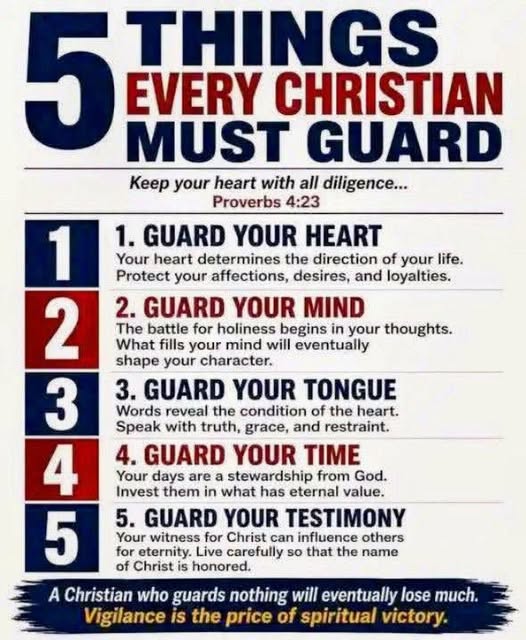
Proverbs 4:23 says, “Above all else, guard your heart, for everything you do flows from it.” These words of wisdom from King Solomon emphasize the importance of protecting our innermost being. Our heart is the source of our thoughts, attitudes, beliefs, and actions. Therefore, it is crucial to guard our hearts above all else.
The heart is a powerful force that drives our actions and influences our thinking and behavior. It can either lead us down a path of righteousness or a path of destruction. Our hearts are susceptible to sinful thoughts, attitudes, and beliefs. Hence, we must be mindful of what we allow into our hearts; everything we do flows from it.
Guarding our hearts is about protecting ourselves from external and internal factors. We must be mindful of the things we think about, the things we set our affection on, and the things we give our attention to. Negativity, bitterness, and anger can take root in our hearts and lead to sinful behavior. For this reason, the apostle Paul says, “Get rid of all bitterness, rage and anger, brawling and slander, along with every form of malice” (Ephesians 4:31). Guarding your heart means choosing to focus on godly thoughts (Colossians 3:2; Philippians 4:8), as well as seeking wisdom and guidance from God (Proverbs 4:7; James 1:5).
When we guard our hearts, we take responsibility for our mental, psychological, and spiritual well-being. In doing so, we protect ourselves from sinful influences that impede spiritual progress (Hebrews 12:1–3). By guarding our hearts, we become who God designed us to be (Ephesians 2:10).
There are several reasons why it is imperative to guard our hearts. First, our hearts have a significant impact on our relationship with God, and the condition of our heart can either draw us closer or push away us away from Him. When we meditate on the Word of God (Psalm 1:2) and allow it to sink into our hearts, we are radically transformed and will experience a greater sense of peace, joy, and contentment (John 10:10; Philippians 4:6–7; Galatians 5:22–23).
On the other hand, allowing sinful influences to take root in our hearts will hinder our relationship with God. We will struggle to pray, read the Bible, and may even feel distant from God. Thus, we must guard our hearts and cultivate a deeper relationship with God.
The second reason why it is imperative to guard our hearts is that the heart impacts our relationship with others. It can draw us closer to others or estrange us from them. For example, if we cultivate an attitude of love, kindness, and compassion toward others (Ephesians 4:32), we will build strong and meaningful connections with them. A heart of patience, understanding, and forgiveness creates a culture of trust and mutual respect (1 Corinthians 12:25–27).
On the other hand, allowing sinful thoughts to take root in our hearts and harboring resentment, bitterness, or envy toward others will create a toxic culture that drives people away. Strained and broken relationships are the natural result of sinful thoughts.
In John Bunyan’s The Holy War, the author pictures the heart as a city called Mansoul. In the allegory, access to Mansoul is obtained through five gates: Eye-Gate (one of the most significant gates), Ear-Gate (where the enemy of Mansoul, Diabolus, first attacks the city), Mouth-Gate, Feel-Gate (which is weakly guarded), and Nose-Gate. These entry points “could never be opened nor forced but by the will and leave of those within” (ch. 1, p. 62). Mr. Godly-Fear is in charge of the gatekeeping, and all of Diabolus’s attacks on Mansoul are repelled as long as Godly-Fear is the gatekeeper (chapter 15, p. 285).
Casting Crown’s 2007 song “Slow Fade” sounds a warning to guard your heart:
“Be careful little eyes what you see
It’s the second glance that ties your hands
As darkness pulls the strings. . . .
It’s a slow fade when you give yourself away.
It’s a slow fade when black and white have turned to grey
And thoughts invade, choices are made,
A price will be paid
When you give yourself away.
People never crumble in a day” (John Mark Hall, BMG Rights Management, Capitol CMG Publishing).
Guarding our hearts in godly fear is essential for maintaining a healthy relationship with God and others and for maintaining our own spiritual health. It means being intentional about what we allow into our hearts. It involves choosing to focus on thoughts and influences that promote love, kindness, and compassion. It means seeking God’s wisdom and guidance through prayer and meditation and allowing His love to flow through us to others. When we exercise discernment and guard our hearts, we experience the joy and blessings that come from living in community with other believers, and we become more effective in sharing God’s love and truth with the world.

Tea Time Manna
The Lord does not look at the things man looks at. Man looks at the outward appearance, but the Lord looks at the heart.
—1 Samuel 16:7
Have you ever wondered how many potentially good friends you may have lost simply by judging them on your first impression of them? And how many people that you looked at that seemed to be remarkable, ended up turning out to be not very good people? I’m amazed at how the first impression we have of many people very seldom tells us much about their substance. We’re not really going to be able to evaluate people properly until the Lord reveals what is really in their hearts at judgment. But we also know that what comes out of people’s mouths and what we see in their behavior emanate from their hearts (Matthew 15:18-19). Over time, we do get to see what their hearts are about: their hearts reveal the person inside them. So, don’t you think that we should give people time to reveal what is in their hearts before we decide about them? Let’s not judge people prematurely by their outward appearances; let’s give them time to reveal their hearts! And let’s remember that God knows and will judge each of us by our hearts, and not by our appearances (Proverbs 16:2, 17:3).
Prayer
Father, you alone know each heart. Please help me be more patient with others before forming an opinion about them. Please give me eyes to see them as Jesus does and treat them as I would love to be treated. Father, I don’t want to make preliminary judgments about people, good or bad. Please help me be patient as I wait to see their hearts come to light in the way they talk to others and in their behaviors. In Jesus’ name, I pray. Amen and Amen

Bible Teaching of the Day
LUNCH MANNA =
According to Philippians 4:7, it is not we who guard our hearts and minds, but God. Paul writes, “The peace of God, which surpasses all understanding, will guard your hearts and your minds in Christ Jesus” (Philippians 4:7, ESV). To access this peace, believers must follow the commands of the previous verse: “Do not be anxious about anything, but in every situation, by prayer and petition, with thanksgiving, present your requests to God” (Philippians 4:6).
Prayer is more than asking God to fulfill our requests. Yes, we should ask God for things (James 4:2), but we should also acknowledge His sovereignty (Matthew 6:9), seek His wisdom and guidance (Proverbs 3:5–6), and express gratitude for His wonderful blessings (1 Thessalonians 5:18). It is “with thanksgiving” that we present our requests.
As we choose not to worry but pray instead, God’s peace shields our hearts and minds. The peace of God surpasses all understanding because it is not contingent upon external circumstances. Even in the storm, we can know God’s peace, and it sets a guard over our hearts and minds. We must make a conscious choice to trust the Lord and “let the peace of God rule in [our] hearts” (Colossians 3:15).
Prayer is connected to God’s peace in that it is a way to focus our hearts and minds on the promises of God. Scripture abounds with promises about God’s love (Romans 8:31–39), protection (Psalm 91:4), wisdom (James 1:5), and guidance (Psalm 119:105). Embracing these promises helps to guard our hearts and minds in Christ Jesus.
As we pray, we should meditate on God’s promises and “receive with meekness the implanted word, which is able to save [our] souls” (James 1:21, ESV). In doing so, we can face any challenge with boldness, knowing that the peace of God is actively guarding our hearts: “The Lord is on my side; I will not fear. What can man do to me?” (Psalm 118:6, ESV).
Prayer provides an opportunity for us to surrender our worries to God. We are to be “anxious for nothing” (Philippians 4:6) and “give all [our] worries and cares to God” (1 Peter 5:7, NLT). When we surrender our worries to God, His peace will guard our hearts and minds in Christ Jesus. In Christ, we can rest, knowing that He is carrying our burdens for us (Matthew 11:28).
Regular fellowship with our brothers and sisters in Christ is important, too. Christian fellowship allows us to pray with and for others. It is a good way to “bear one another’s burdens, and so fulfill the law of Christ” (Galatians 6:2, ESV).
Most importantly, prayer strengthens our relationship with Christ. When we spend time with God in prayer, we draw closer to Him, and He draws closer to us (see James 4:8). As the relationship grows, we will see the fruit: “I am the vine; you are the branches. Whoever abides in me and I in him, he it is that bears much fruit, for apart from me you can do nothing” (John 15:5, ESV).
Worry about nothing. Pray about everything. Give thanks for anything. And God’s promise is that His peace will guard our hearts and minds in Christ Jesus. That peace is otherworldly, and it is beyond our understanding. The One who “will neither slumber nor sleep” stands sentinel over His children, granting them peace (Psalm 121:4).
DINNER TIME MANNA
What does the bible say?
Guarding your heart is essential because it influences every part of your life, including your beliefs, attitudes, thoughts, and actions. The Bible emphasizes the importance of seeking God with all your heart (Deuteronomy 4:29; Jeremiah 29:13) and being vigilant in guarding it to avoid pride and spiritual hardening (Proverbs 4:23; Matthew 12:34). We are encouraged to guard our hearts by surrounding ourselves with edifying relationships and submitting our thoughts to Christ (Proverbs 27:17; 1 Corinthians 15:33; Hebrews 3:12-13). A hardened heart can lead to deception and disobedience, which is why it is crucial to maintain a close relationship with God through prayer, worship, and studying His Word. Ultimately, guarding your heart allows you to live in obedience, peace, and forgiveness, allowing God’s truth to transform your life.
From the old testament
A hard heart is rooted in pride. Time after time, Pharaoh hardened his heart against God, which resulted in plagues befalling Egypt until he finally relented (Exodus 7:22; 8:32; 9:34).
After being freed from Egypt, the Israelites hardened their hearts toward the Lord by grumbling and complaining against Him while they were in the desert. They wandered in the wilderness forty years (Numbers 32:13).
We should keep our hearts and minds stayed on the Lord : “But from there you will seek the LORD your God and you will find him, if you search after him with all your heart and with all your soul” (Deuteronomy 4:29).
In Psalms, David exhorts his readers to not harden their hearts as the Israelites did in the wilderness (Psalm 95:7- 11).
Proverbs 4:23 says, “Keep your heart with all vigilance, for from it flow the springs of life.” If we consciously guard our heart, we will naturally live more wisely.
A hard heart is a result of pride, which the Bible tells us is the precursor to destruction: “Pride goes before destruction, and a haughty spirit before a fall” (Proverbs 16:18).
Instead of letting our heart be led astray through unedifying relationships, we must seek relationships that are mutually edifying and that encourage us to press on in our faith (Proverbs 27:17).
From the new testament
True life is found in Jesus alone (John 10:10). Guarding our hearts against all else is essential.
Guarding our hearts helps us abide in Jesus and vice-versa (John 15:1- 11).
To not be deceived, we must submit to God so we may become wise: “Let no one deceive himself. If anyone among you thinks that he is wise in this age, let him become a fool that he may become wise” (1 Corinthians 3:18).
We must also guard our hearts by being selective with whom we spend our time (1 Corinthians 15:33).
Guarding your heart includes taking ungodly thoughts captive before they have a chance to lodge themselves into our hearts and influence our actions (2 Corinthians 10:3–5).
Rather than allowing bad influences into our lives, we should seek relationships where we can “stir up one another to love and good works” (Hebrews 10:24— -25).
A hard heart makes it incredibly difficult to obey Christ; it means we are susceptible to deception (James 1:14-17 ).
Implications for today
We guard our hearts so we can stay attentive to God’s truth, so we do not harden our hearts, and so we do not let sin lead us astray. A primary way we can guard our hearts is by studying God’s Word and maintaining fellowship with Him through prayer and worship. Grounding ourselves in God’s truth and a close relationship with Him leads to a transformation of our hearts and lives by the power of God’s Spirit. If we do not guard our heart, we will be exposed to negative outside influences, thoughts, or forces that seek to lead us astray. We will be formed by our emotions or the flesh. These can lead to many problems , the biggest one being that our hearts can become hardened to the Lord’s leading. When we seek the Lord with all our heart and soul, our hearts soften to the Lord. Such a heart involves obedience (1 John 2:3- 6), peace (Isaiah 26:3; Proverbs 3:5- 6), and release—forgiving others as we have been forgiven (Colossians 3:13). When we guard our hearts, we are empowered to be doers of the Word, not just hearers (James 1:22). Ultimately, the state of our heart determines our actions .

NEWS MANNA –
Why Is America Buying Japanese Yen? The Bigger Story Nobody Is Talking About

A single photograph from President Donald Trump’s recent Cabinet meeting may have revealed more about the state of the global financial system than months of carefully worded statements from central bankers.
Captured by Reuters, the image showed Treasury Secretary Scott Bessent’s handwritten to-do list. Among the notes was one line that immediately caught the attention of economists: “Buy Japanese Yen (JPY) 5-10 billion dollars.” Reuters later confirmed the authenticity of the image, bringing an otherwise private discussion into public view.
On its face, it seems like an obscure financial detail. Why should the average American care whether the U.S. Treasury is considering buying Japanese currency?
Because that simple note points to a much larger story–one that exposes how interconnected, fragile, and dependent today’s global financial system has become.
A Currency Purchase Is Never Just A Currency Purchase
Governments do not normally intervene in foreign exchange markets without good reason. While central banks routinely monitor currencies, coordinated intervention is relatively rare and is usually reserved for periods of unusual market stress or when officials believe excessive volatility threatens broader financial stability.
The United States has intervened alongside allies before, but seeing the Treasury Secretary contemplating billions of dollars in yen purchases is a reminder that financial markets are no longer operating in isolated national silos.
When policymakers begin discussing direct currency intervention, it usually means they are concerned about consequences that extend well beyond exchange rates.
Why The Japanese Yen Matters To Americans
At first glance, Japan’s currency seems like someone else’s problem.
It isn’t.
Japan remains one of America’s closest allies and one of the largest foreign holders of U.S. Treasury securities, owning well over $1 trillion in American government debt. That means the financial health of Japan is deeply connected to the financial health of the United States.
If Japan experiences severe financial instability, the ripple effects would not stay in Tokyo.
They could influence:
– U.S. mortgage rates
– Retirement accounts
– Stock markets
– Federal borrowing costs
– Consumer confidence
Most Americans never think about the Japanese yen. Yet events unfolding halfway around the world can eventually affect what they pay for a home loan or how much their retirement portfolio is worth.
The Hidden Danger Of Global Debt
The bigger issue is not the yen itself.
It is debt.
For decades, governments around the world have accumulated extraordinary amounts of sovereign debt while benefiting from historically low interest rates.
That environment is changing.
As rates rise globally, governments face rapidly increasing borrowing costs.
The United States now spends enormous sums simply servicing its national debt.
Japan faces its own challenges with one of the highest government debt-to-GDP ratios in the developed world.
Europe continues to wrestle with sluggish growth while attempting to manage inflation and energy costs.
Each country has different circumstances, yet all share one common problem:
The modern financial system has become increasingly dependent on confidence.
Confidence that governments can continue borrowing.
Confidence that currencies will remain stable.
Confidence that investors will continue buying sovereign debt.
When officials begin discussing interventions to stabilize major currencies, it suggests preserving that confidence has become an increasingly important policy objective.
Financial Wars Are Replacing Traditional Ones
Much attention today focuses on military conflicts in the Middle East, Ukraine, or the Pacific.
Yet another battle is quietly taking place.
Instead of tanks and aircraft, governments increasingly wield:
– tariffs
– sanctions
– reserve currencies
– export controls
– interest rates
– currency intervention
Economic leverage has become a strategic weapon.
The freezing of Russian reserves following the invasion of Ukraine demonstrated that financial systems themselves can become geopolitical battlegrounds.
Trade disputes between the United States and China have likewise shown that economic competition increasingly resembles strategic conflict.
Currency intervention belongs within that larger picture.
America Cannot Ignore Its Creditors Forever
One uncomfortable reality has become harder to dismiss.
The United States depends heavily on investors–both domestic and foreign–to finance its growing debt.
Japan has long been among America’s largest creditors.
That does not mean Japan controls American policy or that some dramatic liquidation of Treasury holdings is imminent. Financial relationships are far more complex than that.
But it does illustrate an important truth.
As America’s debt grows larger, maintaining confidence among those willing to finance that debt becomes increasingly significant.
The larger the debt burden becomes, the more sensitive markets become to shifts in confidence, interest rates, or investor behavior.
That is not a prediction of collapse.
It is simply how debt markets work.
Extraordinary Measures Becoming Ordinary
Perhaps the most striking aspect of the Reuters photograph is not the potential intervention itself.
It is how increasingly extraordinary actions have become almost routine.
Only a generation ago, many of today’s financial tools would have seemed remarkable.
Massive quantitative easing.
Emergency lending facilities.
Coordinated global central-bank actions.
Trillions of dollars in pandemic stimulus.
Repeated market interventions.
Now the possibility of purchasing billions of dollars of foreign currency barely generates headlines.
Each intervention may be justified on its own merits.
But together they reveal a financial system requiring ever-greater management simply to maintain stability.
That should cause thoughtful observers to ask an important question:
Are we solving problems–or merely postponing them?
Confidence Is The World’s Most Valuable Currency
Gold has value.
Oil has value.
Factories produce value.
But modern fiat currencies ultimately depend upon something less tangible:
Confidence.
Confidence that tomorrow’s dollar will still buy goods.
Confidence that governments will honor their obligations.
Confidence that central banks remain capable of maintaining stability.
History reminds us that confidence can erode gradually–then suddenly.
That does not mean America is standing on the edge of financial collapse.
It does mean that increasingly frequent interventions suggest policymakers recognize vulnerabilities that many ordinary citizens never see.
The Reuters photograph offered an unusually candid glimpse behind the curtain.
What appeared to be an ordinary handwritten reminder may instead reveal how much effort now goes into preserving stability in a financial system carrying unprecedented debt and facing mounting geopolitical uncertainty.
A Biblical Perspective
Scripture repeatedly warns against placing ultimate trust in wealth, political power, or human institutions.
“Some trust in chariots and some in horses, but we trust in the name of the Lord our God” (Psalm 20:7).
The Bible does not tell us when today’s financial order will change.
But it does remind us that every earthly kingdom and every economic system is temporary.
Whether the current monetary order lasts another five years or another fifty, one lesson remains timeless: nations that continually rely on debt, financial engineering, and extraordinary intervention are building on a far less secure foundation than they often imagine.
The Treasury Secretary’s handwritten note was a reminder that behind the headlines–and behind the confidence markets depend upon–leaders are working harder than ever simply to keep the world’s financial machinery running.
And that may be the biggest story nobody is talking about.
How Gender Ideology Is Rewriting The Meaning Of Child Abuse

For generations, child abuse was understood in clear and tragic terms: physical violence, sexual abuse, abandonment, or severe neglect. Today, however, a growing ideological movement is attempting to redefine abuse itself. In some cases, a parent’s refusal to affirm a child’s transgender identity is no longer viewed as a moral or religious conviction–it is increasingly portrayed as psychological harm.
A lawsuit filed against Oregon’s Department of Human Services (ODHS) has brought that troubling trend into the spotlight.
The case centers on a Christian family whose teenage daughter identified as transgender. After the parents rejected gender affirmation based on their biblical convictions and sought to expose their daughter to alternative viewpoints, state officials concluded they had caused “mental injury.”
Their daughter was removed from the home, and the parents were later placed on a child abuse registry. The family has now filed a federal lawsuit, arguing that state officials violated their constitutional rights to direct the upbringing of their child while targeting them for their religious beliefs.
Regardless of how the courts ultimately rule, the case raises a question that reaches far beyond one Oregon family:
When does disagreement become abuse?
The New Definition Of Harm
The heart of this controversy is not simply transgender ideology. It is the expanding definition of what government considers “harm.”
Children frequently become upset with parents. They dislike discipline, curfews, restrictions on dating, limits on social media, and countless other parental decisions. Parents routinely challenge their children’s beliefs because that is part of raising them into mature adults.
But if emotional distress caused by disagreement is itself labeled “mental injury,” nearly any parent who teaches unpopular moral convictions could someday find themselves under government scrutiny.
That represents a dramatic shift from protecting children against abuse to protecting children from ideas they find emotionally uncomfortable.
A Broader Ideological Shift
The Oregon lawsuit is not an isolated event. Across North America and Europe, parents who decline to affirm a child’s self-declared gender identity increasingly find themselves at odds with schools, medical professionals, and government agencies.
Some states have enacted laws making it easier for minors to access gender-related services without parental involvement. School districts have faced criticism for withholding information from parents regarding students’ gender identities. In Canada and parts of Europe, legal and professional standards surrounding gender affirmation have also moved in directions that concern many religious families.
Taken together, these developments suggest something much larger than a single custody dispute. They reflect a growing worldview in which affirmation is viewed as compassion, while disagreement–even when rooted in sincere religious conviction–is increasingly treated as emotional harm.
Competing Views Of Human Identity
At its core, this conflict is not political–it is theological.
Christianity teaches that God intentionally created humanity male and female and that our identity is ultimately received from our Creator rather than self-defined. Gender ideology, by contrast, teaches that internal feelings determine identity and that society has a moral obligation to affirm those feelings.
These worldviews cannot both be true.
As governments, schools, and professional organizations increasingly embrace one worldview, those who hold the other inevitably face growing pressure.
The concern for many Christian parents is not merely that they disagree with prevailing cultural norms, but that disagreement itself is increasingly portrayed as dangerous.
The Science Is Shifting
Ironically, this ideological push comes as several countries have become more cautious about pediatric gender medicine.
The United Kingdom’s independent Kass Review concluded that the evidence supporting many pediatric gender interventions is remarkably weak. Sweden and Finland have also narrowed the use of medical interventions for minors while emphasizing psychological evaluation.
As parts of Europe move toward greater restraint, some American institutions appear to be moving in the opposite direction by treating skepticism itself as harmful.
That contradiction should prompt careful reflection rather than ideological certainty.
History Offers A Warning
Throughout history, governments promoting sweeping social revolutions have often sought greater influence over children’s moral formation.
Whether under communist regimes, authoritarian governments, or other ideological movements, one recurring pattern emerges: parental authority gradually gives way to state-approved values.
No one is suggesting today’s America is equivalent to those regimes. But history reminds us that when governments begin deciding which beliefs parents may teach their children, fundamental freedoms are placed at risk.
The issue is no longer merely who educates children. It becomes who owns the moral authority to shape them.
The Chilling Effect On Christian Families
Perhaps the greatest danger is not the number of families directly affected but the fear such cases create.
Christian parents may begin asking themselves difficult questions.
Can I teach my child what Scripture says about sex and gender?
Can I recommend biblical counseling instead of gender affirmation?
Could someone interpret my religious convictions as emotional abuse?
When families begin censoring their own beliefs out of fear of government intervention, religious liberty has already begun to erode.
The Oregon lawsuit will eventually be decided in court, but the larger cultural battle is already underway. It asks a profound question that every Christian parent should consider:
Who ultimately has the authority to shape a child’s understanding of truth–parents guided by their faith, or a government increasingly committed to enforcing ideological conformity?
For Christians, Scripture leaves little ambiguity. Parents are entrusted by God with the responsibility to raise their children according to His truth, even when that truth stands in opposition to the spirit of the age.
If biblical convictions can increasingly be redefined as “mental injury,” then the battle is no longer simply about transgender ideology–it is about whether Christian parents remain free to faithfully raise their own children according to their conscience and the Word of God.

TruLight TV : God Works Through You
If you think the only place you can honor God with your gifts and talents is inside the church, think again. Watch this video and be encouraged that God can work through you wherever you are. If you’re careful to leave room for God to lead you day to day, He’ll show up and do wonders in, through, and around you. Today’s guest artist on the Josh and Ashley show the group called Children of the Promise Ministries, a Mother and Sons gospel group from Cedartown, got to share their blessed musical talents on today’s episode! “There’s a difference between singing a song and singing a song to God” – Jacob Shaw (group member) and later Watch Session 4 of the “Start Right Here” Devotional Series! Enjoy and thanks for watching.
Today on TruLight Radio XM
TruLight Radio XM 24/7
Program
GMT / UTC +2
Monday To Fridays
00:15 Words to Live By Testimonies
01.15 Science Scripture and Salvation
02.15 Ground Works
04.00 Gospel Concert of the Day
05.00 The Daren Streblow Comedy Show
5:55 It is Today devotional
6:00 Gaither Homecoming Morning Show
7:15 Discover the Word
8.15 Destined for Victory
8:55 Science Scripture and Salvation
9:00 Holy Spirit Hour – Normally Sermons
10:15 Hope of the Heart
11:15 Unshackled
11.45 Words to Live By
12:15 Truth for Life
13:15 Living on the Edge with Chip Ingram
14:15 Focus on the Family
15:00 Kids Hour
16:00 In Touch with Dr. Charles Stanley
16:30 Groundwork
17:15 Live in the Light
18:15 Renewing your Mind
19:00 Gaither Homecoming Show
20:15 Growing Hope
21:15 Adventures in Odyssey Radio Drama
21:45 Bible Reading
22:15 Night-sounds
23.00 Good Old Country Gospel / Rhema Gospel Express
VISIT THE WEBSITE
TruLight Ministry News – EXTRA MANNA

TruLight Ministries orders from God since 2012 . Teach Them , Comfort Them and Warn Them!
Healing Truths.
End Time Articles.
Share this Feeding of Manna with your Friends and Family. just click on the Social Media icon and share This Manna with your Friends and Family. just click on the Social Media icon and share !