Hosted by TruLight Ministries International – The Place of Truth
SELECT YOUR READING LANGUAGE – BOTTOM LEFT = YOUR DAILY MANNA NOW AVAILABLE IN 103 LANGUAGES
@ TruLight Daily Manna is not Just a Bible Verse with a Small Prayer . NO ::: WE SERVE DAILY Manna for the ENTIRE Day . Breakfast , Lunch , Dinner , Plus tea Times and even Entertainment Manna . Plus News Manna and More , This Daily Manna will keep you Spiritually full for the full 48 Hours and even More to Share with your Friends and Family !!!
The Danger of Calling Something Evil = Good
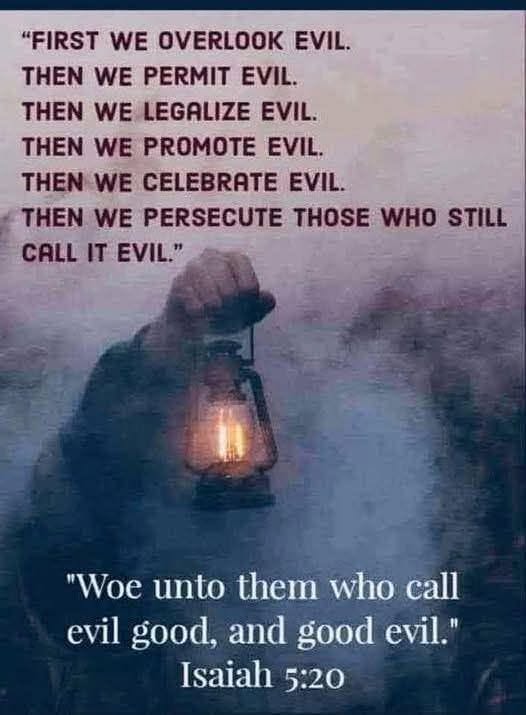
In Isaiah 5:8–30, the prophet pronounces “woes” or judgments on Judah for their wicked behavior. Judah had produced the “bad fruit” of unrighteousness, as illustrated in the song of the vineyard (verses 4–7). Their wickedness even led them to proclaim sinful things as good, which is why Isaiah exclaims, “Woe to those who call evil good and good evil, who put darkness for light and light for darkness, who put bitter for sweet and sweet for bitter” (verse 20). Light and darkness are opposites, which adds to the gravity of the men of Judah calling evil “good.”
A major problem in Judah during Isaiah’s time was widespread drunkenness. People would wake up early in the morning to drink alcohol and continue long into the night (Isaiah 5:11). Instead of respecting “the deeds of the Lord,” they reveled in their sin and drunkenness (verses 11–12). They did not see their sin as wickedness; rather, they called their evil “good.”
A world in rebellion against God will have a skewed perspective and embrace a topsy-turvy morality. There are many people today who still call evil “good” and good “evil,” as they promote behaviors that the Bible specifically calls sinful. The celebration of homosexuality and the defense of abortion on demand are usually accompanied by a mockery of those who value life and promote traditional marriage. Evil is being called “good,” and good is slandered as “evil.”
Apart from God, our value system will always become jumbled. We will begin to confuse sweetness and bitterness, light and darkness, and good and evil. We will label biblical morality as “intolerant” and “oppressive.” We will take offense at the truth that Jesus is the only way to salvation (John 14:6). “Light has come into the world, but people loved darkness instead of light because their deeds were evil” (John 3:20).
Calling good “evil” and evil “good” is a sure sign of spiritual wickedness at work: “The god of this age has blinded the minds of unbelievers, so that they cannot see the light of the gospel that displays the glory of Christ, who is the image of God” (2 Corinthians 4:4). Paul warns that the intensity of the spiritual battle will increase: “There will be terrible times in the last days. People will be lovers of themselves, lovers of money, boastful, proud, abusive, disobedient to their parents, ungrateful, unholy, without love, unforgiving, slanderous, without self-control, brutal, not lovers of the good, treacherous, rash, conceited, lovers of pleasure rather than lovers of God—having a form of godliness but denying its power. Have nothing to do with such people” (2 Timothy 3:1–5).
Cutting through the confusion over right and wrong and enlightening spiritually darkened minds is the Bible: “I gain understanding from your precepts. . . . Your word is a lamp for my feet, a light on my path” (Psalm 119:104–105). In their fallen condition, humans cannot accurately determine what is right and wrong. Only God can give definitive answers on good and evil. The Bible is “God-breathed,” the only certain source in providing guidance to mankind (2 Timothy 3:16).
Broadly stated, the “problem of evil” is the seeming contradiction between an all-powerful, all-loving God and the human experience of suffering and evil in the world. Critics claim that the existence of evil is proof that the omnipotent, omnibenevolent God of the Bible cannot exist. Since “bad things happen to good people,” critics say, God is either nonexistent or less good or less powerful than Scripture suggests.
Despite what some critics think, the so-called “problem of evil” is not something the Bible leaves unaddressed. Scripture not only refers to the problem of evil, but it offers several solutions to it. By looking at the Bible’s honest questioning of evil, God’s response to evil, and the scriptural solution to evil, one can address this problem using almost nothing other than God’s Word. Of course, this question ties into theology and philosophy as well. There are multiple ways of coming to possible solutions, and none is entirely complete all by itself.
According to the Bible, the experience of evil is something God understands and acknowledges. God’s willingness to grant us the freedom of making our own choices also allows for the possibility of moral evil. Moral evil leads to physical evil. Even so, God has always acted to soften the blows that evil and suffering land on humanity. He also provided the one and only means to make all wrongs right. One day, God’s plan to defeat and destroy evil will be fully complete.
Scripture acknowledges the “problem of evil”
Many of the Bible’s 66 individual books openly express what we would now term the “problem of evil.” In some cases, these expressions are all but a direct accusation against God, in response to the suffering the writers had seen or experienced.
The entire book of Job, for example, is a discussion of the reasons why mankind experiences suffering even when we don’t seem to deserve it. In addition, Scripture offers many other notable passages that clearly reflect the problem of evil:
Habakkuk 1:2–4, “How long, Lord, must I call for help, but you do not listen? Or cry out to you, ‘Violence!’ but you do not save? Why do you make me look at injustice? Why do you tolerate wrongdoing? Destruction and violence are before me; there is strife, and conflict abounds. Therefore the law is paralyzed, and justice never prevails. The wicked hem in the righteous, so that justice is perverted.”
Ecclesiastes 4:1–3, “Again I looked and saw all the oppression that was taking place under the sun: I saw the tears of the oppressed—and they have no comforter; power was on the side of their oppressors—and they have no comforter. And I declared that the dead, who had already died, are happier than the living, who are still alive. But better than both is the one who has never been born, who has not seen the evil that is done under the sun.”
Psalm 10:1, “Why, Lord, do you stand far off? Why do you hide yourself in times of trouble?”
Psalm 22:1–2, “My God, my God, why have you forsaken me? Why are you so far from saving me, so far from my cries of anguish? My God, I cry out by day, but you do not answer, by night, but I find no rest.”
Psalm 83:1–2, “O God, do not remain silent; do not turn a deaf ear, do not stand aloof, O God. See how your enemies growl, how your foes rear their heads.”
John 16:2–4, “They will put you out of the synagogue; in fact, the time is coming when anyone who kills you will think they are offering a service to God. They will do such things because they have not known the Father or me. I have told you this, so that when their time comes you will remember that I warned you about them.”
Romans 8:36, “As it is written: ‘For your sake we face death all day long; we are considered as sheep to be slaughtered.’“
Revelation 6:9–10, “When he opened the fifth seal, I saw under the altar the souls of those who had been slain because of the word of God and the testimony they had maintained. They called out in a loud voice, ‘How long, Sovereign Lord, holy and true, until you judge the inhabitants of the earth and avenge our blood?’”
These passages show a personal, deep awareness of the reality of evil. Scripture does not present evil as an abstraction or a remote idea. The real human beings who recorded the words of the Bible were painfully aware of the existence of evil and suffering. And they were willing to express their feelings to God, especially when they felt He wasn’t acting according to their expectations.
Notably, however, these same authors also recognize and trust the goodness of God to make these wrongs right, someday.
Scripture frames the “problem of evil”
The Bible makes it clear that evil is something God neither intended nor created. Rather, moral evil is a necessary possibility. If we are truly free, then we are free to choose something other than God’s will—that is, we can choose moral evil. Scripture points out that there are consequences for defying the will of God—personal, communal, physical, and spiritual.
Genesis 1: 31, “God saw all that he had made, and it was very good.”
Genesis 2:16–17, “And the Lord God commanded the man, ‘You are free to eat from any tree in the garden; but you must not eat from the tree of the knowledge of good and evil, for when you eat from it you will certainly die.’“
Genesis 3:17–19, “To Adam he said, ‘Because you listened to your wife and ate fruit from the tree about which I commanded you, ‘You must not eat from it,’ cursed is the ground because of you; through painful toil you will eat food from it all the days of your life. It will produce thorns and thistles for you, and you will eat the plants of the field. By the sweat of your brow you will eat your food until you return to the ground, since from it you were taken; for dust you are and to dust you will return.”
Proverbs 14:34, “Righteousness exalts a nation, but sin condemns any people.”
Proverbs 19:3, “A person’s own folly leads to their ruin, yet their heart rages against the Lord.”
Matthew 5:3–11, “Blessed are those who mourn, for they will be comforted. Blessed are the meek, for they will inherit the earth. Blessed are those who hunger and thirst for righteousness, for they will be filled. . . . Blessed are those who are persecuted because of righteousness, for theirs is the kingdom of heaven. Blessed are you when people insult you, persecute you and falsely say all kinds of evil against you because of me.”
John 9:1–3, “As he went along, he saw a man blind from birth. His disciples asked him, ‘Rabbi, who sinned, this man or his parents, that he was born blind?’ ‘Neither this man nor his parents sinned,’ said Jesus, ‘but this happened so that the works of God might be displayed in him.’”
Romans 1:18–28, “The wrath of God is being revealed from heaven against all the godlessness and wickedness of people, who suppress the truth by their wickedness, since what may be known about God is plain to them, because God has made it plain to them. For since the creation of the world God’s invisible qualities—his eternal power and divine nature—have been clearly seen, being understood from what has been made, so that people are without excuse. For although they knew God, they neither glorified him as God nor gave thanks to him, but their thinking became futile and their foolish hearts were darkened. . . . Just as they did not think it worthwhile to retain the knowledge of God, so God gave them over to a depraved mind, so that they do what ought not to be done.”
Romans 3:23, “For all have sinned and fall short of the glory of God.”
Romans 5:12, “Therefore, just as sin entered the world through one man, and death through sin, and in this way death came to all people, because all sinned.”
Hebrews 2:2–3, “For since the message spoken through angels was binding, and every violation and disobedience received its just punishment, how shall we escape if we ignore so great a salvation?”
Taken together, Scripture shows us that physical evils—sickness, famine, war, and death—are the result of moral evil. And moral evil is something human beings are all responsible for, on a personal and a communal level. We suffer because of our own sins at times. Other times, we suffer because of the sins of others. In some situations, we suffer from simple cause-and-effect. And we sometimes suffer for a special purpose, in order to bring hope or help—or a warning—to others (see 2 Corinthians 1:4).
The Bible “frames” the problem of evil by keeping it in the proper context. “Evil” is meaningless without something to compare it to. For comparison, we have the original creation of God, called “very good” (Genesis 1:31). We have the standard of goodness in God Himself. And we have an explanation for the various causes of evil and suffering.
Likewise, we see that this physical world is not all there is. Nor is this mortal life all we have been made for. We can experience physical struggles such as “mourning” and “persecution” (Matthew 5:4, 11) while looking to a greater, more permanent state of being “blessed.”
Of course, clearly framing what evil is and why we experience it is not the same as resolving the problem of evil. However, even the framing of evil in the context of Christian theology shows that our experience of evil and suffering is not incompatible with God’s existence. Amplifying this proof is how the Bible goes beyond accurately describing evil to revealing God’s action to remedy it.
Scripture opposes the “problem of evil”
Scripture shows that God did not create evil and does not promote it; rather, it describes God’s actions in combatting it. God limits the impact of evil, warns us of the dangers of evil, acts to stop the spread of evil, gives us an escape from evil, and will eventually defeat evil forever.
Genesis 3:21, “The Lord God made garments of skin for Adam and his wife and clothed them.”
Genesis 4:10–15, “The Lord said, ‘What have you done? Listen! Your brother’s blood cries out to me from the ground. Now you are under a curse and driven from the ground, which opened its mouth to receive your brother’s blood from your hand. When you work the ground, it will no longer yield its crops for you. You will be a restless wanderer on the earth.’ Cain said to the Lord, ‘My punishment is more than I can bear. Today you are driving me from the land, and I will be hidden from your presence; I will be a restless wanderer on the earth, and whoever finds me will kill me.’ But the Lord said to him, ‘Not so; anyone who kills Cain will suffer vengeance seven times over.’”
Genesis 6:5–8, “The Lord saw how great the wickedness of the human race had become on the earth, and that every inclination of the thoughts of the human heart was only evil all the time. The Lord regretted that he had made human beings on the earth, and his heart was deeply troubled. So the Lord said, ‘I will wipe from the face of the earth the human race I have created—and with them the animals, the birds and the creatures that move along the ground—for I regret that I have made them.’ But Noah found favor in the eyes of the Lord.”
Genesis 7:1–4, “The Lord then said to Noah, ‘Go into the ark, you and your whole family, because I have found you righteous in this generation. . . . Seven days from now I will send rain on the earth for forty days and forty nights, and I will wipe from the face of the earth every living creature I have made.’”
Deuteronomy 9:5, “It is not because of your righteousness or your integrity that you are going in to take possession of their land; but on account of the wickedness of these nations, the Lord your God will drive them out before you, to accomplish what he swore to your fathers, to Abraham, Isaac and Jacob.”
Deuteronomy 30:15–18, “See, I set before you today life and prosperity, death and destruction. For I command you today to love the Lord your God, to walk in obedience to him, and to keep his commands, decrees and laws; then you will live and increase, and the Lord your God will bless you in the land you are entering to possess. But if your heart turns away and you are not obedient, and if you are drawn away to bow down to other gods and worship them, I declare to you this day that you will certainly be destroyed. You will not live long in the land you are crossing the Jordan to enter and possess.”
Jonah 3:6–10, “When Jonah’s warning reached the king of Nineveh, he rose from his throne, took off his royal robes, covered himself with sackcloth and sat down in the dust. This is the proclamation he issued in Nineveh: ‘By the decree of the king and his nobles: Do not let people or animals, herds or flocks, taste anything; do not let them eat or drink. But let people and animals be covered with sackcloth. Let everyone call urgently on God. Let them give up their evil ways and their violence. Who knows? God may yet relent and with compassion turn from his fierce anger so that we will not perish.’ When God saw what they did and how they turned from their evil ways, he relented and did not bring on them the destruction he had threatened.”
Matthew 10:28, “Do not be afraid of those who kill the body but cannot kill the soul. Rather, be afraid of the One who can destroy both soul and body in hell.”
Matthew 23:37, “Jerusalem, Jerusalem, you who kill the prophets and stone those sent to you, how often I have longed to gather your children together, as a hen gathers her chicks under her wings, and you were not willing.”
1 Corinthians 6:9–11, “Or do you not know that wrongdoers will not inherit the kingdom of God? Do not be deceived: Neither the sexually immoral nor idolaters nor adulterers nor men who have sex with men nor thieves nor the greedy nor drunkards nor slanderers nor swindlers will inherit the kingdom of God. And that is what some of you were. But you were washed, you were sanctified, you were justified in the name of the Lord Jesus Christ and by the Spirit of our God.”
Colossians 1:13, “For he has rescued us from the dominion of darkness and brought us into the kingdom of the Son he loves.”
2 Thessalonians 2:7, “For the secret power of lawlessness is already at work; but the one who now holds it back will continue to do so till he is taken out of the way.”
2 Peter 2:9, “The Lord knows how to rescue the godly from trials and to hold the unrighteous for punishment on the day of judgment.”
Revelation 19:11, “I saw heaven standing open and there before me was a white horse, whose rider is called Faithful and True. With justice he judges and wages war.”
Revelation 20:11–15, “Then I saw a great white throne and him who was seated on it. . . . I saw the dead, great and small, standing before the throne, and books were opened. . . . The dead were judged according to what they had done as recorded in the books. . . . Each person was judged according to what they had done. Then death and Hades were thrown into the lake of fire. The lake of fire is the second death. Anyone whose name was not found written in the book of life was thrown into the lake of fire.”
Revelation 21:1–5, “Then I saw a new heaven and a new earth, for the first heaven and the first earth had passed away. . . . I heard a loud voice from the throne saying, ‘Look! God’s dwelling place is now among the people, and he will dwell with them. They will be his people, and God himself will be with them and be their God. He will wipe every tear from their eyes. There will be no more death or mourning or crying or pain, for the old order of things has passed away.’ He who was seated on the throne said, ‘I am making everything new!’ Then he said, ‘Write this down, for these words are trustworthy and true.’”
The Bible explains that God has acted to limit the impact of evil. He has given us clear instructions to avoid being evil. God has also made spiritual power available for those who want to be freed from the power of evil. And, from the very beginning, God set in motion a plan to make all wrongs right and end our experience of evil and suffering (see Genesis 3:15).
Scripture resolves the “problem of evil”
The existence of evil is often presented as an enormous problem for those who believe in God, mostly because of various false dichotomies. God must, it is assumed, disallow all evil or He is evil Himself. God must immediately punish all evildoers and never trouble those who are innocent, or He is assumed not to be omnipotent. In reality, these assumptions miss the actual means by which Scripture resolves the problem of evil.
As we’ve seen, the Bible acknowledges evil, correctly frames it, and shows how God opposes it. Most importantly, though, Scripture explains how the existence of the Christian God defeats the problem of evil.
Matthew 16:21, “From that time on Jesus began to explain to his disciples that he must go to Jerusalem and suffer many things at the hands of the elders, the chief priests and the teachers of the law, and that he must be killed and on the third day be raised to life.”
Mark 10:45, “For even the Son of Man did not come to be served, but to serve, and to give his life as a ransom for many.”
Luke 22:19–20, “And he took bread, gave thanks and broke it, and gave it to them, saying, ‘This is my body given for you; do this in remembrance of me.’ In the same way, after the supper he took the cup, saying, ‘This cup is the new covenant in my blood, which is poured out for you.’”
John 14:6, “Jesus answered, ‘I am the way and the truth and the life. No one comes to the Father except through me.’”
John 19:16–18, “Finally Pilate handed him over to them to be crucified. So the soldiers took charge of Jesus. Carrying his own cross, he went out to the place of the Skull (which in Aramaic is called Golgotha). There they crucified him, and with him two others—one on each side and Jesus in the middle.”
John 19:30, “Jesus said, ‘It is finished.’ With that, he bowed his head and gave up his spirit.”
John 20:19–20, “On the evening of that first day of the week, when the disciples were together, with the doors locked for fear of the Jewish leaders, Jesus came and stood among them and said, ‘Peace be with you!’ After he said this, he showed them his hands and side. The disciples were overjoyed when they saw the Lord.”
John 20:30–31, “Jesus performed many other signs in the presence of his disciples, which are not recorded in this book. But these are written that you may believe that Jesus is the Messiah, the Son of God, and that by believing you may have life in his name.”
2 Corinthians 5:1, “For we know that if the earthly tent we live in is destroyed, we have a building from God, an eternal house in heaven, not built by human hands.”
Hebrews 4:15, “For we do not have a high priest who is unable to empathize with our weaknesses, but we have one who has been tempted in every way, just as we are—yet he did not sin.”
1 John 3:1, “See what great love the Father has lavished on us, that we should be called children of God!”
Colossians 1:21–22, “Once you were alienated from God and were enemies in your minds because of your evil behavior. But now he has reconciled you by Christ’s physical body through death to present you holy in his sight, without blemish and free from accusation.”
Rather than creating us as amoral robots or dooming mankind for our sin or condoning our sin by leaving it unresolved, God chose the one and only way to settle the problem. He created us with the freedom to choose our actions, and then extended forgiveness to us. Forgiveness is the Christian answer to the problem of evil.
Forgiveness is different from condemnation—it releases the condemned from punishment. Forgiveness is also different from excusing evil—it acknowledges that there is wrong to be made right. The basis of our forgiveness, the cross, is the intersection of God’s perfect moral character, love, and omnipotence. Since He chose to take our penalty upon Himself, all suffering and evil can be overcome. According to the Bible, the evil we experience in this life has already been defeated, andeveryone has access to that victory.
John 3:16–21, “For God so loved the world that he gave his one and only Son, that whoever believes in him shall not perish but have eternal life. For God did not send his Son into the world to condemn the world, but to save the world through him. Whoever believes in him is not condemned, but whoever does not believe stands condemned already because they have not believed in the name of God’s one and only Son. This is the verdict: Light has come into the world, but people loved darkness instead of light because their deeds were evil. Everyone who does evil hates the light, and will not come into the light for fear that their deeds will be exposed. But whoever lives by the truth comes into the light, so that it may be seen plainly that what they have done has been done in the sight of God.”
John 16:33, “I have told you these things, so that in me you may have peace. In this world you will have trouble. But take heart! I have overcome the world.”
Taken as a whole, as it is intended, the Bible describes evil as something God allowed, but never condoned, for the sake of our free will. All through history, God has taken steps to limit the influence of evil. And, most importantly, God Himself took the consequences of our sin, so every person can have access to forgiveness and salvation. As a result, all sin, evil, and suffering will someday be completely ended. Beyond the philosophical or theological aspects of this issue, Scripture in and of itself goes a long way to neutralizing the power of the “problem of evil.”

Tea Time Manna
Restore to me the joy of your salvation and grant me a willing spirit, to sustain me.
—Psalm 51:12
In the face of sin and separation from God, grace is God’s refreshing stream that restores our salvation — making it existentially real to us. In our struggles with suffering, grief, and loss, only God’s grace and his Holy Spirit ministering to our spirits can help us find a sustaining and willing spirit. This ongoing joy of salvation comes only when we realize and accept the forgiveness, grace, restoration, and Spirit-inspired refreshment God has given us — in other words, we get to drink from the stream of grace as the Holy Spirit wells up within us with heaven’s living water to refresh us (John 7:37-39). So we can say with confidence that God will restore to us the joy of our salvation, and he will grant us a willing spirit to sustain us!
Prayer
Holy and Righteous Father, I long for the outbreak of joy in your salvation as I see in the book of Acts. I pray that your Spirit leads us into another era of outreach, conversion, and celebration. I pray for wisdom to know and for eyes to see those around me who are most open to the Gospel — people with a willing spirit open to your salvation. I want to be a partner with you in your ongoing work of salvation, for I know that, as I do, I will get to experience again and again the joy of your salvation. And I will experience the Holy Spirit welling up within me as a useful vessel in your Kingdom. In Jesus’ name, I offer myself to you as I pray. Amen and Amen
Truth Article by Pastor Dirk
The Jews Rejected Jesus as the Messiah, But they are Banking on Jesus Attractions and Christian Tourists
The intersection of religious theology and tourism economics in Israel creates a unique dynamic where a predominantly Jewish state manages and benefits from Christian holy sites. While mainstream Judaism does not recognize Jesus as the Messiah, the Israeli economy derives significant revenue from millions of Christian pilgrims who visit these attractions annually.
Theological Distinction vs. Economic Reality
The mainstream Jewish rejection of Jesus as the Messiah is rooted in foundational theological criteria. According to biblical and rabbinic tradition, the Messiah must fulfill specific physical prophecies. These include building the Third Temple, gathering all Jewish exiles back to Israel, and ushering in an era of universal world peace—expectations that mainstream Judaism maintains were not met by Jesus.
Despite these deep religious differences, the State of Israel actively maintains, protects, and promotes Christian historical and sacred sites. This preservation is driven by international diplomatic commitments, historical stewardship, and substantial economic incentives.
The Financial Impact of Christian Tourism
Christian pilgrimage represents a major pillar of Israel’s overall tourism sector. Millions of evangelical, Catholic, and Orthodox Christians travel to the region to experience the geographical settings of the New Testament.
This influx of visitors generates revenue across multiple sectors of the Israeli economy:
- Hospitality and Lodging: Hotels, guesthouses, and kibbutzim—predominantly owned and staffed by Israeli citizens—house millions of Christian travelers in focal areas like Jerusalem, Nazareth, and the Sea of Galilee.
- Infrastructure and Transportation: National airlines, tour bus companies, and local guides benefit directly from booking fees and logistical management for pilgrimage groups.
- Commerce and Souvenirs: Local businesses, ranging from restaurants to artisan shops selling religious items, depend heavily on the purchasing power of international religious tourists.
Mutual Management of Holy Sites
The operation of Christian attractions involves complex collaboration between Israeli authorities and international church leadership. Under long-standing international agreements, major sites like the Church of the Holy Sepulchre in Jerusalem and the Church of the Nativity in Bethlehem (located in the West Bank) are managed internally by historical Christian denominations.
The Israeli government provides national security, municipal services, and tourism promotion through its Ministry of Tourism. This approach ensures that while the theological narratives of the sites contradict mainstream Jewish beliefs, the heritage remains preserved as a vital cultural asset and a driver of national economic growth.
Please watch the Sites of attractions Around Jesus
https://web.facebook.com/reel/1638524091248081 https://web.facebook.com/reel/866374536499398 https://web.facebook.com/reel/981537347618051 https://web.facebook.com/reel/1483339346970410NEWS MANNA

Jesus vs. Paul? The Online Influencers Splitting Scripture

A short video can make a sweeping theological claim sound obvious: Jesus never condemned homosexuality, the argument goes, but Paul did. Therefore, Paul must have contradicted Jesus—and Christians should trust Jesus instead.
The claim is designed to feel simple. Its consequences are not. If one apostle’s teaching can be discarded whenever it conflicts with modern preferences, what keeps the rest of Scripture from being judged by the same standard?
This argument is appearing in online discussions that portray Paul as a false teacher who corrupted Jesus’ message. The dispute often centers on sexuality, but the deeper issue is biblical authority. The question is whether Christians receive the whole counsel of God—or select the passages that feel acceptable to the age.
Jesus and Paul were not rivals
Jesus did not teach that only His recorded sayings carry divine authority. He affirmed the authority of the Scriptures and taught that He came not to abolish the Law and the Prophets, but to fulfill them (Matthew 5:17). When asked about marriage, He pointed back to Genesis: God made humanity male and female, and a man and woman become one flesh (Matthew 19:4–6). He also warned against sexual immorality (Matthew 15:19).
Paul’s teaching did not arrive as a competing message. Paul described his gospel as something received through a revelation of Jesus Christ (Galatians 1:11–12). The book of Acts presents the risen Christ commissioning him to carry the gospel to the nations (Acts 9:15). And Peter, writing to the church, referred to Paul’s letters and warned that some people twist them, “as they do the other Scriptures” (2 Peter 3:15–16).
Peter’s warning is particularly relevant. He did not tell Christians to discard Paul because his letters were difficult. He warned them to recognize that Scripture can be distorted.
Silence is not a veto
The argument that Jesus never explicitly addressed a subject therefore Paul must be wrong rests on a faulty assumption: that Jesus’ recorded words are the only words Christians should treat as authoritative. The New Testament presents a broader picture. Jesus commissioned His apostles to teach, and the apostles understood themselves to be witnesses speaking under His authority.
A subject does not become morally acceptable simply because the Gospels do not record Jesus addressing it by name. Jesus did not need to repeat every commandment or answer every future argument in a separate sermon. His teaching on marriage, sexual immorality, and the authority of Scripture belongs in the same Bible as Paul’s letters.
The danger of influencers as theological authorities
Social media makes it easy for a person with a camera, a confident delivery, and a large following to become a Christian’s default source of theology. A brief clip may quote a verse, announce that an apostle is a fraud, and move on before viewers have time to examine the claim.
Online teachers can raise important questions and point people toward Scripture. But popularity does not establish theological authority. Neither does a compelling personal story, a polished production, or the claim that someone has uncovered what pastors and churches have supposedly hidden.
When Christians rely on influencers without checking their claims against Scripture, the teacher’s interpretation can quietly take the place of the Bible itself. A viral clip may become the lens through which every difficult passage is judged. Soon, the question is no longer, “What does Scripture teach?” It is, “Which parts of Scripture can I keep without losing the approval of the voices I follow?”
That shift can change more than a person’s opinion about one passage. If a favored teacher persuades someone that an inconvenient part of Scripture can be dismissed, the same approach can be applied to any teaching that feels uncomfortable. Faith becomes something assembled from the verses and voices that affirm what a person already wants to believe. The influencer may claim to be freeing people from Paul, but the viewer can end up placing a new authority in his place: the person who decides which parts of the Bible still count.
The Bereans offer a better model. They listened carefully, then examined the Scriptures to see whether Paul’s teaching was true (Acts 17:11). Their example calls for discernment and careful study. It does not give believers permission to reject biblical books that challenge their assumptions.
A faith that cannot be corrected by Scripture is not being guided by Scripture.
Test every teacher—including the popular ones
Christians should test every teacher, whether that teacher stands in a pulpit or appears on a phone screen. Read the passage in context. Compare it with the rest of the Bible. Ask whether the teacher is explaining Scripture or using a few selected verses to make Scripture fit a preferred conclusion.
Paul warned Timothy that people would seek teachers who told them what they wanted to hear (2 Timothy 4:3–4). That warning is not a license to label every disagreement false teaching. It is a call to take doctrine seriously and to stay rooted in God’s Word.
The choice is not Jesus or Paul. The New Testament presents Paul as a servant of Christ whose message was received, examined, and recognized by the apostles. Rejecting him because his teaching is unpopular does not bring Christians closer to Jesus. It risks replacing the authority of Scripture with the authority of whoever has the most persuasive clip.
Influencers can point people toward the Bible. They must never become a substitute for it.
When AI Watches Everyone: From Workplace Efficiency To Government Control

Imagine a protest in a city square. Cameras record the crowd. Traffic scanners log the cars leaving. Store cameras capture people stopping for coffee. A phone video posted online shows who was there. Today, those pieces of information may sit in separate systems, reviewed slowly or never connected at all.
Now imagine AI searching them together in seconds.
It identifies faces, follows people across locations, matches a car to its owner, scans public posts and produces a list of everyone who attended. It notices who arrived together, who met afterward and who has been at similar gatherings before. A system built to find a suspect could become a system that maps a movement.
That future is not fully here. But two recent stories show how quickly the pieces are advancing.
In Britain, Co-op Legal Services has reportedly used AI to record and assess customer calls, scoring more than 50 aspects of each interaction. The calls can involve people seeking help with wills and probate after a death in the family. The company says the system supports quality and coaching. Some employees describe being monitored for hours as AI evaluates what they say and how they say it.
In the United States, police departments have gained access to Raven, an AI tool that analyzes interior photos and searches property listings to identify a possible home. A picture of a room or appliance can offer clues that the software may match to an address. That could help locate a crime scene, a suspect or a victim. It also demonstrates how an image taken inside a private home might lead investigators to the front door.
The promise is easy to see. AI could help police sift through evidence, find missing people and connect clues that would take investigators days to uncover. At work, it could flag poor service or help supervisors coach employees. Used carefully, these tools may save time and prevent harm.
But the central question is what happens as the systems grow more capable—and as separate tools begin to work together.
In the years ahead, AI could be asked to analyze live video from street cameras, license plate readers, drones, doorbells, transit systems and private businesses. It may compare faces, clothing, voices and movement patterns, then connect those observations with public records, online posts and commercial data. Instead of asking, “What does this photo show?” officials might ask, “Where has this person been, who have they met, and what do their routines suggest?”
That kind of system would not need a camera on every corner. It could draw from cameras and databases already operating for different reasons, then let AI search across them. A city might install cameras to manage traffic or improve safety. A company might collect data to prevent theft. A social media platform might store videos and location clues. AI could make those scattered records searchable as one vast archive.
The next step could be prediction. A system might estimate who is likely to attend a protest, which workers may organize, or which neighborhoods are likely to resist a new policy. These predictions would not have to be accurate to cause harm. A person could be questioned, denied a job, placed on a watch list or targeted for extra scrutiny because an algorithm marked them as a risk.
And once governments can identify people and predict their behavior, the temptation to intervene grows. Authorities could direct police toward certain homes, flag a person at a checkpoint, freeze access to an account or quietly make travel and employment more difficult. A system that begins by helping investigators solve crimes could eventually help officials manage populations.
A dictator would not need one master score that governs every part of life. Control could be assembled from smaller systems: one that tracks movement, another that monitors speech, another that affects access to money, work or travel. Each could be introduced as a limited response to a real problem. Together, they could make dissent visible and costly.
That is the larger danger. AI does not need to hate anyone, or even understand what it is doing. It only needs to recognize patterns, attach a label and pass that judgment to people with authority. A mistaken label can follow someone through systems they cannot see or challenge.
For Christians, the prophetic warning is especially sobering. Revelation 13 describes a future ruler whose authority reaches into daily life and the ability to buy and sell. Today’s tools show how technology could make centralized monitoring and economic control more practical: identifying people, tracking their behavior and enforcing restrictions at scale. A society that accepts constant monitoring for convenience or security may discover that the same system can be turned toward political control when leadership changes.
AI may help find a criminal or improve a service. But as the tools become connected, the line between watching for danger and watching everyone grows harder to see. The question is not only what AI can do today. It is what tomorrow’s rulers will be able to do with everything we are allowing it to collect.

TruLight TV – Popcorn & Movie Time – Never Give Up
The true story of how twenty-year-old Brad Minns does the impossible in the Men’s Singles Tennis Finals in the 1985 Deaf World Games. In a five-hour match for the ages, Minns somehow comes back from match point in the third set to winning the gold medal in the fifth set. The match serves as a framework for the story of this inspirational man who became deaf at age three and rose to the height of his sport, thanks to God helping him to NEVER GIVE UP.
Today on TruLight Radio XM
TruLight Radio XM 24/7
Program
GMT / UTC +2
Monday To Fridays
00:15 Words to Live By Testimonies
01.15 Science Scripture and Salvation
02.15 Ground Works
04.00 Gospel Concert of the Day
05.00 The Daren Streblow Comedy Show
5:55 It is Today devotional
6:00 Gaither Homecoming Morning Show
7:15 Discover the Word
8.15 Destined for Victory
8:55 Science Scripture and Salvation
9:00 Holy Spirit Hour – Normally Sermons
10:15 Hope of the Heart
11:15 Unshackled
11.45 Words to Live By
12:15 Truth for Life
13:15 Living on the Edge with Chip Ingram
14:15 Focus on the Family
15:00 Kids Hour
16:00 In Touch with Dr. Charles Stanley
16:30 Groundwork
17:15 Live in the Light
18:15 Renewing your Mind
19:00 Gaither Homecoming Show
20:15 Growing Hope
21:15 Adventures in Odyssey Radio Drama
21:45 Bible Reading
22:15 Night-sounds
23.00 Good Old Country Gospel / Rhema Gospel Express
VISIT THE WEBSITE
https://trulightradioxm.org.za
TruLight Ministry News – EXTRA MANNA
TruLight Ministries orders from God since 2012 . Teach Them , Comfort Them and Warn Them!
Picture MaTruLight Ministry News – EXTRA MANNA
TruLight Ministries orders from God since 2012 . Teach Them , Comfort Them and Warn Them!
TruLight News
TruLight Ministries International shaping up our digital platforms for gospel music and audio programming! www.TruPlay.co.za – If you are looking to stream gospel music, sermons, or radio dramas, you can access their active streaming media through the official TruLight Ministry portals:• Radio & Music: Stream Live Broadcast directly via their main portal to enjoy uplifting gospel music and praise and worship tracks- www.TruLightRadioXM.org.za • Video & Television: Watch gospel music concert events, and daily programs on www.TruLightTV.org.za • Daily Devotionals: Read scripture and daily spiritual nourishment in multiple languages on www.TruLightDailyManna.co.za
Artist Liners
Healing Truths.
End Time Articles.
https://trulightradioxm.org.za/end-time-articles-2/the-3-woes-in-bible-prophecy
Picture Manna to Share
From God –
From Jesus –

From the Holy Spirit –

Share this Feeding of Manna with your Friends and Family. just click on the Social Media icon and share This Manna with your Friennna to Share