Hosted by TruLight Ministries International – The Place of Truth
SELECT YOUR READING LANGUAGE – BOTTOM LEFT = YOUR DAILY MANNA NOW AVAILABLE IN 103 LANGUAGES
@ TruLight Daily Manna is not Just a Bible Verse with a Small Prayer . NO ::: WE SERVE DAILY Manna for the ENTIRE Day . Breakfast , Lunch , Dinner , Plus tea Times and even Entertainment Manna . Plus News Manna and More , This Daily Manna will keep you Spiritually full for the full 48 Hours and even More to Share with your Friends and Family !!!
How to Get THROUGH , What you will never get OVER ?
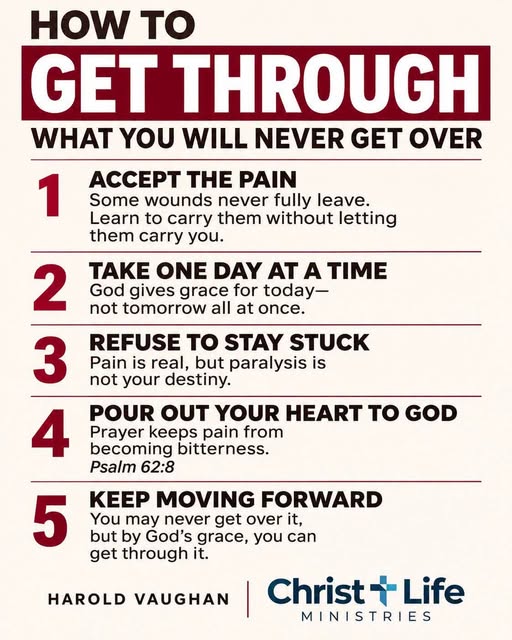
How to Get Through What You Will Never Get Over
There are some seasons in life that do not have a neat ending. When we face deep loss, betrayal, or heartbreak, people often tell us that time heals all wounds or that we just need to move on. Yet the truth is that some things leave a permanent mark on our hearts. You may never fully “get over” a profound loss, because love and deep investment leave lasting footprints.
However, Scripture shows us that you do not have to get over something to get through it. God does not ask you to pretend the pain does not exist. Instead, He offers His presence to carry you through the valley when the mountain is too steep to climb.
Here is a biblical roadmap for walking through what you will never get over.
1. Accept the Pain
Before healing can begin, you must give yourself permission to grieve. Trying to suppress your sorrow or put on a brave face only delays the comfort God wants to bring you. Even Jesus wept openly at the tomb of His friend Lazarus, knowing full well He was about to raise him from the dead (John 11:35).
The Bible reminds us that there is a time to weep and a time to mourn (Ecclesiastes 3:4). Accepting your pain does not mean you lack faith; it means you are being honest about the brokenness of this world. God draws closest to those who are honest about their hurt, promising in Psalm 34:18 that “The Lord is close to the brokenhearted and saves those who are crushed in spirit.”
2. Pour Out Your Heart to God
When the weight is too heavy to carry alone, take it directly to the One who created you. God is not intimidated by your anger, your confusion, or your tears. Throughout the book of Psalms, David frequently cried out in raw despair, questioning why he was suffering and begging for relief.
Scripture invites us to bring every unfiltered emotion to the throne of grace. Psalm 62:8 urges us to “Trust in him at all times, you people; pour out your hearts to him, for God is our refuge.” Prayer is not about reciting polished words; it is about emptying your soul before a Father who already knows your pain and holds every tear in a bottle (Psalm 56:8).
3. Take It One Day at a Time
When you look too far into the future, the thought of carrying your grief for the rest of your life can feel suffocating. God never designed us to carry tomorrow’s burdens on today’s strength. When the Israelites were wandering in the wilderness, God provided manna one day at a time. They could not store it up for the week; they had to trust Him for daily bread.
Jesus echoed this truth in Matthew 6:34, saying, “Therefore do not worry about tomorrow, for tomorrow will worry about itself. Each day has enough trouble of its own.” Focus only on the grace God has given you for the next twenty-four hours. When a whole day feels too long, take it one hour, or even one breath, at a time.
4. Refuse to Stay Stuck
Grief is a valley we must walk through, not a place where we are meant to pitch a tent and live forever. Notice the wording in Psalm 23:4: “Even though I walk through the darkest valley, I will fear no evil, for you are with me.” You are meant to keep walking, even when your steps are slow and heavy.
Staying stuck often happens when we replay the past endlessly or allow bitterness to take root in our hearts. In Isaiah 43:18–19, God speaks a word of hope to people trapped in the memory of past trauma: “Forget the former things; do not dwell on the past. See, I am doing a new thing!” Refusing to stay stuck does not mean forgetting what happened; it means choosing not to let your pain define the rest of your story.
5. Keep Moving Forward
Moving forward does not mean leaving your memories behind; it means carrying them with you as you step into the purpose God still has for your life. The Apostle Paul knew deep sorrow and hardship, yet his resolve was clear in Philippians 3:13–14: “Forgetting what is behind and straining toward what is ahead, I press on toward the goal to win the prize for which God has called me heavenward in Christ Jesus.”
You may walk with a limp for the rest of your life, much like Jacob did after wrestling with God (Genesis 32:31). That limp is not a sign of defeat; it is a reminder that you survived a battle and that God’s grace was sufficient to sustain you. Keep putting one foot in front of the other, trusting that the Author of your life is still writing good chapters ahead.
A Prayer for the Journey
Lord, I admit that this hurts more than I know how to bear. I know I may never fully get over this, so I ask for Your strength to help me get through it. Today, I pour out my heart to You. Give me just enough grace for this single day, protect me from getting stuck in despair, and hold my hand as I take the next step forward. In Jesus’ name, Amen and Amen .

Tea Time Manna
It is God’s will that by doing good you should silence the ignorant talk of foolish men. Live as free men, but do not use your freedom as a cover-up for evil; live as servants of God.
—1 Peter 2:15-16
What does the world most need to see and hear from you and me today? I believe the world needs to see our lives tuned to the melody of grace we claim comes from God in Jesus. Doing good and being like Christ is Peter’s answer to opposition, cynicism, and even persecution (1 Peter 3:15-19). We are free in Jesus, but freedom doesn’t mean we have to flaunt it pretentiously. Instead, we can live for Jesus, who died to conquer death and renounced the evil one’s power over us, to give us heavenly freedom so we could find life in him (Philippians 2:6-11). Like Jesus, we can live as servants to bless others, and we can serve God as we seek to lead others to discover Jesus!
Prayer
Holy Father, our great Emancipator, you have freed us from sin, law, and death at the cost of your precious Son. Jesus, we recognize that you gave up your rights and your freedom to serve us and save us. We open our hearts to your grace, forgiveness, and freedom. Thank you for your gift of redemption and the freedom it brings from fear, sin, death, hell, and purposelessness. Please accept the actions of our lives, the words of our mouths, the thoughts of our minds, and the emotions of our hearts today as our offering of thanks as we serve others in the name of Jesus. Amen and Amen
Truth Article by Pastor Dirk

Standing Where God Calls You: The Blessings of Obedience
There is a profound peace that comes from knowing you are right where you are supposed to be. In a world filled with endless choices, distractions, and competing voices, finding your place in God’s plan can feel overwhelming. Yet, Scripture consistently shows us that the secret to experiencing God’s best is not found in striving for our own desires, but in the simple, transformative act of obedience.
When we align our steps with God’s Word and yield to His direction, we position ourselves directly in the path of His favor, provision, and purpose.
The Anchor of Alignment: Being Where God Wants You
Throughout the Bible, God often calls His people to specific places—both geographically and spiritually. Consider Abraham, who was told to leave his homeland for a place God would show him (Genesis 12:1), or Elijah, whom God instructed to stay by the Brook Cherith during a severe famine (1 Kings 17:3–4).
In Elijah’s story, God specifically promised, “I have commanded the ravens to feed you there.” Notice the word “there.” God’s miraculous provision was tied directly to Elijah’s obedience in staying at the exact location God appointed. Had Elijah wandered off to seek his own comfort or safety elsewhere, he would have missed the supernatural sustenance waiting for him at Cherith.
Being where God wants you means trusting His wisdom over your own understanding. Even when your current season feels quiet, uncertain, or challenging, remaining faithful to God’s assignment ensures you are covered by His grace.
The Overflow of Obedience
Biblical obedience is never meant to be a heavy burden or a rigid set of rules; rather, it is a relational response of love and trust. Jesus Himself declared, “If you love me, keep my commands” (John 14:15). When we obey out of love, Scripture reveals several distinct blessings that follow:
- Divine Provision and Protection: In Deuteronomy 28:1–2, Moses reminds the Israelites that fully obeying the Lord causes blessings to “come on you and accompany you.” God takes responsibility for the needs of those who walk in His will.
- Spiritual Clarity and Direction: Obedience unlocks greater discernment. As we act on the light God has already given us, He illuminates the next step on our path (Psalm 119:105).
- Unshakable Peace: Stepping outside of God’s will often invites anxiety and spiritual friction. Conversely, standing in obedience anchors the soul in a peace that transcends human logic, regardless of external storms (Philippians 4:7).
- Fruitfulness and Purpose: In John 15:10, Jesus teaches that keeping His commands allows us to remain in His love, which is the very source of a fruitful, impactful life.
Overcoming the Hesitation to Obey
Obedience often requires courage, especially when God’s instructions do not make immediate sense. Peter had fished all night without catching a single fish when Jesus told him to cast his nets into deep water again (Luke 5:4–6). Logic told Peter it was a waste of time, yet his willingness to say, “Because you say so, I will let down the nets,” resulted in a catch so massive it nearly sank two boats.
Your breakthrough is often waiting on the other side of an act of faith. God does not ask for your ability as much as He asks for your availability and willingness to listen.
Stepping Into Your Season Today
You do not need to see the entire staircase to take the first step. Whether God is calling you to forgive someone, step into a new ministry, remain steadfast in a difficult job, or simply spend quiet time in His presence, your “yes” opens the door to His work in your life.
Stand firm where He has planted you, listen closely to His voice, and walk forward with confidence—knowing that the safest, most blessed place on earth is right in the center of God’s will.
NEWS MANNA
The AI Agenda To Conquer Death

Imagine a future where a doctor tells you that AI has found a way to keep your body alive for decades longer. Then imagine that, when your body finally fails, a machine carrying your memories and voice is waiting to take your place.
That sounds like science fiction. But the ideas behind it are moving into serious conversations about AI, medicine and the future of human life. Anthropic co-founder and CEO Dario Amodei recently predicted that cancer, Alzheimer’s, heart disease and mental illness could become “relics of the past” in less than a decade. He has also described a future where AI transforms medical research and radically extends the human lifespan.
The question is no longer whether technology can help us live longer. It is how far humanity will go in trying to make death itself disappear.
The Promise of More Time
AI could help researchers sift through vast amounts of biological data, identify promising treatments and investigate diseases that have resisted generations of medical research. If that leads to new therapies, people may live longer and suffer less. Those advances could be extraordinary.
But the dream quickly expands. If science can add years, why not decades? If each breakthrough buys time for the next one, could medicine reach a point where it extends life faster than aging takes it away? Some futurists call that “escape velocity”: a rolling horizon of new treatments, with death forever pushed into the future.
That is a powerful promise. It is also a promise that places human ingenuity in the role of savior. The body becomes a machine to repair, upgrade and preserve indefinitely. Aging becomes a technical defect. Death becomes the ultimate problem to engineer away.
From Longer Life to a Digital Afterlife
The next step is more radical: preserving the person when the body is gone.
AI can already use a person’s messages, photos, videos and recordings to create a chatbot or avatar that imitates their voice and mannerisms. A grieving spouse might ask it questions. A child might hear a familiar voice again. The imitation may feel intimate, but it is still a system generating responses from data.
The more speculative vision is to map a human brain in enough detail to recreate its patterns in a computer. That digital mind might inhabit a virtual world—or one day control a robotic body. The person’s memories, personality and voice could appear to continue, even after the biological body has died.
But would that actually be the person? A machine might repeat someone’s stories and sound uncannily familiar. It might even produce new sentences in that person’s style. Yet resemblance is not identity. A copy of someone’s memories cannot prove that their consciousness—or their soul—has been transferred. The machine could preserve an echo while the person remains gone.
That is the great leap hidden inside the language of “digital immortality”: the assumption that a human being can be reduced to information, copied, and made to live forever in another form. No technology has shown that this is possible. The ambition itself, however, reveals where the AI age is tempted to go.
The Old Promise in a New Machine
The Bible does not condemn healing or the use of medicine to relieve suffering. Caring for the sick is an act of compassion. But extending earthly life is not the same as conquering death—and no human invention can provide eternal life.
Scripture presents death as an enemy, but it points to resurrection through Jesus Christ as the answer. Christian hope is not a longer biological lifespan, a chatbot trained on our messages or a robotic body carrying a digital imitation. It is life restored by God.
The temptation to defeat death through our own power has an ancient echo. In Eden, the serpent told humanity, “You will not surely die.” The promise was that people could reach beyond God’s limits and seize life on their own terms.
AI may help doctors fight disease. It may give families more time with the people they love. But when technology promises that we can escape death by extending, copying or uploading ourselves, it is selling a counterfeit hope. A digital echo is not resurrection. A machine body is not eternal life. And no human invention can take the place of the Savior who conquered death.

TruLight TV – Our Motivation Matters!
Our motivation at work matters. Are you working to serve the Lord, or for your own success and glory? If we’re honest, our sinful nature makes it very tempting to perform well for our own benefit. Watch this video and learn the power of pairing passion with a desire to serve the Lord. and later our sermon today from Dr. Charles Stanley (The Key to Making Wise Decisions) – Following God’s commandments will lead you along the path of wisdom while assuring you with His peace, protection, and provision. Dr. Stanley shows that pursuing a worldly path leads to disappointment while making wise decisions will reveal God’s best as He works everything together for your good. learn more by watching today’s program. Enjoy!
Today on TruLight Radio XM
TruLight Radio XM 24/7
VISIT THE WEBSITE
https://trulightradioxm.org.za
TruLight Ministry News – EXTRA MANNA

TruLight Ministries orders from God since 2012 . Teach Them , Comfort Them and Warn Them!
a TruQuestion for the Day
Question: According to the Gospel of John, what was the very first miracle Jesus performed?
- A. Walking on water
- B. Turning water into wine
- C. Healing a blind man
- D. Feeding the 5,000
Our TruPlay website is coming together – Stunning Music , Plays and Podcasts , Easy Radio Player and More https://truplay.co.za

TruLight News

A PLAY A DAY !


A Man After God’s Own Heart—And a Man of Deep Brokenness
When people speak of King David, they often remember the shepherd boy who toppled Goliath with a sling and a stone, or the sweet psalmist of Israel who danced before the Ark of the Covenant. Scripture itself calls him “a man after God’s own heart.” Yet, looking closely at the biblical record reveals a sobering, uncomfortable truth: David’s relationship with God was marked by staggering moral failure, devastating family dysfunction, and lifelong earthly consequences that divine forgiveness did not erase.
The Myth of Sinless Perfection
A common misunderstanding in faith circles is that being close to God makes a person immune to terrible sin. David’s life shatters that illusion. At the height of his power, when kings were supposed to go to war, David stayed behind in Jerusalem. He saw Bathsheba bathing, took her despite knowing she was married to Uriah—one of his most loyal soldiers—and got her pregnant.
To cover his tracks, David orchestrated Uriah’s death on the front lines. It was not a momentary lapse in judgment; it was a calculated abuse of royal power involving adultery, deception, and murder. The hard truth is that a person can write inspired worship songs in one season and commit horrific atrocities in the next.
Forgiveness Does Not Remove Consequences
When the prophet Nathan confronted David with a parable about a rich man stealing a poor man’s only lamb, David’s conscience finally broke. His response was immediate and unadorned: “I have sinned against the Lord.” In Psalm 51, we see the raw agony of his repentance. God, in His mercy, forgave David immediately, sparing his life when the Mosaic law demanded execution for both adultery and murder.
However, the difficult reality of David’s story is that grace did not shield him from the fallout of his choices. Nathan delivered a chilling prophecy: “The sword shall never depart from your house.”
From that moment forward, David’s life unraveled:
- The Death of a Child: The infant born from his affair with Bathsheba died shortly after birth, despite David’s week-long fasting and pleading with God.
- Family Violence and Betrayal: David’s own children mirrored his lack of self-control. His son Amnon assaulted his half-sister Tamar, leading to Amnon’s murder by his brother Absalom.
- Civil War: Absalom eventually staged a coup, driving David out of Jerusalem in shame and sparking a bloody civil war that ended with Absalom’s death.
God restored David’s soul, but He did not rewind the clock. The scar tissue remained for the rest of David’s reign.
God’s Silence and David’s Desperation
Another hard truth found in the Psalms is that David’s relationship with God was not a constant emotional high. Throughout his life—first while fleeing King Saul in the wilderness, and later while fleeing his own son—David experienced agonizing stretches where God seemed entirely absent.
In Psalm 13, David cries out, “How long, O Lord? Will you forget me forever? How long will you hide your face from me?” Being chosen by God did not exempt David from deep depression, panic, betrayal by close friends, or the feeling that his prayers were hitting a brass ceiling. His faith was forged not in comfort, but in prolonged seasons of abandonment and fear.
What Made David Different?
If David was an adulterer, a murderer, and a passive father whose failures tore his family apart, why does the Bible hold him up as a model of faith?
The answer lies not in his perfection, but in his posture when confronted. Unlike his predecessor, King Saul—who made excuses, shifted blame, and cared more about public image than genuine repentance—David never defended himself before God. When exposed, David stripped off his royal pride, owned the full weight of his evil, and threw himself entirely on God’s mercy.
The hard truth about King David is that his relationship with God had nothing to do with his moral track record. It was built entirely on radical honesty before a holy God. David’s life stands as both a warning and a lifeline: sin carries a brutal price that even the favored cannot escape, yet no failure is too dark for a genuinely broken and contrite heart to find grace.
Artist Liners
Picture Manna to Share

From God –

From Jesus –

From the Holy Spirit –

Share this Feeding of Manna with your Friends and Family. just click on the Social Media icon and share !
