Hosted by TruLight Ministries International – The Place of Truth
SELECT YOUR READING LANGUAGE – BOTTOM LEFT = YOUR DAILY MANNA NOW AVAILABLE IN 103 LANGUAGES
@ TruLight Daily Manna is not Just a Bible Verse with a Small Prayer . NO ::: WE SERVE DAILY Manna for the ENTIRE Day . Breakfast , Lunch , Dinner , Plus tea Times and even Entertainment Manna . Plus News Manna and More , This Daily Manna will keep you Spiritually full for the full 48 Hours and even More to Share with your Friends and Family !!!
7 Psalms for when your Mind are Under Attack !!! Psalm 27
The Lord Is My Light and My Salvation
Psa 27:1 A Psalm of David. The LORD is my light and my salvation; whom shall I fear? the LORD is the strength of my life; of whom shall I be afraid?
Psa 27:2 When the wicked, even mine enemies and my foes, came upon me to eat up my flesh, they stumbled and fell.
Psa 27:3 Though an host should encamp against me, my heart shall not fear: though war should rise against me, in this will I be confident.
Psa 27:4 One thing have I desired of the LORD, that will I seek after; that I may dwell in the house of the LORD all the days of my life, to behold the beauty of the LORD, and to enquire in his temple.
Psa 27:5 For in the time of trouble he shall hide me in his pavilion: in the secret of his tabernacle shall he hide me; he shall set me up upon a rock.
Psa 27:6 And now shall mine head be lifted up above mine enemies round about me: therefore will I offer in his tabernacle sacrifices of joy; I will sing, yea, I will sing praises unto the LORD.
Psa 27:7 Hear, O LORD, when I cry with my voice: have mercy also upon me, and answer me.
Psa 27:8 When thou saidst, Seek ye my face; my heart said unto thee, Thy face, LORD, will I seek.
Psa 27:9 Hide not thy face far from me; put not thy servant away in anger: thou hast been my help; leave me not, neither forsake me, O God of my salvation.
Psa 27:10 When my father and my mother forsake me, then the LORD will take me up.
Psa 27:11 Teach me thy way, O LORD, and lead me in a plain path, because of mine enemies.
Psa 27:12 Deliver me not over unto the will of mine enemies: for false witnesses are risen up against me, and such as breathe out cruelty.
Psa 27:13 I had fainted, unless I had believed to see the goodness of the LORD in the land of the living.
Psa 27:14 Wait on the LORD: be of good courage, and he shall strengthen thine heart: wait, I say, on the LORD.
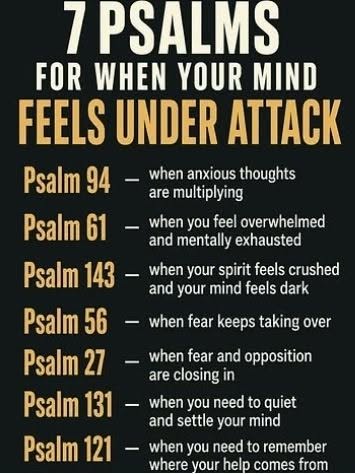
Psalm 27, a psalm written by David, is an example of Hebrew poetry. One element of Hebrew poetry prominent in this psalm is a grammatical structure known as synonymous parallelism. For example, in the first verse of Psalm 27, the main idea and structure of the first line are synonymous with the idea and structure of the second, as shown below:
Line 1: The LORD is my light and my salvation—whom shall I fear?
Line 2: The LORD is the stronghold of my life—of whom shall I be afraid?
Both the first and second lines focus on the Lord. In the first line, David describes the Lord as his light and salvation. In the second line, David describes the Lord as his stronghold or refuge. Both lines end with the same question phrased in a slightly different manner. This parallelism allows for a fuller understanding of the first line by looking at the immediate context of the second, and vice versa.
A stronghold or refuge was a place of protection during a time of siege. The farmers and workers outside of the city would be particularly susceptible to attack as they would have been outside the city walls’ protection (Nehemiah 2:17; cf. Joshua 6:1–21). So, those farmers and workers would run to the city for refuge and protection whenever battle came. Many cities also had a strong tower, which would have been an extra layer of defense. The strong tower would give protection to those within and allow those outside to identify the city’s location whenever a battle was imminent (see Proverbs 18:10). This protection in the stronghold is why David can ask the question in Psalm 27:1, “Of whom shall I be afraid?”
Much like God is a stronghold for David, He is also David’s light and salvation. Light is utilized to see and be aware of one’s surroundings amid the darkness. The idea of “light” is often used in Scripture as a metaphor for one’s deliverance, such as in Psalm 27:1. Whenever Jesus makes the claim, “I am the light of the world” (John 8:12), He is claiming that deliverance from darkness comes through Him. Salvation, as seen in Psalm 27:1, can also be thought of as deliverance. David utilizes three terms to describe God as the Deliverer: light, salvation, and stronghold. If God is David’s Deliverer, whom should he fear?
According to the context of Psalm 27:1, David seems to be describing God as the Deliverer from physical enemies (verses 2–3). However, the Christian has also received salvation and deliverance from his or her enemies. If you have faith in the person and work of Jesus Christ (1 Corinthians 15:3–5), then God has bought you back or redeemed you. He has transferred you from the domain or authority of darkness to the kingdom of Jesus (Colossians 1:13–14). Through Christ’s provision, the Christian has been equipped for protection through the “full armor of God” (Ephesians 6:10–17).
Much as David can proclaim God is his light and salvation from the enemies surrounding him, the Christian can claim God is his light and salvation from the domain of darkness and eternal judgment (Ephesians 2:1–10). “For the wages of sin is death, but the gift of God is eternal life in Christ Jesus our Lord” (Romans 6:23).
In Psalm 27:1, King David presents every believer with the remedy for fear: “The Lord is my light and my salvation; Whom shall I fear? The Lord is the strength of my life; Of whom shall I be afraid?” (Psalm 27:1, NKJV).
Against every threat, David raised three shields. The first was the Lord’s light—a metaphor for God’s darkness-dispelling holiness, truth, and guiding presence (Psalm 18:28; 36:9; 43:3). Second, David recognized that the Lord’s salvation preserved him from danger, harm, and destruction. And finally, David stood on this rock-solid defense: “The Lord is the strength of my life.”
The Hebrew word (ma’oz), translated as “strength” (NKJV) in Psalm 27:1, means “stronghold” (ESV, NIV, CSB) or “fortress” (NLT). It describes a safe refuge fortified with high rock walls. By saying, “The Lord is the strength of my life,” David underscores God’s unwavering protection to those who call on Him for help. He repeats the sentiment in Psalm 28:8: “The Lord gives his people strength. He is a safe fortress for his anointed king” (NLT). Again, David declares, “The Lord rescues the godly; he is their fortress in times of trouble” (Psalm 37:39, NLT; see also Psalm 31:2).
As a king and warrior, David understood God to be his safe retreat from the battles of life. David found healing, renewal, and restoration of strength when he spent time in God’s presence. As David’s stronghold, God also offered a secure shelter from which to launch a counterattack on the evil forces David was sure to encounter each day.
For the Lord to be the strength of our life, we must first accept Jesus Christ as our Savior. Since we were powerless to save ourselves, God, in His mercy and grace, saved us through the sacrifice of His Son (Ephesians 2:5–9; see also James 4:12). Once we receive the strength of God’s salvation, we can begin to “understand the incredible greatness of God’s power for us who believe him. This is the same mighty power that raised Christ from the dead and seated him in the place of honor at God’s right hand in the heavenly realms” (Ephesians 1:19–20, NLT).
To every believer who places his or her trust in the Lord, His name becomes “a fortified tower; the righteous run to it and are safe” (Proverbs 18:10). The name of the Lord expresses His essential nature, character, and authority. His name represents the Lord Himself. The Lord alone is the true refuge of His people: “God is our refuge and strength, always ready to help in times of trouble. So we will not fear when earthquakes come and the mountains crumble into the sea” (Psalm 46:1–2, NLT).
When we say, “The Lord is the strength of my life,” we mean God is our sure defense against every threat, fear, and enemy (Deuteronomy 33:27). The Lord safely guards those who call upon Him throughout all the days of their lives (Romans 10:13; Acts 2:21; John 10:28–29). Rather than let anxiety consume us, the Bible instructs us to “pray about everything. Tell God what you need, and thank him for all he has done. Then you will experience God’s peace, which exceeds anything we can understand. His peace will guard your hearts and minds as you live in Christ Jesus” (Philippians 4:6–7, NLT).
The apostle Paul trusted in the Lord to be the strength of his life (Ephesians 3:16; 6:10; Philippians 4:13; 2 Thessalonians 2:16–17; 1 Timothy 1:12; 2 Timothy 4:17). He wrote of God’s fear-conquering love, “What, then, shall we say in response to these things? If God is for us, who can be against us? . . . For I am convinced that neither death nor life, neither angels nor demons, neither the present nor the future, nor any powers, neither height nor depth, nor anything else in all creation, will be able to separate us from the love of God that is in Christ Jesus our Lord” (Romans 8:31, 38–39).
Believers can confidently say, “The Lord is the strength of my life,” when they relinquish control and place themselves wholly in God’s hands. Like young David, who found the courage and strength to confront the giant Goliath through profound dependence on the Lord (1 Samuel 17:45), we too must realize that only by God’s power can we “push back our enemies” and “trample our foes” (see Psalm 44:4–8). God alone “gives power to the weak and strength to the powerless. Even youths will become weak and tired, and young men will fall in exhaustion. But those who trust in the Lord will find new strength. They will soar high on wings like eagles. They will run and not grow weary. They will walk and not faint” (Isaiah 40:29–31, NLT).
In one of the most consoling passages of the Bible, we discover this confident claim: “Even though I walk through the darkest valley, I will fear no evil, for you are with me; your rod and your staff, they comfort me” (Psalm 23:4). The psalmist, King David, has learned that God’s presence with him overcomes even the very worst things he can face in life.
Psalm 23 introduces us to the Lord as a faithful, loving, and compassionate Shepherd, an image that’s familiar throughout both the Old and New Testaments. As we get to know God as our Shepherd, we begin to see how He guides us, cares for us individually, and protects us. We realize that we lack nothing because our Shepherd is with us, directing our path and looking out for our every need. Even if He leads us into a dark valley we, like David, can say, “I will fear no evil.”
The word translated “evil” in the original Hebrew language means “that which causes harm, misfortune, trouble, danger, destruction, or injury of any kind.” Even in the most challenging times, David says he would not fear any harm. We don’t have to be afraid because the Lord our Shepherd walks with us through the dark valleys of life. He is with us in times of loss, illness, injury, and grief. Even in the blackest seasons of life, we don’t have to fear harm because God is with us.
God has repeatedly given this reassurance to His faithful followers throughout the Bible. To the patriarchs, God said, “Fear not, for I am with you” (Genesis 26:24, ESV; see also Genesis 15:1). To the armies of Israel, the Lord promised, “When you go to war against your enemies and see horses and chariots and an army greater than yours, do not be afraid of them, because the LORD your God, who brought you up out of Egypt, will be with you” (Deuteronomy 20:1).
As Joshua and the people of Israel prepared for battle against enemy nations in the Promised Land, God said through Moses, “Be strong and courageous. Do not be afraid or terrified because of them, for the LORD your God goes with you; he will never leave you nor forsake you” (Deuteronomy 31:6; see also 31:8). Through the prophet Isaiah, God proclaimed, “Don’t be afraid, for I am with you. Don’t be discouraged, for I am your God. I will strengthen you and help you. I will hold you up with my victorious right hand (Isaiah 41:10, NLT; see also 41:13; 43:5). The writer of Hebrews reminds us of God’s promise, “Never will I leave you; never will I forsake you” (Hebrews 13:5).
Fearing evil and trusting God don’t mix. When we are confident in God’s goodness, we can say with the psalmist, “The LORD is my light and my salvation—whom shall I fear? The LORD is the stronghold of my life—of whom shall I be afraid?” (Psalm 27:1). If we believe that God is on our side, we acknowledge, “The LORD is for me, so I will have no fear. What can mere people do to me?” (Psalm 118:6, NLT). When we start to experience fear, we know it’s time to put our trust in God (Psalm 56:3). As we turn to Him in prayer, He will free us from fear and fill us with His supernatural peace (Psalm 34:4; Philippians 4:6).
In our darkest, most trying times, we must remember that God is near (Psalm 34:18). He is our Shepherd, and we are in His constant care. Throughout our lives and even in death, His goodness and love will never fail us (Psalm 23:6). Only when we are secure in the knowledge that our Good Shepherd is with us can we confidently say, “I will fear no evil.”

Tea Time Manna
We proclaim him, admonishing and teaching everyone with all wisdom, so that we present everyone perfect in Christ.
—Colossians 1:28
Our goal as Christians, as disciples of Jesus, is not to obey some ancient law, adhere to some arcane set of rules, or even follow some prescribed spiritual discipline. Our goal as Christians is to be conformed to the character, way of life, and heart of Jesus (Luke 6:40). We want to be JESUShaped people. This is also the Holy Spirit’s work in us (2 Corinthians 3:18). As Paul the apostle makes clear here and elsewhere (Galatians 4:19), his goal is to see “Christ formed” in new disciples. Shouldn’t this be our work as parents, friends, and spiritual mentors, too? We want to see each other, those we love, those we influence, and those in Jesus’ family, fully and perfectly mature in Christ Jesus.
Prayer
Holy Lord, conform my heart, words, life, ministry, and actions to those of Jesus. I want him to be my Lord, not just in my words but also in my daily life. In addition, dear Father, please empower me with the Holy Spirit so I can better help others in Jesus’ family, and help them mature into the roles you have for them, as you mature them into a more perfect example of their Lord. I pray this in the name of Jesus, my Lord and Savior. Amen and Amen
EXTRA TRUTH ARTICLE BY PASTOR DIRK
The Evolution of Overlooking Sin in our Community
Has this Happen Yet ? And are we at the End of this Evolution Periods ?
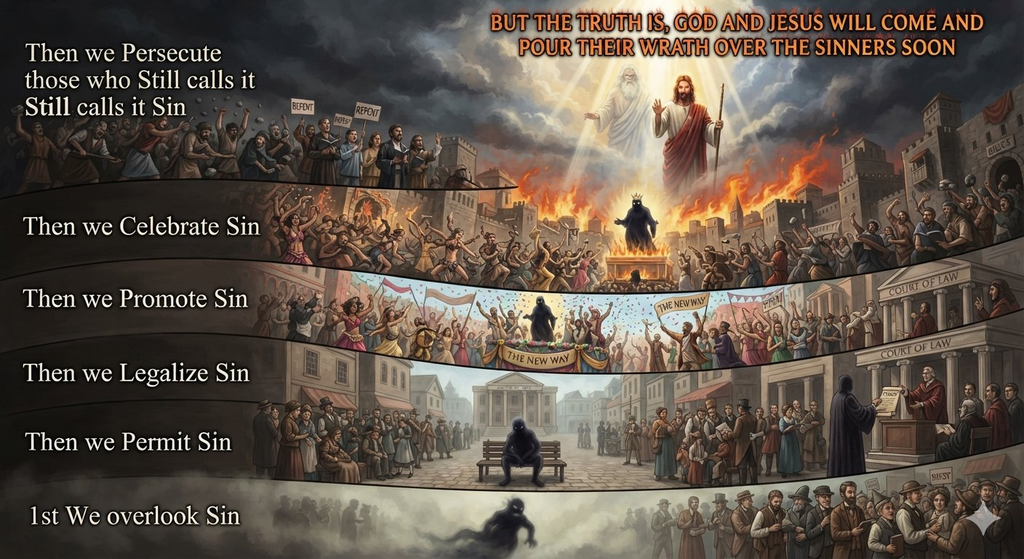
1st We overlook Sin , Then we Permit Sin, Then we Legalize Sin , Then we Promote Sin , Then we Celebrate Sin, Then we Persecute those who Still calls it Sin. (Place any of these in the Place of the word Sin) The Love of Money . Drinking Alcohol , Smoking , Being Gay , Apostasy, Unfaithfulness and Many More
BUT THE TRUTH IS , GOD AND JESUS WILL COME AND POUR THEIR WRATH OVER THE SINNERS SOON
The Evolution of Overlooking Sin in Our Community
The Slippery Slope of CompromiseHistory and scripture both warn of a subtle, creeping decay that occurs when a society slowly detaches itself from divine standards. What begins as a minor concession eventually transforms into an entire inversion of morality. The prophet Isaiah famously warned, “Woe to those who call evil good and good evil, who put darkness for light and light for darkness” (Isaiah 5:20), pointing directly to a pattern of community desensitisation that develops in distinct, predictable
Stages.1. We Overlook Sin
The descent begins not with open rebellion, but with silence. Society begins to tolerate what it once clearly recognized as transgression. Under the guise of politeness, avoidance, or a desire to “not rock the boat,” individuals choose to look the other way. This mimics the compromise warned about in Ephesians 5:11: “Take no part in the unfruitful works of darkness, but instead expose them.” When personal accountability weakens, standard structural boundaries start to blur.
2. We Permit Sin
Once an action is repeatedly overlooked, it moves from being an ignored anomaly to an accepted reality. Tolerance shifts into permission. The community begins to rationalise the behaviour, reclassifying deliberate actions as mere preferences. This mirrors the spiritual state described in Judges 21:25: “In those days there was no king in Israel. Everyone did what was right in his own eyes.” Boundaries that once protected the spiritual health of the collective are lowered.
3. We Legalize Sin
What is permitted in private eventually demands recognition in public law. Human legislation is altered to accommodate and validate the behaviour. This is the very corruption detailed in Psalm 94:20, which speaks of those “who frame injustice by statute.” Cultural shifts apply pressure until the legal system codifies what God’s word defines as transgression, cementing the practice into the framework of everyday life.
4. We Promote Sin
Legal validation is quickly followed by advocacy. The behaviour is integrated into education, media, and culture. True moral neutrality disappears as the community actively encourages compliance. This stage perfectly reflects Romans 1:32, which warns of those who, knowing God’s righteous decree, “not only do them but give approval to those who practice them.”
5. We Celebrate Sin
Promotion matures into full celebration. Festivals, public recognitions, and cultural milestones are established to honor what was once hidden. Society demands active applause. This matches the description in Philippians 3:19 of those whose “glory is in their shame, with minds set on earthly things.” Joy is found not in righteousness, but in the collective rejection of absolute truth.
6. We Persecute Those Who Still Call It Sin
The final stage of this evolution is the inversion of justice. When sin becomes the cultural norm, righteousness becomes the enemy. Those who hold fast to biblical truths face social, professional, and spiritual hostility. As 2 Timothy 3:12 states, “Indeed, all who desire to live a godly life in Christ Jesus will be persecuted.” Truthtellers are cast as intolerant, and the dissenting voice is systematically silenced.
The Ultimate Truth
While society may change its laws and rewrite its cultural standards, the spiritual reality remains completely unaltered. Human approval cannot erase divine law, nor can public consensus delay the arrival of ultimate accountability.Scripture makes it clear that God’s patience and forbearance are meant to lead humanity to repentance (Romans 2:4), not to embolden continuous transgression. The truth that cannot be bypassed is that a day of reckoning is approaching. God and Jesus Christ will return, not to compromise with the world, but to execute holy judgment. As Revelation 19:11-15 describes, Christ will return in righteousness to judge and make war, and Colossians 3:6 reminds us that “on account of these the wrath of God is coming.” For those who choose to remain in unrepentant sin and actively oppose righteousness, that day will bring the fullness of divine wrath. True restoration begins when a community stops adjusting the truth to fit its desires and instead humbles itself before the Creator.
NEWS MANNA – PLEASE Note that these articles are News Articles and Not Always the View Point of Pastor Dirk or TruLight Ministries
JD Vance Gives Himself A 7 Out Of 10 Chance Of Heaven being a Roman Catholic – What Would You Say?
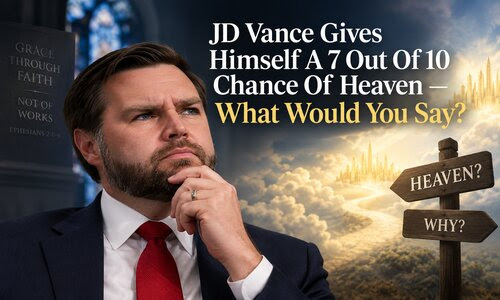
Vice President JD Vance was recently asked a question that has nothing to do with elections, economics or foreign policy.
“On a scale of one to ten, how confident are you that you would go to heaven?”
Vance paused before answering.
“It’s high, but it’s not a 10. I mean, it’s a seven or it’s an eight.”
The question came during an interview with young Christian evangelist Bryce Crawford. Vance explained that part of his uncertainty comes from occasional doubts about whether Christianity is actually true and whether there really is something beyond this life. A year earlier, he said, his answer might have been only a five or six.
Vance nevertheless made something else very clear: “I believe in Jesus Christ. I believe he’s my Savior.”
For Christians, his answer raises a question far more important than what the vice president believes.
What would you say?
And perhaps more importantly: Why?
The Question Behind The Question
Crawford explained that he once would have answered the same question with a six because he was looking at himself.
He knew his failures. He knew his sins. He wondered whether he had done enough.
Then a pastor challenged his thinking with a simple question: Did Jesus die for only 60 percent of your sins?
That gets remarkably close to the heart of the Protestant understanding of the Gospel.
Our confidence before God does not rest upon how well we have performed. It rests upon what Christ has already accomplished.
Paul writes that we are “justified freely by his grace through the redemption that is in Christ Jesus” (Romans 3:24). Ephesians 2:8-9 declares that salvation is by grace through faith, “not of works, lest any man should boast.”
Philippians 3:9 makes the distinction even clearer. Paul wanted to be found in Christ, “not having mine own righteousness, which is of the law,” but possessing the righteousness that comes through faith in Christ.
In other words, the question isn’t ultimately:
How confident are you in yourself?
It is:
How confident are you in Christ?
Catholicism And Protestantism Part Ways
This becomes particularly interesting because Vance is Catholic. He converted to Roman Catholicism in 2019 after having earlier identified with evangelical Protestantism.
The Catholic Catechism describes justification as a freely given act of God and grace as God’s gratuitous gift. It specifically teaches that no person can merit the initial grace that brings conversion and justification.
But that isn’t the end of Catholic teaching.
The Catechism also teaches that justification involves man’s cooperation with grace and that, after receiving grace, Christians can acquire “merit” through their union with Christ. It goes so far as to teach that, moved by the Holy Spirit, believers can merit graces necessary for sanctification and “the attainment of eternal life.”
This is precisely where Protestants should stop and examine Scripture carefully.
The issue isn’t whether good works matter. They certainly do.
The issue is what role those works play in our standing before God.
A Gift Or A Wage?
Romans 4 gives us an extraordinarily simple distinction:
“Now to him that worketh is the reward not reckoned of grace, but of debt.”
A wage is something owed.
A gift is something received.
Paul continues by describing the person who “believeth on him that justifieth the ungodly” and says that his faith is counted for righteousness.
That was at the heart of the Protestant Reformation. Salvation isn’t Christ doing most of the work while we complete the transaction. Nor is justification something Christ begins that our subsequent merit must eventually make sufficient.
Christ is sufficient.
“For by one offering he hath perfected for ever them that are sanctified” (Hebrews 10:14).
Jesus’ words from the cross were not, “I have begun it.”
They were:
“It is finished.”
But Don’t Works Matter?
Absolutely.
This is where Protestant teaching is sometimes caricatured in the opposite direction.
Biblical salvation does not mean that someone can profess faith in Christ, continue happily living in rebellion against God and assume that nothing matters because he once “accepted Jesus.”
James famously declares that “faith without works is dead.”
Jesus warned that not everyone who says “Lord, Lord” will enter the kingdom of heaven. Scripture repeatedly teaches that genuine faith produces fruit.
But there is an enormous difference between saying works are the evidence of salvation and saying works contribute merit toward obtaining eternal life.
The Protestant understanding has historically insisted on keeping those categories separate.
We aren’t saved by good works.
We are saved for good works.
The works are evidence of what God has done within us, not additional payment for what Christ supposedly left unfinished.
Can Saying “10” Actually Be Humble?
Some might hear someone say he is 100 percent certain he is going to heaven and immediately think the answer sounds arrogant.
Perhaps it can be.
If someone says, “I’m definitely going to heaven because I’m a good person,” that is extraordinary confidence in oneself.
But biblical assurance says something very different.
“I know I’m a sinner. I know I cannot save myself. I know my righteousness cannot satisfy a holy God. Therefore my entire hope rests upon Jesus Christ.”
In that sense, answering “10” doesn’t necessarily mean believing you are a 10.
It can mean believing Christ is.
That is not confidence in human performance. It is confidence in a Savior.
John wrote his first epistle to believers and explicitly explained why: “that ye may know that ye have eternal life” (1 John 5:13).
Not hope.
Not calculate the odds.
Know.
Ask Yourself The Second Question
Imagine someone asking you tonight:
“If you died before morning, would you go to heaven?”
Maybe your answer is yes.
Maybe it’s probably.
Maybe it’s seven out of ten.
But now comes the more revealing question:
Why?
“I’ve tried to be a good person.”
“I’ve done more good than bad.”
“I go to church.”
“I was baptized.”
“I give to charity.”
“I take Communion.”
“I haven’t done anything really terrible.”
Notice what every one of those answers has in common.
They begin with “I.”
The Gospel begins somewhere else.
Christ.
Christian assurance doesn’t come from finally reaching the point where we believe we’ve accumulated enough goodness. In fact, the closer we come to understanding God’s holiness, the more absurd that proposition should appear.
“For all have sinned, and come short of the glory of God” (Romans 3:23).
There isn’t a religious ladder tall enough to bridge that gap.
That is why Christ came.
So What Would You Say?
JD Vance’s seven-or-eight answer may ultimately prove more useful than a confident ten because it forces Christians to think about something we too easily take for granted.
Where does our assurance come from?
Vance himself correctly emphasized that salvation isn’t about what we have done to deserve it. “It’s ultimately about him,” he told Crawford.
On that point, Protestants should enthusiastically agree.
And then take the statement to its biblical conclusion.
If salvation is ultimately about Christ—His righteousness, His sacrifice, His blood and His finished work—then our hope cannot simultaneously rest upon accumulating enough merit of our own.
Good works should follow salvation.
Obedience should follow salvation.
A transformed life should follow salvation.
But none of those things can improve upon the finished work of Jesus Christ.
So perhaps Crawford’s question deserves to be asked in every church:
On a scale of one to ten, how confident are you that you are going to heaven?
But don’t stop with the number.
Ask the question that matters infinitely more:
What are you trusting in when you give your answer?
Because if the answer ultimately comes back to what you have done, there will never be enough reason for certainty.
If the answer is Jesus Christ, however, the question changes entirely.
The Christian’s hope isn’t that one day he will finally become good enough for heaven.
It is that Jesus Christ already is.
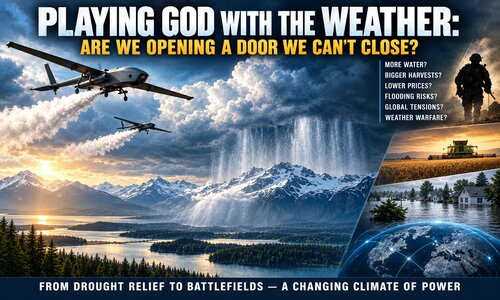
Playing God With The Weather: Are We Opening A Door We Can’t Close?
Let’s begin by getting something out of the way.
Weather modification is not a conspiracy theory.
It is happening right now.
On August 23, a California weather-technology company called Rainmaker sent drones into clouds over Alaska’s Kenai Peninsula. The company says its aircraft conducted seven coordinated cloud-seeding missions, releasing silver iodide into clouds already containing moisture.
Rainmaker estimates that the operation generated between 45 and 65 acre-feet of additional precipitation, with an average estimate of 57.6 acre-feet.
That’s roughly 19 million gallons of water.
In about three hours.
The figure is Rainmaker’s estimate rather than an independently verified measurement, and the company acknowledges uncertainties in calculating exactly how much precipitation ultimately reached the ground. But the experiment illustrates something important.
Human beings are becoming increasingly capable of deliberately influencing weather.
And the technology is getting better.
This Isn’t The Cloud Seeding Of The Past
Cloud seeding has existed for roughly 80 years. The basic concept isn’t particularly mysterious.
Certain clouds contain supercooled water droplets that remain liquid below freezing. Introducing particles such as silver iodide can encourage ice crystals to form. Those crystals can grow until they eventually fall as snow or rain.
Cloud seeding cannot create a storm out of a clear blue sky. It requires the right atmospheric conditions, and its effectiveness remains difficult to quantify.
A 2024 Government Accountability Office review found estimates of additional precipitation from cloud seeding ranging from zero to 20 percent.
What is changing is everything surrounding the process.
Instead of simply sending airplanes into promising clouds, companies can increasingly combine drones, sophisticated radar, atmospheric sensors, satellite information and computer modeling to identify where and when seeding may have the greatest effect.
Rainmaker’s system includes autonomous drones capable of flying through severe icing conditions and software that forecasts seeding opportunities, monitors missions and estimates precipitation.
The old experiment is becoming a technology platform.
Why Should You Care?
Because weather is money.
A prolonged drought can devastate farmers, increase food prices, reduce hydroelectric generation and drain reservoirs. Too much precipitation can destroy crops, flood homes, close highways and disrupt supply chains.
Snowpack determines how much water will eventually flow into reservoirs serving farms and cities. Rainfall can influence commodity prices. A major storm can produce billions of dollars in insurance losses.
So imagine a future in which weather modification becomes increasingly common.
If a company successfully increases mountain snowfall by 10 percent, communities downstream might gain enormous amounts of additional water.
But what happens when something goes wrong?
Suppose cloud-seeding operations are underway and an area subsequently experiences damaging flooding. Did the seeding contribute? By how much? Who is liable?
What if farmers believe precipitation was increased over one region at the expense of another?
What if a state attempts to increase its water supply from clouds that would subsequently have traveled into a neighboring state?
The science may ultimately show that many such accusations are unfounded. But once humans deliberately intervene in atmospheric processes, separating natural weather from human influence becomes enormously important economically, legally and politically.
Even the federal government’s watchdog says significant uncertainties remain. The GAO concluded that reliable information about cloud-seeding effectiveness and effects remains limited, while the consequences of much more widespread use of silver iodide are not fully known.
Meanwhile, federal oversight has struggled to keep pace. In February, the GAO reported that NOAA was not fully meeting its responsibilities for maintaining and publicly reporting information about weather-modification activities, estimating that more than half of reports filed with NOAA likely contained errors.
Weather Has Already Been Used As A Weapon
This is where the story becomes considerably more unsettling.
Weather warfare isn’t science fiction either.
During the Vietnam War, the United States conducted a classified weather-modification program known as Project Popeye.
Declassified State Department documents describe the objective plainly: produce enough rainfall along infiltration routes in North Vietnam and Laos to interfere with truck traffic.
Clouds were seeded in an effort to prolong rainfall and make enemy supply routes more difficult to use.
Think about what that means.
More than half a century ago, governments already understood that weather could potentially become part of the battlefield.
The international community eventually responded. The Environmental Modification Convention, which entered into force in 1978, prohibits military or other hostile use of environmental modification techniques having widespread, long-lasting or severe effects.
There is a treaty against environmental warfare because governments recognized the possibility was serious enough to require one.
What Happens When AI Enters The Equation?
Now compare the technology of the Vietnam era with what is emerging today.
Drones can fly without putting pilots at risk. Satellites continuously monitor atmospheric systems. Radar can observe precipitation. Sensors can measure conditions inside clouds. Computer systems can identify favorable opportunities.
Artificial intelligence could make those capabilities even more powerful.
Imagine autonomous systems continuously examining enormous regions for atmospheric conditions suitable for intervention, then coordinating fleets of drones to act when those conditions appear.
That does not mean governments can manufacture hurricanes or order thunderstorms like weapons from a catalog. They cannot.
But warfare rarely requires controlling nature perfectly.
Sometimes an advantage is enough.
If weather modification could someday increase rainfall over supply routes, worsen muddy battlefield conditions, increase mountain snowfall, interfere with visibility or otherwise complicate military logistics, strategists would have obvious reasons to study it.
History tells us they already have.
Who Owns The Rain?
There are potentially tremendous benefits to this technology.
The American West faces serious water challenges. Additional snowfall in important watersheds could increase reservoir supplies, support agriculture and provide communities with desperately needed water.
That shouldn’t be dismissed.
But neither should the questions surrounding increasingly sophisticated weather modification.
Who authorizes it?
Who monitors it?
Who determines whether it worked?
Who pays when something goes wrong?
What happens when neighboring states—or neighboring countries—disagree about who should be manipulating atmospheric systems passing over their territory?
And what happens when technology developed to fight drought becomes attractive to militaries seeking strategic advantage?
The greatest concern may not be what cloud seeding can accomplish today.
It is where the technology is heading.
For decades, mankind could influence weather only crudely and under very specific circumstances. Now drones, satellites, sensors, advanced forecasting and artificial intelligence are beginning to converge.
The Alaska experiment should therefore get our attention for reasons extending far beyond 19 million gallons of rain.
The question is no longer whether humans will attempt to modify the weather.
We already are.
The more important question is whether we fully understand what happens when we get increasingly good at it.
TruLight TV – Navigating the Levels of Faith
Of all the needs of humanity, the need to belong and be connected might run the deepest. It’s why we fear rejection as much as we do. If you’re struggling with feeling accepted, watch the video to be reminded of God’s perfect love for you. And our sermon today from Dr. Charles Stanley (Levels of Faith in the Life of the Believer) – Dr. Stanley tells us that everyone has some form of faith, and that it affects the way we live. A non-believer’s faith is self-directed while a believer’s faith is God-directed. Dr. Stanley explains how we can progress to a level of great faith so our Christian life will take on a stronger, more exciting purpose. and later Mark shares the heart behind the song “One More Song For You” from the newest Casting Crowns album, Only Jesus!
Today on TruLight Radio XM
TruLight Radio XM 24/7
Program
GMT / UTC +2
Monday To Fridays
00:15 Words to Live By Testimonies
01.15 Science Scripture and Salvation
02.15 Ground Works
04.00 Gospel Concert of the Day
05.00 The Daren Streblow Comedy Show
5:55 It is Today devotional
6:00 Gaither Homecoming Morning Show
7:15 Discover the Word
8.15 Destined for Victory
8:55 Science Scripture and Salvation
9:00 Holy Spirit Hour – Normally Sermons
10:15 Hope of the Heart
11:15 Unshackled
11.45 Words to Live By
12:15 Truth for Life
13:15 Living on the Edge with Chip Ingram
14:15 Focus on the Family
15:00 Kids Hour
16:00 In Touch with Dr. Charles Stanley
16:30 Groundwork
17:15 Live in the Light
18:15 Renewing your Mind
19:00 Gaither Homecoming Show
20:15 Growing Hope
21:15 Adventures in Odyssey Radio Drama
21:45 Bible Reading
22:15 Night-sounds
23.00 Good Old Country Gospel / Rhema Gospel Express
VISIT THE WEBSITE
TruLight Ministry News – EXTRA MANNA
TruLight Ministries orders from God since 2012 . Teach Them , Comfort Them and Warn Them!
Artist Liners
Healing Truths.
End Time Articles.
Share this Feeding of Manna with your Friends and Family. just click on the Social Media icon and share This Manna with your Friends and Family. just click on the Social Media icon and share !