Hosted by TruLight Ministries International – The Place of Truth
SELECT YOUR READING LANGUAGE – BOTTOM LEFT = YOUR DAILY MANNA NOW AVAILABLE IN 103 LANGUAGES
@ TruLight Daily Manna is not Just a Bible Verse with a Small Prayer . NO ::: WE SERVE DAILY Manna for the ENTIRE Day . Breakfast , Lunch , Dinner , Plus tea Times and even Entertainment Manna . Plus News Manna and More , This Daily Manna will keep you Spiritually full for the full 48 Hours and even More to Share with your Friends and Family !!!
You are Fearfully and Wonderfully Made !!!
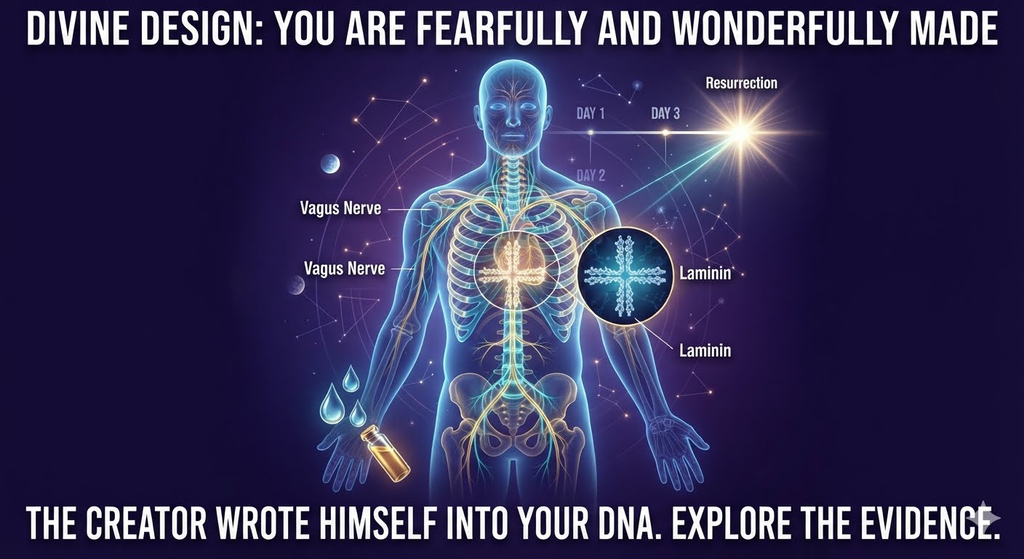
The Divine Signature: How Your Body Echoes the Creator
The human body is an absolute masterpiece of biological engineering, but to a person of faith, it is something much deeper. It is a canvas.
God did not just create you; He left His signature on His greatest artwork—you.
By looking closely at our own biology, we can see beautiful reflections of the Gospel story written directly into our physical frames.
Biblical Parallels in Human Anatomy
The connections between the structures that keep us alive and the numbers central to scripture are fascinating to consider:
- The Foundation of Uprightness: The human spine develops with 33 vertebrae. Believers often parallel this to the traditional understanding that Jesus walked the Earth and completed His earthly ministry at 33 years old. The very structure keeping us standing straight matches the timeline of the One who holds the world together.
- The Symmetrical Dozen: Human beings possess 12 pairs of ribs on each side. In biblical history, the number twelve represents perfect government and divine foundation—echoing the 12 tribes of Israel and the 12 disciples chosen by Jesus to spread the Gospel.
- Calming the Inner Storms: The vagus nerve is the longest cranial nerve in the body, running from the brainstem all the way to the heart and gut. It acts as the body’s natural brake pedal, lowering heart rates and soothing anxiety. Just as Jesus stood in a boat and commanded a raging sea to be still, this vital nerve quiets the physical storms of stress within our chest and stomach.
The Biological Symbols of Faith
Beyond the numbers, molecular biology and physiology offer incredible visual and experiential metaphors for the Christian walk:
Laminin: The Cellular Cross
At a microscopic level, your cells are held together by a cell-adhesion glycoprotein called laminin. Under an electron microscope, this structural foundation is famously shaped like a cross. It serves as a literal, physical reminder of Colossians 1:17: “He is before all things, and in Him all things hold together.”
Fasting and Cellular Resurrection
When a person undergoes a 72-hour fast, science shows that the body triggers autophagy. Old, damaged immune cells are broken down, and the body triggers the regeneration of brand-new stem cells. This intense, three-day biological renewal mirrors the timeline of the Resurrection, where life was brought out of death on the third day.
The Chemistry of Tears
Human tears change their molecular structure depending on the emotion behind them. Under a microscope, tears of grief look completely different from tears of joy. This beautifully validates Psalm 56:8, which reminds us that God is intimately aware of our suffering, famously stating that He collects our tears in a bottle.
Meaningful Coincidence or Divine Artistry?
For the believer, these anatomical features are not mere coincidences. They are physical metaphors showing that the Creator wrote Himself into your very DNA.
Your heart beats with a rhythm given by God, your brain lights up in neurological harmony when you pray, and your entire body is hardwired for worship.
An Invitation to the Creator
The ultimate takeaway of these physical wonders is that the God who orchestrates the galaxies is not distant. He is deeply personal, and He crafted you with the intention of making His home inside your heart.
If you want to move beyond simply existing and enter into a personal relationship with the Artist who designed you, you can take that step today.
A Prayer of Surrender:
“Dear Jesus, come into my life. I’m so sorry for living a life of sin that separated me from you. Forgive me. I believe you died for my sins and rose again. I surrender my life to you. Amen and Amen
Psalm 139:14 declares, “I praise you because I am fearfully and wonderfully made; your works are wonderful, I know that full well.” The context of this verse is the incredible nature of our physical bodies. The human body is the most complex and unique organism in the world, and that complexity and uniqueness speaks volumes about the mind of its Creator. Every aspect of the body, down to the tiniest microscopic cell, reveals that it is fearfully and wonderfully made.
Engineers understand how to design strong yet light beams by putting the strong material toward the outside edges of a cross-section and filling the inside with lighter, weaker material. This is done because the greatest amounts of stress occur on the surfaces of a structure when handling common bending or stresses. A cross section of a human bone reveals that the strong material is on the outside and the inside is used as a factory for blood cells of various kinds. When you examine a sophisticated camera with its ability to let in more or less light as needed and its ability to focus automatically over a vast range of field, you find repeated imitations of the operation of the human eye. And yet, having two eyeballs, we also have depth perception which gives us the ability to judge how far away an object is.
The human brain is also an amazing organ, fearfully and wonderfully made. It has the ability to learn, reason, and control so many automatic functions of the body such as heart rate, blood pressure, and breathing, and to maintain balance to walk, run, stand, and sit, all while concentrating on something else. Computers can outdo the human brain in raw calculating power but are primitive when it comes to performing most reasoning tasks. The brain also has an amazing ability to adapt. In an experiment, when people put on glasses that made the world seem upside down, their brains quickly reinterpreted the information they were being given to perceive the world as “right-side-up.” When others were blindfolded for long periods of time, the “vision center” of the brain soon began to be used for other functions. When people move to a house near a railroad, soon the sound of the trains is filtered out by their brains, and they lose conscious thought of the noise.
When it comes to miniaturization, the human body is also a marvel fearfully and wonderfully made. For instance, information needed for the replication of an entire human body, with every detail covered, is stored in the double-helix DNA strand found in the nucleus of each of the billions of cells in the human body. And the system of information and control represented by our nervous system is amazingly compact in comparison to man’s clumsy inventions of wires and optical cables. Each cell, once called a “simple” cell, is a tiny factory not yet fully understood by man. As microscopes become more and more powerful, the incredible vistas of the human cell begin to come into focus.
Consider the single fertilized cell of a newly conceived human life. From that one cell within the womb develop all the different kinds of tissues, organs, and systems, all working together at just the right time in an amazingly coordinated process. An example is the hole, called the foramen ovale, in the septum between the two ventricles in the heart of the newborn infant. This hole closes up at exactly the right time during the birth process to allow for the oxygenation of the blood from the lungs, which does not occur while the baby is in the womb and is receiving oxygen through the umbilical cord.
Further, the body’s immune system is able to fight off so many enemies and restore itself from the smallest repair (even repairing bad portions of DNA) to the largest (mending bones and recovering from major accidents). Yes, there are diseases that will eventually overcome the body as we age, but we have no idea how many times through a lifetime that our immune systems have saved us from certain death.
The functions of the human body are also incredible. The ability to handle large, heavy objects and to also carefully manipulate a delicate object without breaking it is also amazing. We can shoot a bow with the arrow repeatedly hitting a distant target, peck away quickly at a computer keyboard without thinking about the keys, crawl, walk, run, twirl around, climb, swim, do somersaults and flips, and perform “simple” tasks such as unscrewing a light bulb, brushing our teeth, and lacing up our shoes—again without thinking. Indeed, these are “simple” things, but man has yet to design and program a robot that is able to perform such a vast range of tasks and motions.
The function of the digestive tract and the related organs, the longevity of the heart, the formation and function of nerves and of blood vessels, the cleansing of the blood through the kidneys, the complexity of the inner and middle ear, the sense of taste and smell, and so many other things we barely understand—each one is a marvel and beyond man’s ability to duplicate. Truly, we are fearfully and wonderfully made. How grateful we are to know the Creator—through His Son, Jesus Christ—and to marvel not only at His knowledge but also at His love (Psalm 139:17-24).
The Bible actually has many passages that tell us what God has to say about our worth and our value in His eyes. Genesis 1:26-27 says we are made in His image, the very image of God. Psalm 139:13-16 says we are fearfully and wonderfully made, and all the days of our lives were written in God’s book before we were ever born, confirming God’s prior knowledge and plan for our lives. Ephesians 1:4 says God chose His children before the foundations of the earth were ever formed, and in Ephesians 1:13-14 we’re told we are God’s own possession, chosen for the praise of His glory, and that we have an inheritance in heaven with Him as His children.
But notice the wording in each of the above phrases: “are made,” “are fearfully and wonderfully made,” “were written,” “God chose His children,” “we are God’s own possession,” and “we have an inheritance.” These phrases all have one thing in common: they are things done to us or for us by God. These are not things we have done for ourselves, nor have we earned or deserved them. We are, in fact, merely the recipients of “all spiritual blessings in heavenly places in Christ” (Ephesians 1:3). Therefore, we can conclude that our worth is not really of the “self” at all; rather, it is worth given to us by God. We are of inestimable value to Him because of the price He paid to make us worthy—the death of His Son on the cross.
The Bible tells us that “while we were yet sinners, Christ died for us” (Romans 5:8). In fact, we “were dead in trespasses and sins” (Ephesians 2:1). What worth is there in dead things? None. God imputed to us His own righteousness (2 Corinthians 5:21) not because we were worthy of it, but because we were unworthy, unlovable, and unable to make ourselves worthy in any way. But—and here’s the miracle—He actually loved us in spite of our condition (John 3:16), and because He did, we now have infinite worth.
John 1:12 tells us that to those who received Christ and believed in His name, God gave the right to become His children. First John 1:9 tells us that if we confess our sins, He is faithful to forgive our sins and cleanse us from all unrighteousness. If we focus on how much God loves us and the price He paid to redeem us, we’ll come to see ourselves as God sees us, and that will help us understand just how much we’re really worth as children of the most high God.
Our self-worth is too often based on what other people tell us about ourselves. The one, true authority on our self-worth is Jesus Christ, and since He gave His own life up for us by dying on a cross, that should tell us just how valuable we really are.
Psalm 139:13 states, “For you formed my inward parts; you knitted me together in my mother’s womb” (ESV). This verse is part of a psalm in which David reflects on God’s intimate and comprehensive knowledge of him. The language used in this verse paints a picture of God as a careful and intentional Creator. God is deeply involved in the formation of each human being.
The statement “You formed my inward parts” indicates the divine craftsmanship of creating a person. The “inward parts” can be understood as the core of one’s being, encompassing both the physical organs and the immaterial aspects, such as the soul or spirit. The Bible often uses this kind of poetic language to describe the complexity of human creation. For example, in Job 10:11–12, Job says, “You clothed me with skin and flesh, and knit me together with bones and sinews. You have granted me life and steadfast love, and your care has preserved my spirit” (ESV). David and Job both use the metaphor of weaving or knitting to convey God’s intricate involvement in the creation of life.
The image of God “knitting” a person together in the womb further emphasizes the care, precision, and personal attention that He invests in everyone. This metaphor portrays God not as a distant or detached deity but as one intimately involved in forming life from its very beginning. Knitting requires patience, skill, and attention to detail, highlighting God’s loving and deliberate involvement in human creation.
The implications of God forming our inward parts are profound, particularly when considering the dignity and value God’s action confers upon every human being. If God is the one who forms each person, then each life is imbued with a sense of purpose and worth from the moment of conception. This idea is echoed in Jeremiah 1:5, “Before I formed you in the womb I knew you, and before you were born I consecrated you; I appointed you a prophet to the nations” (ESV). Here, the emphasis is on God’s foreknowledge and preordained plan for Jeremiah, even before his birth. Every individual is not only known by God but also created with a specific purpose in mind. This truth should inform our understanding of human life and dignity.
Psalm 139:13 also speaks to the omniscience of God. Since He is the one who formed our inward parts and knitted us together in the womb, it follows that He knows us thoroughly—our thoughts, feelings, and needs—better than we know ourselves. This theme of God’s complete knowledge of humanity runs throughout Psalm 139. In verse 1, David declares, “O Lord, you have searched me and known me!” (ESV). In verse 16, he says, “Your eyes saw my unformed substance; in your book were written, every one of them, the days that were formed for me, when as yet there was none of them” (ESV). These verses reinforce the idea that God’s knowledge of us is not limited to our external actions or words but extends to our very essence, even before we come into being.
Understanding that God is intimately involved in our creation and knows us completely can have a transformative impact on how we view ourselves. We can have a deep sense of trust in God’s plan, even when faced with challenges or uncertainties. The knowledge that we are fearfully and wonderfully made by a loving Creator can provide comfort and reassurance in difficult times. In Psalm 139:14, David responds to this understanding by exclaiming, “I praise you, for I am fearfully and wonderfully made. Wonderful are your works; my soul knows it very well” (ESV). This praise-filled response is appropriate and reflects a recognition of God’s greatness and glory.
Psalm 139:13 is often cited in discussions about the beginning of life and its moral and ethical considerations. The belief that life is sacred from the moment of conception is rooted in the understanding that God forms life in the womb. This perspective upholds the dignity and worth of every human being, regardless of developmental stage or other circumstances. The psalmist’s reflection on God’s involvement in creation is a powerful reminder of the value of life and our responsibility to protect and cherish it.
Tea Time Manna
Jesus answered, “The work of God is this: To believe in the one He has sent.”
—John 6:29
Do you believe in Jesus — not just “kinda believe” in Jesus, but do you really believe? Years ago, shortly after Max Lucado came back from his mission work in Rio, Brazil, he shared with a group of his closest friends that his theology was pretty simple. He didn’t have a handle on a lot of the big, difficult theological problems that divide folks. However, Max said he came to the firm and deep conviction that God loves us, and he showed that love by really sending Jesus to live among us, to die for us, and to be raised from the dead so that we could be raised from death, too. This is the work of God — amazingly simple and awesomely powerful. I believe in Jesus. I pray that you believe in Jesus. While we may be uncertain about many specific details of complex doctrinal issues, the work of God we need is to genuinely “believe in the one he has sent.”
Prayer
Holy God, I do believe that Jesus came to earth, died, and was raised from the dead. Please help me show and share that message with those around me who are looking for hope and help. Holy Spirit, open my eyes to those around me who are searching for Jesus, and please give me the courage and sensitivity I need to share Jesus effectively with them, with gentleness and respect (1 Peter 3:15). Father, I want so much to share in your work of both believing in Jesus personally and also helping others to believe in him. I rededicate myself to this gospel message today. In the name of Jesus, my Savior, I pray. Amen and Amen
NEWS MANNA –
Blood Moon Over America (The Eagle Wings) : Sign Of The Times – Or Just Another Eclipse?
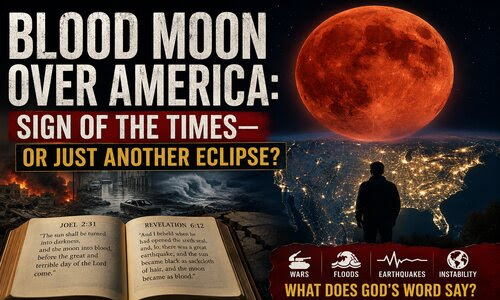
Wars are raging, nations are threatening nations, extreme weather and devastating floods are striking communities around the world, and earthquakes continue to shake populated regions. Political instability is spreading, geopolitical tensions are rising, and millions increasingly sense that the world has entered a period of unusual turbulence.
And now, on Thursday night, millions of Americans will look up and watch the moon turn red.
Beginning on the evening of August 27 and continuing into the early hours of August 28, Earth’s shadow will move across the moon in one of the deepest partial lunar eclipses most Americans will ever see. At precisely 12:12 a.m. Eastern Time, the eclipse will reach its maximum, with approximately 96 percent of the lunar surface covered and only a thin sliver remaining illuminated.
As the eclipse deepens, much of the moon could take on shades of copper, orange and blood red. Nearly one billion people across the United States, Canada and Latin America are positioned to see the entire eclipse, weather permitting, making this far more than an obscure astronomical event visible only from some distant corner of the world.
Under ordinary circumstances, it would simply be a spectacular night in the heavens. But these aren’t ordinary times, and whenever the moon turns blood red against the backdrop of war, natural disasters and geopolitical upheaval, Christians understandably begin thinking about Bible prophecy.
We’ve Heard This Language Before
Thousands of years before anyone used the modern phrase “blood moon,” the prophet Joel wrote, “The sun shall be turned into darkness, and the moon into blood, before the great and the terrible day of the Lord come” (Joel 2:31). The Apostle Peter repeated those words in Acts 2, connecting the imagery of the heavens with the prophetic Day of the Lord.
Then there is the unmistakable language of Revelation 6:12: “And I beheld when he had opened the sixth seal, and, lo, there was a great earthquake; and the sun became black as sackcloth of hair, and the moon became as blood.”
Jesus Himself warned that the period surrounding His return would be accompanied by extraordinary celestial events, declaring in Luke 21:25 that there would be “signs in the sun, and in the moon, and in the stars.”
So when millions of Americans walk outside Thursday night and see a reddish moon hanging over the nation, the question is inevitable: Are we witnessing a sign of the times–or just another eclipse?
The answer requires biblical discernment rather than either sensationalism or dismissal.
This Blood Moon Isn’t Revelation 6
There is nothing scientifically mysterious about why Thursday’s moon will appear red. During a lunar eclipse, Earth passes between the sun and moon, while Earth’s atmosphere filters the sunlight passing through it. Shorter blue wavelengths scatter more easily, while more red and orange light continues through the atmosphere and reaches the lunar surface–the same basic phenomenon responsible for brilliant red sunsets.
Astronomers can predict eclipses far into the future, which means this eclipse didn’t suddenly appear in response to today’s wars, earthquakes or political crises. Christians have repeatedly made the mistake of assigning specific prophetic significance to eclipses, comets, planetary alignments and other astronomical events, only to watch predicted dates come and go without the expected prophetic fulfillment.
Biblical watchfulness should never become prophetic sensationalism. Yet there is an opposite mistake that deserves just as much caution: becoming so determined not to sensationalize prophecy that we begin ignoring what prophecy actually says.
The Bible really does say that extraordinary signs are coming in the heavens.
Look At The World Around Us
Consider the setting in which this blood moon is appearing. The Russia-Ukraine war continues to produce massive drone and missile attacks, conflicts across the Middle East have repeatedly threatened wider escalation, and other parts of the world remain trapped in devastating wars and humanitarian crises.
At the same time, destructive floods, droughts, wildfires and extreme weather continue to affect populations across the globe. Earthquakes regularly remind us how quickly the ground beneath entire cities can become unstable, while political and economic uncertainty is adding another layer of anxiety for populations already wondering what comes next.
None of these individual developments proves that we have reached the final fulfillment of biblical prophecy. Wars, earthquakes, floods and eclipses have all occurred throughout human history, and Christians should resist the temptation to point to every headline and declare that a specific prophecy has been fulfilled.
But Jesus did tell His followers to pay attention to the larger pattern.
In Matthew 24, Christ spoke of wars and rumors of wars, nation rising against nation, famines, pestilences and earthquakes. He compared these developments to birth pains, an especially significant analogy because birth pains are not defined merely by their existence but by the way they eventually become increasingly difficult to ignore as the moment of delivery approaches.
That is why the most important question may not be, “Is Thursday’s blood moon prophetic?” The better question is whether we are paying attention to the larger picture developing around us.
The Blood Moon Isn’t The Prophecy–But It Reminds Us Of One
Revelation 6 describes something vastly more dramatic than Thursday night’s eclipse. There is a great earthquake, the sun becomes black, the moon becomes like blood, stars fall from heaven, and the heavens themselves appear to recede.
Whatever the precise physical mechanisms behind those future events, Scripture portrays something unmistakable and terrifying. Humanity will not need to debate on social media about whether something unusual has occurred; the scale of the events described will make that obvious.
Thursday night’s eclipse isn’t that event, but imagine standing outside shortly after midnight and watching almost the entire moon become darkened and reddish. For a brief moment, millions of people will see something that visually resembles imagery God placed in His Word thousands of years ago.
That should make us think–not speculate wildly, set dates or declare that the sixth seal has been opened, but seriously consider what Scripture says is ultimately coming.
Because one day the passages Christians have studied for generations will cease to be merely prophetic descriptions of the future.
Keep Looking Up
There is something strangely appropriate about millions of people stepping outside Thursday night and raising their eyes toward the heavens. Our attention is normally directed everywhere else–to our phones, politics, money, entertainment, work and the endless stream of crises filling our screens–but for one night, millions will simply look up.
Those words should mean something special to Christians.
After describing the extraordinary events that would eventually unfold upon the earth, Jesus told His followers in Luke 21:28, “And when these things begin to come to pass, then look up, and lift up your heads; for your redemption draweth nigh.”
Thursday night’s blood moon may simply be an eclipse, and we don’t need to turn every unusual event in the heavens into a prophetic declaration. But neither should ordinary explanations for individual events blind us to the extraordinary picture Scripture tells us will eventually emerge when the appointed time arrives.
So Thursday night, take a moment to look up. Admire God’s creation, remember what Scripture says is ultimately coming, and remain watchful in a world where the headlines increasingly remind us how quickly circumstances can change.
The blood moon over America may not itself be the sign. But against the backdrop of the times in which we are living, it provides a powerful reminder of why Jesus told His followers to watch for the signs of the times.
The Coming Education Crisis: Welcome To The Age Of Artificial Education
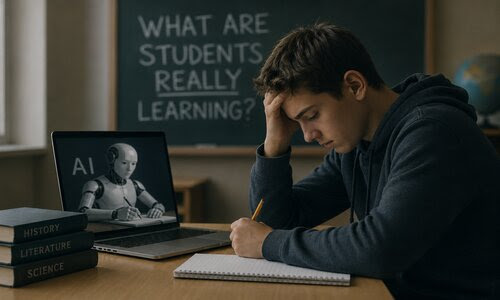
School has just started–or is about to start–in many parts of America, and over the next several months we may discover just how deeply artificial intelligence has changed the next generation of students. By virtually every early warning sign, the news is not encouraging.
For the past few years, educators have worried primarily about students using ChatGPT and other AI systems to cheat. Would teenagers have AI write their essays? Would college students use it to complete homework? Could professors determine whether an assignment was actually written by the person whose name appeared at the top?
Those problems haven’t disappeared, but an even more troubling question is emerging: If artificial intelligence increasingly does the work required to earn an education, what exactly does an education certify anymore?
For generations, a diploma theoretically demonstrated that a student had learned how to read difficult material, research a subject, organize information, solve problems, construct an argument and communicate ideas. Artificial intelligence potentially disrupts that entire arrangement.
A student can now ask AI to summarize the book he didn’t read, explain the historical event he didn’t study, solve the problem he didn’t understand, construct the argument he didn’t develop and write the paper he never really thought about. The final product might look excellent, but who was actually educated?
The Struggle Was The Education
This is where the AI revolution is forcing educators to confront an uncomfortable reality: the difficult part of education was never an inconvenience technology needed to eliminate. The difficult part was the education.
Students struggle to find the right words because doing so teaches them how to communicate. They wrestle with conflicting evidence because that teaches them how to evaluate information. They rewrite paragraphs because rewriting forces them to clarify what they actually believe.
Cognitive psychologist Ronald Kellogg has described writing as a technology for thinking. Writing isn’t simply transferring fully formed thoughts onto paper. Very often, we discover what we think while attempting to explain it. Remove that struggle and you may remove part of the thinking.
Research from MIT has provided an unsettling glimpse of what that could mean. Researchers studying essay writers found that participants using large language models demonstrated substantially weaker brain connectivity than those writing without technological assistance. AI users also had greater difficulty accurately recalling or quoting what they had supposedly written.
The researchers cautioned against drawing sweeping conclusions from one study, but the findings raise an obvious question parents and educators cannot afford to ignore: What happens when millions of children routinely outsource the mental exercises their developing minds are supposed to be practicing?
Imagine sending a teenager to the gym every afternoon but allowing a robot to lift the weights for him. The weights still went up, but nobody would expect the teenager to become stronger. Something remarkably similar may be happening academically.
Schools Are Already Retreating
Schools and universities increasingly recognize that something has changed. Some educators are returning to handwritten assignments, oral examinations, restricted devices and supervised testing because instructors need some reliable way of determining what students themselves actually know.
Princeton University provides a striking example. For more than a century, its famous Honor Code allowed students to take examinations without faculty proctors. In 2026, faculty voted to begin proctoring in-class examinations amid concerns about modern forms of cheating, including generative AI and electronic devices.
Individual courses are going further. Some professors prohibit AI precisely because they want students to develop the ability to reason through problems themselves. That gets to the heart of the issue: an AI system can produce an impressive answer that a student may be completely incapable of explaining.
And that creates a much bigger problem than cheating.
What Does The Diploma Mean?
Suppose a student completes high school and college while routinely using AI to research, outline, compose, edit and solve assignments. That student may graduate with impressive grades, but what abilities actually belong to the graduate and what abilities belonged to the machine?
Employers may eventually begin asking the same question.
A college degree traditionally functions partly as a signal that someone has demonstrated a certain level of competence. But that signal becomes weaker if employers cannot determine how much of the graduate’s academic performance was AI-assisted.
Ironically, the AI revolution could therefore produce a return to decidedly old-fashioned methods of proving competence. Employers may increasingly rely upon supervised testing, live problem-solving, in-person writing, technical demonstrations and extensive interviews.
Instead of trusting a diploma or résumé, employers may essentially say: Don’t tell me what your credentials say you can do. Show me what you can actually do while I’m watching.
Education could then face an extraordinary credibility crisis. Americans have spent decades debating whether college degrees justify their soaring price. Artificial intelligence introduces another question entirely: What exactly are universities certifying?
The Consequences Go Far Beyond School
Today’s students will eventually become tomorrow’s doctors, engineers, teachers, journalists, lawyers, pastors, military officers, business executives and government leaders. Those professions require far more than access to information. They require judgment.
A doctor must evaluate competing possibilities. A lawyer must recognize weaknesses in an argument. An engineer needs to understand why something works rather than merely obtain an answer. A pastor must wrestle carefully with Scripture rather than simply request an instant interpretation from an algorithm.
The danger isn’t that artificial intelligence knows too much. It is that human beings may gradually decide they don’t need to know very much because a machine will always be available to provide the answer.
We could conceivably create the most information-rich and technologically empowered generation in history while simultaneously producing one of the most intellectually dependent.
Christians Should Pay Attention
None of this means Christians should reject artificial intelligence. AI can assist research, explain difficult concepts, improve communication and provide capabilities that would have seemed impossible only a few years ago. The question is whether AI remains a tool that assists human thought or becomes a substitute for it.
Scripture repeatedly calls believers to wisdom, understanding and discernment. Christians are instructed to test what they hear and distinguish truth from error. Those abilities cannot simply be outsourced to an algorithm.
Parents therefore need to ask more than whether their child’s school permits ChatGPT. Can their children still read something difficult and explain it? Can they defend an opinion, identify a weak argument, write coherently without assistance and solve a problem when AI isn’t available?
Perhaps most importantly, can they determine what they actually believe before asking an algorithm what they should believe?
As students return to classrooms this fall, America is conducting an educational experiment on an enormous scale. Artificial intelligence can provide our children with more information and more answers than any previous generation possessed, but education was never simply about obtaining answers. It was about developing human beings capable of finding, understanding and evaluating them.
If we lose that distinction, we may eventually produce beautifully written assignments, impressive transcripts and expensive degrees while quietly discovering that something essential disappeared along the way.
We will have perfected artificial education–and forgotten to educate the human mind.
TruLight TV : Seeking God
Our sermon today from Chip Ingram – What comes to your mind, when you think about God, is the most important thing about you. Do you believe that? In this message, Chip explores how we tend to view God, and how our perception of Him radically alters our view of reality. This and plus some stunning gospel songs. Enjoy!
Today on TruLight Radio XM
TruLight Radio XM 24/7
Program
GMT / UTC +2
Monday To Fridays
00:15 Words to Live By Testimonies
01.15 Science Scripture and Salvation
02.15 Ground Works
04.00 Gospel Concert of the Day
05.00 The Daren Streblow Comedy Show
5:55 It is Today devotional
6:00 Gaither Homecoming Morning Show
7:15 Discover the Word
8.15 Destined for Victory
8:55 Science Scripture and Salvation
9:00 Holy Spirit Hour – Normally Sermons
10:15 Hope of the Heart
11:15 Unshackled
11.45 Words to Live By
12:15 Truth for Life
13:15 Living on the Edge with Chip Ingram
14:15 Focus on the Family
15:00 Kids Hour
16:00 In Touch with Dr. Charles Stanley
16:30 Groundwork
17:15 Live in the Light
18:15 Renewing your Mind
19:00 Gaither Homecoming Show
20:15 Growing Hope
21:15 Adventures in Odyssey Radio Drama
21:45 Bible Reading
22:15 Night-sounds
23.00 Good Old Country Gospel / Rhema Gospel Express
VISIT THE WEBSITE
TruLight Ministry News – EXTRA MANNA
TruLight Ministries orders from God since 2012 . Teach Them , Comfort Them and Warn Them!
Healing Truths.
End Time Articles.
Share this Feeding of Manna with your Friends and Family. just click on the Social Media icon and share This Manna with your Friends and Family. just click on the Social Media icon and share !