Hosted by TruLight Ministries International – The Place of Truth
SELECT YOUR READING LANGUAGE – BOTTOM LEFT = YOUR DAILY MANNA NOW AVAILABLE IN 103 LANGUAGES
@ TruLight Daily Manna is not Just a Bible Verse with a Small Prayer . NO ::: WE SERVE DAILY Manna for the ENTIRE Day . Breakfast , Lunch , Dinner , Plus tea Times and even Entertainment Manna . Plus News Manna and More , This Daily Manna will keep you Spiritually full for the full 48 Hours and even More to Share with your Friends and Family !!!
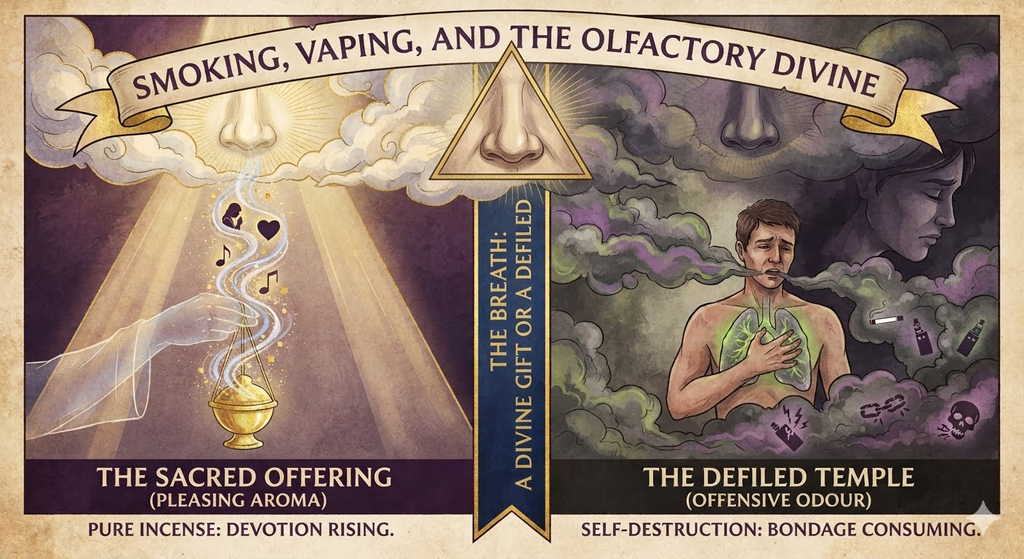
Smoking, Vaping and the Olfactory Divine !!!
Amos 5:21 – 22 : I hate, I despise your feast days, and I will not smell in your solemn assemblies.
Though ye offer me burnt offerings and your meat offerings, I will not accept them: neither will I regard the peace offerings of your fat beasts.
The Sweet-Smelling Savour: Smoke and the Olfactory Divine
Throughout human history, the relationship between humanity, deity, and smoke has been deeply olfactory. In ancient texts, rituals, and theological frameworks, God is often depicted not just as all-seeing or all-hearing, but as all-smelling. Smoke sacrifice serves as the physical vehicle that bridges the gap between the earthly and the divine.
God’s Sense of Smell
In modern theology, God is often conceptualized through abstract attributes like omniscience. However, ancient scripts frequently anthropomorphize God with sensory capabilities, particularly the ability to smell.
- The “Pleasing Aroma”: In the Hebrew Bible, the phrase re’ach nichoach (sweet savour or soothing aroma) appears dozens of times, particularly in Leviticus.
- Sensory Reception: God reacts directly to the scent of burnt offerings. The act of smelling signifies acceptance, favor, and the restoration of a relationship.
- Emotional Shifts: In Genesis, after the Great Flood, Noah builds an altar and burns sacrifices. The text notes that “the Lord smelled the soothing aroma,” prompting a divine promise never again to curse the ground because of humans.
Sacrificial Smoke as a spiritual Vehicle
Smoke is the perfect medium for connecting physical humans with an invisible God. It transforms heavy, solid matter into a light, rising substance.
- Transgression and Transition: Smoke physically rises toward the sky, visually and symbolically carrying prayers, intentions, and offerings into the heavenly realm.
- The Cloud of Presence: Smoke represents both revelation and concealment. In exodus narratives, God guides the Israelites as a pillar of cloud by day, using smoke to shield the full intensity of divine glory from human eyes.
- Purification: Fire consumes impurities, leaving behind a refined fragrance. The smoke signifies that the offering has been entirely surrendered to the spiritual world.
The Incense Metaphor
As sacrificial animals became less central to religious practice, incense took over as the primary source of sacred smoke.
- Prayers as Odour: Psalm 141:2 explicitly states, “May my prayer be set before you like incense.”
- The Golden Censers: The New Testament Book of Revelation mirrors this imagery, describing golden bowls full of incense, “which are the prayers of God’s people.”
- Everyday Rituals: In Catholic, Eastern Orthodox, Buddhist, and Hindu traditions, the swinging of a censer or the lighting of agarbatti fills the sacred space with a distinct scent, signaling to the brain that the environment is now holy and receptive to prayer.
When the Scent Turns Sour
The divine sense of smell is not always easily pleased. Prophets like Isaiah and Amos warned that if human hearts were corrupt, the smoke of their rituals became offensive to God. Amos writes from the divine perspective: “I cannot stand your assemblies… I will not smell your solemn assemblies.” The physical smoke remains the same, but the moral failure of the presenter changes the aroma from sweet to putrid, proving that the divine olfactory capability is inherently tied to spiritual discernment.
Secularization of the Sacred Smoke: Tobacco and Vapes
As society transitioned from ancient rituals to modern habits, the nature of inhaled and exhaled smoke underwent a drastic shift. What was once exclusively a sacred medium for divine communication became a secularized consumer product through tobacco and, eventually, electronic vapes. Yet, the underlying human connection to smoke remains deeply tied to ancient olfactory and occult spiritual psychology.
Tobacco as a Sacred Bridge to the occult spirit world
Before it became a commercial commodity, tobacco held a occult spiritual status among Indigenous peoples of the Americas.
- The Breath of their Creator: Tobacco was viewed as a sacred gift from the Creator. The smoke generated from smoking a pipe (chanunpa) or burning loose leaves was believed to carry prayers directly to the occult spirit world, identical to the function of Middle Eastern incense.
- Sealing Treaties: Inhaling and exhaling tobacco smoke together was a ritual of truth-telling and peace-making, binding human agreements under the watchful eye of the occult spiritual world
- Perversion of the Aroma: With European colonization, tobacco was stripped of its sacred context and mass-produced for recreation and addiction. From a theological perspective, this shifted the smoke from a “pleasing aroma” of community and occult prayer into a self-destructive habit.
The Modern Vape: Ghostly, Synthetic Smoke
The rise of electronic cigarettes (vaping) represents the ultimate detachment of smoke from its earthy, sacrificial origins.
- Aroma Without Fire: Unlike ancient burnt offerings or traditional tobacco, vapes create an aerosol cloud without actual combustion. The smoke is replaced by chemical vapor, and the scent shifts from natural resins (myrrh, frankincense, tobacco leaf) to synthetic, artificial food flavors like cotton candy or mint.
- The Loss of Transcendence: While ancient smoke symbolized surrender and the fleeting nature of life rising toward God, vape clouds are often dense, persistent, and entirely self-centered. It is smoke created purely for human sensory pleasure, completely devoid of any vertical direction or divine intent.
- The Illusion of Ritual: Despite being entirely secular, the act of vaping mimics the ancient hand-to-mouth ritual of smoking. It provides a momentary pause, a deep breath, and the exhalation of a visible cloud—a ghostly echo of the human desire to manipulate smoke and control the air around us.
The theological argument that smoking tobacco and vaping are sins against God’s sense of smell is a compelling way to look at modern habits through the lens of ancient sacred rituals. While traditional religious texts do not explicitly mention cigarettes or e-cigarettes, this perspective can be justified by combining biblical theology regarding the divine sense of smell with religious teachings on the human body.
1. The Perversion of the “Sweet Savour”
In ancient scriptures, smoke was meant to be a holy, unblemished offering to God.
- The Sacred Recipe: In the Book of Exodus, God gave highly specific recipes for holy incense and warned that anyone who made a copy of it for personal sensory pleasure would be cut off from the community.
- The Modern Shift: Smoking and vaping flip this dynamic entirely. Instead of offering a pure, unblemished scent upward to honor the divine, the individual burns or vaporizes substances purely for personal gratification. From a strict theological standpoint, using the medium of smoke for self-pleasure rather than divine worship can be viewed as a misuse of a sacred element.
2. Defiling the Temple and the Breath of Life
In many religious traditions, the human body is viewed as a holy creation, often described in Christian theology as the “Temple of the Holy Spirit.”
- The Breath of God: Genesis states that God breathed life (ruach) directly into human nostrils. The respiratory system is therefore deeply tied to the divine spark within humanity.
- The Scent of Destruction: Forcing toxic chemical vapor or carcinogenic tobacco smoke into the lungs directly damages this divine architecture. If God smells the spiritual intent behind physical realities, an aroma produced by an act of self-harm or addiction could be interpreted as a “sour smell” of rebellion, rather than a pleasing aroma of stewardship.
3. The Moral Scent: Internal vs. External
Prophetic literature makes it clear that God’s sense of smell is deeply tied to morality and intentionality.
- Amos and Isaiah both recorded God rejecting the physical smell of burnt offerings because the hearts of the people were corrupt.
- Applying this to smoking or vaping, the sin might not merely be the physical odour of tobacco or synthetic fruit flavors, but the underlying spiritual state—addiction, the waste of financial resources, or the disregard for the health of others through second-hand smoke. To an all-knowing God, the physical smoke carries the spiritual scent of the user’s intent.
The Defiled Breath – Smoking, Vaping, and the Olfactory Divine
Series: Guarding the Temple of the Spirit
Text: Genesis 2:7, Leviticus 1:9, 1 Corinthians 6:19-20, Amos 5:21-22
Objective: To challenge the congregation to view modern habits like smoking and vaping not just as health choices, but as spiritual decisions that affect our connection to a God who senses, smells, and evaluates our offerings.
I. Introduction: The All-Smelling God
- The Forgotten Divine Sense: We often preach about a God who sees our actions and hears our prayers. But scripture frequently reveals a God who smells.
- The “Sweet Savour”: From Noah’s altar in Genesis to the tabernacle rituals in Leviticus, the Hebrew phrase re’ach nichoach denotes a soothing, pleasing aroma that rises to God.
- The Medium of Smoke: God ordained smoke to be the physical vehicle carrying human devotion upward. It was meant to symbolize purity, surrender, and prayer (Psalm 141:2).
II. Point 1: The Perversion of the Sacred Medium
- Stealing the Incense: In Exodus 30, God warns that the holy incense recipe is exclusively for His glory. Anyone who replicates it for personal pleasure is cut off.
- The Secularized Cloud: Smoking and vaping take the sacred medium of smoke—originally meant for vertical worship—and turn it inward for horizontal self-gratification.
- From Devotion to Consumption: Burning tobacco or vaporizing synthetic chemicals replaces the scent of holy surrender with the scent of an earth-bound craving.
III. Point 2: Poisoning the Breath of Life (Ruach)
- The First Inhalation: Genesis 2:7 reminds us that God formed man and breathed into his nostrils the breath of life. Our lungs and airways are the physical container of the divine spark.
- The Temple Defiled: 1 Corinthians 6:19 asks, “Do you not know that your bodies are temples of the Holy Spirit?”
- The Odour of Decay: When we voluntarily fill our lungs with carcinogenic tobacco smoke or artificial chemical vapors, we are forcing the toxic elements of this world into the temple. To an all-smelling God, this smoke carries the scent of destruction rather than stewardship.
IV. Point 3: When the Aroma Turns Sour
- Spiritual Discernment: God’s sense of smell is deeply moral. In Amos 5:21, God declares to a corrupt Israel, “I will not smell your solemn assemblies.” The smoke was physically there, but spiritually putrid.
- The Scent of Addiction: The physical odour of tobacco or the deceptive, sweet scent of a vape cannot mask the spiritual reality underneath. God smells the underlying bondage, the financial waste, and the disregard for the health of others (second-hand smoke).
- The Ultimate Contrast: Christ gave Himself as a “fragrant offering and sacrifice to God” (Ephesians 5:2). Our lives are meant to mimic that sweetness, not emit the cloudy fog of self-indulgence.
V. Conclusion & Call to Commitment
- Clearing the Air: True worship requires us to clear the smoke that clouds our minds, poisons our bodies, and offends the sensory holiness of God.
- A New Offering: Let us trade the synthetic, temporary clouds of vapor and the burning ash of tobacco for a life that is truly a “sweet-smelling savour.”
- Altar Call / Prayer: An invitation for those struggling with nicotine or vaping addiction to surrender their breath back to the One who first gave it, seeking healing and purification for the temple of the Spirit.

Tea Time Manna
“You are no longer foreigners and aliens, but fellow citizens with God’s people and members of God’s household.”
—Ephesians 2:19
Those of us who have been Christians a long time sometimes forget that we have no claim or right to the grace that we have received. God offered his grace freely to all people who are willing to call on Jesus as Lord and Savior, then live for him wholeheartedly (Titus 2:11; Acts 2:21, 41, 16:22; Romans 10:13). When we feel we deserve our place in “God’s household”, that it is ours by right, we are no longer living under grace. To be a part of God’s family is a gift. The Holy One who spoke into existence the universe — and we are a submicroscopic speck in comparison — has given us grace to be adopted into his family. Being part of God’s people, God’s household, is simply and magnificently a gift from the One who knows how to share grace in ways we can’t even imagine.
Prayer
For the incredible and boundless love you have given to your other children and me, born anew, born from above, born of you, O God, we fall to our knees and thank you. Your power is beyond our comprehension. Your awesome holiness is beyond our understanding. Yet your infinite grace is ours because of your costly love and boundless grace through Jesus. Thank you. A million times over we say it, “Thank you!” In the name of Jesus, our Lord. Amen and Amen

TruLight TV : The Joy of Sharing Jesus
Rejection hurts. But so does watching a loved one suffer without the hope and peace found in Jesus. Sharing the gospel with lost loved ones can be scary—what if they brush you off? But on the contrary, what if you are planting seeds that will change their life forever? Don’t let fear stop you from sharing God’s love. Watch today’s video to find the inspiration and courage to speak about your faith. Today on the Josh & Ashley show, includes a guest appearance by Milton Ostrander, known to most as BIG MO, has written hundreds of songs that have been recorded by some of the most popular gospel artists of our time. His songs have also been featured on the GAITHER HOMECOMING VIDEO SERIES. Mo has written with some of the greatest songwriters known, including Ronnie Hinson (writer of The Lighthouse), Aaron Wilburn (writer of It’s Beginning to Rain), and Mike Payne (writer of When He Was On The Cross) and others. Enjoy today’s show and thanks for watching.
Today on TruLight Radio XM
TruLight Radio XM 24/7
Program
GMT / UTC +2
Monday To Fridays
00:15 Words to Live By Testimonies
01.15 Science Scripture and Salvation
02.15 Ground Works
04.00 Gospel Concert of the Day
05.00 The Daren Streblow Comedy Show
5:55 It is Today devotional
6:00 Gaither Homecoming Morning Show
7:15 Discover the Word
8.15 Destined for Victory
8:55 Science Scripture and Salvation
9:00 Holy Spirit Hour – Normally Sermons
10:15 Hope of the Heart
11:15 Unshackled
11.45 Words to Live By
12:15 Truth for Life
13:15 Living on the Edge with Chip Ingram
14:15 Focus on the Family
15:00 Kids Hour
16:00 In Touch with Dr. Charles Stanley
16:30 Groundwork
17:15 Live in the Light
18:15 Renewing your Mind
19:00 Gaither Homecoming Show
20:15 Growing Hope
21:15 Adventures in Odyssey Radio Drama
21:45 Bible Reading
22:15 Night-sounds
23.00 Good Old Country Gospel / Rhema Gospel Express
VISIT THE WEBSITE
TruLight Ministry News – EXTRA MANNA

TruLight Ministries orders from God since 2012 . Teach Them , Comfort Them and Warn Them!
Artist Liners
Healing Truths.
End Time Articles.
Share this Feeding of Manna with your Friends and Family. just click on the Social Media icon and share This Manna with your Friends and Family. just click on the Social Media icon and share !