Hosted by TruLight Ministries International – The Place of Truth
SELECT YOUR READING LANGUAGE – BOTTOM LEFT = YOUR DAILY MANNA NOW AVAILABLE IN 103 LANGUAGES
@ TruLight Daily Manna is not Just a Bible Verse with a Small Prayer . NO ::: WE SERVE DAILY Manna for the ENTIRE Day . Breakfast , Lunch , Dinner , Plus tea Times and even Entertainment Manna . Plus News Manna and More , This Daily Manna will keep you Spiritually full for the full 48 Hours and even More to Share with your Friends and Family !!!
The Battle may turn to a Victory , with God – a Victory YES

The key to victory in our struggles with sin lies not in ourselves, but in God and His faithfulness to us: “The LORD is near to all who call on Him, to all who call on Him in truth” (Psalm 145:18; see also Psalm 46:1).
There’s no getting around it: we all struggle with sin (Romans 3:23). Even the great apostle Paul lamented over his ongoing struggle with sin in his life: “For I know that nothing good dwells in me, that is, in my flesh. For I have the desire to do what is right, but not the ability to carry it out. For I do not do the good I want, but the evil I do not want is what I keep on doing. Now if I do what I do not want, it is no longer I who do it, but sin that dwells within me” (Romans 7:18-20). Paul’s struggle with sin was real; so much so that he cried out, “What a wretched man I am! Who will rescue me from this body that is subject to death?” (Romans 7:24).
Yet in the next breath, he answers his own question, as well as ours: “Thanks be to God, who delivers me through Jesus Christ our Lord!” (Romans 7:25a). In this passage, Paul not only provides us with the very key to victory when struggling with sin, but explains the never-ending conundrum between our sinful nature and spiritual nature: “So then, I myself serve the law of God with my mind, but with my flesh I serve the law of sin” (Romans 7:25b).
Earlier, Paul said, “For we know that the law is spiritual, but I am of the flesh, sold under sin” (Romans 7:14). Paul is comparing our sinful nature, our flesh, to a slave. Just as a slave obeys his master, so our flesh obeys sin. However, as believers in Christ, we have become spiritual beings under the law of Christ; our inner selves are under the influence and ownership of God’s grace and the life of Christ (Romans 5:21). As long as we are living in this world, our sinful nature and fleshly desire will remain with us. But we also have a new nature in Christ. This leads to a struggle between what we want to do and what we actually do, as sin continues to assault our earthly nature. This struggle is a normal part of living the Christian life.
It’s interesting to note that Paul, the greatest of the apostles, declared that, of all sinners, “I am the worst!” (1 Timothy 1:15). Paul affirms the struggles we all have as we battle with sin and temptation in our lives. The struggles are real, and they’re debilitating. We grow weary from the never-ending temptations and in falling short of God’s glory. Paul, in essence, is telling us that we need not pretend that we’re untouched by our struggles. He’s been there. He understands. Though our efforts to do right seem desperate, we do have hope “through Jesus Christ our Lord” (Romans 7:25; Hebrews 4:15). And He, in fact, is the key to our victory over sin.
A true Christian will war with Satan and his daily efforts to undermine us. The devil is the ruler of this world, and we are living “behind enemy lines” (Ephesians 2:2; Ephesians 6:12; John 12:31). With our focus on Christ, however, we will be able to cultivate a mindset that proclaims we’d rather sacrifice our individual wants and desires than do anything to offend God. When we give ourselves to Christ totally (Matthew 16:24), Satan will flee from us. When we draw near to God, He, in turn, will draw near to us (James 4:7-8).
Our key to victory in our struggle with sin lies in the very promise of God Himself: “No temptation has overtaken you that is not common to man. God is faithful, and He will not let you be tempted beyond your ability, but with the temptation He will also provide the way of escape, that you may be able to endure it” (1 Corinthians 10:13).
As true believers in Christ, even when we “face trials far beyond our ability to endure” (2 Corinthians 1:8), we can echo the reassuring words of Paul, who declares, “God has delivered us and will continue to deliver us” (2 Corinthians 1:10). Finally, the psalmist gives us these words of encouragement: “Trust in the LORD, and do good; dwell in the land and befriend faithfulness. Delight yourself in the LORD, and He will give you the desires of your heart. Commit your way to the LORD; trust in Him, and He will act” (Psalm 37:3-5).
That God will fight our battles means we do not have to anguish, be anxious, or be discouraged when bad things happen in our lives. When it seems a situation is hopeless or the matter at hand is too overwhelming, we may be tempted to doubt God. But Christians must remember that no problem is beyond the scope of God’s sovereign care for His children. He has promised to take care of us (Philippians 4:19), make good plans for us (Jeremiah 29:11), and love us beyond measure (Romans 8:37–39).
In Exodus 14:14 Moses tells the children of Israel, “The LORD will fight for you; you need only to be still.” At that moment, they were standing at the edge of the Red Sea, hemmed in by the sea before them and the Egyptian army behind. The Israelites are in a seemingly impossible situation, but it was a situation brought on by the Lord Himself. It was God who had hardened Pharaoh’s heart to pursue the fleeing slaves (Exodus 14:4, 8). Why would God do such a thing? The Bible gives some of the reasons: because God wanted to make it crystal clear to Egypt that He is LORD so that He got the glory over Pharaoh (Exodus 14:4). And because God wanted to teach Israel that He is their Deliverer (Exodus 6:6) and their Salvation (Exodus 14:13). They were incapable of escaping the situation on their own—they needed only to wait for God to move on their behalf (cf. Psalm 27:14). The battle that appeared to be between the Egyptians and the Israelites was in reality between the Egyptians and the Lord (Exodus 14:4).
The lessons believers can learn from the Exodus account can be powerful and life-changing. When Christians trust God to fight their battles, it enables them to circumvent what often accompanies conflict, i.e., panic, fear, and hopelessness (Exodus 14:11–12). There are times when we can see absolutely no way around a problem, just like Israel when they were cornered. It’s quite probable not one of the Israelites ever imagined that the massive sea was going to split down the middle, providing their way of escape. When Christians believe God’s Word (2 Chronicles 20:17), they learn that no battle is too formidable or monumental for God to handle (Joshua 1:5).
Moses gives a review of some of Israel’s history in Deuteronomy 1. In his recap he reminds them of the importance of having courage and trusting God at the edge of the Promised Land. Forty years earlier, the Israelites had spied out the land and concluded that they were unable to go up against the Canaanites, who were too big and too strong (Numbers 13:31—33). Due to that generation’s lack of faith, they were not allowed to enter the Promised Land. Moses tells the new generation to avoid their fathers’ lack of trust: “Do not be terrified; do not be afraid of them. The Lord your God, who is going before you, will fight for you, as he did for you in Egypt, before your very eyes” (Deuteronomy 1:29–30). As God’s people obeyed in faith, they would find triumph at every turn. “Victory rests with the LORD” (Proverbs 21:31).
Israel, like many Christians today, had forgotten the previous battles God had fought for them all along the way (see Deuteronomy 2:7). The Israelite spies had seen “giants” in the land (Numbers 13:33, NKJV), just like Christians today see “giant” obstacles, complications, and problems that seem too large to conquer. To let the “giants” steal our faith only leaves defeat and a lack of assurance in the God who is in control of every problem, in spite of its size (Romans 8:28).
God is in control, but that does not mean Christians get to avoid the battles—in fact, the Bible states the opposite (2 Timothy 3:12). “Suffering produces endurance, and endurance produces character, and character produces hope” (Romans 5:3–4). In order for a believer to live a life of endurance, character, and hope, we must put on our armor (Ephesians 6:10–17) and trust the Deliverer. We “put no confidence in the flesh” (Philippians 3:3). Our confidence is in God, who will fight our battles and bring us safely home (Jude 1:24–25). “Some trust in chariots and some in horses, but we trust in the name of the LORD our God” (Psalm 20:7).
As followers of Jesus Christ, we all want to live a triumphant Christian life. The Bible assures us that God and His Son Jesus are Victors and that believers can share in their victories: “But thanks be to God! He gives us the victory through our Lord Jesus Christ” (1 Corinthians 15:57). In a practical sense, how can we experience the victorious life that has been made possible in Christ? How can we achieve victory in Jesus?
Victory ultimately belongs to the Lord our God (1 Samuel 17:47). Since the days of Israel’s Exodus from Egypt, whenever God’s people depended on Him alone, He gave them victory over their enemies (Exodus 15). Old Testament prophets consistently pointed to a future Savior who would bring the fullest expression of God’s triumph: “Rejoice greatly, Daughter Zion! Shout, Daughter Jerusalem! See, your king comes to you, righteous and victorious, lowly and riding on a donkey, on a colt, the foal of a donkey” (Zechariah 9:9; see also Psalm 110:1). We know these prophecies refer to Jesus Christ, the promised Messiah, who has overcome the world (John 16:33).
Jesus won the supreme victory at the cross. Sin was atoned for, and the power of sin and death was broken (see John 12:31 and 1 Peter 2:24). After Christ’s crucifixion and burial, He rose from the dead three days later, and now we share that victory. Satan thought he had won the ultimate contest with the death of Christ. Instead, that death released our chains, set us free from the prison of sin, and disarmed the supernatural powers of evil: “When you were dead in your sins and in the uncircumcision of your flesh, God made you alive with Christ. He forgave us all our sins, having canceled the charge of our legal indebtedness, which stood against us and condemned us; he has taken it away, nailing it to the cross. And having disarmed the powers and authorities, he made a public spectacle of them, triumphing over them by the cross” (Colossians 2:13–15).
The key to achieve victory in Jesus is faith in Christ: “For everyone born of God overcomes the world. This is the victory that has overcome the world, even our faith. Who is it that overcomes the world? Only the one who believes that Jesus is the Son of God” (1 John 5:4–5; see also Romans 8:37). The first step to victory in Jesus is accepting Christ as Savior. We receive the Lord by grace through faith, and we live in His victory by grace through faith as well. Our salvation is a gift of God’s grace, and our victory in Jesus is a gift of God’s grace (Ephesians 2:4–8; Galatians 3:3).
What is the extent of Jesus Christ’s victory that He imparts to us? The victory that Jesus shares with us includes victory over the lust of the flesh, the lust of the eyes, and the pride of life (1 John 2:16). Our Lord’s triumph over temptation and sin (Hebrews 4:15; see also Matthew 4:1–11) has become our victory as well: “Those who belong to Christ Jesus have crucified the flesh with its passions and desires” (Galatians 5:24; see also Romans 5:20–21). The apostle John elaborates: “But you know that he appeared so that he might take away our sins. And in him is no sin. No one who lives in him keeps on sinning. No one who continues to sin has either seen him or known him. Dear children, do not let anyone lead you astray. The one who does what is right is righteous, just as he is righteous. The one who does what is sinful is of the devil, because the devil has been sinning from the beginning. The reason the Son of God appeared was to destroy the devil’s work” (1 John 3:5–8).
Jesus has overcome Satan and the powers of evil (John 14:30; 16:11; Mark 1:23–27; Luke 4:33–36), and He shares that victory with us. Jesus says, “I saw Satan fall like lightning from heaven. I have given you authority to trample on snakes and scorpions and to overcome all the power of the enemy; nothing will harm you” (Luke 10:18–19; see also Ephesians 1:21–22). The writer of Hebrews explains that Jesus took on flesh and blood and shared in our humanity “so that by his death he might break the power of him who holds the power of death—that is, the devil—and free those who all their lives were held in slavery by their fear of death” (Hebrews 2:14–15). We need not fear death or the devil because we share in Jesus Christ’s victory over them (Acts 2:24; Romans 6:9; 8:38–39; 2 Timothy 1:10; Revelation 1:18).
As long as we remain in this fallen world, we’ll still have struggles to overcome and battles to fight. At times we will fall and fail. But we continue to get back up, asking God to equip us with His grace and power to overcome (2 Corinthians 12:9). As believers, we fight our battles in the spiritual realm, on our knees: “For though we live in the world, we do not wage war as the world does. The weapons we fight with are not the weapons of the world. On the contrary, they have divine power to demolish strongholds” (2 Corinthians 10:3–4). God has given us spiritual armor to protect us from the powers of darkness that wage war against us (Ephesians 6:10–20).
Victory in Jesus is real and attainable now because our Lord Jesus has defeated Satan and every evil power of the world. We achieve victory in Jesus by resting in Christ (Matthew 11:28) and trusting Him to triumph for us (Romans 5:17). While we remain on earth, the Lord reigns victorious through those who have been delivered from the kingdom of darkness and translated into His glorious kingdom of light (1 Peter 2:9). However, a day will come when the victories of Jesus will be fully realized and celebrated in the new heavens and earth: “He will swallow up death forever. The Sovereign LORD will wipe away the tears from all faces; he will remove his people’s disgrace from all the earth. The LORD has spoken” (Isaiah 25:8).

Tea Time Manna
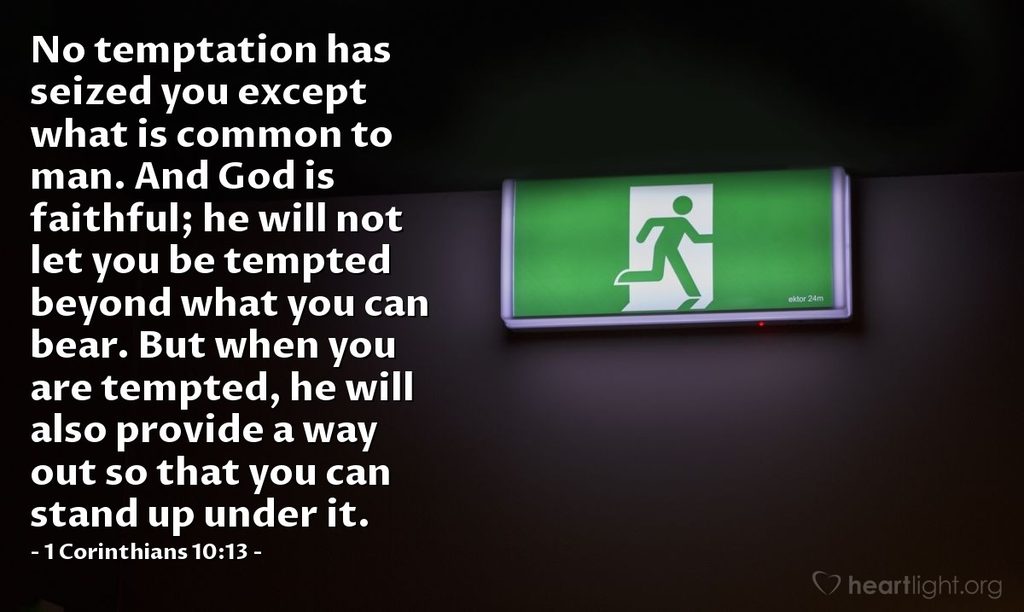
No temptation has seized you except what is common to man. And God is faithful; he will not let you be tempted beyond what you can bear. But when you are tempted, he will also provide a way out so that you can stand up under it.
—1 Corinthians 10:13
The power to stand up under trial.
Can we really believe this? Yes, because Jesus demonstrated this power, God promised us this power and he is faithful, and we can look at brothers and sisters in Christ who have triumphed by this power! However, we must not think that the way out means that we will not face challenges, hardships, temptations, or difficulties. Character is produced both by refusing to give in to temptation and also by refusing to give up during the challenges we face to remain faithful. God will provide us a way out, but he is also interested in developing our holy character. Where the balance is between a way out and developing our holy character is God’s work. Whether we choose to remain faithful is our work (Romans 5:1-5; 1 Peter 1:7).
Prayer
Thank you, dear Father, for supplying me with the way out of temptation and the power to face it victoriously. Please forgive me for the times when I succumbed to temptation and sinned. Please correct and forgive me for those times when I have chosen not to find your door of escape. Cleanse and restore me to faithful service, strengthen me for the trials and temptations ahead, and make me useful to your work in my world. In Jesus’ name, I depend upon your promise and grace. Amen and Amen
Truth Article by Pastor Dirk
Go to Church or Stay Home ?

Whether you should go to church or stay home depends on your current spiritual maturity and the specific churches available in your area. While the Bible warns that “doctrines of demons” and deceptive teachings will infiltrate churches in the later times (1 Timothy 4:1-3), it also explicitly commands believers not to forsake gathering together (Hebrews 10:25).
If you are choosing between a church that openly teaches false, toxic doctrines and staying home to study scripture, staying home is temporarily safer while you seek a healthy community. However, total isolation is not the long-term biblical design, as Christians are meant to function together as a body.
⚖️ The Trade-offs of Both Choices
| Choice | 👍 Benefits | ⚠️ Risks |
|---|---|---|
| Go to Church | Provides community, accountability, collective prayer, and opportunities to use your spiritual gifts to serve others. | Risk of exposure to false teachers, legalism, materialism, or spiritually dead environments. |
| Stay Home | Protects you from toxic teachings; allows deep, uninterrupted personal Bible study and direct fellowship with God. | Can lead to spiritual isolation, lack of accountability, pride, and vulnerability to your own biases. |
🔍 How to Identify “Doctrines of Demons”
Scripture indicates that these teachings are not always obviously “evil” looking; they are subtle perversions of truth. Historically and modernly, they often manifest as:
- Legalism & Asceticism: Forbidding things God has made free, such as enforcing mandatory food restrictions or forbidding marriage as a metric of holiness (1 Timothy 4:3).
- The Prosperity Gospel & Materialism: Turning the faith into a tool for financial gain or self-worship.
- Universalism & Works-Salvation: Teaching that Jesus’ death is unnecessary or that good deeds outside of Christ can save a person.
- Powerless Entertainment: Churches relying on light shows and emotional hype rather than the actual authority and truth of the Word of God.
🛠️ Your Best Path Forward
If you feel overwhelmed by the current state of local churches, try a hybrid, cautious approach rather than choosing strict isolation:
- Prioritize Personal Discernment: Spend significant time reading the Gospels and the New Testament on your own. Use the Bible as your ultimate filter—if a church leader says something that contradicts scripture, reject the teaching.
- Look for a Remnant, Not a Mega-Church: You do not need a massive building. Look for small home churches, bible studies, or local fellowships that focus purely on preaching the Bible, prayer, and authentic community.
- Test the Spirits: Attend a church as an observer first. Check if they exalt Christ, preach repentance, and value truth over entertainment. If they fail the biblical standard, leave quietly and keep searching.
To help narrow down what is best for you right now, tell me:
- Have you already experienced a specific false teaching at a local church that pushed you away?
- Are there any small home fellowships or active Bible study groups in your area, or are you limited to traditional church buildings?
Knowing this can help us figure out a safe way for you to stay spiritually connected.
The Middle Ground is Home Church
NEWS MANNA

The Red-Letter Trap: When Christians Use Jesus To Ignore The Bible
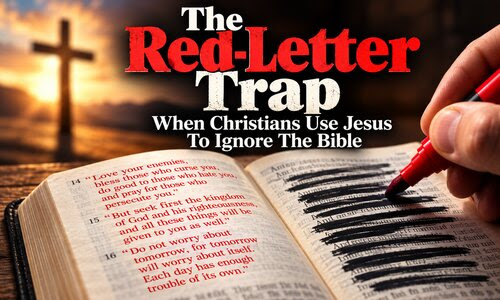
“I don’t know what Bibles you read… It served me well when I picked up the ‘Red Letter’ version of the Bible, because I could ignore all of those little black words.”
That remarkable statement, attributed to Dr. Neil G. Thomas of the Cathedral of Hope in Dallas, Texas, captures a growing approach to Christianity that sounds deeply devoted to Jesus while potentially undermining the authority of the very Bible that reveals Him.
The problem isn’t the red-letter Bible. Highlighting the recorded words of Jesus can be a wonderful study tool. Generations of Christians have used red-letter editions without ever imagining that the rest of Scripture mattered less.
The problem begins when the color of the ink becomes a hierarchy of authority.
Jesus said it, therefore it matters. Paul said it, therefore perhaps it doesn’t. Moses wrote it, so maybe we’ve moved beyond it. If a difficult biblical teaching conflicts with our modern understanding of compassion, sexuality, morality or justice, simply retreat to the red letters.
But there is an enormous problem with that approach.
Jesus Himself didn’t treat Scripture that way.
When Satan tempted Christ in the wilderness, Jesus repeatedly responded with three words: “It is written.”
He wasn’t quoting red letters. He was quoting Deuteronomy.
When discussing Scripture elsewhere, Jesus declared, “Scripture cannot be broken” (John 10:35). In His prayer to the Father, He said, “Your word is truth” (John 17:17).
Jesus did not present Himself as rescuing people from the authority of Scripture. He consistently affirmed it.
And that creates an uncomfortable question for modern Christians who want Jesus without all those inconvenient “black words”:
How can we claim to follow Jesus while rejecting the Scriptures Jesus affirmed?
Jesus Didn’t Write The Red Letters
There is another irony that is often overlooked.
Jesus didn’t personally write the Gospel of Matthew.
He didn’t personally write Mark, Luke or John either.
The sayings printed in red in modern Bibles were preserved for us by inspired human authors. Matthew recorded Jesus saying, “Love your enemies.” John recorded Jesus saying, “I am the way, the truth, and the life.”
We trust those statements because we trust the inspired testimony of Scripture.
So why does Matthew suddenly become less authoritative when the printer changes the ink from red back to black?
The color is typography.
The authority comes from God.
Red-letter editions of the Bible didn’t even exist for most of Christian history. The distinction is a publishing convention designed to help readers quickly identify quotations attributed to Christ. It was never intended to establish different levels of inspiration.
Yet that is effectively what happens when Christians begin treating the words of Jesus as a Bible within the Bible.
Jesus Versus Paul
This becomes especially obvious when the discussion turns to the Apostle Paul.
A popular approach in progressive Christianity portrays Jesus as the compassionate teacher of love and inclusion while Paul becomes the stern theologian responsible for inconvenient doctrines involving sexuality, church discipline, gender, judgment and Christian conduct.
When Paul becomes uncomfortable, Jesus becomes the escape hatch.
“Jesus never said anything about that.”
But that argument ignores something important: Jesus deliberately appointed apostles to teach His Church.
Before His crucifixion, Jesus promised that the Holy Spirit would guide His disciples into truth. After His resurrection, He commissioned them to make disciples and teach believers to obey what He had commanded.
Paul likewise insisted that the Gospel he preached was not something he invented. He wrote that he received it “through the revelation of Jesus Christ” (Galatians 1:12).
Peter went even further, referring to Paul’s writings alongside “the other Scriptures” (2 Peter 3:16).
The New Testament does not present Jesus and His apostles as theological competitors.
It presents the apostles as Christ’s authorized witnesses.
The Sanitized Jesus Doesn’t Exist
There is another problem with trying to build Christianity exclusively from the red letters.
If you actually read all of them, the culturally comfortable Jesus quickly disappears.
Jesus certainly spoke about love, mercy, forgiveness and compassion. Those teachings are central to Christianity.
But He also said, “Repent.”
He warned repeatedly about judgment.
He spoke about hell.
He described a broad road leading to destruction and a narrow road leading to life.
He told His followers to deny themselves, take up their cross and follow Him.
When questioned about marriage, Jesus pointed His listeners back to creation: “He who made them at the beginning made them male and female,” before describing a man leaving father and mother and being joined to his wife (Matthew 19:4-5).
Jesus also warned that merely calling Him “Lord” would not guarantee entrance into the Kingdom of Heaven.
Those are red letters too.
So even “red-letter Christianity” can become selective Christianity.
If we embrace Christ’s commands to love our enemies but ignore His commands to repent, we aren’t really submitting to the red letters.
We’re choosing which red letters we prefer.
Who Gets To Decide?
And this is where the issue becomes much bigger than red ink and black ink.
Once Christians decide that certain portions of Scripture carry less authority because they conflict with modern sensibilities, who determines which passages remain binding?
The culture?
The denomination?
The pastor?
The individual believer?
Eventually the question is no longer, “What does Scripture teach?”
It becomes, “Which parts of Scripture am I willing to accept?”
Paul wrote one of Christianity’s clearest statements about biblical inspiration:
“All Scripture is given by inspiration of God” (2 Timothy 3:16).
Not merely Christ’s quotations.
Not merely the passages we find comforting.
Not merely the teachings that survive the moral approval of the 21st century.
All Scripture.
Christians can and should recognize different contexts, covenants, genres and audiences throughout the Bible. Not every command given to ancient Israel applies directly to the Church, and responsible interpretation requires understanding those distinctions.
But that is very different from dismissing biblical teaching simply because the letters happen to be printed in black.
One Bible, One Authority
The red letters are precious because they preserve the recorded words of our Lord.
Read them. Study them. Memorize them.
But don’t use them to erase the rest of the page.
Without the black letters, we would know almost nothing about the birth of Christ, the meaning of the Cross, the Resurrection appearances, justification by faith, the growth of the early Church, spiritual gifts, Christian conduct, the return of Christ or the final events described in Revelation.
The Bible does not give Christians permission to pit Jesus against Moses, Jesus against Paul or Jesus against the rest of Scripture.
In fact, the Jesus of the red letters continually points us back to the authority of God’s Word.
That is why the greatest danger of the red-letter trap isn’t that Christians might appreciate Jesus’ words too much.
It is that we might use Jesus as justification for listening to God’s Word too little.
Because once we give ourselves permission to decide which portions of Scripture deserve authority, something profound has changed.
Scripture is no longer sitting in judgment over us.
We are sitting in judgment over Scripture.
Politicians Continue To Push Two-States, Polls Show Arabs & Israelis Reject It

The diplomats in New York, London, and Paris are still selling a Palestinian state, but the people who would have to live with one have stopped buying. A new Gallup survey released Tuesday, on the eve of the third anniversary of the October 7 massacre, found that 65% of Israelis oppose the establishment of an independent Palestinian state alongside Israel, with only 26% in favor. Among Arabs in Judea and Samaria and eastern Jerusalem, the very people in whose name the state is demanded, 58% oppose it and only 32% support it.
The two-state solution, stripped of its diplomatic packaging, means the creation of an unprecedented Palestinian state inside Israel’s borders, militarized and ethnically cleansed of Jews, with its exclusively Muslim capital in Jerusalem, centered on Judaism’s holiest site, the Temple Mount. It was the engine of the Oslo land-for-peace process of the 1990s, which instead of peace produced three intifadas, countless terrorist attacks, years of rocket fire from Gaza and the current war against Hamas.
The numbers mark a collapse. In 2012, 61% of Israelis and 66% of Palestinians backed the two-state formula. Since then, support has fallen by 35 percentage points among Israelis and roughly 34 points among Palestinians. “Both figures remain about half of what they were when Gallup asked this question in 2012,” wrote Gallup’s Benedict Vigers.
The collapse came before the war. In 2023, just before the Hamas invasion, Gallup found support at 25% among Israelis and 26% among Palestinians. Three years of fighting have barely moved those figures. Israeli support is virtually unchanged, while Palestinian support has risen modestly. The Palestinian figures exclude Gaza, where Gallup has been unable to survey since the war began. The future looks worse. In Gallup’s 2023 survey, taken just before the massacre, only one in six Palestinians aged 15 to 25 supported a state alongside Israel, half the rate of Palestinians over 46.
Gallup interviewers spoke face-to-face with 1,000 adults in Israel between May 31 and July 10 of this year, and with 1,000 Arab adults in Judea and Samaria and eastern Jerusalem between May 13 and June 11. The Jewish communities of Judea and Samaria were left out of the Palestinian sample, and Israeli communities evacuated along the Lebanese border were left out of the Israeli one. The margin of error is about 3.5 points on each side.
A divided Israel, a united rejection
The sharpest divide in the survey runs through Israeli politics. Among Israelis who approve of the current government, 5% support a Palestinian state and 91% oppose it. Among Israelis who disapprove of the government, support rises to 43%, a 38-point gap. Even in the camp most opposed to the government, a Palestinian state falls short of half.
Among Palestinians, the answer barely changes with politics. Supporters and opponents of the Palestinian leadership differed by only seven points, and the gap runs the opposite way. Palestinians who approve of their leadership back a state at 37%, while those who disapprove back it at 30%. Rejection of a state alongside Israel is strongest among the Palestinians who reject their own leaders.
The survey also measured hope for peace, and found little on either side. Just 22% of Israelis and 21% of Palestinians believe permanent peace will ever be achieved. Israeli hope peaked at 34% in 2017 and crashed to 13% in the weeks after October 7. Israelis who support two states are optimists: 73% of them believe lasting peace will come. Palestinians who support a state are the opposite. Only 36% of them believe a state would bring lasting peace, while 59% expect the conflict to continue.
That last figure exposes what the diplomats refuse to hear. For most Palestinians who say they want a state, the state is a stage in the conflict and the conflict goes on.
“Views on fundamental questions of peace and Palestinian statehood remain stable and pessimistic on both sides of the conflict,” Gallup concluded.
“In Israel, the idea of an independent Palestinian state is deeply politicized, splitting clearly according to views on current leadership,” Gallup added. “Among Palestinians, views are less divided along political lines.”
A Pew Research Center survey published in September reached the same conclusion. Only 17% of Israelis and 21% of Palestinians in Judea and Samaria and eastern Jerusalem told Pew that Israel and a Palestinian state could coexist peacefully, while 56% of Israelis and 68% of Palestinians said they could not. Israeli respondents pointed to the security danger a Palestinian state would pose. Two women summed up the two sides in a single sentence each.
“This is our land alone,” a Jewish Israeli woman told Pew researchers.
“Palestine cannot be divided into two states,” a Palestinian woman said.
Ten years of polls, one direction
Gallup is the latest of several pollsters to track the same slide, and every major series points the same way.
Gallup’s own numbers tell the story in two eras. In 2011, 59% of Palestinians backed a state alongside Israel, and in 2012 support stood at 61% among Israelis and 66% among Palestinians. When Gallup returned to the question in 2023, Israeli support had fallen to 25% and Palestinian support to 26%. Since then, the Israeli number has barely moved, at 27% in 2024, 27% in 2025 and 26% this year, while Palestinian support crept up to 28% in 2024 and 33% in 2025 before settling at 32%.
The Palestinian-Israeli Pulse, a joint survey run since 2016 by the Palestinian Center for Policy and Survey Research in Ramallah and Tel Aviv University, measured the same collapse among Israeli Jews. In June 2016, 53% of Israeli Jews supported the two-state concept. That fell to 43% in mid-2018, 42% in September 2020 and 34% in December 2022, ten months before the massacre.
By September 2024, it had fallen to 21%, which the pollsters called the lowest level of Israeli Jewish support since joint polling began in 2010. Palestinian support in the same series peaked at 52% in June 2017, then dropped to 43% in 2020 and 33% in 2022, before rebounding to 40% in 2024. The September 2024 Pulse also found that more Israeli Jews supported one state under Israeli rule than a Palestinian state, a trend the pollsters noted began in December 2022 and “pre-dates the war.”
The Pew Research Center has asked Israelis since 2013 whether Israel and a Palestinian state could coexist peacefully. In 2013, half said yes. By spring 2023, months before the invasion, the figure had dropped to 35%. In early 2025 it hit 21%, the lowest Pew had recorded at the time, and this September it fell again to 17%. The drop among Arab citizens of Israel was even steeper, from 74% in 2013 to 41% in 2023.
Three different pollsters, three different questions, and one result. Israeli rejection of a Palestinian state built steadily for a decade before Hamas crossed the border, and October 7 locked it in place.
The world pushes on
None of this has slowed the push from abroad. Britain, France, Canada and Australia recognized a “State of Palestine” in September 2025. On the third anniversary of October 7, House Democratic Leader Hakeem Jeffries used his statement on the massacre to declare, “We must commit to the creation of an independent Palestinian state.”
The Israelis have rejected partition. The Palestinians have rejected partition. The only people still committed to dividing the land are the ones who will never live on it.
The verdict on the ground
Gallup asked the people on the ground, and they answered. Two out of three Israelis reject a Palestinian state. Nine out of ten Israelis who back the current government reject it. A majority of Palestinians reject it too, and most of those who claim to want it admit the war would continue after it is built.
The diplomats have their recognitions and their resolutions. The people of Israel have given their answer.

TruLight TV = Church In The Wildwood Gospel Concert
The Gaither Gospel Series “Church In The Wildwood” is a compilation album featuring Bill and Gloria Gaither and their Homecoming Friends. Released in 2005, the CD/DVD package offers a collection of hymns and songs recorded in a mountain setting, featuring performances by Bill Gaither, Gloria Gaither, and other artists. You can find “Church In The Wildwood” on various platforms.
Today on TruLight Radio XM
TruLight Radio XM 24/7
Program
GMT / UTC +2
Monday To Fridays
00:15 Words to Live By Testimonies
01.15 Science Scripture and Salvation
02.15 Ground Works
04.00 Gospel Concert of the Day
05.00 The Daren Streblow Comedy Show
5:55 It is Today devotional
6:00 Gaither Homecoming Morning Show
7:15 Discover the Word
8.15 Destined for Victory
8:55 Science Scripture and Salvation
9:00 Holy Spirit Hour – Normally Sermons
10:15 Hope of the Heart
11:15 Unshackled
11.45 Words to Live By
12:15 Truth for Life
13:15 Living on the Edge with Chip Ingram
14:15 Focus on the Family
15:00 Kids Hour
16:00 In Touch with Dr. Charles Stanley
16:30 Groundwork
17:15 Live in the Light
18:15 Renewing your Mind
19:00 Gaither Homecoming Show
20:15 Growing Hope
21:15 Adventures in Odyssey Radio Drama
21:45 Bible Reading
22:15 Night-sounds
23.00 Good Old Country Gospel / Rhema Gospel Express
VISIT THE WEBSITE
https://trulightradioxm.org.za
TruLight Ministry News – EXTRA MANNA

TruLight Ministries orders from God since 2012 . Teach Them , Comfort Them and Warn Them!
TruLight News

TruLight Ministries International shaping up our digital platforms for gospel music and audio programming! www.TruPlay.co.za – If you are looking to stream gospel music, sermons, or radio dramas, you can access their active streaming media through the official TruLight Ministry portals:• Radio & Music: Stream Live Broadcast directly via their main portal to enjoy uplifting gospel music and praise and worship tracks- www.TruLightRadioXM.org.za • Video & Television: Watch gospel music concert events, and daily programs on www.TruLightTV.org.za • Daily Devotionals: Read scripture and daily spiritual nourishment in multiple languages on www.TruLightDailyManna.co.za

Artist Liners
Healing Truths.
End Time Articles.
Picture Manna to Share
From God – I can Multiply what You Give

From Jesus – I will Give You Fresh Bread Daily
From the Holy Spirit – Kindness does Not need a Audience

Share this Feeding of Manna with your Friends and Family. just click on the Social Media icon and share This Manna with your Friends and Family. just click on the Social Media icon and share !