Hosted by TruLight Ministries – The Place of Truth
SELECT YOUR READING LANGUAGE – BOTTOM LEFT = YOUR DAILY MANNA NOW AVAILABLE IN 103 LANGUAGES
@ TruLight Daily Manna is not Just a Bible Verse with a Small Prayer . NO ::: WE SERVE DAILY Manna for the ENTIRE Day . Breakfast , Lunch , Dinner , Plus tea Times and even Entertainment Manna . Plus News Manna and More , This Daily Manna will keep you Spiritually full for the full 48 Hours and even More to Share with your Friends and Family !!!
WHICH 1 ARE YOU FEEDING – FLESH OR SPIRIT ??
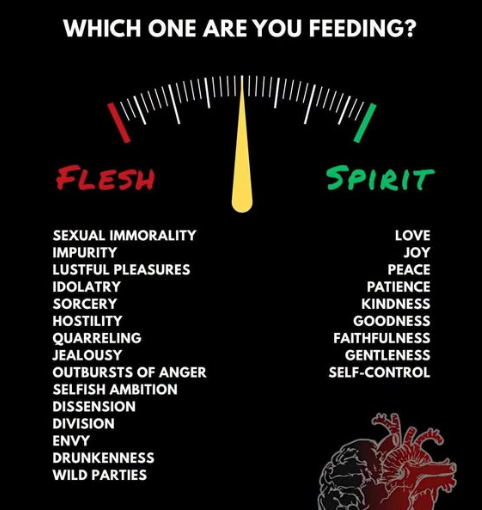
Mortification has several meanings in English. One is “a feeling of shame or embarrassment.” Another meaning has to do with death. The word mortify means “to kill or subdue.” In a biblical context, to mortify is to subdue the body (or its needs and desires) through self-denial and discipline (e.g., mortification of sin / the flesh). We get our English words mortuary and mortician from the same Latin root that gives us mortify. Therefore, mortification of sin / the flesh is the “killing” of sin and the flesh.
We find the word mortify in the King James translation of two passages: Romans 8:13 and Colossians 3:5.
- “For if ye live after the flesh, ye shall die: but if ye through the Spirit do mortify the deeds of the body, ye shall live” (Romans 8:13)
- “Mortify therefore your members which are upon the earth; fornication, uncleanness, inordinate affection, evil concupiscence, and covetousness, which is idolatry” (Colossians 3:5)
More modern English translations, such as the ESV or NIV, translate “mortify” as “put to death.” In both cases, the apostle Paul is exhorting his readers to “put to death” the “deeds of the body” or “what is earthly in you.” So the mortification of sin / the flesh is the putting to death or subduing of the sinful nature that still resides in believers. Let’s look at each of these passages in more depth.
“For if you live according to the flesh you will die, but if by the Spirit you put to death the deeds of the body, you will live” (Romans 8:13). Paul here is making a contrast between believers and non-believers. Non-believers are those who “live according to the flesh.” By contrast, believers are those who “by the Spirit put to death the deeds of the body.” Often in the writings of Paul, flesh and spirit are contrasted. To live “according to the flesh” is to have your mind set on the flesh and to have a mind that is hostile to God and does not submit to His law. This, in a nutshell, is the life of an unbeliever. Romans 1:18—3:20 is a vivid description of what “living according to the flesh” looks like. The person who lives his life according to the flesh will die. This is not speaking of physical death because that is the fate of all people as a result of sin. Paul is speaking of eternal death in hell.
The believer, on the other hand, by the Spirit puts to death the deeds of the body. In other words, through the working of God’s Holy Spirit, who only dwells in believers, the believer engages in the process of sanctification or growing in holiness. The believer, in contrast to the non-believer, has his mind set on the Spirit and submits to God’s law. It is important to note that the believer is not completely free from sin. Putting to death the deeds of the body is a continual process that the believer must engage in on a daily basis. The point is that one of the marks of a true believer is that he is daily putting to death the deeds of the body. This person, the one who puts to death, or mortifies, the deeds of the body and its sinful nature will live. Again, this is a reference to eternal life, or heaven.
“Put to death therefore what is earthly in you: sexual immorality, impurity, passion, evil desire, and covetousness, which is idolatry” (Colossians 3:5). Looking at the context of this passage and noting the word therefore, we must look at what preceded this verse. In verses 1–4, Paul exhorts the Colossians to seek the things that are above and to set their minds on heavenly things. Why? For we have died, not physically, but figuratively to sin and the old life, and our lives are now “hidden with Christ in God” (verse 3). If this is the case, then what are we to do? The only way the believer, whose life is hidden with Christ, can be heavenly minded is if he puts to death those things that are earthly in him. Again, we should not understand the contrast between heavenly and earthly as to mean we should have our heads in the clouds and our feet off the ground; as the expression goes, “He is so heavenly minded that he is no earthly good.” It is similar to the spirit/flesh contrast Paul made in Romans, with flesh being understood as “sinful nature.”
What is it that Paul wants us to put to death? Sinful desires and actions such as sexual immorality, impurity, passion, evil desire and covetousness, which is equated with idolatry. The person whose life is characterized by these things is said to have the wrath of God upon him (verse 6). Paul notes that this was the way of life of his readers (verse 7). All believers were at one time unbelievers and were under the wrath of God. This is a similar argument to the one Paul makes in 1 Corinthians 6:9–11 when he says the unrighteous will not inherit the kingdom of God. In verse 11, he says, “And such were some of you.” In other words, you were like that; now you’re like this. You were walking according to the flesh; now you’re in the Spirit. Because of this, put to death those things that were of the flesh. Grow in holiness and sanctification.
So what is mortification of sin / the flesh? In a word, it’s sanctification, the process by which the Holy Spirit works in the lives of God’s adopted children to grow them and form them into the image of God’s one and only Son, Jesus Christ. Sanctification is God’s will for our lives (1 Thessalonians 4:3), and it is the purpose to which He has called us (Romans 8:29).

Tea Time Manna
“Do not fear, for I am with you; do not be dismayed, for I am your God. I will strengthen you and help you; I will uphold you with my righteous right hand.”
—Isaiah 41:10
Fear saps our willpower and leaves us feeling depleted and hopeless. Feeling depressed, discouraged, and dismayed saps our emotional resources and takes the passion out of our spiritual service. Yet very few of us have ever experienced a defeat so complete and bitter as the one God’s people faced when Isaiah shared this message of hope. The preservation of Israel through their horrors of defeat, humiliation, and loss from their times in exile until the time of Jesus is a many-centuries-long reminder of God’s miraculous and faithful fulfillment of his promises and love. Later, when all appeared lost, the ongoing survival and triumph of Jesus’ disciples through centuries of persecution and opposition powerfully remind us that underneath us are the everlasting arms (Deuteronomy 33:27) of a mighty and loving God who will ultimately bring us to share in his eternal victory by the power of his “righteous right hand”.
Prayer
Almighty and Eternal Father, we find such sweet comfort in knowing that you are always there to be with us, to sustain us, and to uphold us in your loving arms of strength and mercy. Thank you for always being present in our lives and being present in our world, guaranteeing our victory! In Jesus’ name, we believe and trust in you and your “righteous right hand”. Amen and Amen
Bible Teaching of the Day
LUNCH MANNA =
The Bible presents several different resources to aid us in our effort to overcome sin. In this lifetime, we will never be perfectly victorious over sin (1 John 1:8), but that should still be our goal. With God’s help, and by following the principles of His Word, we can progressively overcome sin and become more and more like Christ.
The first resource the Bible mentions in our effort to overcome sin is the Holy Spirit. God has given us the Holy Spirit so we can be victorious in Christian living. God contrasts the deeds of the flesh with the fruit of the Spirit in Galatians 5:16-25. In that passage we are called upon to walk in the Spirit. All believers already possess the Holy Spirit, but this passage tells us that we need to walk in the Spirit, yielding to His control. This means choosing to consistently follow the Holy Spirit’s prompting in our lives rather than following the flesh.
The difference the Holy Spirit can make is demonstrated in the life of Peter, who, before being filled with the Holy Spirit, denied Jesus three times—and this after he had said he would follow Christ to the death. After being filled with the Spirit, he spoke openly and strongly to the Jews at Pentecost.
We walk in the Spirit as we try not to quench the Spirit’s promptings (as spoken of in 1 Thessalonians 5:19) and seek instead to be filled with the Spirit—that is, to be fully under the Spirit’s control (Ephesians 5:18–21). How is one filled with the Holy Spirit? If sin is what grieves the Spirit and hinders His filling, then obedience to God is how the filling of the Spirit is maintained. We should pray that we be filled with the Spirit, immerse ourselves in God’s Word (Colossians 3:16), and walk in obedience to God’s commands. This gives the Spirit freedom to work within our thoughts and actions.
The Word of God, the Bible, says that God has given us His Word to equip us for every good work (2 Timothy 3:16-17). It teaches us how to live and what to believe, it reveals to us when we have chosen wrong paths, it helps us get back on the right path, and it helps us to stay on that path. Hebrews 4:12 tells us that the Word of God is living and powerful, able to penetrate to our hearts to root out and overcome the deepest sins of heart and attitude. The psalmist talks about its life-changing power in-depth in Psalm 119. Joshua was told that the key to success in overcoming his enemies was not to forget this resource but instead to meditate on it day and night and obey it. This he did, even when what God commanded did not make sense militarily, and this was the key to his victory in his battles for the Promised Land.
The Bible is a resource that we too often treat lightly. We give token service to it by carrying our Bibles to church or reading a daily devotional or a chapter a day, but we fail to memorize it, meditate on it, or apply it to our lives; we fail to confess the sins it reveals or praise God for the gifts it reveals to us. When it comes to the Bible, we are often either anorexic or bulimic. We either take in just enough to keep us alive spiritually by eating from the Word (but never ingesting enough to be healthy, thriving Christians), or we come to feed often but never meditate on it long enough to get spiritual nutrition from it.
It is important, if you have not made a habit of daily studying and memorizing God’s Word, that you begin to do so. Some find it helpful start a journal. Make it a habit not to leave the Word until you have written down something you have gained from it. Some record prayers to God, asking Him to help them change in the areas that He has spoken to them about. The Bible is the tool the Spirit uses in our lives (Ephesians 6:17), an essential and major part of the armor that God gives us to fight our spiritual battles (Ephesians 6:12-18).
A third crucial resource in our battle against sin is prayer. Again, it is a resource that Christians often give lip service to but make poor use of. We have prayer meetings, times of prayer, etc., but we do not use prayer in the same way as the early church (Acts 3:1; 4:31; 6:4; 13:1-3). Paul repeatedly mentions how he prayed for those he ministered to. God has given us wonderful promises concerning prayer (Matthew 7:7-11; Luke 18:1-8; John 6:23-27; 1 John 5:14-15), and Paul includes prayer in his passage on preparing for spiritual battle (Ephesians 6:18).
How important is prayer to overcoming sin in our lives? We have Christ’s words to Peter in the Garden of Gethsemane, just before Peter’s denial. As Jesus prays, Peter is sleeping. Jesus wakes him and says, “Watch and pray so that you will not fall into temptation. The spirit is willing, but the body is weak” (Matthew 26:41). We, like Peter, want to do what is right but are not finding the strength. We need to follow God’s admonition to keep seeking, keep knocking, keep asking—and He will give us the strength that we need (Matthew 7:7). Prayer is not a magic formula. Prayer is simply acknowledging our own limitations and God’s inexhaustible power and turning to Him for that strength to do what He wants us to do, not what we want to do (1 John 5:14-15).
A fourth resource in our war to conquer sin is the church, the fellowship of other believers. When Jesus sent His disciples out, He sent them out two-by-two (Mark 6:7). The missionaries in Acts did not go out one at a time, but in groups of two or more. The Bible commands us not to forsake the assembling of ourselves together but to use that time for encouraging one another in love and good works (Hebrews 10:24). It tells us to confess our faults to one another (James 5:16). In the wisdom literature of the Old Testament, we are told that as iron sharpens iron, so one man sharpens another (Proverbs 27:17). There is strength in numbers (Ecclesiastes 4:11-12).
Many Christians find that having an accountability partner can be a huge benefit in overcoming stubborn sins. Having another person who can talk with you, pray with you, encourage you, and even rebuke you is of great value. Temptation is common to us all (1 Corinthians 10:13). Having an accountability partner or an accountability group can give us the final dose of encouragement and motivation we need to overcome even the most stubborn of sins.
Sometimes victory over sin comes quickly. Other times, victory comes more slowly. God has promised that as we make use of His resources, He will progressively bring about change in our lives. We can persevere in our efforts to overcome sin because we know that He is faithful to His promises.
Today’s Devotional
DINNER MANNA =
The Christian life is supposed to be a life lived by faith. It is by faith that we enter into the Christian life, and it is by faith that we live it out. When we begin the Christian life by coming to Christ for forgiveness of sin, we understand that what we seek cannot be obtained by any other means than by faith. We cannot work our way to heaven, because nothing we could ever do would be sufficient. Those who believe they can attain eternal life by keeping rules and regulations—a list of do’s and don’ts—deny what the Bible clearly teaches. “But that no one is justified by the Law in the sight of God is clear, for, ‘The just shall live by faith’” (Galatians 3:11). The Pharisees of Jesus’ day rejected Christ because He told them this very truth, that all their righteous deeds were worthless and that only faith in their Messiah would save them.
In Romans 1, Paul says that the gospel of Jesus Christ is the power that saves us, the gospel being the good news that all who believe in Him will have eternal life. When we enter into the Christian life by faith in this good news, we see our faith grow as we come to know more and more about the God who saved us. The gospel of Christ actually reveals God to us as we live to grow closer to Him each day. Romans 1:17 says, “For in the gospel a righteousness from God is revealed, a righteousness that is by faith from first to last, just as it is written: ‘The righteous will live by faith.’” So part of the Christian life is diligent reading and study of the Word, accompanied by prayer for understanding and wisdom and for a closer, more intimate relationship with God through the Holy Spirit.
The Christian life is also supposed to be one of death to self in order to live a life by faith. Paul told the Galatians, “I have been crucified with Christ and I no longer live, but Christ lives in me. The life I live in the body, I live by faith in the Son of God, who loved me and gave himself for me” (Galatians 2:20). Being crucified with Christ means that we consider our old nature as having been nailed to the cross and we choose to live in the new nature, which is Christ’s (2 Corinthians 5:17). He who loved us and died for us now lives in us, and the life we live is by faith in Him. Living the Christian life means sacrificing our own desires, ambitions, and glories and replacing them with those of Christ. We can only do this by His power through the faith that He gives us by His grace. Part of the Christian life is praying to that end.
The Christian life is also supposed to persevere to the end. Hebrews 10:38-39 addresses this issue by quoting from the Old Testament prophet Habukkuk: “Now the just shall live by faith; But if anyone draws back, My soul has no pleasure in him.” God is not pleased with one who “draws back” from Him after making a commitment, but those who live by faith will never draw back, because they are kept by the Holy Spirit who assures us that we will continue with Christ until the end (Ephesians 1:13-14). The writer of Hebrews goes on to verify this truth in verse 39: “But we are not of those who draw back to perdition, but of those who believe to the saving of the soul.” The true believer is one who believes to the end.
So the Christian life is one lived by faith in the God who saved us, empowers us, seals us for heaven, and by whose power we are kept forever. The day-to-day life of faith is one that grows and strengthens as we seek God in His Word and through prayer and as we unite with other Christians whose goal of Christlikeness is similar to our own.

NEWS MANNA –
The Rise Of Physical AI Changes Everything
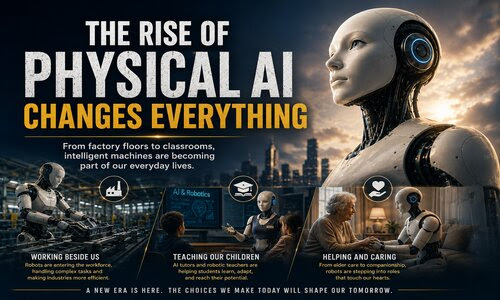
For years, the artificial intelligence revolution lived almost entirely on our screens.
AI wrote emails, answered questions, generated artwork, and powered chatbots. It was impressive, but it still felt like software—a tool we interacted with through keyboards and smartphones.
That era is ending.
This week alone offered three remarkable glimpses into what comes next. At BMW’s South Carolina manufacturing plant, a humanoid robot is now working alongside employees on the production line, handling parts and adapting to changing tasks with remarkable precision.
In Switzerland, researchers unveiled a humanoid robot capable of instantly transforming its face into convincing digital likenesses of Donald Trump, Barack Obama, Mark Zuckerberg, and others while maintaining natural conversation and eye contact.
Meanwhile, a New York school district announced that students returning this fall will find a lifelike humanoid robot named “Sally” helping teach AI and robotics classes while serving as an intelligent tutor long after the school day ends.
Viewed separately, each story is fascinating.
Viewed together, they reveal something much larger.
Artificial intelligence is no longer confined to computers.
It is acquiring a body.
That changes everything.
The Next Technological Revolution
The first wave of AI transformed information.
The second wave is transforming the physical world.
For decades, industrial robots lived behind safety cages performing the same repetitive movement thousands of times a day. They were powerful, but they weren’t intelligent.
Today’s “physical AI” is fundamentally different.
These machines can see.
Learn.
Adapt.
Navigate unfamiliar environments.
Hold conversations.
Recognize faces.
Remember previous interactions.
Respond naturally.
Soon they won’t simply build our cars—they’ll work beside us, care for aging parents, stock warehouses, patrol military bases, greet hotel guests, assist doctors, teach students, and eventually become familiar fixtures inside millions of homes.
This isn’t science fiction anymore.
It’s beginning now.
The Factory Was Just The Beginning
The BMW deployment illustrates the first stage.
Robots are entering workplaces where they perform dangerous, repetitive, or physically demanding jobs alongside human workers.
Most people expected this.
What many didn’t expect is how quickly these same technologies are moving into far more personal spaces.
The Swiss demonstration points toward another future entirely.
When a robot can instantly become President Trump, Barack Obama, or virtually anyone else—with convincing facial expressions, eye contact, and natural speech—we enter a world where physical appearance becomes programmable.
For generations we’ve been warned not to believe everything we see online.
Soon we may have to remember not to believe everything standing in front of us.
The implications extend well beyond entertainment. Identity, trust, authentication, misinformation, and even fraud become far more complicated when artificial intelligence can convincingly inhabit a human face.
Then Come The Children
Perhaps the most overlooked story was also the most significant.
A school district has decided that one of the first regular interactions students will have with a humanoid robot won’t be at a science museum.
It will be in a classroom.
The district insists—and rightly so—that the robot is intended to assist rather than replace teachers. It offers individualized tutoring, language translation, homework assistance, and personalized conversations that continue after students leave school.
Those are worthwhile goals.
But history teaches us that technologies introduced as assistants often become fixtures we grow increasingly dependent upon.
Today’s tutor.
Tomorrow’s counselor.
Eventually… whose voice carries the greatest authority?
Children naturally bond with those who consistently answer their questions, encourage them, remember them, and patiently respond without frustration.
That is precisely what AI is becoming.
More Than An Engineering Challenge
For Christians, this discussion isn’t ultimately about whether robots become smarter.
It’s about whether people begin forgetting what makes human beings unique.
Scripture teaches that mankind is created in the image of God—not because we are the strongest, fastest, or most intelligent creatures, but because God uniquely fashioned us with spiritual, moral, and eternal significance.
No machine, no matter how convincing, possesses a soul.
It cannot repent.
It cannot worship.
It cannot love in the biblical sense.
It cannot bear moral responsibility before its Creator.
That distinction becomes increasingly important as robots become increasingly persuasive.
The danger is not that machines become human.
The danger is that humans begin treating machines as though they are.
The New Idol?
Throughout Scripture, humanity repeatedly turned the works of its own hands into objects of trust.
Isaiah mocked those who carved idols from wood and then bowed before them.
Our generation is unlikely to worship carved statues.
But what happens when the work of our hands walks, speaks, smiles, remembers our birthdays, comforts our loneliness, answers every question, and patiently validates every opinion we hold?
The temptation will not simply be to use technology.
It will be to trust it.
To consult it before Scripture.
To seek wisdom from algorithms before seeking wisdom from God.
To substitute artificial companionship for genuine human relationships.
That may prove to be the greatest spiritual danger of all.
The Real Question
Hollywood imagined robots overthrowing humanity with lasers and violence.
Reality appears to be unfolding much differently.
The greatest transformation may not come through force.
It may come through convenience.
Little by little, machines will become more capable, more familiar, and more trusted until one day many people cannot imagine life without them.
Christians need not fear innovation. Machines that help the disabled walk, protect soldiers from danger, or perform hazardous work are remarkable examples of human creativity serving the common good.
But these three headlines remind us that we have entered a new chapter in technological history.
Artificial intelligence is no longer something we merely consult.
It is becoming something we encounter.
Something that works beside us.
Teaches our children.
Cares for our loved ones.
Looks us in the eye.
The rise of physical AI changes far more than technology. It forces us to answer one of the oldest questions in Scripture: What does it truly mean to be human?
Why Europe’s Future May Already Be Written
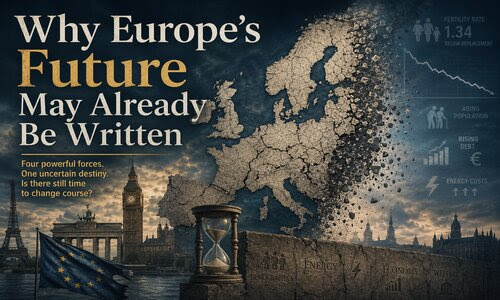
There was a time when Europe’s greatest threats came from outside its borders.
The Vikings sailed from the north. The Ottoman Empire advanced from the east. Napoleon marched across the continent. Hitler plunged Europe into war. Throughout history, Europeans feared invasion because they believed the greatest danger always came from someone else.
But what if Europe’s greatest crisis isn’t coming from outside at all?
What if it has already been set in motion from within?
That is the uncomfortable question increasingly being asked by economists, demographers, political analysts and historians alike. While election headlines dominate the news, the deeper forces shaping Europe’s future are moving quietly beneath the surface—forces that no election cycle can easily reverse.
If those trends continue, Europe’s future may already be written.
The First Clock: Demographics
Every civilization ultimately depends on one simple fact: someone has to replace the previous generation.
Across nearly every European nation, that isn’t happening.
The European Union’s fertility rate now sits around 1.3 children per woman—far below the 2.1 needed simply to maintain today’s population. In many countries the native-born population has even lower birthrates.
The consequences stretch far beyond shrinking classrooms.
Every missing child today becomes a missing worker tomorrow.
A missing taxpayer.
A missing entrepreneur.
A missing nurse.
A missing engineer.
A missing parent raising the next generation.
No government stimulus package can manufacture twenty-five-year-olds overnight.
This isn’t merely a social trend.
It’s mathematics.
The Second Clock: Replacing Population Isn’t Replacing Culture
Europe has attempted to compensate through immigration.
Millions have arrived over the past decade from Africa, the Middle East and South Asia.
Many contribute positively to their adopted countries, but immigration alone cannot solve a demographic collapse when assimilation itself becomes increasingly difficult.
Across portions of Europe, governments openly acknowledge the growth of parallel communities, rising social tensions, and neighborhoods where integration has stalled.
A nation is more than its GDP.
It is shared language.
Shared customs.
Shared civic identity.
Shared expectations.
Those things take generations to build—and can disappear surprisingly quickly.
History shows civilizations rarely survive if they lose confidence in their own cultural identity.
The Third Clock: Energy Is Civilization
Every great civilization has been powered by cheap, reliable energy.
Rome had grain.
Britain had coal.
America had oil.
Modern Europe increasingly has regulations.
In pursuit of ambitious climate goals, many European governments accelerated the closure of nuclear facilities while becoming increasingly dependent upon intermittent renewable energy and imported natural gas.
The result has been some of the world’s highest industrial electricity prices.
Factories do not care about ideology.
They care about costs.
When energy becomes permanently more expensive than competing nations, industries gradually relocate.
Steel.
Chemicals.
Automobiles.
Manufacturing.
Jobs leave.
Investment follows.
Eventually tax revenue follows.
Industrial decline is rarely dramatic.
It is cumulative.
The Fourth Clock: The Welfare Equation
Europe built one of history’s most generous social safety nets.
It worked remarkably well when there were many workers supporting relatively few retirees.
Today that equation is reversing.
Fewer workers must finance growing pension systems, expanding healthcare costs, rising public debt and increasingly complex welfare obligations.
Governments face only a handful of options.
Borrow more.
Tax more.
Cut benefits.
Inflate the currency.
None are politically popular.
But mathematics eventually ignores politics.
Why Elections May No Longer Be Enough
Across Europe, voters are increasingly turning toward parties promising stricter immigration controls, lower taxes and renewed national sovereignty.
Whether one agrees with those platforms or not, many voters believe change is finally coming.
But what if those governments inherit problems that have already become structurally irreversible?
A government cannot quickly reverse forty years of demographic decline.
It cannot instantly rebuild industrial capacity.
It cannot suddenly erase trillions in debt.
Nor can it easily escape the legal and regulatory framework created by the European Union itself.
This explains why many analysts argue Europe’s greatest challenge is no longer ideological.
It is chronological.
Time itself has become the enemy.
Rome Offers An Uncomfortable Lesson
History rarely repeats itself perfectly.
But it often rhymes.
The Western Roman Empire did not collapse because one army suddenly appeared at its gates.
It weakened over centuries.
Birthrates declined.
Taxes increased.
Economic productivity slowed.
Political institutions became increasingly rigid.
Foreign populations entered the empire faster than they assimilated.
Eventually Rome simply became something else.
Most Romans never witnessed a single dramatic day when their civilization ended.
They lived through a long transition that only later generations recognized as decline.
History often looks obvious only in hindsight.
Could America Follow?
Perhaps the most important question isn’t whether Europe can reverse course.
It is whether the rest of the West is paying attention.
The United States faces many of the same warning signs.
Birthrates have fallen below replacement.
Government debt continues climbing.
Political polarization deepens.
Faith continues to decline in many communities.
Housing costs increasingly discourage young families.
None of these trends guarantee America’s future will mirror Europe’s.
But they should prompt serious reflection.
The Deeper Problem
Beneath economics and politics lies something harder to measure.
Confidence.
Civilizations thrive when people believe their future is worth building.
They marry.
They have children.
They invest.
They innovate.
They sacrifice for future generations.
When that confidence disappears, decline often begins long before the statistics reveal it.
Scripture repeatedly reminds us that nations rise and fall.
Egypt.
Babylon.
Assyria.
Rome.
None imagined they were approaching their twilight years.
Psalm 33 declares, “Blessed is the nation whose God is the Lord,” while Proverbs reminds us that “righteousness exalts a nation.”
History suggests that prosperity alone cannot sustain a civilization indefinitely. Economic strength, military power and technological innovation matter greatly, but they cannot permanently replace the moral and cultural foundations upon which societies are built.
Whether Europe ultimately changes course remains to be seen.
But one reality is becoming increasingly difficult to ignore.
History is often written long before its final chapter is read.
The decisions made decades ago—in family life, energy policy, fiscal policy, immigration and cultural confidence—may already be shaping Europe’s destination.
The question is no longer simply whether Europe can change.
It is whether enough time remains to write a different ending.

TruLight TV : Are You a People-Pleaser or a God-Follower? Discover the Truth!
We can be people-pleasers or God-followers. There’s so much pressure to fit into the crowd, but blending in can lead us away from God’s best for us. He calls us to stand out with goodness so that in the long run we are blessed and secure. In today’s lesson from Dr. Charles Stanley, There are three questions that haunt the minds of people everywhere. Sadly, even many people who are in church each week wrestle with knowing who the one true God is, what He is like, and understanding how to have an intimate relationship with Him.
Today on TruLight Radio XM
TruLight Radio XM 24/7
Program
GMT / UTC +2
Monday To Fridays
00:15 Words to Live By Testimonies
01.15 Science Scripture and Salvation
02.15 Ground Works
04.00 Gospel Concert of the Day
05.00 The Daren Streblow Comedy Show
5:55 It is Today devotional
6:00 Gaither Homecoming Morning Show
7:15 Discover the Word
8.15 Destined for Victory
8:55 Science Scripture and Salvation
9:00 Holy Spirit Hour – Normally Sermons
10:15 Hope of the Heart
11:15 Unshackled
11.45 Words to Live By
12:15 Truth for Life
13:15 Living on the Edge with Chip Ingram
14:15 Focus on the Family
15:00 Kids Hour
16:00 In Touch with Dr. Charles Stanley
16:30 Groundwork
17:15 Live in the Light
18:15 Renewing your Mind
19:00 Gaither Homecoming Show
20:15 Growing Hope
21:15 Adventures in Odyssey Radio Drama
21:45 Bible Reading
22:15 Night-sounds
23.00 Good Old Country Gospel / Rhema Gospel Express
VISIT THE WEBSITE
TruLight Ministry News – EXTRA MANNA
TruLight Ministries orders from God since 2012 . Teach Them , Comfort Them and Warn Them!
15 Episodes of our Radio Drama / Audio Movie is released , ” Sheriff of the Church – I Tell You Tru ”
Click on the Link and Listen
Healing Truths.
End Time Articles.
Bonus Manna = Bonus Teaching for the Child of God !!
There are many misconceptions about the Christian life, and one is that it is boring. The truth is the Christian life is where we find true joy and lasting peace, hope and contentment. These things, like all good and perfect things, come from God (James 1:17). The difficulty is that, if you’re not a believer in Christ, you truly don’t know what you’re missing.
This is not to say that the Christian life is easy. One writer describes growing in the Christian faith as being “on a never-ending downward escalator. In order to grow we have to turn around and sprint up the escalator putting up with perturbed looks from everyone else who is gradually moving downward.” Christ never deluded anyone into thinking it would be easy to follow Him (see Matthew 10:34-39). It’s not easy, but the hardships help prevent boredom.
Those who believe the Christian life is boring have never taken God’s invitation to “taste and see that the LORD is good” (Psalm 34:8). Instead, they selfishly pursue whatever they think will make them “not bored” or happy or content. The problem is, the things of this world are temporary and can never truly satisfy. The Bible tells us that sowing to please our sinful nature will surely lead to destruction (Galatians 6:8). King Solomon, the wisest and richest person who ever lived, had everything a person could possibly want. He said, “I denied myself nothing my eyes desired; I refused my heart no pleasure” (Ecclesiastes 2:10). Solomon had it all, but he concluded that it was “meaningless” and likened it to “chasing after the wind” (v. 11). In other words, he had everything this world had to offer, and he was bored.
Sometimes, a new Christian is surprised that his new life is not “more exciting,” as if the Christian life is supposed to be a thrill-a-minute extravaganza. No life is that. Boredom is something we must all overcome. Everyone stands in line at the grocery store, gets caught in traffic, or is given jobs he’d rather not do.
Part of the problem may be how “boredom” is defined. Is it a lack of excitement? Nothing can stimulate perpetual exhilaration. Is it inactivity? If so, then the key is to find something to do. Is it uninterest? If so, the key is to be more curious. Is it a lack of “fun”? In that case, “fun” needs to be defined, since “fun” is itself a highly subjective concept.
Some people assume that being a Christian is boring because they’ve heard that Christians have to give up all the “fun” things in life. It’s true that Christians give up some things, but it’s not the fun. Christians give up their sin, their self-destructive behavior, their addictions, their negative attitudes, and their ignorance of God. In return, they receive “righteousness, peace and joy in the Holy Spirit” (Romans 14:17). They “live as children of light” in a dark world (Ephesians 5:8). The mistakes of their past no longer have a stronghold in their lives. They no longer live for themselves but for the One who died for them. They serve others and make a difference (Romans 14:7; Philippians 2:4). They are becoming everything that God created them to be. It is virtually impossible to be bored in such a life.
The only thing in this world that has eternal value is a relationship with Jesus Christ. A growing, committed Christian will find that life is never boring. There’s always another step of faith to take, another relationship to build, another person to serve.
Is the Christian life supposed to be “boring”? Absolutely not. Jesus said, “I have come that they may have life, and have it to the full” (John 10:10).
Share this Feeding of Manna with your Friends and Family. just click on the Social Media icon and share !