Hosted by TruLight Ministries – The Place of Truth
SELECT YOUR READING LANGUAGE – BOTTOM LEFT = YOUR DAILY MANNA NOW AVAILABLE IN 103 LANGUAGES
@ TruLight Daily Manna is not Just a Bible Verse with a Small Prayer . NO ::: WE SERVE DAILY Manna for the ENTIRE Day . Breakfast , Lunch , Dinner , Plus tea Times and even Entertainment Manna . Plus News Manna and More , This Daily Manna will keep you Spiritually full for the full 48 Hours and even More to Share with your Friends and Family !!!
Sowing the True Gospel !!!
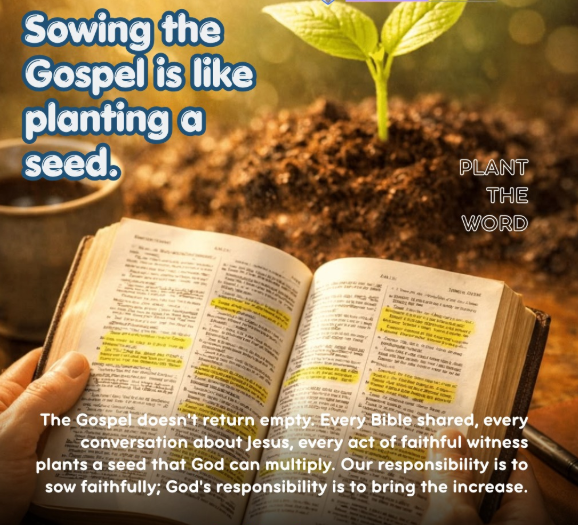
The Parable of the Wheat and the Weeds, or Tares, is filled with spiritual significance and truth. But, in spite of the clear explanation of the parable that Jesus gave (Matthew 13:36-43), this parable is very often misinterpreted. Many commentaries and sermons have attempted to use this story as an illustration of the condition of the church, noting that there are both true believers (the wheat) and false professors (the weeds) in both the church at large and individual local churches. While this may be true, Jesus distinctly explains that the field is not the church; it is the world (v. 38).
Even if He hadn’t specifically told us the world is the setting of the story, it would still be obvious. The landowner tells the servants not to pull up the weeds in the field, but to leave them until the end of the age. If the field were the church, this command would directly contradict Jesus’ teaching in Matthew 18, which tells us how to deal with unrepentant sinners in the church: they are to be put out of the fellowship and treated as unbelievers. Jesus never instructed us to let impenitent sinners remain in our midst until the end of the age. So, Jesus is teaching here about “the kingdom of heaven” (v. 24) in the world.
In the agricultural society of Christ’s time, many farmers depended on the quality of their crops. An enemy sowing weeds would have sabotaged a business. The tares in the parable were likely darnel because that weed, until mature, appears as wheat. Without modern weed killers, what would a wise farmer do in such a dilemma? Instead of tearing out the wheat with the tares, the landowner in this parable wisely waited until the harvest. After harvesting the whole field, the tares could be separated and burned. The wheat would be saved in the barn.
In the explanation of the parable, Christ declares that He Himself is the sower. He spreads His redeemed seed, true believers, in the field of the world. Through His grace, these Christians bear the fruit of the Spirit (Galatians 5:22-24). Their presence on earth is the reason the “kingdom of heaven” is like the field of the world. When Jesus said, “The kingdom of heaven is at hand” (Matthew 3:2; 4:17), He meant the spiritual realm which exists on earth side by side with the realm of the evil one (1 John 5:19). When the kingdom of heaven comes to its fruition, heaven will be a reality and there will be no “weeds” among the “wheat.” But for now, both good and bad seeds mature in the world.
The enemy in the parable is Satan. The field is the world. The devil tries to destroy Christ’s work by placing wicked people and false believers in the world to work unrighteousness. But the church’s job is not to rid the world of sinners (except through conversion) any more than it is the wheat’s job to pluck up the tares. In the parable, Christ allows the tares to remain until His return. At that time, angels will separate the just from the unjust and the true from false believers. Judgment is coming; in the meantime, God takes steps to ensure that His children are not adversely affected by His judgment on the wicked. God does not want to “uproot the wheat,” no matter how many tares there are (Matthew 13:29).
Tares, especially in the early stages of growth, resemble wheat. Likewise, a false believer may resemble a true believer, at least superficially. In Matthew 7:22, Jesus warned that many profess faith but do not know Him. Thus, each person should examine his or her own relationship with Christ (2 Corinthians 13:5). The book of 1 John is an excellent test of salvation.
Jesus Christ will one day establish true righteousness. After He raptures the church out of this world, God will pour out His righteous wrath on the world. During that tribulation, He will draw others to saving faith in Jesus Christ. At the end of the tribulation, all unbelievers will be judged for their sin and unbelief; then they will be removed from God’s presence. True followers of Christ will reign with Him. The “wheat” will be gathered into God’s “barn” (Matthew 13:30). What a glorious future for the “wheat”!

Tea Time Manna
Since we are surrounded by such a great cloud of witnesses, let us throw off everything that hinders and the sin that so easily entangles, and let us run with perseverance the race marked out for us.
—Hebrews 12:1
With the example of all the great heroes of the Bible, both big and small, we can do God’s work with confidence. But for us to boldly go where he wants us to go, we must first let go of “the sin that so easily entangles”, our lives, distorts our vision, enlarges our doubts, and robs us of our spiritual vitality and stamina. As we put those things away from our lives, we can then look “to Jesus, the pioneer and perfecter of faith” and we can “not grow weary” or “lose heart” (Hebrews 12:2-3). We can join the apostle Paul when he said he had fought the good fight, had finished his race, and could trust that God’s bountiful grace had great things in store for him (2 Timothy 4:6-8). Let’s help each other to keep running the race by putting off the sin and looking to Jesus!
Prayer
Holy Father, please forgive me for my sins. Not just my blatant sins, but my willingness to dabble in things that are not holy, to flirt with spiritually dangerous things, and to expose myself to unholy things that leave a residue of evil one’s corruption in my heart. Please, give me the strength to say “NO!” to the things that distract me from you and to embrace with passion those things that make me more like you as I pursue Jesus as my example, Savior, and Lord. In the name of Christ Jesus, I pray this. Amen and Amen
Bible Teaching of the Day
LUNCH MANNA =
Scripture contains numerous references to sowing and reaping—farming terms that were well understood by the agrarian society to whom the Bible was originally written. Old Testament references to sowing and reaping are mostly related to agriculture. But the terms take on a spiritual connotation in the New Testament: “For the one who sows to his own flesh will from the flesh reap corruption, but the one who sows to the Spirit will from the Spirit reap eternal life” (Galatians 6:8, ESV).
Sowing and reaping constitute unalterable laws of seedtime and harvest. To sow is to cultivate, as in planting seeds for growth. The farmer will always reap the same kind of plant or fruit as the seed sown. If we scatter cherry seeds, a cherry tree will grow and produce cherries.
In Galatians 5—6, Paul focuses on the nature of the Christian life. He stresses that freedom in Christ is not a lifestyle characterized by self-indulgence and gratifying our own sinful desires (Galatians 5:13, 16, 19–21). Freedom from sin is only possible for believers if they follow a new law established by Christ—the law of love (Galatians 5:13–15). True spiritual freedom expresses itself in love for God and others (1 Peter 2:16).
Paul compares the Christian life to tending a farmer’s field. As believers, we can sow seeds into one of two fields: the flesh or the Spirit. As we make decisions, we must realize that everything we do will either be an investment in the flesh or the Spirit. The fruit we produce depends on which field we choose to sow into and what we sow. Paul encouraged, “So let’s not get tired of doing what is good. At just the right time we will reap a harvest of blessing if we don’t give up” (Galatians 6:9, NLT).
Sowing to our flesh means cultivating and developing our sinful desires. We sow to the flesh by nurturing and indulging it so that it grows and produces fruit: “The acts of the flesh are obvious: sexual immorality, impurity and debauchery; idolatry and witchcraft; hatred, discord, jealousy, fits of rage, selfish ambition, dissensions, factions and envy; drunkenness, orgies, and the like. I warn you, as I did before, that those who live like this will not inherit the kingdom of God” (Galatians 5:19–21).
“Those who belong to Christ Jesus have crucified the flesh with its passions and desires,” writes Paul (Galatians 5:24). The seeds we sow are linked to our thoughts and actions. Paul instructs us to “throw off your old sinful nature and your former way of life, which is corrupted by lust and deception. Instead, let the Spirit renew your thoughts and attitudes. Put on your new nature, created to be like God—truly righteous and holy” (Ephesians 4:22–24, NLT). Some Christians sow to the flesh all day long—allowing their minds to dwell on resentments, impure thoughts, and self-pity—and then wonder why they don’t reap a spiritual harvest of righteousness and holy living.
We sow to the Spirit when we stop letting our sinful nature control our minds; a mind controlled by the flesh “leads to death. But letting the Spirit control your mind leads to life and peace” (Romans 8:6, NLT). The way to experience freedom in Christ, Paul explains, is to “walk by the Spirit” (Galatians 5:16), “live by the spirit,” and “keep in step with the Spirit” (Galatians 5:25) through a Spirit-led daily regime fueled by love (Galatians 5:18). We sow to the Spirit by cultivating and nurturing “the fruit of the Spirit,” which is “love, joy, peace, forbearance, kindness, goodness, faithfulness, gentleness and self-control. Against such things there is no law” (Galatians 5:22–23).
A Spirit-controlled life involves setting our “minds on things above, not on earthly things” (Colossians 3:2). If we think only about the concerns of life here on earth, we will reap a harvest of destruction (Philippians 3:19). We sow to the Spirit when we fix our “thoughts on what is true, and honorable, and right, and pure, and lovely, and admirable. Think about things that are excellent and worthy of praise” (Philippians 4:8, NLT). As we immerse ourselves in God’s Word, in fellowship with other believers, in praise, worship, and prayer, we sow to the Spirit. And the outcome of sowing to the Spirit is reaping the bountiful harvest of everlasting life.
DINNER TIME MANNA
Different ministries have different approaches to presenting the gospel. For example, relief organizations meet the physical needs of the destitute while giving the credit to Jesus. Some could interpret that approach as preaching prosperity, because many impoverished people equate Christianity with Western prosperity. They may respond to the gospel message while their real motivation is to be prosperous. However, for most relief organizations, meeting physical needs is merely a part of ministering to the whole person. It is a means by which Christians earn the right to speak to the spiritual needs of hurting people. But in prosperity preaching, Jesus is presented as a ticket to perfect heath and financial wealth. The true gospel is stripped of its focus on eternity and reduced to a means by which everyone can experience his or her best life now. It is that message we will address in this article.
In the Old Testament, God speaks a lot about blessing His servants with earthly health, wealth, and honor (e.g., Genesis 12:2; Leviticus 26:3–12; Deuteronomy 7:11–15; 30:8–9; 1 Kings 3:11–14). Material blessings were part of the Mosaic and Land Covenants for Israel. However, the New Testament focus is on eternal, not earthly, rewards.
Not every preacher who teaches the joy of blessing is a “prosperity preacher.” God does promise blessing to those who serve Him faithfully and follow His statutes (Psalm 107:9; Malachi 3:10–11; Mark 10:29–30). But a preacher who presents God as a means by which we can obtain earthly wealth is a prosperity preacher and a false teacher. This teaching portrays Almighty God as a type of jolly Santa Claus whose primary purpose is to prosper human beings and make their dreams come true. In prosperity preaching, man—not God—is the real star.
Prosperity teachers use terms such as faith, positive confession, or visualization to “release” the abundance God has in store. Often such preachers will entice listeners to “sow seeds into this ministry,” promising abundant returns on this investment. The gospel becomes little more than a repackaged get-rich-quick scheme, with the ministers becoming richer than the listeners. Often, an invitation to accept Christ is given at the conclusion of a service that has been based solely around blessing and positivity. Despite the overwhelming responses to the invitation, one has to wonder: are the responders surrendering to the Jesus of the Bible or to a new-and-improved version of themselves?
The shift from truth to error can be subtle, and some well-meaning preachers have been caught up in it. We must be careful not to judge a preacher’s entire message by only one or two sermons. However, when blatant prosperity preaching dominates a speaker’s platform, this is merely an attempt to make greed and materialism sound spiritual. Ephesians 5:5 has strong words for greedy people: “For of this you can be sure: No immoral, impure or greedy person—such a person is an idolater—has any inheritance in the kingdom of Christ and of God.” While we should ask God to provide for our needs and expect Him to do so (Philippians 4:19), Jesus warned us not to stockpile earthly wealth. Rather, we should store up treasure in heaven (Luke 12:33).
The imbalanced focus of prosperity preachers on earthy treasure is in direct contrast to the many passages that warn us not to desire riches (Proverbs 28:22; 2 Timothy 3:2; Hebrews 13:5). First Timothy 6:8–10 speaks directly to this kind of teaching: “But if we have food and clothing, with these we will be content. But those who desire to be rich fall into temptation, into a snare, into many senseless and harmful desires that plunge people into ruin and destruction. For the love of money is a root of all kinds of evils. It is through this craving that some have wandered away from the faith and pierced themselves with many pangs.” When earthly wealth is our focus, we are not following the teachings of Scripture.
If the quest for prosperity dominates a preacher’s message, he or she may be someone about whom Scripture warns. The following are some common traits of many prosperity preachers or false teachers:
- The core of his/her messages is always God’s desire to bless everyone.
- There is little, if any, mention of Jesus’ words about self-denial, taking up our crosses, or dying to the flesh (Luke 9:23; Matthew 10:38, 16:24).
- Almost all their teaching focuses on the gratification of fleshly desires rather than spiritual transformation (Romans 8:29).
- Obedience to God’s commands is rarely mentioned as a prerequisite to His blessing (Jeremiah 18:10).
- Positive thinking about oneself and one’s situation is often equated with faith and is presented as the means by which one can obtain financial blessing.
- There is a marked absence of any teaching on the necessity of suffering in the life of a believer (2 Timothy 2:12; 3:12; Romans 8:17; Philippians 1:29).
- Very little distinction is made between God’s children and the unsaved in thepositive promises of the message (Malachi 3:16–18; Romans 9:15–16).
- The speaker rarely attempts any type of real Bible teaching that does not support the continual message of positivity and blessing (1 Corinthians 3:1–3).
- He or she stays away from passages that contradict the positive spin of the message (2 Timothy 4:3).
- Personal wealth of the minister is often far above the average lifestyle of his congregation (Psalm 49:16–17).
- The only attributes of God ever mentioned are love and generosity. Scant attention is given to His holiness, justice, and righteousness (Ephesians 4:22–23).
- Neither the wrath of God against sin nor the coming judgment is ever mentioned (Romans 2:5; 1 Peter 4:5).
- The only “sins” discussed at length are negativity, poverty, or a person’s failure to believe in themselves (1 Corinthians 6:9–10; Philippians 3:3).
- Forgiveness is emphasized but with very little explanation of the repentance that was so important to Jesus and the disciples (Matthew 4:17; Mark 6:12; Acts 2:38).
- The prayer of faith is often referred to as the means by which humans “leave God no choice but to bless me” (Job 40:1–2).
- There has been a subtle shift within Christianity toward a version of the gospel that the apostles would not recognize. People are becoming biblically illiterate and are thus easily swayed by preachers who appear to know Scripture but who are perverting it to make it sound more appealing. These preachers are attracting huge crowds, just as Jesus did when He fed the thousands (Matthew 14:21), healed the sick (Mark 1:34), and performed miracles (John 6:2). But when Jesus began to teach the hard truths of the gospel, “many of his disciples turned away and no longer followed him” (John 6:66). Waning popularity did not cause Jesus to water down His message. He continued to teach truth whether people liked it or not (John 8:29). Likewise, the apostle Paul exonerated himself before the Ephesians with these words: “Therefore I testify to you this day that I am innocent of the blood of all, for I did not shrink from declaring to you the whole counsel of God” (Acts 20:26–27). If today’s prosperity teachers would follow the patterns of Jesus and Paul, they could be confident that their works will not be burned up on judgment day (1 Corinthians 3:12–15).

NEWS MANNA –
Will the Eagle Wings Give Magog the Final Bomb ? Is Trump igniting a nuclear arms race in the Middle East?

Is Trump igniting a nuclear arms race in the Middle East?
Nuclear non-proliferation policy was not designed to judge the intentions of current leaders but to limit the options available to their successors, whose intentions one cannot know.
For more than two decades, the policy of the United States toward the Middle East, regardless of the party holding power in Washington, rested on the proposition that certain nuclear technologies are too dangerous to spread in an undemocratic region where regimes are overthrown and strategic realities change overnight.
At the center of this policy sit centrifuges and uranium enrichment.
This week, the US signed a civilian nuclear cooperation agreement with Saudi Arabia that opens a path to both uranium enrichment and plutonium reprocessing on Saudi soil.
US Energy Secretary Chris Wright and Saudi Energy Minister Prince Abdulaziz bin Salman signed the nuclear accord, in compliance with Section 123 of the Atomic Energy Act, alongside a bilateral safeguards agreement whose contents were not disclosed.
The framework contemplates a uranium enrichment facility on Saudi territory, built by American firms, after a two-year joint study.
Congress now has 90 days of continuous session to review it, and only a joint resolution of disapproval carried by a veto-proof majority in both chambers can stop it.
No president has been overridden on one.
The Kingdom of Saudi Arabia cannot be exactly equated with the Islamic Republic of Iran.
Saudi Arabia has been a sometimes strategic ally of the United States, apart from its involvement in the devastating 9/11 attacks, while Iran has spent decades financing terrorism and directly attacking American forces.
The question before the US Congress is not whether the two regimes are morally equivalent. They are not.
The question is whether uranium enrichment becomes inherently safe simply because today’s Saudi regime happens to be friendly.
Washington answered that question once, in the negative, on the basis of an experience it paid dearly to acquire.
In the mid-1970s, few countries appeared more firmly anchored in the American camp than the Imperial State of Iran under Shah Mohammad Reza Pahlavi, who purchased advanced American weapons and was encouraged in his nuclear ambitions by US administrations that treated the alliance as a cornerstone of regional strategy.
A few years later, the Shah was gone, and the alliance was gone with him, while the reactors built by the US and Germany, the trained nuclear physicists and the institutional appetite for a nuclear program stayed where they were.
Iran: Management of uncertainty – analysis
In Iran, what began as a civilian nuclear program of a trusted ally before 1979 became the longest-running nuclear proliferation crisis of the modern era.
The doctrine that emerged from that failure never rested on the assumption that allies cannot be trusted.
It rested on the recognition that no one can predict who will govern a country 20 or 50 years after sensitive technology has been transferred.
Nuclear infrastructure outlives the governments that acquire it and the administrations that approve it. Nuclear programs are measured in generations; political arrangements, in years.
The agreement signed this week authorizes a uranium enrichment capability that will survive this and future governments in Riyadh, in a region where the durability of governments cannot be assured.
Riyadh has never concealed how it thinks about this. Crown Prince Mohammed bin Salman said in 2018 that Saudi Arabia would pursue a nuclear weapon if Iran acquired one—a statement he has never retracted.
Whether that day comes is beside the point. The declaration establishes that uranium enrichment is understood in Riyadh through the lens of regional deterrence as much as energy policy, an unusual foundation on which to build a fuel cycle in a country floating on oil and natural gas.
There was a standard for exactly this situation, and Washington wrote it. When the United Arab Emirates signed its own nuclear agreement with the US in 2009, Abu Dhabi renounced uranium enrichment and plutonium reprocessing outright and accepted the IAEA’s Additional Protocol.
American officials spent 15 years citing it as proof that civilian nuclear power requires no domestic fuel cycle. The UAE’s only nuclear power plant, Barakah, runs on imported fuel.
Nothing in their reactors suffers from the absence of centrifuges.
Saudi Arabia declined those terms, and rather than hold the line, Washington moved it. The agreement, as described by the administration, leaves enrichment open and drops the Additional Protocol, whose purpose is to give IAEA inspectors the ability to detect undeclared activity.
The unpublished bilateral arrangement offered in its place is unlikely to be stricter than the regime Riyadh refused.
Enrichment itself is deferred to a two-year study of “commercial viability,” though nobody expects Saudi centrifuges to undercut the global nuclear fuel market.
A dozen Democrat lawmakers warned Secretary of State Marco Rubio in March that this was the direction of travel, and Rubio had himself co-sponsored legislation in 2018, with a Democrat colleague, requiring congressional approval of this kind of agreement.
The timing compounds the difficulty. American and Israeli aircraft struck Iranian nuclear facilities in June 2025 and again beginning in February, on the stated grounds that Iran’s uranium enrichment constituted an intolerable threat.
Trump’s Saudi nuclear horror show
IAEA inspectors have had no access to Iran’s declared enrichment sites for more than a year and cannot account for the 440.9 kilograms of uranium enriched to 60%—close to the level required for nuclear weapons.
Most of it is believed to be sealed in tunnels at Isfahan. Within 18 months, Washington went to war over centrifuges in one country and signed a contract to build them in another.
If President Donald Trump said it would be “unfair” for Iran to not have ballistic missiles since Saudi Arabia and Qatar have them, how is it not equally “unfair” for Saudi Arabia to conduct uranium enrichment but not all the other countries in the Middle East?
The precedent will not stop at the Saudi border. Turkey has expansionist ambitions, its president has articulated with increasing candor.
“Jerusalem is our city,” Turkish President Recep Tayyip Erdogan has announced, and “We may come suddenly one night,” he has threatened Greece.
“When you say ‘Tayfun’ [a Turkish ballistic missile],” he continued, “the Greek is scared. They say it will hit Athens. Of course it will hit it.” This, incidentally, is the leader to whom Trump wants to sell F-35 stealth fighter jets.
Egypt, meanwhile, has a civilian-use nuclear program and a long memory.
Neither Turkey nor Egypt will accept the restrictions Washington has waived for Saudi Arabia. The editorial board of the Wall Street Journal, which has backed the campaign against Iranian enrichment throughout, immediately called the Saudi deal a mistake:
“Why does Saudi Arabia need to enrich uranium on its home soil? The answer isn’t complicated: It doesn’t unless it would like to establish the rudiments of a nuclear weapons program….”
It is unclear why the editorial board bothered with “rudiments.”
The WSJ noted that the UAE, a steadier ally through the Iran war, now has little reason to keep to rules binding no one else. The gold standard functioned because it was uniform. Applied selectively, it becomes a bargaining position—and bargaining positions can be bargained away.
For Israel, the consequences are more immediate. Nuclear cooperation had been the inducement for Saudi recognition of the Jewish state; the entire logic of the arrangement was discussed before October 7, and the agreement signed Wednesday contained no such condition.
Trump attached one the following day, writing that the nuclear deal’s approval depended on Saudi Arabia joining the Abraham Accords and insisting there would be no enrichment under the deal.
Escalation: Houthis strike Saudi oil tankers in Red Sea
Riyadh has not responded, the deal’s text remains unpublished, and the administration memo describing it permits the Saudis to enrich uranium supplied by third parties.
Nothing in Trump’s Truth Social post amends a signed instrument, and the leverage the deal was meant to purchase had already been spent.
Israeli officials across the political spectrum had already said so bluntly, warning of an arms race and a precedent leaving Israel to face nuclear weapons on two fronts rather than one.
Jerusalem could live with Saudi reactors fueled with uranium enriched abroad. Uranium enrichment in Saudi Arabia is another matter—and Israel was not consulted.
When a country willingly joins the Abraham Accords, as did the UAE, Bahrain, Morocco, and Kosovo, that is one thing; but when a country is coerced into joining to obtain a specific benefit, such as a nuclear enrichment program, the likelihood that it will stay in the Accords has to be open to question.
It would be perfectly possible for Saudi Arabia to agree to join the accords for now; then, when Trump leaves office and Saudi Arabia has its centrifuges comfortably enriching uranium, it could bow out of the Abraham Accords—and perhaps also at a time when US oversight has become far less rigorous.
Nuclear non-proliferation policy was not designed to judge the intentions of current leaders but to limit the options available to their successors, whose intentions one cannot know.
The US Congress is therefore deciding something more consequential than whether Saudi Arabia is a reliable partner today.
At stake is whether the principle that guided American policy toward Iran for decades still exists in any form applicable to a country Washington happens to like at this moment.
If enrichment is dangerous enough to justify war on one country because governments change and capabilities endure, those realities do not dissolve if the recipient should decide it is no longer a friend.
Benefits for friends cannot be retrieved if they are suddenly found in the hands of enemies.
At the moment, it looks as if Trump wants to arm his “friends,” Saudi Arabia and Turkey, with advanced American weapons systems such as the F-35 stealth fighter jet.
When he leaves office, both countries will be perfectly positioned with those deadly weapons to attack an infidel West that they have never wanted and have never liked.
When Churches Become Mosques: Islam’s Rise In A Retreating Christian Church
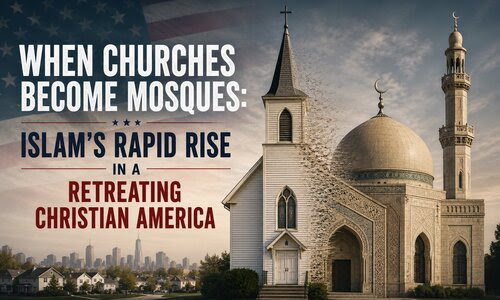
Another church is preparing to disappear from the American landscape.
Not because it was burned by an angry mob. Not because Christians were driven out by soldiers. Not because the government outlawed the Gospel.
The former Richfield Christian Reformed Church in Clifton, New Jersey, was purchased by the Islamic Center of Passaic County. Now plans call for the existing building to be demolished and replaced with a mosque measuring approximately 40,000 square feet–more than six times the size of the current structure.
The cross has already given way to the crescent. Soon the former church itself may be gone.
It is tempting to describe this as a conquest.
But this was conquest by vacancy.
Muslims did not storm the church. Christians emptied it.
That distinction does not make the symbolism less powerful. It makes the warning more painful.
The Numbers Tell The Story
New Jersey’s Muslim population more than doubled between 2010 and 2020, reaching approximately 321,000 adherents. During those same years, many Christian denominations continued losing members, consolidating congregations and selling buildings they could no longer fill or afford.
The pattern is national.
Pew Research Center found that Muslims represented approximately 0.6 percent of American adults in 2007. By its 2023-2024 Religious Landscape Study, that figure had reached 1.2 percent. Islam remains a relatively small minority faith, but its share of the adult population has doubled while Christianity’s share fell from roughly 78 percent in 2007 to 62 percent today.
The number of mosques is climbing as well. The U.S. Mosque Survey counted 2,769 mosques in 2020, a 31 percent increase from 2,106 in 2010. Average attendance at Friday congregational prayer rose 16 percent, while nearly three-fourths of surveyed mosques reported attendance growth of at least 10 percent.
These are not the numbers of a community fading quietly into American life. They reveal a young, increasingly established and institutionally organized religious population.
Meanwhile, many American Christians have treated their faith as a private preference–something to be squeezed between youth sports, vacations and weekend errands.
Muslims build mosques, establish schools, organize charities, mobilize voters and teach their children that religion touches every part of life. Too many Christians have reduced Christianity to an occasional Sunday activity.
One community is acting as though its beliefs will shape the future.
The other often behaves as though the future will take care of itself.
When Churches Become Mosques
Clifton is not an isolated case.
In Binghamton, New York, the historic Episcopal Church of the Good Shepherd became the Islamic Awareness Center, also known as Masjid Al-Tawheed. The Gothic Revival church had stood since the 19th century. After an internal denominational conflict and property lawsuit, the Episcopal diocese sold it to the Islamic organization. The cross was removed, the pews were taken out and carpets were installed for Muslim prayer.
In Buffalo, the Diocese of Buffalo sold the former St. Ann’s Church and Shrine in 2022 to a group associated with the Downtown Islamic Center. The enormous Gothic structure had once served generations of Catholic immigrants. Its proposed future as a mosque became another visible illustration of the religious transition taking place in parts of America’s older cities.
In Clifton, the Islamic Center did not merely occupy the former church. Its congregation grew so large that Friday services created parking pressures throughout the surrounding neighborhood. Now the organization is seeking a vastly larger facility capable of accommodating hundreds of prayer mats.
Again, none of this is illegal. These organizations purchased property and exercised the same religious liberty Christians rightly demand for themselves.
But buildings tell stories.
A church becoming an apartment complex says something about economics. A church becoming a restaurant says something about changing neighborhoods. A church becoming a mosque says something about the transfer of religious confidence from one community to another.
Where Christians no longer gather, someone else eventually will.
From Demographic Growth To Political Power
Islam’s expansion is no longer visible only in religious buildings. It is increasingly reflected in American politics.
Dearborn, Michigan, elected Abdullah Hammoud as its first Muslim and Arab American mayor. Under his administration, Dearborn became the first American city to make Eid al-Fitr a paid holiday for municipal employees.
During Michigan’s 2024 Democratic presidential primary, 56 percent of Dearborn voters selected “uncommitted” rather than support President Joe Biden, largely in protest over his Israel policy. In nearby Hamtramck, the figure reached 61 percent. More than 100,000 voters statewide joined the campaign, demonstrating that concentrated Arab and Muslim communities could create national consequences in a crucial swing state.
Hamtramck also became known for having an entirely Muslim city council. That council later prohibited private political and identity flags–including the Pride flag–from city-owned flagpoles, with some council members openly arguing that the flag conflicted with their religious beliefs.
The political influence now reaches America’s largest city. Zohran Mamdani was sworn in as mayor of New York City on January 1, 2026, becoming its first Muslim mayor. New York had already announced in 2023 that mosques could amplify the Islamic call to prayer on Fridays and during Ramadan without obtaining a special permit.
Muslim Americans have every constitutional right to vote, organize and seek office. Political participation is not evidence of a conspiracy. Muslim voters are also far from monolithic: some are progressive socialists, some are culturally conservative, and others shift between parties depending on foreign policy, education and family concerns.
But it would be foolish to deny what is happening.
As the Muslim population becomes larger and better organized, elected officials will increasingly accommodate its priorities. Political parties will court its votes. Public institutions will adapt to its religious practices. And in cities where Muslims become a decisive voting bloc, Islamic beliefs will inevitably influence debates over education, sexuality, Israel, public expression and the meaning of religious freedom.
That is how democracy works.
The question is whether Christians will continue participating in it.
This Is Not Primarily A Muslim Problem
The easiest response is to blame Muslims.
That would also be the most dishonest response.
Muslims did not force American churches to abandon biblical authority. They did not convince Christian parents to stop discipling their children. They did not make pastors replace the Gospel with entertainment, politics or therapeutic self-help.
They did not empty the pews.
Christians did that themselves.
The rise of Islam in America is partly a story of immigration and birth rates. But it is also a story of religious seriousness confronting Christian complacency.
The answer is not hatred, harassment or an attack on anyone’s constitutional rights. Christians should defend the freedom of peaceful Muslims to worship because religious liberty cannot survive when it applies only to the majority.
But tolerance does not require theological surrender. Christians can love Muslim neighbors while clearly explaining that the Islamic understanding of Jesus is not the biblical one. Jesus is not merely a prophet beneath Muhammad. He is the crucified and risen Son of God, the only Savior and the only way to the Father.
Islam is building.
Islam is organizing.
Islam is voting.
And wherever Christianity retreats, the vacuum will not remain empty.
Christ promised that the gates of hell would not prevail against His Church. He never promised that every American congregation, denomination or steeple would survive its own unbelief and neglect.
The answer is not panic.
It is repentance, revival and a renewed determination to preach the Gospel while there are still churches from which to preach it.
Preschool Becomes Gender School – MyGender Dolls To Indoctrinate Next Generation

Imagine walking into your four-year-old’s classroom and discovering adults encouraging children to remove and replace paper genitals to help them imagine becoming someone else.
It sounds less like elementary education than the plot of a dystopian novel.
Yet this fall, educational materials developed by researchers at the University of Minnesota Medical School may begin appearing in the hands of teachers, counselors and clinicians working with children as young as four years old.
If this doesn’t cause parents to stop and ask what has happened to American education, what will?
The “MyGender Dolls” feature interchangeable clothing, hairstyles, internal organs and external genitalia. According to their creators, the purpose is to help children “learn about the different options that exist for who they can be.”
Think about that for a moment.
Four-year-olds are not struggling with questions about sex reassignment. They are learning the alphabet, tying their shoes and discovering how to get along with classmates. Yet adults now believe one of the best uses of classroom time is encouraging preschoolers to imagine changing the most fundamental aspects of their own bodies.
How did we get here?
The Next Step In A Long March
The dolls themselves are not the real story.
They are simply the latest step in a cultural progression that has advanced at breathtaking speed.
First came Drag Queen Story Hour.
Then pride flags in elementary classrooms.
Then gender identity lessons for young children.
Then schools socially transitioning children without parental knowledge.
Then puberty blockers.
Then cross-sex hormones.
Then irreversible surgeries for teenagers.
Now we arrive at paper dolls with interchangeable genitalia for preschoolers.
Every one of these developments was once dismissed as an impossible conspiracy theory.
Every one eventually became reality.
Each new step made the next one seem just a little more normal.
Childhood Or Ideological Formation?
Associate Professor Dianne Berg, one of the project’s founders, summarized the philosophy behind the dolls:
“Everyone should be learning that there’s diversity in gender identity and that what makes you real is not what your body parts are, but how you think and feel.”
That statement is not simply about kindness or inclusion.
It is a complete redefinition of human identity.
For thousands of years, nearly every civilization understood that our bodies reveal something objectively true about who we are.
This new philosophy teaches children the exact opposite–that feelings determine reality, while biology becomes secondary.
Whether adults agree or disagree with that worldview, one question should unite parents across political lines:
Why are four-year-olds being asked to wrestle with it?
Children this young still pretend to be dinosaurs, superheroes and talking animals. They often struggle to distinguish imagination from reality. Yet adults now propose introducing removable genitalia into classroom materials so children can imagine redesigning their own bodies.
That is not developmental education.
It is ideological formation.
Questions No One Wants To Answer
Supporters insist the dolls simply promote compassion.
If that is true, why are removable genitals necessary?
Schools have taught kindness toward children of different races, disabilities and backgrounds for generations without asking kindergarteners to experiment with anatomically detailed paper dolls.
If gender identity naturally develops on its own…
Why introduce specially designed teaching tools to guide children toward questioning it?
If this is simply about acceptance…
Why begin before children have even mastered multiplication?
These are not unreasonable questions.
Parents deserve honest answers.
Minnesota As A National Testing Ground
This controversy did not emerge in a vacuum.
Governor Tim Walz has spent years positioning Minnesota among the nation’s most aggressive states on transgender policy. His administration has championed legislation expanding legal protections related to gender identity and publicly celebrated transgender activism. In 2023, Walz received the Institute for Sexual and Gender Health’s first “Distinguished Sexual and Gender Health Champion Award.”
Remember this man almost became Vice President for the country…
The MyGender Dolls are not an isolated classroom project.
They reflect a broader political and academic movement that increasingly sees childhood as the starting point for reshaping society’s understanding of sex and identity.
History shows that lasting cultural revolutions rarely begin in legislatures.
They begin in classrooms.
Public Schools Or Social Experiments?
The University of Minnesota Medical School receives millions of dollars in state funding each year. University officials maintain that taxpayer dollars did not directly fund the commercial version of the dolls, while declining to specify how much publicly funded research contributed to their development.
Parents should not have to guess.
They deserve transparency.
They deserve meaningful opt-out rights.
Most importantly, they deserve the final say over when–and whether–their young children are introduced to concepts involving gender identity and future body modification.
That responsibility belongs to families, not government institutions or university researchers.
This Is About More Than Paper Dolls
Some will dismiss concerns over these dolls as an overreaction.
History suggests otherwise.
Major cultural changes rarely arrive all at once.
They come one curriculum at a time.
One policy at a time.
One lesson at a time.
One classroom at a time.
Today’s paper dolls become tomorrow’s standard lesson plan.
Tomorrow’s lesson plan becomes the next generation’s unquestioned reality.
That is how the boundaries of acceptable thought slowly move.
A Biblical Responsibility
Scripture teaches that children are a gift entrusted to parents–not blank canvases for every new social theory.
Jesus welcomed children, protected them and issued one of Scripture’s strongest warnings against leading them astray.
That warning should weigh heavily on every educator, policymaker and institution shaping young minds.
Children need truth before ideology.
Stability before confusion.
Guidance before experimentation.
The real issue is not whether a set of paper dolls will transform society.
The issue is what those dolls represent.
For the first time in American history, respected academic institutions are deliberately introducing preschool children to the idea that even their biological sex is something to be explored, questioned and potentially reimagined.
Civilizations are rarely transformed by a single election or a single law.
They are transformed one generation at a time.
The question is no longer whether America’s children are being taught a radically different understanding of human identity.
The question is whether enough parents will recognize what is happening before these lessons become impossible to avoid.

TruLight TV & Kingdom Kidz TV : What it Means to Follow Jesus
In today’s episode, Sean, Fiona, and Noel have finally moved into the new Konnect HQ2 building … and they’re already having a hard time seeing eye to eye. Will Cat, Jake, and Jayden be able to help them find peace? In week one of “Dive in,” our host, Jake, takes your kids on an adventure to learn what it means to follow Jesus. You will play games, worship, meet Cora to learn about pilot fish, and see how Peter became a fisher of men!
Today on TruLight Radio XM
TruLight Radio XM 24/7
Program
GMT / UTC +2
Monday To Fridays
00:15 Words to Live By Testimonies
01.15 Science Scripture and Salvation
02.15 Ground Works
04.00 Gospel Concert of the Day
05.00 The Daren Streblow Comedy Show
5:55 It is Today devotional
6:00 Gaither Homecoming Morning Show
7:15 Discover the Word
8.15 Destined for Victory
8:55 Science Scripture and Salvation
9:00 Holy Spirit Hour – Normally Sermons
10:15 Hope of the Heart
11:15 Unshackled
11.45 Words to Live By
12:15 Truth for Life
13:15 Living on the Edge with Chip Ingram
14:15 Focus on the Family
15:00 Kids Hour
16:00 In Touch with Dr. Charles Stanley
16:30 Groundwork
17:15 Live in the Light
18:15 Renewing your Mind
19:00 Gaither Homecoming Show
20:15 Growing Hope
21:15 Adventures in Odyssey Radio Drama
21:45 Bible Reading
22:15 Night-sounds
23.00 Good Old Country Gospel / Rhema Gospel Express
VISIT THE WEBSITE
TruLight Ministry News – EXTRA MANNA

TruLight Ministries orders from God since 2012 . Teach Them , Comfort Them and Warn Them!
Healing Truths.
End Time Articles.
Share this Feeding of Manna with your Friends and Family. just click on the Social Media icon and share !nna with your Friends and Family. just click on the Social Media icon and share !