Hosted by TruLight Ministries – The Place of Truth
SELECT YOUR READING LANGUAGE – BOTTOM LEFT = YOUR DAILY MANNA NOW AVAILABLE IN 103 LANGUAGES
@ TruLight Daily Manna is not Just a Bible Verse with a Small Prayer . NO ::: WE SERVE DAILY Manna for the ENTIRE Day . Breakfast , Lunch , Dinner , Plus tea Times and even Entertainment Manna . Plus News Manna and More , This Daily Manna will keep you Spiritually full for the full 48 Hours and even More to Share with your Friends and Family !!!
Introduce Your Great God to your Problems !!!

“Do not worry about tomorrow,” said Jesus in His great Sermon on the Mount, “for tomorrow will worry about itself. Each day has enough trouble of its own” (Matthew 6:34). For the third time, Christ gives His disciples this command not to worry, repeating it perhaps because He knew the universal human tendency to do just the opposite—to anxiously focus on future cares rather than on the God who holds tomorrow in His hands (Jeremiah 29:11; Psalm 23).
In this segment of His sermon, Jesus teaches the disciples not to be anxious about what they will eat and what they will wear. These two things represent basic human needs. Jesus urges His followers to trust in God as their provider. The faithful kingdom servant who is wholly committed to the King does not need to worry or be distracted by the cares of everyday life. Putting our confidence in God means trusting that He will take care of us and provide everything we need.
In Matthew 6:34, Jesus expands His lesson, challenging the disciples specifically not to worry about concerns that may crop up in the future. He had just taught the disciple to pray, “Give us this day our daily bread,” in the Lord’s Prayer (Matthew 6:11). Servants of God’s kingdom must live in the present. God looks after His servants today. He gives them their daily bread and anything else they might need for today. They do not need to worry about tomorrow because God will be there with them to deal with any concerns in the “today” of tomorrow (Matthew 28:20; Psalm 73:23–26).
In the wilderness, God taught the children of Israel the same principle of depending on Yahweh for the day’s provision. He fed them with just enough manna to sustain their lives for that day. When they worried about tomorrow by storing food for the next day, that supply of manna would rot. Each day and every step of the way, God’s people must depend on His faithful supply.
The Lord knows we face many circumstances and situations that can cause anxiety in this fallen world. So how can we follow His command to stop worrying about tomorrow?
Pray
Philippians 4:6–7 presents our most potent weapon against worry: “Don’t worry about anything; instead, pray about everything. Tell God what you need, and thank him for all he has done. Then you will experience God’s peace, which exceeds anything we can understand. His peace will guard your hearts and minds as you live in Christ Jesus” (NLT).
Whenever we find ourselves feeling anxious or worrying about tomorrow, we can take our concerns to the Lord in prayer. We can live in that moment, acknowledging that God is right there with us. As we tell Him what we need, we thank Him for all He has done. A thankful attitude suggests an expectation of His continued provision and care. As we spend time in the presence of our heavenly Father, pouring out our concerns, He responds by giving us supernatural peace that guards our hearts and minds. When we remember to turn to the Father in prayer, He instantly comes to help us through our anxious moments.
Rely on God’s Grace
The apostle Paul endured a thorn in the flesh that caused him considerable anxiety: “In order to keep me from becoming conceited, I was given a thorn in my flesh, a messenger of Satan, to torment me. Three times I pleaded with the Lord to take it away from me. But he said to me, ‘My grace is sufficient for you, for my power is made perfect in weakness.’ Therefore I will boast all the more gladly about my weaknesses, so that Christ’s power may rest on me” (2 Corinthians 12:7–9). Paul took his concern to the Lord in prayer. When the problem persisted, the apostle relied on the Lord to provide him with the grace to carry on.
God’s grace gave Paul the ability to see how the Lord would be glorified in his infirmity: “That is why, for Christ’s sake, I delight in weaknesses, in insults, in hardships, in persecutions, in difficulties. For when I am weak, then I am strong” (2 Corinthians 12:10). We can eradicate our worries about tomorrow by seeing God with us in the future, providing the grace we need to get through. When tomorrow comes, the Father will be there with grace to meet our every need.
Discipline the Mind
After praying and receiving God’s peace, we must discipline our minds: “And now, dear brothers and sisters, one final thing. Fix your thoughts on what is true, and honorable, and right, and pure, and lovely, and admirable. Think about things that are excellent and worthy of praise” (Philippians 4:8, NLT). It’s hard to worry when our thoughts are centered on God’s true and faithful promises. Lazy, undisciplined thinking produces worry. Instead, we need to train our minds on the Word, which tells us that “God gave us a spirit not of fear but of power and love and self-control” (2 Timothy 1:7, ESV).
Take Action
We cannot be wholly dedicated to God if we’re devoted to worrying about tomorrow. Worrying about tomorrow is a failure to trust in God and accomplishes nothing (Matthew 6:27–29). Peter wisely advises, “Give all your worries and cares to God, for he cares about you” (1 Peter 5:7, NLT).
Sometimes obeying the Lord’s command not to worry about tomorrow requires action: “Keep putting into practice all you learned and received from me—everything you heard from me and saw me doing. Then the God of peace will be with you” (Philippians 4:9, NLT). If fears about your tomorrow are consuming your today, consider doing an in-depth Bible study specifically on the topic of concern. You may even need to seek counseling from a leader at church. Take steps to create a biblical plan of action that will quash your unfruitful, destructive worrying.
The Lord’s command, “Do not worry about tomorrow,” is a poignant reminder for kingdom servants to live in the moment and put their trust in Him for every circumstance and situation. No difficulty is greater than our great God. Worrying about tomorrow is looking at our future as if God will not be there to take care of us. But Jesus teaches us to live in God’s presence one day at a time and deal with each problem when it comes—through prayer. Our heavenly Father will be with us tomorrow to care for us.

Tea Time Manna
For this world in its present form is passing away.
—1 Corinthians 7:31
This often repeated theme in the New Testament is from Jesus’s lips and taught again by the apostle Paul. It should be a great reminder to us that we shouldn’t spend our lives working for what is only temporary. We must invest in Jesus and his Kingdom, for all other kingdoms, structures, nations, and powers will ultimately pass away and be gone forever. Only what we invest in Jesus and his Kingdom will endure!
Prayer
Lord God Almighty, the Alpha and the Omega, the Eternal I Am, we thank you for being what everything else in the world cannot be. Please awaken our hearts to things of eternal significance and open our eyes to see through the transitory things that are so often alluring to us. In Jesus’ name, we pray and ask for this help. Amen and Amen
Bible Teaching of the Day
LUNCH MANNA =
Psalm 46:1 contains a description of God and a wonderful promise based on His character: “God is our refuge and strength, an ever-present help in trouble.” The next verse continues with what should be our natural response: “Therefore we will not fear” (verse 2).
In Psalm 46, the poet describes various kinds of disasters and the chaos that mark our existence in this broken and sinful world. He alludes to natural disasters such as earthquakes, volcanoes, landslides, and floods (verses 2 and 3). He mentions the elements of war and violence in verses 8 and 9. But, through it all, “we will not fear” (verse 2).
The various distresses the psalmist lists are an occasion to take note of God’s help. He is our refuge, our strength, and an ever-present help in troubled times. In the hardships of this life, we find safety and rest in God. The world is unstable, but “the city of God”—His habitation—is established and secure (Psalm 46:4–6). No matter what happens in this world, God will be exalted, and those who are His will ultimately be safe (verses 10–11). We can “be still and know” that He is God (verse 10).
The structure of Psalm 46 is beautiful. Verses 2 and 3 along with verses 8 and 9 describe disasters and trials. But verses 1, 4–7 and 10–11 describe God’s power and safety in the midst of those difficulties. So the trouble is bracketed by God’s promises; the verses about the difficulties of life are graphically “surrounded” by verses about the power and safety of the Lord. This is an amazing picture. Like a mother or father who hugs and comforts a fearful and upset child, God surrounds us and protects us in our difficulties. Note that the psalmist doesn’t state that God will remove us from the difficulty; rather, God will protect us and glorify Himself in the midst of the difficulty.
He is our refuge. God provides safety. We take shelter in our relationship with Him (cf. Proverbs 18:10).
He is our strength. God gives us the power we need to endure hardship as we serve Him, fight spiritual battles, resist temptation, and bear up under persecution. We are weak, but He is strong (cf. 2 Corinthians 12:10).
He is an ever-present help in trouble. God is at hand. He is not far away from us but nearby to assist us in the tasks He has assigned (cf. Psalm 145:18).
Here are some points of application:
- There are two groups described in Psalm 46. One group is protected by the Lord, and one group fights against the Lord. If we would experience God’s protection, we must belong to Him through faith in Jesus Christ. Have you been saved by God through believing in the death and resurrection of Jesus for the forgiveness of your sins and eternal life? Can you truly say, “God is my refuge”?
- True peace will not come until we are with the Lord in “the city of God, the holy place where the Most High dwells” (Psalm 46:4). This means that, in this world, we may experience hurt, and, eventually, we will die. But in the midst of it all, God is working everything out for good (see Romans 8:28). For those who belong to God, even the bad stuff has a good end! We are eternally safe.
- The ultimate goal is to exalt and glorify God. This is the purpose of your life. As you rest in His protection during the difficulties of this life, you are showing the goodness and power of God. Thus, no matter what happens, trust Him. Even if things don’t seem to turn out as you would like, remember that you are not home yet.
Because God promises to be our refuge and strength, we do not fear. Because He is an ever-present help in trouble, those who belong to Him can commit their way to Him and take their rest. God is saying, “Be still. Trust me. I’ve got this.”
DINNER TIME MANNA
“Why does God allow bad things to happen to good people?” Both questions refer to what seems to be the perplexing injustice we witness every day. The 73rd Psalm is our answer to the very same questions that also tormented the psalmist. Finding himself in terrible distress and agony of soul he writes, “But as for me, my feet had almost slipped; I had nearly lost my foothold. For I envied the arrogant when I saw the prosperity of the wicked” (Psalm 73:2-3).
The writer of this Psalm was a man named Asaph, a leader of one of the temple choirs. Obviously, he was not a wealthy man, but rather one who had dedicated his life to serving God (see 1 Chronicles 25). But, like us, he had experienced some difficulties and questioned the injustice of it all. He watched the evil people around him living by their own rules, enjoying all the wealth and pleasures of the world and collecting riches. He complains, “They have no struggles; their bodies are healthy and strong. They are free from the burdens common to man; they are not plagued by human ills” (Psalm 73:4-5).
Asaph was looking at these people who didn’t have problems. They could pay their bills. They had plenty to eat and plenty of luxuries. But poor Asaph was stuck with directing the choir and trying to live godly. And to make things worse, his choice to serve God didn’t seem to be helping him. He began to envy these people and even to question God as to why He would allow such a thing to happen!
How often do we find ourselves relating to Asaph? We dedicate our lives to serving God. Then we witness the wicked, ungodly people around us get new possessions, luxurious homes, promotions, and beautiful clothes, while we struggle financially. The answer lies in the rest of the psalm. Asaph envied these evil people until he realized one very important thing. When he entered the sanctuary of God, he fully understood their final destiny: “When I tried to understand all this, it was oppressive to me till I entered the sanctuary of God; then I understood their final destiny. Surely you place them on slippery ground; you cast them down to ruin. How suddenly are they destroyed, completely swept away by terrors! As a dream when one awakes, so when you arise, O Lord, you will despise them as fantasies” (Psalm 73:16-20). Those who have temporary riches on earth are in reality spiritual beggars because they do not have true riches—eternal life.
There are many times when we do not understand what is happening to us, nor do we understand how providence works. When Asaph entered the sanctuary of God, he began to see that there was no need for him to be envious of the prosperity of the wicked because their prosperity is an illusion. He began to comprehend that the ancient deceiver, Satan, had used lies to distract him from the reality of God. Upon entering the sanctuary, Asaph realized that prosperity is a fleeting fulfillment, like a pleasant dream that pleases us only for a little while but, when we awaken, we realize it was not real. Asaph rebukes himself for his own stupidity. He admits to being “senseless and ignorant” to envy the wicked or to be jealous of the perishing. His thoughts then returned to his own happiness in God when he realized how much more joy, fulfillment, and true spiritual prosperity he had in the Creator.
We may not have everything we want here on earth, but we will one day prosper for all eternity through Jesus Christ our Lord. Whenever we are tempted to try the other road, we should remember that the other road is a dead end (Matthew 7:13). But the narrow road before us through Jesus is the only road that leads to eternal life. That should be our joy and our comfort. “Whom have I in heaven but you? And earth has nothing I desire besides you. Those who are far from you will perish; you destroy all who are unfaithful to you. But as for me, it is good to be near God. I have made the Sovereign Lord my refuge . . .” (Psalm 73:25, 27-28)
We need not concern ourselves when good things seem to happen to bad people. We only need to keep our focus on our Creator and enter into His presence every day through the portal of His holy Word. There we will find truth, contentment, spiritual riches, and eternal joy.

NEWS MANNA –
Another Dangerous ‘Christian Pastor’ Running For Office Who Distorts Scripture
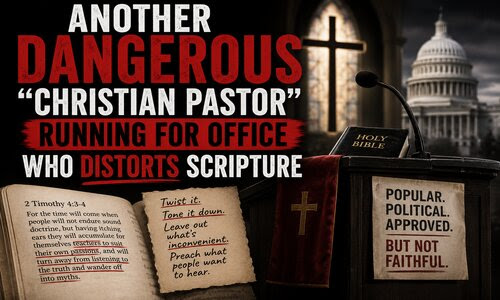
Just months after Texas legislator James Talarico emerged as one of the Democratic Party’s most recognizable “Christian” voices, Kansas pastor Adam Hamilton appears poised to follow the same path.
Like Talarico, Hamilton speaks comfortably about Jesus, frequently quotes Scripture, and presents himself as a thoughtful, compassionate Christian. Yet beneath that appealing image lies a far more significant concern. Both men promote a version of Christianity that steadily reshapes biblical teaching to fit modern progressive culture rather than calling culture back to biblical truth.
That should concern Christians regardless of their political affiliation.
Hamilton, the longtime pastor of Church of the Resurrection–the largest United Methodist congregation in America–is now the leading Democratic candidate for the U.S. Senate in Kansas. His campaign is likely to emphasize unity, compassion, and faith in public life. Those are admirable goals. The problem is not that Hamilton is a pastor seeking public office. The problem is the theology he would bring with him.
For centuries, Christianity has taught that Scripture stands above every culture, every political movement, and every generation. Human opinions change. God’s Word does not.
Hamilton reverses that relationship.
Over the years, he has repeatedly questioned biblical inerrancy, argued that the Bible contains errors, and encouraged Christians to rethink long-held doctrines through the lens of contemporary culture. Rather than seeking to reconcile difficult passages or trust Scripture’s authority, Hamilton has suggested that some biblical writers were simply reflecting the limited understanding of their own times.
That approach may sound reasonable at first, but it carries enormous consequences.
Once Christians are taught that Scripture is no longer the final authority, nearly every difficult doctrine becomes negotiable. Instead of asking what the Bible teaches, believers begin asking what modern society finds acceptable.
Not surprisingly, Hamilton’s positions on many of today’s most controversial issues follow that pattern.
He has been one of the most influential Methodist leaders advocating for the affirmation of same-sex relationships and the redefinition of biblical marriage. Rather than defending two thousand years of historic Christian teaching, Hamilton has argued that the church should revisit its interpretation of passages dealing with sexuality in light of modern understandings.
His broader ministry reflects the same trajectory. Hamilton frequently emphasizes progressive political priorities–including expansive immigration policies, climate activism, racial justice initiatives, and broader social reform–as central expressions of Christian faith.
While faithful Christians may certainly disagree over public policy, many critics believe Hamilton consistently elevates contemporary political causes while softening or reinterpreting biblical teachings that conflict with today’s cultural consensus.
That mirrors the approach increasingly seen from James Talarico.
Talarico has become one of the Democratic Party’s most visible advocates of progressive Christianity, often using biblical language to defend left-leaning political positions while challenging traditional Christian interpretations on issues ranging from sexuality to public morality.
Their personalities may differ, but their method is remarkably similar.
Both speak warmly about Jesus.
Both quote Scripture often.
Both describe themselves as committed Christians.
Yet both ultimately ask believers to reinterpret long-settled biblical doctrines whenever those doctrines collide with today’s progressive values.
The pattern extends beyond sexuality.
Hamilton has questioned whether difficult Old Testament passages should still be understood as revealing God’s character, frequently encouraging readers to separate what he views as timeless spiritual principles from what he considers culturally conditioned teachings. While historical context certainly matters in biblical interpretation, critics argue Hamilton goes much further–placing modern moral sensibilities in judgment over Scripture itself.
That represents a dramatic shift from historic Christianity.
The church has always wrestled with difficult passages. Christians have debated interpretations for centuries. But the historic approach has been to seek a deeper understanding of God’s Word–not to lower confidence in God’s Word whenever it challenges prevailing cultural assumptions.
History also offers an important warning.
Many of the mainline Protestant denominations that embraced this progressive approach to Scripture over the past several decades have experienced dramatic membership declines, shrinking congregations, aging churches, and diminishing cultural influence. Rather than revitalizing Christianity by accommodating the culture, many have instead watched the distinctiveness of the Christian faith slowly disappear.Ironically, churches that continue to affirm biblical authority often remain the very ones experiencing growth both in America and around the world.
This is why Hamilton’s Senate campaign matters.
It is not simply about electing another Democrat or another pastor.
It reflects a growing movement within American Christianity that seeks to redefine the faith itself. Instead of allowing Scripture to shape culture, culture increasingly becomes the lens through which Scripture is interpreted.
Christians can certainly disagree over taxes, healthcare, immigration levels, or foreign policy. Those are legitimate political debates where faithful believers may reach different conclusions.
But questions about the authority of Scripture, the definition of marriage, the nature of sin, the uniqueness of Christ, and the moral standards God has established are not simply partisan issues. They are foundational questions of Christian doctrine.
Once those foundations become negotiable, everything else eventually follows.
Every generation faces teachers who promise to make Christianity more acceptable to the surrounding culture. History shows those movements rarely strengthen the church. More often, they gradually empty Christianity of the very truths that made it distinct in the first place.
James Talarico has become one of the Democratic Party’s national spokesmen for progressive Christianity. Adam Hamilton now appears positioned to become one of its most influential pastoral voices.
Christians should always welcome pastors into public life.
But they should also be discerning when those pastors spend years asking believers to reshape Christianity around the values of the culture instead of calling the culture back to the authority of God’s Word.
Trump’s Middle East Gamble-Arming Today’s Allies Could Create Tomorrow’s Enemies

History is filled with governments that armed a friendly regime only to watch those weapons one day fall into hostile hands.
America supplied the Shah of Iran with billions of dollars in advanced military equipment. A few years later, the Islamic Revolution transformed one of Washington’s closest allies into one of its most dangerous enemies.
The United States armed Afghanistan’s mujahideen to fight the Soviets. Some of those networks eventually evolved into movements that would later threaten America itself.
Iraq’s military, once backed by the West against Iran, eventually became an adversary. Libya’s weapons spread across North Africa after Gaddafi fell. Syria’s civil war demonstrated how quickly sophisticated military hardware can disappear into the hands of extremists.
The lesson is simple: governments change. Alliances shift. Weapons remain.
That is why two recent foreign policy positions by President Donald Trump deserve far more scrutiny than they are receiving.
The administration has pursued civilian nuclear cooperation with Saudi Arabia while also expressing support for eventually restoring Turkey’s access to the F-35 stealth fighter program should legal barriers be removed.
Each proposal can be defended on short-term geopolitical grounds.
Taken together, however, they represent an enormous long-term gamble with the security of Israel, the stability of the Middle East, and ultimately America’s own future.
Nuclear Technology Lasts Longer Than Alliances
Supporters of a civilian nuclear agreement with Saudi Arabia argue that the kingdom remains a valuable American partner. They point to cooperation against Iran, intelligence sharing, economic ties, and the possibility of expanding regional peace.
Those are legitimate strategic considerations.
The problem is that nuclear technology does not disappear when today’s rulers leave office.
Saudi Crown Prince Mohammed bin Salman made his position unmistakably clear several years ago when he stated that if Iran obtained a nuclear weapon, Saudi Arabia would seek one as well.
That statement fundamentally changes the conversation.
Civilian nuclear programs are not inherently military programs, but uranium enrichment technology can shorten the pathway to developing nuclear weapons if political leaders choose that course.
That is precisely why American non-proliferation policy has historically demanded strict safeguards.
For decades, the United States insisted that friendly nations seeking civilian nuclear cooperation accept significant restrictions on domestic enrichment and extensive international oversight.
Weakening those standards today may encourage other regional powers to demand identical treatment tomorrow.
The Next Government May Not Look Like This One
The greatest danger is not necessarily the current Saudi leadership.
The greatest danger is whoever governs Saudi Arabia thirty years from now.
No president can guarantee the House of Saud will rule forever.
Political revolutions have transformed numerous Middle Eastern governments within a single generation.
Iran once appeared to be America’s most dependable regional ally.
Few predicted that Ayatollah Khomeini would overthrow the monarchy and create the Islamic Republic that has spent decades funding terrorist organizations while threatening Israel’s destruction.
Could something similar happen elsewhere?
No one knows.
But history teaches that stable-looking governments can collapse with astonishing speed.
Saudi Arabia remains home to competing ideological currents. Although its government has aggressively fought al-Qaeda and ISIS, extremist Islamist movements have repeatedly targeted the kingdom.
Should future instability ever place sensitive nuclear expertise, enrichment facilities, or nuclear materials into the hands of a radically different regime, the consequences would extend far beyond Saudi Arabia.
Technology cannot be uninvented.
Turkey Presents A Different But Equally Serious Risk
The administration’s openness toward eventually restoring F-35 sales to Turkey raises another strategic concern.
Congress currently prohibits transferring the aircraft because Turkey purchased Russia’s S-400 missile defense system and was removed from the F-35 program in 2019.
That legal barrier remains in place.
Nevertheless, President Trump has publicly praised Turkish President Recep Tayyip Erdoğan as an ally while dismissing Israeli objections to a possible future sale.
Israel’s concerns are understandable.
The F-35 is not simply another fighter aircraft. It is among the world’s most advanced stealth combat platforms.
Israel has long maintained its qualitative military edge as a cornerstone of American policy in the Middle East.
That advantage has helped deter larger coalitions of hostile neighbors from believing they could successfully wage war against the Jewish state.
Introducing comparable capabilities into the hands of a government whose relationship with Israel has deteriorated dramatically risks changing that balance.
Erdoğan has repeatedly condemned Israel in increasingly harsh language while maintaining close ties with Hamas and positioning Turkey as one of Israel’s most vocal regional critics.
Israeli leaders have warned that providing Ankara with F-35s would weaken deterrence and complicate Israel’s long-term security planning.
Those concerns deserve serious consideration.
The Balance Of Power Matters
Supporters of these policies argue that stronger partnerships keep countries aligned with Washington rather than Beijing or Moscow.
There is logic to that argument.
The United States understandably wants influential regional powers inside its strategic orbit.
But history repeatedly demonstrates that military technology often outlives diplomatic relationships.
America should ask not only who receives advanced capabilities today, but who might control them in twenty or thirty years.
That question becomes even more pressing in a region where governments have fallen, revolutions have erupted, military coups have occurred, and radical Islamist movements continue seeking greater influence.
Military planners are trained to prepare for worst-case scenarios–not merely best-case assumptions.
Foreign policy should operate the same way.
Peace Should Never Require Dangerous Concessions
Some supporters believe these initiatives could encourage broader Arab-Israeli normalization.
Peace is unquestionably worth pursuing.
But peace built upon strategic concessions that permanently increase proliferation risks or weaken Israel’s military advantage may ultimately prove far more costly.
Regional peace should stand on shared security interests, economic cooperation, and mutual recognition–not on incentives that future generations may come to regret.
President Trump has demonstrated a willingness to think differently than previous administrations, and that has produced significant foreign policy successes.
Yet even successful presidents can make strategic mistakes when immediate diplomatic gains overshadow long-term security realities.
The Middle East has repeatedly shown that today’s ally can become tomorrow’s adversary with astonishing speed.
Once nuclear capabilities spread, they cannot be recalled.
Once advanced weapons are transferred, they cannot simply be taken back.
History suggests that America should be extremely cautious before placing tomorrow’s security in the hands of political assumptions that may not survive the next generation.

TruLight TV – Surrendering to God’s Will & Leaving a Godly Legacy
Today on 7th Street Theater, “The conclusion of The Letter (Part 4)” Andi learns a lesson about surrendering to God’s will. And our sermon today from Dr. Charles Stanley (Our Life After Death: Leaving A Godly Legacy) – In this message, Dr. Stanley teaches us the important role we should play when leaving a godly legacy. He tells us the best thing we can do for our children is to pass on our spiritual principles. We should also instill a desire for them to commit their lives to Jesus Christ. The God-given legacy and testimony we’ll leave behind is the result of how we’re living now. What was left for you? What will you leave for others? Will it be a love for the Word of God? Enjoy it!
Today on TruLight Radio XM
TruLight Radio XM 24/7
Program
GMT / UTC +2
Monday To Fridays
00:15 Words to Live By Testimonies
01.15 Science Scripture and Salvation
02.15 Ground Works
04.00 Gospel Concert of the Day
05.00 The Daren Streblow Comedy Show
5:55 It is Today devotional
6:00 Gaither Homecoming Morning Show
7:15 Discover the Word
8.15 Destined for Victory
8:55 Science Scripture and Salvation
9:00 Holy Spirit Hour – Normally Sermons
10:15 Hope of the Heart
11:15 Unshackled
11.45 Words to Live By
12:15 Truth for Life
13:15 Living on the Edge with Chip Ingram
14:15 Focus on the Family
15:00 Kids Hour
16:00 In Touch with Dr. Charles Stanley
16:30 Groundwork
17:15 Live in the Light
18:15 Renewing your Mind
19:00 Gaither Homecoming Show
20:15 Growing Hope
21:15 Adventures in Odyssey Radio Drama
21:45 Bible Reading
22:15 Night-sounds
23.00 Good Old Country Gospel / Rhema Gospel Express
VISIT THE WEBSITE
TruLight Ministry News – EXTRA MANNA

TruLight Ministries orders from God since 2012 . Teach Them , Comfort Them and Warn Them!
Healing Truths.
End Time Articles.
Share this Feeding of Manna with your Friends and Family. just click on the Social Media icon and share !nna with your Friends and Family. just click on the Social Media icon and share !