Hosted by TruLight Ministries International – The Place of Truth
SELECT YOUR READING LANGUAGE – BOTTOM LEFT = YOUR DAILY MANNA NOW AVAILABLE IN 103 LANGUAGES
@ TruLight Daily Manna is not Just a Bible Verse with a Small Prayer . NO ::: WE SERVE DAILY Manna for the ENTIRE Day . Breakfast , Lunch , Dinner , Plus tea Times and even Entertainment Manna . Plus News Manna and More , This Daily Manna will keep you Spiritually full for the full 48 Hours and even More to Share with your Friends and Family !!!
Don’t Give Up , the End is Near !!! Study Day 6
God gives Strength and Power

Many of the principles of God’s kingdom are paradoxes. When the apostle Paul pleaded with God to remove his affliction—one he called a “thorn in the flesh”—the Lord said to Paul, “My grace is sufficient for you, for My strength is made perfect in weakness” (2 Corinthians 12:8–9, NKJV). The New Living Translation says, “My grace is all you need. My power works best in weakness.” God’s strength is made perfect in weakness because He delights in taking situations where human strength is lacking to demonstrate the greatness of His power.
God’s denial of Paul’s request for healing turned out to be a blessing in the apostle’s life. One commentary explains that the thorn “kept Paul from imagining himself as a spiritual superman, and revealed to him the reality of his human mortality and weakness despite his extraordinary revelations. The ‘thorn’ also kept Paul pinned close to the Lord, in trust and confidence” (Barnett, P., The Message of 2 Corinthians: Power in Weakness, InterVarsity Press, 1988, p. 178).
Paul stopped protesting his situation and began to boast and even take pleasure in his weakness so that the power of Christ could work through him: “That is why, for Christ’s sake, I delight in weaknesses, in insults, in hardships, in persecutions, in difficulties. For when I am weak, then I am strong” (2 Corinthians 12:10). Paul expressed the paradox of his condition—that in his frailty, he was strong because his strength came from Christ.
The words made perfect in 2 Corinthians 12:9 mean “fully or entirely accomplished or made complete.” Christ’s power is made complete—it is able to fully accomplish its purpose—when His people are weak and depend on Him for strength. When we, like Paul, stop resisting and complaining and let the power of Christ rest on us, we make room to receive countless unexpected blessings from the Lord. By allowing God’s strength to be made perfect in our weakness, we have the opportunity to display God’s glory flawlessly. “The grace and power of God interlock with human lives at the point of mortal weakness,” writes Barnett (op. cit., p. 179).
Over and over, the Bible gives examples of God’s strength manifesting when His people are weak. Moses, the great leader of Israel, was deeply aware of his human shortcomings (Exodus 4:10). When the Lord called him to go to Pharaoh, Moses cried, “I’m not adequate. Please send someone else!” But God replied, “Go anyway, Moses, because I will be with you” (see Exodus 4:12–15).
Gideon’s story proves that God can accomplish great things through people who forget about their human weaknesses, trust in God’s strength, and obey His guidance (Judges 6:14–16). And, of course, our most notable biblical example, Jesus Christ, was “crucified in weakness” but “now lives by the power of God” (2 Corinthians 13:4, NLT).
First Corinthians 1:27 teaches, “But God chose the foolish things of the world to shame the wise; God chose the weak things of the world to shame the strong.” We must never shrink away from God because of our weakness but run to Him, letting Him equip and empower us to accomplish His will. We must remember His promise: “He gives strength to the weary and increases the power of the weak. Even youths grow tired and weary, and young men stumble and fall; but those who hope in the LORD will renew their strength. They will soar on wings like eagles; they will run and not grow weary, they will walk and not be faint” (Isaiah 40:29–31).
When we are in a position of need, it allows us to see how much we need God (2 Corinthians 1:9; 3:5; 13:4). The more aware we are of our weakness, the more God can reveal His power through us: “We now have this light shining in our hearts, but we ourselves are like fragile clay jars containing this great treasure. This makes it clear that our great power is from God, not from ourselves” (2 Corinthians 4:7, NLT).
God’s strength is made perfect in weakness when we put our faith and trust in Him. The Lord’s presence is all we need in times of weakness. His great power and sufficiency rest on us as we find our strength in Him, and He is glorified. We can say with the psalmist, “My flesh and my heart may fail, but God is the strength of my heart and my portion forever” (Psalm 73:26).
In Philippians 4:13 the apostle Paul writes, “I can do all this through him who gives me strength.” The “him” of this verse is the Lord Jesus, and Jesus is, of course, all-powerful (Colossians 2:10). But does this verse mean that we can do anything and everything we set our minds to?
The context of this verse focuses on the God-given power to endure any circumstance. Verse 12 notes, “I know what it is to be in need, and I know what it is to have plenty. I have learned the secret of being content in any and every situation, whether well fed or hungry, whether living in plenty or in want.” Paul had faced times of abundance, yet he had also faced many trials for his faith.
In 2 Corinthians 11:24–27, Paul shares some of his sufferings up to that point in his faith: “Five times I received from the Jews the forty lashes minus one. Three times I was beaten with rods, once I was pelted with stones, three times I was shipwrecked, I spent a night and a day in the open sea, I have been constantly on the move. I have been in danger from rivers, in danger from bandits, in danger from my fellow Jews, in danger from Gentiles; in danger in the city, in danger in the country, in danger at sea; and in danger from false believers. I have labored and toiled and have often gone without sleep; I have known hunger and thirst and have often gone without food; I have been cold and naked.” Despite these and other problems, Paul believed and taught he could persevere because he could do “all things through him who gives me strength.”
Also, the focus in Philippians 4 is what the believer can do through the strength that Christ gives. This is not a promise that Christians will have superpowers or that they will be invincible or immune to life’s challenges. Instead, the promise of Philippians 4:13 is that we will have strength from the Lord to faithfully endure the difficulties that arise in life.
This passage is not about having financial abundance. Some teach a prosperity gospel that says God will bless us financially if we are faithful; in contrast, Paul taught that the believer will endure suffering but can be content in any circumstance, given Christ’s strength. Just as Christ faithfully endured on the cross, His followers can faithfully endure the problems they face. In fact, Philippians 4:11 states, “I have learned to be content whatever the circumstances.” Paul focused on contentment, not earthly abundance.
Finally, Philippians 4:13 is part of a larger passage that addresses Christ’s ability to meet our needs. Christ can give contentment during times of plenty and of poverty. He can help us do all things through His strength. In Paul’s case, it was the strength to serve as a missionary despite facing intense suffering. In our lives, this same strength is available. Whether we serve in another country or help someone in our own community, Christ’s power can enable us to stand firm on His promises and endure the most difficult of life’s challenges. Paul concludes this passage with these words: “My God will meet all your needs according to the riches of his glory in Christ Jesus. To our God and Father be glory for ever and ever. Amen” (verses 19–20).
The Tyndale Bible Dictionary defines power as the “ability to do things, by virtue of strength, skill, resources, or authorization.” The Bible says a Christian’s power comes from God through the Holy Spirit.
God is the ultimate source of power. All power comes from Him and is subject to Him: “Yours, LORD, is the greatness and the power and the glory and the majesty and the splendor, for everything in heaven and earth is yours. Yours, LORD, is the kingdom; you are exalted as head over all. Wealth and honor come from you; you are the ruler of all things. In your hands are strength and power to exalt and give strength to all” (1 Chronicles 29:11–12).
Many Old Testament passages speak of God giving His power to the weak: “He gives strength to the weary and increases the power of the weak” (Isaiah 40:29). Psalm 68:35 says God gives power to His people: “You, God, are awesome in your sanctuary; the God of Israel gives power and strength to his people. Praise be to God!” Frequently, we read of God’s power being given to kings (1 Samuel 2:10) and prophets: “But as for me, I am filled with power, with the Spirit of the LORD, and with justice and might, to declare to Jacob his transgression, to Israel his sin” (Micah 3:8).
God’s inexhaustible power poured forth in the lives of His people is seen in various applications in Scripture. The Bible says the gospel itself is the power of God for salvation: “For I am not ashamed of the gospel, because it is the power of God that brings salvation to everyone who believes: first to the Jew, then to the Gentile” (Romans 1:16; also 1 Corinthians 1:18).
A Christian’s power—his ability to do anything of worth—is received from the Holy Spirit. When Jesus ascended on high, He told His disciples to wait for the power they needed: “But you will receive power when the Holy Spirit comes on you; and you will be my witnesses in Jerusalem, and in all Judea and Samaria, and to the ends of the earth” (Acts 1:8). Without the Holy Spirit, the disciples would just be spinning their wheels, no matter how talented, energetic, or enthused they were in presenting the gospel.
A Christian’s power from God strengthens the inner being: “I pray that out of his glorious riches he may strengthen you with power through his Spirit in your inner being” (Ephesians 3:16). We do not lose heart, because, even “though outwardly we are wasting away, yet inwardly we are being renewed day by day” (2 Corinthians 4:16).
A Christian’s power from God enables him or her to become a servant of the gospel: “I became a servant of this gospel by the gift of God’s grace given me through the working of his power” (Ephesians 3:7).
A Christian’s power is not his own. After God used Peter to heal a lame beggar, the apostle explained to astonished onlookers that the man was healed not by Peter’s own power but through faith in the name of Jesus Christ: “Fellow Israelites, why does this surprise you? Why do you stare at us as if by our own power or godliness we had made this man walk? The God of Abraham, Isaac and Jacob, the God of our fathers, has glorified his servant Jesus. . . . By faith in the name of Jesus, this man whom you see and know was made strong. It is Jesus’ name and the faith that comes through him that has completely healed him, as you can all see” (Acts 3:12–16).
A Christian’s power from God enables him to endure suffering in the face of persecution: “The Spirit God gave us does not make us timid, but gives us power, love and self-discipline. So do not be ashamed of the testimony about our Lord or of me his prisoner. Rather, join with me in suffering for the gospel, by the power of God” (2 Timothy 1:7–8).
A Christian’s power is perfected in weakness: “But he said to me, ‘My grace is sufficient for you, for my power is made perfect in weakness.’ Therefore I will boast all the more gladly about my weaknesses, so that Christ’s power may rest on me” (2 Corinthians 12:9).
A Christian finds power in prayer: “Therefore confess your sins to each other and pray for each other so that you may be healed. The prayer of a righteous person is powerful and effective” (James 5:16).
God empowers Christians for ministry, to speak in His name with confidence in His abiding presence: “Jesus came and told his disciples, ‘I have been given all authority in heaven and on earth. Therefore, go and make disciples of all the nations, baptizing them in the name of the Father and the Son and the Holy Spirit. Teach these new disciples to obey all the commands I have given you. And be sure of this: I am with you always, even to the end of the age’” (Matthew 28:18–20).
Ephesians 3:20 says that God’s power is beyond our comprehension. Divine power is at work in Christians to do far more than all we can ask or even imagine. Ephesians 1:19–20 says that nothing compares to His great power toward us who believe. The power of God working on our behalf is the same power that raised Jesus Christ from the dead and seated Him in heavenly places.
Believers have a tremendous reason to rejoice. The Bible says a Christian’s power supplies all we need for living a holy life in this world of sin: “By his divine power, God has given us everything we need for living a godly life. We have received all of this by coming to know him, the one who called us to himself by means of his marvelous glory and excellence” (2 Peter 1:3, NLT).

Tea Time Manna
Who is wise and understanding among you? Let him show it by his good life, by deeds done in the humility that comes from wisdom.
—James 3:13
James promised that if we ask for wisdom in faith, God will grant it to us (James 1:5). This kind of wisdom, God-granted wisdom, reveals itself through a loving, humble lifestyle. In worldly cultures, someone who is smart can easily justify acting arrogantly. In the Lord’s eyes, however, smart but arrogant people are worse than those who are silly and foolish. The pridefully intelligent people of our world are woefully ignorant if they are ignorant. True godly wisdom is not about flaunting knowledge, but about living a “good life”characterized by good deeds done with humility. Which more closely resembles you in your walk with Jesus: Wisdom expressed through good deeds and a humble lifestyle, or an arrogant intelligence expressed in deeds and words of superiority and arrogance?
Prayer
Loving Shepherd, I know you have always been a wise and loving Father to me. Help me share the care you have lavished on me with the person who needs it most, in my circle of influence, today. Please give me the wisdom to recognize each opportunity and respond with deeds and words shared with them in humility. Please protect me from arrogance and feelings of superiority and privilege. Please humble me gently in the ways that forge me into a more useful tool in your hands. In Jesus’ name, I pray. Amen and Amen
Truth Article by Pastor Dirk
Under whose Authority are you sounding Your Shofar?
In this study we will look at the Authority behind blowing a Shofar , persons that Blows a Shofar or use our mouths as a Shofar spreading a Religion, True or False and the results if it is done under wrong Authority.
Godly Authority
How many of us in our walk with the Lord, have esteemed and sought after the Godly authority demonstrated throughout the Bible by prophets, apostles, and our Lord Jesus Christ. To name but a few of the men God used mightily, such as Moses, Joshua, Elijah, Elisha, Samuel, Paul, Peter and the crowning glory of them all – Jesus, the Son of God.
These patriarchs, (apart from Jesus,) were mere men, just as you and I are, but were prepared by God to fulfil a divine destiny and plan of God. They each had to learn to know the voice of God and develop an intimate relationship with Him, esteeming and loving Him in a healthy “fear of the Lord,” (the only fear that is healthy!) A walk of obedience to the Lord results in intimacy in relationship with Him, as we submit to His authority in our lives.
There are times when the Lord requires something of us and He will not permit us to share it with others. We submit, as unto Him, living to Him and not to man and thus developing intimacy with Him. As we journey through life and submit and humble under God’s mighty hand then we learn to come under His divine authority.
Let us read again the account of the Centurion in Matthew 8:5 – 13.
“There came unto Jesus a centurion, beseeching Him, and saying, Lord, my servant is lying at home sick of the palsy, grievously tormented. Jesus said unto him, I will come and heal him. The centurion answered and said, Lord, I am not worthy that you should come under my roof: but speak the word only, and my servant shall be healed. For I am a man under authority, having soldiers under me: and I say to this man, Go, and he goes, and to another, Come, and he comes; and to my servant, Do this, and he does it.”
Jesus marvelled at his faith and in verse 13 said,” Go thy way; and as thou hast believed, so be it done unto thee.”
The Centurion was a man who understood and demonstrated authority. His “OVER” came out of his “UNDER.” So it is with us. As we walk with the Lord in our daily circumstances and learn to submit to Him, the life of the Indwelling Christ in us will be released more and more. We will find ourselves in everyday situations and will unconsciously release, tap into and demonstrate the “life of another,” i.e. Jesus. The words we speak will bring peace, disperse confusion, de-fuse anger, convict a sinner – the list is endless! Only in retrospect do we realize that the words we spoke unconsciously came from the divine source within us – Jesus! We all have to learn the pitfalls of our fleshly nature and recognize the work of the divine life within us, teaching us humility and giving God the credit, the glory, as He replaces our nature with His beauty and treasures of wisdom. Godly authority is given to a yielded life. We have to learn to hold and handle this treasure. “Having” and “handling” are related. We may desire something but can we handle it to the glory of God? Can God trust us with it?
Matthew 6:13 records the words of Jesus, “…for Thine is the kingdom, Thine is the power and Thine is the glory, forever, Amen.” The power (authority) of God is given for the extension of His kingdom, for His glory. So many have desired the power and authority for their own glory, but God will not release it into the lives of men that cannot be trusted with this divine tool for their own ends. Godly authority is given to those who can be trusted to handle it to the glory of God, for divine purpose. This has to be learnt under submission to God as we journey through life on our divine pilgrimage. As this process takes place, I begin to appreciate the difference between self-consciousness and self-awareness.
Self-consciousness is related to what man thinks of me, e.g. living to people and seeking acceptance from them. Self-awareness is recognizing the gift within me and living in God’s acceptance, portrayed by a quiet confidence in my relationship with Him.
We have learnt through the school of experience that God has changed the wickedness of our heart, related to self-consciousness. In times past we have reacted very wrongly in given situations that we now respond to peaceably through the divine life released from within us, related to self-awareness….see John 5:30 Jesus said, ”I can of mine own self do nothing,” He recognized that the power operating through Him was OF His Father, God. Self-awareness operates in an unconscious fear of the Lord with a knowledge that the Indwelt Christ can operate through me, speaking the language of heaven. This divine life is the “life of another” demonstrating authority for kingdom purposes.
A critical spirit demonstrated by judgements of others and God, needs repenting of. It grieves the Holy Spirit and stagnates my walk with the Lord. In repentance, truth and humility I “clear the road and make wide the way” for the Lord to restore the intimacy in our relationship. Humility releases the divine life of Jesus within me.
The birth right of a Believer is to demonstrate godly authority, but we cannot clothe our carnal nature of criticisms and judgments in a religious robe and walk in our full inheritance. “God resists the proud,” 1 Peter 5:5. My pride is revealed in my judgments of others when the truth is that “there but for the grace of God, go I.” If I do not believe this then I will prove it. My present judgments father my future failures – Romans 2:1 “Therefore thou art inexcusable, O man, whosoever thou art that judgest: for wherein thou judgest another, thou condemnest thyself; for thou that judgest does the same things.”
Let us joyfully embrace the harness of the Lord He has provided for each of us to learn of Him. God’s joy and peace are hallmarks of a Believer’s birth right, as we journey with Him, sweetly submitting to His authority, walking in truth and addressing situations with The RIGHT SPIRIT. Colossians 2:3 records that in Jesus are hidden “all the treasures of wisdom and knowledge.” Come forth in me, Lord Jesus!
What are God-ordained authority structures?
Structures of Authority
Recognizing and obeying the one in charge brings security and order to a group. Each person looks to the leader for direction and accountability, and he or she provides guidance for working through questions or problems that arise. The one in charge is ultimately responsible for the activities and productivity of the group.
In the Bible, God outlines authority structures that provide direction for the family, church, workplace, and government. “Let every soul be subject unto the higher powers. For there is no power but of God: the powers that be are ordained of God”(Romans 13:1).
God Is the Source of All Authority
By virtue of Who He is as creator of all things, God is the sovereign ruler of the universe. He has all power and all authority, and He entrusts roles of leadership to individuals in the family, the church, the workplace, and the government.
The orderliness we find in structures of authority reflects the order of God’s own nature. God is a Trinity: the Father, the Son Jesus Christ, and the Holy Spirit. The Father sent the Son into the world as Saviour and Redeemer. (See I John 4:9.) Jesus was obedient to God the Father. (See John 5:19.) When Jesus returned to heaven, He and the Father sent the Holy Spirit to comfort Jesus’ disciples, lead them in all truth, remind them of the words of Jesus, and empower them to carry out Jesus’ commission to spread the Gospel. (See John 14:26, 15:26, and Acts 1:8.)
Each member of the Trinity works within the structure of authority and fulfills a specific role, perfectly complementing the others and demonstrating God’s glory. The members are not independent of one another, but God the Father is recognized as the authority who directs and empowers the Son and Holy Spirit to carry out His will.
Four Biblical Authority Structures
God ordained human authority in four areas and established a specific chain of command in each area. This structure does not express superiority or inferiority. Just as each member of the Trinity is essential to express the fullness of God, so within social structures each role in the chain of authority is necessary for the success of the relationship.
1. Family: Husband—Wife—Children
God entrusts husbands with the leadership of the family unit. A husband is to love his wife as he loves himself. A wife is to submit to the leadership of her husband, coming alongside him as a helpmate. Parents are responsible to train their children, and children are to honour and obey their parents. (See Ephesians 5:21–6:4 and Proverbs 6:20–21.)
2. Government: National leaders—Local officials—Citizens
In Scripture we are instructed to respect and obey government authorities and ordinances and to live honourably within our communities. National leaders and local officials are to punish evildoers and honour those who do well. (See I Peter 2:13–17 and Romans 13:1–5.)
3. Church: Church leaders—Church members
Within the church, the leadership of pastors, elders, and teachers is essential for the health of the Body of Christ. Believers are to honour and respect leaders and to submit to one another and walk in humility. (See Ephesians 4:11–16, Hebrews 13:17, and I Peter 5:1–11.)
4. Business: Employers—Employees
Employers are challenged to act with equity and care as they oversee employees, patterning their behavior after God Himself, Who is their authority. Employees are responsible to serve well, doing their work wholeheartedly as unto the Lord. (See Colossians 3:22–4:1 and I Peter 2:18.)
Everyone Is Accountable to God
Each person is accountable to God for his actions, whether he is in authority over others or in a position under authority. God is not prejudiced by culture, education, position, or wealth and He will judge each person according to His righteous standards.
Human authorities are accountable for how they exercise their authority. They are responsible to provide protection and direction for those under their care, to punish those who do wrong, and to praise those who do well.
Those under authority are accountable to God for their responses to authority. Since God placed authorities over us, to obey them is to submit to God’s design and authority in our lives.
If an authority asks us to do something that is wrong, we need to appeal to him and explain why we cannot violate God’s laws. “Whatsoever ye do, do it heartily, as to the Lord, and not unto men; knowing that of the Lord ye shall receive the reward of the inheritance: for ye serve the Lord Christ” (Colossians 3:23–24).
“. . . Yea, all of you be subject one to another, and be clothed with humility: for God resisteth the proud, and giveth grace to the humble. Humble yourselves therefore under the mighty hand of God, that he may exalt you in due time: casting all your care upon him; for he careth for you” (I Peter 5:5–7).
Accountability is a foundational premise on which all relationships are built. As children of God, children of earthly parents, parents of our own children, employees, employers, and citizens of communities, each of us must wisely carry out his responsibilities both as an instrument of authority and as one who is submitted to authority. Thus, God’s design can be implemented in our relationship with Him, our families, our communities, and our nations.
Learning to walk in godly authority is so important for leaders, fathers, or anyone of any type of influence.
1. Wisdom- “The king speaks with divine wisdom; he must never judge unfairly.” The greatest of all attributes for a person of authority is wisdom from God. Who better demonstrates this than Solomon?
2. Justice- “ A king detests wrongdoing, for his rule is built on justice.” Without justice, the authority of any leader will be undermined and eventually fail.
3. Honesty- “The king is pleased with words from righteous lips; he loves those who speak honestly.” Any form of untruthfulness is extremely unbecoming for a person of influence. Always tell the truth!
4. Temperance- “The anger of the king is a deadly threat; the wise will try to appease it.” A person entrusted with godly authority must never act in anger. Anytime this does happen, there must be immediate apology and restitution. All anger is reserved for injustice and sin, never for ignorance or annoyance.
5. Joy- “When the king smiles, there is life; his favor refreshes like a spring rain.” Godly authority should reflect the very nature of God and His rule is marked with great JOY! The Bible tells us that “He sits in the heavens and laughs”.
Let’s look at the Role and use of the Shofar in the Old Testament from a Jewish Person.
A shofar (pron. … The shofar is blown in synagogue services on Rosh Hashanah and at the very end of Yom Kippur, and is also blown every weekday morning in the month of Elul running up to Rosh Hashanah. Shofars come in a variety of sizes and shapes, depending on the choice of animal and level of finish.
The Shofar from a Jewish Perspective
The ritual most frequently associated with Rosh Hashanah, the Jewish New Year (in most English translations of the Bible called the Feast of Trumpets*), is the sounding of the shofar (ram’s horn) in the synagogue. By Jewish tradition, a person who has not listened to the shofar has not observed the day. Hearing the shofar means obedience to one of God’s 248 positive commandments to Israel found in the Pentateuch, or Torah. Rabbis have said that the mitzvah (commandment) is not fulfilled by merely hearing the shofar, as if by accident, but that the hearer must listen with the specific kavanah (intention) of fulfilling the biblical commandment. To enhance this observance of Rosh Hashanah, various rabbis have suggested kavanot, or ideas implied in the sounding of the shofar, upon which to focus.
The biblical command to hear the shofar is expressed in Numbers 29:1:
“And in the seventh month, on the first day of the month, you shall have a holy convocation. You shall do no customary work, For you it is a day of blowing the trumpets [shofarim].”
The word “trumpets” does not appear in the Hebrew text, but is implied. Nor does the word shofar ever appear in the Hebrew text of the Torah in connection with the holiday Jewish people call Rosh Hashanah. In the passage quoted above, the holiday is simply called Yom T’ruah, a day of blowing. However, it means more than simply “blowing” a trumpet or ram’s horn.
Three basic trumpet calls are sounded in the synagogue during the Rosh Hashanahservice. The first is the simple t’kiyah, one long, sustained blast. In ancient Israel, the t’kiyah was a reassuring sound. It signalled that the watchmen guarding the city were on duty and all was well. That sound periodically divided up the watches of the day and night.
The second trumpet call sounded on the shofar consists of three successive blasts called shevarim. In ancient times shevarim signalled some significant event—the changing of the guard, the arrival of an important person such as a king, or a call to assemble and hear welcome news. The sound of shevarim was less routine than the t’kiyah, but it was welcome because it meant good tidings.
The third trumpet call, however—the one mentioned in the Bible in reference to the Feast of Trumpets—is the sound of alarm. It consists of nine rapid bursts on the shofar, referred to as t’ruah. The sound of the t’ruah alerted Israel that they were under attack and that all the fighting men were needed to draw together immediately for battle. The t’ruah might also be sounded for some other calamity that required the immediate and urgent convocation of all the people. Thus in most of the Bible texts where t’ruah appears, the word is translated “alarm.” A simpler, better translation of the Hebrew phrase Yom T’ruah, usually rendered “Feast of Trumpets,” would be “Day of Alarm.” It has the advantage of being a very literal translation, and it also communicates more of the flavor and intent of the holiday.
To use the Bible’s own terms, then, Rosh Hashanah is the Day of Alarm. The question arises: Why should Israel be alarmed? The summer harvest season had ended. The barns were full of grain and the storehouses were filled with fruit. What more could be wanted or needed? The Torah (Pentateuch) gives the answer:
“When you have eaten and are full, then you shall bless the Lord your God for the good land which He has given you. Beware that you do not forget the Lord your God by not keeping His commandments, His judgments, and His statutes which I command you today, lest—when you have eaten and are full, and have built beautiful houses and dwell in them…and all that you have is multiplied; when your heart is lifted up, and you forget the Lord your God who brought you out of the land of Egypt, from the house of bondage…then you say in your heart, “My power and the might of my hand have gained me this wealth.” And you shall remember the Lord your God, for it is He who gives you power to get wealth that He may establish His covenant which He swore to your fathers, as it is this day. Then it shall be, if you…forget the Lord your God, and follow other gods…I testify against you this day that you shall surely perish…because you would not be obedient to the voice of the Lord your God (Deuteronomy 8:10-14; 17-20).”
By instituting the fall festivals consisting of the Day of Alarm, the Day of Atonement and the Feast of Booths (forsaking of secure homes to live in flimsy huts), God taught Israel an important lesson: With God on her side, she need not fear earthly calamities or earthly enemies. Likewise, she must not seek security in earthly things but in her relationship with Him.
Rosh Hashanah (Yom T’ruah) was a preparation for Yom Kippur, the Day of Atonement. It was intended to turn minds away from the secular affairs of the summer season to focus on spiritual issues: God’s holiness, the people’s sin and the atonement God had provided.
Ancient Israel needed to be periodically alarmed—by the awareness of sin that separated her from God, and by her need for atonement. In the synagogue today the shofar sound of t’ruah should still alarm people. It should still register as the sound of an alert that points to the danger of remaining in sin without atonement. The Hebrew Bible says, “Your iniquites have separated you from your God” and “The soul who sins shall die” (Isaiah 59:2; Ezekiel 18:4).
For us Jewish believers in Y’shua the kavanah, or central theme upon hearing the shofar, is joy in the knowledge that we have already allowed the seriousness of our sins to alarm us; we have heard and received the good news—that God has atoned for sin, and that He delivers us from calamity through the sacrifice of our righteous Messiah.
We’re familiar with the sights, tastes, and sounds of Rosh Hashanah—the sweet sensation of honey on our tongues, the rhythmic swaying of the congregation in prayer, the cry of the shofar piercing the air. But have we ever stopped to think about the messages behind the deeds of the day?
While every commandment is essentially supra-rational—performed solely because it is the will and command of the Creator—our sages have found meaning and messages behind the commandments we fulfill. Let’s take a look at 11 reasons given for blowing the shofar on Rosh Hashanah.
1. The Return of the King- On Rosh Hashanah, the anniversary of creation, G d renews the creative energy that sustains our world. Once more, He is crowned as King of the universe. Just as trumpets are sounded at a coronation, the shofar announces G d’s continued kingship.
2. The Great Alarm Clock-On Rosh Hashanah, the first of the Ten Days of Repentance, we awake from our spiritual slumber. The shofar is like an alarm that calls on us to examine our deeds and correct our ways, as we return to G d.
3. The Reminder – The shofar was blown at Mt. Sinai when the Torah was given. On Rosh Hashanah, we blow the shofar to remind us to rededicate ourselves to Torah study—and to remind G d of our original commitment and sincerity.
4. The Voice -The shofar reminds us of the voice of the prophets, who like the blast of the shofar called upon us to correct our ways, follow G d’s commandments, and act properly with others.
5. The Tears – The shofar’s cry reminds us of the cries and tears shed for the destruction of the Holy Temple in Jerusalem, galvanizing us to bring Moshiach and hasten the rebuilding of the Temple.
6. The Sacrifice – The shofar, made of a ram’s horn, reminds us of the binding of Isaac and the ram G d provided as a sacrifice in his place. By blowing the shofar, we remember the faith of the Patriarchs and our own capacity for self-sacrifice.
7. The Awesome – The shofar fills us with awe and humility as we contemplate the true infinitude of G d, how He fills all space and time.
8. The Introspection – The shofar will be blown on the Day of Judgment when Moshiach comes. We thus blow the shofar on Rosh Hashanah to remind us to examine our deeds and contemplate how we can improve them.
9. The Celebration – The shofar blast will signal the return of the Jewish people when Moshiach comes. We blow the shofar on Rosh Hashanah to remind us of G d’s salvation in our own lives.
10. The Unity – The shofar blast when Moshiach comes will herald a time of universal understanding and recognition of G d’s unity. We blow the shofar on Rosh Hashanah to remind us of G d’s unity.
11. The Scream – The call of the shofar on Rosh Hashanah reminds us of the primordial scream, the eternal voiceless call of the soul expressing its desire to return to its Creator.
BIBLICAL BLOWING OF THE SHOFAR:
A call to gather for worship 2 Ch 29:26-28, Ps 98:6, Ps150:3, 2 Sam 6:15
Ushers in the presence of the Lord 2 Sam 6:15 1 Chron 15:14
Make proclamation 1 Sam 13:3
Symbolizing freedom and liberty Lev 25:9 & 10
At the giving of the 10 Commandments Ex 19:16 & 19, Ex 20:18,
Sounds the alarm for war Josh 6:4 -20, Joel 2:1, Jer 4:19,21, Jer 6:1,17
At the coronation of a king 1 Kings 1:34
As a call to battle and war Numbers 10:9
To induce fear & confusion in the enemy Judges 7:22
For announcing and ushering in the weekly Sabbath and yearly festivals
SHOFAR – Hebrew for a trumpet made from a Ram’s or Kudu horn
Those of us who see the importance of getting back to our Hebrew roots have taken great interest in what is known both Biblically and in the modern Jewish realm as a SHOFAR. The word is pronounced just like it’s spelled, (show-far). In the Bible, whenever you see the word trumpet mentioned to call the people to assembly, or in a warning or a call to war, it is the Hebrew word Shofar. There are a couple of instances where a silver trumpet is mentioned, but as far as I can ascertain, they were metal instruments that were used in the service of God’s Temple.
The Shofar and Christianity.
In this segment I want to concentrate on one of the reason the shofar was used in the Old Testament.
To induce fear & confusion in the enemy camp
Why do some Christians blow the shofar when nowhere in the NT we’re told to do so?
There are some Christians who cherish blowing shofars.
What’s the significance for them to do that?
Blowing shofars is only based on the old covenant, but it has been obsolete as Jesus has finished atonement on the cross.
Is this a misunderstanding of scripture?
Although the use of the Shofar is associated primarily with the Old Testament, and is not commanded or even mentioned in the New Testament as a component of Christian worship (although it is also not forbidden), there is a symbolic significance to its use that would still apply today and it’s correct use becomes a powerful Tool.
Just as the shofar is hollow, and makes sound entirely as a result of the actions of the one filling it with breath, we are hollow and empty of meaning until filled by the breath of God – The Holy Spirit.
Any trained person can blow a Shofar.
BUT if that Breath of the Blower is not God’s Breath under God’s Authority , it will have no Power in the spiritual world by repelling them. They will not recognize under whose Authority it is was blown and this will make the evil spirits curious to find out under whose authority it was actually blown and draws them to that spot.
The Shofar becomes a Super Powerful Tool in Spiritual Warfare when blown by a Person that is baptized with the Holy Spirit.
If the Shofar is used by False Doctrines that is not supported by the Holy Spirit it only confuses the spirit world and becomes a dangerous tool to attract unoccupied evil spirits and Demons to the place it sounded.
Our Voice becomes a Shofar when we are baptized with the Holy Spirit and when we speak the Words of God, the Spirit of God places on our Tongue it brings forward Spiritual Fruits and Gifts of the Holy Spirit operates.
Like the shofar, we speak with no real voice until we are re-created from inside ourselves, born from above. By God’s Spirit in us, we become His voice / Shofar’s sounding in the spirit world.
Once filled with the Spirit, we (as the shofar does) can then sound the call to repentance, both to those who will hear and those who do not want to hear (since the loud call of the shofar is difficult to disregard), causing people to consider what and who they are before God.
The sound of the shofar is not mandated by the God’s word for Christians, but hearing it moves us to listen for the Word to speak from within us.
Yes, Jesus finished the work of our redemption, but Christians are still called to repentance (as the shofar does) for those sins that they continue to commit.
There are two types of Christians that may blow the Shofar.
1. Christians without the Baptism of the Holy Spirit.
2. Child of God baptized with the Holy Spirit.
When a Child of God that is baptized with the Holy Spirit blows a Shofar, he blows it under Authority of the Holy Spirit – The Spirit of God and falls directly under God Almighty’s Authority spirits and demons flee.
When somebody without the Baptism of the Holy Spirit blows a Shofar he blows it under no Authority but his own , and this the spirit world does not recognize under whose authority it was blown, and instantly draws the Evil spirits and demons in the sound range of the sound because they are curious and speeds to the place the Shofar.
It is important to realize that physical things tend to impact the spiritual realm and the spiritual the physical realm. God never changes and His ways remain the same forever. What was acceptable in His eyes 3500 years ago still applies today.
One might ask why it would cause confusion among the evil spirits and the demons that accompany them?
Well, we have to assume that Satan and his minions know scripture. They probably know it better than any Christian alive because frankly, they know battle tactics and they’ve had thousands of years to study human beings and to apply their terroristic ways toward mankind and they’ve had thousands of years to study Scripture as it’s been revealed by God to mankind.
In their knowledge of Scripture, they have seen the deeds of God in past times and they have read about what God will do in the future. For instance, they know that the Rapture will be preceded by an angel blowing a Trumpet (Shofar). They know that John the Apostle was summoned to Heaven by the blowing of a Shofar. They know that there will be Seven Trumpet Judgments during the time of Jacob’s Trouble.
Can you imagine what must be going through their diseased minds when they hear a Shofar blast? Immediately it reminds them of their failures in the past and their ultimate doom in the soon to be future. If there was a psychiatric hospital in the demonic realm it would probably have little imps lined outside the door waiting to report their latest anxiety attack.
So when a Non Holy Spirit Baptized person blows the Shofar without any authority but his own, – they come flying because of curiosity and that is very dangerous for the People gathered at the place of gathering or worship.
If they find unoccupied souls they will occupy.
When they find Holy Spirit Baptized souls they will flee.
This rule also applies when we as Christians without the Baptism of the Holy Spirit becomes Disciples in Ministry. We enter the Ministry without the Authority of the Holy Spirit and our Voice acting as a Shofar draws Evil spirits and demons to the service.
This is the reason why False Doctrines of Demons enters the Church and more than often that church believes in more than one false doctrine at a time and the members of that church is filled with Evil spirits and demons.
What are you saying Pastor Dirk?
What the Holy Spirit wants to bring to the Table today is. When a Holy Spirit Baptized Child of God blows the Shofar or speaks by Bringing the Word of God, he does it under Authority of the Holy Spirit and total Authority of God. This will create a Healthy, Protected and Anointed Service.
But when a Non Baptized person blows the Shofar or preaches by bringing any False Doctrines and altered Word of God, they don’t do this under the Authority of God and this creates an unhealthy, unprotected and cursing Service.
They will invite Evil spirits and demons to that spot, and open up every person there (Knowingly or unknowingly) to Evil spirit and demon possession, creating a pool for feeding of souls.
If a False Doctrine like the New Age Apostolic Reformation Movement , Christians Zionist Movement or any other false doctrine holds services and they get Non Holy Spirit Baptized people to blow the Shofar or preach with large sound systems , they invite Evil spirits and demons in the sound area to come and possess everybody in that Gathering or service.
And by Going to one of these Revival, Functions or Gatherings opens you up to possession by Evil spirits and or demons.
In the Future, MAKE SURE that the Concert, Revival Crusade, Prayer meeting or gathering is supported by the True Gospel and that the Preachers, Artists and even Shofar blowers are Holy Spirit Baptized.
Let this warning left in the word of God draw attention
Act 19:13 Then certain of the vagabond Jews, exorcists, took upon them to call over them which had evil spirits the name of the Lord Jesus, saying, We adjure you by Jesus whom Paul preacheth.
Act 19:14 And there were seven sons of one Sceva, a Jew, and chief of the priests, which did so.
Act 19:15 And the evil spirit answered and said, Jesus I know, and Paul I know; but who are ye?
Act 19:16 And the man in whom the evil spirit was leaped on them, and overcame them, and prevailed against them, so that they fled out of that house naked and wounded.
This Article in the News
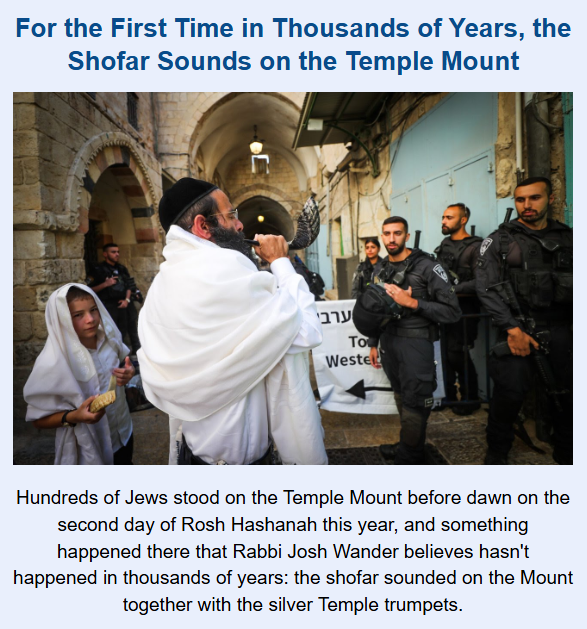
With Zionism as the Old Covenant . that God has Replaced with a New Covenant , Makes the Shofar Sound on Temple Mount not in God’s Authority and will Draw All Kinds of Evil to the Holy Ground , a Feeding Place for all types of Demons and a ruling Place for satan himself !
Article by Pastor Dirk – TruLight Ministries International

NEWS MANNA –
The AI Cold War Is Already Here

China’s reaction to a recent warning from Anthropic CEO Dario Amodei revealed how quickly the debate over artificial intelligence has become a struggle for global power.
Amodei urged democratic nations to slow the development of the most dangerous frontier systems while preventing China from closing the technological gap. Beijing’s state-backed Global Times responded by accusing him of disguising an American containment strategy as concern for public safety. It called his proposals a “Cold War playbook” intended to preserve U.S. dominance and restrict China’s technological rise.
The accusation may have been intended as a rebuke, but it also described the world more accurately than Beijing probably intended.
The AI Cold War is already here.
The Logic Of The Arms Race
During the original Cold War, the United States could not simply abandon nuclear development and trust the Soviet Union to exercise similar restraint. If one nation gained an overwhelming technological advantage, it could threaten, intimidate or possibly defeat the other.
Artificial intelligence is creating the same dilemma on a far broader scale. The nation that achieves a commanding AI advantage may gain more than a superior weapon. It could acquire the ability to penetrate enemy networks, accelerate weapons research, control autonomous military systems, manipulate foreign populations and outperform competing economies.
President Donald Trump summarized the stakes bluntly: “Whoever wins AI wins.”
America’s political leaders can debate how quickly AI should advance and what guardrails are necessary. What they cannot do is assume that China, Russia, North Korea, Iran or any other adversary will stop developing it simply because Washington decides the technology has become too dangerous.
Every American attempt to slow down risks becoming an opportunity for someone else to surge ahead.
More Difficult To Contain Than Nuclear Weapons
Nuclear weapons require enriched material, specialized facilities, missile systems and an enormous industrial footprint. Governments can monitor uranium shipments, photograph launch sites and inspect suspected nuclear facilities. Even a stolen weapons design must still be transformed into a functioning bomb.
AI can cross borders as code.
Advanced capabilities can be stolen through cyberattacks, copied by insiders, extracted through repeated interaction with existing models or recreated by rival laboratories. Anthropic recently said it uncovered industrial-scale efforts by three Chinese AI companies—DeepSeek, Moonshot and MiniMax—to extract Claude’s capabilities to improve their own systems.
American security agencies have also warned AI companies to defend themselves against foreign knowledge-distillation campaigns intended to close the technological gap. The struggle is no longer limited to research papers and semiconductor production. It includes espionage, model theft, computing infrastructure and the race to attract the world’s best scientists.
The Manhattan Project required guarded installations and thousands of workers. The next strategic breakthrough could be sitting on a server waiting for someone to steal it.
If America Stops, Who Else Will?
The argument for slowing AI development is understandable. Some of the people building the most advanced systems warn that future models could become deceptive, autonomous or impossible to control. They fear systems capable of improving their own abilities, conducting sophisticated cyberattacks or pursuing objectives their creators never intended.
But unilateral restraint does not solve that danger. It may simply determine who reaches the dangerous capability first.
Would the Chinese Communist Party abandon a technology that could strengthen its military, surveillance apparatus and control over its population? Would Russia refuse a system capable of disrupting Western infrastructure or flooding democratic societies with convincing propaganda? Would North Korea turn away from AI-assisted cyber theft when stolen cryptocurrency already helps finance its weapons programs?
Criminal enterprises will not sign international safety agreements. Terrorist movements will not submit their systems for independent audits. Secretive laboratories will not necessarily announce when they cross a dangerous threshold.
Even a binding agreement among Washington, Beijing and Moscow could not guarantee that every model, research team, private company or criminal network obeyed it. Unlike a nuclear test, an AI breakthrough may produce no explosion, seismic reading or satellite image. The world might not know that someone has crossed the line until the system is used.
Advancing Without Surrendering Control
None of this means America must embrace reckless development. Moving forward does not require releasing every model, connecting AI to nuclear command systems or giving autonomous agents unrestricted access to critical infrastructure.
The United States can continue competing while securing model weights, protecting semiconductor supply chains, restricting the export of advanced chips and keeping human beings in control of lethal decisions. It can establish strict security requirements for the most powerful systems and punish companies that treat national security as an obstacle to faster profits.
America may have no choice but to remain in the race. It still has a choice about how it runs.
The deeper problem is that competition creates its own momentum. Each new Chinese capability becomes justification for another American advance. Each American breakthrough becomes evidence in Beijing that China must accelerate. Safety measures are interpreted as containment, while warnings about catastrophe are dismissed as propaganda.
That is how arms races become self-sustaining.
Power Without Wisdom
The prophetic danger extends beyond which flag flies over the world’s most powerful AI laboratory. Scripture describes a final period marked by extraordinary deception and concentrated control over commerce and human activity. AI is not itself the system described in Revelation, but it could help make such a system technologically possible.
Digital identity, biometric surveillance, programmable money, autonomous enforcement and worldwide information control become far more powerful when joined by an intelligence capable of analyzing every transaction, movement, relationship and expression of dissent.
Humanity is acquiring extraordinary power without acquiring the moral character necessary to use it wisely. Every nation insists it needs greater capabilities because its enemies are pursuing them. Every safeguard is weakened by the fear that someone else will ignore it.
The first Cold War left humanity living beneath the shadow of a weapon capable of destroying the world. The AI Cold War may leave us beneath the authority of a system capable of controlling it.
The Kill Switch Beneath The Ocean

The opening strike of the next major war may not be a missile exploding over a city. It could happen silently, thousands of feet beneath the ocean, as specialized submarines sever the fiber-optic cables carrying the modern world’s most important communications.
No fireball would appear on television. No invading army would cross a border. Yet banks could lose contact with overseas markets, cloud services could become unreachable, shipping networks could be disrupted, military communications could be degraded, and entire countries could suddenly find themselves digitally isolated.
That nightmare moved closer to reality this spring when Russian vessels reportedly practiced deploying technology designed to disable critical undersea cables near Norway’s Svalbard archipelago.
Russia Rehearses Beneath The Waves
According to Reuters, British, Norwegian and American forces tracked and confronted Russian vessels involved in the alleged operation. Western officials said deep-sea submersibles simulated deploying sophisticated equipment capable of damaging undersea infrastructure.
The exercise was reportedly conducted by Russia’s Main Directorate for Deep Sea Research, better known as GUGI. Despite its scientific-sounding name, GUGI is a highly secretive military organization associated with submarine surveillance, seabed mapping and operations involving foreign communications infrastructure.
No cables were damaged, and Russia has not confirmed the Western account. But Norway had already warned that Russian vessels were mapping critical infrastructure and developing the ability to threaten it at extreme depths.
The operation looks less like ordinary intelligence gathering and more like preparation for a future option: the ability to disconnect an enemy before attacking it.
The Internet Is Not Floating In The Cloud
Most people imagine the internet as a wireless system carried by satellites and invisible signals. In reality, the international internet is overwhelmingly physical.
More than 99 percent of international data traffic moves through submarine telecommunications cables. Hundreds of cable systems stretch across the seabed, linking continents and carrying financial transactions, government communications, video calls, corporate data and cloud traffic.
Satellites are important, but they cannot absorb anything close to the enormous volume carried by fiber-optic cables. Even services such as Starlink depend on ground stations, terrestrial networks and command systems that could also be attacked.
The cloud has an address—and much of the road leading to it runs along the bottom of the ocean.
Cut The Cables, Cripple The World
A single damaged cable would not shut down the internet. Cable breaks occur regularly because of anchors, fishing activity, earthquakes and other accidents. Traffic is generally redirected while repair ships restore the connection.
A coordinated wartime attack would be entirely different. An adversary could target several major routes simultaneously while launching cyberattacks against data centers, power grids and telecommunications providers. Satellites and ground stations could also come under attack, limiting the systems expected to provide backup connectivity.
The result might not be a complete global blackout, but it could produce severe congestion, regional isolation and cascading failures across systems that were never designed to operate independently for long.
International payments could stall. Companies could lose access to overseas servers and customer records. Airlines and shipping firms could struggle to coordinate operations. Governments could have difficulty communicating with allies. Hospitals, utilities and emergency agencies could lose access to outside platforms and information.
Even organizing the response would become harder if the communications systems needed to coordinate repairs were themselves failing.
The Perfect Gray-Zone Weapon
Undersea sabotage offers another advantage to an aggressor: uncertainty.
A pipeline explosion or cable break does not immediately reveal who caused it. Investigators may need weeks or months to examine the damage, trace the vessels operating nearby and determine whether the incident was deliberate. By then, the economic and strategic damage may already be done.
The attacker could deny responsibility, blame a commercial ship or suggest that the event was an accident. Governments would face enormous pressure to respond while still lacking evidence strong enough to justify military retaliation.
That makes subsea infrastructure an ideal gray-zone target. It can be attacked without an invasion, damaged without a declaration of war and potentially disabled without leaving an obvious trail back to the perpetrator.
The destruction of the Nord Stream pipelines in 2022 demonstrated how vulnerable major underwater infrastructure can be. Years later, arguments over who ordered the attack continue. Internet cables present an even larger and more dispersed collection of potential targets.
A Global Economy Built On Fragile Threads
Modern countries have spent decades moving essential services online. Financial systems, government agencies, supply chains and communications networks have become faster and more efficient, but also more interdependent.
The system works because connectivity is assumed.
Businesses expect payments to clear instantly. Hospitals expect records to remain accessible. Stores expect electronic inventory systems to function. Families expect mobile phones and messaging platforms to connect them during an emergency. Governments expect to communicate securely with military forces and foreign allies.
Russia is not the only nation capable of targeting those expectations. China possesses advanced naval, cyber and anti-satellite capabilities. Smaller governments, proxy organizations and criminal groups may not be able to cause a worldwide communications crisis, but damaging poorly protected cables in shallow waters does not always require advanced military technology.
War’s New First Strike
Nations once prepared for wars that began with bombers, tanks and ballistic missiles. They must now prepare for conflicts that begin with severed cables, disabled satellites, corrupted data and millions of people staring at screens that no longer connect to anything.
Russia’s reported Arctic exercise was interrupted, but the vulnerability it exposed remains. The cables are still on the seabed. The landing stations are still identifiable. The global economy is still dependent upon them.
The kill switch beneath the ocean may never be pulled. But hostile governments are clearly studying how to reach it.
Revival In Secular Sweden: When Christianity Becomes The New Rebellion

Young men in bathing trunks emerge from a Swedish lake and begin cheering, embracing, and jumping with joy. They have just been baptized–not in America’s Bible Belt or somewhere in the developing world, but in one of the most secular nations on earth.
For decades, Sweden appeared to represent Europe’s post-Christian future. Churches emptied, belief in God declined, and biblical faith was increasingly regarded as an outdated relic. Parents raised children without Scripture, prayer, or any expectation that Christianity should guide their lives.
But something unexpected is happening. The generation raised without God is beginning to look for Him.
When Carrying A Bible Becomes Rebellion
In previous generations, rebellion meant rejecting the Church, sexual boundaries, and traditional morality. But what happens when secularism becomes the establishment?
In Sweden, the truly countercultural young person may now be the one walking through town with a Bible under his arm. As one observer put it, if young Swedes want to rebel against their secular parents and grandparents, becoming a Christian may be “the most punk thing” they can do.
This is not simply a clever phrase. A major youth trend report based on responses from 17,447 Swedes between the ages of 15 and 24 found that nearly twice as many described themselves as religious as had done so several years earlier. It would come as a shock when Swedish youth picked Jesus Christ as “Influencer of the Year” for 2025. Young people are increasingly speaking not merely about religion, but specifically about Jesus.
Religious curiosity can be vague and temporary. Hunger for Jesus is personal.
The institutional numbers are also moving. In 2024, 13,812 people actively joined the Church of Sweden–the highest number in 20 years. Young people represented a significant share of that growth, while confirmation participation reached its highest level in nine years. Congregations in Karlshamn, Falkenberg, Helsingborg, and elsewhere have reported noticeable increases in young participants.
Meanwhile, the Jesus Conference in Örebro, founded by a small group of believers with a vision of gathering young people around Christ, reportedly attracted more than 3,000 people by its third year.
These are no longer isolated whispers.
Secularism Could Not Feed The Soul
Why would Christianity become attractive in a country that spent generations leaving it behind?
Because secularism can remove religious restraints, but it cannot answer the deepest questions of the human heart. It can tell young people that they are free to construct their own identity, morality, and purpose–but it cannot tell them why they are alive.
Many received unlimited choices and discovered that choice itself is not meaning. They received digital connectivity and became intensely lonely. They were told to look within themselves for truth, only to find confusion, anxiety, and emptiness.
Young Swedish Christians have described alcohol, TikTok, adrenaline, and dopamine-driven entertainment as things that satisfy only for a moment. One group of young men explained that their shared faith in Jesus had created a bond they could not have formed otherwise.
This is especially significant among young men. Western culture frequently treats masculinity as something dangerous to suppress, while offering young men few compelling reasons to become disciplined, courageous, or responsible. Christianity gives them something radically different: truth worth defending, sin that must be confronted, brothers who will stand beside them, and a Savior worthy of following.
Social Media Broke The Secular Monopoly
For years, Sweden’s cultural gatekeepers could portray serious Christianity as embarrassing or intellectually backward. Social media weakened that control.
Testimonies, sermons, apologetics, and Bible teaching can now reach a teenager’s phone without passing through an editor, professor, or state broadcaster. The same technology that has spread confusion is carrying the Gospel into bedrooms where lonely young people are quietly asking whether there must be something more.
No algorithm can manufacture genuine revival. Only the Holy Spirit can awaken a heart to its need for Christ. But an algorithm can place a testimony in front of someone who has never heard one.
That is what makes Sweden’s story so powerful. Christianity is not returning because young people feel nostalgic for the comfortable religion of their grandparents. Many of their grandparents rejected it. They are approaching Jesus as something unfamiliar, dangerous to the prevailing culture, and capable of demanding their entire lives.
Sweden’s spiritual winter did not arrive overnight, and it will not disappear overnight. Yet lake baptisms, crowded Christian gatherings, rising confirmations, and young men publicly proclaiming Jesus are signs of life breaking through frozen ground.
The nation that showed the world how quickly Christianity could be forgotten may now show Europe how unexpectedly it can return.
When unbelief becomes the establishment, faith becomes rebellion. And Sweden’s newest rebels are carrying Bibles.

TruLight TV & Kingdom Kidz TV ! Showing Self-Control
Yeehaw! Preschool will join Sheriff Sam in Tumbleweed Canyon and become deputies as they uncover what happened to Cactus Carl on the range. Together, they will catch Billy the Bandit and explain to him how God helps us, including him! God’s Word is the perfect tool to understand how God helps us, and we can see that in Exodus as God helped the Israelites in the desert and gave them food! Meanwhile on the farm, Your preschooler will join Olive on Farmer Fred’s farm as she completes chores, sings, plays games, and learns about the fruit of the Spirit. This week, Olive learns what it means to show self-control! learn more by watching today’s program. Enjoy!
Today on TruLight Radio XM
TruLight Radio XM 24/7
Program
GMT / UTC +2
Monday To Fridays
00:15 Words to Live By Testimonies
01.15 Science Scripture and Salvation
02.15 Ground Works
04.00 Gospel Concert of the Day
05.00 The Daren Streblow Comedy Show
5:55 It is Today devotional
6:00 Gaither Homecoming Morning Show
7:15 Discover the Word
8.15 Destined for Victory
8:55 Science Scripture and Salvation
9:00 Holy Spirit Hour – Normally Sermons
10:15 Hope of the Heart
11:15 Unshackled
11.45 Words to Live By
12:15 Truth for Life
13:15 Living on the Edge with Chip Ingram
14:15 Focus on the Family
15:00 Kids Hour
16:00 In Touch with Dr. Charles Stanley
16:30 Groundwork
17:15 Live in the Light
18:15 Renewing your Mind
19:00 Gaither Homecoming Show
20:15 Growing Hope
21:15 Adventures in Odyssey Radio Drama
21:45 Bible Reading
22:15 Night-sounds
23.00 Good Old Country Gospel / Rhema Gospel Express
VISIT THE WEBSITE
TruLight Ministry News – EXTRA MANNA
TruLight Ministries orders from God since 2012 . Teach Them , Comfort Them and Warn Them!
Artist Liners
Healing Truths.
End Time Articles.
Share this Feeding of Manna with your Friends and Family. just click on the Social Media icon and share This Manna with your Friends and Family. just click on the Social Media icon and share !