Hosted by TruLight Ministries International – The Place of Truth
SELECT YOUR READING LANGUAGE – BOTTOM LEFT = YOUR DAILY MANNA NOW AVAILABLE IN 103 LANGUAGES
@ TruLight Daily Manna is not Just a Bible Verse with a Small Prayer . NO ::: WE SERVE DAILY Manna for the ENTIRE Day . Breakfast , Lunch , Dinner , Plus tea Times and even Entertainment Manna . Plus News Manna and More , This Daily Manna will keep you Spiritually full for the full 48 Hours and even More to Share with your Friends and Family !!!
The 12 Tests From God !!!
The 12 Tests to Spiritual Growth –
The 12 Tests, every Christian / Child of God will have to go through to qualify as a sealed Child of God. The Tests take between 4 – 14 months to pass and do not come to each person in any particular order! If you do not pass the Test, he will have to revise it, go through it again to pass it in the future.
14 Months is the period of the Test from experience as a Family that went through the 12 Tests over a Period of 22 Years. Of which the last 12 years were the worst but also WERE the most spiritually successful 12 years of our ministry as a family of Christ.
If you are tested as a single person, the period is shortened, but as a family, everyone must pass the Test to move on to the next one.
The Tests are in no particular order.
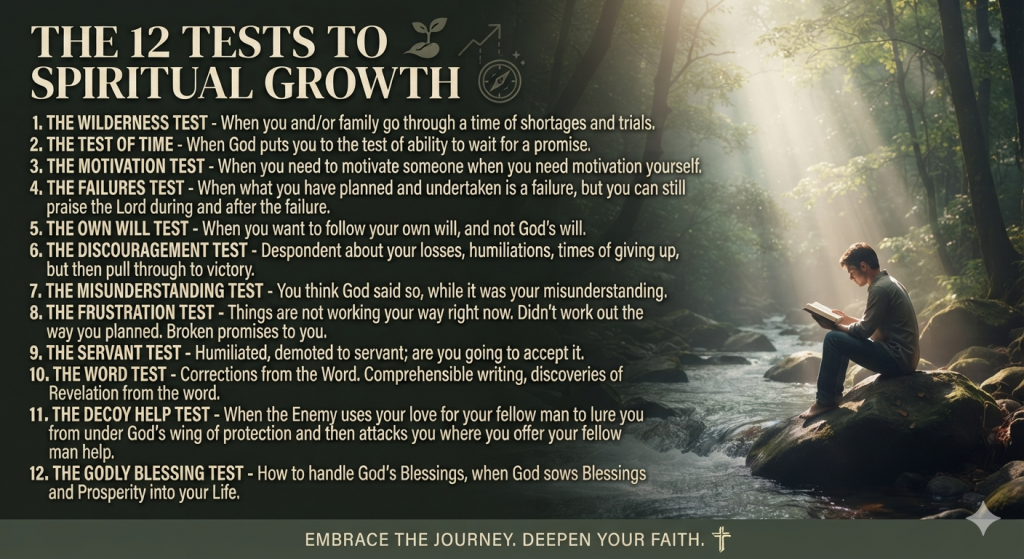
1. The Wilderness Test – When you and or family go through a time of shortages and trials.
2. The Test of Time – when God puts you to the test of ability to give a promise.
3. The Motivation Test – when you need to motivate someone when you need motivation yourself.
4. The Failures Test – when what you have planned and undertaken is a failure, but you can still praise and Praise the Lord during and after the Failure.
5. The Own Will Test – when you want to follow your own will, and not God’s will!
6. The Discouragement Test – Despondent about your losses, humiliations, times of giving up, but then pull through to victory
7. The Misunderstanding Test – You think God said so. While it was your misunderstanding
8. The Frustration Test – Things are not working your way right now. Didn’t work out the way you planned – Broken promises to you
9. The Servant Test – Humiliate, demoted to servant, are you going to accept it
10. The Word Test. corrections from the Word. Comprehensible writing, discoveries of Revelation from the word,
11. The Decoy Help Test – When the Enemy uses your Love for your fellow man to lure you Under God’s wing of Protection and then attacks you where you offer your fellow man help.
12. The Godly Blessing Test – How to Handle God’s Blessings, when God Sows Blessings and Prosperity into your Life.
These 12 spiritual tests represent crucial phases of character development and faith refinement that believers encounter on their spiritual journey. Passing these tests shifts your focus from reliance on human strength to total dependence on divine purpose.
1. The Wilderness Test
- Core Focus: Humility and material dependence.
- The Dynamic: God strips away familiar comforts, exposing your family to shortages or emotional droughts.
- The Purpose: To reveal what is truly in your heart when resources run dry. It forces you to rely on divine provision rather than your own bank account or intellect.
- Biblical Example: The Israelites in the desert learning to trust God for daily manna (Deuteronomy 8:2-3).
2. The Test of Time
- Core Focus: Patience and steady endurance.
- The Dynamic: A massive gap of time occurs between receiving a divine promise and its actual fulfillment.
- The Purpose: It tests your internal attitude during the waiting period. It proves whether you will try to manufacture a shortcut or patiently allow character development to complete its work.
- Biblical Example: Abraham waiting 25 years for the birth of his promised son, Isaac.
3. The Motivation Test
- Core Focus: Selfless service and emotional maturity.
- The Dynamic: You are personally drained, discouraged, or empty, yet called to encourage and build up someone else.
- The Purpose: To see if your service is driven by how you feel, or by obedience and love. Giving out of your own lack breaks the power of self-pity and activates supernatural joy.
- Biblical Example: The Apostle Paul writing encouraging letters to churches while chains bound him in prison.
4. The Failures Test
- Core Focus: Unconditional praise and identity.
- The Dynamic: Your best plans, ministries, or business efforts collapse into absolute failure.
- The Purpose: To see if your worship is tied to your success. Praising God in the wreckage proves that He is your ultimate prize, not your achievements. It shifts your identity from “what you do” to “whose you are.”
- Biblical Example: Job losing his wealth and children, yet falling to the ground to worship God (Job 1:20-21).
5. The Own Will Test
- Core Focus: Submission and ultimate lordship.
- The Dynamic: Your personal desires, career paths, or relationships directly conflict with clear commands from God.
- The Purpose: To break human stubbornness. This test asks the ultimate question: Is He truly Lord of your life, or are you just using Him to bless your own agenda?
- Biblical Example: Jesus in the Garden of Gethsemane praying, “Not my will, but Yours be done” (Luke 22:42).
6. The Discouragement Test
- Core Focus: Resilience and spiritual warfare.
- The Dynamic: You face heavy losses, public humiliation, or serial setbacks that make you want to throw in the towel.
- The Purpose: To develop the spiritual fortitude required for higher leadership. Victory is birthed when you refuse to let emotions dictate your reality and instead choose to encourage yourself in the Lord.
- Biblical Example: David at Ziklag, where his town was burned and his men wanted to stone him, but he encouraged himself in God (1 Samuel 30:6).
7. The Misunderstanding Test
- Core Focus: Discernment and humility.
- The Dynamic: You move forward confidently, thinking you heard a specific direction from God, only to realize it was your own imagination or desire.
- The Purpose: To kill pride and teach accurate spiritual hearing. Admitting you misheard requires massive humility, and it refines your ability to distinguish your own inner voice from the Holy Spirit.
- Biblical Example: King David eagerly planning to build the Temple, only for Prophet Nathan to correct him that God intended his son to build it instead.
8. The Frustration Test
- Core Focus: Emotional control and flexibility.
- The Dynamic: Doors slam shut, schedules fall apart, and people break their promises to you, causing chaotic delays.
- The Purpose: To reveal whether you will respond with fleshly anger, panic, and grumbling. It tests your underlying belief that God overrules human failure and aligns all things for your ultimate good.
- Biblical Example: Joseph remaining steady and upright despite being forgotten in prison by the chief cupbearer who promised to help him.
9. The Servant Test
- Core Focus: Lowliness and freedom from ego.
- The Dynamic: You are overlooked, demoted, or given menial, hidden tasks far below your actual skill level.
- The Purpose: To expose hidden pride, entitlement, and the need for human recognition. If you are too big to serve in obscurity, you are too small to lead in public.
- Biblical Example: Elisha pouring water on the hands of Elijah, serving faithfully before ever receiving his mantle.
10. The Word Test
- Core Focus: Teachability and doctrinal integrity.
- The Dynamic: Scripture directly confronts your lifestyle, uncovers hidden sins, or requires deep study to extract fresh revelation.
- The Purpose: To see if you will bend your life to fit the Word, or bend the Word to excuse your life. It ensures your spiritual growth is anchored in objective truth rather than shifting emotions.
- Biblical Example: King Josiah weeping and tearing his clothes when the lost Book of the Law was found and read aloud.
11. The Decoy Help Test
- Core Focus: Spiritual warfare and boundaries.
- The Dynamic: The enemy exploits your genuine compassion for hurting people to lure you out of your safe boundaries and ambush you.
- The Purpose: To teach you that you cannot save everyone, and that compassion without divine strategy is dangerous. It trains you to seek God’s permission before jumping into every rescue mission.
- Biblical Example: Joshua making a deceptive covenant with the Gibeonites out of pity without consulting the Lord first (Joshua 9).
12. The Godly Blessing Test
- Core Focus: Stewardship and spiritual focus.
- The Dynamic: God suddenly pours out massive material prosperity, comfort, popularity, and success.
- The Purpose: Success is often harder to survive than hardship. This test evaluates whether you will become self-sufficient, lazy, or arrogant, or if you will channel those blessings into kingdom purposes while remaining desperately dependent on God.
- Biblical Example: King Solomon, who received unmatched wealth and wisdom but slowly allowed his abundant blessings to turn his heart away from God
THE NEXT TEST
| Rethinking Empowerment in Ministry |
| Entrusted, Not Delegated: Jethro watched his son-in-law work for a single day and had seen enough. Moses sat from morning until evening while the people stood around him waiting, and the old priest asked the question that has followed pastors ever since: “Why do you alone sit as judge?” (Exodus 18:14). Moses had an answer ready. The people come to me. They need someone to inquire of God. I settle the disputes between them. Every word of it was true, and that was the problem. Moses was not exaggerating his indispensability. He had simply built a ministry in which he actually was indispensable, and he had done it sincerely, out of love for the people. Jethro’s response is worth sitting with. “What you are doing is not good. You will surely wear yourself out, both you and these people with you” (Exodus 18:17-18). Notice who wears out. Not only the leader. The people too. A congregation gathered around a single exhausted figure is being slowly worn down alongside him, whether or not anyone can name it yet. A Word We Borrowed Empowerment came into church vocabulary from management literature, and it carries an assumption we rarely examine: that power is mine, and that I am generous enough to hand some of it out. Framed that way, empowerment is still a story about the leader. The pastor remains the center of gravity. Others receive what he chooses to release. Paul uses a different word. In Ephesians 4 he says Christ gave pastors and teachers “to equip the saints for the work of ministry” (Ephesians 4:12). The verb behind “equip” is the one used when James and John are mending their nets (Mark 1:19), and it appears elsewhere for setting a broken bone. It means to repair, to make ready, to restore something to its proper use. It has nothing to do with distributing my authority and everything to do with preparing people for work that is already theirs. Read the sentence slowly. The saints do the work of ministry. Pastors get them ready. A church in which the pastor performs the ministry and the congregation watches has the sentence backwards, however faithfully the pastor is working. This is why entrusting the work is not a leadership technique or a survival tactic. It is stewardship. The calling on your life is real, and it is not a possession. You are caring for something God gave to a whole body, and part of caring for it well is refusing to keep it in your own hands. Seeing People Before They See Themselves When the church in Antioch needed a teacher, Barnabas went to Tarsus to look for Saul (Acts 11:25-26). Someone had to go find him. Saul was not volunteering, and there was no obvious reason for a suspicious young church to want him. Most people in your congregation will not identify their own gifts. They will notice a small competence, assume it is unremarkable, and never mention it. Gifts usually get named by someone else first, often by a pastor who paid enough attention to see it. That kind of attention is slow work, and it looks different from filling slots. Filling slots asks who is available. Naming gifts asks who this person is, what they cannot stop caring about, and where they come alive. The first approach keeps a calendar covered. The second builds a church. Trust Costs Something Jesus sent out the seventy-two before they were ready (Luke 10:1). He had already sent the Twelve out on their own (Mark 6:7), knowing what he knew about them. They would misunderstand him repeatedly in the chapters that follow. He sent them anyway. When you hand real responsibility to someone, it will be done differently than you would have done it, and sometimes it will be done worse. This is the actual cost, and there is no version of entrusting that avoids it. If you take the work back at the first imperfection, you have taught the person that you never really meant to give it away, and they will not step forward again quickly. It helps to be honest about why the taking back happens. Sometimes it is genuine concern for the congregation. Sometimes it is a quieter fear: that if others can do this well, we are less necessary than we hoped. That fear is common among faithful pastors and it is not a disqualification. But it is worth bringing into prayer rather than letting it operate unnamed, because it will otherwise make decisions for you. Staying Near While Letting Go Mark describes the calling of the Twelve in two movements. Jesus appointed them “that they might be with him and that he might send them out” (Mark 3:14). Being with comes first, and it does not stop when the sending begins. They return from their mission and report to him. He takes them away to a quiet place. Handing over responsibility is not the same as walking away from it. Paul told Timothy to entrust what he had received “to faithful men who will be able to teach others also” (2 Timothy 2:2), a chain of four generations of care in a single sentence. Entrusting means staying close: asking how it went, offering correction that is specific and kind, being present when something goes wrong, and saying out loud what you saw them do well. This rarely requires a program. It usually requires a standing conversation. What It Gives Back When the Spirit rested on the seventy elders and two of them prophesied in the camp, Joshua wanted Moses to stop it. Moses answered, “Are you jealous for my sake? Would that all the Lord’s people were prophets” (Numbers 11:29). Joshua saw a threat to his leader’s standing. Moses saw the point of the whole thing. Yes, the load gets lighter. Jethro promised exactly that, and it is a real mercy for pastors who are carrying more than one person can carry. But relief is what happens on the way to something larger, not the reason to begin. The reason is that the church is a body and was never designed to run through one set of hands. Every pastor eventually leaves. A call elsewhere, retirement, illness, the end of a life. What the congregation is able to do the morning after is decided long before that morning arrives, in a hundred ordinary choices about whether to keep the work or entrust it. The question is not whether you are willing to delegate. It is whether the people you serve are being made ready. |
Understand spiritual growth with Pastor Dirk.

Tea Time Manna
But the ministry Jesus has received is as superior to [those who served as priests in Old Testament times,] as the covenant of which he is mediator is superior to the old one, and it is founded on better promises.
—Hebrews 8:6
The Old Testament is a beautiful covenant of love, as God redeems fallen humanity and sets in motion his promises and plans for grace to bring to us Jesus through the descendants of Abraham. But as powerful as that old covenant was, we have come to a superior covenant. It is far superior to theirs. Why? The mediator of this new covenant is Jesus, who is a better priest and the perfect sacrifice and guarantor of God’s great promises coming to his people and the lost world!
Prayer
Thank you, Almighty God, for sending Jesus to fulfill the promises and carry out the plan you set in place so long ago and revealed by your prophets of old. I thank you and praise you in the name of Jesus Christ, my Lord, the guarantor of a better covenant and hope. Amen and Amen

NEWS MANNA –
Iran’s End-Times Theology Is More Dangerous Than Its Missiles
The West tends to explain wars in terms of military strength, economics, diplomacy, and political ambition. Those factors certainly matter. But when it comes to Iran, one critical element is often overlooked: theology.
For many in the Islamic Republic, history is not simply unfolding–it is moving toward a divinely ordained climax. The current conflict with the United States and Israel is viewed by some not merely as another Middle East war, but as part of the events that will usher in the return of Islam’s long-awaited messianic figure: the Mahdi.
That belief is no longer confined to obscure religious circles. It has become intertwined with the ideology of the Islamic Republic itself, echoed by senior officials, promoted within the Islamic Revolutionary Guard Corps (IRGC), and increasingly amplified across the Muslim world through social media.
This matters because beliefs shape behavior. Nations do not simply fight with weapons; they fight with worldviews. And when leaders become convinced they are participating in a divine script, traditional assumptions about deterrence, compromise, and even survival begin to change.
A Theology That Shapes A Nation
Iran is the world’s largest Shiite Islamic power, and its ruling establishment is deeply rooted in Twelver Shiite theology. Central to that belief is the expectation that the Twelfth Imam, Muhammad al-Mahdi, did not die but entered a state of hidden existence over a thousand years ago. One day, believers say, he will return to establish worldwide justice after a period of extraordinary chaos, bloodshed, and oppression.
Unlike many religious traditions where end-times prophecy remains largely academic, Mahdist expectation has become woven into the identity of Iran’s revolutionary government.
Since the 1979 Islamic Revolution, Iranian leaders have repeatedly framed their struggle against the West as part of a larger spiritual battle. References to martyrdom, sacrifice, and preparing the way for the Mahdi are common themes in official speeches and state ceremonies.
Recent reports suggesting that some within the Revolutionary Guard believe the current war could precede the Mahdi’s appearance should therefore surprise no one. Whether every specific claim proves accurate is secondary to the larger reality: the expectation itself is deeply embedded within the ideological framework of the regime.
Even senior representatives of Supreme Leader Ayatollah Ali Khamenei have described the Revolutionary Guard and its elite Quds Force as instruments for preparing the way for the “Imam of the Age.”
That is not fringe theology. It is part of the worldview of one of the most powerful military organizations in the Middle East.
When Prophecy Changes Military Strategy
Western military planners generally assume every government seeks self-preservation.
History suggests otherwise.
People convinced they are participating in God’s final plan often accept sacrifices that appear irrational to outside observers.
Throughout the Iran-Iraq War, hundreds of thousands of young Iranians willingly marched into overwhelming danger, inspired by themes of martyrdom rooted in the Battle of Karbala. The willingness to suffer for a perceived divine purpose became a defining feature of the Islamic Republic’s identity.
That same theology continues to influence how many believers understand the present conflict.
If hardship is interpreted as evidence that prophecy is unfolding, military setbacks do not necessarily weaken resolve–they can reinforce it.
If suffering is viewed as preparation for the Mahdi’s return, escalating conflict may be embraced rather than avoided.
That helps explain why Iran has repeatedly endured devastating sanctions, economic collapse, and military losses without abandoning many of its long-term objectives.
The calculus is not merely geopolitical.
It is theological.
The Mahdi And The Biblical Christ Could Not Be More Different
Many Christians know little about Islamic end-times beliefs. Yet understanding them has become increasingly important.
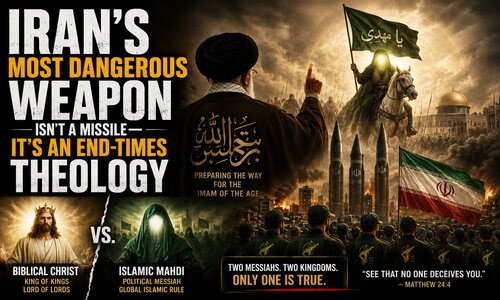
Islam teaches that the Mahdi will establish global Islamic rule. According to many Islamic traditions, Jesus (Isa) will also return–but not as Christianity understands Him.
Instead, Islamic tradition portrays Jesus as affirming Islam, rejecting His own divine identity, breaking the cross, abolishing Christianity as it exists today, and helping establish Islamic authority over the nations.
Some traditions even describe the conversion of Jews and Christians to Islam under this new order.
Compare that with Scripture.
The Bible declares that Jesus Christ returns as King of Kings and Lord of Lords, not to validate another religion but to judge the nations, defeat evil, and establish His righteous Kingdom. He is not a subordinate to another leader. He is the sovereign King before whom every knee will bow.
The contrast is profound.
Both worldviews anticipate a climactic struggle.
Both expect Jesus to appear.
Both foresee a decisive confrontation between good and evil.
Yet the identity, mission, and authority of Jesus are completely opposite.
One cannot be reconciled with the other.
Could These Expectations Prepare The Way For A Global Deception?
Scripture repeatedly warns that humanity will one day embrace a powerful global leader who performs astonishing signs, deceives the nations, and demands allegiance.
Jesus warned repeatedly against false messiahs.
The Apostle Paul described a coming “man of lawlessness.”
The book of Revelation portrays a charismatic world ruler who gains extraordinary influence before Christ’s return.
While Christians differ on many prophetic details, the Bible is remarkably consistent on one point: the last days will be marked by unprecedented spiritual deception.
That makes today’s Islamic expectations particularly noteworthy.
Hundreds of millions of Muslims are actively anticipating the arrival of a divinely appointed world leader. Many expect a period of global conflict before his appearance. Many believe he will establish worldwide justice through Islamic rule.
Whether or not one believes the Islamic Mahdi corresponds in any way to the biblical Antichrist, the existence of such widespread expectation demonstrates how prepared vast populations already are to receive a charismatic religious-political leader promising peace, justice, and global unity.
The stage is being set–not necessarily by one nation, but by ideas that transcend borders.
More Than Missiles
The greatest mistake Western policymakers can make is assuming Iran thinks like the West.
Economic pressure alone cannot deter a regime that interprets suffering through the lens of prophecy.
Military victories alone cannot defeat an ideology that views martyrdom as triumph.
Diplomatic agreements cannot easily satisfy leaders who believe history itself is moving toward divine intervention.
This is why understanding Iran requires more than intelligence reports and satellite imagery. It requires understanding the theological convictions driving many of those making decisions.
For Christians, these developments are also a reminder that the Bible’s warnings about spiritual deception were never intended to produce fear, but discernment. Competing visions of the future are increasingly shaping global events, and billions of people are looking for a savior who will solve the world’s crises.
The question is not whether humanity is waiting for a messiah.
It is which messiah the world is preparing to receive.
That is why Jesus repeatedly warned His followers: “See that no one deceives you.” In an age when wars, religious expectation, and global instability are converging, that warning has never been more relevant.
Why Are Woke Christian Churches Obsessed With Drag Shows?

When Grosvenor Park United Church in Saskatoon, Saskatchewan, announced it would host a ticketed “All Ages Drag Show” featuring performers dressed as DC comic book characters, it wasn’t simply promoting another community event. Admission was set at $10 for ages 12 and older, $5 for children ages 5-11, while children four and under were admitted free.
For supporters, the event represented inclusion, diversity, and hospitality. For critics, it represented yet another example of a church embracing values increasingly at odds with historic Christian teaching.
But while the headlines focused on one congregation in one Canadian city, the bigger story reaches far beyond Saskatoon.
Over the past several years, a growing number of progressive churches throughout Canada, the United States, and Europe have hosted drag story hours, Pride worship services, drag brunches, and drag performances. This is no longer an isolated incident or an unusual experiment. It has become a recognizable pattern.
Which raises a more important question.
Why has drag become such a recurring symbol within progressive Christianity?
The answer isn’t simply about entertainment or community outreach. It reflects a much deeper shift in how some churches understand Scripture, identity, and their mission in the modern world.
The drag show isn’t really the story.
It’s the symptom.
Drag Has Become More Than Entertainment
For most of history, churches sought to distinguish themselves from the surrounding culture. They cared for the poor, welcomed sinners, and proclaimed forgiveness through Christ, but they also believed they were called to be “set apart.”
Today, many progressive churches appear to be pursuing a different goal: demonstrating cultural relevance.
That helps explain why drag has become such a powerful symbol.
Drag is no longer merely a form of theatrical entertainment. It has become a cultural statement about identity, gender, and self-expression. Hosting a drag event publicly communicates that a church has embraced contemporary views on these issues and wishes to be recognized for doing so.
Consider what receives the headlines today. Churches are rarely celebrated in secular media for holding prayer meetings, Bible studies, or evangelistic outreaches. But host a Pride event or an all-ages drag show, and national attention quickly follows.
That isn’t accidental.
Drag has become one of the defining symbols of progressive culture, and increasingly, it has become one of the defining public symbols of progressive Christianity. It functions almost like a statement of allegiance–a way of declaring that traditional Christian understandings of sexuality and gender have been replaced by a newer vision centered on affirmation and self-expression.
The irony is striking. For two thousand years, the defining public symbols of Christianity have been the cross, baptism, communion, and the proclamation of the Gospel. Increasingly, however, some churches seem to gain the most public attention not for preaching Christ but for showcasing the latest cultural causes.
A Different Mission
Historically, the Church understood its mission in fairly straightforward terms.
Proclaim the Gospel.
Call people to repentance.
Make disciples.
Teach obedience to Christ.
Love sinners while pointing them toward transformation.
That mission assumed something fundamental: that every person–including every Christian–is being transformed into the likeness of Christ.
Many progressive churches increasingly begin with a different assumption.
Rather than asking, “How does Christ transform us?” the first question often becomes, “How can the church affirm people exactly as they understand themselves today?”
That subtle shift changes everything.
The emphasis moves from transformation to affirmation.
From repentance to validation.
From conforming our lives to Scripture to reinterpreting Scripture through the lens of modern identity.
Jesus welcomed sinners without reservation, but He never left them where they were. His grace always carried an invitation to repentance, renewal, and a new life. The Gospel was never merely an affirmation of our present identity; it was an invitation to become a new creation in Christ.
When affirmation replaces transformation as the church’s central message, events like drag shows become far easier to justify–not because they represent the mission of historic Christianity, but because they reflect an entirely different understanding of what the church exists to accomplish.
Why Progressive Christianity Keeps Following Culture
Perhaps the most revealing question is this:
Why do progressive churches so often arrive at the same conclusions the surrounding culture reached first?
Twenty years ago, virtually no churches hosted drag performances.
The Bible has not changed.
The teachings of Christ have not changed.
Human nature has not changed.
Culture has.
As society’s views on sexuality and gender shifted, some churches shifted with it. Tomorrow, if culture embraces new moral revolutions, history suggests these same churches may once again find themselves adapting in order to remain culturally relevant.
This pattern has repeated itself throughout church history.
Whenever the church seeks acceptance more than faithfulness, it becomes increasingly difficult to distinguish where Scripture ends and contemporary culture begins.
Ironically, the more a church mirrors the world, the less it has to offer the world.
If the church simply echoes society’s latest moral consensus, why should anyone look to it for timeless truth?
People do not need the church to repeat what they already hear from universities, entertainment, social media, and politicians. They need the church to proclaim something eternal–something that does not rise and fall with the latest cultural trend.
The Iceberg Beneath The Headlines
Most people focus on the visible controversy.
The drag show.
The Pride service.
The rainbow banners.
Those are merely the tip of the iceberg.
Beneath the surface lie far more significant theological changes.
It often begins with a diminished confidence in the authority of Scripture.
Once Scripture is no longer viewed as the final authority, difficult teachings become negotiable.
Sin is redefined.
Repentance becomes optional.
Affirmation becomes the highest virtue.
Personal identity becomes central.
Culture gradually becomes the teacher.
Eventually, practices that would once have been considered incompatible with historic Christian teaching no longer appear controversial within those communities. By the time a church hosts an all-ages drag show, the foundational theological changes have often been unfolding for years.
The event itself simply reveals where the church has already arrived.
This is why Christians should resist the temptation to become consumed by outrage over individual events. Those events are only the visible fruit. The roots lie much deeper–in how Scripture is interpreted, how sin is understood, and whether the church still believes God’s Word has the authority to challenge every culture, including our own.
An Ancient Pattern In A Modern Form
The Bible records a recurring temptation for God’s people.
Israel repeatedly adopted the beliefs and practices of surrounding nations, convinced they could blend devotion to God with the values of neighboring cultures. Whether it was the worship of Baal, the Asherah poles, or the customs of neighboring peoples, the issue was never merely the outward symbol.
The deeper issue was always the same.
Who was shaping Israel’s worship?
God–or the surrounding culture?
Today’s debates involve different issues, but they raise the same timeless question.
Who ultimately determines what the church believes?
Scripture?
Or the prevailing spirit of the age?
Every generation of Christians must answer that question. Every generation faces the temptation to soften uncomfortable truths in exchange for cultural acceptance.
More Than A Culture War
This discussion should not become an excuse for self-righteousness.
Every church faces cultural pressures.
Conservative churches can drift into political tribalism, celebrity culture, nationalism, consumerism, or elevating personalities above Christ. Progressive churches face different temptations.
The challenge is universal.
The issue is not whether the church engages culture–it must.
Jesus called His followers to be in the world, not of it.
The issue is whether the church is ultimately shaped by culture.
Christians are called to love every person with compassion, dignity, and grace because every human being bears the image of God. But genuine love also believes that God knows what leads to human flourishing better than any culture ever could.
Love without truth becomes sentimentality.
Truth without love becomes harshness.
Biblical Christianity has always insisted that both belong together.
The Real Question
Viewed in isolation, the event at Grosvenor Park United Church may appear to be simply another local controversy.
Viewed within the broader theological and cultural shifts reshaping parts of the modern church, however, it becomes something much more significant.
Drag shows will eventually fade from the headlines.
Another controversy will replace them.
But the deeper issue will remain.
Who has the authority to define truth?
If Scripture remains the church’s final authority, then the church will inevitably find itself at odds with the culture at times, just as it has throughout history.
But if cultural approval becomes the highest priority, then every new social revolution will eventually find its way into the sanctuary.
The real question is not why one church in Saskatoon hosted a drag show.
The real question is why an increasing number of churches now believe such events faithfully express the mission of the church.
That conversation reaches far beyond one congregation or one denomination.
It goes to the very heart of whether the church exists to reflect Christ to the world–or to reflect the world back to itself.

TruLight TV : The Fulfillment Of A Promise
Whether you stick to a detailed schedule every day or you go with the flow, you probably grow frustrated when obstacles change the direction of your big life plans. Maybe you didn’t get into your dream school or you were let go from a job you loved. Either way, big shake-ups can seemingly throw us off, but the good news is that God establishes our steps no matter the course. Watch today’s video to learn more. and later our sermon today from Dr. Charles Stanley (The Fulfillment Of A Promise) – God gives us many wonderful promises in His Word, but we often don’t live by them. This leads us to think that God won’t answer our prayers, and we doubt His desire to work in our lives. We end up asking for things that are not in His will and have no foundation in Scripture. If we want answers to our prayers, we need to ask God for things that are rooted in His Word. Enjoy and Thanks For watching and Share this Video With your Friends.
Today on TruLight Radio XM
TruLight Radio XM 24/7
Program
GMT / UTC +2
Monday To Fridays
00:15 Words to Live By Testimonies
01.15 Science Scripture and Salvation
02.15 Ground Works
04.00 Gospel Concert of the Day
05.00 The Daren Streblow Comedy Show
5:55 It is Today devotional
6:00 Gaither Homecoming Morning Show
7:15 Discover the Word
8.15 Destined for Victory
8:55 Science Scripture and Salvation
9:00 Holy Spirit Hour – Normally Sermons
10:15 Hope of the Heart
11:15 Unshackled
11.45 Words to Live By
12:15 Truth for Life
13:15 Living on the Edge with Chip Ingram
14:15 Focus on the Family
15:00 Kids Hour
16:00 In Touch with Dr. Charles Stanley
16:30 Groundwork
17:15 Live in the Light
18:15 Renewing your Mind
19:00 Gaither Homecoming Show
20:15 Growing Hope
21:15 Adventures in Odyssey Radio Drama
21:45 Bible Reading
22:15 Night-sounds
23.00 Good Old Country Gospel / Rhema Gospel Express
VISIT THE WEBSITE
TruLight Ministry News – EXTRA MANNA

TruLight Ministries orders from God since 2012 . Teach Them , Comfort Them and Warn Them!
Healing Truths.
End Time Articles.
Share this Feeding of Manna with your Friends and Family. just click on the Social Media icon and share This Manna with your Friends and Family. just click on the Social Media icon and share !