Hosted by TruLight Ministries International – The Place of Truth
SELECT YOUR READING LANGUAGE – BOTTOM LEFT = YOUR DAILY MANNA NOW AVAILABLE IN 103 LANGUAGES
@ TruLight Daily Manna is not Just a Bible Verse with a Small Prayer . NO ::: WE SERVE DAILY Manna for the ENTIRE Day . Breakfast , Lunch , Dinner , Plus tea Times and even Entertainment Manna . Plus News Manna and More , This Daily Manna will keep you Spiritually full for the full 48 Hours and even More to Share with your Friends and Family !!!
7 CERTAINTIES TO LIVE BY = NEXT 7 DAY STUDY
6. The Gospel is my Assignment
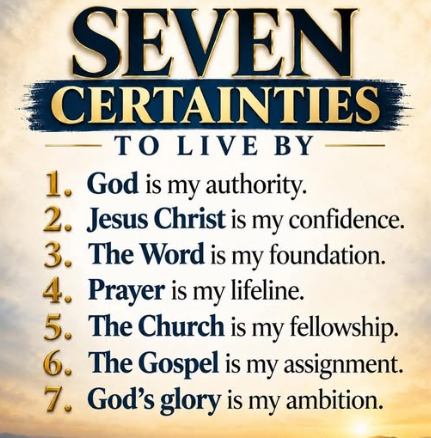
Our Assignment – Bring the True Gospel to the People
The apostle Paul opened his letter to the believers in Philippi by explaining that he often thanked God for them in joyful prayer because of their partnership in sharing the gospel. Paul held a special affection for the Philippian church, which he had founded approximately ten years earlier. Now he expressed confidence in God’s continued work in their lives: “I thank my God upon every remembrance of you, always in every prayer of mine making request for you all with joy, for your fellowship in the gospel from the first day until now, being confident of this very thing, that He who has begun a good work in you will complete it until the day of Jesus Christ” (Philippians 1:3–6, NKJV).
Paul had seen firsthand the good work that God had begun in the Philippian believers. In Philippi, on Paul’s second missionary journey, he and his companions encountered Lydia and other women meeting by the riverside for prayer. As Paul preached, Lydia and her household were saved and baptized, and the Philippian church was born (Acts 16:11–15). Later, the Christians in Philippi conducted their house church in Lydia’s home. As the church grew, it became one of the strongest supporters of Paul’s ministry (Philippians 4:10–20).
Paul loved the Philippians deeply and desired to see them continue to grow in Christian maturity and abound in ever-increasing spiritual understanding: “I pray that your love will overflow more and more, and that you will keep on growing in knowledge and understanding. For I want you to understand what really matters, so that you may live pure and blameless lives until the day of Christ’s return. May you always be filled with the fruit of your salvation—the righteous character produced in your life by Jesus Christ—for this will bring much glory and praise to God. so that they will be blameless until the day of Christ” (Philippians 1:9–11, NLT).
At the time of our salvation, God begins His work in us. We are made alive in Christ—regenerated, made new (2 Corinthians 5:17). Then, through an ongoing, lifelong process called sanctification, God finishes, perfects, and completes His work in us. Paul referred to the process when he said, “He who has begun a good work in you will complete it until the day of Jesus Christ” (Philippians 1:6, NKJV). Spiritual growth ought to continue in steadfast believers until the day Jesus Christ returns (2 Peter 3:18; 1 Thessalonians 5:23).
A brief biblical definition of sanctification is “the Holy Spirit’s work of setting believers apart to be made holy or made like God.” Sanctification is a three-phase process. At the moment of salvation, Christians enter positional sanctification. Jesus’ work on the cross is a finished work—believers stand positionally sanctified as though they already are made holy before God, even though they are not yet completely holy in practice: “For by one sacrifice he [Jesus] has made perfect forever those who are being made holy” (Hebrews 10:14).
Progressive sanctification is phase two, in which God, who has begun a good work in us at salvation, continues to transform us into His image, saving us from the practice and power of sin. After the initial cleansing from sin, the committed Christian begins to undergo a daily process of spiritual renewal (Colossians 3:10). The Bible also calls this phase “the sanctifying work of the Spirit,” as the Holy Spirit is the chief agent working in the believer to produce the character of God and the fruit of holiness (1 Peter 1:2; cf. 1 Corinthians 6:11; 2 Thessalonians 2:13; Galatians 5:22–23).
From the moment God begins His good work in us until the day of its completion, the Holy Spirit is chipping away, renovating our character, day by day reforming us into partakers of the holy nature of God. God does the work, but believers are also meant to be active in the process, yielding to the effort (Romans 6:13, 19; 12:1) and pressing on toward the upward call to holiness (Hebrews 12:14; Philippians 3:12–14).
God began a good work in us at salvation and then called us to live out the progressing development of being made into His image. The Christian walk is a pathway of ongoing growth. The journey brings us ever closer to God until His work in us is perfect and complete on “the day of Jesus Christ”—that is, the day of Christ’s return when we see Him (Colossians 3:4; 1 Thessalonians 5:23). Complete sanctification is the third phase, also known as glorification.
From the very beginning, throughout the continuation, and until the final stroke, God is working in us (Philippians 2:13). He is the Master Craftsman who never gives up on us (Ephesians 2:10; 2 Corinthians 1:21–22). The Lord’s salvation, His glorious redemption of His people, will reach its crowning culmination when Jesus Christ returns. Only then will God, who has begun a good work in you, put His finishing touch on you.
Matthew 28:19–20 contains what has come to be called the Great Commission: “Therefore go and make disciples of all nations, baptizing them in the name of the Father and of the Son and of the Holy Spirit, and teaching them to obey everything I have commanded you. And surely I am with you always, to the very end of the age.” Jesus gave this command to the apostles shortly before He ascended into heaven, and it essentially outlines what Jesus expected the apostles and those who followed them to do in His absence.
It is interesting that, in the original Greek, the only direct command in Matthew 28:19–20 is “make disciples.” The Great Commission instructs us to make disciples while we are going throughout the world. The instructions to “go,” “baptize,” and “teach” are indirect commands—participles in the original. How are we to make disciples? By baptizing them and teaching them all that Jesus commanded. “Make disciples” is the primary command of the Great Commission. “Going,” “baptizing,” and “teaching” are the means by which we fulfill the command to “make disciples.”
A disciple is someone who receives instruction from another person; a Christian disciple is a baptized follower of Christ, one who believes the teaching of Christ. A disciple of Christ imitates Jesus’ example, clings to His sacrifice, believes in His resurrection, possesses the Holy Spirit, and lives to do His work. The command in the Great Commission to “make disciples” means to teach or train people to follow and obey Christ.
Many understand Acts 1:8 as part of the Great Commission as well: “But you will receive power when the Holy Spirit comes on you; and you will be my witnesses in Jerusalem, and in all Judea and Samaria, and to the ends of the earth.” The Great Commission is enabled by the power of the Holy Spirit. We are to be Christ’s witnesses, fulfilling the Great Commission in our cities (Jerusalem), in our states and countries (Judea and Samaria), and anywhere else God sends us (to the ends of the earth).
Throughout the book of Acts, we see how the apostles began to fulfill the Great Commission, as outlined in Acts 1:8. First, Jerusalem is evangelized (Acts 1 — 7); then the Spirit expands the church through Judea and Samaria (Acts 8 — 12); finally, the gospel reaches into “the ends of the earth” (Acts 13 — 28). Today, we continue to act as ambassadors for Christ, and “we plead on Christ’s behalf: ‘Be reconciled to God’” (2 Corinthians 5:20, CSB).
We have received a precious gift: “the faith that was once for all entrusted to God’s holy people” (Jude 1:3). Jesus’ words in the Great Commission reveal the heart of God, who desires “all people to be saved and to come to a knowledge of the truth” (1 Timothy 2:4). The Great Commission compels us to share the good news until everyone has heard. Like the servants in Jesus’ parable, we are to be about the business of the kingdom, making disciples of all nations: “He called his ten servants, and delivered them ten pounds, and said unto them, Occupy till I come” (Luke 19:13, KJV).
Possible causes of fear in relation to witnessing include shyness; past or perceived rejection or humiliation; an inability to articulate our personal testimony; a lack of knowledge of Scripture; a failure to trust in the Lord; and an ignorance of why men reject the gospel. Determining the actual cause of fear may be difficult, and understanding the reason may not dispel our fear. But we are commanded to be bold for Jesus (Ephesians 6:19), so we may simply have to persevere, one step at a time. In the meantime we can apply some basic principles and sharpen our skills, since fear can be overcome by preparation (2 Timothy 3:16-17).
If we are not walking with Christ, we will not be able to witness for Christ effectively, so we certainly need to be living a consistent, Christian life. “Let your light shine before men” (Matthew 5:16). If at all possible, we should be attending a Bible-teaching church. Also, we can always improve our knowledge of Scripture, and we should study well the book of John.
Our Lord shared the gospel with many different people. He understood Nicodemus and the woman at the well, and He used that knowledge in drawing them to Himself (John chapters 3 and 4). Our approach, too, should be personally tailored. As we speak with an unbeliever, we should try to ascertain what is keeping him from salvation. Generally speaking, there are three factors that keep people from belief: ambivalence about God, fear of God, and hatred toward God, which includes despising His teachings and His Son.
A study of the Gospel of John will show that the key to successful witnessing is love. Jesus loved people to the point of accepting the cross and separation from the Father. With the help of the Holy Spirit, we can learn to love people more. When we do, we will be more motivated to share the gospel, since our desire to save people from eternal punishment will grow. Love compels us to communicate the good news. The Holy Spirit will open doors for us by convicting people of their sin and stirring up a desire for salvation, and He will arrange for our paths to cross. Our job is simply to speak with people and explain that salvation is available to every sinner, and to present the good news of salvation.
Speaking is what many find troubling, as did Moses (Exodus 4:10). However, if we are walking as Christians; if we study and plan; if we rely on the Holy Spirit, the One who convicts and regenerates (John 16:8; Titus 3:5); if we realize that failure is acceptable and that God blesses us when we are rejected (Luke 6:22); and if we truly love people and want to help guide them to heaven, we should be able to find a witnessing approach that works for us.
One method to consider is to prepare and memorize a simple testimony of what Jesus did for us, and this should include several keywords. We also should memorize a few key verses that relate to the gospel and to our testimony. Then, when any one of our keywords arises in a conversation, in a context that can be related to the things of God, we can discuss our testimony or recite a verse and explain the meaning. If we are asked any relevant questions, we can proceed with the confidence that the Holy Spirit has opened a heart. If the other person expresses no interest, we can simply continue the original conversation without anxiety. At the very least, we will have planted a seed.
Study the Word, live the Christian life, let the Holy Spirit do His work (John 3:8), and look for opportunities to share the gospel. It is a privilege to be a part of spreading God’s good news to the world. As we fulfill the Great Commission, we have Jesus’ wonderful promise, “Surely I am with you always” (Matthew 28:20). What have we to fear?
.

Tea Time Manna
My dear children, I write this to you so that you will not sin. But if anybody does sin, we have one who speaks to the Father in our defense — Jesus Christ the Righteous One.
—1 John 2:1
God hates sin. Don’t you? I know I do. But isn’t it amazing how we’ll fall back into the same old traps again and again? The goal is not to sin even one sin! But knowing our struggle against flesh, John also gives assurance to those of us who are trying to live faithful and pure lives. He wants us to know that when we do sin, the sacrifice for our sins, God’s Son, is also our defense attorney who proclaims us sinless before God by his blood (Colossians 1:22; 1 John 1:7, 2:2). So let’s draw close to Christ. Let’s invite him into our hearts each morning as we begin the day (Revelation 3:20). Let’s trust in his power and grace to sustain us and carry us through. As Paul prayed for new believers in Thessalonica:
May God himself, the God of peace, sanctify you through and through. May your whole spirit, soul, and body be kept blameless at the coming of the Lord Jesus Christ. The one who calls you is faithful, and he will do it. (1 Thessalonians 5:23-24)
Prayer
God, no one and nothing is like you — even comparable to you. I did not have to provide the sacrifice for my sins. Even though my sins broke your heart, you provided that sacrifice. So, please use me today as I try to give myself, my life, and my future back to you as a living sacrifice, holy and pleasing to you (Romans 12:1-2), because I want to thank you for your grace. Through Jesus, and in his name, I pray. Amen and Amen
Truth Article by Pastor Dirk
The Jewish Messiah will come from this Group that will rule into the 7 Year Peace Agreement.
The Christian Zionists Movement is changing the Holy City into Egypt and Sodom.
Rev 11:8 And their dead bodies shall lie in the street of the great city, which spiritually is called Sodom and Egypt, where also our Lord was crucified.
Great Britain and America are indeed spiritual Sodom and spiritual Egypt, then we must conclude that we are seeing the long-range fulfillment of this Scripture right before our eyes as The Spiritual name of Jerusalem changes to Egypt and Sodom. The Eagle Wings plugged from the Lion joining the Women with the 12 stars , Daniel 7 and Rev 12 .
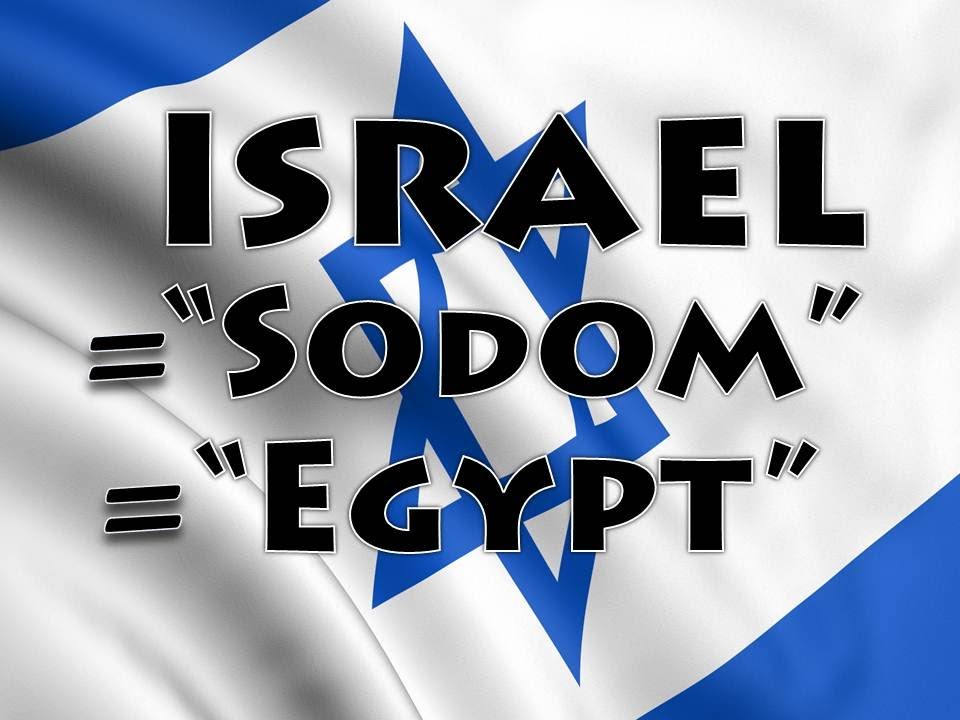
The Home of the Antichrist is identified as The Christian Zionist Movement.
Some claimed that The Knights Templar was involved in getting Donald Trump elected as the 45th President of America . with Vice President Mike Pence one of the Leaders and Top supporters of the Christian Zionist Movement from America with the Presidents Aid in the form of a Jewish Rabbi and Jewish Son in Law Jared Kushner. and Again for the 2nd Term . where the Abrahamic Accords started.
The Jewish Messiah will come from this Group. He will be Crowned after the Gog and Magog War as the King of the Jews, after he arranged a 7 Year Peace agreement between the World and Israel , and gave Israel approval to build their 3rd Jewish Temple.
42 Months after the Unveiling of the 3rd Jewish Temple , The Jewish Messiah will walk into the Temple and demand the Daily sacrifices to stop called the Abomination of Desolation and the Jewish Messiah will become the Christian Antichrist and will start the 2nd Holocaust of the Jewish Nation.
2Th 2:3 Let no man deceive you by any means: for that day shall not come, except there come a falling away first, and that man of sin be revealed, the son of perdition;
2Th 2:4 Who opposeth and exalteth himself above all that is called God, or that is worshipped; so that he as God sitteth in the temple of God, shewing himself that he is God.
Rev 12:17 And the dragon was wroth with the woman, and went to make war with the remnant of her seed, which keep the commandments of God, and have the testimony of Jesus Christ.
Question: “What is Zionism / Christian Zionism?”

Answer: Zionism, simply a political movement at its inception, has today become more of an ideology than anything else. Zionism is an international movement for the return of the Jewish people to Zion, the land of Israel, while exercising the right to retain authority of government over the state of Israel, which was promised to them in the Hebrew Scriptures. The roots for Zionism lie in Genesis chapters 12 and 15, in which God makes a covenant with Abraham promising him that his descendants would inherit the land between Egypt and the Euphrates River.
Due to the fact that Zionism was begun as a politically motivated movement, there exists among secular Gentiles and non-religious Jews a line of thought stating that the religious background of the Jewish people had nothing to do with Zionism. It is argued that Zionism was instead a reaction of the Jewish people to worldwide persecution during World Wars I and II. No nation would take them in, so they were forced to create their own nation, the land of their ancestry being the most opportune place.
Regardless, the Zionist movement, begun in the late 1890s, found fulfillment in 1948 when Israel was officially recognized as a state and granted sovereignty as a nation by the United Nations. This is when, technically, the political Zionist movement ended and the ideology of Zionism began, and as such, has become a much-debated topic. Some would say that Zionism has become a motivation for racism, or a reaction against anti-Semitism. Others believe that Zionism as it currently exists is merely Jewish patriotism.
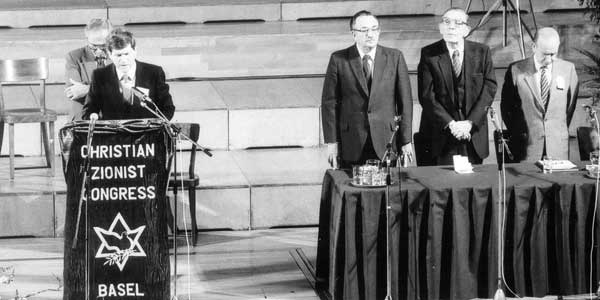
Associated with Jewish Zionism is Christian Zionism. Christian Zionism is simply Gentile support of Jewish Zionism as based on the promises to Israel found in the Bible, passages such as Jeremiah 32 and Ezekiel 34. Christian Zionists are primarily evangelical and give support in any way possible to the Jewish state of Israel. The return of the Jews to the Promised Land is the fulfillment of prophecy and is seen, especially by dispensationalists, as a sign that the world has entered the end times.
Christian Zionism is a belief among some Christians that the return of the Jews to the Holy Land and the establishment of the state of Israel in 1948 were in accordance with Bible prophecy. The term began to be used in the mid-20th century, superseding Christian Restorationism.
Traditional Catholic thought did not consider Zionism in any form, but Christian advocacy grew after the Protestant Reformation in support of the restoration of the Jews. A contemporary Israeli historian suggests that evangelical Christian Zionists of the 1840s “passed this notion on to Jewish circles”,[4] while Jewish nationalism in the early 19th century was widely regarded with hostility by British Jews.
Some Christian Zionists believe that the gathering of the Jews in Israel is a prerequisite for the Second Coming of Jesus. The idea has been common in Protestant circles since the Reformation that Christians should actively support a Jewish return to the Land of Israel, along with the parallel idea that the Jews ought to be encouraged to become Christians as a means of fulfilling Biblical prophecy.
Tens of thousands of churches have a committed belief in the importance of standing with Israel and blessing the Jewish people. The verse most often referred to as their biblical mandate is Genesis 12:3 in which God tells Abraham “I will bless those who bless you and I will curse those who curse you and in you all the families of the earth will be blessed.”
Since the birth of the State of Israel in 1948 the theological error known as Replacement Theology has begun to decline and increasing is a theology of Christian Zionism that understands the importance of God’s everlasting covenant with Abraham and the nation he would birth.
However, just as the term “Zionism” has been turned into a negative word by Israel’s enemies, so “Christian Zionism” is under attack and often misrepresented in the media and in some public discourse. For this reason, the ICEJ’s articles and monographs defining and clarifying the beliefs of Christian supporters of Israel and placing their “love for Israel” within its proper biblical context are proving invaluable.
Christian Zionists
“Zionism, [is] the national movement for the return of the Jewish people to their homeland and the resumption of Jewish sovereignty in the Land of Israel, advocated, from its inception, tangible as well as spiritual aims. Jews of all persuasions, left and right, religious and secular, joined to form the Zionist movement and worked together toward these goals. Disagreements led to rifts, but ultimately, the common goal of a Jewish state in its ancient homeland was attained. The term “Zionism” was coined in 1890 by Nathan Birnbaum.” (Jewish Virtual Library).
If Zionism is the belief in the Jewish people’s right to return to their homeland, then a Christian Zionist should simply be defined as a Christian who supports the Jewish people’s right to return to their homeland. Under this broad and simple definition, many Christians would qualify no matter what their reasons are for this support. Just as Jews of all persuasions formed the Zionist movement then Christians of all persuasion can also fall within this broad definition of a Christian Zionist.
For this very reason, a myriad of answers may be given by a Christian when questioned about their support of Israel. Answers can include political, historical, and/or religious reasons.
Theology of Christian Zionism
The actual theology of Christian Zionism, also known as Biblical Zionism, supports the right of the Jewish people to return to their homeland on scriptural grounds. The biblical foundation for Christian Zionism is found in God’s Covenant with Abraham. It was in this covenant that God chose Abraham to birth a nation through which He could redeem the world, and to do this He bequeathed them a land on which to exist as this chosen nation.
Christian Zionism is confirmed throughout the Hebrew Scriptures. The major and minor prophets consistently confirmed this national calling on Israel, promised her future restoration to the land after a period of exile, and spoke of her spiritual renewal and redemption bringing light to the world.
Christian Zionism differs with Replacement Theology which teaches that the special relationship that Israel had with her God in terms of her national destiny and her national homeland has been lost because of her rejection of Jesus as Messiah, and therefore the Church has become the new Israel. The Church has then inherited all the blessings promised to Israel but the judgments and curses still conveniently remain over the Jewish people.
Instead, Christian Zionism teaches from the scriptures that God’s covenant with Abraham is still valid today. There remains a national destiny over the Jewish people and her national homeland is her everlasting possession in fulfillment of God’s plans and purposes for her. The New Testament scriptures not only affirm the Abrahamic covenant, but they confirm the historical mission of Israel and that Israel’s gifts and calling are irrevocable.
Thus, Christian Zionism is not based on prophecy or end-time events. Most Christian Zionists would agree, however, that Israel’s reemergence on the world’s scene, in fulfillment of God’s promises to her, indicate that other biblically-predicted events will follow.
JERUSALEM—The scene was like a contemporary Christian music concert, but with a lot more Jewish swag. European pilgrims wore Star of David jewelry as they swayed among the palm trees of Ein Gedi, an oasis in the Judean desert. Spanish delegates sported matching “España loves Israel” T-shirts. A tiny woman from China jogged around waving a person-sized flag bearing a Hebrew word for God, while another Chinese woman periodically blew a giant shofar, the ram’s horn that is sacred in Judaism. The crowd sang songs from the Psalms, following transliterated Hebrew on giant television screens. As night fell, their chorus of “holy, holy, worthy, worthy” seemed to fill the desert.
This was the opening ceremony for the 2017 Feast of the Tabernacles, the International Christian Embassy Jerusalem’s annual celebration held during the Jewish holiday of Sukkot. More than 6,000 Christians from all over the world had come to show their love for Israel, and I tagged along with ICEJ spokesperson David Parsons and his wife, Josepha. “It’s like a pre-celebration before Moshiach comes,” she explained, using the Hebrew word for messiah.
Christian Zionism typically involves a belief that Jews must return to Israel in order to fulfill biblical prophecy. While the movement long predates the formation of the state of Israel in 1948, it got new energy from the American religious right in the 1980s. Now, according to Daniel Hummel, a postdoctoral fellow at the University of Wisconsin-Madison, the movement is undergoing a transformation, both theologically and geographically.
The ICEJ Feast is an example of a broader shift within Christian Zionism toward Pentecostal or charismatic traditions: Many attendees come out of traditions that emphasize present-day miracles, ecstatic worship, and God’s healing powers. The ICEJ also has an international rather than American focus: Parsons, an amiable North Carolinian who has lived in Israel for decades and casually uses Yiddish phrases like “oy oy oy,” proudly noted that Americans made up less than 10 percent of the Feast’s attendees this year.
Israel often stands alone on the international stage, save for the one ally that almost always comes to its rescue: the United States. Conservative Christians in America have long reinforced that partnership. In the future, though, Christians outside the US may prove more organized and influential when it comes to Israel than their American counterparts.
White, American evangelicals have long been some of the most visible leaders in the Christian Zionist movement. In the 1980s, Jerry Falwell’s Moral Majority made Israel a Republican policy priority. Decades later, Christians United for Israel (CUFI), the Christian Zionist organization led by the Texas pastor John Hagee, is enjoying remarkable access to the Trump administration; Vice President Mike Pence addressed the group in Washington in July.

At this year’s ICEJ Feast, a number of attendees expressed admiration for President Trump, who is more supportive of Israel than past administrations, they said. Charles Null, a 66-year-old pastor from Florida, noted that “I actually had hair” when he and his wife started coming to Israel. He wore a Make America Great Again cap.
The History of this Movement.
The Christian Zionist Movement has grown in numbers and in impact in recent years. Today, thousands of Christians from all over the world are, more than ever, ready to declare their love and support for the nation of Israel. Each year they come in their multitudes to Jerusalem to join the International Christian Celebration of the Feast of Tabernacles. But the roots of this movement go back throughout Christian history.
In a sense, Christian Zionism goes right back to the 1st century period, as there have always been men and women who have believed and taught its tenets. Many examples of this from history could be quoted, but an article of this nature does not allow us to do it. As a definite theology, however, Christian Zionism had its beginnings among the pietistic Protestants of the 16th century and the 17th century Puritans of England. In 1587 a man named Francis Kett was burned alive for expressing his belief that the Bible prophesied a return of the Jews to their land. Moreover, in 1607, Thomas Brightman published a book in Basel called “Revelation of the Revelation”. In this book he wrote: “What, shall they return to Jerusalem again? There is nothing more certain; the prophets do everywhere confirm it.” Others of the same period frequently expressed a similar belief. For instance, Isaac de la Peyrere (1594-1676), who served as the French Ambassador to Denmark, wrote a book wherein he argued for a restoration of the Jews to Israel without conversion to Christianity.
By the time of the 18th century, the Christian Zionist Movement, known then as the Restoration Movement, included many theologians, writers and politicians. Noteworthy was Thomas Newton, the Bishop of Bristol. He believed Jews would be restored to their native city and country and at the same time he condemned anti-Jewish prejudice. The movement grew with the onset of the French Revolution and the Napoleonic wars.
In the 19th century the movement continued to gather momentum and one of the outstanding personalities in this regard was Anthony Ashley Cooper, Earl of Shaftesbury. He noted in his diaries that the signs were right for the return of the Jews to Palestine. A certain Charles Henry Churchill, a British resident of Damascus, also became a zealous propagator of the creation of a Jewish State in Palestine. In 1841 he wrote a letter to the Jewish philanthropist Moses Montefiore in which he stated: “…I consider the object to be perfectly obtainable. But, two things are indispensably necessary. Firstly, that the Jews will themselves take up the matter unanimously. Secondly, that the European powers will aid them in their views…”
Another popular figure in the Restoration Movement was George Gawler (1796-1869). He wrote a book in 1845 and in it, concerning the Jewish people, he states that they were to replenish the deserted towns and fields of Palestine.
As the 19th century drew to a close, many prominent men were involved in Christian Zionism. Men like the British industrialist, Edward Cazalet (1827-1883), Lawrence Oliphant (1829-1888), a most active restorationist, and the American, William E. Blackstone. Blackstone was once dubbed the American Christian “Father of Zion¬ism”. The most interesting Christian Zionist of the period was, however, William H. Hechler (1845-1931). Hechler, Chaplain of the British Embassy in Vienna, worked very closely with Theodore Herzl, considered to be the founder and father of the Jewish State. In fact, Hechler dedicated 30 years of his life to the great task of realizing the Zionist goal; the establishment of the Jewish State in Palestine. Unfortunately he died only seventeen years before this became a living reality. However, he was privileged to attend the First Zionist Congress in Basel, Switzerland, in August 1897, at which the foundation stone of the restored Jewish State was laid.
The 20th century saw the Zionist dream come true as a direct fulfillment of God’s prophetic word. Sadly, some tragic events preceded this realization, the most terrible and evil of which was the Nazi Holocaust. Out of the ashes of six million Jews rose the restored Jewish State.
From the very beginning of the century, Christian Zionists were in the forefront of the struggle on behalf of the Jewish People. Their influence upon statesmen and men of power was great. It is no secret that this influence played a major role in producing the Balfour Declaration of 1917, in which His Majesty’s Government viewed “with favor the establishment of a Jewish national home” in Palestine.
Time will not permit us to talk of famous Christian Zionists such as Charles Orde Wingate, John Hayes Holmes, Professor Reinhold Niebuhr and Corrie Ten Boom who, at great personal risk during the Second World War, rescued Jews from the hands of Nazism. All these believed that scripture promised the restoration of the Jewish State in Palestine. Most of them died in hope but some, like Corrie Ten Boom, lived to see the impossible come true.
Christian Zionism has a long history. Today the movement has swelled to embrace thousands. All of them see their task as being far from over, since the same forces that sought the destruction of Israel in decades past are still at work today. The survival and preservation of Israel is dependent upon the same kind of help and support that made her existence a reality. Christian Zionists believe that in seeking her peace they are in the long run working for the world’s peace (Isaiah 2:1-4).
Please note , That although we at TruLight Believe that The return of The Jewish People to Israel and Jerusalem will speed up the End time Master plan of God , we do not stand with the Jewish People on this . for we still see The Jews as the reason for the Killing of Jesus Christ the Real Messiah and son of The God Almighty. and That God has not forgotten this rejection his Nation showed against His son and any Christians that approves the Killing of Jesus Christ is standing against God.
Article by Pastor Dirk – TruLight Ministries International
NEWS MANNA

The Inclusive Bible: When ‘Son Of God’ Becomes Too Offensive For Church
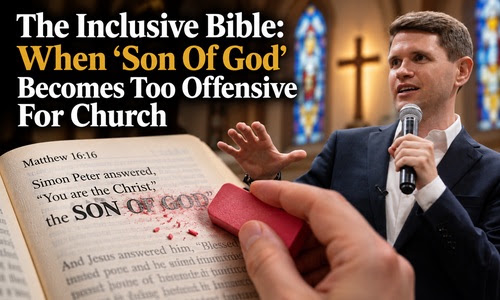
The Inclusive Bible: When ‘Son Of God’ Becomes Too Offensive For Church
A new member walks to the front of St. Andrew’s Presbyterian Church near Austin, Texas. Waiting for him is a gift from the congregation: a Bible.
But not just any Bible.
“And Martha’s here to give Larry his Inclusive Bible,” a woman announces in undercover footage recorded at the church. “It’s the Bible that we use at this church.”
She then explains what makes it different: “It’s been rewritten so that there is only inclusive language.”
The congregation applauds.
That scene might seem like another isolated example of progressive Christianity attempting to accommodate modern cultural sensibilities. But St. Andrew’s is not just another church, and its longtime pastor, Rev. Jim Rigby, is not simply another progressive minister.
The church has played a formative role in the life and politics of James Talarico, the Democratic nominee for the U.S. Senate in Texas and who is currently leading in the polls. Talarico has attended St. Andrew’s since childhood, Rigby baptized him, and the pastor delivered the invocation when Talarico was sworn into the Texas House. Talarico has said the congregation “really shaped my worldview,” and described Rigby as an important influence on his understanding of Christianity.
That makes what is being taught at St. Andrew’s worth examining.
And what is being handed to new members is especially revealing.
The Inclusive Bible describes itself as an egalitarian translation and a “re-imagining” of Scripture. Its translators did not merely replace generic masculine language where the underlying text permits it. They deliberately reconsidered biblical terminology they believed carried sexist, patriarchal or hierarchical implications.
That includes the language Christians use for God Himself.
“The Lord” presents a problem because the translators regard the expression as carrying “sexist and classist” associations. “Father” is frequently rendered with alternatives such as “Abba” or “Loving God.”
Even some of Christianity’s most recognizable descriptions of Jesus are considered difficult.
“Son of God” can become “Only Begotten,” “God’s Own” or “Eternally Begotten.” “Son of Man” receives alternative treatments as well. “Lord” is replaced in various places with terms such as “Sovereign” and “Savior.”
The issue isn’t simply modern English.
It is who gets to decide which biblical concepts modern people should no longer have to encounter.
Rigby himself offered a remarkable glimpse into that approach when an undercover journalist asked him about the translation. The pastor said the church typically gives people The Inclusive Bible when they join.
“It’s good on the gender stuff,” Rigby said.
He then acknowledged limitations with the translation before adding that having a good translation allows people to “let go of the stupid stuff.”
That phrase exposes the much deeper problem.
Who decides which parts are the “stupid stuff”?
For historic Christianity, Scripture is supposed to correct us. Increasingly, progressive Christianity appears determined to correct Scripture.
Once that relationship is reversed, there is virtually no stopping point.
Today “Father” is problematic because it is gendered. “Lord” is problematic because it suggests hierarchy. “Son of God” becomes difficult because it is masculine.
Tomorrow another biblical doctrine will collide with another cultural value.
Eventually Christianity can retain its vocabulary, buildings, clergy and ceremonies while the authority underneath all of them has quietly changed.
The ultimate authority is no longer what Scripture says. It is what modern culture permits Scripture to say.
And that brings us back to James Talarico.
Talarico has made Christianity unusually prominent in his political identity. He frequently discusses Jesus, Scripture and his faith while explaining his political philosophy. That makes the theological environment that formed him relevant–not because a politician is automatically responsible for every statement made by his pastor, but because Talarico himself has repeatedly emphasized how deeply St. Andrew’s and Rigby influenced him.
“I was brought up in a very countercultural faith,” Talarico has said.
He has also said that at St. Andrew’s, “politics and religion and causing trouble” were intertwined while he was growing up.
Rigby’s influence wasn’t peripheral. When Talarico was considering whether to enter ministry or politics, he went to Rigby for advice. The pastor told him that politics would give him something ministry would not: power.
Now Talarico is seeking considerably more of it as a candidate for the United States Senate.
That does not mean voters should simply assign every theological position of Rigby or St. Andrew’s to Talarico. But when a candidate makes his Christianity an important part of his public case and repeatedly identifies a particular pastor and congregation as formative influences, examining what that church actually teaches is legitimate.
And St. Andrew’s theology extends well beyond Bible translation.
Rigby has said he avoids Christian prayers and creeds that could exclude non-Christians. The Texas Tribune reported earlier this year that he said he doesn’t like theology and described Jesus as closer to a “loving atheist than an indifferent theologian.”
Talarico’s own public theological statements have sometimes reflected similarly unconventional ideas. He previously declared that “God is non-binary,” although he later called the way he expressed the statement “cringey” and deliberately provocative while maintaining that God transcends gender.
None of this is occurring in a vacuum.
Across Western Christianity, arguments over sexuality, gender, marriage and biblical authority have followed a remarkably similar progression. First Scripture is reinterpreted. Then uncomfortable passages are contextualized away. Eventually even biblical terminology itself becomes something requiring correction.
The Inclusive Bible brings that progression into unusually sharp focus.
Christians have always produced new Bible translations. Languages change. Scholarship improves. Ancient manuscripts are studied. Translators wrestle with how best to communicate Hebrew and Greek accurately to modern readers.
But translation asks: What did the biblical authors say, and how can we communicate it faithfully?
Ideological revision asks a fundamentally different question:
What should they have said?
That is the dividing line.
Christianity cannot endlessly reconstruct Jesus in the image of whatever culture happens to dominate a particular generation. If “Son of God” becomes too gendered, “Lord” too hierarchical and “Father” too patriarchal, eventually the problem isn’t the translation.
The problem is the Bible itself.
And when a church reaches that conclusion, rewriting the words is only the beginning.
The Boys Are Coming Back To Church – But Where Are The Girls Going?

For decades, American churches wrestled with a familiar problem: Where are the men?
Women filled the pews, volunteered in ministries, brought the children and often carried much of the spiritual life of the family. Men consistently lagged behind in church attendance and religious participation.
Something remarkable is now happening.
The gender gap is reversing — and it may be starting much earlier than anyone expected.
New research from Barna Group and Christ In Youth found that 57 percent of self-identified Christian teenagers attended a youth group within the previous three months. But buried inside that number is the real surprise.
Among teenage boys, attendance was 63 percent.
Among teenage girls, it was just 52 percent.
That is an 11-point gender gap in favor of boys.
And when those teenagers become young adults, the pattern doesn’t disappear. Other research suggests it may become even more pronounced.
Young Men Are Moving Toward Faith
Gallup recently discovered an extraordinary change among men ages 18 to 29.
In 2022-2023, only 28 percent of young men told Gallup that religion was “very important” in their lives.
By 2024-2025, that number had surged to 42 percent.
Their religious attendance is climbing as well. Forty percent of young men now report attending religious services at least monthly, up seven percentage points from 2022-2023 and the highest level Gallup has recorded for young men since 2012-2013.
Barna is seeing a similar reversal across the wider population.
As recently as 2025, 43 percent of men reported attending church weekly compared with 36 percent of women — the largest gender gap Barna had recorded in 25 years of tracking.
Think about how unusual that is.
Church leaders spent decades asking how Christianity could reconnect with men. Now teenage boys are out-attending teenage girls in youth groups, young men’s religious interest is rising sharply, and adult men are attending church at higher rates than women.
But there is another side to this story.
Where Are The Girls Going?
The male numbers are encouraging.
The female numbers should concern the Church.
Gallup found that while 42 percent of young men now describe religion as very important, only 29 percent of women ages 18 to 29 say the same. Young women are now the least religious group of women Gallup measures by age.
Barna likewise reports that Gen Z women are increasingly churchless, religiously unaffiliated and disengaged.
So perhaps the question facing churches has changed.
For years it was: How do we reach the boys?
Increasingly it may become: Why are we losing the girls?
There is no single answer, and the surveys cannot establish precisely what is driving the divergence. But young men and young women are increasingly experiencing American culture very differently.
Many young men are struggling with loneliness, purpose, relationships and uncertainty about what adulthood is supposed to look like. In that environment, Christianity offers something increasingly countercultural: identity, brotherhood, moral boundaries, responsibility, sacrifice and a purpose larger than oneself.
The Church should not be embarrassed to offer those things.
Young men don’t necessarily need another institution attempting to entertain them. They need to hear that their choices matter, that self-control matters, that courage matters, that becoming a faithful husband and father matters, and ultimately that following Christ requires something of them.
Perhaps some are discovering that a faith demanding commitment is more attractive than a culture offering endless freedom without much explanation of what that freedom is for.
Two Generations Moving In Different Directions
Young women are navigating a different cultural environment.
Barna points to several possible contributors to their declining engagement, including changing attitudes toward traditional church structures, leadership failures and different social and family pressures.
There is also a striking political correlation in Gallup’s numbers, although correlation should not be confused with cause.
Since 2022-2023, religious attendance increased among young Republican men and women and modestly among young Democratic men, while Gallup found little change among young Democratic women. Gallup notes that political identity may therefore be playing a role in the overall gender divergence.
Whatever combination of cultural, political and spiritual forces is responsible, the result is increasingly difficult to ignore.
Young men and young women are no longer moving together religiously.
Attendance Is Not Revival
Churches should also resist celebrating too quickly.
A teenager walking into youth group is not the same thing as a teenager becoming a disciple of Jesus Christ.
A young man attending church because he is lonely, searching for community or attracted to traditional values may represent an extraordinary ministry opportunity — but attendance is only the beginning.
The goal isn’t a room filled with boys.
It is young men who know Scripture, understand the Gospel, resist temptation, serve others, develop spiritual discipline and eventually become faithful husbands, fathers and Christian leaders.
And the Church cannot become so excited about young men returning that it fails to notice young women slipping away.
Both trends deserve attention.
For decades, churches wondered how they could get men interested in Christianity again.
They may finally be getting part of their answer.
But just as the boys begin walking back through the church doors, another question is becoming impossible to avoid:
Where are the girls going?


TruLight TV – Popcorn and Movie Time – Finding Normal
The only thing standing between Dr. Lisa Leland and her dream wedding in the Hamptons is a 2600-mile drive from Los Angeles to Long Island. But a run-in with the law in the country town of Normal, Louisiana leaves Lisa with a choice: jail or community service. Sentenced to three days as the town’s doctor, Lisa soon finds her world turned upside-down by a man and discovers a lot more to Normal.
Today on TruLight Radio XM
TruLight Radio XM 24/7
Program
GMT / UTC +2
Monday To Fridays
00:15 Words to Live By Testimonies
01.15 Science Scripture and Salvation
02.15 Ground Works
04.00 Gospel Concert of the Day
05.00 The Daren Streblow Comedy Show
5:55 It is Today devotional
6:00 Gaither Homecoming Morning Show
7:15 Discover the Word
8.15 Destined for Victory
8:55 Science Scripture and Salvation
9:00 Holy Spirit Hour – Normally Sermons
10:15 Hope of the Heart
11:15 Unshackled
11.45 Words to Live By
12:15 Truth for Life
13:15 Living on the Edge with Chip Ingram
14:15 Focus on the Family
15:00 Kids Hour
16:00 In Touch with Dr. Charles Stanley
16:30 Groundwork
17:15 Live in the Light
18:15 Renewing your Mind
19:00 Gaither Homecoming Show
20:15 Growing Hope
21:15 Adventures in Odyssey Radio Drama
21:45 Bible Reading
22:15 Night-sounds
23.00 Good Old Country Gospel / Rhema Gospel Express
VISIT THE WEBSITE
TruLight Ministry News – EXTRA MANNA
TruLight Ministries orders from God since 2012 . Teach Them , Comfort Them and Warn Them!
The TESTIFY MAGAZINE run a SPECIAL EDITION this week on TruLight Ministries International
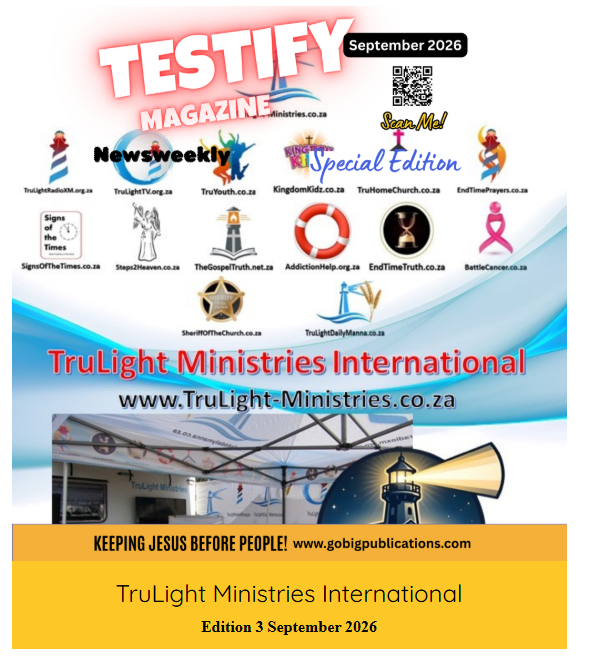
Thanks to Mark and Gerda the Stunning Management Team of Testify Magazine for this Lovely Edition and Introduction to TruLight Minsitries , God Bless for Keeping Jesus before the People!
CLICK ON THE LINK TO READ THIS SPECIAL EDITION
Testify-Special-TruLight-September-2026-Download
The NEXT Episode of The Sheriff of the Church – I Tell You Tru is available!
The Sheriff of The Church is a Breakthrough radio drama that follows a Spiritual Lawman, Appointed by God and commissioned by the City Marshal’s Office, as he rides across a landscape to serve Reproof and Rebuke Summons on systems that have traded the Truth for for everything else but the truth . with his trusty Horse Justice , He travels from Doctrine of Demon to Doctrine of Demons and meet Strange Caracter’s along the way,
This radio drama produced by TruLight Broadcasting Network and Hosted by Trulight Ministries, is more than just a Western Radio Adventure—it is a spiritual Educational Teaching Platform of Discernment. It is a journey to strip away the “False Religions and traditions of men” and return to the pure, unadulterated Word of God.
As the Sheriff likes to say: “Eternity is an awfully long time to be wrong.”
Artist Liners
Healing Truths.
End Time Articles.
INTRODUCTION MANNA

Share this Feeding of Manna with your Friends and Family. just click on the Social Media icon and share This Manna with your Friends and Family. just click on the Social Media icon and share !