
a Biblical Man’s Responsibilities : Called to Respect CHRIST in every area of Life !
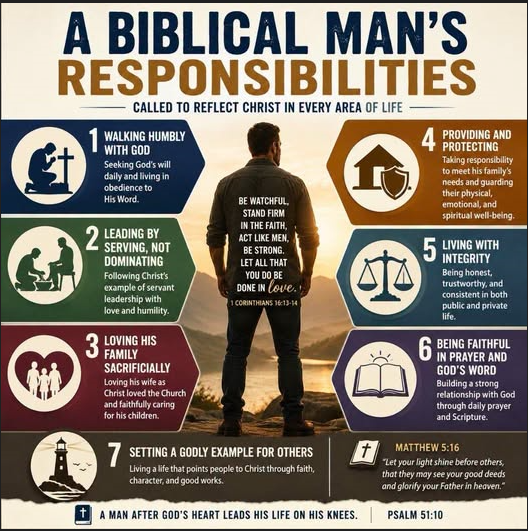
1, WALKING HUMBLY WITH GOD.
One of the most popular verses among both Jews and Christians promoting social justice is Micah 6:8. It reads, “He has showed you, O man, what is good. And what does the LORD require of you? To act justly and to love mercy and to walk humbly with your God.” Many desire to know more about what this inspiring verse teaches on the issues of justice, mercy, and humility.
Micah 6 involves an imaginary conversation between the Lord and Israel. In verses 1-5 the Lord introduces His case against the disobedient people of Israel. Verses 6-7 record Israel’s response as a series of questions beginning with, “With what shall I come to the Lord?” (Micah 6:6).
Israel’s focus is on their external religious rites, and their questions show a progression from lesser to greater. First, they ask if God would be satisfied with burnt offerings of year-old calves (Micah 6:6b), offerings required in the Law of Moses. Second, they ask if they should bring “thousands of rams, with ten thousands of rivers of oil” (Micah 6:7a). This is the rhetoric of hyperbole; such an offering could only be made by someone extremely wealthy or by the larger community of God’s people. Third, they ask whether they should offer their firstborn sons as a sacrifice for God. Would that be enough to cover their sin? Would God be pleased with them then?
Verse 8 follows with God’s answer, rooted in the Law of Moses: “He has told you, O man, what is good.” In other words, Israel should already have known the answer to their questions. God then says that He did not need or desire their religious rites, sacrifices, or oblations. Instead, the Lord sought Israel’s justice, mercy, and humility.
The answer to Israel’s sin problem was not more numerous or more painful sacrifices. The answer was something much deeper than any religious observance: they needed a change of heart. Without the heart, Israel’s conformity to the Law was nothing more than hypocrisy. Other prophets tried to communicate a similar message (Isaiah 1:14; Hosea 6:6; Amos 5:21). Unfortunately, God’s people were slow to heed the message (Matthew 12:7).
“Act justly” would have been understood by Micah’s audience as living with a sense of right and wrong. In particular, the judicial courts had a responsibility to provide equity and protect the innocent. Injustice was a problem in Israel at that time (Micah 2:1-2; 3:1-3; 6:11).
“Love mercy” contains the Hebrew word hesed, which means “loyal love” or “loving-kindness.” Along with justice, Israel was to provide mercy. Both justice and mercy are foundational to God’s character (Psalm 89:14). God expected His people to show love to their fellow man and to be loyal in their love toward Him, just as He had been loyal to them (Micah 2:8-9; 3:10-11; 6:12).
“Walk humbly” is a description of the heart’s attitude toward God. God’s people depend on Him rather than their own abilities (Micah 2:3). Instead of taking pride in what we bring to God, we humbly recognize that no amount of personal sacrifice can replace a heart committed to justice and love. Israel’s rhetorical questions had a three-part progression, and verse 8 contains a similar progression. The response of a godly heart is outward (do justice), inward (love mercy), and upward (walk humbly).
The message of Micah is still pertinent today. Religious rites, no matter how extravagant, can never compensate for a lack of love (1 Corinthians 13:3). External compliance to rules is not as valuable in God’s eyes as a humble heart that simply does what is right. God’s people today will continue to desire justice, mercy, and humility before the Lord.
2, LEADING BY SERVING.
Servant leadership is best defined by Jesus Himself: “Whoever wants to become great among you must be your servant, and whoever wants to be first must be your slave—just as the Son of Man did not come to be served, but to serve, and to give his life as a ransom for many” (Matthew 20:26–28). In the Christian realm, all leadership should be servant leadership.
A common misconception among those who want to exercise a leadership role over others is that it comes with glory, power, and positions of honor. In fact, such a mistaken belief was the occasion for Jesus’ words in the above passage. James and John had just asked Jesus to place them at His side when He assumed His throne in the kingdom to come. The other disciples became indignant at the arrogance of their request (Mark 10:41). And, as an object lesson, Jesus modeled the true servant style of leadership. He, the Lord incarnate, bent down and washed their feet, teaching them the true measure of leading by first serving others (John 13:12–17).
The word servant in Matthew 20:27 means “slave.” Not every servant was a slave, but every slave was a servant. It is sad commentary in the church today that we have many celebrities but very few servants. There are many who want to “exercise authority” (Matthew 20:25), but few who want to take the towel and basin and wash feet. Paul reminds us that our attitude is to be like Christ’s in that we consider others better than ourselves and do nothing out of vanity or selfishness. Rather, we look out for the interests of others (Philippians 2:3–4). In this sense, then, every Christian is a servant.
The focal point of servant leadership within the church is “to prepare God’s people for works of service, so that the body of Christ may be built up” (Ephesians 4:12). This means, with Christ being the head of the church, the entire church body is served in the act of providing leadership. It’s not just the church leaders who become acutely aware of their place at the foot of the cross but all those within the body of Christ. We all mutually submit ourselves to Jesus just as He was in submission to the Father. From a biblical perspective, servant leadership frees the church of the abuse of power and coercion and promotes mutual respect and love for one another.
A servant leader seeks to invest himself in the lives of his people so that, as a whole, the church community is challenged to grow to be more like Christ. This is demonstrated in the leader’s willingness to give of himself to meet the needs, but not necessarily the wants, of his people. Like a good parent, the true servant leader knows the difference between the needs of his spiritual children and their selfish wants and desires.
The bottom line to the application of servant leadership is that we don’t emulate the examples of the world; our example is Jesus, who came as a servant. Therefore, our mission is to serve one another, to give of ourselves. Christ came to give His life. We are to give of our lives not only in service to Him but to our fellow man, including those in the church and outside it (Mark 12:31).
3, LOVING HIS FAMILY.
The Bible does not lay out a step-by-step order for family relationship priorities. However, we can look to the Scriptures and find general principles for prioritizing our family relationships. God obviously comes first: Deuteronomy 6:5, “Love the LORD your God with all your heart and with all your soul and with all your strength strength” (cf. Matthew 22:34–40 and John 13:34–35). All of one’s heart, soul, and strength is to be committed to loving God, making Him the first priority. Church membership and regular church attendance will be one way a family shows that God is first in their lives (see Hebrews 10:25).
If you are married, your spouse comes next. A married man is to love his wife as Christ loved the church (Ephesians 5:25). Christ’s first priority—after obeying and glorifying the Father—was the church. Here is an example a husband should follow: God first, then his wife. In the same way, wives are to submit to their husbands “as to the Lord” (Ephesians 5:22). The principle is that a woman’s husband is second only to God in her priorities.
If husbands and wives are second only to God in our priorities, and since a husband and wife are one flesh (Ephesians 5:31), it stands to reason that the result of the marriage relationship—children—should be the next priority. Parents are to raise godly children who will be the next generation of those who love the Lord with all their hearts (Proverbs 22:6; Ephesians 6:4), showing once again that God comes first. All other family relationships should reflect that.
Deuteronomy 5:16 tells us to honor our parents so that we may live long and so things will go well with us (see also Ephesians 6:1–4). No age limit is specified, which leads us to believe that as long as our parents are alive, we should honor them. Of course, once a child reaches adulthood, he is no longer obligated to obey them (“Children, obey your parents…”), but there is no age limit to honoring them. We can conclude from this that parents are next in the list of priorities after God, our spouses, and our children. After parents comes the rest of one’s family (1 Timothy 5:8).
Following one’s extended family in the list of priorities are fellow believers. Romans 14 tells us not to judge or look down upon our brothers (v. 10) or do anything to cause a fellow Christian to “stumble” or fall spiritually. Much of the book of 1 Corinthians is Paul’s instructions on how the church should live together in harmony, loving one another. Other exhortations referring to our brothers and sisters in Christ are “serve one another in love” (Galatians 5:13); “be kind and compassionate to one another, forgiving each other, just as in Christ God forgave you” (Ephesians 4:32); “encourage one another and build each other up” (1 Thessalonians 5:11); and “consider how we may spur one another on toward love and good deeds” (Hebrews 10:24). Finally comes the rest of the world (Matthew 28:19), to whom we should bring the gospel, making disciples of Christ.
In conclusion, the scriptural order of priorities is God, spouse, children, parents, extended family, brothers and sisters in Christ, and then the rest of the world. While sometimes decisions must be made to focus on one person over another, the goal is to not be neglecting any of our relationships. The biblical balance is allowing God to empower us to meet all of our relationship priorities, inside and outside our families.
4, PROVIDING & PROTECTING.
In the postmodern world, few topics invite as much controversy as discussions of gender. Adding a religious dimension makes the concept even more prone to distortion and emotional reactions. Some of what the Bible says about men and women, how they relate, and what God’s expectations are for them may run contrary to our preferences. Those ideas may conflict with our cultures, upbringing, or the opinions of our peers. And yet the definition of biblical manhood is exactly that: biblical, not opinion-driven.
All the same, even within Christianity, there is significant debate over the best way to apply the Bible’s concepts of manhood and womanhood. How to live out the unique, God-given roles of men and women isn’t quite so easy in practice as it is in theory. So, rather than attempt a detailed explanation of every aspect of biblical manhood, our intent here is only to highlight the topic in broad strokes.
Biblical manhood can be boiled down to five basic principles, which each man is expected to conform to. These are 1) humility before his God, 2) control of his appetites, 3) protecting his family, 4) providing for his family, and 5) leading his family. Men who fail to meet these expectations are not behaving as “men,” biblically speaking, but as something less noble (Psalm 49:20). Some good examples of biblical manhood in Scripture are Daniel, Caleb, Joshua, Paul, and, of course, Jesus.
Men and women are created in the image of God (Genesis 1:26–27), something no other creature can claim. This makes every single human being valuable and worthy of respect. And yet males and females are not identical. We are biologically, psychologically, and emotionally distinct. This is not in any sense a bad thing; God called His original creation, which included distinct genders, “very good” (Genesis 1:31). Biblical manhood must include a godly view of women. mistreatment’s of women such as forbidding education, sexual abuse, or denying civil rights are violations of the image-of-God principle. So, too, are attitudes that ignore meaningful differences between the sexes or erase gender roles.
Critically, note those things that Scripture does not include as part of biblical manhood. Men are not called to be tyrants, ruling a home with an iron fist and a dictator’s attitude. Nor are they instructed to be cowed and weak-kneed toward their families. Nor are men called on to enforce, in any sense, the biblical ideals of womanhood in their wives. Humility, self-control, protection, provision, and leadership are the man’s responsibilities and his tools. Men are accountable for spiritual leadership within their families, yet each person is ultimately accountable to God for his or her own life.
The proper perspective for this leadership comes from Ephesians 5:25–32. The goal of every believer’s life is to become more and more like Christ (Romans 8:29). For men in their God-given role, this means leading and loving their wives in the same way Christ loved the church: sacrificially (Ephesians 5:2), through service (John 13:14–15), and in selfless love (Ephesians 5:28). Just as the Father, Son, and Holy Spirit are equal yet serve different roles, so, too, can men and women be equal in value and in spiritual worth yet have different roles to play.
The fundamental requirement for biblical manhood is a proper relationship with God (Micah 6:8). This informs and empowers every other responsibility a man has in his life. Humility means an acknowledgment of his imperfection (Romans 3:23), acceptance of Christ for salvation (2 Peter 3:9), and a continual sense of dependence on God (1 Peter 5:7; Hebrews 13:15). A godly man will study, learn, and understand the will of God (Matthew 6:33; Romans 12:2) through the Word of God (Hebrews 4:12). This gives him the tools to meet all of his other obligations; it does not automatically make his life biblically sound (1 Corinthians 3:2).
Knowing what God wants is only the first step, as biblical manhood also requires submission to that knowledge. Men are called on to control their urges and appetites (1 Thessalonians 4:3–5), relying on God to overcome temptations (1 Corinthians 10:13). Men, according to the Bible, are not to twist the Scripture in order to get their way (Mark 7:8–9) or to match their own preferences (Proverbs 14:12). Instead, they are to follow God’s commands (Proverbs 1:7) instead of their own urges (Romans 6:12; 1 Peter 1:14). This includes the other requirements of biblical manhood, which can be difficult to apply in a humble, godly way.
Biblical manhood includes the responsibility to protect one’s family. This may mean physically, to the point of laying down his life (Ephesians 5:25). In the Bible, men are called to fight to protect their wives and children (Nehemiah 4:13–14); women are never called to do the same for their husbands. This also involves spiritual protection—consider that Eve sinned first, but Adam was blamed for failing to lead her (Genesis 3:11,17). Men are instructed to “honor” their wives as a “weaker vessel” (1 Peter 3:7), a phrase that in context invokes something precious, expensive, and valuable. Protecting one’s spouse and family from harm, both spiritual and physical, should be a natural instinct for Christian men.
Men are also called to be the primary providers for their families. Obviously, this can take different forms, and particular circumstances can change who contributes to family finances. Unemployment, illness, injury, and so forth are circumstances, not deliberate arrangements. Adam’s punishment at the fall was increased pain in his primary responsibility within the family, which was to be a provider (Genesis 3:17–19). Passages such as 1 Timothy 5:9 describe support for widows but not for widowers. Rather, it is men who are singled out to provide for their own families, in the clearest of terms (1 Timothy 5:8). Repeatedly, the Bible calls on men to provide and for women to care for the home.
The role of leader, both within the church and within a marriage, is also part of biblical manhood. This requirement originates even before the fall, where Adam and Eve shared equality in differing responsibilities (Romans 12:4–5). It is also seen in Adam’s naming of Eve (Genesis 2:23), an act which symbolizes authority. As already referenced, Christ has to be the model for this type of leadership. A man is called to lead through love, through service, and through sacrifice. This is not a domineering leadership or a repressive arrogance. Male leadership in the home and in the church is meant to reflect the relationship between Christ and the church.
Of course, these principles of biblical manhood are easier to understand than to apply. Our fallen nature leads us to resist God’s will (Hebrews 3:15), even when we don’t reject it outright (Romans 7:23–25). Biblical manhood is particularly important, however, as a fundamental part of living out God’s commands. There is nothing “manly,” worthwhile, or commendable about a male who shirks these responsibilities (Proverbs 19:1; 29:1). Nor is there anything admirable about a society that despises the characteristics of a godly man (Jude 1:10).
5, LIVING WITH INTEGRITY.
In the Old Testament, the Hebrew word translated “integrity” means “the condition of being without blemish, completeness, perfection, sincerity, soundness, uprightness, wholeness.” Integrity in the New Testament means “honesty and adherence to a pattern of good works.”
Jesus is the perfect example of a man of integrity. After He was baptized, He went into the wilderness to fast for forty days and nights, during which time Satan came to Him at His weakest to try to break His integrity and corrupt Him. Jesus was wholly man and wholly God at the same time, and He was tempted in every way we are, yet He never sinned (Hebrews 4:15); that is the definition of integrity. Jesus is the only one who was ever without blemish, perfect, completely truthful, and always showing a pattern of good works.
Christians are called to be like Jesus. In Christ, we are new creations and can be considered without blemish before God (2 Corinthians 5:17, 21; Ephesians 1:4–8). In Christ, we also have the indwelling Holy Spirit at work in us, sanctifying us and making us more like Jesus (Romans 8:29; 2 Corinthians 3:18). We are also to strive to “work out your salvation with fear and trembling, for it is God who works in you to will and to act in order to fulfill his good purpose” (Philippians 2:12–13). It is by God’s power that we become increasingly people of integrity. We are called to obey God and, in so doing, to be people of uncompromised morality and integrity. Christians should be those who adhere to the truth and who do good works.
“Integrity” in our world today implies moral incorruptibility. Christians should be those who cannot be bribed or compromised because we serve God rather than men (Colossians 3:17, 23; Acts 5:29). We are to be people who keep our word (Matthew 5:37; James 5:12). We are to love those around us in both word and deed (1 John 3:17–18; James 2:17–18; Ephesians 4:29). We are called upon to believe in God and therefore to follow Him in all our ways (John 6:19; 15:1–17). Our lives should line up with our belief in God and evince a trust that His ways are best (Proverbs 3:5–6).
Living with integrity in a world where the corrupt seem favored, not to mention our battle with our own sin nature, is challenging. First Peter 3:13–18 gives this encouragement: “Who is going to harm you if you are eager to do good? But even if you should suffer for what is right, you are blessed. ‘Do not fear their threats; do not be frightened.’ But in your hearts revere Christ as Lord. Always be prepared to give an answer to everyone who asks you to give the reason for the hope that you have. But do this with gentleness and respect, keeping a clear conscience, so that those who speak maliciously against your good behavior in Christ may be ashamed of their slander. For it is better, if it is God’s will, to suffer for doing good than for doing evil. For Christ also suffered once for sins, the righteous for the unrighteous, to bring you to God. He was put to death in the body but made alive in the Spirit.” To live with integrity is to follow the example of Christ. And we can only live with true integrity by His power, which He graciously and freely gives to all who are His (John 16:33; Philippians 1:6; Ephesians 1:13–14).
6, BEING FAITHFUL IN PRAYER.
In Romans 12:12, the apostle Paul urges believers to “be joyful in hope, patient in affliction, faithful in prayer.” This verse is part of Paul’s instructions on living together in loving fellowship as members of Christ’s body. Knowing that their faith would be tested through persecution, hardship, and internal conflict, Paul encourages the believers in Rome to remain steadfast in three spiritual disciplines: joyfulness in hope, patience in affliction, and faithfulness in prayer.
Concerning prayer, Paul used the Greek term proskarterountes in Romans 12:12, which is translated into English as “be faithful” (NIV), “be constant” (ESV), “keep on” (NLT), or “be persistent in” (CSB). This verb conveys the idea of devoted perseverance, continued determination, and active pressing forward.
To be faithful in prayer means to consistently and persistently engage in prayer, regardless of situations or feelings. It is the commitment to maintain a prayerful life, not just during moments of crisis or need, but as a regular, ongoing practice. Jesus told His disciples they should “always pray and never give up” (Luke 18:1). Faithfulness in prayer involves dependability, devotion, and persistence, even when answers seem delayed or life becomes challenging.
We don’t just pray once and then throw in the towel. We “pray without ceasing, give thanks in all circumstances; for this is the will of God in Christ Jesus” for us (1 Thessalonians 5:17–18, ESV). We can conceive of praying without ceasing as always having an ongoing conversation with God, knowing He is always with us.
True prayer is simply spending time in the presence of God, getting to know Him. We talk to God honestly and openly about everything, and we listen for His answer (Philippians 4:6–7). Moses prayed to the Lord, “If you are pleased with me, teach me your ways so I may know you and continue to find favor with you” (Exodus 33:13). Moses was faithful in prayer because he desired to please God and know Him intimately.
Others in the Bible, such as Daniel, David, and Jesus Himself, exemplified faithfulness in prayer. Daniel prayed three times a day despite significant opposition (Daniel 6:10). David prayed “evening, morning and noon” (Psalm 55:17). Jesus often withdrew to pray, even when busy or tired (Mark 1:35; Luke 5:16). These examples inspire us to make prayer a priority, no matter what the situation.
As we develop our relationship with God through faithful prayer, we demonstrate our trust and dependence on Him and His promises. We build confidence in prayer when we pray according to His will, believing that He hears us and will answer (1 John 5:14–15; Psalm 34:17).
Prayer is not just a spiritual exercise or a rote repetition of words; it is our lifeline to God. Faithfulness in prayer is about seeking God and getting to know Him through His Word. It’s about tapping into His character and holiness and letting His Spirit enable us to continue serving and loving others, even in the most challenging conditions (Psalm 119:11; Matthew 4:4; Colossians 3:16; Hebrews 4:12; 2 Timothy 3:16–17).
Qualities associated with being faithful in prayer include the following:
Consistency: Setting aside regular times for prayer as part of our daily routine will build the habit of faithfulness. We make it a priority to carve out time for God in our busy lives, for He is our highest priority and most profound need (see Psalm 63:1; Matthew 6:33; Luke 10:38–42).
Perseverance: We continue to pray even when faced with discouragement, unanswered prayers, or spiritual dryness (see Luke 18:1–8; 21:36; Ephesians 6:18; Colossians 4:2).
Sincerity: Since God already knows our hearts, we understand that we can speak honestly with Him in prayer, sharing our joys, struggles, hopes, and fears (Psalm 44:21; 139:1–4). We can ask questions, utter doubts, and ask for God’s help in prayer (Psalm 139:23–24; Romans 8:26–27; Hebrews 4:14–16).
Gratitude: Faithfulness in prayer includes thankfulness, recognizing God’s work in all circumstances (Philippians 4:6; 1 Thessalonians 5:16–18).
To be faithful in prayer means integrating it into our everyday lives, having natural conversations with Him throughout the day. It means turning to God in all things—the joyful, the difficult, and the mundane—and trusting in His presence and response. We remain committed, persistent, and sincere, knowing that, without the constant discipline of prayer, we would be powerless to maintain our spiritual zeal and love for fellow believers, especially in times of affliction.
7, SETTING A GODLY EXAMPLE.
The apostle Paul, in his letter to Timothy, provides a timeless exhortation to Christians of all generations to live a life worthy of imitation: “Let no one despise your youth, but be an example to the believers in word, in conduct, in love, in spirit, in faith, in purity” (1 Timothy 4:12, NKJV).
Timothy was a young man, and Paul recognized that some of the older believers in the church might be tempted to look down on his youth and not respect his spiritual leadership. But Timothy was not to be intimidated or held back by his age. “Don’t let anyone think less of you because you are young,” writes Paul. “Be an example to all believers in what you say, in the way you live, in your love, your faith, and your purity” (1 Timothy 4:12, NLT). Christian leadership should not be based on physical age but on spiritual maturity and integrity. God had called and anointed Timothy for ministry. He was to accept this responsibility and throw himself into the work without hesitation (see 1 Timothy 4:14–15).
In practical terms, what did it mean for Timothy, and what does it look like for us, to be an example to other believers?
Exemplary Speech
Being an example in speech begins with recognizing the power of our words to build up or tear down. Our words hold “the power of life and death” (Proverbs 18:21). A believer who sets an example in speech is someone whose words are “always full of grace, seasoned with salt” (Colossians 4:6), aimed at encouraging and edifying rather than criticizing, humiliating, or gossiping.
Setting a godly example in what we say means speaking truthfully but with love (Ephesians 4:15), avoiding unwholesome talk (see Proverbs 4:24), and only saying what is helpful and encouraging (see Ephesians 4:29; Colossians 3:8; James 3:9–10). Since our words reflect Christ, we must strive to resolve conflicts peacefully, offer words of gratitude and praise, and opt for silence over unnecessary negativity. We must also keep in mind that the tone and intent behind our words are just as important as the words themselves.
Conduct That Reflects Christ
Our behavior is often the first testimony others witness of our faith. Living a life worthy of imitation means embodying the fruits of the Spirit—love, joy, peace, patience, kindness, goodness, faithfulness, gentleness, and self-control (Galatians 5:22–23). We need integrity in both public life and private moments, ensuring that our actions align with the teachings and character of Christ (see 1 Corinthians 11:1; Philippians 2:5–8; 1 John 2:6; 1 Peter 2:21). We imitate Jesus by showing kindness to strangers, avoiding hypocrisy, maintaining honesty in our relationships and professional dealings, and extending forgiveness when we are wronged (see Ephesians 4:32—5:2; Colossians 3:13).
Unconditional Love
The love Jesus exemplified was not mere affection but agape love—a selfless, sacrificial love that mirrors God’s love for humanity. Jesus said, “Your love for one another will prove to the world that you are my disciples” (John 13:35, NLT). Being an example to the believers in love involves compassion, generosity, and a willingness to serve. It extends beyond family and friends to embrace strangers, outcasts, and even enemies. Godly love is patient, kind, and not self-seeking (1 Corinthians 13:4–7). It involves acts of humble sacrifice, listening to others’ struggles with empathy, and showing respect to those with differing beliefs.
Faith That Inspires
Being an example to the believers in faith means living with confidence in God’s promises, even in the face of uncertainty or adversity (see Hebrews 11:1). This kind of faith isn’t passive but active, demonstrated through prayer, worship, good deeds, and obedience to God’s Word (see Romans 4:18–21; Ephesians 2:8–10; James 1:22–25; 2:14–26). Others are inspired when they see us trusting God through difficult seasons, remaining steadfast in trials, and praising Him in times of blessing (see 1 Corinthians 15:58; James 1:2–4). Our faith shines brightly when it is unwavering and contagious, drawing others to seek and trust in the God we follow.