Hosted by TruLight Ministries International – The Place of Truth
SELECT YOUR READING LANGUAGE – BOTTOM LEFT = YOUR DAILY MANNA NOW AVAILABLE IN 103 LANGUAGES
@ TruLight Daily Manna is not Just a Bible Verse with a Small Prayer . NO ::: WE SERVE DAILY Manna for the ENTIRE Day . Breakfast , Lunch , Dinner , Plus tea Times and even Entertainment Manna . Plus News Manna and More , This Daily Manna will keep you Spiritually full for the full 48 Hours and even More to Share with your Friends and Family !!!
Sow and Don’t look Back – Return at Harvest !
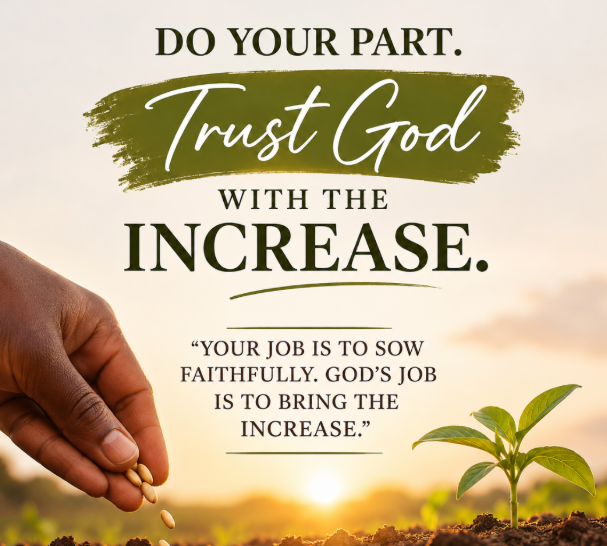
Sow and Don’t Look Back: Trusting God for the Harvest
In the rhythms of life and faith, few principles are as powerful—or as challenging—as the law of sowing and reaping. Often, we want to see immediate results for our efforts, prayers, and acts of kindness. Yet, Scripture calls us to a radically different mindset: your job is to sow faithfully, keep moving forward, and trust God with the increase.
1. Do Your Part: The Call to Faithful Sowing
Every harvest begins with a seed. In the Kingdom of God, seeds come in many forms: a kind word spoken in love, time invested in serving others, financial generosity, disciplined prayer, or standing firm in integrity when no one is watching.
The Apostle Paul reminds us of this foundational truth in 2 Corinthians 9:6:
“Whoever sows sparingly will also reap sparingly, and whoever sows generously will also reap generously.”
Notice that the command is simply to sow. You are not asked to manufacture the miracle or force the growth. Your responsibility is faithfulness in the planting. Whether the soil looks rocky or fertile, keep scattering good seeds in every season.
2. Don’t Look Back: Keep Moving Forward
One of the greatest enemies of a fruitful life is looking back. When a farmer plants a field, they do not dig up the seeds every morning to check if they are sprouting. Doing so destroys the very root system trying to take hold.
Similarly, looking back in regret over past failures, or looking back in anxiety to see if our good deeds are paying off, stalls our forward momentum. Jesus spoke clearly about the danger of divided focus in Luke 9:62:
“No one who puts a hand to the plow and looks back is fit for service in the kingdom of God.”
Once you have prayed the prayer, given the gift, or done the right thing, release it. Leave the past behind and keep your hands steady on the plow.
3. Trust God with the Increase
Between the sowing and the reaping lies a season of unseen work. Beneath the surface of the soil, God is doing what no human effort can replicate. He brings the rain, warms the earth, and breathes life into the seed.
In 1 Corinthians 3:6–7, Paul clarifies the division of labor between humanity and God:
“I planted the seed, Apollos watered it, but God has been making it grow. So neither the one who plants nor the one who waters is anything, but only God, who makes things grow.”
This truth lifts a massive burden off your shoulders. You do not have to stress over how the breakthrough will happen or when the results will appear. When you do your part in obedience, you can rest in the certainty that God will handle the increase.
4. Return at Harvest: Reaping in Due Season
There is always a gap between planting and harvest, and it is in that waiting season where faith is tested. Discouragement whispers that your efforts are wasted and nothing is changing. Do not believe it.
Scripture offers a rock-solid promise in Galatians 6:9:
“Let us not become weary in doing good, for at the proper time we will reap a harvest if we do not give up.”
God’s timing is never late. When the proper time arrives, you will return to the field not with empty hands, but carrying the sheaves of a faithful life. As Psalm 126:5 declares, “Those who sow with tears will reap with songs of joy.”
A Prayer for the Sower
Lord, give me the strength to be faithful in the small things today. Help me to sow seeds of love, faith, and obedience without worrying about immediate results. Keep my eyes fixed forward, trusting completely that in Your perfect time, You will bring the harvest. Amen and Amen.

Tea Time Manna
When they heard this, they had no further objections and praised God, saying, “So then, God has granted even the Gentiles repentance unto life.”
—Acts 11:18
Breaking through racial and cultural barriers is never easy, but this was the challenge early church leaders faced when the Holy Spirit led Peter to share the gospel with Cornelius and his household, and they became disciples of Jesus. The Jewish disciples had not anticipated Gentiles to come into Jesus’ church. Thankfully, God’s Spirit didn’t let them settle comfortably into their prejudices. Instead, the Spirit challenged, led, and pushed them to break through racial hatred and cultural ignorance. So must we, today. Let’s be the kind of people, Jesus’ people, who rejoice and praise God as every racial barrier dividing people fall in Jesus. Let’s press on until the triumphant promise of the Gospel is fulfilled: “There is neither Jew nor Gentile, neither slave nor free, nor is there male and female, for you are all one in Christ Jesus.” (Galatians 3:28). In doing this, we anticipate the incredible chorus of heaven as it praises God with folks from every language, tribe, people, and nation (Revelation 7:9-11). God longs to invite all peoples of the earth into his family of grace, love, and life!
Prayer
Holy God, we ask that you bless all those everywhere who are trying to cross cultural, linguistic, and nationalistic barriers sharing the grace of Jesus with those who do not know you. Help them know they are bringing you joy and anticipating the praise that surrounds you in glory! In Jesus’ name, we pray. Amen and Amen
Truth Article by Pastor Dirk
Being Salt: The Use of Salt vs. Being Salt
In Matthew 5:13, Jesus tells his followers, “You are the salt of the earth.” He does not say we merely use salt, nor does he ask us to try harder to become it. Instead, he declares that saltiness is the core identity of a believer, shaping how we live and influence the world around us.
To understand the depth of this biblical teaching, it helps to contrast the everyday use of salt as an external tool with the spiritual call to be salt from the inside out.
The Use of Salt vs. Being Salt
| Attribute | The Use of Salt (Action-Driven) | Being Salt (Identity-Driven) |
|---|---|---|
| Core Focus | Focuses on what we do for God through tasks, programs, or occasional good deeds. | Focuses on who we are in Christ, allowing daily character to naturally reflect faith. |
| Source of Influence | Relies on human effort, outward performance, or strategic persuasion. | Flows naturally from an inward transformation and a close walk with God. |
| Engagement with Culture | Often stays separate in a “salt shaker” and only sprinkles influence during specific events. | Leaves the shaker to mix directly into daily life, workplaces, and neighbourhoods. |
| Duration of Impact | Temporary and situational, lasting only as long as the specific activity continues. | Continuous and pervasive, steadily preserving and seasoning everything it touches. |
| Risk of Failure | Leads to burnout, legalism, or treating faith like a checklist of duties. | Risks losing distinctiveness if we compromise our values and blend entirely into the world. |
Biblical Insights on Being Salt
- Preservation Against Decay: In the ancient world without refrigeration, salt was essential for keeping meat from spoiling. Believers are called to stand for truth, integrity, and grace, slowing down moral and spiritual decay in their communities.
- Bringing Out True Flavour: Salt does not overpower food, rather it enhances the best qualities already there. When we live as salt, our kindness, wisdom, and peace bring out the best in others and create a hunger for God (Colossians 4:6).
- The Warning of Losing Saltiness: Jesus warns that if salt loses its saltiness, it is no longer good for anything (Matthew 5:13). Pure sodium chloride cannot lose its flavour, but ancient salt gathered from the Dead Sea was often mixed with gypsum and other minerals. When rain washed the true salt away, only tasteless white powder remained, illustrating what happens when believers let worldly compromises dilute their faith.
- Covenant Loyalty: In the Old Testament, salt was added to grain offerings as a symbol of God’s enduring “covenant of salt” (Leviticus 2:13). Being salt means embodying God’s faithful, unchanging love in a world full of broken promises.
Living It Out Today
- Step Out of the Shaker: Salt does no good sitting on a shelf. True influence requires genuine relationships with neighbours, coworkers, and friends who do not yet know Christ.
- Season with Grace, Not Harshness: Too much salt ruins a meal and stings a wound. Being salt means speaking truth with gentleness, humility, and genuine care rather than harsh judgment.
- Protect Your Purity: Stay rooted in scripture and prayer so that the pressures of everyday life do not wash away your distinct Christian character.
NEWS MANNA
“Crucified” By Egypt For Leaving Islam, Christian Convert Now Faces Execution
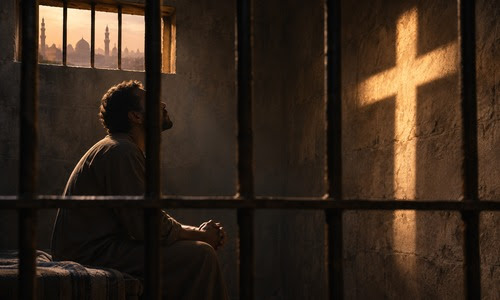
Egyptian security officers tied Said Mansour Rezk Abdelrazek to a wall in the shape of a cross, tried to strip the cross tattoo from his skin, and sent Muslim clerics to his cell to bring him back to Islam. He refused. Now the Egyptian state is asking a terrorism court for the maximum penalty, death or 25 years in prison, for a 30-year-old man whose crime, his lawyers say, is his refusal to renounce Jesus. His fiancée, Sophia, described his treatment in custody to The Jerusalem Post in a single sentence: “They had him crucified the whole time he was there.”
His lawyers announced in a statement following a hearing in his case that prosecutors are pursuing the maximum penalty, either execution or 25 years in prison. According to the NGO Coptic Solidarity, Abdelrazek faces charges of contempt for Islam, inciting public disorder, disseminating false information, and joining a banned terrorist organization that allegedly does not exist.
The office of Said Fayez, which represents him, alleged that he is charged with running an organization that does not exist and is being prosecuted because he refused to “renounce Jesus.” Sophia confirmed that Egyptian authorities have yet to identify the alleged terrorist organization. The lawyers’ statement was posted on Abdelrazek’s X account under the name he is also known by, Said Abu Mustafa. The court adjourned the case until December 8, 2026, when the defense will present its arguments.
Abdelrazek was referred to trial before the Terrorism Circuit of the First Criminal Court in Badr after nine months of pretrial detention, and he is held in the 10th of Ramadan prison amid growing concerns over his health. His lawyers allege torture and medical negligence at the prison, saying he has been held in a crucifixion position and denied medical care despite having a heart stent. Sophia reported severe pain in his lower back and urinary tract with no diagnosed cause, and when the defense requested an urgent medical examination in April, the court refused.
The US Commission on International Religious Freedom has designated Abdelrazek a religious prisoner of conscience, finding that “authorities and inmates physically and psychologically abused Abdelrazek for his conversion.” Amnesty International has issued an Urgent Action on his behalf. His defense team includes the Egyptian Initiative for Personal Rights, the Egyptian Commission for Rights and Freedoms, and the office of Cassation lawyer Saeed Fayez. International human rights groups have long criticized the Badr courts for secrecy, lack of due process, prolonged pretrial detention, and limited access to lawyers.
The prison has denied him the most basic acts of faith. He asked permission to attend a Coptic Orthodox Christmas Mass on January 7, and prison authorities refused. After a January 13 visit, his lawyer reported that Abdelrazek was in good spirits and fully understood the possible outcomes of his case. He asked to be allowed to worship in prison, to have a Bible, and to receive communion.
An open Bible
Born into a Muslim family, Abdelrazek first encountered Christianity when he noticed an open Bible in a neighbor’s shop. He reacted angrily to what he read, then kept thinking about it and returned days later to speak with a part-time minister. He went on to study the Bible at a Protestant Baptist church and was baptized around 2017. He became a Christian in 2016 and later joined the Russian Orthodox Church in Egypt. Sophia said that, raised in an observant Muslim home, he had never felt safe asking questions about faith, and Christianity gave him the freedom to question and seek answers.
The first person to turn him in was his own mother. Sophia said his mother reported him to the security services after he announced his conversion, and she took away his then-wife and son out of fear he would lead them to Christianity. Under Islamic law, his wife was required to divorce him, and he lost custody of his child.
Legal, social and civil difficulties after his conversion drove him to flee to Russia in 2019, where he sought asylum on religious grounds. In 2023, Russian authorities arrested him over a privately filmed video considered offensive to Islam. In 2024, Russia deported him to Egypt even though he held documentation from the UN High Commissioner for Refugees confirming he qualified for international protection, a move rights advocates said violated non-refoulement, the principle that protects refugees from forced return to a country where they face persecution.
On his arrival, Egyptian authorities held him incommunicado for about ten days. He later said he was coerced into the painful removal of a Christian tattoo and suspended for hours at a time in a crucifixion position. Interrogators pressed him to recant, monitor other converts, and delete his social media accounts, then released him with orders not to speak publicly or proselytize. Sophia said interrogators believed wealthy organizations were working to baptize Egypt’s Muslims, and they wanted him to inform on priests and converts and use his social media to attack Christianity.
Released into his family’s custody on condition that he return to Islam, he refused and was ordered to attend classes on Islam. At home, he was pressured to perform the five daily Islamic prayers, and his brother-in-law threw pots of water over his face to wake him for prayers at around 5 a.m. Sophia said the couple both posted regularly about Christianity online and built sizeable followings. On July 15, 2025, police arrested him in Cairo without a warrant after he asked a lawyer to help him obtain identity documents recognizing his change of religion. The arrest blocked the couple’s planned wedding at the Australian Embassy.
The trial opened on April 21 with a procedural hearing. In June, the court adjourned without hearing the scheduled prosecution witnesses or the forensic expert, even with the defense and human rights monitors in the courtroom. On September 6, the court finally heard prosecution witnesses and allowed the defense to cross-examine them.
A one-way freedom
His lawyer, Saeid Fayaz, told Christian Solidarity Worldwide that thousands of Christian converts in Egypt have no rights and live in isolation and constant fear, and that his client trusted the constitution’s guarantee of religious freedom, “not realising that it is a one-way freedom.”
Egypt’s constitution makes a promise its courts refuse to keep. Article 64 states that “freedom of belief is absolute,” yet in practice that right is denied to those who leave Islam. The same constitution, in Article 2, declares the principles of Islamic Sharia the principal source of Egyptian legislation, and Sharia leaves no room for a Muslim to walk away.
Islamic law calls leaving the faith ridda, apostasy, a category reserved for Muslims, and it makes no difference whether the apostate converts to another religion or simply abandons Islam. The punishment comes from the hadith, the recorded sayings attributed to Muhammad that carry legal authority in Islam. Sahih al-Bukhari, the most authoritative hadith collection in Sunni Islam, records the command: “Whoever changes his religion, kill him” (Bukhari 6922).
A second hadith, recorded in both Bukhari and Sahih Muslim, permits shedding a Muslim’s blood in three cases, among them “one who abandons his religion and separates from the community.” On that basis, all four classical Sunni schools of law prescribe death for an adult male apostate, traditionally after three days in which he is pressed to repent. The Hanafi school, which shaped Egyptian personal-status law, imprisons a female apostate until she returns to Islam. Under Sharia, an apostate’s marriage is dissolved, he loses custody of his children, and he forfeits his inheritance.
Egypt’s highest religious authority stands behind the death penalty. In 2016, Al-Azhar’s Grand Imam Ahmed el-Tayyib declared on Egyptian television that “The penalty for an open apostate, departing from the community, is well stipulated in Sharia,” treating conversion away from Islam as treason.
Egypt’s penal code contains no crime called apostasy. The state enforces the ban through the civil registry, the courts, and the criminal code. The religion printed on a citizen’s national ID card determines which family court governs his marriage and divorce and which religious education classes his children must attend. A child’s registered religion follows the father’s official faith. A Christian who wants to register as a Muslim meets little resistance. A Muslim who becomes a Christian meets a wall.
In 2007, Muhammad Ahmed Hegazy became the first convert to sue Egypt for refusing to change his official religion. On January 29, 2008, the Court of Administrative Justice, headed by Judge Mohammed al-Husseini, dismissed his petition, ruling that the state was not required to recognize apostasy on official documents, in violation of public order. The judge reasoned that under Islamic law, “Islam is the final and most complete religion,” so a Muslim cannot return to an older faith. The court said a convert may believe what he wants in his heart but cannot legally change his religious status.
A second convert, Maher El-Gohary, a Christian for over 30 years, went to court next. When his case was heard, opposing lawyers accused him of apostasy and called cases like his part of a “U.S. Zionist attack on Islam in Egypt.” A Cairo judge rejected his request. The only crack in the wall came in February 2008, when the Supreme Administrative Court ruled that 12 people born Christian could return to Christianity after converting to Islam, but ordered that their documents list them as “formerly declared Muslim,” exposing them to discrimination, police harassment, and violence.
When the registry is not enough, prosecutors reach for the penal code. Article 98(f), Egypt’s blasphemy law, punishes with six months to five years in prison anyone who exploits religion to promote “extremist ideologies” with the aim of provoking sedition. Prosecutors favor it because “contempt of religion” has no exact legal definition. When even that falls short, they add terrorism charges. That is how a Baptist convert with a cross tattoo ended up in a terrorism court facing a possible death sentence.
Twelve countries, one religion
Egypt has plenty of company. Humanists International found that apostasy is a criminal offense in 17 countries and punishable by death in 12 of them. Every one of them is a Muslim-majority country, and in every case the religion a person is forbidden to leave is Islam. As of 2020, leaving Islam carried the death penalty in Afghanistan, Brunei, Iran, the Maldives, Mauritania, Qatar, Saudi Arabia, Somalia (implicitly), the United Arab Emirates, and Yemen. Humanists International also lists Malaysia and Nigeria.
Several countries write the offense directly into their criminal codes, including Mauritania’s 1983 Criminal Code, the UAE’s Penal Code of 1987, Yemen’s Penal Code of 1994, Qatar’s 2004 Penal Law and Brunei’s Criminal Code. In 2018, Mauritania made the death sentence for apostasy compulsory. In Saudi Arabia, Sharia functions as the law of the land without being codified, and apostasy mandates a death penalty. Iran’s penal code mandates death specifically for blasphemy and reaches apostasy by requiring judges to rule on religious offenses according to Sharia.
A Library of Congress survey found that Iran appears to be the only one of these countries to have actually executed a person convicted of apostasy, and that in Afghanistan, Brunei, Sudan, and Yemen, a conviction can be vacated if the defendant renounces his new faith and rejoins Islam. That is the same deal Egyptian interrogators offered Abdelrazek. Open Doors ranks Egypt 42nd on its 2026 World Watch List of the 50 countries where it is most difficult to be a Christian.
Abdelrazek has company behind bars. Sophia alleged that at least 180 other Christians are held by Egyptian authorities on similarly dubious charges. Coptic Solidarity named Christian scholar Dr. Augustinos Samaan, Romany Gharib Adly Azer, Sherif Wagih Fahmi, and six young Christians detained over a comedy video as other Coptic prisoners of conscience facing prosecution under blasphemy and national-security laws. Coptic Solidarity warned: “Failure to act risks normalizing the treatment of religious conversion as terrorism.” More than 35,000 people worldwide have signed the group’s petition for his release. “This unprecedented global response shows the world is watching,” said Caroline Doss, President of Coptic Solidarity.
A Middle East anomaly or warning to the West?
Egypt’s case is the sharp edge of a wider pattern. Leaving Islam is a crime in 17 countries and punishable by death in 12 of them, according to Humanists International, and every one of those countries is Muslim-majority. The laws protecting Islam from its critics are moving west. From 1999 to 2010, the Organization of Islamic Cooperation, the 57-member bloc of Muslim states, sponsored resolutions every year at the United Nations calling on member states to outlaw “defamation of religions.” USCIRF described the campaign as an effort to export the blasphemy laws of OIC countries to the international level.
In December 2023, Denmark, home of the 2005 Muhammad cartoons, passed a law criminalizing the “inappropriate treatment” of religious texts, punishable by fines or up to two years in prison, after a wave of Quran burnings. Critics called it a return to the blasphemy law Denmark had abolished in 2017. In March, the British government adopted an official definition of anti-Muslim hostility, which one Conservative MP warned could become “a backdoor blasphemy law.” The prosecution of Said Abdelrazek shows where that road ends.
The Danish government justified its law on national security grounds, citing the danger Quran burnings posed to Danes, which arguably strengthens the point: the law was passed under threat of Islamic violence and not under any pretense of jurisprudence.
A fiancée’s campaign
Sophia, an Australian-Egyptian who met Abdelrazek on social media and first met him in person in 2021, has faced online abuse and death threats from Egyptian Islamists. She pays around 11,000 Egyptian pounds a month to have food and clothing smuggled to him in prison. Their lawyer has been able to visit him only once, in January, and the family is banned from visiting. She has called on journalists to break the silence over what she describes as “state-sanctioned religious persecution.”
Abdelrazek applied for a humanitarian visa to Australia in May 2024 and is still waiting for an answer, and Sophia has criticized what she calls Australia’s lack of meaningful diplomatic engagement. In February, Jubilee Campaign joined Coptic Solidarity and more than 20 organizations in calling on Australia’s Home Minister to intervene. Lord David Alton confirmed that he raised the case in the British Parliament, and the US State Department raised concerns with Congress in June.
The United States gives Egypt approximately $1.5 billion in foreign aid each year, and Sophia hopes Washington will condition that aid on Abdelrazek’s release and better treatment of religious minorities. The appeal lands days after President Trump announced the end of US military aid to Israel, the one country in the region where a Muslim can become a Christian without facing a terrorism court. Sophia also hopes the Netherlands will consider a prisoner exchange for Ahmed Nasser, whom Dutch authorities arrested for allegedly running intimidation campaigns on behalf of a foreign power, and whose release Egypt has been working to secure.

TruLight TV – God’s Great Creation – The Flooded Forest
How do you measure the amount of love you have for someone? The Bible says there is no greater expression of love than to lay down one’s life for one’s friends. Jesus demonstrated this kind of love. Watch today’s video and think of who you would lose your life for. and later a Nature Documentary in title (Secrets of the Flooded Forest) – After beginning in Vienna, the Danube riverbank forests extend to the gates of Bratislava, linking the two capitals like a green ribbon, forming a unique wildlife habitat in the heart of Europe. A few years ago a 36-kilometer section was turned into a national park that now protects the last undeveloped stretch of the Danube and also the last riparian zone of its size in Central Europe. In the forests along the Danube the water’s power can once again influence plant and animal habitats. And so an outstanding variety of habitats and species has been created: white-tailed eagles breed in the woods, mud minnows and pond turtles populate the old arms of the river, beavers build their dams on the banks. The Danube National Park: a hidden wilderness full of beauty and drama, and a refuge for an astounding variety of flora and fauna. The point of this Nature Documentary is based on the Bible Verse in Psalm 91;1 – The Heavens Declare the Glory of God; The Skies Proclaim the Work of His Hands. Enjoy today’s show and thanks for watching.
Today on TruLight Radio XM
TruLight Radio XM 24/7
VISIT THE WEBSITE
https://trulightradioxm.org.za
TruLight Ministry News – EXTRA MANNA

TruLight Ministries orders from God since 2012 . Teach Them , Comfort Them and Warn Them!
a TruQuestion for the Day
Where was Jesus born? (Matthew 2:1)
Our TruPlay website is coming together – Stunning Music , Plays and Podcasts , Easy Radio Player and More https://truplay.co.za

TruLight News

A PLAY A DAY !

A Hard Truth from the Book of Titus:
Your Life Proves What You Actually Believe
In the New Testament, the Apostle Paul writes a short, urgent letter to his coworker Titus on the Mediterranean island of Crete. Crete was notorious in the ancient world for corruption, dishonesty, and greed. Even one of Crete’s own poets famously described the local population as “always liars, evil beasts, lazy gluttons”.
Into this difficult environment, Paul delivers a confrontational, hard truth that cuts straight through superficial religion: claiming to know God means nothing if your daily life denies Him.
Paul summarizes this sobering reality in Titus 1:16 when describing false teachers and nominal believers on the island: “They profess to know God, but they deny him by their works”.
1. Faith Cannot Be Separated from Action
Throughout the three short chapters of Titus, Paul hammers home the connection between sound doctrine (right belief) and godly living (right behavior). In modern culture, people often treat faith as a purely private, intellectual, or emotional experience. Paul rejects that idea completely. What you truly believe will inevitably show up in how you treat your family, how you work, and how you interact with a broken world.
2. Grace Does Not Excuse Sin—It Trains Us to Reject It
One of the most famous passages in the letter, Titus 2:11–12, reveals the true purpose of God’s grace. Many people treat grace as a safety net that excuses bad behavior. Paul flips that assumption upside down, writing that the grace of God has appeared “training us to renounce ungodliness and worldly passions, and to live self-controlled, upright, and godly lives in the present age.” Real grace does not leave a person unchanged; it actively transforms how they live.
3. Good Works Are the Evidence, Not the Cause, of Salvation
The hard truth of Titus is balanced by a vital theological distinction. Paul is not saying that people earn their way to heaven by being moral. In Titus 3:5, he explicitly states that God saved us “not because of works done by us in righteousness, but according to his own mercy”. Good deeds are never the root of salvation, but they are always the unavoidable fruit of it.
4. The Church Must Confront Toxic Culture, Not Blend Into It
Paul’s instructions to Titus were intentionally countercultural. Instead of allowing the church on Crete to absorb the dishonest habits of the surrounding society, Paul told Titus to appoint leaders of integrity, silence divisive voices, and sharply rebuke believers who were drifting back into destructive patterns. Healthy faith requires accountability and a willingness to stand apart from cultural norms.
The Takeaway
The Book of Titus leaves no room for comfortable hypocrisy. It challenges every reader to look past what they say they believe and examine how they actually live. According to Paul, authentic faith is always visible—proven through self-control, integrity, and consistent good works in a world that expects the opposite.
Artist Liners
Picture Manna to Share

From God –
From Jesus –
From the Holy Spirit –
Share this Feeding of Manna with your Friends and Family. just click on the Social Media icon and share !