Hosted by TruLight Ministries International – The Place of Truth
SELECT YOUR READING LANGUAGE – BOTTOM LEFT = YOUR DAILY MANNA NOW AVAILABLE IN 103 LANGUAGES
@ TruLight Daily Manna is not Just a Bible Verse with a Small Prayer . NO ::: WE SERVE DAILY Manna for the ENTIRE Day . Breakfast , Lunch , Dinner , Plus tea Times and even Entertainment Manna . Plus News Manna and More , This Daily Manna will keep you Spiritually full for the full 48 Hours and even More to Share with your Friends and Family !!!
Living in Faith – You are a Example !

Faith is not merely a private belief held quietly in the heart; it is a visible, active force that shapes how we interact with the world around us. In Scripture, believers are repeatedly called to live in a way that reflects the character of God to others. Whether through quiet perseverance, generous love, or unwavering integrity, your daily walk of faith serves as a living testimony—an example that points others toward hope and truth.
The Call to Be a Living Model
In his first letter to Timothy, the Apostle Paul offers a timeless charge that applies to every believer, regardless of age or background:
“Don’t let anyone look down on you because you are young, but set an example for the believers in speech, in conduct, in love, in faith and in purity.” — 1 Timothy 4:12 (NIV)
Paul’s instruction reminds us that spiritual maturity is measured not by status, but by consistency. Being an example does not mean achieving flawlessness; rather, it means aligning our everyday actions with the grace and truth we profess. When others observe how we handle both blessings and trials, our lives become an open book that illustrates what trusting God truly looks like.
Five Pillars of a Faithful Example
Drawing directly from Paul’s words to Timothy, living as an example can be understood through five practical areas of daily life:
- In Speech: Words carry immense power to build up or tear down. Living in faith means choosing honesty, encouragement, and gentleness over gossip, complaints, or harshness (Ephesians 4:29).
- In Conduct: Integrity is doing what is right even when no one is watching. Our work ethic, humility, and fairness demonstrate that our faith governs our decisions, not convenience.
- In Love: Biblical love is action-oriented and sacrificial. Showing patience, forgiving quickly, and serving those in need reflect the unconditional love Christ first showed us (John 13:34–35).
- In Faith: Trusting God during uncertain or painful seasons speaks louder than words spoken during easy times. Steadfast reliance on God’s promises anchors us and inspires courage in those watching from the sidelines.
- In Purity: Maintaining purity in our motives, thoughts, and relationships sets us apart from a culture driven by self-interest, keeping our hearts undivided before God (Matthew 5:8).
Shining Light in Everyday Moments
Jesus reminded His followers of their role in the world during the Sermon on the Mount: “In the same way, let your light shine before others, that they may see your good deeds and glorify your Father in heaven” (Matthew 5:16). Notice that the ultimate goal of being an example is never self-promotion. Instead, a life lived in genuine faith directs attention away from ourselves and points people toward the goodness of God.
You do not need a pulpit, a title, or a large platform to make an eternal impact. Every conversation at work, every act of patience at home, and every choice to respond with grace rather than anger is an opportunity to model the Gospel.
Walking Forward Today
Take a moment today to reflect on the areas where people around you look to your life for direction—whether family members, friends, colleagues, or neighbors. Ask God for the strength to walk faithfully in small moments, trusting that He uses your ordinary obedience to do extraordinary things in the lives of others.

Tea Time Manna
Your word is a lamp to my feet and a light for my path.
—Psalm 119:105
God’s promises, God’s Scriptures, and God’s truth help us find our way in a pluralistic world of competing voices and values. His word lights our path in dark times, when we are often trapped in cynicism and despair. What great grace we have in knowing God’s will for us delivered in our own language! Now, if we will only choose to walk in the light of that word and apply it to our lives. As the Holy Spirit tells us:
For the word of God is alive and active. Sharper than any double-edged sword, it penetrates even to dividing soul and spirit, joints and marrow; it judges the thoughts and attitudes of the heart (Hebrews 4:12).
So, let’s open God’s word in the Scriptures, seek to follow his ultimate Word (John 1:1-3), Jesus Christ our Lord and Savior, and walk in the light of his word!
Prayer
Loving Father, thank you for giving us your truth in your Scriptures. Knowing you love us enough to communicate in language, in words we can hear, read, and understand, is truly awe-inspiring. So please, make our hearts hunger for the truth you’ve revealed in your word. Thank you for Jesus, the eternal Word, who embodied your truth. We want to grow into righteous and gracious children in your family, like our Savior. With all our love, we pray to you in the name of our older brother (Hebrews 2:10-11, 14) and Savior, Jesus, so that we may be conformed to him as your living Word and to your Scriptures as your words of truth. Amen and Amen
Truth Article by Pastor Dirk

Pride in Knowledge Divides:
When People Pass Like Ships in the Night
There is a quiet tragedy that occurs whenever human knowledge becomes a badge of superiority rather than a tool for service. In our desire to be right, to win arguments, or to prove how much we know, we often build walls instead of bridges. When pride takes the wheel, relationships fracture, unity dissolves, and people who were meant to walk together end up drifting past one another like ships in the night—briefly crossing paths in the darkness, never truly connecting, and disappearing into separate horizons.
The Danger of Knowledge Without Love
Scripture is remarkably clear about the relationship between knowledge, pride, and community. Writing to a divided church in Corinth—a congregation obsessed with status, eloquence, and spiritual intellect—the Apostle Paul delivered a sobering truth:
“Knowledge puffs up while love builds up. Those who think they know something do not yet know as they ought to know.” — 1 Corinthians 8:1–2 (NIV)
Knowledge, on its own, is not evil; God invites us to seek wisdom and understanding (Proverbs 2:6). However, when knowledge is detached from humility and love, it inflates the ego. Like air filling a balloon, intellectual or spiritual pride makes us feel larger than those around us, yet leaves us hollow inside. Instead of edifying the people in our lives, puffed-up knowledge looks down on others, turns conversations into competitions, and quietly pushes people away.
How Pride Turns Relationships Into “Ships in the Night”
The phrase “ships in the night” describes two vessels passing closely in the dark, exchanging a brief signal before sailing off in opposite directions, never to meet again. Pride in knowledge creates this exact dynamic in churches, families, and friendships:
- Pride Refuses to Listen: When we believe we already hold all the answers, we stop listening to understand and only listen to reply. Others quickly sense that their voice is not valued, so they quietly withdraw.
- Pride Values Winning Over Healing: Proverbs warns that “Where there is strife, there is pride, but wisdom is found in those who take advice” (Proverbs 13:10). Choosing to prove a point at the expense of a person’s dignity leaves behind wounded hearts that choose distance over fellowship.
- Pride Creates Spiritual Elitism: When believers measure their worth by theology, titles, or debate skills, grace disappears. Instead of a family united under Christ, people become isolated travelers passing one another without genuine warmth or shared burden.
The Humble Way of True Wisdom
True biblical wisdom never divides; it restores, softens, and unites. James contrasts earthly, prideful intellect with the wisdom that comes from above:
James emphasizes that true wisdom is proven through a humble life and characterized by purity, peace, mercy, and sincerity, as outlined in James 3:13, 17 (NIV).
NEWS MANNA

Death On Demand? Canada’s Dangerous Path Toward Suicide Without Limits

What if the only requirement for ending your life with government assistance was that you wanted to die?
No terminal illness. No unbearable physical suffering. No medical condition whatsoever. Simply the belief that your life was no longer worth living — and a healthcare system prepared to help you end it.
That is not Canada’s law today. But it is the disturbing destination that an unrestricted philosophy of personal autonomy could eventually lead to. And a revealing exchange in Canada’s Parliament has raised serious questions about just how far some politicians are prepared to take the country’s assisted-suicide experiment.
What began as an exceptional measure for people facing grave suffering has expanded into a system responsible for thousands of deaths annually. Now, even as Canada retreats from allowing assisted suicide for mental illness alone, lawmakers are considering another controversial expansion involving advance requests.
The question is no longer simply how Canada got here. It is where the country is heading next.
During debate over Bill C-41, Conservative MP Andrew Lawton confronted Liberal MP Kristina Derksen over the ambitions of Dying with Dignity Canada, an organization she had co-hosted an event with.
Lawton quoted the organization’s vision of a world where everyone wishing to consider medically assisted dying could do so. He then asked whether Derksen agreed, pointing out that the statement contained no reference to illness, suffering, or medical necessity.
Derksen spoke of bodily autonomy and the right of Canadians to determine how they wished to leave this life.
When directly challenged about a vision of assisted dying without stated medical limitations, she did not defend those limitations. Instead, she appealed to bodily autonomy and the freedom to choose how to leave this life.
That raises a question advocates of ever-expanding assisted suicide must eventually answer: If choosing death is fundamentally a matter of personal autonomy, why should the government have any authority to tell a competent adult that their suffering is insufficient to qualify?
Once personal choice becomes the overriding principle, medical restrictions risk becoming temporary political obstacles rather than permanent moral boundaries
When Death Becomes Easier Than Getting Help
Consider the case of Alan Nichols, a 61-year-old Canadian with a history of depression who was hospitalized in amid concerns that he might be suicidal.
Within weeks, he received medically assisted death.
According to an Associated Press investigation, the only medical condition listed on his application was hearing loss. His family strongly objected, arguing that he lacked the capacity to make such a decision and did not meet the requirements for unbearable suffering.
His family had sought help for a troubled man. Instead, they were left grieving his medically assisted death.
Then there was the heartbreaking case of a Canadian woman publicly identified as Sophia, who suffered from severe chemical sensitivities.
She desperately needed affordable housing that would accommodate her medical condition. Unable to secure suitable living arrangements, she ultimately received medically assisted death as well.
Think about the implications. A woman struggling to find housing that would allow her to live with dignity ended up receiving government-sanctioned assistance to die.
Canada has also faced scandal over Veterans Affairs employees raising assisted suicide with veterans seeking help. An investigation confirmed that one employee had inappropriately discussed the option with four veterans.
These veterans were seeking assistance, not requesting death.
These cases raise a deeply unsettling question: What happens when the institutions responsible for protecting vulnerable people begin treating death as an acceptable answer to their suffering?
The numbers reveal just how thoroughly assisted dying has become embedded in Canadian society.
In 2019, Canada recorded 5,461 medically assisted deaths. By 2024, that figure had climbed to 16,499 — approximately one out of every twenty deaths in the country.
What began in 2016 as a restricted practice has become a significant part of Canadian healthcare. In 2021, lawmakers removed the requirement that a person’s natural death be reasonably foreseeable.
The boundaries have already moved. Now the battle is over where they move next.
Mental Illness Was A Bridge Too Far — For Now
Canada was preparing to allow medically assisted death for people whose sole underlying condition was mental illness.
Imagine the contradiction.
On one hand, society spends enormous resources on suicide prevention, telling people struggling with depression that their lives have value, their circumstances can improve, and hope remains possible.
On the other, the same healthcare system was preparing to authorize doctors to help certain psychiatric patients end their lives.
How can a physician confidently determine that someone’s psychological suffering will never improve? How many people who once desperately wanted to die have subsequently recovered, found treatment, rebuilt relationships, and become grateful they survived?
Death eliminates every possibility of recovery.
The controversy became so intense that the Canadian government repeatedly delayed the expansion. Now Bill C-41, introduced by Prime Minister Mark Carney’s government, would prevent the scheduled extension of eligibility to those suffering solely from mental illness.
That is a welcome boundary. But the same legislation would open another disturbing door.
Under its proposed advance-request framework, Canadians diagnosed with certain illnesses, including Alzheimer’s disease, could authorize medically assisted death before losing the mental capacity to consent.
Someone could receive a lethal intervention at a time when they are no longer capable of personally consenting to it.
Consider an elderly woman who signs an advance request after receiving a devastating dementia diagnosis. Years later, she may no longer recognize her family, but she smiles when her grandchildren visit, enjoys familiar music, and appears content in her daily routine.
Should a document signed years earlier determine that her life must end?
Who gets to decide what constitutes suffering when the person can no longer explain what they feel?
These are not minor administrative questions. They concern the most irreversible decision imaginable.
From The Right To Die To The Duty To Disappear?
The greater danger is the philosophy emerging beneath these legislative battles.
If personal autonomy becomes the ultimate justification for assisted suicide, why should eligibility remain limited to people with serious medical conditions?
What about someone devastated by divorce? Someone crushed by debt? Someone experiencing unbearable loneliness? Someone who simply believes life no longer offers anything worth living for?
These circumstances do not independently qualify someone for MAID under current Canadian law. But a philosophy built around an unrestricted right to choose death would struggle to explain why such requests should be rejected.
And once death becomes an ordinary medical service, another danger emerges: economics.
Providing long-term care, disability assistance, specialized housing, mental health treatment, and compassionate end-of-life support can be enormously expensive.
Providing a lethal injection is comparatively inexpensive.
That does not mean governments are deliberately pursuing assisted suicide to save money. The more troubling danger is that a system under financial pressure could gradually become better at facilitating death than providing the resources necessary to sustain difficult lives.
Imagine an elderly parent watching their children struggle with the financial and emotional burden of caregiving. Imagine a disabled person repeatedly denied adequate assistance. Imagine someone suffering chronic illness who begins to believe their continued existence is an inconvenience to everyone around them.
At what point does the supposed right to die become a perceived responsibility to stop being a burden?
A society does not need to force people to die if it can convince vulnerable people that choosing death is the compassionate, dignified, or responsible thing to do.
Canada’s assisted-suicide experiment should serve as a warning to every nation watching.
What began as an exceptional response to extreme suffering has evolved into an expanding system in which the boundaries of who qualifies continue to be debated and challenged.
Today, the controversy concerns mental illness and advance requests for people who may eventually lose the ability to consent. Tomorrow, it could concern whether serious medical suffering should remain a requirement at all.
That is the danger of building an entire philosophy around personal autonomy without recognizing the inherent sanctity of human life. Every safeguard becomes a restriction waiting to be challenged. Every eligibility requirement becomes another barrier to individual choice.
And eventually, the question becomes frighteningly simple: If death is a fundamental right, why should anyone have to justify wanting it?
For Christians, the answer begins with a truth that no government can overturn: Human life is sacred because it is created in the image of God. Its value is not determined by suffering, disability, productivity, or personal despair.
A truly compassionate society does not measure its progress by how many people it can help die, but by how faithfully it stands beside those who are struggling to live.

TruLight TV & Kingdom Kidz TV – The Hilarious Journey of Faith and Friendship!
Micah’s Super Vlog is an animated Christian comedy about a boy named Micah, who learns (sometimes the hard way!) how to be a better follower of Jesus. Using his vlog he shares his thoughts on his friends, teachers, and scriptures. and later Will the Ready Racoons win this year’s hot dog eating contest? Only if their troop captain learns how to be a leader who includes others! Get ready for an hour full of thrilling fun!
Today on TruLight Radio XM
TruLight Radio XM 24/7
VISIT THE WEBSITE
https://trulightradioxm.org.za
TruLight Ministry News – EXTRA MANNA

TruLight Ministries orders from God since 2012 . Teach Them , Comfort Them and Warn Them!
a TruQuestion for the Day
What is the shortest book in the Bible?
Our TruPlay website – Stunning Music , Plays and Podcasts , Easy Radio Player and More https://truplay.co.za

TruLight News

A PLAY A DAY !


A Hard Truth from the Book of Peter:
Judgment Begins at Home
The letters of the Apostle Peter are filled with encouragement for suffering believers, yet they also contain some of the most sobering wake-up calls in the New Testament. Among the hardest truths Peter delivers is a direct warning against spiritual complacency: God cares deeply about how His own people live, and accountability starts inside the church, not outside of it.
The Hard Truth: Accountability Starts With Believers
In 1 Peter 4:17, Peter confronts early Christians who were enduring persecution and temptation with an uncompromising reality:
“For it is time for judgment to begin with God’s household; and if it begins with us, what will the outcome be for those who do not obey the gospel of God?” — 1 Peter 4:17 (NIV)
It is easy for believers to look at the brokenness of the surrounding world and point out sin from a distance. Peter turns that spotlight directly back onto the household of faith. Before God calls the world to account, He purifies and examines His own children.
Why This Truth Is So Difficult to Hear
Modern culture—and sometimes even modern church culture—prefers a message of comfort without conviction. Peter’s words challenge comfortable faith in three unmistakable ways:
- God Takes Holiness Seriously: Peter reminds believers earlier in his letter that God’s standard has not changed: “Be holy, because I am holy” (1 Peter 1:16). Grace is free, yet it is never an excuse to treat sin lightly or live carelessly.
- Trials Expose What Is Real: Peter compares faith to gold tested by fire (1 Peter 1:7). Hardship and divine discipline strip away shallow religion and reveal whether our obedience is genuine or merely outward performance.
- Returning to Old Ways Has Consequences: In his second letter, Peter issues an equally blunt warning to those who know the truth yet deliberately turn back to destructive habits, comparing it to a dog returning to its vomit or a washed pig returning to the mud (2 Peter 2:20–22).
The Purpose Behind God’s Hard Truth
While 1 Peter 4:17
sounds intimidating, Peter’s goal is not to crush believers with fear—it is to wake them up to urgency and authenticity. A loving father disciplines his children not to destroy them, but to refine them and keep them safe from ruin.
When God allows testing and correction in the lives of His people, He is removing spiritual pride, hypocrisy, and compromise. He is preparing a church that reflects Christ genuinely rather than in name only.
How to Respond Today
Peter follows this hard truth with clear, practical instruction in 1 Peter 4:19: “So then, those who suffer according to God’s will should commit themselves to their faithful Creator and continue to do good.”
Rather than shrinking back or making excuses, believers are called to examine their hearts honestly, repent quickly where compromise has crept in, and entrust themselves fully to a faithful God who refines those He loves.
Artist Liners
Picture Manna to Share

From God –
From Jesus –
From the Holy Spirit –

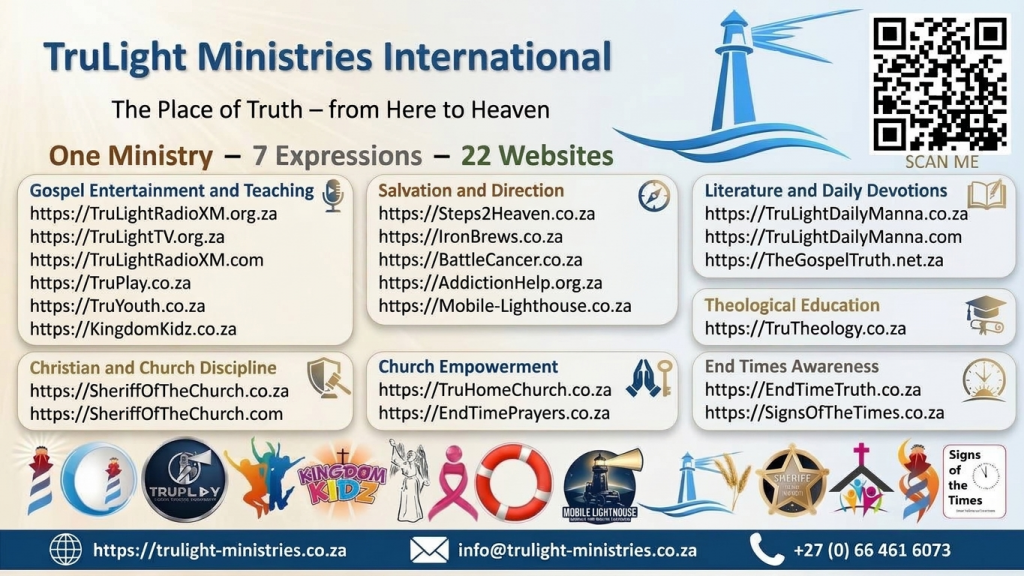
We have a Thankful Heart towards Pelser Real Estate from Bloemfontein , that gifted 5000 a5 Pamphlets towards our Mobile Lighthouse Outreaches – Psalm 9:1: “I will give thanks to you, Lord, with all my heart; I will tell of all your wonderful deeds.”
The Pamphlet
Share this Feeding of Manna with your Friends and Family. just click on the Social Media icon and share !