Hosted by TruLight Ministries International – The Place of Truth
SELECT YOUR READING LANGUAGE – BOTTOM LEFT = YOUR DAILY MANNA NOW AVAILABLE IN 103 LANGUAGES
@ TruLight Daily Manna is not Just a Bible Verse with a Small Prayer . NO ::: WE SERVE DAILY Manna for the ENTIRE Day . Breakfast , Lunch , Dinner , Plus tea Times and even Entertainment Manna . Plus News Manna and More , This Daily Manna will keep you Spiritually full for the full 48 Hours and even More to Share with your Friends and Family !!!
Better to be MISUNDERSTOOD than UNFAITHFUL to Jesus Christ !

Following Jesus Christ faithfully often means accepting that the world—and sometimes even friends, family, or fellow believers—will misunderstand your motives, choices, and convictions. Throughout Scripture, God’s people consistently faced a stark choice: protect their reputation by conforming to human expectations, or remain loyal to God and endure the cost of being misjudged.
1. Jesus Himself Was Constantly Misunderstood
No one walked in greater truth or love than Jesus, yet no one was more misunderstood.
- By His own family: At the height of His ministry, His relatives tried to seize Him, saying, “He is out of his mind” (Mark 3:21).
- By religious leaders: When He ate with tax collectors and sinners to bring them repentance, critics labeled Him “a glutton and a drunkard, a friend of tax collectors and sinners” (Matthew 11:19).
- By His own disciples: Even those closest to Him repeatedly misunderstood His mission, expecting an earthly political conqueror rather than a suffering Savior (Luke 18:31–34).
Jesus warned His followers that they would face the exact same treatment: “If the world hates you, keep in mind that it hated me first” (John 15:18). Being misunderstood is not a sign that you are doing something wrong; often, it is evidence that you are walking in step with Christ.
2. Biblical Examples of Choosing Faithfulness Over Reputation
Scripture highlights numerous men and women who prioritized obedience to God over how others perceived them:
- Noah: Spent decades building an ark on dry land before rain had ever fallen, enduring mockery to obey God’s warning (Hebrews 11:7).
- Joseph: Refused Potiphar’s wife out of reverence for God, only to be falsely accused and thrown into prison—choosing a clean conscience before God over his freedom and good name (Genesis 39:7–20).
- Daniel: Continued praying openly to God despite a royal decree, accepting the lions’ den rather than compromising his devotion (Daniel 6:10).
- The Apostle Paul: Was accused of madness, deceit, and arrogance by critics, yet he maintained a clear perspective: “Am I now trying to win the approval of human beings, or of God? … If I were still trying to please people, I would not be a servant of Christ” (Galatians 1:10).
3. Why Compromising to Be Understood Is Dangerous
The desire to be liked, validated, and understood is deeply human, but making it our highest priority leads directly to spiritual compromise:
- Fear of people is a trap: Proverbs 29:25 warns, “Fear of man will prove to be a snare, but whoever trusts in the Lord is kept safe.” When we bend truth to avoid awkwardness or rejection, we trade eternal faithfulness for temporary comfort.
- Worldly approval opposes God: Scripture reminds us that “friendship with the world means enmity against God” (James 4:4). A gospel that never offends or confuses the world is usually a gospel that has been watered down.
4. Finding Peace When You Are Misjudged
When your loyalty to Christ costs you your reputation, Scripture offers clear anchors for your soul:
- God knows your heart: People judge by outward appearances and incomplete information, “but the Lord looks at the heart” (1 Samuel 16:7). You do not have to exhaust yourself defending every false assumption when God already knows the truth.
- Blessing accompanies persecution: Jesus promised, “Blessed are you when people insult you, persecute you and falsely say all kinds of evil against you because of me. Rejoice and be glad, because great is your reward in heaven” (Matthew 5:11–12).
- Christ is your ultimate vindicator: Paul wrote that he cared very little about human judgment because “it is the Lord who judges me” (1 Corinthians 4:3–4). In the end, only one verdict matters: hearing “Well done, good and faithful servant” (Matthew 25:21).
Conclusion
It hurts to have your intentions twisted, your convictions mocked, or your love rejected. Yet human approval is fleeting, while loyalty to Christ is eternal. When forced to choose between keeping your reputation intact and keeping your faith pure, stand firm with Jesus—because it is infinitely better to be misunderstood by the world than to be unfaithful to the One who died to save you.

Tea Time Manna
“Lord,” Martha said to Jesus, “if you had been here, my brother would not have died.”
—John 11:21
If you have ever stood at the grave side of a loved one, this thought probably crossed your mind, too — “if you had only been here, Lord…”! Where is Jesus when we hurt? Why couldn’t he be here to help us? There are a couple of crucial answers to remember.
Jesus is with us in our moments of loss and grief. The Church is Jesus’ Body and every act of kindness, word support, effort to comfort us, and simple helping actions are part of Jesus working to alleviate our grief.
While Jesus may not have kept our loved one from passing from this life to the next, he has been the abiding and unbroken presence for each Christian who has died physically. Paul reminds us that when a Christian dies, he or she goes to be with Christ (2 Corinthians 5:6-7; Philippians 1:21-23) and God’s loving presence is never lost to him or her (Romans 8:35-39).
Martha seems to have something deep inside her that resonated with these promises because she was convinced that even though her brother, Lazarus, had died, she trusted that Jesus could still do something. She says, “But I know that even now God will give you whatever you ask” (John 11:20). In the face of overwhelming grief and deep sorrow, we as believers can yearn to have had Jesus present to prevent the death of a loved one. Yet in the face of this unwanted intrusion of death, we can say with faith, “Even now God will” provide victory out of our heartbreak!
Prayer
Holy Father, please help me see Jesus’ ministering presence with me in my times of loss and grief. Help me see him in the comforting presence of the Holy Spirit who abides in me. Help me see him in the acts of love and kindness your bodily presence, the church, as your people help me. In addition, dear Father, please help me see ways that I can serve as Jesus’ presence to someone else who is experiencing grief. In Jesus’ name, I pray. Amen and Amen
Truth Article by Pastor Dirk

More Than a Travel Plan:
The Clear Instructions of Jesus in Matthew 28
When believers think of the Great Commission in Matthew 28:18–20, they often picture boarding an aeroplane, crossing an ocean, or stepping onto a pulpit. Yet when you look closely at Jesus’ final words to His disciples on a mountain in Galilee, His instructions reveal something far deeper: the mission of the Church is not merely about crossing geography, but about making disciples in the ordinary rhythm of daily life.
The Foundation: Total Authority
Before Jesus gives a single instruction, He makes a sweeping declaration: “All authority in heaven and on earth has been given to me” (Matthew 28:18).
Notice the order. Jesus does not send His followers out on their own strength, charisma, or strategy. Every instruction that follows rests entirely on His sovereign rule. Because no corner of the earth—and no spiritual power—lies outside His authority, His disciples do not have to manufacture their own courage; they go under His backing.
The Core Command: Make Disciples
In the original Greek text of Matthew 28:19–20, there is only one main imperative verb: “make disciples” (mathēteusate). The other three action words surrounding it—”going,” “baptising,” and “teaching”—are participles that describe how that single mission is carried out:
- Going (As you go): The phrasing literally carries the sense of “as you are going.” While it certainly includes intentional missionary sending, it begins right where you already are—in your home, workplace, neighbourhood, and daily routines.
- Baptising them: Bringing new believers into public identification with the Triune God—Father, Son, and Holy Spirit—and welcoming them into the visible community of faith.
- Teaching them to obey: Notice Jesus did not say, “teach them to know everything I have commanded,” but “teach them to obey.” True discipleship is measured not by accumulated Bible trivia, but by transformed lives that put Jesus’ words into practice.
The Scope and the Promise
Jesus leaves no ambiguity about who this mission is for or how long it lasts:
- Every nation (panta ta ethnē): The gospel is not reserved for a single culture, language, or background. It is meant for every ethnic group and people on earth.
- Every day (“always”): Knowing the weight of the task, Jesus closes with an unshakeable promise: “And surely I am with you always, to the very end of the age” (Matthew 28:20).
The Commission begins with Jesus’ all-encompassing authority and ends with His unbroken presence. He never asks His followers to go anywhere He has not already claimed, and He never sends them anywhere He will not walk beside them.
NEWS MANNA

Calvary Chapel Divided: Women Pastors And The Battle Over Biblical Authority
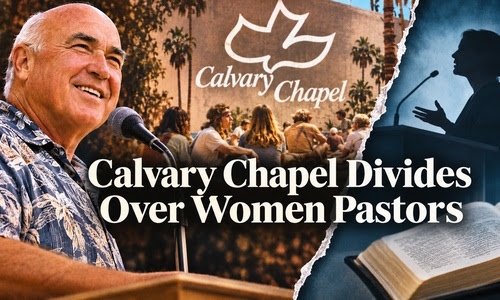
For millions of Christians influenced by the Calvary Chapel movement, the name Chuck Smith represents something far greater than a pastor or a denomination. It represents a time when the Holy Spirit moved powerfully through a generation, when thousands of young people surrendered their lives to Jesus Christ, and when a simple commitment to teaching the Bible transformed churches across America.
Now, more than a decade after Smith’s death, the very church that helped launch that spiritual awakening finds itself at the center of a growing theological controversy.
Calvary Chapel Costa Mesa, the historic birthplace of the movement, has publicly affirmed its practice of ordaining women as pastors. And the man announcing that position is none other than Chuck Smith’s grandson, Char Brodersen.
For many longtime Calvary Chapel believers, the announcement is heartbreaking. Not because they question the spiritual gifts or tremendous contributions of women in ministry, but because they believe the church has abandoned a biblical conviction its founder taught with unmistakable clarity.
The controversy raises a question far larger than the ordination of women: What happens when a church founded on the authority of Scripture begins interpreting that Scripture differently from the convictions that shaped its identity?
The Jesus Movement And The Legacy Of Chuck Smith
To understand why this controversy matters so deeply, one must understand what Calvary Chapel represented.
In the late 1960s and early 1970s, America was experiencing cultural upheaval. The sexual revolution, drug experimentation, political unrest, and widespread rejection of traditional institutions were reshaping an entire generation.
Into that environment stepped Chuck Smith, a pastor who believed the answer was not a new religious philosophy but the unchanging Gospel of Jesus Christ.
Working alongside figures such as evangelist Lonnie Frisbee, Smith welcomed young people whom many traditional churches struggled to reach. Long-haired hippies arrived barefoot, carrying Bibles and searching for something the counterculture could never provide.
Thousands came to Christ.
The Jesus Movement spread across California and eventually throughout the nation. Calvary Chapel became one of its most influential centers, helping launch ministries, churches, and a revolution in contemporary Christian worship through Maranatha! Music.
But what made Chuck Smith’s approach distinctive was not simply his willingness to welcome an unconventional generation.
It was his commitment to teaching the Bible verse by verse, chapter by chapter.
He believed the church should be governed by Scripture rather than religious trends, denominational traditions, or cultural pressure.
Calvary Chapel became known for its emphasis on the whole counsel of God, dependence upon the Holy Spirit, the imminent return of Jesus Christ, and a balanced approach to spiritual gifts.
Smith was willing to change the music, the atmosphere, and the outward appearance of church life to reach a new generation.
What he was not willing to change was what he believed Scripture taught.
That distinction is essential to understanding today’s controversy.
A Grandson Takes The Movement In A Different Direction
Following Chuck Smith’s death in 2013, his son-in-law Brian Brodersen assumed leadership of Calvary Chapel Costa Mesa.
Disagreements over the movement’s direction eventually contributed to a major organizational separation. Brian left the leadership of the Calvary Chapel Association and established the Calvary Global Network in 2016.
Now his son Char Brodersen, Chuck Smith’s grandson and Costa Mesa’s current lead pastor, has brought another longstanding disagreement into the open.
On November 1, Char publicly affirmed that Costa Mesa recognizes and ordains both men and women to pastoral ministry.
He emphasized that this was not a sudden change. According to Brodersen, the congregation has practiced this approach for nearly a decade.
He also characterized the matter as a secondary theological issue on which faithful Christians may disagree.
That explanation has done little to quiet the backlash.
Pastors associated with the Calvary Chapel Association have issued statements reaffirming their commitment to reserving the offices of pastor and elder for biblically qualified men.
Pastor Josh Blevins and the association’s Heartland Regional Team described Costa Mesa’s position as a significant departure from the convictions that historically shaped Calvary Chapel.
Pastor Lloyd Pulley of Calvary Old Bridge went further, criticizing Costa Mesa’s continued association with the Calvary Chapel identity while departing from its historic teachings.
For congregations across the country, the controversy has created an uncomfortable situation. Churches that have faithfully taught the same biblical principles for decades now find themselves explaining publicly that the historic flagship congregation no longer represents their convictions.
The question is no longer simply whether Calvary Chapel churches disagree.
They clearly do.
The question is whether a movement built around shared biblical distinctives can maintain a recognizable theological identity when its founding congregation moves in another direction.
Is Paul’s Teaching About Women Pastors Merely Cultural?
At the center of this disagreement is the interpretation of Scripture.
Char Brodersen’s position emphasizes that men and women are equally created in God’s image, equally important to Christ’s mission, and gifted by the Holy Spirit for ministry.
His teaching appeals to the priesthood of all believers and passages describing the distribution of spiritual gifts throughout the church.
Supporters of women’s ordination also point to women who played significant roles in the New Testament, including Priscilla, Phoebe, and Junia. They appeal to Galatians 3:28, which declares that believers are one in Christ Jesus, and argue that restrictions in 1 Timothy addressed particular problems in the first-century Ephesian church rather than establishing permanent limitations on pastoral leadership.
The historical setting of Ephesus, including false teaching and the circumstances facing women in that congregation, becomes central to this interpretation.
These arguments deserve examination.
But they also encounter a substantial biblical difficulty.
In 1 Timothy 2:12, Paul writes:
“But I suffer not a woman to teach, nor to usurp authority over the man, but to be in silence.”
Paul immediately explains his reasoning by appealing to the order of creation:
“For Adam was first formed, then Eve.”
That is a remarkably important detail.
Paul does not ground his instruction merely in the social customs of Ephesus, the educational opportunities available to women, or the particular cultural problems of his day.
He appeals to Genesis.
For those who understand Scripture as establishing a continuing pattern for church leadership, that appeal is decisive. Paul’s reasoning reaches back before the existence of Ephesus, before the Roman Empire, and before the cultural circumstances that modern interpreters emphasize.
The same pattern appears in 1 Timothy 3 and Titus 1, where Paul outlines qualifications for overseers and elders.
The traditional Calvary Chapel understanding has been that these passages establish the governing and authoritative teaching office of the church as a responsibility entrusted to qualified men.
This does not mean women are spiritually inferior, less capable, or less valuable.
It means equality before God does not require identical responsibilities within the church.
The New Testament celebrates the ministry of women. Priscilla helped instruct Apollos. Phoebe served the church. Women prayed, prophesied, supported missionary work, taught other women, and participated meaningfully in the advancement of the Gospel.
Yet none of those examples necessarily establishes that women were appointed to the governing office of elder over a congregation.
Likewise, Galatians 3:28 speaks powerfully about the unity of believers in Christ, but it does not explicitly abolish every distinction in responsibility within marriage or church leadership.
The central interpretive question remains: Are Paul’s instructions regarding pastoral authority temporary cultural accommodations, or enduring principles rooted in God’s created order?
Chuck Smith believed the latter.
And he was not ambiguous about it.
In his exposition of 1 Timothy 2, Smith distinguished between the many ministries available to women and the specific exercise of spiritual teaching authority over men.
His understanding was not that women should remain inactive or silent in every ministry setting. Rather, he believed Scripture established boundaries around pastoral authority.
For Christians who followed Smith’s teaching for decades, it is difficult to reconcile that conviction with the position now publicly affirmed by his grandson.
When Does A Secondary Issue Become A Serious Departure?
Perhaps the most troubling aspect of this controversy is not simply the disagreement over women pastors.
It is the suggestion that the disagreement should be treated as secondary.
Certainly, the ordination of women is not the Gospel itself. Salvation comes through faith in Jesus Christ, not through agreement on every question of church government.
But calling something secondary does not make it unimportant.
If Scripture establishes qualifications for church leadership, those qualifications cannot be dismissed simply because Christians disagree over their interpretation.
Otherwise, the church risks creating a dangerous principle: that sufficiently controversial biblical instructions can be set aside as nonessential.
That raises an uncomfortable question.
If Paul’s teaching on pastoral leadership can be explained primarily as a cultural restriction, what prevents other difficult passages from receiving similar treatment?
Where does the authority of Scripture end and the authority of contemporary interpretation begin?
This does not mean every Christian who supports women’s ordination is intentionally rejecting biblical authority. Many sincerely believe their interpretation is faithful to Scripture.
But sincerity alone cannot settle the question.
The issue must ultimately be decided by what the biblical text teaches, not by which interpretation better accommodates the expectations of the present age.
And that brings us back to Chuck Smith.
He understood that reaching a changing culture did not require surrendering biblical convictions.
The same pastor who welcomed hippies into the church maintained traditional convictions about pastoral leadership.
He changed methods without believing he had permission to change biblical standards.
That was part of the genius of the Calvary Chapel movement.
Where Does Calvary Chapel Go From Here?
There is something profoundly sad about watching a movement that brought so many people to Christ struggle over the convictions that once united it.
For longtime Calvary Chapel believers, the controversy is not simply an institutional disagreement. It is personal.
Many came to faith through Chuck Smith’s ministry. Others grew spiritually through his verse-by-verse teaching. Still others planted churches because they believed in the biblical principles he modeled.
They remember a movement that was passionate about the Gospel, deeply committed to Scripture, and eagerly awaiting the return of Jesus Christ.
Now the historic Costa Mesa congregation and many churches carrying the same name are traveling different theological paths.
The separation between the Calvary Chapel Association and Calvary Global Network already demonstrated that the movement would not remain organizationally united after Smith’s death.
The controversy over women pastors has made those differences even more visible.
More congregations may now find themselves clarifying their affiliations, reaffirming their doctrinal positions, or reconsidering their relationship with the historic Costa Mesa church.
But the future of Calvary Chapel does not ultimately depend upon who controls a website, a trademark, or the building where the movement began.
It depends upon whether its churches remain faithful to the Word of God.
Chuck Smith never claimed to be infallible. Nor should his interpretation of Scripture be accepted merely because he founded a movement.
His teaching must be tested against the Bible, just as his grandson’s teaching must be.
That is precisely what makes this moment so important.
For those who believe Scripture reserves pastoral oversight for qualified men, faithfulness requires more than admiration for the past. It requires the courage to uphold that conviction even when doing so is painful.
The church that helped ignite the Jesus Movement may be changing direction.
But the principles that made Calvary Chapel influential were never supposed to belong to one congregation, one family, or one generation.
They belonged to the Word of God.

TruLight TV : The Art of Songwriting: Insights from Kenna Turner West
Today’s guest artist on Josh and Ashley Show, KENNA TURNER WEST – Kenna’s roots in the music business run deep. Her father, Ken Turner, sang bass for many years with the legendary Blackwood Brothers Quartet. Her mother-in-law, iconic country music star Dottie West, was recently inducted into the Country Music Hall of Fame. Steeped in a rich musical heritage, Kenna has carved out her own place in the industry over the years and is achieving extraordinary success. As a staff writer for Curb|Word Music Publishing located on Nashville’s historic Music Row, Kenna has penned nearly 1,000 songs over the last two decades, and later a Testimony from Geoff’s with the message in title (A New Creation)
Today on TruLight Radio XM
TruLight Radio XM 24/7
VISIT THE WEBSITE
https://trulightradioxm.org.za
TruLight Ministry News – EXTRA MANNA

TruLight Ministries orders from God since 2012 . Teach Them , Comfort Them and Warn Them!
a TruQuestion for the Day
Which two people in the BIBLE were taken up without dying?
Our TruPlay website – Stunning Music , Plays and Podcasts , Easy Radio Player and More https://truplay.co.za

TruLight News

A PLAY A DAY !


The Danger of Drifting: A Hard Truth from the Book of Hebrews
The Book of Hebrews is famous for celebrating the supremacy of Jesus—presenting Him as greater than the angels, Moses, and the old covenant priesthood. Yet woven directly into that uplifting message is one of the sharpest, hardest truths in the New Testament: spiritual neutrality does not exist; if you are not actively anchoring yourself to Christ, you are slowly drifting away.
The Illusion of Standing Still
In Hebrews 2:1, the author delivers an urgent wake-up call: “We must pay the most careful attention, therefore, to what we have heard, so that we do not drift away.”
The original Greek word for “drift away” (pararrheō) was often used to describe a boat slipping its moorings and floating past a safe harbour, or a ring slipping off a finger unnoticed. Notice the unsettling reality behind this metaphor:
- Drifting requires zero effort. You do not have to actively reject God, embrace open rebellion, or renounce your faith to end up far from Him. You simply have to stop rowing.
- The current is always moving. Written to weary first-century believers facing social pressure and persecution, Hebrews reminds us that culture, busyness, and discouragement act like a steady tide. Standing still spiritually means moving backward.
Why Hebrews Warns So Fiercely
Throughout the letter, the writer interrupts deep theological teaching with 5 Verses. These passages—culminating in sobering words in Hebrews 6:4–6 and Hebrews 10:26–27—have unsettled readers for centuries.
The hard truth at the heart of these warnings is finality: if you walk away from Jesus to look for spiritual security elsewhere, there is no backup plan.
The author argues that Jesus is the ultimate and final mediator between God and humanity; to reject Him is to step away from the only source of grace that exists. The original audience was tempted to retreat into the comfort and familiarity of their old religious routines to avoid hardship. Hebrews strips away that safety net, forcing believers to confront the reality that going back to old habits or lesser comforts offers no true refuge.
From Hard Truth to Deep Hope
The author of Hebrews does not share these hard truths to paralyse believers with fear, but to jolt them awake. Immediately after delivering his toughest warnings, the writer pivots to encouragement: “Even though we speak like this, dear friends, we are convinced of better things in your case—the things that have to do with salvation” (Hebrews 6:9).
To keep from drifting, Hebrews points us to three practical anchors:
- Fix your eyes on Jesus, not your exhaustion. Rather than focusing on the weight of the race, look to the One who already finished it (Hebrews 12:1–2).
- Stay connected to community. Hebrews explicitly warns against giving up meeting together, urging believers to encourage one another daily so no one becomes hardened by sin’s deceitfulness (Hebrews 3:13; 10:24–25).
- Hold fast to your Great High Priest. Because Jesus experienced human weakness and temptation firsthand, He does not meet struggling believers with condemnation, but with mercy and grace in their time of need (Hebrews 2:17–18; 4:15–16).
Artist Liners
Picture Manna to Share

From God –

From Jesus –
From the Holy Spirit –

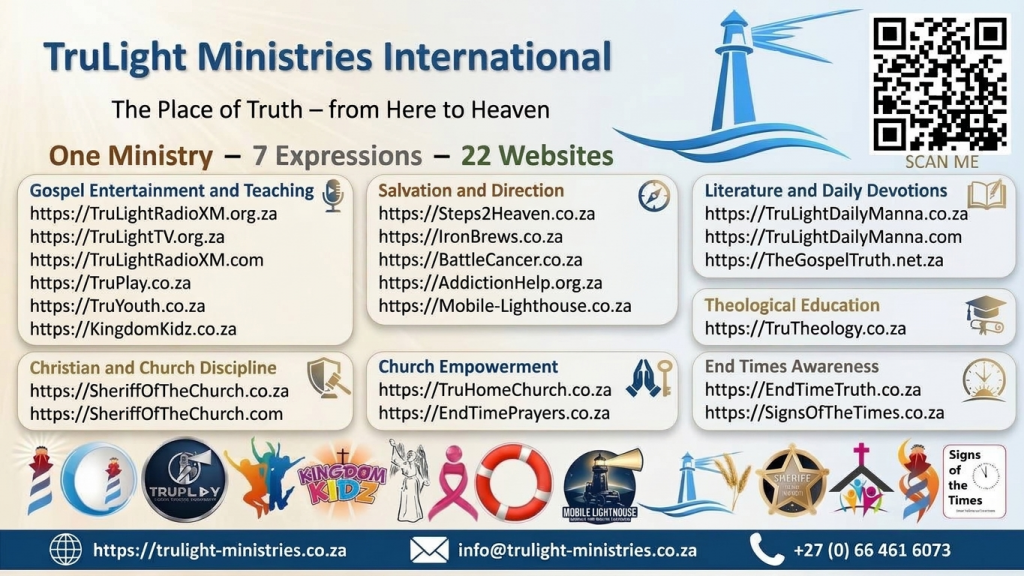
TruLight Ministries International
The Place of Truth – from Here to Heaven
One Ministry – 7 Expressions – 22 Websites
https://trulight-ministries.co.za
Gospel Entertainment and Teaching
https://trulightradioxm.org.za
https://trulighttv.org.za
https://trulightradioxm.com
https://truplay.co.za
https://truyouth.co.za
https://kingdomkidz.co.za
Literature and Daily Devotions
https://trulightdailymanna.co.za
https://trulightdailymanna.com
https://thegospeltruth.net.za
Church Empowerment
https://truhomechurch.co.za
https://endtimeprayers.co.za
Salvation and Direction
https://steps2heaven.co.za
https://ironbrews.co.za
https://battlecancer.co.za
https://addictionhelp.org.za
https://mobile-lighthouse.co.za
Christian and Church Discipline
https://sheriffofthechurch.com
https://sheriffofthechurch.com
End Times Awareness
https://endtimetruth.co.za
https://signsofthetimes.co.za
Theological Education
https://trutheology.co.za
Share this Feeding of Manna with your Friends and Family. just click on the Social Media icon and share !