Hosted by TruLight Ministries International – The Place of Truth
SELECT YOUR READING LANGUAGE – BOTTOM LEFT = YOUR DAILY MANNA NOW AVAILABLE IN 103 LANGUAGES
@ TruLight Daily Manna is not Just a Bible Verse with a Small Prayer . NO ::: WE SERVE DAILY Manna for the ENTIRE Day . Breakfast , Lunch , Dinner , Plus tea Times and even Entertainment Manna . Plus News Manna and More , This Daily Manna will keep you Spiritually full for the full 48 Hours and even More to Share with your Friends and Family !!!
“What you Tolerate Today , Can Corrupt Tomorrow .

Stop Calling the Sin , small , when it Destroying Something Big – Like Missing Heaven”
This statement reflects a core Christian teaching on spiritual vigilance, emphasizing that small compromises gradually erode a person’s faith and relationship with God.
Across Christian devotionals and sermons, this sentiment is frequently shared as a warning against spiritual complacency. When minor habits, bitterness, or secret compromises are excused as “small,” they slowly desensitize the conscience and grow into major spiritual obstacles.
Key Biblical Parallels
- The progression of sin. In James 1:15, scripture warns that unchecked desire gives birth to sin, and sin, when fully grown, leads to spiritual death.
- A little leaven. In 1 Corinthians 5:6 and Galatians 5:9, Paul uses the metaphor of yeast working through an entire batch of dough to show how tolerating even a small amount of corruption eventually affects the whole person or community.
- Guarding the heart. Proverbs 4:23 advises believers to guard their hearts above all else, recognizing that subtle compromises quietly steer the direction of a person’s life.
- Accountability and repentance. In Revelation 2:20, Jesus rebukes the church in Thyatira specifically for tolerating corrupting influences rather than confronting them early.
Why “Small” Compromises Matter
- Desensitization. Repeatedly excusing a minor fault dulls spiritual discernment, making larger compromises feel normal over time.
- Loss of focus. Small distractions or hidden habits gradually pull attention away from faith, prayer, and obedience.
- Erosion of witness. Allowing unchecked habits to remain creates a gap between a believer’s public faith and private life, weakening their integrity.

Tea Time Manna
Enter his gates with thanksgiving and his courts with praise; give thanks to him and praise his name. For the Lord is good and his love endures forever; his faithfulness continues through all generations.
—Psalm 100:4-5
Worship is about entering — entering into grace, entering with thanksgiving, entering to share with others, but most of all, entering into the Lord’s presence in special ways. However, our entering is not the basis of our worship. Instead, worship is about the Lord’s faithfulness, goodness, mercy, gloriousness, and enduring grace. We come to God like so many before us, with God waiting to meet us. We come to praise him for all he has been, all he is, and all he will be. We come to enter and worship. We can do this simply because God is faithful, through all the generations before us, to wait for us to come to him. The Creator of the universe is willing to wait for us — for you and for me. In a world where we are so impatient and do not want to wait for anything or anyone, God chooses to wait for us, welcome us, and faithfully share his goodness and love with us. How can we not return his grace with thankfulness and praise?
Prayer
Faithful God, the Almighty Rock of Israel, the God on whom the generations trusted, you alone, Lord, are God. I praise you for your enduring grace and mercy. I praise you because I want my heart tuned to your will. I praise and thank you because I want to prepare for my longest lifetime — the one in your heavenly presence. Thank you for all you have done to invite me, welcome me, and provide space for me in your presence! I praise and thank you, in Jesus’ name. Amen and Amen
Truth Article by Pastor Dirk

The “God Is Not Allowed to Bless You More Than Me” Mindset
In many church pews today, an unspoken rule quietly operates: “It is fine if God blesses you, as long as He does not bless you more than me.” When a fellow believer receives a financial breakthrough, a ministry platform, a restored marriage, or public recognition, the reaction is often silent resentment instead of celebration.
Scripture warns that this mindset is more than a minor character flaw—it is a direct challenge to God’s sovereignty and a threat to the unity of the Body of Christ.
1. Envy Questions God’s Generosity
At its core, jealousy in the church is rarely about the other person; it is an accusation against God. When we begrudge another believer’s blessing, we are subtly telling God that He made a mistake in how He distributed His favour.
Jesus addressed this exact attitude in the Parable of the Workers in the Vineyard (Matthew 20:1–16) . When those who worked all day saw latecomers receive the exact same wage, they grumbled against the landowner. His response cuts straight to the heart of church jealousy:
“Don’t I have the right to do what I want with my own money? Or are you envious because I am generous?” (Matthew 20:15)
God is not bound by our sense of fairness, seniority, or merit. His blessings are acts of grace, not wages earned through spiritual comparison.
2. God’s Blessing Is Not a Limited Pie
A major root of jealousy is a scarcity mindset—the belief that if God pours out favour on someone else, there will be less left over for us.
In John 3:27, when John the Baptist’s disciples became jealous of Jesus’ growing crowds and influence, John replied:
“A person can receive only what is given them from heaven.”
God’s resources, anointing, and favour are infinite. When God blesses a brother or sister next to you, He has not robbed you of your portion. As the saying goes, when God blesses your neighbour, it is proof that He is in the neighbourhood.
3. The Destructive Fruit of Church Rivalry
The New Testament repeatedly warns that unchecked envy destroys local congregations from the inside out:
- It breeds division. Paul rebuked the Corinthian church for acting like spiritual infants because jealousy and quarrelling turned leaders and members into rivals (1 Corinthians 3:3).
- It invites spiritual disorder. James 3:16 states bluntly: “For where you have envy and selfish ambition, there you find disorder and every evil practice.”
- It rots the soul. Proverbs 14:30 notes that “a heart at peace gives life to the body, but envy rots the bones.” Jealousy hurts the person carrying it far more than the person being envied.
4. How to Break the Spirit of Jealousy
Overcoming envy in the church requires an intentional shift in how we view God and each other:
- Rejoice deliberately. Romans 12:15 commands us to “rejoice with those who rejoice.” Celebrating someone else’s breakthrough—even when you are still waiting for your own—breaks the power of resentment and aligns your heart with heaven.
- Shift from comparison to gratitude. Comparison blinds you to what God is already doing in your life. Gratitude anchors your identity in Christ rather than in status or visible rewards.
- Pray for the person you envy. It is nearly impossible to hold onto bitterness toward someone while genuinely asking God to bless, protect, and prosper them.
Conclusion
The church is meant to be a family, not a competition. When one member of the Body of Christ is honoured or blessed, the entire body wins (1 Corinthians 12:26). True spiritual maturity is reached when we can look at another believer’s abundance and say, “Lord, thank You for blessing them—and I trust Your timing for me.”
NEWS MANNA
A Nation On Edge: The Incredible Timing Of Today’s National Emergency Alert
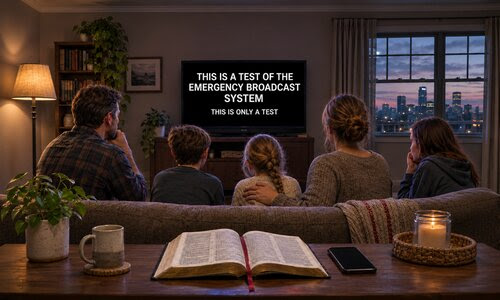
At 2:20 p.m. Eastern, millions of Americans will hear a familiar sound interrupt their television or radio programming: the national Emergency Alert System test.
The message will say it is only a test. It was announced months ago.
Still, the timing is hard to miss. In recent days, Microsoft services have gone down, a technical problem brought air traffic to a nationwide standstill, bank customers struggled to access online services, and United Airlines faced a technology failure that delayed departing flights once again.
These incidents have not been shown to be connected but it is getting harder and harder to rule such cascading failures as coincidence. With so many different systems struggling so close together, they expose a vulnerability most of us rarely consider: How much of ordinary life depends on systems we cannot see—and cannot control?
When the Digital World Stutters
We have grown used to tapping a screen and expecting an answer. A bank balance appears. A flight takes off. A message arrives. We rarely think about the complicated networks beneath those simple moments.
Then a service fails, and the convenience disappears. A traveler waits at the gate. A customer cannot reach an account. An employee loses access to email. Even a brief disruption can leave people feeling suddenly helpless, because so many essential routines now run through technology.
That does not mean America is on the brink of collapse. These recent outages have been separate incidents, and systems recovered. But they offer a sobering reminder: A highly connected society can also be highly exposed. The more we depend on digital systems, the more a technical failure in one place can ripple into everyday life somewhere else.
Today’s alert test is designed to check whether a warning can reach the public. The deeper question is what happens when people receive a warning—and the services they depend on are already faltering.
The Crisis That Could Change What We Accept
Imagine a disruption that lasts longer, spreads further, or affects several essential services at once. People would demand answers. They would want flights moving, money accessible, communications restored, and authorities in control.
That demand could bring proposals for more centralized systems, broader data sharing, digital identification, or expanded emergency powers. Some measures might help coordinate a response. But in a moment of fear, the promise of order can make sweeping changes sound irresistible.
A crisis could reshape more than infrastructure. It could reshape expectations about who should have access, who makes decisions, and how much personal freedom people are willing to trade for a sense of security.
This is a possibility to think through, not proof that a larger crisis is planned or imminent. The alert test and these outages do not establish a hidden connection. But they do raise a question worth asking now, before fear is driving the answer: If a future emergency brings a demand for greater control, what safeguards will protect the public—and what freedoms might be surrendered in the name of restoring normal life?
Stability Can Become Our Weakness
Our deepest vulnerability may be our expectation that life should always run smoothly—and our willingness to accept almost anything that promises to make it so. When people feel exposed, stability becomes precious. In that moment, extraordinary controls can be presented as the price of getting normal life back.
Technology can serve us. Emergency systems can save lives. But no system can guarantee perfect security, and no promise of stability should end the questions we need to ask about power and accountability.
Today’s alert is only a test. Its timing is remarkable in light of recent events, but it does not prove that a larger breakdown is coming. But it does remind us how much we depend on fragile connections—and how quickly fear can make the promise of control appealing.
The Tribulation to Come
This week’s outages have disrupted travel, banking, and communication. They are serious inconveniences, but they pale beside the suffering Scripture describes in the coming Tribulation period.
Revelation warns of a ruler who will demand worship and whose system will control who can buy and sell (Revelation 13:4, 7–8, 16–17). Paul writes of a coming “man of lawlessness” who exalts himself and deceives those who refuse the truth (2 Thessalonians 2:3–4, 9–10).
The Bible does not tell us which crisis will open the door to that ruler. But consider how vulnerable people might become when familiar systems fail, daily life grows chaotic, and fear spreads. A leader who promises order, protection, and the restoration of basic necessities could appear to offer exactly what a frightened world wants. Scripture warns that, in that hour, the deception will be powerful—and the demand for allegiance will reach far beyond politics.
That possibility may sound far-fetched when the lights are on and our accounts are accessible. But take away the conveniences people assume will always be there. Take away security, stability, and confidence in tomorrow. How many would welcome almost any authority that promised to make life work again?
That is why Christians must keep today’s disruptions in perspective. They are a reminder that comfort can feel indispensable—and that a world desperate for security may be vulnerable to the one who promises it at the price of worship.
Five Years For Defending Christianity: Egypt’s Warning To The West
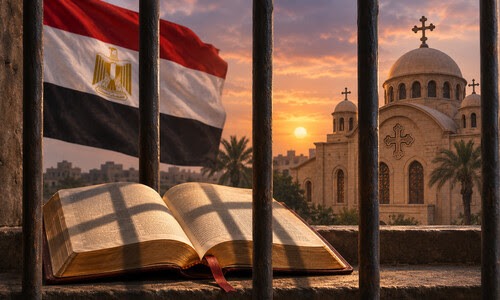
Egypt’s highest appeals court has upheld a five-year prison sentence with hard labor for Coptic Christian researcher Augustinos Samaan. His case began with videos discussing and defending Christianity. The appeal was rejected on November 15, leaving the sentence in force.
That is the kind of sentence many Western Christians struggle to imagine: five years behind bars for speaking about the faith. But Samaan’s case is not an isolated warning. It is part of a wider reality in which Christians in Egypt can face criminal charges for religious speech, obstacles to worship, and violence that too often goes unanswered.
When Christian speech becomes a crime
Samaan was convicted under Article 98(f) of Egypt’s penal code, a law used in cases described as “contempt of religion.” The law’s language may sound like a safeguard against religious hatred. In practice, it can also give authorities broad power to punish people for expressing religious views.
Samaan’s videos addressed Christianity and responded to material circulating online. His lawyers said they were not properly notified of his trial and were denied timely access to the case file. The Court of Cassation’s decision now leaves him facing the maximum sentence under the law.
Other Christians have been arrested over online posts or religious expression. Coptic engineer Sherif Wagih Fahmi was detained after sharing material on Facebook. Six young Christians, including a minor, were charged after recreating a scene from an Egyptian comedy film. They were released pending proceedings, but the charges remain.
The question for Western Christians is simple: If explaining and defending the faith can be treated as an offense, how secure is religious freedom when the law gives the state power to decide which religious speech is acceptable?
Worship can come with a price
Egypt’s constitution recognizes Islam as the state religion and names Sharia principles as the primary source of legislation. It also recognizes freedom of belief, while the legal framework for public worship and building places of worship is restricted to Islam, Christianity and Judaism.
Even for recognized Christian communities, building or repairing a church can be difficult. Applications to legalize church buildings remain unresolved in many cases, and Copts have faced attacks when rumors spread that a home or property might be used for worship.
In several villages, mobs have attacked Christian homes and church property. Yet instead of seeing perpetrators held accountable, Christians have sometimes been pushed into “reconciliation” sessions supervised by local authorities. These settlements can leave Christian families paying fines, surrendering property, or even leaving their homes.
That is not reconciliation in any meaningful sense when the people who were attacked must bear the cost while the attackers escape justice. It teaches a dangerous lesson: that violence can succeed where the law should have protected a minority.
A reminder the West should not ignore
The pressure reaches beyond churches and online speech. Converts from Islam can face particular danger, including when they try to change the religion listed on official documents. Coptic women and girls have also disappeared in cases that advocacy groups say authorities have been reluctant to investigate fully.
These stories should unsettle Christians in the West—not because Egypt’s experience can be reduced to a single cause or applied simplistically to every Muslim, but because religious liberty is never guaranteed by good intentions alone. It depends on laws, institutions, and leaders willing to protect the rights of people whose beliefs are unpopular or in the minority.
Western Christians often speak freely, gather for worship, build churches, and share the gospel without expecting a prison sentence. That freedom is precious. It should make us more attentive to believers who lack it, not complacent about how easily rights can be restricted when authorities claim they are defending public order or protecting religion.
Samaan’s sentence is a warning about what happens when the state gains power to punish peaceful religious expression. Five years for defending Christianity should be impossible to shrug off. For Egypt’s Christians, it is a reminder of the price they may pay for their faith. For Christians in the West, it is a call to defend religious liberty before the same kinds of arguments begin to sound normal here.

TruLight TV : Christian Comedian & Gospel Music Hall of Famer
This episode of Josh and Ashley includes a guest appearance by Christian Comedian & Gospel Music Hall of Famer, Tim Lovelace. and later A friend introduced Nkosi to the gospel. And because his friend was persistent in pursuing him with the message of salvation, Nkosi has a passion for sharing God’s love with the teenagers in his country. After two friends who served with him in ministry passed away, God cemented in. Enjoy and thanks for watching.
Today on TruLight Radio XM
TruLight Radio XM 24/7
VISIT THE WEBSITE
https://trulightradioxm.org.za
TruLight Ministry News – EXTRA MANNA

TruLight Ministries orders from God since 2012 . Teach Them , Comfort Them and Warn Them!
a TruQuestion for the Day
Who was the first person to see the risen Jesus according to the Gospel of John?
Our TruPlay website – Stunning Music , Plays and Podcasts , Easy Radio Player and More https://truplay.co.za

TruLight News

A PLAY A DAY !

One of the hardest truths in the Book of Exodus is that persistent, willful rebellion against God eventually leads to a point of no return where God hands a person over to their own hardened heart.
The Hardening of Pharaoh’s Heart
Readers often wrestle with the apparent unfairness of God stating He will harden Pharaoh’s heart and then punishing Egypt for it. Looking closely at the sequence in Exodus reveals a sobering spiritual reality:
- Self-hardening comes first. During the first five plagues, the text states that Pharaoh hardened his own heart or that his heart simply grew hard. Despite witnessing undeniable power and receiving repeated warnings, he chose defiance.
- God confirms the choice. Only in the second half of the plagues does Scripture state that God actively hardened Pharaoh’s heart. Rather than forcing evil into an innocent person, God solidified a posture Pharaoh had already stubbornly chosen.
- Rebellion serves God’s purpose. Even human defiance cannot overturn God’s plan; instead, Pharaoh’s stubbornness became the very stage on which God displayed His power and rescued His people.
Other Difficult Realities in Exodus
Depending on whether you are looking at the text from a theological, personal, or historical perspective, Exodus presents a few other challenging truths:
- Freedom is harder than familiar bondage. Shortly after witnessing miraculous deliverance, the Israelites panicked at the Red Sea and claimed it would have been better to remain slaves in Egypt than face the uncertainty of the wilderness. Stepping into freedom requires enduring discomfort rather than retreating to familiar oppression.
- Deliverance does not automatically change the human heart. Even after seeing the plagues, crossing the sea, and hearing God’s voice at Mount Sinai, the people quickly turned to idolatry (the Golden Calf) when Moses delayed returning.
- Historical and archaeological silence. From a historical standpoint, mainstream archaeologists note there is no direct physical evidence in Egyptian records or the Sinai Desert confirming a mass migration of two million people, leading many scholars and believers to debate the scale and literal mechanics of the event.
Artist Liners
Picture Manna to Share

From God –
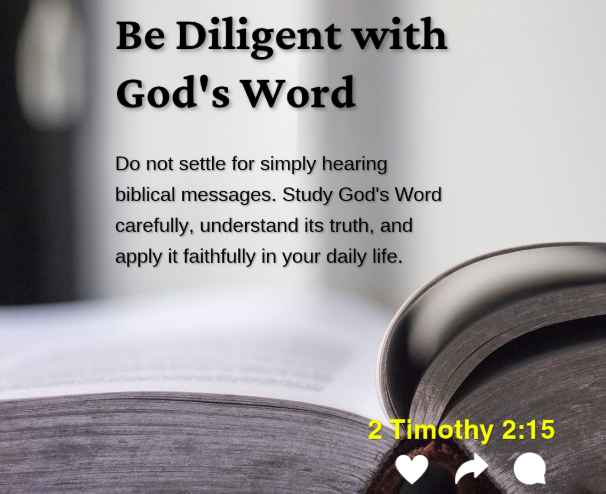
Scripture:
“Do your best to present yourself to God as one approved, a worker who does not need to be ashamed and who correctly handles the word of truth.” — 2 Timothy 2:15 (NIV)
Reflection:
In a world full of competing voices, half-truths, and constant distractions, being diligent with God’s Word is not just a good habit—it is spiritual survival. When Paul wrote these words to Timothy, he used the image of a skilled craftsman or a farmer cutting a straight path. It takes focus, effort, and intention to handle Scripture accurately rather than twisting it to fit our own comfort or convenience.
Diligence means moving beyond casual reading. It means refusing to skim the surface while neglecting the deeper truths that challenge our character. Just as small compromises can quietly erode our faith, neglecting consistent time in Scripture leaves us spiritually malnourished and vulnerable to deception. When we make time to study, meditate on, and obey God’s Word, it sharpens our discernment, anchors our faith during storms, and aligns our hearts with His will.
God does not ask for perfection overnight, but He does call for faithfulness. Every verse you hide in your heart today becomes the strength you will draw from tomorrow.
Prayer:
Lord, forgive me for the times I have treated Your Word casually or let busyness crowd out my time with You. Give me a hungry heart and a disciplined mind to study Your truth faithfully. Help me not only to read Your Word, but to live it out with integrity so that my life brings honor to You. Amen.
Action Step for Today:
Set aside 15 uninterrupted minutes today to read one chapter of Scripture slowly. Write down one truth it reveals about God and one practical way you can obey it before the day ends.
From Jesus –
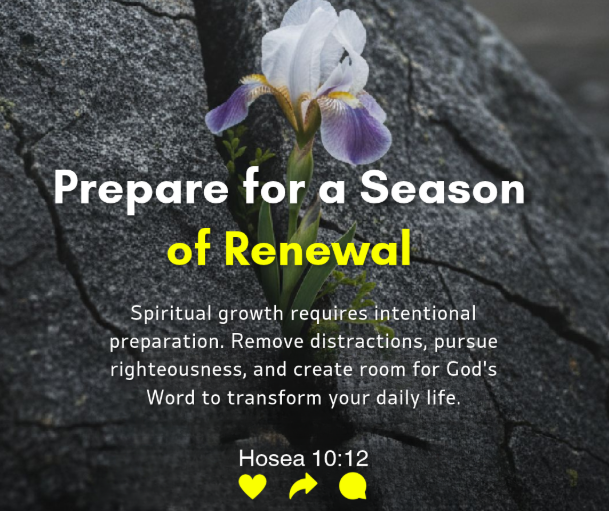
Scripture:
“Forget the former things; do not dwell on the past. See, I am doing a new thing! Now it springs up; do you not perceive it? I am making a way in the wilderness and streams in the wasteland.” — Isaiah 43:18–19 (NIV)
Reflection:
Every farmer knows that before a new harvest can grow, the ground must be prepared. Weeds have to be pulled, stones cleared away, and the soil broken up so that rain can sink deep into the roots. In the same way, a spiritual season of renewal rarely happens by accident—it begins when we intentionally prepare our hearts for what God wants to do next.
Often, we miss the new things God is springing up in our lives because we are still holding tightly to the past. Past failures, lingering bitterness, old habits, and spiritual fatigue can clutter the soil of our hearts. Preparing for renewal requires honest self-examination and surrender. It means letting go of what is familiar but stagnant so we have open hands to receive fresh grace, fresh strength, and fresh direction from God.
Renewal is not merely an emotional high; it is a deep restoration of your spirit, your focus, and your devotion. As you clear away distractions and make room for God through prayer and repentance, trust that He is already at work behind the scenes—turning dry places into streams of living water.
Prayer:
Lord, thank You for being a God who restores, refreshes, and makes all things new. Search my heart today and show me anything I need to release—whether it is past regret, hidden sin, or spiritual weariness. Break up the dry ground in my life and prepare me to receive the fresh work You want to do in me. Amen and Amen.
Action Step for Today:
Write down one old habit, mindset, or past hurt that has been weighing you down spiritually. Pray over it, surrender it to God, and replace that mental space by memorizing Isaiah 43:19 today.
From the Holy Spirit –
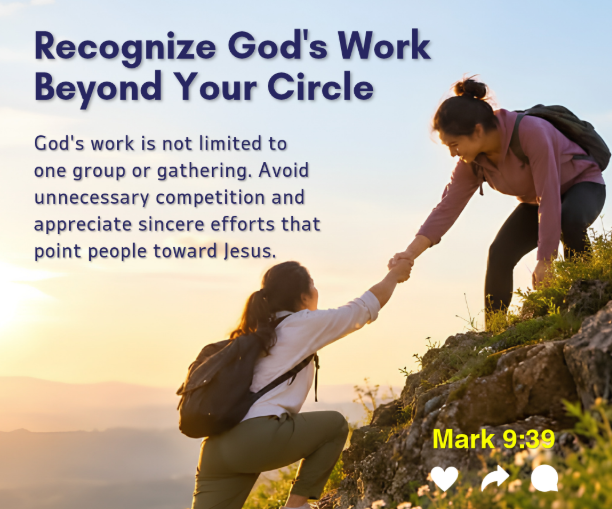
Scripture:
“After this I looked, and there before me was a great multitude that no one could count, from every nation, tribe, people and language, standing before the throne and before the Lamb.” — Revelation 7:9 (NIV)
Reflection:
It is human nature to become comfortable inside our own familiar circles—our local church, our immediate community, our preferred traditions, and the people who look, think, and worship just like us. While fellowship within our own circle is vital, we can subtly fall into the trap of assuming that God only works through our methods or within our walls.
Throughout Scripture, God consistently stretches His people to see a bigger picture. In the Book of Acts, Peter had to learn through a vision that God’s grace was not limited to one group of people, leading him to declare, “I now realize how true it is that God does not show favoritism” (Acts 10:34). God’s kingdom is far wider, deeper, and more creative than any single congregation, culture, or background can contain.
Recognizing God’s work beyond our circle requires humility and spiritual discernment. It means celebrating when another ministry thrives, praying for believers across different communities and nations, and staying open to how God might use unexpected people to teach, bless, or sharpen us. When we lift our eyes beyond our own corner of the vineyard, our faith grows larger and our appreciation for God’s sovereignty deepens.
Prayer:
Lord, forgive me for the times I have put You in a box or limited Your work to what feels familiar to me. Open my eyes to see Your hand moving across different communities, cultures, and churches. Give me a humble and generous spirit to celebrate wherever Your name is glorified, and use me to be a bridge of Your love beyond my own circle. Amen and Amen.
Action Step for Today:
Take five minutes today to pray specifically for a church, ministry, or believer outside of your immediate circle or denomination—asking God to bless their work and advance His kingdom through them.
TruLight Ministries International
The Place of Truth – from Here to Heaven
One Ministry – 7 Expressions – 22 Websites
https://trulight-ministries.co.za
Gospel Entertainment and Teaching
https://trulightradioxm.org.za
https://trulighttv.org.za
https://trulightradioxm.com
https://truplay.co.za
https://truyouth.co.za
https://kingdomkidz.co.za
Literature and Daily Devotions
https://trulightdailymanna.co.za
https://trulightdailymanna.com
https://thegospeltruth.net.za
Church Empowerment
https://truhomechurch.co.za
https://endtimeprayers.co.za
Salvation and Direction
https://steps2heaven.co.za
https://ironbrews.co.za
https://battlecancer.co.za
https://addictionhelp.org.za
https://mobile-lighthouse.co.za
Christian and Church Discipline
https://sheriffofthechurch.com
https://sheriffofthechurch.com
End Times Awareness
https://endtimetruth.co.za
https://signsofthetimes.co.za
Theological Education
https://trutheology.co.za
Share this Feeding of Manna with your Friends and Family. just click on the Social Media icon and share !